“Helping
Children Handle
Stress”
by: Dr. Imelda Villar
Everyday Stress
When they have to wait
 When they want something they can’t
have
 When they lose or break their toys or
valued items.

Common Sources of Stress
Early or rushed mornings, being hurried
 Exposure to new situations/starting
school/transferring school
 Too many expectations or demands
 Difficulties with peer/friendships

Common Sources of Stress
Transitioning from one activity or place
to another
 New beginnings/ frequent change
of/unavailability caregivers
 Difficult assignments/tasks
 Parents cannot be reached when they
need to get something for school

Sources of Long-Term
Stress
Separation from parents (especially for
younger kids)
 Fights or disagreements with siblings
 Being compared to siblings
 Being bullied by siblings

Sources of Long-term
Stress
Serious ongoing conflict between family
members
 Divorce or separation
 Serious illness or health condition
 Death of a loved one
 Frequent moves
 Being bullied or harassed over time

Sources of Long-Term
Stress
Dealing with unrealistic expectations
and demands (one’s own or from others)
 Being picked on at home
 Being compared with others
 Parental absence especially when in
trouble
 Physical/emotional/sexual/ financial
abuse

Factors That Help Prevent
Stress
Positive problem solving and coping
skills
 Close, supportive relationships at home
and school, with peers and adults
 Clear expectations
 Permission and ability to learn from
mistakes
 Developing competencies
(academic, social, extracurricular, and
life skills)

Factors That Help Prevent
Stress
Consistent, positive discipline
 Ability to express feelings appropriately
 Feeling physically and emotionally safe
 Good nutrition and exercise
 Time to relax or do recreational activities


 (www.nasponline.org)
How Parents Can Help Prevent
Stress
(www.nasponline.org)
Be aware of your child’s behaviors and
emotions
 Build trust with your child
 Be available and open to talk with your
child when he/she is ready
 Encourage the expression of feelings
 Teach and model good emotional
responses

How Parents Can Help Prevent
Stress






Encourage them to tell you if they feel
overwhelmed
Encourage healthy and diverse friendships
Encourage physical activity, good
nutrition, rest
Teach child to problem solve
Remind child of ability to get through tough
times, particularly with love and support of
family and friends
 (www.nasponline.org)
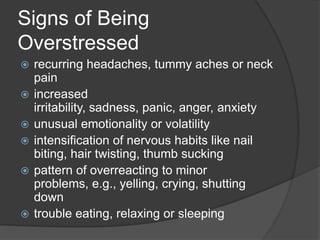
Signs of Being
Overstressed









recurring headaches, tummy aches or neck
pain
increased
irritability, sadness, panic, anger, anxiety
unusual emotionality or volatility
intensification of nervous habits like nail
biting, hair twisting, thumb sucking
pattern of overreacting to minor
problems, e.g., yelling, crying, shutting
down
trouble eating, relaxing or sleeping
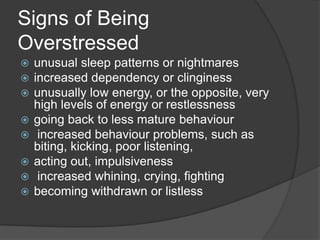
Signs of Being
Overstressed









unusual sleep patterns or nightmares
increased dependency or clinginess
unusually low energy, or the opposite, very
high levels of energy or restlessness
going back to less mature behaviour
increased behaviour problems, such as
biting, kicking, poor listening,
acting out, impulsiveness
increased whining, crying, fighting
becoming withdrawn or listless
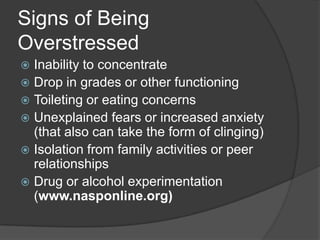
Signs of Being
Overstressed
Inability to concentrate
 Drop in grades or other functioning
 Toileting or eating concerns
 Unexplained fears or increased anxiety
(that also can take the form of clinging)
 Isolation from family activities or peer
relationships
 Drug or alcohol experimentation
(www.nasponline.org)

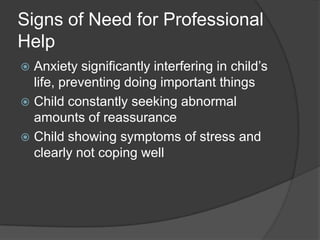
Signs of Need for Professional
Help
Anxiety significantly interfering in child’s
life, preventing doing important things
 Child constantly seeking abnormal
amounts of reassurance
 Child showing symptoms of stress and
clearly not coping well

Basics of How Parents Can
Help


Establish Connection: assure and
ensure someone will be there to help
them deal with their problems --> helps
children trust and listen to adult
supporting them.
Basics of How Parents Can
Help


Provide Loving Home environment:
ensure healthy, balanced lifestyle
 good food
 lots of time for physical activity
 play relaxation
 daily routines that make their world feel

predictable and safe
Basics of How Parents Can
Help


Comfort: comfort of physical contact
one of best stress relievers there is
positive brain stimulation from being
touched in early childhood helps build
brain’s pathways for coping with stress
Preventing and Managing
Stress
Plenty of unstructured play time
 Regular bedtime routine with
quiet, calming activities such as
music, reading or quiet play for half an
hour before bedtime
 Ensure 8-10 hours of sleep
 Vigorous physical activity - at least two
hours of physical activity every day

Preventing and Managing
Stress
Show love with words, hugs, kisses
 Play and laugh together

When Child Observed to be
Stressed
Ask how body feels (tummy, tense
muscles, etc.)
 Explain there is a connection between
the way bodies feel and emotions such
as worry, sadness and anger

When Child Observed to be
Stressed
Wait for calm moment
 Encourage to describe his worries or
fears
 Listen very carefully
 Try not to interrupt or finish child’s
sentences
 Take worries or fears seriously, even if
they seem silly.

When Child Observed to be
Stressed
Try to understand feelings and verbalize
what you read as his/her feelings
 Allow to talk about feelings: Point
feelings out and use words to help
identify emotions. “I guess you felt mad
when you were not chosen for the
school play.”
 Naming emotional state helps child learn
to express feelings in words rather than
acting out

When Child Observed to be
Stressed
Don’t judge/take sides
 Don’t advice unless asked
 Don’t to pacify or preach
 Ask questions to clarify

When Child Observed to be
Stressed
Restate important things he/she has
said
 Summarize what he/she has said
occasionally
 Ask what he/she would like to happen in
the situation
 Ask what he/she can do to feel better

When Child Observed to be
Stressed
Involve him/her in activities enjoyed
such as playing with favourite
toys, reading a book, cuddling with a
stuffed animal
 Teach relaxation and stress-reducing
techniques: deep breathing (breathe in
through nose and slowly out through
mouth
 Model breathing for you to calm down in
stressful moments

When Child Observed to be
Stressed
Spend extra time together and watch
him/her more closely than usual
 Offer extra physical contact: holding
his/her hand while walking or pulling
him/her up against you as you watch TV
together
 If child doesn’t want extra contact, don’t
force, but be there

When Child Observed to be
Stressed
Limit TV, computer and video game time
and encourage kid to be active.
 Be active with them - go for
walks, runs, park
 Put on some music for a family dance
party (be sensitive to reactions)

When Child Observed to be
Stressed


Give opportunities to make small
choices appropriate for age: “Do you
want to eat in Jollibee or McDonald’s
today?” to give them sense of control in
their life.
When Child Observed to be
Stressed


Model effective stress-management
strategies e.g when feeling stressed
, stop yourself and say, “Wow, I’m
feeling stressed. I’m going to take a few
deep breaths to help me calm down.”
General Tips for Preventing and
Addressing Stress
Stop, Look and Listen


Stop
 Set the climate. E.g. “I know there are things that upset

you sometimes. Can you tell me about them?” Give time
to finish talking. Listen both words and feeling in words.
 Choose the moment. Any quiet time during the day or
at bedtime, but ensure you are relaxed and not feeling
rushed and can be together without interruption. Arrange
for privacy
 Find “little” opportunities to connect. Everyday activity

together like going to school, taking snacks (but not
dinner)
General Tips for Preventing and
Addressing Stress


Look
 Once a day, check child’s face and body -

eye contact? relaxed or tense? eyes calm or
darting back and forth? Is there tension in
her body?
 Pay close attention to facial
expressions, mood, body language and
activity level
 Notice signs of stress
General Tips for Preventing and
Addressing Stress


Listen
 Give your full attention. Show you are really

interested by facing child and making eye
contact. Try saying things like, “We all feel
worried or scared sometimes and it’s good to
talk about those feelings.”
 Listen without speaking. Nod head; give other
nonverbal signs of interest. Don’t finish his
sentences, even if you think you know what he
is trying to say. Give him time to put it into his
own words.
General Tips for Preventing and
Addressing Stress


Just be there
 Respect child’s refusal to talk about what’s bothering

him/her- give space, but show you’ll be there when they feel like
talking. Whether they need to talk or just be in the same room
with you – make yourself available.

 Do something fun together. If child seems stressed or having a

bad day but doesn’t feel like talking, initiate activity you can do
together - read book, go for walk, watch movie, or bake, to
teach children that there are ways of taking care of self and
cheer self up.

 Give children time and space to unwind. Sometimes children

need time on their own with quiet activities such as blocks, play
dough or imaginative play
General Tips for Preventing and
Addressing Stress
Keep child aware of anticipated family
changes.
 Monitor television programs that could
worry your child and pay attention to use of
computer games, movies, and the Internet.
 Use encouragement and natural
consequences when poor decisions are
made.
 Help your child select appropriate
extracurricular activities and limit overscheduling.

General Tips for Preventing and
Addressing Stress
Make child aware of harmful effects of
drugs and alcohol before experimentation
begins.
 Monitor own stress level. Take care of
yourself.
 Contact child’s teachers with concerns and
make them part of team available to assist
your child.
 Seek assistance of
physician, psychologist, or school
counselor, if stress continues

General Tips for Preventing and
Addressing Stress


Working with care provider
 Make sure child is understood and treated

well
 Ask how child was
 Check for abuses of care provider; observe
reactions to care provider
Caveat
Children differ in dealing with stressful
situation
 Some children experience more stress
than others
 Some are more sensitive to stress
 Some are better at handling it than
others.
 Big challenge: know your children, pay
attention to their stress and try to ease


Helping Children Handle Stress

  • 1.
  • 2.
    Everyday Stress When theyhave to wait  When they want something they can’t have  When they lose or break their toys or valued items. 
  • 3.
    Common Sources ofStress Early or rushed mornings, being hurried  Exposure to new situations/starting school/transferring school  Too many expectations or demands  Difficulties with peer/friendships 
  • 4.
    Common Sources ofStress Transitioning from one activity or place to another  New beginnings/ frequent change of/unavailability caregivers  Difficult assignments/tasks  Parents cannot be reached when they need to get something for school 
  • 5.
    Sources of Long-Term Stress Separationfrom parents (especially for younger kids)  Fights or disagreements with siblings  Being compared to siblings  Being bullied by siblings 
  • 6.
    Sources of Long-term Stress Seriousongoing conflict between family members  Divorce or separation  Serious illness or health condition  Death of a loved one  Frequent moves  Being bullied or harassed over time 
  • 7.
    Sources of Long-Term Stress Dealingwith unrealistic expectations and demands (one’s own or from others)  Being picked on at home  Being compared with others  Parental absence especially when in trouble  Physical/emotional/sexual/ financial abuse 
  • 8.
    Factors That HelpPrevent Stress Positive problem solving and coping skills  Close, supportive relationships at home and school, with peers and adults  Clear expectations  Permission and ability to learn from mistakes  Developing competencies (academic, social, extracurricular, and life skills) 
  • 9.
    Factors That HelpPrevent Stress Consistent, positive discipline  Ability to express feelings appropriately  Feeling physically and emotionally safe  Good nutrition and exercise  Time to relax or do recreational activities   (www.nasponline.org)
  • 10.
    How Parents CanHelp Prevent Stress (www.nasponline.org) Be aware of your child’s behaviors and emotions  Build trust with your child  Be available and open to talk with your child when he/she is ready  Encourage the expression of feelings  Teach and model good emotional responses 
  • 11.
    How Parents CanHelp Prevent Stress      Encourage them to tell you if they feel overwhelmed Encourage healthy and diverse friendships Encourage physical activity, good nutrition, rest Teach child to problem solve Remind child of ability to get through tough times, particularly with love and support of family and friends  (www.nasponline.org)
  • 12.
    Signs of Being Overstressed       recurringheadaches, tummy aches or neck pain increased irritability, sadness, panic, anger, anxiety unusual emotionality or volatility intensification of nervous habits like nail biting, hair twisting, thumb sucking pattern of overreacting to minor problems, e.g., yelling, crying, shutting down trouble eating, relaxing or sleeping
  • 13.
    Signs of Being Overstressed         unusualsleep patterns or nightmares increased dependency or clinginess unusually low energy, or the opposite, very high levels of energy or restlessness going back to less mature behaviour increased behaviour problems, such as biting, kicking, poor listening, acting out, impulsiveness increased whining, crying, fighting becoming withdrawn or listless
  • 14.
    Signs of Being Overstressed Inabilityto concentrate  Drop in grades or other functioning  Toileting or eating concerns  Unexplained fears or increased anxiety (that also can take the form of clinging)  Isolation from family activities or peer relationships  Drug or alcohol experimentation (www.nasponline.org) 
  • 15.
    Signs of Needfor Professional Help Anxiety significantly interfering in child’s life, preventing doing important things  Child constantly seeking abnormal amounts of reassurance  Child showing symptoms of stress and clearly not coping well 
  • 16.
    Basics of HowParents Can Help  Establish Connection: assure and ensure someone will be there to help them deal with their problems --> helps children trust and listen to adult supporting them.
  • 17.
    Basics of HowParents Can Help  Provide Loving Home environment: ensure healthy, balanced lifestyle  good food  lots of time for physical activity  play relaxation  daily routines that make their world feel predictable and safe
  • 18.
    Basics of HowParents Can Help  Comfort: comfort of physical contact one of best stress relievers there is positive brain stimulation from being touched in early childhood helps build brain’s pathways for coping with stress
  • 19.
    Preventing and Managing Stress Plentyof unstructured play time  Regular bedtime routine with quiet, calming activities such as music, reading or quiet play for half an hour before bedtime  Ensure 8-10 hours of sleep  Vigorous physical activity - at least two hours of physical activity every day 
  • 20.
    Preventing and Managing Stress Showlove with words, hugs, kisses  Play and laugh together 
  • 21.
    When Child Observedto be Stressed Ask how body feels (tummy, tense muscles, etc.)  Explain there is a connection between the way bodies feel and emotions such as worry, sadness and anger 
  • 22.
    When Child Observedto be Stressed Wait for calm moment  Encourage to describe his worries or fears  Listen very carefully  Try not to interrupt or finish child’s sentences  Take worries or fears seriously, even if they seem silly. 
  • 23.
    When Child Observedto be Stressed Try to understand feelings and verbalize what you read as his/her feelings  Allow to talk about feelings: Point feelings out and use words to help identify emotions. “I guess you felt mad when you were not chosen for the school play.”  Naming emotional state helps child learn to express feelings in words rather than acting out 
  • 24.
    When Child Observedto be Stressed Don’t judge/take sides  Don’t advice unless asked  Don’t to pacify or preach  Ask questions to clarify 
  • 25.
    When Child Observedto be Stressed Restate important things he/she has said  Summarize what he/she has said occasionally  Ask what he/she would like to happen in the situation  Ask what he/she can do to feel better 
  • 26.
    When Child Observedto be Stressed Involve him/her in activities enjoyed such as playing with favourite toys, reading a book, cuddling with a stuffed animal  Teach relaxation and stress-reducing techniques: deep breathing (breathe in through nose and slowly out through mouth  Model breathing for you to calm down in stressful moments 
  • 27.
    When Child Observedto be Stressed Spend extra time together and watch him/her more closely than usual  Offer extra physical contact: holding his/her hand while walking or pulling him/her up against you as you watch TV together  If child doesn’t want extra contact, don’t force, but be there 
  • 28.
    When Child Observedto be Stressed Limit TV, computer and video game time and encourage kid to be active.  Be active with them - go for walks, runs, park  Put on some music for a family dance party (be sensitive to reactions) 
  • 29.
    When Child Observedto be Stressed  Give opportunities to make small choices appropriate for age: “Do you want to eat in Jollibee or McDonald’s today?” to give them sense of control in their life.
  • 30.
    When Child Observedto be Stressed  Model effective stress-management strategies e.g when feeling stressed , stop yourself and say, “Wow, I’m feeling stressed. I’m going to take a few deep breaths to help me calm down.”
  • 31.
    General Tips forPreventing and Addressing Stress Stop, Look and Listen  Stop  Set the climate. E.g. “I know there are things that upset you sometimes. Can you tell me about them?” Give time to finish talking. Listen both words and feeling in words.  Choose the moment. Any quiet time during the day or at bedtime, but ensure you are relaxed and not feeling rushed and can be together without interruption. Arrange for privacy  Find “little” opportunities to connect. Everyday activity together like going to school, taking snacks (but not dinner)
  • 32.
    General Tips forPreventing and Addressing Stress  Look  Once a day, check child’s face and body - eye contact? relaxed or tense? eyes calm or darting back and forth? Is there tension in her body?  Pay close attention to facial expressions, mood, body language and activity level  Notice signs of stress
  • 33.
    General Tips forPreventing and Addressing Stress  Listen  Give your full attention. Show you are really interested by facing child and making eye contact. Try saying things like, “We all feel worried or scared sometimes and it’s good to talk about those feelings.”  Listen without speaking. Nod head; give other nonverbal signs of interest. Don’t finish his sentences, even if you think you know what he is trying to say. Give him time to put it into his own words.
  • 34.
    General Tips forPreventing and Addressing Stress  Just be there  Respect child’s refusal to talk about what’s bothering him/her- give space, but show you’ll be there when they feel like talking. Whether they need to talk or just be in the same room with you – make yourself available.  Do something fun together. If child seems stressed or having a bad day but doesn’t feel like talking, initiate activity you can do together - read book, go for walk, watch movie, or bake, to teach children that there are ways of taking care of self and cheer self up.  Give children time and space to unwind. Sometimes children need time on their own with quiet activities such as blocks, play dough or imaginative play
  • 35.
    General Tips forPreventing and Addressing Stress Keep child aware of anticipated family changes.  Monitor television programs that could worry your child and pay attention to use of computer games, movies, and the Internet.  Use encouragement and natural consequences when poor decisions are made.  Help your child select appropriate extracurricular activities and limit overscheduling. 
  • 36.
    General Tips forPreventing and Addressing Stress Make child aware of harmful effects of drugs and alcohol before experimentation begins.  Monitor own stress level. Take care of yourself.  Contact child’s teachers with concerns and make them part of team available to assist your child.  Seek assistance of physician, psychologist, or school counselor, if stress continues 
  • 37.
    General Tips forPreventing and Addressing Stress  Working with care provider  Make sure child is understood and treated well  Ask how child was  Check for abuses of care provider; observe reactions to care provider
  • 38.
    Caveat Children differ indealing with stressful situation  Some children experience more stress than others  Some are more sensitive to stress  Some are better at handling it than others.  Big challenge: know your children, pay attention to their stress and try to ease 