STREPTOCOCCUS
DR. MUKTA SHARMA
PROF. AND HEAD
DEPARTMENT OF MICROBIOLOGY
SBB DENTAL COLLEGE, GHAZIABAD
GENERAL FEATURES
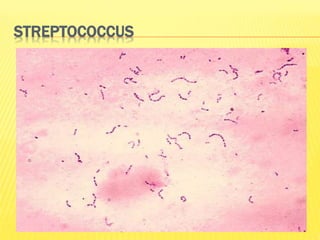
Gram’s positive cocci
 Arranged in chains
(sometimes pairs)
0.7-0.9 µm in diameter
Facultative anaerobes
Catalase negative
Oxidase negative
STREPTOCOCCUS
COMPARISION BETWEEN STREPTOCOCCUS AND STAPHYLOCOCCUS
CLASSIFICATION
 Lancefield classification-
Based on carbohydrate (C)
antigens
Rebecca Lancefield groups- 20
serotypes-- A to V
(excluding I and J).
GROUPABLE STREPTOCOCCI
Group A, B and D:
frequent
Group C, G, F :
less frequent
NON-GROUPABLE
Streptococcus pneumoniae :
pneumonia
Viridans streptococci :(S.
mutans): dental caries
HAEMOLYSIS REACTION -
SHEEP BLOOD AGAR
α (alpha) haemolysis
partial haemolysis
green colored zone of
inhibition
β (beta) haemolysis
- complete clearing zone of
inhibition
 γ (gamma) haemolysis
- no lysis of RBC
HAEMOLYSIS
Groups A an B are: β-
haemolytic
Group D are: α or γ-
haemolytic
S. pneumoniae and viridans
are:
α -haemolytic
Streptococcus
pyogenes
Group A Streptococcus
STREPTOCOCCUS PYOGENES
PYOGENES MEANS PUS PRODUCING
Group A streptococcal
infections affect all ages
peak incidence at 5-15
years of age
One of the most important
pathogens
Gram positive cocci in chains
Lancefield Serological Group A
Beta Haemolytic on blood agar
DISEASES CAUSED BY S. PYOGENES
Suppurative
infections
Non-suppurative
complications
SUPPURATIVE DISEASES
1. Respiratory infections
-Pharyngitis or sore throat
2. Skin and subcutaneous infections
-Wound infections
-Burns
-Erysipelas
-Impetigo
-Scarlet fever
-Cellulitis
NON-SUPPURATIVE COMPLICATIONS
1. Acute rheumatic fever
2. Acute
glomerulonephritis
SORE THROAT OR PHARYNGITIS
Most common of all Strep
diseases
Spread by saliva or nasal
secretions
Incubation period 2-4 days
Sore throat, slight fever (101)
Important to treat immediately to
avoid post strep diseases
Streptococci adhere to the
pharyngeal mucosa
By means of lipoteichoic acid
covering the surface pili
Multiplication occur
Streptococci may spread to
the surrounding tissues
leading to suppurative
complications
ERYSIPELAS
Acute infection and
inflammation of the dermal
layer of skin.
Painful red patches which
enlarge and thicken
Treatment -penicillin or
erythromycin
IMPETIGO OR PYODERMA
Found mainly in young children
Affecting face, arms, legs & other
exposed parts of the body
Localized infection of skin
Vesicles appear on the skin later
become purulent with honey
coloured crust
SCARLET FEVER
If the strain of S. pyogenes is
lysogenic for a particular
phage which expresses an
erythrogenic toxin the result
is Scarlet fever
Rash appears and
characteristic is the
Penicillin G or Erythromycin
are drugs of choice
Although the disease is self-
limiting, it is important to treat
immediately to avoid post
strep complications
CELLULITIS
 Infection of skin and subcutaneous
tissues
 Characterized by –
-local inflammation
-edema
-erythema
-tenderness
-fever
NONSUPPURATIVE COMPLICATIONS
 Rheumatic Fever-autoimmune
disease involving heart valves,
joints, nervous system.
 Acute glomerulonehritis or Bright’s
Disease-inflamatory disease of renal
glomeruli and structures involved in
blood filter of kidney. Due to
deposition of Ag/Ab complexes
RHEUMATIC FEVER
Most common cause of
permanent heart valve damage in
children
Exact cause not yet known but
there appears to be some
antibody cross reactivity between
the cell wall of S. pyogenes and
heart muscle
GLOMERULAR NEPHRITIS
Diagnosis based on history of
Strep throat and clinical findings.
Symptoms include fever, malaise,
edema, hypertension and blood
or protein in urine
Occurs in 0.5% of those having
strep throat.
VIRULENCE FACTORS
 Streptokinase:-
a proteolytic enzyme which lysis
fibrin
 Hyaluronidase:-
spreading factor- breakdown of
connective tissues
 DNAs:-
destroy DNA
 Haemolysins (leucocidins):-
responsible for rashes in scarlet
fever
 Capsule:-
antiphagocytic
 lipoteichoic acid/F protein
fimbriae
binds to epithelial cells
LABORATORY DIAGNOSIS
Diagnosis of acute suppurative
infection is made by culture while
in the non suppurative
complications, diagnosis is
mainly based on the
demonstration of antibodies.
DIAGNOSIS OF ACUTE SUPPURATIVE INFECTIONS
1. Specimens collection: swab, pus, blood
or CSF
2. Collection & transport: in sterile
container, culture immediately or sent to
the lab. In Pike’s transport medium.
3. Gram‘s staining of the smears: Gram’s
positive cocci in chains
4. Culture: inoculated on blood agar &
incubate at 37°C for 18-24 h… β
haemolytic
5. Colony morphology & staining: colonies
are small (0.5-1.0 mm) pin point colonies
Circular, low convex, β haemolytic
In liquid media- granular turbidity with
powdery deposit
Hanging drop preparation shows non
motile
6. Biochemical reactions: catalase negative
7. Identification of various groups of
streptococci: gp. A are more sensitive to
bacitracin.
8. Lancefield grouping: by serologically
DIAGNOSIS OF NON SUPPURATIVE COMPLICATIONS
By serological tests– the routine test done
is ASO (antistreptolysin O) titration
A titre of 200 units or more is significant in
rheumatic fever
For glomerulonephritis anti DNAs B
estimation is more reliable with titre
higher than300 0r 350
TREATMENT & PREVENTION
 Penicillin (drug of choice)
 Erythromycin (for hypersensitive
patients)
 No vaccine is available
ORAL STREPTOCOCCI
 Live in oropharynx
 Mixed group of organisms
 α- haemolytic on blood agar
 Divided into 4 species groups-
 mutans gp.
 salivarius gp.
 anginosus gp.
 mitis gp.
1. Mutans group-
S. mutans
S. sobrinus
S. cricetus
S. rattus
2. Salivarius group-
S. salivarius
S. vestibularis
3. Anginosus group-
S. intermedius
S. anginosus
4. Mitis group-
S. sanguis
S. gordonii
S. parasanguis
S. oralis
• They makeup a large proportion
of resident oral flora
• One-quarter of the total
cultivable flora from
supragingival & gingival plaque
• Half of the isolates are from the
tongue and saliva
• They are transmitted from
mother to child
STREPTOCOCCUS MUTANS
CULTURE AND IDENTIFICATION
Gram’s positive cocci
In short chains
α-haemolytic
Catalase –ve
Oxidase -ve
PATHOGENICITY
 They causes dental caries
 But in absence of predisposing
factors, such as sucrose, they can
not cause caries
 They have ability to produce
extracellular polysaccharides in the
presence of dietary carbohydrates
That help binding of the
organism to enamel and to each
other
They may also cause infective
endocarditis, as a result of their
entry into the bloodstream during
intraoral surgical procedures
(tooth extraction)
DENTAL CARIES
DENTAL CARIES
 Chronic endogenous infection
 Caused by the normal oral flora
 The carious lesion is the result of
demineralization of enamel &
later of dentine, by acids
produced by plaque m/o, as they
metabolize carbohydrates.
TREATMENT & PREVENTION
 In patient at risk of infective
endocarditis, prophylactic
antibiotic should always be
given before dental
procedures.
THANK YOU

Streptococcus

  • 1.
    STREPTOCOCCUS DR. MUKTA SHARMA PROF.AND HEAD DEPARTMENT OF MICROBIOLOGY SBB DENTAL COLLEGE, GHAZIABAD
  • 2.
    GENERAL FEATURES Gram’s positivecocci  Arranged in chains (sometimes pairs) 0.7-0.9 µm in diameter
  • 3.
  • 4.
  • 5.
  • 7.
    CLASSIFICATION  Lancefield classification- Basedon carbohydrate (C) antigens Rebecca Lancefield groups- 20 serotypes-- A to V (excluding I and J).
  • 8.
    GROUPABLE STREPTOCOCCI Group A,B and D: frequent Group C, G, F : less frequent
  • 9.
  • 10.
    HAEMOLYSIS REACTION - SHEEPBLOOD AGAR α (alpha) haemolysis partial haemolysis green colored zone of inhibition
  • 11.
    β (beta) haemolysis -complete clearing zone of inhibition  γ (gamma) haemolysis - no lysis of RBC
  • 13.
    HAEMOLYSIS Groups A anB are: β- haemolytic Group D are: α or γ- haemolytic S. pneumoniae and viridans are: α -haemolytic
  • 14.
  • 15.
    STREPTOCOCCUS PYOGENES PYOGENES MEANSPUS PRODUCING Group A streptococcal infections affect all ages peak incidence at 5-15 years of age
  • 16.
    One of themost important pathogens Gram positive cocci in chains Lancefield Serological Group A Beta Haemolytic on blood agar
  • 17.
    DISEASES CAUSED BYS. PYOGENES Suppurative infections Non-suppurative complications
  • 18.
    SUPPURATIVE DISEASES 1. Respiratoryinfections -Pharyngitis or sore throat 2. Skin and subcutaneous infections -Wound infections -Burns -Erysipelas -Impetigo -Scarlet fever -Cellulitis
  • 19.
    NON-SUPPURATIVE COMPLICATIONS 1. Acuterheumatic fever 2. Acute glomerulonephritis
  • 21.
    SORE THROAT ORPHARYNGITIS Most common of all Strep diseases Spread by saliva or nasal secretions Incubation period 2-4 days Sore throat, slight fever (101) Important to treat immediately to avoid post strep diseases
  • 22.
    Streptococci adhere tothe pharyngeal mucosa By means of lipoteichoic acid covering the surface pili Multiplication occur Streptococci may spread to the surrounding tissues leading to suppurative complications
  • 23.
    ERYSIPELAS Acute infection and inflammationof the dermal layer of skin. Painful red patches which enlarge and thicken Treatment -penicillin or erythromycin
  • 25.
    IMPETIGO OR PYODERMA Foundmainly in young children Affecting face, arms, legs & other exposed parts of the body Localized infection of skin Vesicles appear on the skin later become purulent with honey coloured crust
  • 26.
    SCARLET FEVER If thestrain of S. pyogenes is lysogenic for a particular phage which expresses an erythrogenic toxin the result is Scarlet fever Rash appears and characteristic is the
  • 28.
    Penicillin G orErythromycin are drugs of choice Although the disease is self- limiting, it is important to treat immediately to avoid post strep complications
  • 29.
    CELLULITIS  Infection ofskin and subcutaneous tissues  Characterized by – -local inflammation -edema -erythema -tenderness -fever
  • 30.
    NONSUPPURATIVE COMPLICATIONS  RheumaticFever-autoimmune disease involving heart valves, joints, nervous system.  Acute glomerulonehritis or Bright’s Disease-inflamatory disease of renal glomeruli and structures involved in blood filter of kidney. Due to deposition of Ag/Ab complexes
  • 31.
    RHEUMATIC FEVER Most commoncause of permanent heart valve damage in children Exact cause not yet known but there appears to be some antibody cross reactivity between the cell wall of S. pyogenes and heart muscle
  • 32.
    GLOMERULAR NEPHRITIS Diagnosis basedon history of Strep throat and clinical findings. Symptoms include fever, malaise, edema, hypertension and blood or protein in urine Occurs in 0.5% of those having strep throat.
  • 33.
    VIRULENCE FACTORS  Streptokinase:- aproteolytic enzyme which lysis fibrin  Hyaluronidase:- spreading factor- breakdown of connective tissues  DNAs:- destroy DNA
  • 34.
     Haemolysins (leucocidins):- responsiblefor rashes in scarlet fever  Capsule:- antiphagocytic  lipoteichoic acid/F protein fimbriae binds to epithelial cells
  • 35.
    LABORATORY DIAGNOSIS Diagnosis ofacute suppurative infection is made by culture while in the non suppurative complications, diagnosis is mainly based on the demonstration of antibodies.
  • 36.
    DIAGNOSIS OF ACUTESUPPURATIVE INFECTIONS 1. Specimens collection: swab, pus, blood or CSF 2. Collection & transport: in sterile container, culture immediately or sent to the lab. In Pike’s transport medium. 3. Gram‘s staining of the smears: Gram’s positive cocci in chains 4. Culture: inoculated on blood agar & incubate at 37°C for 18-24 h… β haemolytic
  • 37.
    5. Colony morphology& staining: colonies are small (0.5-1.0 mm) pin point colonies Circular, low convex, β haemolytic In liquid media- granular turbidity with powdery deposit Hanging drop preparation shows non motile 6. Biochemical reactions: catalase negative 7. Identification of various groups of streptococci: gp. A are more sensitive to bacitracin. 8. Lancefield grouping: by serologically
  • 38.
    DIAGNOSIS OF NONSUPPURATIVE COMPLICATIONS By serological tests– the routine test done is ASO (antistreptolysin O) titration A titre of 200 units or more is significant in rheumatic fever For glomerulonephritis anti DNAs B estimation is more reliable with titre higher than300 0r 350
  • 39.
    TREATMENT & PREVENTION Penicillin (drug of choice)  Erythromycin (for hypersensitive patients)  No vaccine is available
  • 40.
    ORAL STREPTOCOCCI  Livein oropharynx  Mixed group of organisms  α- haemolytic on blood agar  Divided into 4 species groups-  mutans gp.  salivarius gp.  anginosus gp.  mitis gp.
  • 41.
    1. Mutans group- S.mutans S. sobrinus S. cricetus S. rattus 2. Salivarius group- S. salivarius S. vestibularis
  • 42.
    3. Anginosus group- S.intermedius S. anginosus 4. Mitis group- S. sanguis S. gordonii S. parasanguis S. oralis
  • 43.
    • They makeupa large proportion of resident oral flora • One-quarter of the total cultivable flora from supragingival & gingival plaque • Half of the isolates are from the tongue and saliva • They are transmitted from mother to child
  • 45.
  • 46.
    CULTURE AND IDENTIFICATION Gram’spositive cocci In short chains α-haemolytic Catalase –ve Oxidase -ve
  • 47.
    PATHOGENICITY  They causesdental caries  But in absence of predisposing factors, such as sucrose, they can not cause caries  They have ability to produce extracellular polysaccharides in the presence of dietary carbohydrates
  • 48.
    That help bindingof the organism to enamel and to each other They may also cause infective endocarditis, as a result of their entry into the bloodstream during intraoral surgical procedures (tooth extraction)
  • 49.
  • 50.
    DENTAL CARIES  Chronicendogenous infection  Caused by the normal oral flora  The carious lesion is the result of demineralization of enamel & later of dentine, by acids produced by plaque m/o, as they metabolize carbohydrates.
  • 51.
    TREATMENT & PREVENTION In patient at risk of infective endocarditis, prophylactic antibiotic should always be given before dental procedures.
  • 52.