Aquifer Test and Estimation
By : Putika Ashfar .K
May 2016
• Fetter, C.W. (2001): Applied Hydrogeology, Prentice Hall,
New Jersey; 598pp.
• Todd, D.K. and Mays L.W., (2005): Groundwater Hydrology.(3rd
Edition). John Wiley & Sons, New York
• Freeze, R.A. and Cherry, J.A. (1979): Groundwater, Prentice
Hall, New Jersey,604pp.
Introduction
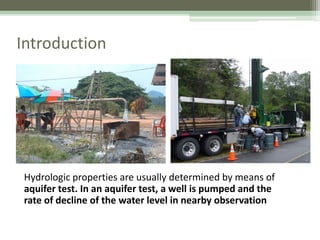
Hydrologic properties are usually determined by means of
aquifer test. In an aquifer test, a well is pumped and the
rate of decline of the water level in nearby observation
Objectives
1. Pumping test used to measure the aquifer response by
monitoring hydraulic parameters of the aquifer as a function
of time.
2. Determine well efficiency and amount of groundwater
avaible in the aquifer
3. Determine the suitable depth of pump
4. Carry out the information about water quality with time
variablity
Several things must be considered before starting a pumping test
1. Literature review or previous report regarding geologic
and hydrogeologic system for the proposed area
2. Pumping test should be carried out within the range of
proposed or designed rate
3. Determine the neraby wells that will be used during the
test if they will be affected.
R0 = 1/2 [(2,25 x T x t /S)]
4. Avoid back flow phenomena with open-end discharge
pipe
5. Measure groundwater levels in both the pumping test
well and nearby wells 24 hours before pumping starts.
Before we start..
Hydraulic Properties
• SWL / static water level (H0) The equilibrium of water level before
pumping
• PWL / pumping water level (H) The equilibrium of water level during
pumping
• Drawdown (s = H0-H) The amount of water level decline in a well due to
pumping. Usualy measured relative to static (non-pumping) conditions
• Well Yield (Q) Volume of water pumped per unit time
• Specific Capacity (Q/S)
• Time drawdown graph
• Transmittivity (T),
• Hydraulic Conducticity (K),
• Storativity (S) The volume of water release from storage per unit surface
area per unit change in head
Equipment Requirements
• Water level indicator to be used to measuring static and
dynamic water level
• Stopwatch
• Personal requirements
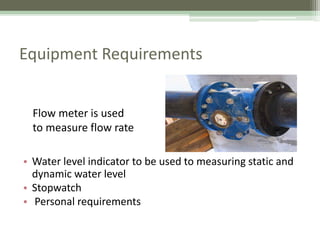
Flow meter is used
to measure flow rate
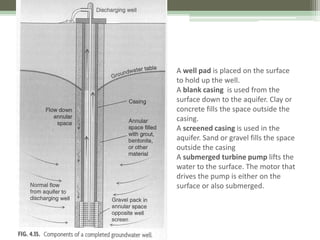
A well pad is placed on the surface
to hold up the well.
A blank casing is used from the
surface down to the aquifer. Clay or
concrete fills the space outside the
casing.
A screened casing is used in the
aquifer. Sand or gravel fills the space
outside the casing
A submerged turbine pump lifts the
water to the surface. The motor that
drives the pump is either on the
surface or also submerged.
Duration of Pumping Test
• In some test, 24-72 hours testing is enough to
produce diagnostic data and enable the ramaining
well test.
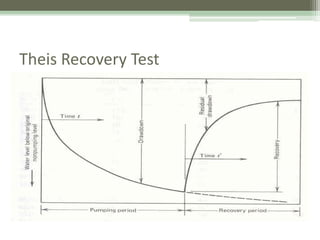
• Recovery test : Rises of water level after the pump
has been shut down. If the pumping rate was not
constant throughout the pumping test, recovery test
are more reliable than drawdown data because the
water table recovers at a constant rate.
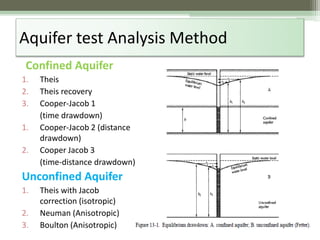
Aquifer test Analysis Method
Confined Aquifer
1. Theis
2. Theis recovery
3. Cooper-Jacob 1
(time drawdown)
1. Cooper-Jacob 2 (distance
drawdown)
2. Cooper Jacob 3
(time-distance drawdown)
Unconfined Aquifer
1. Theis with Jacob
correction (isotropic)
2. Neuman (Anisotropic)
3. Boulton (Anisotropic)
Theis Equation
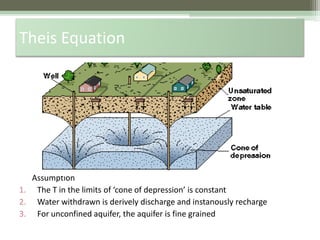
Assumption
1. The T in the limits of ‘cone of depression’ is constant
2. Water withdrawn is derively discharge and instanously recharge
3. For unconfined aquifer, the aquifer is fine grained
Theis Equation
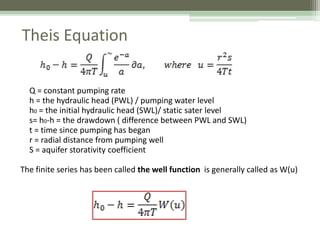
Q = constant pumping rate
h = the hydraulic head (PWL) / pumping water level
h0 = the initial hydraulic head (SWL)/ static sater level
s= h0-h = the drawdown ( difference between PWL and SWL)
t = time since pumping has began
r = radial distance from pumping well
S = aquifer storativity coefficient
The finite series has been called the well function is generally called as W(u)
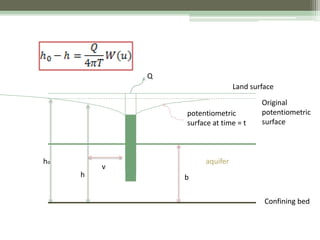
Original
potentiometric
surface
Land surface
potentiometric
surface at time = t
b
v
h
ho
Confining bed
aquifer
Q
Data required for Theis Solution
• Drawdown vs Time Data at an observation well,
• Distance from the pumping well to the observation
well,
• Pumping rate of the well.
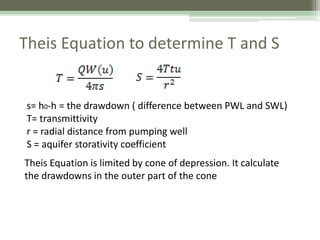
Theis Equation to determine T and S
s= h0-h = the drawdown ( difference between PWL and SWL)
T= transmittivity
r = radial distance from pumping well
S = aquifer storativity coefficient
Theis Equation is limited by cone of depression. It calculate
the drawdowns in the outer part of the cone
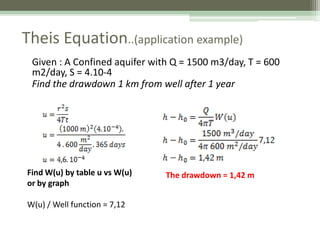
Theis Equation..(application example)
Given : A Confined aquifer with Q = 1500 m3/day, T = 600
m2/day, S = 4.10-4
Find the drawdown 1 km from well after 1 year
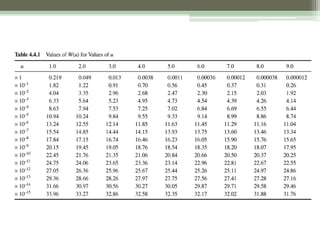
Find W(u) by table u vs W(u)
or by graph
W(u) / Well function = 7,12
The drawdown = 1,42 m
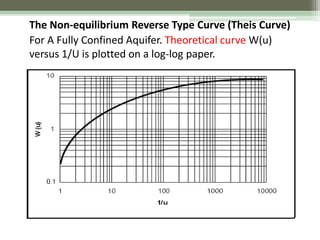
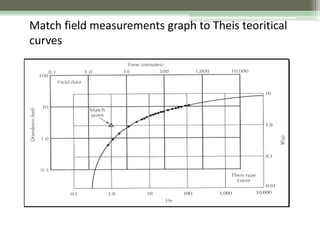
The Non-equilibrium Reverse Type Curve (Theis Curve)
For A Fully Confined Aquifer. Theoretical curve W(u)
versus 1/U is plotted on a log-log paper.
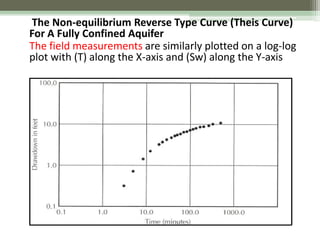
The Non-equilibrium Reverse Type Curve (Theis Curve)
For A Fully Confined Aquifer
The field measurements are similarly plotted on a log-log
plot with (T) along the X-axis and (Sw) along the Y-axis
Match field measurements graph to Theis teoritical
curves
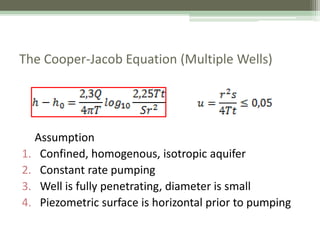
The Cooper-Jacob Equation (Multiple Wells)
Assumption
1. Confined, homogenous, isotropic aquifer
2. Constant rate pumping
3. Well is fully penetrating, diameter is small
4. Piezometric surface is horizontal prior to pumping
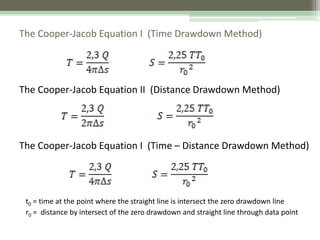
The Cooper-Jacob Equation I (Time Drawdown Method)
t0 = time at the point where the straight line is intersect the zero drawdown line
r0 = distance by intersect of the zero drawdown and straight line through data point
The Cooper-Jacob Equation II (Distance Drawdown Method)
The Cooper-Jacob Equation I (Time – Distance Drawdown Method)
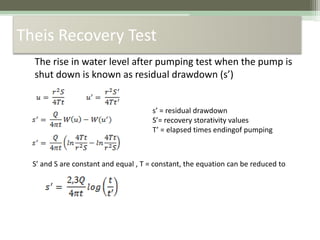
Theis Recovery Test
The rise in water level after pumping test when the pump is
shut down is known as residual drawdown (s’)
s’ = residual drawdown
S’= recovery storativity values
T’ = elapsed times endingof pumping
S’ and S are constant and equal , T = constant, the equation can be reduced to
Theis Recovery Test
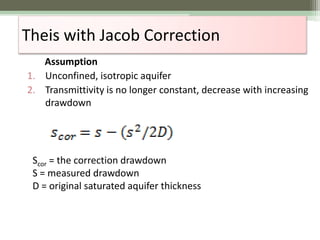
Theis with Jacob Correction
Assumption
1. Unconfined, isotropic aquifer
2. Transmittivity is no longer constant, decrease with increasing
drawdown
Scor = the correction drawdown
S = measured drawdown
D = original saturated aquifer thickness
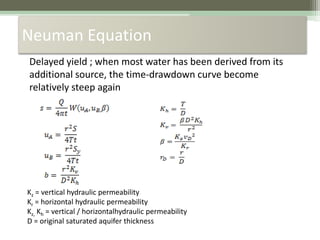
Neuman Equation
Delayed yield ; when most water has been derived from its
additional source, the time-drawdown curve become
relatively steep again
Kz = vertical hydraulic permeability
Kr = horizontal hydraulic permeability
Kz, Kh = vertical / horizontalhydraulic permeability
D = original saturated aquifer thickness
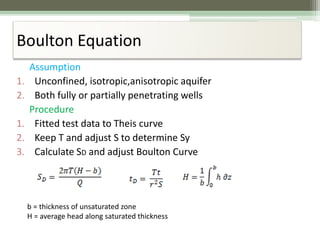
Boulton Equation
Assumption
1. Unconfined, isotropic,anisotropic aquifer
2. Both fully or partially penetrating wells
Procedure
1. Fitted test data to Theis curve
2. Keep T and adjust S to determine Sy
3. Calculate SD and adjust Boulton Curve
b = thickness of unsaturated zone
H = average head along saturated thickness
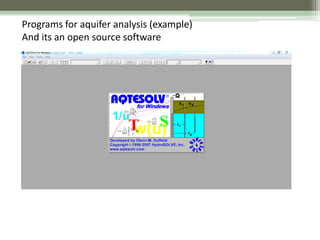
Programs for aquifer analysis (example)
And its an open source software
“Essentially, all models are wrong,
but some are useful“
- George Edward Pelham Bo-

Aquifer test and estimation

  • 1.
    Aquifer Test andEstimation By : Putika Ashfar .K May 2016
  • 2.
    • Fetter, C.W.(2001): Applied Hydrogeology, Prentice Hall, New Jersey; 598pp. • Todd, D.K. and Mays L.W., (2005): Groundwater Hydrology.(3rd Edition). John Wiley & Sons, New York • Freeze, R.A. and Cherry, J.A. (1979): Groundwater, Prentice Hall, New Jersey,604pp.
  • 3.
    Introduction Hydrologic properties areusually determined by means of aquifer test. In an aquifer test, a well is pumped and the rate of decline of the water level in nearby observation
  • 4.
    Objectives 1. Pumping testused to measure the aquifer response by monitoring hydraulic parameters of the aquifer as a function of time. 2. Determine well efficiency and amount of groundwater avaible in the aquifer 3. Determine the suitable depth of pump 4. Carry out the information about water quality with time variablity
  • 5.
    Several things mustbe considered before starting a pumping test 1. Literature review or previous report regarding geologic and hydrogeologic system for the proposed area 2. Pumping test should be carried out within the range of proposed or designed rate 3. Determine the neraby wells that will be used during the test if they will be affected. R0 = 1/2 [(2,25 x T x t /S)] 4. Avoid back flow phenomena with open-end discharge pipe 5. Measure groundwater levels in both the pumping test well and nearby wells 24 hours before pumping starts. Before we start..
  • 6.
    Hydraulic Properties • SWL/ static water level (H0) The equilibrium of water level before pumping • PWL / pumping water level (H) The equilibrium of water level during pumping • Drawdown (s = H0-H) The amount of water level decline in a well due to pumping. Usualy measured relative to static (non-pumping) conditions • Well Yield (Q) Volume of water pumped per unit time • Specific Capacity (Q/S) • Time drawdown graph • Transmittivity (T), • Hydraulic Conducticity (K), • Storativity (S) The volume of water release from storage per unit surface area per unit change in head
  • 7.
    Equipment Requirements • Waterlevel indicator to be used to measuring static and dynamic water level • Stopwatch • Personal requirements Flow meter is used to measure flow rate
  • 8.
    A well padis placed on the surface to hold up the well. A blank casing is used from the surface down to the aquifer. Clay or concrete fills the space outside the casing. A screened casing is used in the aquifer. Sand or gravel fills the space outside the casing A submerged turbine pump lifts the water to the surface. The motor that drives the pump is either on the surface or also submerged.
  • 9.
    Duration of PumpingTest • In some test, 24-72 hours testing is enough to produce diagnostic data and enable the ramaining well test. • Recovery test : Rises of water level after the pump has been shut down. If the pumping rate was not constant throughout the pumping test, recovery test are more reliable than drawdown data because the water table recovers at a constant rate.
  • 11.
    Aquifer test AnalysisMethod Confined Aquifer 1. Theis 2. Theis recovery 3. Cooper-Jacob 1 (time drawdown) 1. Cooper-Jacob 2 (distance drawdown) 2. Cooper Jacob 3 (time-distance drawdown) Unconfined Aquifer 1. Theis with Jacob correction (isotropic) 2. Neuman (Anisotropic) 3. Boulton (Anisotropic)
  • 12.
    Theis Equation Assumption 1. TheT in the limits of ‘cone of depression’ is constant 2. Water withdrawn is derively discharge and instanously recharge 3. For unconfined aquifer, the aquifer is fine grained
  • 13.
    Theis Equation Q =constant pumping rate h = the hydraulic head (PWL) / pumping water level h0 = the initial hydraulic head (SWL)/ static sater level s= h0-h = the drawdown ( difference between PWL and SWL) t = time since pumping has began r = radial distance from pumping well S = aquifer storativity coefficient The finite series has been called the well function is generally called as W(u)
  • 14.
  • 15.
    Data required forTheis Solution • Drawdown vs Time Data at an observation well, • Distance from the pumping well to the observation well, • Pumping rate of the well.
  • 16.
    Theis Equation todetermine T and S s= h0-h = the drawdown ( difference between PWL and SWL) T= transmittivity r = radial distance from pumping well S = aquifer storativity coefficient Theis Equation is limited by cone of depression. It calculate the drawdowns in the outer part of the cone
  • 17.
    Theis Equation..(application example) Given: A Confined aquifer with Q = 1500 m3/day, T = 600 m2/day, S = 4.10-4 Find the drawdown 1 km from well after 1 year Find W(u) by table u vs W(u) or by graph W(u) / Well function = 7,12 The drawdown = 1,42 m
  • 19.
    The Non-equilibrium ReverseType Curve (Theis Curve) For A Fully Confined Aquifer. Theoretical curve W(u) versus 1/U is plotted on a log-log paper.
  • 20.
    The Non-equilibrium ReverseType Curve (Theis Curve) For A Fully Confined Aquifer The field measurements are similarly plotted on a log-log plot with (T) along the X-axis and (Sw) along the Y-axis
  • 21.
    Match field measurementsgraph to Theis teoritical curves
  • 22.
    The Cooper-Jacob Equation(Multiple Wells) Assumption 1. Confined, homogenous, isotropic aquifer 2. Constant rate pumping 3. Well is fully penetrating, diameter is small 4. Piezometric surface is horizontal prior to pumping
  • 23.
    The Cooper-Jacob EquationI (Time Drawdown Method) t0 = time at the point where the straight line is intersect the zero drawdown line r0 = distance by intersect of the zero drawdown and straight line through data point The Cooper-Jacob Equation II (Distance Drawdown Method) The Cooper-Jacob Equation I (Time – Distance Drawdown Method)
  • 24.
    Theis Recovery Test Therise in water level after pumping test when the pump is shut down is known as residual drawdown (s’) s’ = residual drawdown S’= recovery storativity values T’ = elapsed times endingof pumping S’ and S are constant and equal , T = constant, the equation can be reduced to
  • 25.
  • 26.
    Theis with JacobCorrection Assumption 1. Unconfined, isotropic aquifer 2. Transmittivity is no longer constant, decrease with increasing drawdown Scor = the correction drawdown S = measured drawdown D = original saturated aquifer thickness
  • 27.
    Neuman Equation Delayed yield; when most water has been derived from its additional source, the time-drawdown curve become relatively steep again Kz = vertical hydraulic permeability Kr = horizontal hydraulic permeability Kz, Kh = vertical / horizontalhydraulic permeability D = original saturated aquifer thickness
  • 28.
    Boulton Equation Assumption 1. Unconfined,isotropic,anisotropic aquifer 2. Both fully or partially penetrating wells Procedure 1. Fitted test data to Theis curve 2. Keep T and adjust S to determine Sy 3. Calculate SD and adjust Boulton Curve b = thickness of unsaturated zone H = average head along saturated thickness
  • 29.
    Programs for aquiferanalysis (example) And its an open source software
  • 30.
    “Essentially, all modelsare wrong, but some are useful“ - George Edward Pelham Bo-