UNIT-III
Stream Gauging
Introduction:
• Stream Gauging also known as stream flow
measurement, which is the measurement of
discharge / stream flow passing through section in a
unit time.
• The necessity for stream gauging arises
because of many reasons; streams provide water
supply for men and animals, irrigation water for
plants, and energy for production of power.
• Occurrence of flood can be forecasted.
• Assessment of available water for irrigation planning.
• Variation in seasonal and annual runoff of any
stream can be determined.
• Estimation of water loss at different reaches of
stream can be done.
• Planning of rivers can be made for optimum
utilization of water flowing through them.
• Helpful for construction of river valley project.
Importance of stream gauging:
• It should act as permanent control for stream flow
measurement.
• It should be clearly visible and easily assessible.
• Avoid the point where two stream meet because of
back flow of water.
• Site should be free from vegetal growth , boulders or
other obstruction.
Selection of Gauging site (Gauging
point or station):
• Gauging site should be straight and uniform.
• Cross - section of gauging site should be firm and
stable.
• The gauging site should be capable to record
highest and lowest gauges corresponding to highest
and lowest flood peaks.
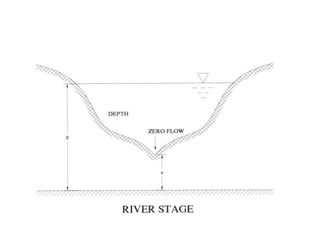
• The river stage has been defined as the height
of water surface in the river at a given section
above any arbitrary datum or mean sea level.
• If a relation between stage and discharge can
be established the stream flow can be determined
from a known stage discharge curve.
River stage:
A. Manual Gauge
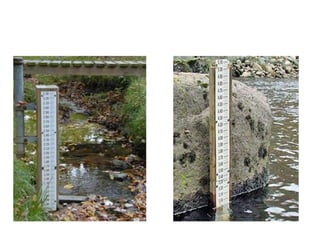
i. Staff gauge
ii. Suspended weight wire gauge
B. Automatic stage recorder
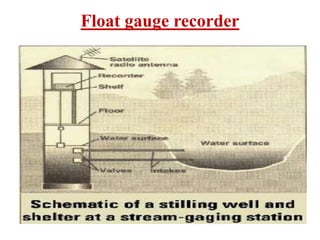
i. Float gauge recorder
Stage measurement methods:
Staff Gauge
Suspended weight wire gauge
Float gauge recorder
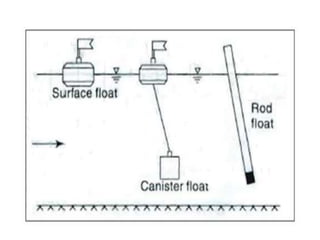
Various devices used for measuring the
flow velocity are :
A. Surface float
B. Sub- surface float
C. Velocity rods
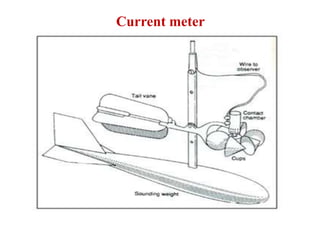
D. Current meter
Measurement of velocity:
Current meter
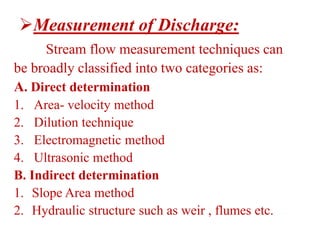
Stream flow measurement techniques can
be broadly classified into two categories as:
A. Direct determination
1. Area- velocity method
2. Dilution technique
3. Electromagnetic method
4. Ultrasonic method
B. Indirect determination
1. Slope Area method
2. Hydraulic structure such as weir , flumes etc.
Measurement of Discharge:
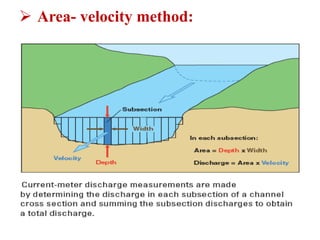
 Area- velocity method:
Dilution techniques:
In this method discharge is determined
by injecting chemical (normally common salt) in
the stream flow at a known rate and determining
the amount of chemical present in the flow at
downstream point which is located at sufficient
distance from injecting point.
Ultrasonic method:
Electromagnetic method:
 Slope Area method:
In this method stream flow rate is calculated
by multiplying average cross-sectional area of the
stream flow and flow velocity determined with help
of slope of water surface in the stream.
• The computation is carried out in flowing steps;
a. Computation of cross sectional area
b. Computation of wetted perimeter
c. Computation of slope
d. Computation of flow velocity using manning's
and chezy’s formula.
 Hydraulic structure such as weir, flumes:
On small streams the flow can be measured
with the help of hydraulic flow measuring
devices such as rectangular, triangular and
trapezoidal weir or flumes like venturi flume and
parshall flume.

Stream Gauging.pptx

  • 1.
  • 2.
    Introduction: • Stream Gaugingalso known as stream flow measurement, which is the measurement of discharge / stream flow passing through section in a unit time. • The necessity for stream gauging arises because of many reasons; streams provide water supply for men and animals, irrigation water for plants, and energy for production of power.
  • 3.
    • Occurrence offlood can be forecasted. • Assessment of available water for irrigation planning. • Variation in seasonal and annual runoff of any stream can be determined. • Estimation of water loss at different reaches of stream can be done. • Planning of rivers can be made for optimum utilization of water flowing through them. • Helpful for construction of river valley project. Importance of stream gauging:
  • 4.
    • It shouldact as permanent control for stream flow measurement. • It should be clearly visible and easily assessible. • Avoid the point where two stream meet because of back flow of water. • Site should be free from vegetal growth , boulders or other obstruction. Selection of Gauging site (Gauging point or station):
  • 5.
    • Gauging siteshould be straight and uniform. • Cross - section of gauging site should be firm and stable. • The gauging site should be capable to record highest and lowest gauges corresponding to highest and lowest flood peaks.
  • 6.
    • The riverstage has been defined as the height of water surface in the river at a given section above any arbitrary datum or mean sea level. • If a relation between stage and discharge can be established the stream flow can be determined from a known stage discharge curve. River stage:
  • 8.
    A. Manual Gauge i.Staff gauge ii. Suspended weight wire gauge B. Automatic stage recorder i. Float gauge recorder Stage measurement methods:
  • 9.
  • 12.
  • 14.
  • 16.
    Various devices usedfor measuring the flow velocity are : A. Surface float B. Sub- surface float C. Velocity rods D. Current meter Measurement of velocity:
  • 18.
  • 20.
    Stream flow measurementtechniques can be broadly classified into two categories as: A. Direct determination 1. Area- velocity method 2. Dilution technique 3. Electromagnetic method 4. Ultrasonic method B. Indirect determination 1. Slope Area method 2. Hydraulic structure such as weir , flumes etc. Measurement of Discharge:
  • 21.
  • 22.
    Dilution techniques: In thismethod discharge is determined by injecting chemical (normally common salt) in the stream flow at a known rate and determining the amount of chemical present in the flow at downstream point which is located at sufficient distance from injecting point.
  • 23.
  • 24.
  • 25.
     Slope Areamethod: In this method stream flow rate is calculated by multiplying average cross-sectional area of the stream flow and flow velocity determined with help of slope of water surface in the stream. • The computation is carried out in flowing steps; a. Computation of cross sectional area b. Computation of wetted perimeter c. Computation of slope d. Computation of flow velocity using manning's and chezy’s formula.
  • 26.
     Hydraulic structuresuch as weir, flumes: On small streams the flow can be measured with the help of hydraulic flow measuring devices such as rectangular, triangular and trapezoidal weir or flumes like venturi flume and parshall flume.