Stream Ciphers CS 519 Cryptography and Network Security Instructor: Ali Aydin Selcuk CS519, © A.Selcuk Stream Ciphers
Stream Ciphers Generate a  pseudo-random  key stream & xor to the plaintext.  Key:  The seed of the PRNG Traditional PRNGs (e.g. those used for simulations) are not secure. E.g., the linear congruential generator:  X i   =  a X i-1  + b  mod m for some fixed a, b, m. It passes the randomness tests, but it is predictible. CS519, © A.Selcuk Stream Ciphers
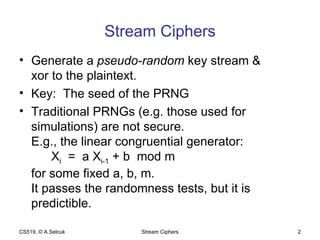
Linear Feedback Shift Registers Feedback shift register: (“register”, “feedback”, “shift”) LFSR:  Feedback fnc. is linear over Z 2   (i.e., an xor): Very compact & efficient in hardware. CS519, © A.Selcuk Stream Ciphers x n x n-1 x 1 . . . . . . . feedback fnc. output bits  . . . . x n x n-1 x 1 . . . . . . . . . . . 
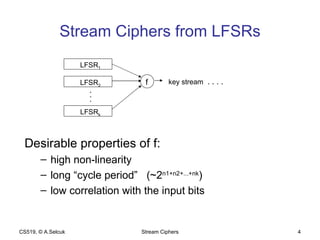
Stream Ciphers from LFSRs Desirable properties of f: high non-linearity long “cycle period”  (~2 n1+n2+...+nk ) low correlation with the input bits CS519, © A.Selcuk Stream Ciphers key stream  . . . . LFSR 1 LFSR 2 LFSR k f . . .
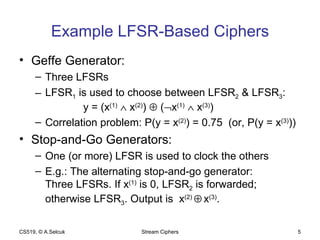
Example LFSR-Based Ciphers Geffe Generator: Three LFSRs LFSR 1  is used to choose between LFSR 2  & LFSR 3 :  y = (x (1)     x (2) )    (  x (1)     x (3) ) Correlation problem: P(y = x (2) ) = 0.75  (or, P(y = x (3) )) Stop-and-Go Generators: One (or more) LFSR is used to clock the others E.g.: The alternating stop-and-go generator: Three LFSRs. If x (1)  is 0, LFSR 2  is forwarded; otherwise LFSR 3 . Output is  x (2)     x (3) . CS519, © A.Selcuk Stream Ciphers
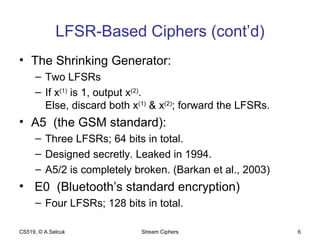
LFSR-Based Ciphers (cont’d) The Shrinking Generator: Two LFSRs If x (1)  is 1, output x (2) . Else, discard both x (1)  & x (2) ; forward the LFSRs. A5  (the GSM standard): Three LFSRs; 64 bits in total. Designed secretly. Leaked in 1994. A5/2 is completely broken. (Barkan et al., 2003) E0  (Bluetooth’s standard encryption) Four LFSRs; 128 bits in total. CS519, © A.Selcuk Stream Ciphers
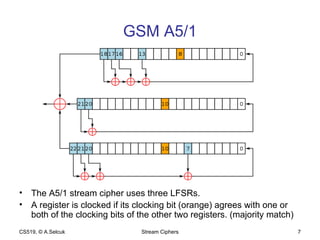
GSM A5/1 The A5/1 stream cipher uses three LFSRs.  A register is clocked if its clocking bit (orange) agrees with one or both of the clocking bits of the other two registers. (majority match) CS519, © A.Selcuk Stream Ciphers
Software-Oriented Stream Ciphers LFSRs slow in software Alternatives: Block ciphers (or hash functions) in  CFB, OFB, CTR modes. Stream ciphers designed for software: RC4 SEAL CS519, © A.Selcuk Stream Ciphers
RC4 (Rivest, 1987) Simple, byte-oriented, fast in s/w. Popular:  MS-Windows, Netscape, Apple,  Oracle Secure SQL, WEP, etc. Algorithm: Works on n-bit words.  (typically, n = 8) State of the cipher: A permutation of {0,1,...,N-1}, where N = 2 n , stored at S[0,1,...,N-1]. Key schedule:  Expands the key (40-256 bits) into the initial state table S. CS519, © A.Selcuk Stream Ciphers
RC4 (cont’d) The encryption (i.e., the PRNG) algorithm: i ← 0 j ← 0 loop: { i ← i + 1 j ← j + S[i] S[i] ↔ S[j] output S[S[i] + S[j]] } CS519, © A.Selcuk Stream Ciphers
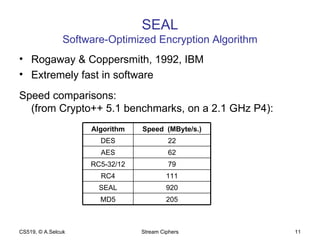
SEAL Software-Optimized Encryption Algorithm Rogaway & Coppersmith, 1992, IBM Extremely fast in software Speed comparisons:  (from Crypto++ 5.1 benchmarks, on a 2.1 GHz P4): CS519, © A.Selcuk Stream Ciphers Algorithm Speed  (MByte/s.) DES 22 AES 62 RC5-32/12 79 RC4 111 SEAL 920 MD5 205
RC4  &  WEP WEP: Wired Eqv. Privacy  (802.11 encryption prot.) RC4 encryption, with 40–104 bit keys. 24-bit IV is prepended to the key; RC4(IV || k). IV is changed for each packet. Integrity protection: By encrypted CRC-32 checksum. (What are some obvious problems so far?) Key management not specified. (Typically, a key is shared among an AP and all its clients.) Design process:  Not closed-door, not very public either. CS519, © A.Selcuk Stream Ciphers
Attacks on WEP (Borisov, Goldberg, Wagner, 2000) Obvious problems: 24-bit IV too shot; recycles easily. (And in most systems, implemented as a counter starting from 0.) CRC is linear; not secure against modifications. Even worse: Using CRC with a stream cipher. Passive decryption attacks: Statistical frequency analysis can discover the plaintexts encrypted with the same IV. An insider can get the key stream for a packet he sent (i.e., by xoring plaintext and ciphertext); hence can decrypt anyone’s packet encrypted with the same IV. CS519, © A.Selcuk Stream Ciphers
Attacks on WEP  (cont’d) Authentication: challenge-response with RC4 server sends 128-bit challenge client encrypts with RC4 and returns server decrypts and compares Problem: attacker sees both the challenge & the response; can easily obtain a valid key stream & use it to respond to future challenges. CS519, © A.Selcuk Stream Ciphers
Attacks on WEP  (cont’d) An active attack: Since RC4 is a stream cipher, an attacker can modify the plaintext bits over the ciphertext and fix the CRC checksum accordingly. Parts of the plaintext is predictable (e.g., the upper-layer protocol headers).  Attacker sniffs a packet and  changes its IP address to his machine from the ciphertext.  (If the attacker’s machine is outside the firewall, the TCP port number could also be changed, to 80 for example, which most firewalls would not block.)  Hence, the attacker obtains the decrypted text without breaking the encryption. CS519, © A.Selcuk Stream Ciphers
Attacks on WEP  (cont’d) A table-based attack: An insider generates a packet for each IV. Extracts the key stream by xoring the ciphertext with the plaintext. Stores all the key streams in a table indexed by the IV. (Requires ~15GB in total.) Now he can decrypt any packet sent to that AP.  Note: All these attacks are practical. Some assume a shared key, which is realistic. CS519, © A.Selcuk Stream Ciphers
Attacks on WEP  (cont’d) The final nail in the coffin: (Fluhrer, Mantin, Shamir, 2001)  The way RC4 is used in WEP can be broken completely: When IV is known, it is possible to get k in RC4(IV || k). WEP2 proposal: 128-bit key, 128-bit IV. This can be broken even faster! CS519, © A.Selcuk Stream Ciphers
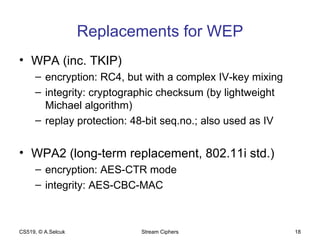
Replacements for WEP WPA (inc. TKIP) encryption: RC4, but with a complex IV-key mixing integrity: cryptographic checksum (by lightweight Michael algorithm) replay protection: 48-bit seq.no.; also used as IV WPA2 (long-term replacement, 802.11i std.) encryption: AES-CTR mode integrity: AES-CBC-MAC CS519, © A.Selcuk Stream Ciphers

Stream ciphers presentation

  • 1.
    Stream Ciphers CS519 Cryptography and Network Security Instructor: Ali Aydin Selcuk CS519, © A.Selcuk Stream Ciphers
  • 2.
    Stream Ciphers Generatea pseudo-random key stream & xor to the plaintext. Key: The seed of the PRNG Traditional PRNGs (e.g. those used for simulations) are not secure. E.g., the linear congruential generator: X i = a X i-1 + b mod m for some fixed a, b, m. It passes the randomness tests, but it is predictible. CS519, © A.Selcuk Stream Ciphers
  • 3.
    Linear Feedback ShiftRegisters Feedback shift register: (“register”, “feedback”, “shift”) LFSR: Feedback fnc. is linear over Z 2 (i.e., an xor): Very compact & efficient in hardware. CS519, © A.Selcuk Stream Ciphers x n x n-1 x 1 . . . . . . . feedback fnc. output bits . . . . x n x n-1 x 1 . . . . . . . . . . . 
  • 4.
    Stream Ciphers fromLFSRs Desirable properties of f: high non-linearity long “cycle period” (~2 n1+n2+...+nk ) low correlation with the input bits CS519, © A.Selcuk Stream Ciphers key stream . . . . LFSR 1 LFSR 2 LFSR k f . . .
  • 5.
    Example LFSR-Based CiphersGeffe Generator: Three LFSRs LFSR 1 is used to choose between LFSR 2 & LFSR 3 : y = (x (1)  x (2) )  (  x (1)  x (3) ) Correlation problem: P(y = x (2) ) = 0.75 (or, P(y = x (3) )) Stop-and-Go Generators: One (or more) LFSR is used to clock the others E.g.: The alternating stop-and-go generator: Three LFSRs. If x (1) is 0, LFSR 2 is forwarded; otherwise LFSR 3 . Output is x (2)  x (3) . CS519, © A.Selcuk Stream Ciphers
  • 6.
    LFSR-Based Ciphers (cont’d)The Shrinking Generator: Two LFSRs If x (1) is 1, output x (2) . Else, discard both x (1) & x (2) ; forward the LFSRs. A5 (the GSM standard): Three LFSRs; 64 bits in total. Designed secretly. Leaked in 1994. A5/2 is completely broken. (Barkan et al., 2003) E0 (Bluetooth’s standard encryption) Four LFSRs; 128 bits in total. CS519, © A.Selcuk Stream Ciphers
  • 7.
    GSM A5/1 TheA5/1 stream cipher uses three LFSRs. A register is clocked if its clocking bit (orange) agrees with one or both of the clocking bits of the other two registers. (majority match) CS519, © A.Selcuk Stream Ciphers
  • 8.
    Software-Oriented Stream CiphersLFSRs slow in software Alternatives: Block ciphers (or hash functions) in CFB, OFB, CTR modes. Stream ciphers designed for software: RC4 SEAL CS519, © A.Selcuk Stream Ciphers
  • 9.
    RC4 (Rivest, 1987)Simple, byte-oriented, fast in s/w. Popular: MS-Windows, Netscape, Apple, Oracle Secure SQL, WEP, etc. Algorithm: Works on n-bit words. (typically, n = 8) State of the cipher: A permutation of {0,1,...,N-1}, where N = 2 n , stored at S[0,1,...,N-1]. Key schedule: Expands the key (40-256 bits) into the initial state table S. CS519, © A.Selcuk Stream Ciphers
  • 10.
    RC4 (cont’d) Theencryption (i.e., the PRNG) algorithm: i ← 0 j ← 0 loop: { i ← i + 1 j ← j + S[i] S[i] ↔ S[j] output S[S[i] + S[j]] } CS519, © A.Selcuk Stream Ciphers
  • 11.
    SEAL Software-Optimized EncryptionAlgorithm Rogaway & Coppersmith, 1992, IBM Extremely fast in software Speed comparisons: (from Crypto++ 5.1 benchmarks, on a 2.1 GHz P4): CS519, © A.Selcuk Stream Ciphers Algorithm Speed (MByte/s.) DES 22 AES 62 RC5-32/12 79 RC4 111 SEAL 920 MD5 205
  • 12.
    RC4 & WEP WEP: Wired Eqv. Privacy (802.11 encryption prot.) RC4 encryption, with 40–104 bit keys. 24-bit IV is prepended to the key; RC4(IV || k). IV is changed for each packet. Integrity protection: By encrypted CRC-32 checksum. (What are some obvious problems so far?) Key management not specified. (Typically, a key is shared among an AP and all its clients.) Design process: Not closed-door, not very public either. CS519, © A.Selcuk Stream Ciphers
  • 13.
    Attacks on WEP(Borisov, Goldberg, Wagner, 2000) Obvious problems: 24-bit IV too shot; recycles easily. (And in most systems, implemented as a counter starting from 0.) CRC is linear; not secure against modifications. Even worse: Using CRC with a stream cipher. Passive decryption attacks: Statistical frequency analysis can discover the plaintexts encrypted with the same IV. An insider can get the key stream for a packet he sent (i.e., by xoring plaintext and ciphertext); hence can decrypt anyone’s packet encrypted with the same IV. CS519, © A.Selcuk Stream Ciphers
  • 14.
    Attacks on WEP (cont’d) Authentication: challenge-response with RC4 server sends 128-bit challenge client encrypts with RC4 and returns server decrypts and compares Problem: attacker sees both the challenge & the response; can easily obtain a valid key stream & use it to respond to future challenges. CS519, © A.Selcuk Stream Ciphers
  • 15.
    Attacks on WEP (cont’d) An active attack: Since RC4 is a stream cipher, an attacker can modify the plaintext bits over the ciphertext and fix the CRC checksum accordingly. Parts of the plaintext is predictable (e.g., the upper-layer protocol headers). Attacker sniffs a packet and changes its IP address to his machine from the ciphertext. (If the attacker’s machine is outside the firewall, the TCP port number could also be changed, to 80 for example, which most firewalls would not block.) Hence, the attacker obtains the decrypted text without breaking the encryption. CS519, © A.Selcuk Stream Ciphers
  • 16.
    Attacks on WEP (cont’d) A table-based attack: An insider generates a packet for each IV. Extracts the key stream by xoring the ciphertext with the plaintext. Stores all the key streams in a table indexed by the IV. (Requires ~15GB in total.) Now he can decrypt any packet sent to that AP. Note: All these attacks are practical. Some assume a shared key, which is realistic. CS519, © A.Selcuk Stream Ciphers
  • 17.
    Attacks on WEP (cont’d) The final nail in the coffin: (Fluhrer, Mantin, Shamir, 2001) The way RC4 is used in WEP can be broken completely: When IV is known, it is possible to get k in RC4(IV || k). WEP2 proposal: 128-bit key, 128-bit IV. This can be broken even faster! CS519, © A.Selcuk Stream Ciphers
  • 18.
    Replacements for WEPWPA (inc. TKIP) encryption: RC4, but with a complex IV-key mixing integrity: cryptographic checksum (by lightweight Michael algorithm) replay protection: 48-bit seq.no.; also used as IV WPA2 (long-term replacement, 802.11i std.) encryption: AES-CTR mode integrity: AES-CBC-MAC CS519, © A.Selcuk Stream Ciphers