pseudorandom number generation
Stream ciphers
RC4
True random numbers
 Random number is a number generated by a
process, whose outcome is unpredictable, and which
cannot be sub sequentially reliably reproduced
 Random numbers play an important role in the use of
encryption for various network security applications.
Two Types of Random Numbers
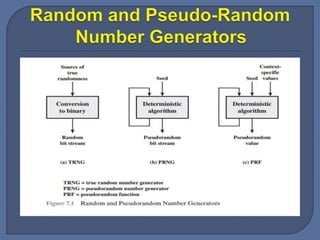
 Pseudorandom numbers are numbers that appear
random, but are obtained in a deterministic,
repeatable, and predictable manner.
 True random numbers are generated in non-
deterministic ways. They are not predictable. They
are not repeatable
1- Key distribution and reciprocal authentication
schemes
2- Session key generation.
 Session key is a secret key for symmetric encryption
generated for use for a short period of time.
3- Generation of keys for the RSA public- key encryption
algorithm
4- Generation of a bit stream for symmetric stream
encryption
 These application give two distinct requirements :
Randomness and Unpredictability
 Two criteria are used to validate that a sequence of
numbers is random:
1. Uniform distribution
The distribution of bits in the sequence should be
uniform .Frequency of occurrence of 1 and 0
approximately equal .
2. Independence : No one subsequence in the
sequence can be inferred from the others
UNPREDICTABILITY
 Hard to predict next value in sequence.
 1-True Random number Generators
 Best source is natural randomness in real world
 TRNG uses a nondeterministic source to produce
randomness
 entropy source refer to produce randomness, from
physical environment .
 Physical environment of the computer and could include
things such as disk electrical activity, mouse
movements, and instantaneous values of the system
clock
 TRNG produce randomness.by measuring unpredictable
natural processes , such as pulse detectors of ionizing
radiation events, gas discharge tubes, and leaky
capacitors.
 Lava rand is an open source project for creating truly
random numbers using inexpensive cameras , open
source code, and inexpensive hardware.
 TRNG may simply involve conversion of an analog
source to a binary output
 Problems of bias or uneven distribution in signal
 have to compensate for this when sample, often by
passing bits through a hash function
 Best to only use a few noisiest bits from each sample
 RFC4086 recommends using multiple sources of
randomness on a computer & hash function to generate
true random output , possible sources is
 Sound /video input
 Disk drivers
 Deskewing :methods of modifying a bit stream to
reduce or eliminate the bias have been developed
 One approach to deskew is to pass the bit stream
through a hash function, such as MD5 or SHA-1
 There is also an online service (random.org), which can
deliver random sequences securely over the Internet.
 Operating systems provide a built-in mechanism for
generating random numbers. For, Linux uses four
entropy sources: mouse and keyboard activity, disk I/O
operations, and specific interrupts.
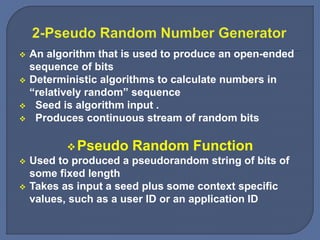
 An algorithm that is used to produce an open-ended
sequence of bits
 Deterministic algorithms to calculate numbers in
“relatively random” sequence
 Seed is algorithm input .
 Produces continuous stream of random bits
Pseudo Random Function
 Used to produced a pseudorandom string of bits of
some fixed length
 Takes as input a seed plus some context specific
values, such as a user ID or an application ID
Hard to determine pseudo-random stream if don’t know
seed (but know algorithm)
1- RANDOMNESS
A. Uniformity : occurrence of a zero or one is equally
likely, n/2where n = the sequence length.
B. Scalability : Any test applicable to a sequence can also
be applied to subsequences extracted at random
C. Consistency : The behavior of a generator must be
consistent
We have Three test:
1-Frequency test
2-Runs test
3- Maurer’s universal statistical test : detect whether or
not the sequence can be significantly compressed without
loss of information
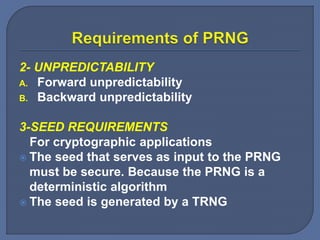
2- UNPREDICTABILITY
A. Forward unpredictability
B. Backward unpredictability
3-SEED REQUIREMENTS
For cryptographic applications
 The seed that serves as input to the PRNG
must be secure. Because the PRNG is a
deterministic algorithm
 The seed is generated by a TRNG
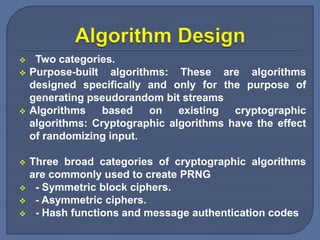
 Two categories.
 Purpose-built algorithms: These are algorithms
designed specifically and only for the purpose of
generating pseudorandom bit streams
 Algorithms based on existing cryptographic
algorithms: Cryptographic algorithms have the effect
of randomizing input.
 Three broad categories of cryptographic algorithms
are commonly used to create PRNG
 - Symmetric block ciphers.
 - Asymmetric ciphers.
 - Hash functions and message authentication codes
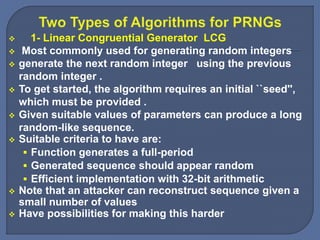
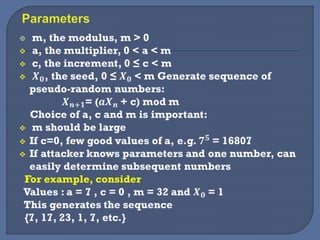
 1- Linear Congruential Generator LCG
 Most commonly used for generating random integers
 generate the next random integer using the previous
random integer .
 To get started, the algorithm requires an initial ``seed'',
which must be provided .
 Given suitable values of parameters can produce a long
random-like sequence.
 Suitable criteria to have are:
 Function generates a full-period
 Generated sequence should appear random
 Efficient implementation with 32-bit arithmetic
 Note that an attacker can reconstruct sequence given a
small number of values
 Have possibilities for making this harder

 Cryptographically secure pseudorandom bit generator
(CSPRBG).
 Named for its developers [BLUM86].
 Based on public key algorithms
 The security of BBS is based on the difficulty of
factoring n
 Unpredictable, passes next-bit test
 Security rests on difficulty of factoring N
 Is unpredictable given any run of bits
 Slow, since very large numbers must be used
 Too slow for cipher use, good for key generation
 p, q: large prime numbers such that:
(p mod 4) = (q mod 4) = 3
 n = p * q
 s: random number relatively prime to n
Generation sequence of bits ,Bi:
𝑋0 = 𝑠2 𝑚𝑜𝑑 𝑛
𝑓𝑜𝑟 𝑖 = 1 𝑡𝑜 ∞
𝑋𝑖 =( 𝑋𝑖−1)2 mod n
𝐵𝑖= 𝑋𝑖 mod 2
 Example:
p=383 ,q=503 ,s=101355
N=p∗q n= 192649
𝑋0 = 𝑆2
mod n
𝑋0 =20749
𝑋𝑖 = ( 𝑋𝑖−1)2 mod n =14135
𝐵𝑖= 𝑋𝑖 mod2 =1
 Is a symmetric encryption algorithm cipher text
output is produced bit by bit or byte by byte
 Another name for the stream cipher is the state
cipher since every digit is dependent on the current
state of the cipher
 Have a pseudo random key stream
 Combined (XOR) with plaintext bit by bit
 Randomness of stream key completely destroys
statistically properties in message
Ci = Mi XOR Stream Keyi
 But must never reuse stream key
 Otherwise can recover messages
1- Synchronous Stream Ciphers
 Called synchronous if key stream does not depend
on the plain text (depends on key alone)
 Both the sender and receiver must use the same
information in order for decryption of the cipher text
to be successful.
 Example: RC4 ,block cipher in OFB.
2- Self-Synchronizing Stream Ciphers
 Key stream depend on the plain text
 Cipher Text Auto Key (CTAK). This concept allows
the receiver to automatically synchronize with the
key stream generator after receiving N cipher text
digits.
 Example: block cipher in cipher feedback CFB mode
 Some design considerations are:
Long period with no repetitions
Key stream should approximate true random
number stream
Key must withstand brute force attacks depends
on large enough key
Comparison to Block Ciphers
• Can be as secure as a block cipher with same size
key
• But Stream ciphers often simpler to implement &
faster
• Block ciphers can re-use keys
 RC4 is a proprietary cipher owned by RSA Security.
 Designed by Ron Rivest in 1987
 Widely used in the web SSL (Secure Socket Layer)/
TLS (Transport Layer Security), wireless WEP(Wired
Equivalent Privacy/WPA( WiFi Protected Access).
 Very simple and efficient implementation.
 Can use variable length key of from 1-256 bytes
(8 to 2048 bits ).
 The algorithm is based on the use of random
permutation of all 8 bit value
Parameters and Variables
 Variable length key, K, from 1 to 256 Bytes
 State vector, S, 256 Bytes
 Temporary vector, T, 256 Bytes
Steps
 Starts with an array S of numbers: 0..255
 Use key to well and truly shuffle
 S forms internal state of the cipher
for i = 0 to 255 do
S[i] = i
T[i] = K[i mod keylen ]
j = 0
for i = 0 to 255 do
j = (j + S[i] + T[i]) (mod 256)
swap (S[i], S[j])
 Encryption continues shuffling array values
 Sum of shuffled pair selects "stream key" value from
permutation
 XOR S[t] with next byte of message to en/decrypt
i = j = 0
for each message byte Mi
i = (i + 1) (mod 256)
j = (j + S[i]) (mod 256)
swap(S[i], S[j])
t = (S[i] + S[j]) (mod 256)
Ci = Mi XOR S[t]
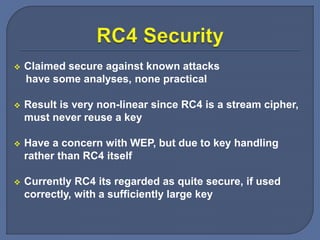
 Claimed secure against known attacks
have some analyses, none practical
 Result is very non-linear since RC4 is a stream cipher,
must never reuse a key
 Have a concern with WEP, but due to key handling
rather than RC4 itself
 Currently RC4 its regarded as quite secure, if used
correctly, with a sufficiently large key
Information and data security pseudorandom number generation and stream cipher

Information and data security pseudorandom number generation and stream cipher

  • 2.
    pseudorandom number generation Streamciphers RC4 True random numbers
  • 3.
     Random numberis a number generated by a process, whose outcome is unpredictable, and which cannot be sub sequentially reliably reproduced  Random numbers play an important role in the use of encryption for various network security applications. Two Types of Random Numbers  Pseudorandom numbers are numbers that appear random, but are obtained in a deterministic, repeatable, and predictable manner.  True random numbers are generated in non- deterministic ways. They are not predictable. They are not repeatable
  • 4.
    1- Key distributionand reciprocal authentication schemes 2- Session key generation.  Session key is a secret key for symmetric encryption generated for use for a short period of time. 3- Generation of keys for the RSA public- key encryption algorithm 4- Generation of a bit stream for symmetric stream encryption  These application give two distinct requirements : Randomness and Unpredictability
  • 5.
     Two criteriaare used to validate that a sequence of numbers is random: 1. Uniform distribution The distribution of bits in the sequence should be uniform .Frequency of occurrence of 1 and 0 approximately equal . 2. Independence : No one subsequence in the sequence can be inferred from the others UNPREDICTABILITY  Hard to predict next value in sequence.
  • 6.
     1-True Randomnumber Generators  Best source is natural randomness in real world  TRNG uses a nondeterministic source to produce randomness  entropy source refer to produce randomness, from physical environment .  Physical environment of the computer and could include things such as disk electrical activity, mouse movements, and instantaneous values of the system clock  TRNG produce randomness.by measuring unpredictable natural processes , such as pulse detectors of ionizing radiation events, gas discharge tubes, and leaky capacitors.
  • 7.
     Lava randis an open source project for creating truly random numbers using inexpensive cameras , open source code, and inexpensive hardware.  TRNG may simply involve conversion of an analog source to a binary output  Problems of bias or uneven distribution in signal  have to compensate for this when sample, often by passing bits through a hash function  Best to only use a few noisiest bits from each sample  RFC4086 recommends using multiple sources of randomness on a computer & hash function to generate true random output , possible sources is  Sound /video input  Disk drivers
  • 8.
     Deskewing :methodsof modifying a bit stream to reduce or eliminate the bias have been developed  One approach to deskew is to pass the bit stream through a hash function, such as MD5 or SHA-1  There is also an online service (random.org), which can deliver random sequences securely over the Internet.  Operating systems provide a built-in mechanism for generating random numbers. For, Linux uses four entropy sources: mouse and keyboard activity, disk I/O operations, and specific interrupts.
  • 9.
     An algorithmthat is used to produce an open-ended sequence of bits  Deterministic algorithms to calculate numbers in “relatively random” sequence  Seed is algorithm input .  Produces continuous stream of random bits Pseudo Random Function  Used to produced a pseudorandom string of bits of some fixed length  Takes as input a seed plus some context specific values, such as a user ID or an application ID
  • 11.
    Hard to determinepseudo-random stream if don’t know seed (but know algorithm) 1- RANDOMNESS A. Uniformity : occurrence of a zero or one is equally likely, n/2where n = the sequence length. B. Scalability : Any test applicable to a sequence can also be applied to subsequences extracted at random C. Consistency : The behavior of a generator must be consistent We have Three test: 1-Frequency test 2-Runs test 3- Maurer’s universal statistical test : detect whether or not the sequence can be significantly compressed without loss of information
  • 12.
    2- UNPREDICTABILITY A. Forwardunpredictability B. Backward unpredictability 3-SEED REQUIREMENTS For cryptographic applications  The seed that serves as input to the PRNG must be secure. Because the PRNG is a deterministic algorithm  The seed is generated by a TRNG
  • 14.
     Two categories. Purpose-built algorithms: These are algorithms designed specifically and only for the purpose of generating pseudorandom bit streams  Algorithms based on existing cryptographic algorithms: Cryptographic algorithms have the effect of randomizing input.  Three broad categories of cryptographic algorithms are commonly used to create PRNG  - Symmetric block ciphers.  - Asymmetric ciphers.  - Hash functions and message authentication codes
  • 15.
     1- LinearCongruential Generator LCG  Most commonly used for generating random integers  generate the next random integer using the previous random integer .  To get started, the algorithm requires an initial ``seed'', which must be provided .  Given suitable values of parameters can produce a long random-like sequence.  Suitable criteria to have are:  Function generates a full-period  Generated sequence should appear random  Efficient implementation with 32-bit arithmetic  Note that an attacker can reconstruct sequence given a small number of values  Have possibilities for making this harder
  • 16.
  • 17.
     Cryptographically securepseudorandom bit generator (CSPRBG).  Named for its developers [BLUM86].  Based on public key algorithms  The security of BBS is based on the difficulty of factoring n  Unpredictable, passes next-bit test  Security rests on difficulty of factoring N  Is unpredictable given any run of bits  Slow, since very large numbers must be used  Too slow for cipher use, good for key generation
  • 18.
     p, q:large prime numbers such that: (p mod 4) = (q mod 4) = 3  n = p * q  s: random number relatively prime to n Generation sequence of bits ,Bi: 𝑋0 = 𝑠2 𝑚𝑜𝑑 𝑛 𝑓𝑜𝑟 𝑖 = 1 𝑡𝑜 ∞ 𝑋𝑖 =( 𝑋𝑖−1)2 mod n 𝐵𝑖= 𝑋𝑖 mod 2  Example: p=383 ,q=503 ,s=101355 N=p∗q n= 192649 𝑋0 = 𝑆2 mod n 𝑋0 =20749 𝑋𝑖 = ( 𝑋𝑖−1)2 mod n =14135 𝐵𝑖= 𝑋𝑖 mod2 =1
  • 19.
     Is asymmetric encryption algorithm cipher text output is produced bit by bit or byte by byte  Another name for the stream cipher is the state cipher since every digit is dependent on the current state of the cipher  Have a pseudo random key stream  Combined (XOR) with plaintext bit by bit  Randomness of stream key completely destroys statistically properties in message Ci = Mi XOR Stream Keyi  But must never reuse stream key  Otherwise can recover messages
  • 21.
    1- Synchronous StreamCiphers  Called synchronous if key stream does not depend on the plain text (depends on key alone)  Both the sender and receiver must use the same information in order for decryption of the cipher text to be successful.  Example: RC4 ,block cipher in OFB. 2- Self-Synchronizing Stream Ciphers  Key stream depend on the plain text  Cipher Text Auto Key (CTAK). This concept allows the receiver to automatically synchronize with the key stream generator after receiving N cipher text digits.  Example: block cipher in cipher feedback CFB mode
  • 23.
     Some designconsiderations are: Long period with no repetitions Key stream should approximate true random number stream Key must withstand brute force attacks depends on large enough key Comparison to Block Ciphers • Can be as secure as a block cipher with same size key • But Stream ciphers often simpler to implement & faster • Block ciphers can re-use keys
  • 25.
     RC4 isa proprietary cipher owned by RSA Security.  Designed by Ron Rivest in 1987  Widely used in the web SSL (Secure Socket Layer)/ TLS (Transport Layer Security), wireless WEP(Wired Equivalent Privacy/WPA( WiFi Protected Access).  Very simple and efficient implementation.  Can use variable length key of from 1-256 bytes (8 to 2048 bits ).  The algorithm is based on the use of random permutation of all 8 bit value
  • 26.
    Parameters and Variables Variable length key, K, from 1 to 256 Bytes  State vector, S, 256 Bytes  Temporary vector, T, 256 Bytes Steps  Starts with an array S of numbers: 0..255  Use key to well and truly shuffle  S forms internal state of the cipher for i = 0 to 255 do S[i] = i T[i] = K[i mod keylen ] j = 0 for i = 0 to 255 do j = (j + S[i] + T[i]) (mod 256) swap (S[i], S[j])
  • 27.
     Encryption continuesshuffling array values  Sum of shuffled pair selects "stream key" value from permutation  XOR S[t] with next byte of message to en/decrypt i = j = 0 for each message byte Mi i = (i + 1) (mod 256) j = (j + S[i]) (mod 256) swap(S[i], S[j]) t = (S[i] + S[j]) (mod 256) Ci = Mi XOR S[t]
  • 29.
     Claimed secureagainst known attacks have some analyses, none practical  Result is very non-linear since RC4 is a stream cipher, must never reuse a key  Have a concern with WEP, but due to key handling rather than RC4 itself  Currently RC4 its regarded as quite secure, if used correctly, with a sufficiently large key