RC4 Encryption
Overview
History



Discussion of RC4 Algorithm

Analysis of RC4



Weaknesses of RC4
Example






History
RC4 was designed by Ron Rivest of RSA Security in 1987. While it is officially
termed “Rivest Cipher 4”.



RC4 was initially a trade secret, but in September 1994 a description of it was
anonymously posted to the Cypherpunks mailing list.



and from there to many sites on the Internet. RC4 has become part of some
commonly used encryption protocols and standards, including WEP and WPA
for wireless cards.



The main factors in RC4's success over such a wide range of applications are
its speed and simplicity: efficient implementations in both software and
hardware are very easy to develop.


Analysis of RC4
Advantages 
Faster than DES 

Enormous key space (average of 1700 bits) 
RC4 is used in popular protocols such as Secure Sockets Layer (SSL)
(to protect Internet traffic) SSL and
In 802.11 WEP(to secure wireless networks).





Disadvantages 
Large number of “weak” keys 1 of 256 
“Weak” keys can be detected and exploited with a high probability 
Weaknesses of RC4
Almost all weaknesses are in the KSA since attacking the PRGA is fairly 
infeasible due to the huge effective key. The fastest known method requires
2700 time.
The KSA can be attacked with several methods mainly because of the simple
initialization permutation used.
Invariance Weakness is the most devastating attack. 
(5% chance of guessing one or more bytes of the key.) 


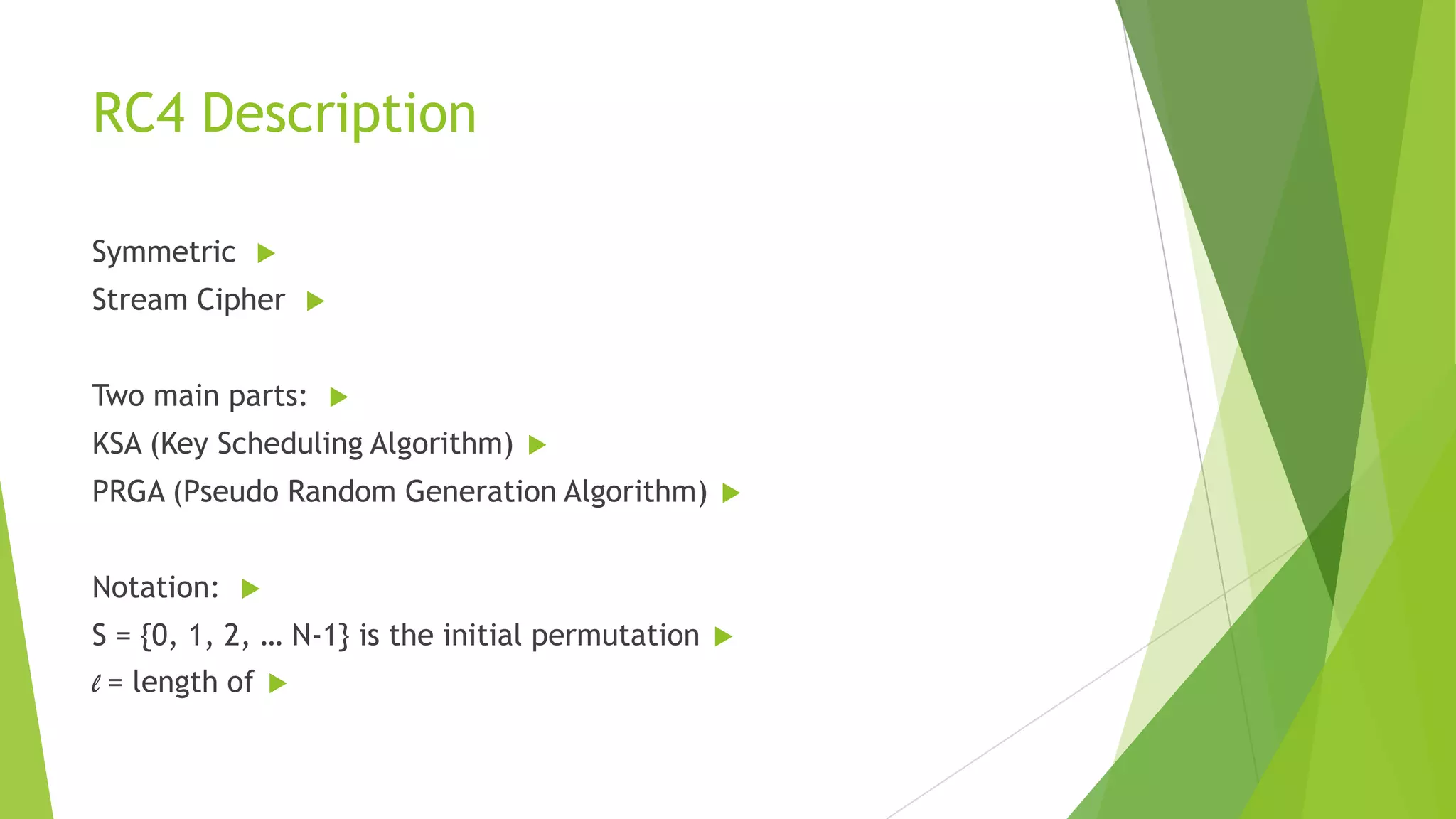
RC4 Description
Symmetric



Stream Cipher



Two main parts:



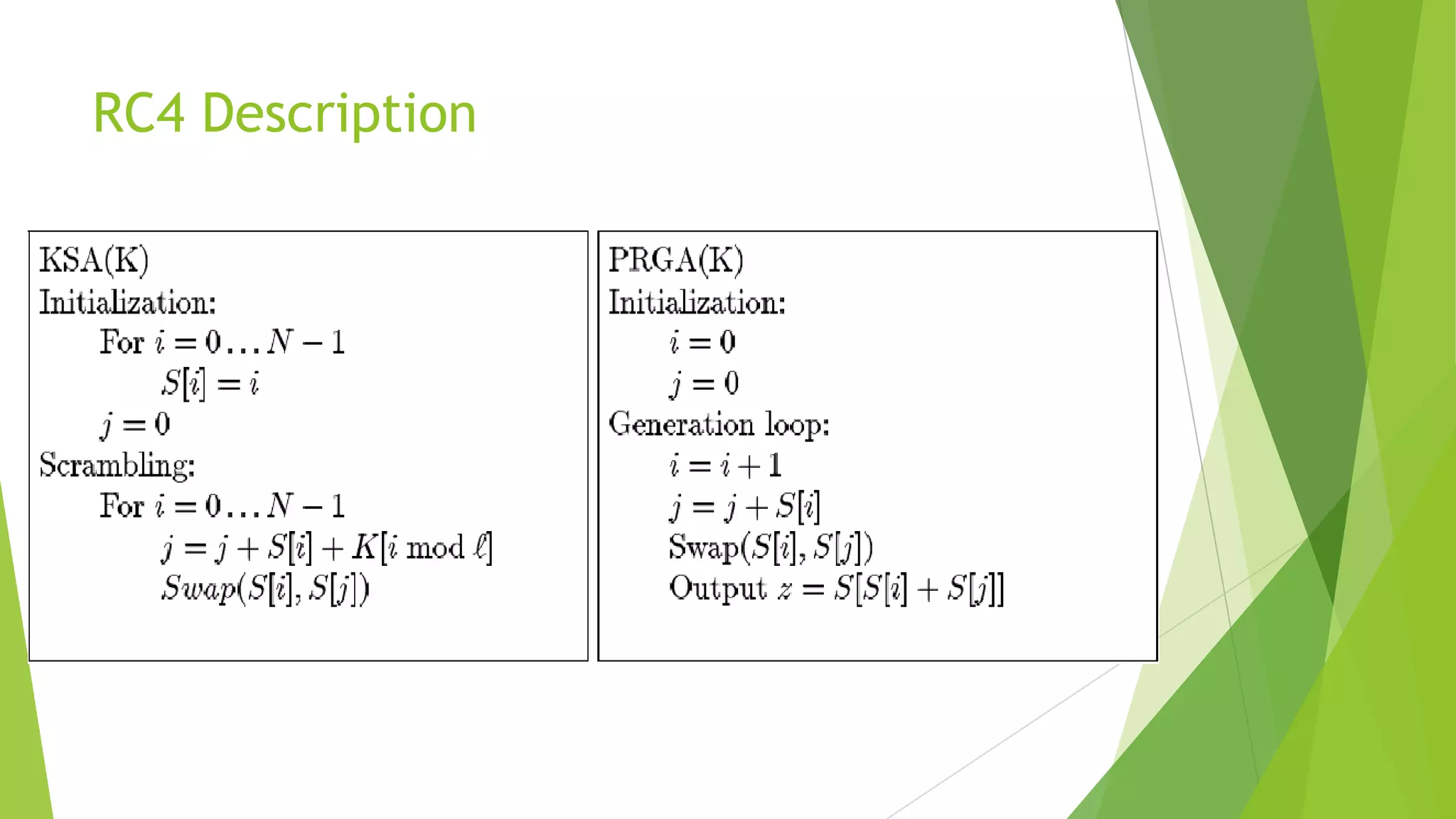
KSA (Key Scheduling Algorithm)



PRGA (Pseudo Random Generation Algorithm)
Notation:





S = {0, 1, 2, … N-1} is the initial permutation
l = length of




RC4 Description
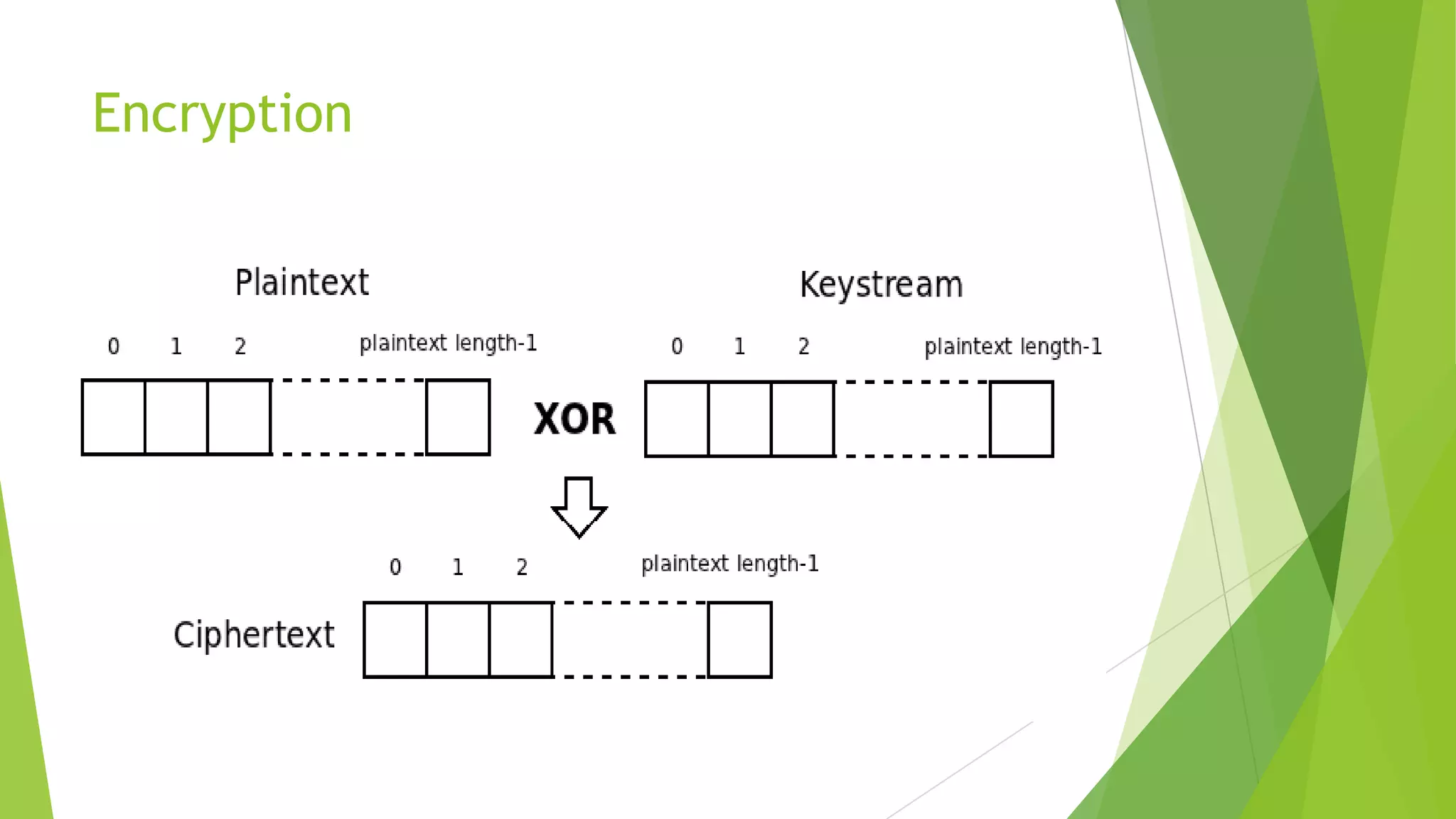
Encryption
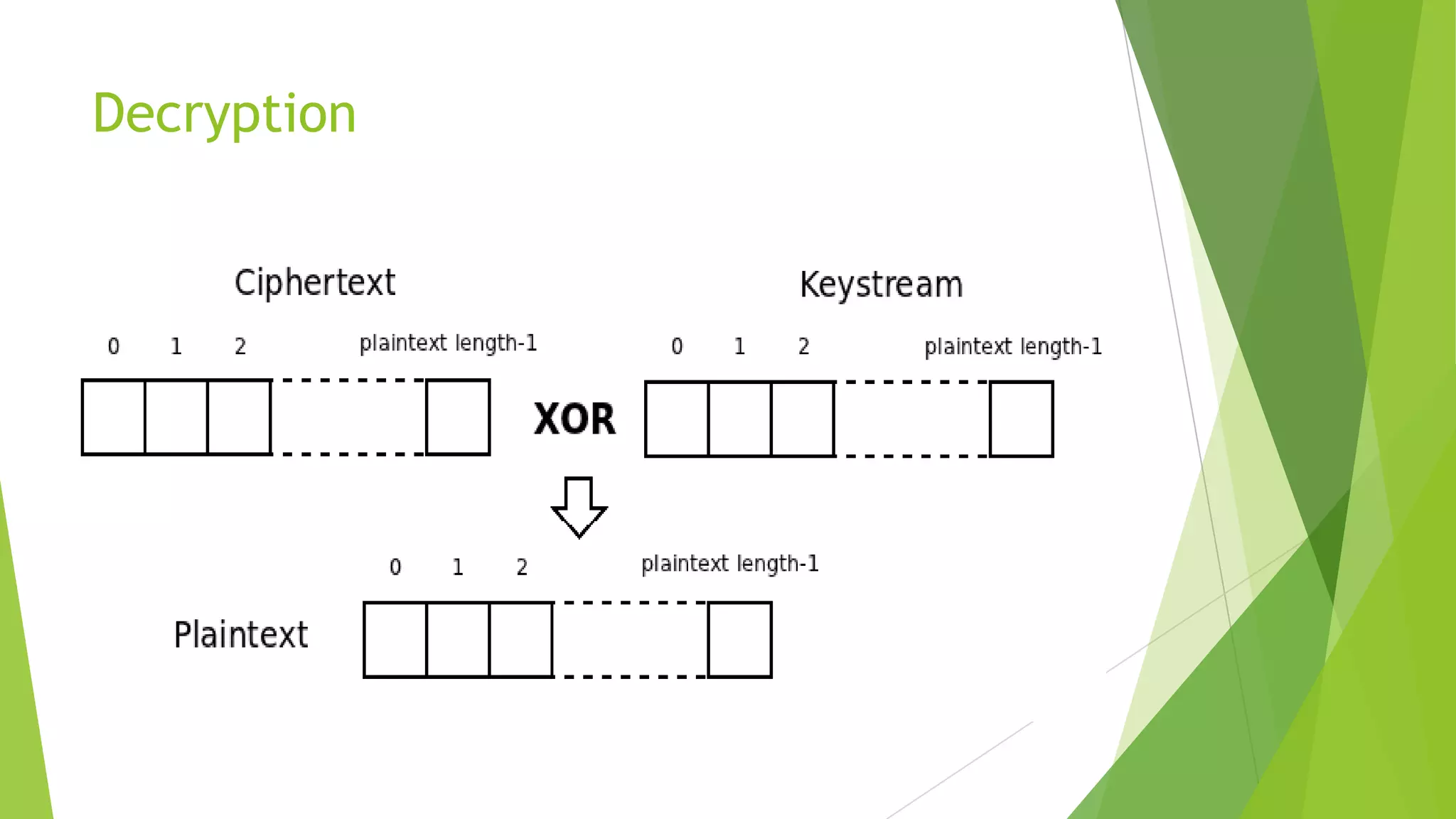
Decryption
RC4 Example
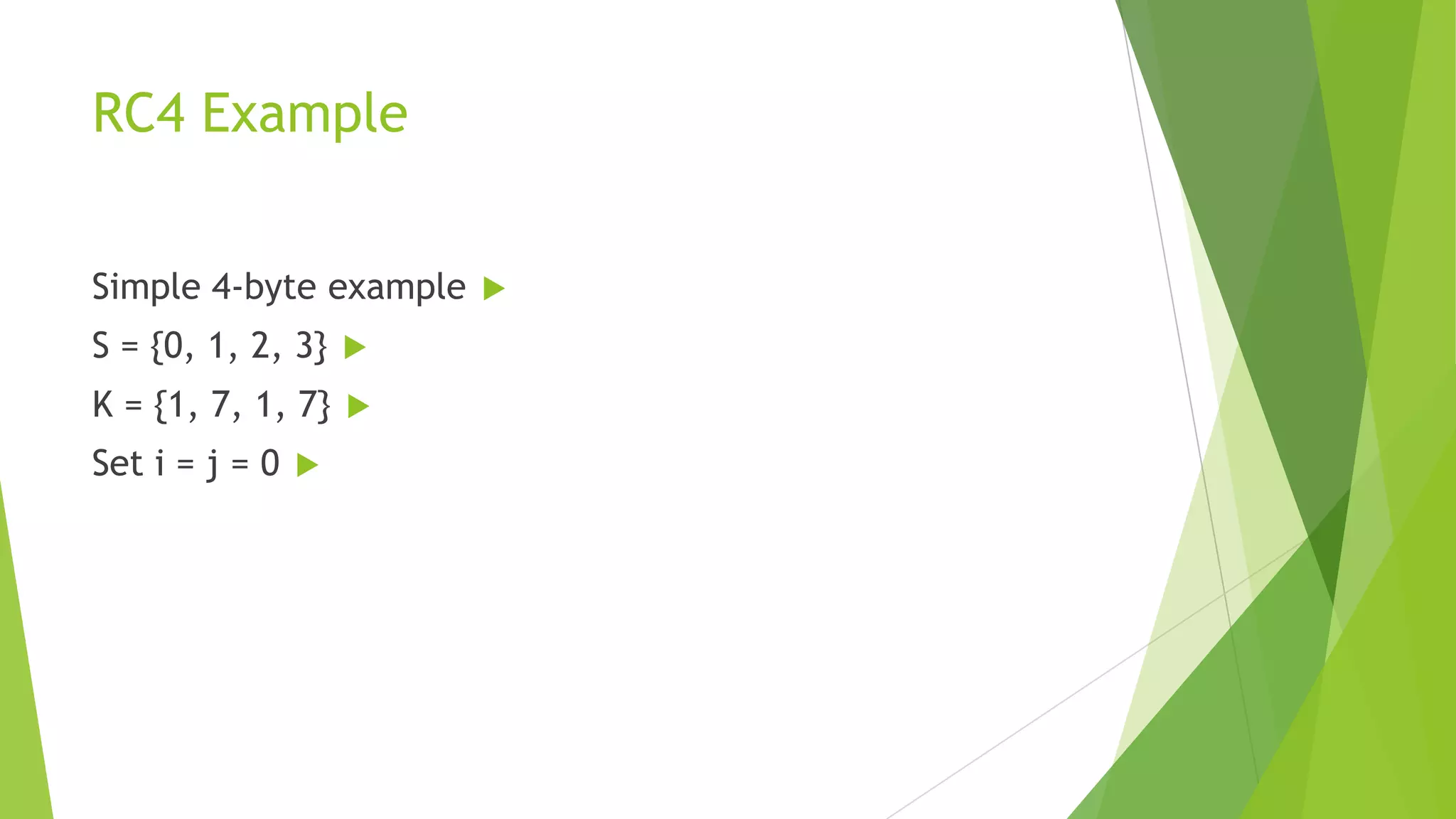
Simple 4-byte example
S = {0, 1, 2, 3}



K = {1, 7, 1, 7}



Set i = j = 0




KSA

K = {1, 7, 1, 7}
S[0]

K[0]

First Iteration (i = 0, j = 0, S = {0, 1, 2, 3}):
j = (j + S[ i ] + K[ i ]) = (0 + 0 + 1) = 1

Swap S[ i ] with S[ j ]: S = {1, 0, 2, 3}

S[i]
S = {0,1, 2, 3}
S[j]

Second Iteration (i = 1, j = 1, S = {1, 0, 2, 3}):
j = (j + S[ i ] + K[ i ]) = (1 + 0 + 7) = 0 (mod 4)
Swap S[ i ] with S[ j ]: S = {0, 1, 2, 3}
KSA

K = {1, 7, 1, 7}
S[0]

K[0]

First Iteration (i = 0, j = 0, S = {0, 1, 2, 3}):
j = (j + S[ i ] + K[ i ]) = (0 + 0 + 1) = 1

Swap S[ i ] with S[ j ]: S = {1, 0, 2, 3}
Second Iteration (i = 1, j = 1, S = {1, 0, 2, 3}):
j = (j + S[ i ] + K[ i ]) = (1 + 0 + 7) = 0 (mod 4)
Swap S[ i ] with S[ j ]: S = {0, 1, 2, 3}

S[i]

1
S = {0 ,1 , 2, 3}
0
S[j]
KSA

K = {1, 7, 1, 7}
S[0]

K[0]

First Iteration (i = 0, j = 0, S = {0, 1, 2, 3}):
j = (j + S[ i ] + K[ i ]) = (0 + 0 + 1) = 1

Swap S[ i ] with S[ j ]: S = {1, 0, 2, 3}
Second Iteration (i = 1, j = 1, S = {1, 0, 2, 3}):
j = (j + S[ i ] + K[ i ]) = (1 + 0 + 7) = 0 (mod 4)
Swap S[ i ] with S[ j ]: S = {0, 1, 2, 3}

1
S = { 1, 0, 2, 3}
0
KSA

K = {1, 7, 1, 7}
K[1]

First Iteration (i = 0, j = 0, S = {0, 1, 2, 3}):
j = (j + S[ i ] + K[ i ]) = (0 + 0 + 1) = 1

Swap S[ i ] with S[ j ]: S = {1, 0, 2, 3}
S[1]

Second Iteration (i = 1, j = 1, S = {1, 0, 2, 3}):
j = (j + S[ i ] + K[ i ]) = (1 + 0 + 7) = 0 (mod 4)
Swap S[ i ] with S[ j ]: S = {0, 1, 2, 3}
KSA

K = {1, 7, 1, 7}
S[2]
K[2]

Third Iteration (i = 2, j = 0, S = {0, 1, 2, 3}):
j = (j + S[ i ] + K[ i ]) = (0 + 2 + 1) = 3

Swap S[ i ] with S[ j ]: S = {0, 1, 3, 2}
Fourth Iteration (i = 3, j = 3, S = {0, 1, 3, 2}):
j = (j + S[ i ] + K[ i ]) = (3 + 2 + 7) = 0 (mod 4)
Swap S[ i ] with S[ j ]: S = {2, 1, 3, 0}
KSA

K = {1, 7, 1, 7}
K[3]

Third Iteration (i = 2, j = 0, S = {0, 1, 2, 3}):
j = (j + S[ i ] + K[ i ]) = (0 + 2 + 1) = 3

Swap S[ i ] with S[ j ]: S = {0, 1, 3, 2}

S[3]

Fourth Iteration (i = 3, j = 3, S = {0, 1, 3, 2}):
j = (j + S[ i ] + K[ i ]) = (3 + 2 + 7) = 0 (mod 4)
Swap S[ i ] with S[ j ]: S = {2, 1, 3, 0}
PRGA
For this example we use plaintext “HI”

Reset i = j = 0, Recall S = {2, 1, 3, 0}
i=i+1=1
j = j + S[ i ] = 0 + 1 = 1
Swap S[ i ] and S[ j ]: S = {2, 1, 3, 0}
Output z = S[ S[ i ] + S[ j ] ] = S[2] = 3
Z = 3 ( 0000 0011 )
H
0100 1000

XOR 0000 0011
0100 1011
i=1 , j=1 , S = {2, 1, 3, 0}
i=i+1=2
j = j + S[ i ] = 1 + 3 = 4 (mod 4) = 0
Swap S[ i ] and S[ j ]: S = {3, 1, 2, 0}
Output z = S[ S[ i ] + S[ j ] ] = S[1] = 1
Z = 1 ( 0000 0001 )
I
0100 1001
XOR 0000 0001
0100 1000
Result : Plaint Text : 0100 1000 0100 1001
Cipher Text: 0100 1011 0100 1000
Resources
Fluhrer, Mantin, Shamir - Weakness in the Key Scheduling Algorithm of RC4. 
http://www.drizzle.com/~aboba/IEEE/rc4_ksaproc.pdf

Stubblefield, Loannidis, Rubin – Using the Fluhrer, Mantin, and Shamir Attack
to Break WEP.



http://www.cs.rice.edu/~astubble/wep/wep_attack.pdf

Rivest – RSA Security Response to Weakness in the Key Scheduling Algorithm of
RC4.
http://www.rsasecurity.com/rsalabs/technotes/wep.html

RC4 Encryption Algorithm. 

http://www.ncat.edu/~grogans/algorithm_breakdown.htm

Computer Network laboratory-RC4 Encryption Algorithm. 
http://www.scribd.com/doc/49849673/21/RC4-Algorithm



Rc4 Research 2013

  • 1.
  • 2.
    Overview History  Discussion of RC4Algorithm Analysis of RC4  Weaknesses of RC4 Example   
  • 3.
    History RC4 was designedby Ron Rivest of RSA Security in 1987. While it is officially termed “Rivest Cipher 4”.  RC4 was initially a trade secret, but in September 1994 a description of it was anonymously posted to the Cypherpunks mailing list.  and from there to many sites on the Internet. RC4 has become part of some commonly used encryption protocols and standards, including WEP and WPA for wireless cards.  The main factors in RC4's success over such a wide range of applications are its speed and simplicity: efficient implementations in both software and hardware are very easy to develop. 
  • 4.
    Analysis of RC4 Advantages Faster than DES  Enormous key space (average of 1700 bits)  RC4 is used in popular protocols such as Secure Sockets Layer (SSL) (to protect Internet traffic) SSL and In 802.11 WEP(to secure wireless networks).   Disadvantages  Large number of “weak” keys 1 of 256  “Weak” keys can be detected and exploited with a high probability 
  • 5.
    Weaknesses of RC4 Almostall weaknesses are in the KSA since attacking the PRGA is fairly  infeasible due to the huge effective key. The fastest known method requires 2700 time. The KSA can be attacked with several methods mainly because of the simple initialization permutation used. Invariance Weakness is the most devastating attack.  (5% chance of guessing one or more bytes of the key.)  
  • 6.
    RC4 Description Symmetric  Stream Cipher  Twomain parts:  KSA (Key Scheduling Algorithm)  PRGA (Pseudo Random Generation Algorithm) Notation:   S = {0, 1, 2, … N-1} is the initial permutation l = length of  
  • 7.
  • 8.
  • 9.
  • 10.
    RC4 Example Simple 4-byteexample S = {0, 1, 2, 3}  K = {1, 7, 1, 7}  Set i = j = 0  
  • 11.
    KSA K = {1,7, 1, 7} S[0] K[0] First Iteration (i = 0, j = 0, S = {0, 1, 2, 3}): j = (j + S[ i ] + K[ i ]) = (0 + 0 + 1) = 1 Swap S[ i ] with S[ j ]: S = {1, 0, 2, 3} S[i] S = {0,1, 2, 3} S[j] Second Iteration (i = 1, j = 1, S = {1, 0, 2, 3}): j = (j + S[ i ] + K[ i ]) = (1 + 0 + 7) = 0 (mod 4) Swap S[ i ] with S[ j ]: S = {0, 1, 2, 3}
  • 12.
    KSA K = {1,7, 1, 7} S[0] K[0] First Iteration (i = 0, j = 0, S = {0, 1, 2, 3}): j = (j + S[ i ] + K[ i ]) = (0 + 0 + 1) = 1 Swap S[ i ] with S[ j ]: S = {1, 0, 2, 3} Second Iteration (i = 1, j = 1, S = {1, 0, 2, 3}): j = (j + S[ i ] + K[ i ]) = (1 + 0 + 7) = 0 (mod 4) Swap S[ i ] with S[ j ]: S = {0, 1, 2, 3} S[i] 1 S = {0 ,1 , 2, 3} 0 S[j]
  • 13.
    KSA K = {1,7, 1, 7} S[0] K[0] First Iteration (i = 0, j = 0, S = {0, 1, 2, 3}): j = (j + S[ i ] + K[ i ]) = (0 + 0 + 1) = 1 Swap S[ i ] with S[ j ]: S = {1, 0, 2, 3} Second Iteration (i = 1, j = 1, S = {1, 0, 2, 3}): j = (j + S[ i ] + K[ i ]) = (1 + 0 + 7) = 0 (mod 4) Swap S[ i ] with S[ j ]: S = {0, 1, 2, 3} 1 S = { 1, 0, 2, 3} 0
  • 14.
    KSA K = {1,7, 1, 7} K[1] First Iteration (i = 0, j = 0, S = {0, 1, 2, 3}): j = (j + S[ i ] + K[ i ]) = (0 + 0 + 1) = 1 Swap S[ i ] with S[ j ]: S = {1, 0, 2, 3} S[1] Second Iteration (i = 1, j = 1, S = {1, 0, 2, 3}): j = (j + S[ i ] + K[ i ]) = (1 + 0 + 7) = 0 (mod 4) Swap S[ i ] with S[ j ]: S = {0, 1, 2, 3}
  • 15.
    KSA K = {1,7, 1, 7} S[2] K[2] Third Iteration (i = 2, j = 0, S = {0, 1, 2, 3}): j = (j + S[ i ] + K[ i ]) = (0 + 2 + 1) = 3 Swap S[ i ] with S[ j ]: S = {0, 1, 3, 2} Fourth Iteration (i = 3, j = 3, S = {0, 1, 3, 2}): j = (j + S[ i ] + K[ i ]) = (3 + 2 + 7) = 0 (mod 4) Swap S[ i ] with S[ j ]: S = {2, 1, 3, 0}
  • 16.
    KSA K = {1,7, 1, 7} K[3] Third Iteration (i = 2, j = 0, S = {0, 1, 2, 3}): j = (j + S[ i ] + K[ i ]) = (0 + 2 + 1) = 3 Swap S[ i ] with S[ j ]: S = {0, 1, 3, 2} S[3] Fourth Iteration (i = 3, j = 3, S = {0, 1, 3, 2}): j = (j + S[ i ] + K[ i ]) = (3 + 2 + 7) = 0 (mod 4) Swap S[ i ] with S[ j ]: S = {2, 1, 3, 0}
  • 17.
    PRGA For this examplewe use plaintext “HI” Reset i = j = 0, Recall S = {2, 1, 3, 0} i=i+1=1 j = j + S[ i ] = 0 + 1 = 1 Swap S[ i ] and S[ j ]: S = {2, 1, 3, 0} Output z = S[ S[ i ] + S[ j ] ] = S[2] = 3 Z = 3 ( 0000 0011 ) H 0100 1000 XOR 0000 0011 0100 1011
  • 18.
    i=1 , j=1, S = {2, 1, 3, 0} i=i+1=2 j = j + S[ i ] = 1 + 3 = 4 (mod 4) = 0 Swap S[ i ] and S[ j ]: S = {3, 1, 2, 0} Output z = S[ S[ i ] + S[ j ] ] = S[1] = 1 Z = 1 ( 0000 0001 ) I 0100 1001 XOR 0000 0001 0100 1000 Result : Plaint Text : 0100 1000 0100 1001 Cipher Text: 0100 1011 0100 1000
  • 19.
    Resources Fluhrer, Mantin, Shamir- Weakness in the Key Scheduling Algorithm of RC4.  http://www.drizzle.com/~aboba/IEEE/rc4_ksaproc.pdf Stubblefield, Loannidis, Rubin – Using the Fluhrer, Mantin, and Shamir Attack to Break WEP.  http://www.cs.rice.edu/~astubble/wep/wep_attack.pdf Rivest – RSA Security Response to Weakness in the Key Scheduling Algorithm of RC4. http://www.rsasecurity.com/rsalabs/technotes/wep.html RC4 Encryption Algorithm.  http://www.ncat.edu/~grogans/algorithm_breakdown.htm Computer Network laboratory-RC4 Encryption Algorithm.  http://www.scribd.com/doc/49849673/21/RC4-Algorithm 