Stream Ciphers
Stream Ciphers
Stream Ciphers
Stream Ciphers
 Generalization of one-time pad
 Trade provable security for practicality
 Stream cipher is initialized with short key
 Key is “stretched” into long keystream
 Keystream is used like a one-time pad
o XOR to encrypt or decrypt
 Stream cipher is a keystream generator
 Usually, keystream is bits, sometimes bytes
Stream Ciphers
Stream Cipher
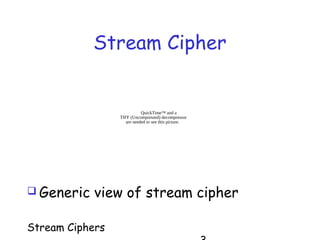
 Generic view of stream cipher
QuickTime™ and a
TIFF (Uncompressed) decompressor
are needed to see this picture.
Stream Ciphers
Stream Cipher
 We consider 3 real stream ciphers
o ORYX — weak cipher, uses shift registers,
generates 1 byte/step
o RC4 — strong cipher, widely used but used
poorly in WEP, generates 1 byte/step
o PKZIP — intermediate strength, unusual
mathematical design, generates 1 byte/step
 But first, we discuss shift registers
Stream Ciphers
Shift Registers
 Traditionally, stream ciphers were based
on shift registers
o Today, a wider variety of designs
 Shift register includes
o A series of stages each holding one bit
o A feedback function
 A linear feedback shift register (LFSR)
has a linear feedback function
Stream Ciphers
 Example (nonlinear) feedback function
f(xi, xi+1, xi+2) = 1⊕ xi⊕xi+2⊕xi+1xi+2
 Example (nonlinear) shift register
 First 3 bits are initial fill: (x0, x1, x2)
QuickTime™ and a
TIFF (Uncompressed) decompressor
are needed to see this picture.
Shift Register
Stream Ciphers
LFSR
 Example of LFSR
 Then xi+5= xi⊕xi+2 for all i
 If initial fill is (x0,x1,x2,x3,x4) = 01110
then (x0,x1,…,x15,…) = 0111010100001001…
QuickTime™ and a
TIFF (Uncompressed) decompressor
are needed to see this picture.
Stream Ciphers
LFSR
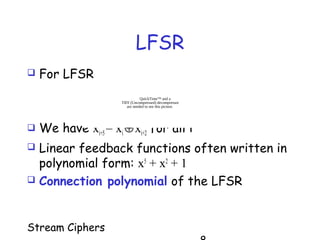
 For LFSR
 We have xi+5= xi ⊕xi+2 for all i
 Linear feedback functions often written in
polynomial form: x5
+ x2
+ 1
 Connection polynomial of the LFSR
QuickTime™ and a
TIFF (Uncompressed) decompressor
are needed to see this picture.
Stream Ciphers
Berlekamp-Massey Algorithm
 Given (part of) a (periodic) sequence,
can find shortest LFSR that could
generate the sequence
 Berlekamp-Massey algorithm
o Order N2
, where N is length of LFSR
o Iterative algorithm
o Only 2N consecutive bits required
Stream Ciphers
Berlekamp-Massey Algorithm
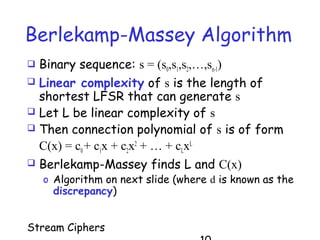
 Binary sequence: s = (s0,s1,s2,…,sn-1)
 Linear complexity of s is the length of
shortest LFSR that can generate s
 Let L be linear complexity of s
 Then connection polynomial of s is of form
C(x) = c0+ c1x + c2x2
+ … + cLxL
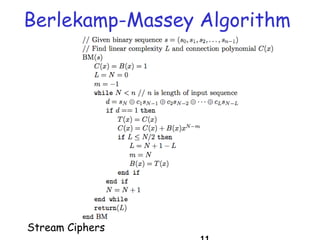
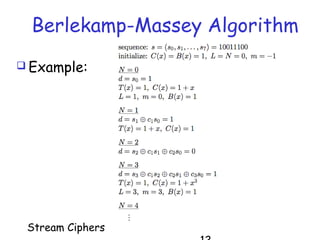
 Berlekamp-Massey finds L and C(x)
o Algorithm on next slide (where d is known as the
discrepancy)
Stream Ciphers
Berlekamp-Massey Algorithm
Stream Ciphers
Berlekamp-Massey Algorithm
 Example:
Stream Ciphers
Berlekamp-Massey Algorithm
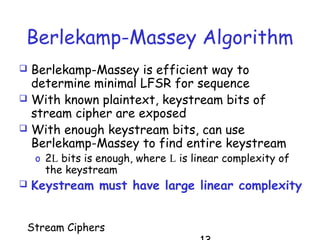
 Berlekamp-Massey is efficient way to
determine minimal LFSR for sequence
 With known plaintext, keystream bits of
stream cipher are exposed
 With enough keystream bits, can use
Berlekamp-Massey to find entire keystream
o 2L bits is enough, where L is linear complexity of
the keystream
 Keystream must have large linear complexity
Stream Ciphers
Cryptographically Strong
Sequences
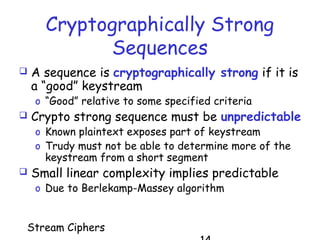
 A sequence is cryptographically strong if it is
a “good” keystream
o “Good” relative to some specified criteria
 Crypto strong sequence must be unpredictable
o Known plaintext exposes part of keystream
o Trudy must not be able to determine more of the
keystream from a short segment
 Small linear complexity implies predictable
o Due to Berlekamp-Massey algorithm
Stream Ciphers
Crypto Strong Sequences
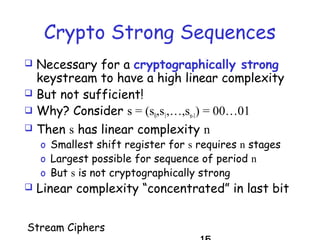
 Necessary for a cryptographically strong
keystream to have a high linear complexity
 But not sufficient!
 Why? Consider s = (s0,s1,…,sn-1) = 00…01
 Then s has linear complexity n
o Smallest shift register for s requires n stages
o Largest possible for sequence of period n
o But s is not cryptographically strong
 Linear complexity “concentrated” in last bit
Stream Ciphers
Linear Complexity Profile
 Linear complexity profile is a better measure
of cryptographic strength
 Plot linear complexity as function of bits
processed in Berlekamp-Massey algorithm
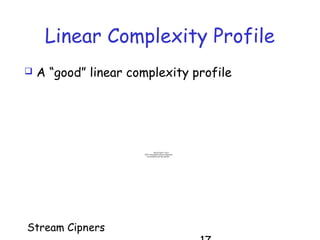
o Should follow n/2 line “closely but irregularly”
 Plot of sequence s = (s0,s1,…,sn-1) = 00…01 would
be 0 until last bit, then jumps to n
o Does not follow n/2 line “closely but irregularly”
o Not a strong sequence (by this definition)
Stream Ciphers
Linear Complexity Profile
 A “good” linear complexity profile
QuickTime™ and a
TIFF (Uncompressed) decompressor
are needed to see this picture.
Stream Ciphers
k-error Linear Complexity
Profile
 Alternative way to measure cryptographically
strong sequences
 Consider again s = (s0,s1,…,sn-1) = 00…01
 This s has max linear complexity, but it is only
1 bit away from having min linear complexity
 k-error linear complexity is min complexity of
any sequence that is “distance” k from s
 1-error linear complexity of s = 00…01 is 0
o Linear complexity of this sequence is “unstable”
Stream Ciphers
QuickTime™ and a
TIFF (Uncompressed) decompressor
are needed to see this picture.
k-error Linear Complexity
Profile
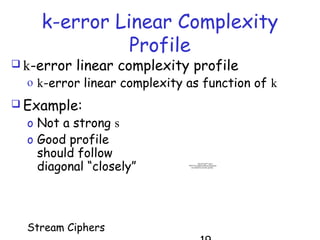
 k-error linear complexity profile
o k-error linear complexity as function of k
 Example:
o Not a strong s
o Good profile
should follow
diagonal “closely”
Stream Ciphers
Crypto Strong Sequences
 Linear complexity must be “large”
 Linear complexity profile must n/2 line
“closely but irregularly”
 k-error linear complexity profile must
follow diagonal line “closely”
 All of this is necessary but not
sufficient for crypto strength!
Stream Ciphers
Shift Register-Based
Stream Ciphers
 Two approaches to LFSR-based stream
ciphers
o One LFSR with nonlinear combining function
o Multiple LFSRs combined via nonlinear func
 In either case
o Key is initial fill of LFSRs
o Keystream is output of nonlinear combining
function
Stream Ciphers
Shift Register-Based
Stream Ciphers
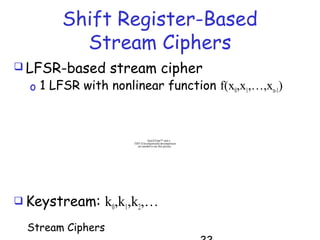
 LFSR-based stream cipher
o 1 LFSR with nonlinear function f(x0,x1,…,xn-1)
QuickTime™ and a
TIFF (Uncompressed) decompressor
are needed to see this picture.
 Keystream: k0,k1,k2,…
Stream Ciphers
Shift Register-Based
Stream Ciphers
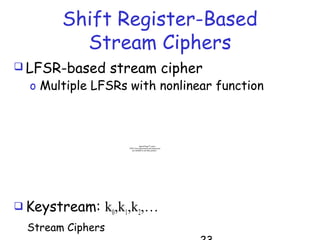
 LFSR-based stream cipher
o Multiple LFSRs with nonlinear function
 Keystream: k0,k1,k2,…
QuickTime™ and a
TIFF (Uncompressed) decompressor
are needed to see this picture.
Stream Ciphers
Shift Register-Based
Stream Ciphers
 Single LFSR example is special case of
multiple LFSR example
 To convert single LFSR case to multiple
o Let LFSR0,…LFSRn-1 be same as LFSR
o Initial fill of LFSR0 is initial fill of LFSR
o Initial fill of LFSR1 is initial fill of LFSR
stepped once
o And so on…
Stream Ciphers
Correlation Attack
 Trudy obtains some segment of keystream
from LFSR stream cipher
o Of the type considered on previous slides
 Can assume stream cipher is the multiple
shift register case
o If not, convert it to this case
 By Kerckhoffs Principle, we assume shift
registers and combining function known
 Only unknown is the key
o The key consists of LFSR initial fills
Stream Ciphers
Correlation Attack
 Trudy wants to recover LFSR initial fills
o She knows all connection polynomials and
nonlinear combining function
o She also knows N keystream bits, k0,k1,…,kN-1
 Sometimes possible to determine initial fills
of the LFSRs independently
o By correlating each LFSR output to keystream
o A classic divide and conquer attack
Stream Ciphers
Correlation Attack
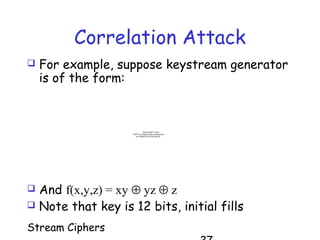
 For example, suppose keystream generator
is of the form:
QuickTime™ and a
TIFF (Uncompressed) decompressor
are needed to see this picture.
 And f(x,y,z) = xy ⊕ yz ⊕ z
 Note that key is 12 bits, initial fills
Stream Ciphers
Correlation Attack
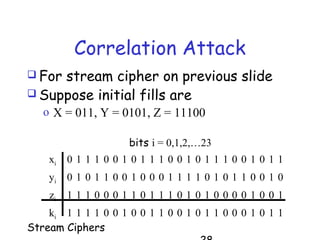
 For stream cipher on previous slide
 Suppose initial fills are
o X = 011, Y = 0101, Z = 11100
xi 0 1 1 1 0 0 1 0 1 1 1 0 0 1 0 1 1 1 0 0 1 0 1 1
yi 0 1 0 1 1 0 0 1 0 0 0 1 1 1 1 0 1 0 1 1 0 0 1 0
zi 1 1 1 0 0 0 1 1 0 1 1 1 0 1 0 1 0 0 0 0 1 0 0 1
ki 1 1 1 1 0 0 1 0 0 1 1 0 0 1 0 1 1 0 0 0 1 0 1 1
bits i = 0,1,2,…23
Stream Ciphers
Correlation Attack
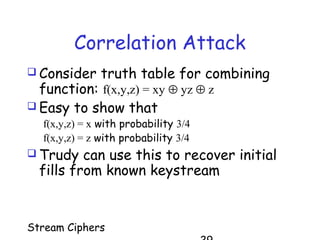
 Consider truth table for combining
function: f(x,y,z) = xy ⊕ yz ⊕ z
 Easy to show that
f(x,y,z) = x with probability 3/4
f(x,y,z) = z with probability 3/4
 Trudy can use this to recover initial
fills from known keystream
Stream Ciphers
Correlation Attack
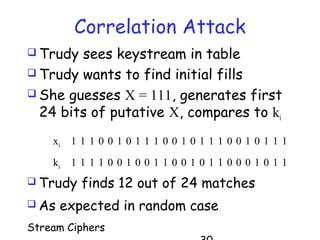
 Trudy sees keystream in table
 Trudy wants to find initial fills
 She guesses X = 111, generates first
24 bits of putative X, compares to ki
ki 1 1 1 1 0 0 1 0 0 1 1 0 0 1 0 1 1 0 0 0 1 0 1 1
xi 1 1 1 0 0 1 0 1 1 1 0 0 1 0 1 1 1 0 0 1 0 1 1 1
 Trudy finds 12 out of 24 matches
 As expected in random case
Stream Ciphers
Correlation Attack
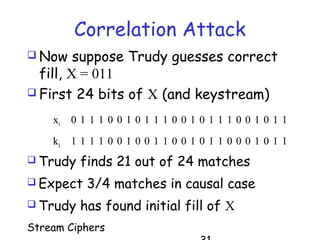
 Now suppose Trudy guesses correct
fill, X = 011
 First 24 bits of X (and keystream)
ki 1 1 1 1 0 0 1 0 0 1 1 0 0 1 0 1 1 0 0 0 1 0 1 1
xi 0 1 1 1 0 0 1 0 1 1 1 0 0 1 0 1 1 1 0 0 1 0 1 1
 Trudy finds 21 out of 24 matches
 Expect 3/4 matches in causal case
 Trudy has found initial fill of X
Stream Ciphers
Correlation Attack
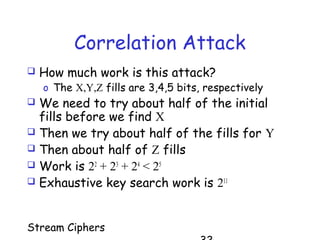
 How much work is this attack?
o The X,Y,Z fills are 3,4,5 bits, respectively
 We need to try about half of the initial
fills before we find X
 Then we try about half of the fills for Y
 Then about half of Z fills
 Work is 22
+ 23
+ 24
< 25
 Exhaustive key search work is 211
Stream Ciphers
Correlation Attack
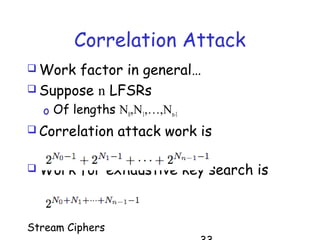
 Work factor in general…
 Suppose n LFSRs
o Of lengths N0,N1,…,Nn-1
 Correlation attack work is
 Work for exhaustive key search is
Stream Ciphers
Conclusions
 Keystreams must be cryptographically
strong
o Crucial property: unpredictable
 Lots of theory available for LFSRs
o Berlekamp-Massey algorithm
o Nice mathematical theory exists
 LFSRs can be used to make stream ciphers
o LFSR-based stream ciphers must be
correlation immune
o Depends on properties of function f
Stream Ciphers
Coming Attractions
 Consider attacks on 3 stream ciphers
o ORYX — weak cipher, uses shift
registers, generates 1 byte/step
o RC4 — strong, widely used but used
poorly in WEP, generates 1 byte/step
o PKZIP — medium strength, unusual
design, generates 1 byte/step

5 stream ciphers

  • 1.
  • 2.
    Stream Ciphers Stream Ciphers Generalization of one-time pad  Trade provable security for practicality  Stream cipher is initialized with short key  Key is “stretched” into long keystream  Keystream is used like a one-time pad o XOR to encrypt or decrypt  Stream cipher is a keystream generator  Usually, keystream is bits, sometimes bytes
  • 3.
    Stream Ciphers Stream Cipher Generic view of stream cipher QuickTime™ and a TIFF (Uncompressed) decompressor are needed to see this picture.
  • 4.
    Stream Ciphers Stream Cipher We consider 3 real stream ciphers o ORYX — weak cipher, uses shift registers, generates 1 byte/step o RC4 — strong cipher, widely used but used poorly in WEP, generates 1 byte/step o PKZIP — intermediate strength, unusual mathematical design, generates 1 byte/step  But first, we discuss shift registers
  • 5.
    Stream Ciphers Shift Registers Traditionally, stream ciphers were based on shift registers o Today, a wider variety of designs  Shift register includes o A series of stages each holding one bit o A feedback function  A linear feedback shift register (LFSR) has a linear feedback function
  • 6.
    Stream Ciphers  Example(nonlinear) feedback function f(xi, xi+1, xi+2) = 1⊕ xi⊕xi+2⊕xi+1xi+2  Example (nonlinear) shift register  First 3 bits are initial fill: (x0, x1, x2) QuickTime™ and a TIFF (Uncompressed) decompressor are needed to see this picture. Shift Register
  • 7.
    Stream Ciphers LFSR  Exampleof LFSR  Then xi+5= xi⊕xi+2 for all i  If initial fill is (x0,x1,x2,x3,x4) = 01110 then (x0,x1,…,x15,…) = 0111010100001001… QuickTime™ and a TIFF (Uncompressed) decompressor are needed to see this picture.
  • 8.
    Stream Ciphers LFSR  ForLFSR  We have xi+5= xi ⊕xi+2 for all i  Linear feedback functions often written in polynomial form: x5 + x2 + 1  Connection polynomial of the LFSR QuickTime™ and a TIFF (Uncompressed) decompressor are needed to see this picture.
  • 9.
    Stream Ciphers Berlekamp-Massey Algorithm Given (part of) a (periodic) sequence, can find shortest LFSR that could generate the sequence  Berlekamp-Massey algorithm o Order N2 , where N is length of LFSR o Iterative algorithm o Only 2N consecutive bits required
  • 10.
    Stream Ciphers Berlekamp-Massey Algorithm Binary sequence: s = (s0,s1,s2,…,sn-1)  Linear complexity of s is the length of shortest LFSR that can generate s  Let L be linear complexity of s  Then connection polynomial of s is of form C(x) = c0+ c1x + c2x2 + … + cLxL  Berlekamp-Massey finds L and C(x) o Algorithm on next slide (where d is known as the discrepancy)
  • 11.
  • 12.
  • 13.
    Stream Ciphers Berlekamp-Massey Algorithm Berlekamp-Massey is efficient way to determine minimal LFSR for sequence  With known plaintext, keystream bits of stream cipher are exposed  With enough keystream bits, can use Berlekamp-Massey to find entire keystream o 2L bits is enough, where L is linear complexity of the keystream  Keystream must have large linear complexity
  • 14.
    Stream Ciphers Cryptographically Strong Sequences A sequence is cryptographically strong if it is a “good” keystream o “Good” relative to some specified criteria  Crypto strong sequence must be unpredictable o Known plaintext exposes part of keystream o Trudy must not be able to determine more of the keystream from a short segment  Small linear complexity implies predictable o Due to Berlekamp-Massey algorithm
  • 15.
    Stream Ciphers Crypto StrongSequences  Necessary for a cryptographically strong keystream to have a high linear complexity  But not sufficient!  Why? Consider s = (s0,s1,…,sn-1) = 00…01  Then s has linear complexity n o Smallest shift register for s requires n stages o Largest possible for sequence of period n o But s is not cryptographically strong  Linear complexity “concentrated” in last bit
  • 16.
    Stream Ciphers Linear ComplexityProfile  Linear complexity profile is a better measure of cryptographic strength  Plot linear complexity as function of bits processed in Berlekamp-Massey algorithm o Should follow n/2 line “closely but irregularly”  Plot of sequence s = (s0,s1,…,sn-1) = 00…01 would be 0 until last bit, then jumps to n o Does not follow n/2 line “closely but irregularly” o Not a strong sequence (by this definition)
  • 17.
    Stream Ciphers Linear ComplexityProfile  A “good” linear complexity profile QuickTime™ and a TIFF (Uncompressed) decompressor are needed to see this picture.
  • 18.
    Stream Ciphers k-error LinearComplexity Profile  Alternative way to measure cryptographically strong sequences  Consider again s = (s0,s1,…,sn-1) = 00…01  This s has max linear complexity, but it is only 1 bit away from having min linear complexity  k-error linear complexity is min complexity of any sequence that is “distance” k from s  1-error linear complexity of s = 00…01 is 0 o Linear complexity of this sequence is “unstable”
  • 19.
    Stream Ciphers QuickTime™ anda TIFF (Uncompressed) decompressor are needed to see this picture. k-error Linear Complexity Profile  k-error linear complexity profile o k-error linear complexity as function of k  Example: o Not a strong s o Good profile should follow diagonal “closely”
  • 20.
    Stream Ciphers Crypto StrongSequences  Linear complexity must be “large”  Linear complexity profile must n/2 line “closely but irregularly”  k-error linear complexity profile must follow diagonal line “closely”  All of this is necessary but not sufficient for crypto strength!
  • 21.
    Stream Ciphers Shift Register-Based StreamCiphers  Two approaches to LFSR-based stream ciphers o One LFSR with nonlinear combining function o Multiple LFSRs combined via nonlinear func  In either case o Key is initial fill of LFSRs o Keystream is output of nonlinear combining function
  • 22.
    Stream Ciphers Shift Register-Based StreamCiphers  LFSR-based stream cipher o 1 LFSR with nonlinear function f(x0,x1,…,xn-1) QuickTime™ and a TIFF (Uncompressed) decompressor are needed to see this picture.  Keystream: k0,k1,k2,…
  • 23.
    Stream Ciphers Shift Register-Based StreamCiphers  LFSR-based stream cipher o Multiple LFSRs with nonlinear function  Keystream: k0,k1,k2,… QuickTime™ and a TIFF (Uncompressed) decompressor are needed to see this picture.
  • 24.
    Stream Ciphers Shift Register-Based StreamCiphers  Single LFSR example is special case of multiple LFSR example  To convert single LFSR case to multiple o Let LFSR0,…LFSRn-1 be same as LFSR o Initial fill of LFSR0 is initial fill of LFSR o Initial fill of LFSR1 is initial fill of LFSR stepped once o And so on…
  • 25.
    Stream Ciphers Correlation Attack Trudy obtains some segment of keystream from LFSR stream cipher o Of the type considered on previous slides  Can assume stream cipher is the multiple shift register case o If not, convert it to this case  By Kerckhoffs Principle, we assume shift registers and combining function known  Only unknown is the key o The key consists of LFSR initial fills
  • 26.
    Stream Ciphers Correlation Attack Trudy wants to recover LFSR initial fills o She knows all connection polynomials and nonlinear combining function o She also knows N keystream bits, k0,k1,…,kN-1  Sometimes possible to determine initial fills of the LFSRs independently o By correlating each LFSR output to keystream o A classic divide and conquer attack
  • 27.
    Stream Ciphers Correlation Attack For example, suppose keystream generator is of the form: QuickTime™ and a TIFF (Uncompressed) decompressor are needed to see this picture.  And f(x,y,z) = xy ⊕ yz ⊕ z  Note that key is 12 bits, initial fills
  • 28.
    Stream Ciphers Correlation Attack For stream cipher on previous slide  Suppose initial fills are o X = 011, Y = 0101, Z = 11100 xi 0 1 1 1 0 0 1 0 1 1 1 0 0 1 0 1 1 1 0 0 1 0 1 1 yi 0 1 0 1 1 0 0 1 0 0 0 1 1 1 1 0 1 0 1 1 0 0 1 0 zi 1 1 1 0 0 0 1 1 0 1 1 1 0 1 0 1 0 0 0 0 1 0 0 1 ki 1 1 1 1 0 0 1 0 0 1 1 0 0 1 0 1 1 0 0 0 1 0 1 1 bits i = 0,1,2,…23
  • 29.
    Stream Ciphers Correlation Attack Consider truth table for combining function: f(x,y,z) = xy ⊕ yz ⊕ z  Easy to show that f(x,y,z) = x with probability 3/4 f(x,y,z) = z with probability 3/4  Trudy can use this to recover initial fills from known keystream
  • 30.
    Stream Ciphers Correlation Attack Trudy sees keystream in table  Trudy wants to find initial fills  She guesses X = 111, generates first 24 bits of putative X, compares to ki ki 1 1 1 1 0 0 1 0 0 1 1 0 0 1 0 1 1 0 0 0 1 0 1 1 xi 1 1 1 0 0 1 0 1 1 1 0 0 1 0 1 1 1 0 0 1 0 1 1 1  Trudy finds 12 out of 24 matches  As expected in random case
  • 31.
    Stream Ciphers Correlation Attack Now suppose Trudy guesses correct fill, X = 011  First 24 bits of X (and keystream) ki 1 1 1 1 0 0 1 0 0 1 1 0 0 1 0 1 1 0 0 0 1 0 1 1 xi 0 1 1 1 0 0 1 0 1 1 1 0 0 1 0 1 1 1 0 0 1 0 1 1  Trudy finds 21 out of 24 matches  Expect 3/4 matches in causal case  Trudy has found initial fill of X
  • 32.
    Stream Ciphers Correlation Attack How much work is this attack? o The X,Y,Z fills are 3,4,5 bits, respectively  We need to try about half of the initial fills before we find X  Then we try about half of the fills for Y  Then about half of Z fills  Work is 22 + 23 + 24 < 25  Exhaustive key search work is 211
  • 33.
    Stream Ciphers Correlation Attack Work factor in general…  Suppose n LFSRs o Of lengths N0,N1,…,Nn-1  Correlation attack work is  Work for exhaustive key search is
  • 34.
    Stream Ciphers Conclusions  Keystreamsmust be cryptographically strong o Crucial property: unpredictable  Lots of theory available for LFSRs o Berlekamp-Massey algorithm o Nice mathematical theory exists  LFSRs can be used to make stream ciphers o LFSR-based stream ciphers must be correlation immune o Depends on properties of function f
  • 35.
    Stream Ciphers Coming Attractions Consider attacks on 3 stream ciphers o ORYX — weak cipher, uses shift registers, generates 1 byte/step o RC4 — strong, widely used but used poorly in WEP, generates 1 byte/step o PKZIP — medium strength, unusual design, generates 1 byte/step