Information Security
Mamoona Jabbar
Information Security
Topic: Cryptology Techniques
Types of Cryptosystem
1. Symmetric key Encryption
2. Asymmetric key Encryption
Cryptographic Systems - History
Before proceeding further, you need to know some facts about historical
cryptosystems
• All of these systems are based on symmetric key encryption scheme.
• The only security service these systems provide is confidentiality of
information.
• Unlike modern systems which are digital and treat data as binary numbers,
the earlier systems worked on alphabets as basic element.
These earlier cryptographic systems are also referred to as Ciphers. In general, a
cipher is simply just a set of steps (an algorithm) for performing both an
encryption, and the corresponding decryption.
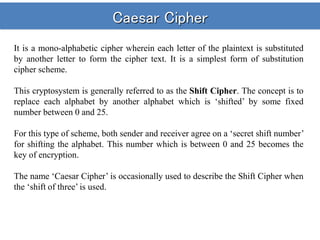
Caesar Cipher
It is a mono-alphabetic cipher wherein each letter of the plaintext is substituted
by another letter to form the cipher text. It is a simplest form of substitution
cipher scheme.
This cryptosystem is generally referred to as the Shift Cipher. The concept is to
replace each alphabet by another alphabet which is ‘shifted’ by some fixed
number between 0 and 25.
For this type of scheme, both sender and receiver agree on a ‘secret shift number’
for shifting the alphabet. This number which is between 0 and 25 becomes the
key of encryption.
The name ‘Caesar Cipher’ is occasionally used to describe the Shift Cipher when
the ‘shift of three’ is used.
Process of Shift Cipher
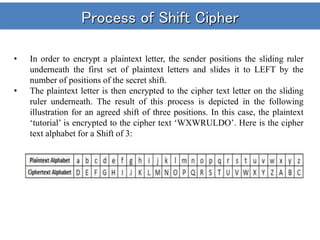
• In order to encrypt a plaintext letter, the sender positions the sliding ruler
underneath the first set of plaintext letters and slides it to LEFT by the
number of positions of the secret shift.
• The plaintext letter is then encrypted to the cipher text letter on the sliding
ruler underneath. The result of this process is depicted in the following
illustration for an agreed shift of three positions. In this case, the plaintext
‘tutorial’ is encrypted to the cipher text ‘WXWRULDO’. Here is the cipher
text alphabet for a Shift of 3:
Process of Shift Cipher
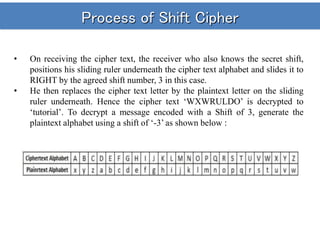
• On receiving the cipher text, the receiver who also knows the secret shift,
positions his sliding ruler underneath the cipher text alphabet and slides it to
RIGHT by the agreed shift number, 3 in this case.
• He then replaces the cipher text letter by the plaintext letter on the sliding
ruler underneath. Hence the cipher text ‘WXWRULDO’ is decrypted to
‘tutorial’. To decrypt a message encoded with a Shift of 3, generate the
plaintext alphabet using a shift of ‘-3’ as shown below :
Process of Shift Cipher
Security Value
Caesar Cipher is not a secure cryptosystem because there are only
26 possible keys to try out. An attacker can carry out an exhaustive
key search with available limited computing resources.
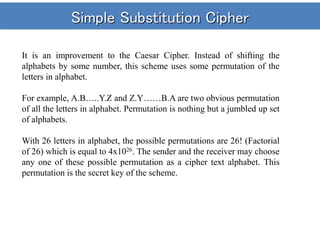
Simple Substitution Cipher
It is an improvement to the Caesar Cipher. Instead of shifting the
alphabets by some number, this scheme uses some permutation of the
letters in alphabet.
For example, A.B…..Y.Z and Z.Y……B.A are two obvious permutation
of all the letters in alphabet. Permutation is nothing but a jumbled up set
of alphabets.
With 26 letters in alphabet, the possible permutations are 26! (Factorial
of 26) which is equal to 4x1026. The sender and the receiver may choose
any one of these possible permutation as a cipher text alphabet. This
permutation is the secret key of the scheme.
Process of Substitution Cipher
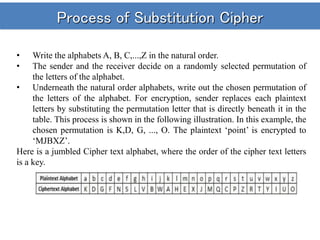
• Write the alphabets A, B, C,...,Z in the natural order.
• The sender and the receiver decide on a randomly selected permutation of
the letters of the alphabet.
• Underneath the natural order alphabets, write out the chosen permutation of
the letters of the alphabet. For encryption, sender replaces each plaintext
letters by substituting the permutation letter that is directly beneath it in the
table. This process is shown in the following illustration. In this example, the
chosen permutation is K,D, G, ..., O. The plaintext ‘point’ is encrypted to
‘MJBXZ’.
Here is a jumbled Cipher text alphabet, where the order of the cipher text letters
is a key.
Process of Substitution Cipher
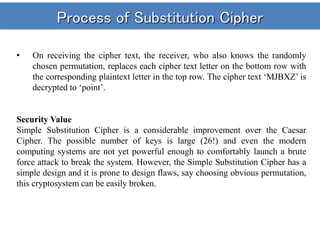
• On receiving the cipher text, the receiver, who also knows the randomly
chosen permutation, replaces each cipher text letter on the bottom row with
the corresponding plaintext letter in the top row. The cipher text ‘MJBXZ’ is
decrypted to ‘point’.
Security Value
Simple Substitution Cipher is a considerable improvement over the Caesar
Cipher. The possible number of keys is large (26!) and even the modern
computing systems are not yet powerful enough to comfortably launch a brute
force attack to break the system. However, the Simple Substitution Cipher has a
simple design and it is prone to design flaws, say choosing obvious permutation,
this cryptosystem can be easily broken.
Monoalphabetic and Polyalphabetic Cipher
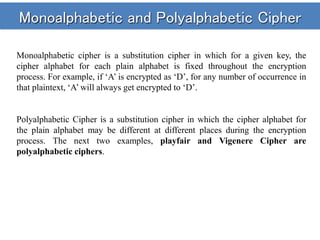
Monoalphabetic cipher is a substitution cipher in which for a given key, the
cipher alphabet for each plain alphabet is fixed throughout the encryption
process. For example, if ‘A’ is encrypted as ‘D’, for any number of occurrence in
that plaintext, ‘A’ will always get encrypted to ‘D’.
Polyalphabetic Cipher is a substitution cipher in which the cipher alphabet for
the plain alphabet may be different at different places during the encryption
process. The next two examples, playfair and Vigenere Cipher are
polyalphabetic ciphers.
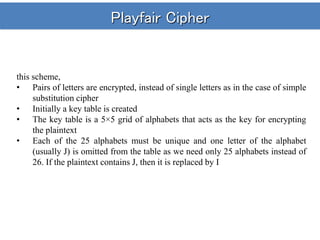
Playfair Cipher
this scheme,
• Pairs of letters are encrypted, instead of single letters as in the case of simple
substitution cipher
• Initially a key table is created
• The key table is a 5×5 grid of alphabets that acts as the key for encrypting
the plaintext
• Each of the 25 alphabets must be unique and one letter of the alphabet
(usually J) is omitted from the table as we need only 25 alphabets instead of
26. If the plaintext contains J, then it is replaced by I
Playfair Cipher
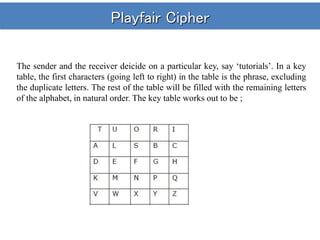
The sender and the receiver deicide on a particular key, say ‘tutorials’. In a key
table, the first characters (going left to right) in the table is the phrase, excluding
the duplicate letters. The rest of the table will be filled with the remaining letters
of the alphabet, in natural order. The key table works out to be ;
Process of Playfair Cipher
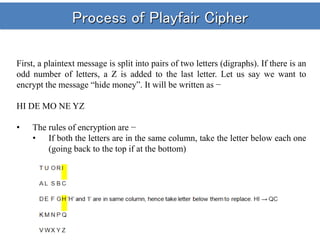
First, a plaintext message is split into pairs of two letters (digraphs). If there is an
odd number of letters, a Z is added to the last letter. Let us say we want to
encrypt the message “hide money”. It will be written as −
HI DE MO NE YZ
• The rules of encryption are −
• If both the letters are in the same column, take the letter below each one
(going back to the top if at the bottom)
Process of Playfair Cipher
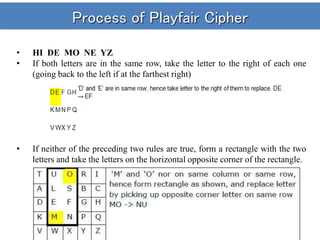
• HI DE MO NE YZ
• If both letters are in the same row, take the letter to the right of each one
(going back to the left if at the farthest right)
• If neither of the preceding two rules are true, form a rectangle with the two
letters and take the letters on the horizontal opposite corner of the rectangle.
Process of Playfair Cipher
Using these rules, the result of the encryption of ‘hide money’ with the key of
‘tutorials’ would be −
QC EF NU MF ZV
Decrypting the Playfair cipher is as simple as doing the same process in reverse.
Receiver has the same key and can create the same key table, and then decrypt
any messages made using that key.
Security Value
It is also a substitution cipher and is difficult to break compared to the simple
substitution cipher. As in case of substitution cipher, cryptanalysis is possible on
the Playfair cipher as well, however it would be against 625 possible pairs of
letters (25x25 alphabets) instead of 26 different possible alphabets.
The Playfair cipher was used mainly to protect important, yet non-critical secrets,
as it is quick to use and requires no special equipment.
Vigenere Cipher
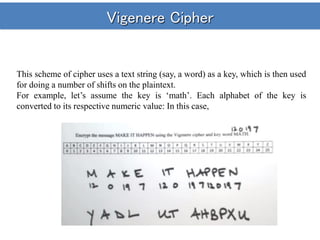
This scheme of cipher uses a text string (say, a word) as a key, which is then used
for doing a number of shifts on the plaintext.
For example, let’s assume the key is ‘math’. Each alphabet of the key is
converted to its respective numeric value: In this case,
Process of Vigenere Cipher
For example, let’s assume the key is ‘point’. Each alphabet of the key is
converted to its respective numeric value: In this case,
p → 16, o → 15, i → 9, n → 14, and t → 20.
Thus, the key is: 16 15 9 14 20.
Process of Vigenere Cipher
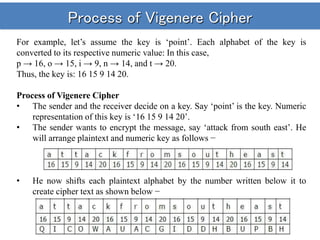
• The sender and the receiver decide on a key. Say ‘point’ is the key. Numeric
representation of this key is ‘16 15 9 14 20’.
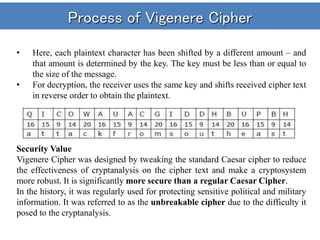
• The sender wants to encrypt the message, say ‘attack from south east’. He
will arrange plaintext and numeric key as follows −
• He now shifts each plaintext alphabet by the number written below it to
create cipher text as shown below −
Process of Vigenere Cipher
• Here, each plaintext character has been shifted by a different amount – and
that amount is determined by the key. The key must be less than or equal to
the size of the message.
• For decryption, the receiver uses the same key and shifts received cipher text
in reverse order to obtain the plaintext.
Security Value
Vigenere Cipher was designed by tweaking the standard Caesar cipher to reduce
the effectiveness of cryptanalysis on the cipher text and make a cryptosystem
more robust. It is significantly more secure than a regular Caesar Cipher.
In the history, it was regularly used for protecting sensitive political and military
information. It was referred to as the unbreakable cipher due to the difficulty it
posed to the cryptanalysis.
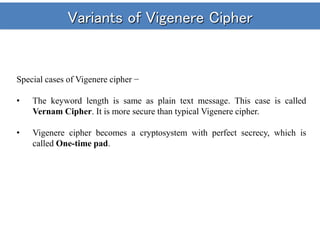
Variants of Vigenere Cipher
Special cases of Vigenere cipher −
• The keyword length is same as plain text message. This case is called
Vernam Cipher. It is more secure than typical Vigenere cipher.
• Vigenere cipher becomes a cryptosystem with perfect secrecy, which is
called One-time pad.
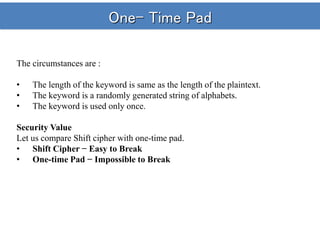
One- Time Pad
The circumstances are :
• The length of the keyword is same as the length of the plaintext.
• The keyword is a randomly generated string of alphabets.
• The keyword is used only once.
Security Value
Let us compare Shift cipher with one-time pad.
• Shift Cipher − Easy to Break
• One-time Pad − Impossible to Break
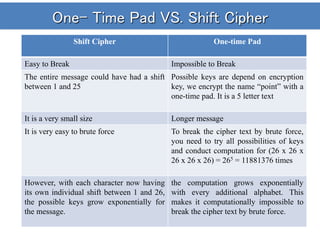
One- Time Pad VS. Shift Cipher
Shift Cipher One-time Pad
Easy to Break Impossible to Break
The entire message could have had a shift
between 1 and 25
Possible keys are depend on encryption
key, we encrypt the name “point” with a
one-time pad. It is a 5 letter text
It is a very small size Longer message
It is very easy to brute force To break the cipher text by brute force,
you need to try all possibilities of keys
and conduct computation for (26 x 26 x
26 x 26 x 26) = 265 = 11881376 times
However, with each character now having
its own individual shift between 1 and 26,
the possible keys grow exponentially for
the message.
the computation grows exponentially
with every additional alphabet. This
makes it computationally impossible to
break the cipher text by brute force.
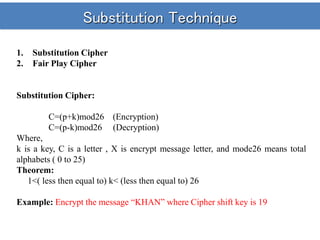
Substitution Technique
1. Substitution Cipher
2. Fair Play Cipher
Substitution Cipher:
C=(p+k)mod26 (Encryption)
C=(p-k)mod26 (Decryption)
Where,
k is a key, C is a letter , X is encrypt message letter, and mode26 means total
alphabets ( 0 to 25)
Theorem:
1<( less then equal to) k< (less then equal to) 26
Example: Encrypt the message “KHAN” where Cipher shift key is 19
Substitution Technique
Fair Play/ Playfair Cipher:
A block of 5*5
Instructions:
1. Divide plain text in pair of letters.
2. Replace repeated letter in the pair with dummy letter.
3. If Pair of plain text are in same row then replace them with right most letter.
4. If the plain text letter are in same column replace them with beneath letter.
5. If plain text letter are in different row and column replace them diagonally.

Caesar Cipher , Substitution Cipher, PlayFair and Vigenere Cipher

  • 1.
  • 2.
  • 3.
    Types of Cryptosystem 1.Symmetric key Encryption 2. Asymmetric key Encryption
  • 4.
    Cryptographic Systems -History Before proceeding further, you need to know some facts about historical cryptosystems • All of these systems are based on symmetric key encryption scheme. • The only security service these systems provide is confidentiality of information. • Unlike modern systems which are digital and treat data as binary numbers, the earlier systems worked on alphabets as basic element. These earlier cryptographic systems are also referred to as Ciphers. In general, a cipher is simply just a set of steps (an algorithm) for performing both an encryption, and the corresponding decryption.
  • 5.
    Caesar Cipher It isa mono-alphabetic cipher wherein each letter of the plaintext is substituted by another letter to form the cipher text. It is a simplest form of substitution cipher scheme. This cryptosystem is generally referred to as the Shift Cipher. The concept is to replace each alphabet by another alphabet which is ‘shifted’ by some fixed number between 0 and 25. For this type of scheme, both sender and receiver agree on a ‘secret shift number’ for shifting the alphabet. This number which is between 0 and 25 becomes the key of encryption. The name ‘Caesar Cipher’ is occasionally used to describe the Shift Cipher when the ‘shift of three’ is used.
  • 6.
    Process of ShiftCipher • In order to encrypt a plaintext letter, the sender positions the sliding ruler underneath the first set of plaintext letters and slides it to LEFT by the number of positions of the secret shift. • The plaintext letter is then encrypted to the cipher text letter on the sliding ruler underneath. The result of this process is depicted in the following illustration for an agreed shift of three positions. In this case, the plaintext ‘tutorial’ is encrypted to the cipher text ‘WXWRULDO’. Here is the cipher text alphabet for a Shift of 3:
  • 7.
    Process of ShiftCipher • On receiving the cipher text, the receiver who also knows the secret shift, positions his sliding ruler underneath the cipher text alphabet and slides it to RIGHT by the agreed shift number, 3 in this case. • He then replaces the cipher text letter by the plaintext letter on the sliding ruler underneath. Hence the cipher text ‘WXWRULDO’ is decrypted to ‘tutorial’. To decrypt a message encoded with a Shift of 3, generate the plaintext alphabet using a shift of ‘-3’ as shown below :
  • 8.
    Process of ShiftCipher Security Value Caesar Cipher is not a secure cryptosystem because there are only 26 possible keys to try out. An attacker can carry out an exhaustive key search with available limited computing resources.
  • 9.
    Simple Substitution Cipher Itis an improvement to the Caesar Cipher. Instead of shifting the alphabets by some number, this scheme uses some permutation of the letters in alphabet. For example, A.B…..Y.Z and Z.Y……B.A are two obvious permutation of all the letters in alphabet. Permutation is nothing but a jumbled up set of alphabets. With 26 letters in alphabet, the possible permutations are 26! (Factorial of 26) which is equal to 4x1026. The sender and the receiver may choose any one of these possible permutation as a cipher text alphabet. This permutation is the secret key of the scheme.
  • 10.
    Process of SubstitutionCipher • Write the alphabets A, B, C,...,Z in the natural order. • The sender and the receiver decide on a randomly selected permutation of the letters of the alphabet. • Underneath the natural order alphabets, write out the chosen permutation of the letters of the alphabet. For encryption, sender replaces each plaintext letters by substituting the permutation letter that is directly beneath it in the table. This process is shown in the following illustration. In this example, the chosen permutation is K,D, G, ..., O. The plaintext ‘point’ is encrypted to ‘MJBXZ’. Here is a jumbled Cipher text alphabet, where the order of the cipher text letters is a key.
  • 11.
    Process of SubstitutionCipher • On receiving the cipher text, the receiver, who also knows the randomly chosen permutation, replaces each cipher text letter on the bottom row with the corresponding plaintext letter in the top row. The cipher text ‘MJBXZ’ is decrypted to ‘point’. Security Value Simple Substitution Cipher is a considerable improvement over the Caesar Cipher. The possible number of keys is large (26!) and even the modern computing systems are not yet powerful enough to comfortably launch a brute force attack to break the system. However, the Simple Substitution Cipher has a simple design and it is prone to design flaws, say choosing obvious permutation, this cryptosystem can be easily broken.
  • 12.
    Monoalphabetic and PolyalphabeticCipher Monoalphabetic cipher is a substitution cipher in which for a given key, the cipher alphabet for each plain alphabet is fixed throughout the encryption process. For example, if ‘A’ is encrypted as ‘D’, for any number of occurrence in that plaintext, ‘A’ will always get encrypted to ‘D’. Polyalphabetic Cipher is a substitution cipher in which the cipher alphabet for the plain alphabet may be different at different places during the encryption process. The next two examples, playfair and Vigenere Cipher are polyalphabetic ciphers.
  • 13.
    Playfair Cipher this scheme, •Pairs of letters are encrypted, instead of single letters as in the case of simple substitution cipher • Initially a key table is created • The key table is a 5×5 grid of alphabets that acts as the key for encrypting the plaintext • Each of the 25 alphabets must be unique and one letter of the alphabet (usually J) is omitted from the table as we need only 25 alphabets instead of 26. If the plaintext contains J, then it is replaced by I
  • 14.
    Playfair Cipher The senderand the receiver deicide on a particular key, say ‘tutorials’. In a key table, the first characters (going left to right) in the table is the phrase, excluding the duplicate letters. The rest of the table will be filled with the remaining letters of the alphabet, in natural order. The key table works out to be ;
  • 15.
    Process of PlayfairCipher First, a plaintext message is split into pairs of two letters (digraphs). If there is an odd number of letters, a Z is added to the last letter. Let us say we want to encrypt the message “hide money”. It will be written as − HI DE MO NE YZ • The rules of encryption are − • If both the letters are in the same column, take the letter below each one (going back to the top if at the bottom)
  • 16.
    Process of PlayfairCipher • HI DE MO NE YZ • If both letters are in the same row, take the letter to the right of each one (going back to the left if at the farthest right) • If neither of the preceding two rules are true, form a rectangle with the two letters and take the letters on the horizontal opposite corner of the rectangle.
  • 17.
    Process of PlayfairCipher Using these rules, the result of the encryption of ‘hide money’ with the key of ‘tutorials’ would be − QC EF NU MF ZV Decrypting the Playfair cipher is as simple as doing the same process in reverse. Receiver has the same key and can create the same key table, and then decrypt any messages made using that key. Security Value It is also a substitution cipher and is difficult to break compared to the simple substitution cipher. As in case of substitution cipher, cryptanalysis is possible on the Playfair cipher as well, however it would be against 625 possible pairs of letters (25x25 alphabets) instead of 26 different possible alphabets. The Playfair cipher was used mainly to protect important, yet non-critical secrets, as it is quick to use and requires no special equipment.
  • 18.
    Vigenere Cipher This schemeof cipher uses a text string (say, a word) as a key, which is then used for doing a number of shifts on the plaintext. For example, let’s assume the key is ‘math’. Each alphabet of the key is converted to its respective numeric value: In this case,
  • 19.
    Process of VigenereCipher For example, let’s assume the key is ‘point’. Each alphabet of the key is converted to its respective numeric value: In this case, p → 16, o → 15, i → 9, n → 14, and t → 20. Thus, the key is: 16 15 9 14 20. Process of Vigenere Cipher • The sender and the receiver decide on a key. Say ‘point’ is the key. Numeric representation of this key is ‘16 15 9 14 20’. • The sender wants to encrypt the message, say ‘attack from south east’. He will arrange plaintext and numeric key as follows − • He now shifts each plaintext alphabet by the number written below it to create cipher text as shown below −
  • 20.
    Process of VigenereCipher • Here, each plaintext character has been shifted by a different amount – and that amount is determined by the key. The key must be less than or equal to the size of the message. • For decryption, the receiver uses the same key and shifts received cipher text in reverse order to obtain the plaintext. Security Value Vigenere Cipher was designed by tweaking the standard Caesar cipher to reduce the effectiveness of cryptanalysis on the cipher text and make a cryptosystem more robust. It is significantly more secure than a regular Caesar Cipher. In the history, it was regularly used for protecting sensitive political and military information. It was referred to as the unbreakable cipher due to the difficulty it posed to the cryptanalysis.
  • 21.
    Variants of VigenereCipher Special cases of Vigenere cipher − • The keyword length is same as plain text message. This case is called Vernam Cipher. It is more secure than typical Vigenere cipher. • Vigenere cipher becomes a cryptosystem with perfect secrecy, which is called One-time pad.
  • 22.
    One- Time Pad Thecircumstances are : • The length of the keyword is same as the length of the plaintext. • The keyword is a randomly generated string of alphabets. • The keyword is used only once. Security Value Let us compare Shift cipher with one-time pad. • Shift Cipher − Easy to Break • One-time Pad − Impossible to Break
  • 23.
    One- Time PadVS. Shift Cipher Shift Cipher One-time Pad Easy to Break Impossible to Break The entire message could have had a shift between 1 and 25 Possible keys are depend on encryption key, we encrypt the name “point” with a one-time pad. It is a 5 letter text It is a very small size Longer message It is very easy to brute force To break the cipher text by brute force, you need to try all possibilities of keys and conduct computation for (26 x 26 x 26 x 26 x 26) = 265 = 11881376 times However, with each character now having its own individual shift between 1 and 26, the possible keys grow exponentially for the message. the computation grows exponentially with every additional alphabet. This makes it computationally impossible to break the cipher text by brute force.
  • 24.
    Substitution Technique 1. SubstitutionCipher 2. Fair Play Cipher Substitution Cipher: C=(p+k)mod26 (Encryption) C=(p-k)mod26 (Decryption) Where, k is a key, C is a letter , X is encrypt message letter, and mode26 means total alphabets ( 0 to 25) Theorem: 1<( less then equal to) k< (less then equal to) 26 Example: Encrypt the message “KHAN” where Cipher shift key is 19
  • 25.
    Substitution Technique Fair Play/Playfair Cipher: A block of 5*5 Instructions: 1. Divide plain text in pair of letters. 2. Replace repeated letter in the pair with dummy letter. 3. If Pair of plain text are in same row then replace them with right most letter. 4. If the plain text letter are in same column replace them with beneath letter. 5. If plain text letter are in different row and column replace them diagonally.