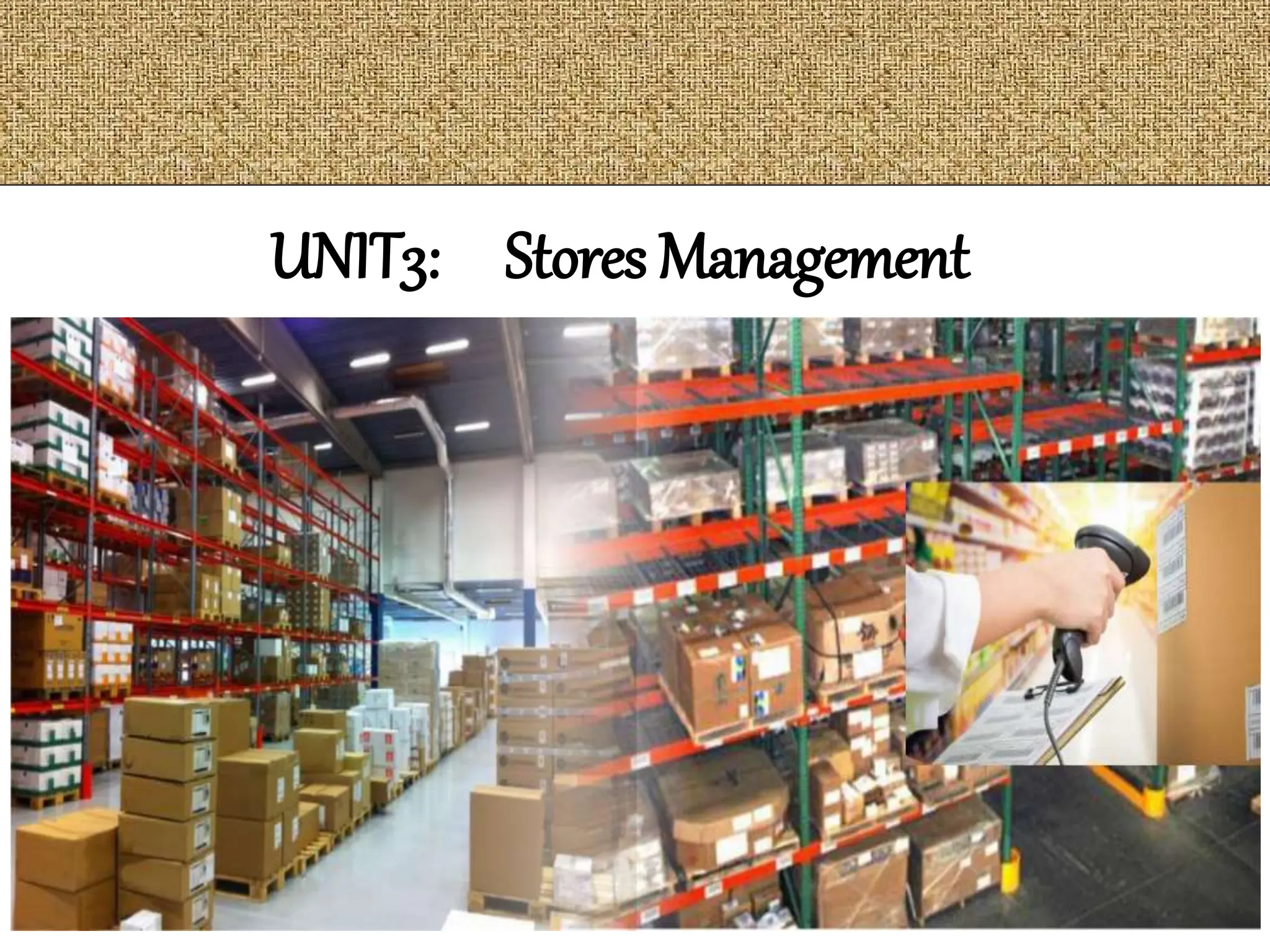
UNIT3: Stores Management
Stores management
Refers to the efficient organization and operation of retail businesses.
It involves overseeing the daily operations of a store, including staff
management, inventory management, financial management, and
customer service management.
Effective stores management can improve sales and profitability by
optimizing store layout, product displays, and sales tactics.
It also involves analyzing and interpreting data to make informed
business decisions.
Stores' Systems and Procedures
Any Stores system starts with planning the need for materials. It is assumed
here that the need itself has been forecast with a considerable degree of
accuracy. The forecast also must be subjected to periodic review.
The art of storekeeping is largely that of optimizing the use of resources to
meet actual needs in an efficient manner.
Efficiency of Stores function is measured by the number of times the stocks
have turned over. That is how much time material spends in the stores.
The lesser time it spends the better it is.
Stores is a very broad word that indicates a wide variety of materials stored
such as chemical, metals, liquids, gases, spare parts, equipment, or finished
goods, ranging from engineering components to drugs and pharmaceuticals.
Meaning of Stores' Systems and Procedures
Stores Systems and Procedures refer to the methods and processes
implemented by retail establishments to manage their inventory, sales,
customer service, and other aspects of their operations.
These systems can range from basic manual methods to complex
computerized systems that use barcode scanning, RFID (Radio freq ID) tags,
and other technologies. Proper implementation of these systems can help
stores improve their efficiency, accuracy, and overall profitability.
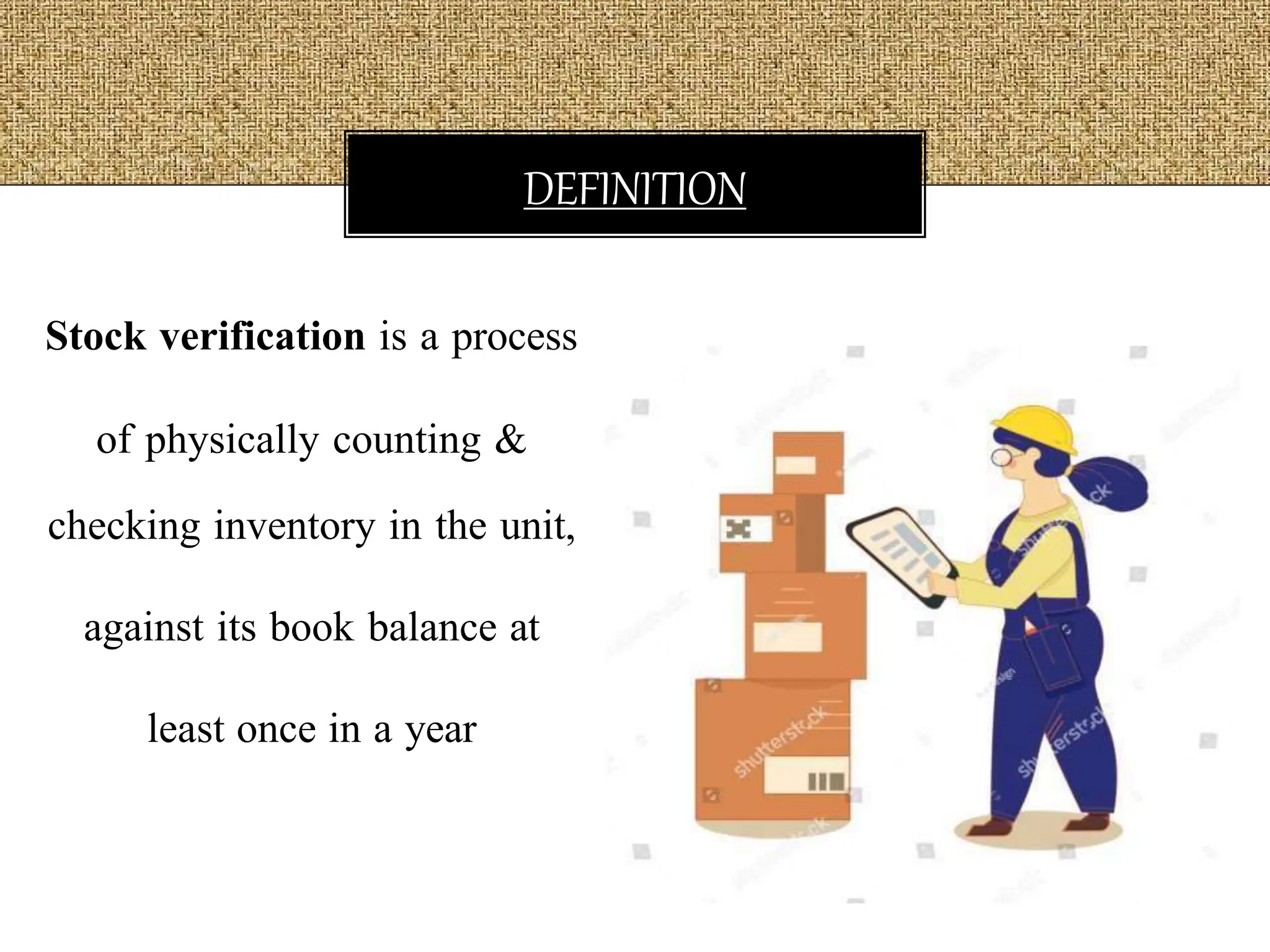
Stock verification is a process
of physically counting &
checking inventory in the unit,
against its book balance at
least once in a year
DEFINITION
Value of Stocks
• better management &
control over various
activities of production.
• goods in process &
finished goods.
• basis of inventory control
by value.
Items of Stock
• Accounting of all materials
received.
• Tally of accounts- physical
v/s accounting
• Determining ordering
quality
• Stock taking- physical
inventory/ stock
verification
STORES& ACCOUNTING
Physical verification is necessary since
they are the assets of the organization
• Correctness of stocks & values of stocks.
• Detection of frauds, thefts, loss & damage
– deviation from procedure etc.
• Examines the process of storage for any
weaknesses.
• Moral check on the staff.
PURPOSES
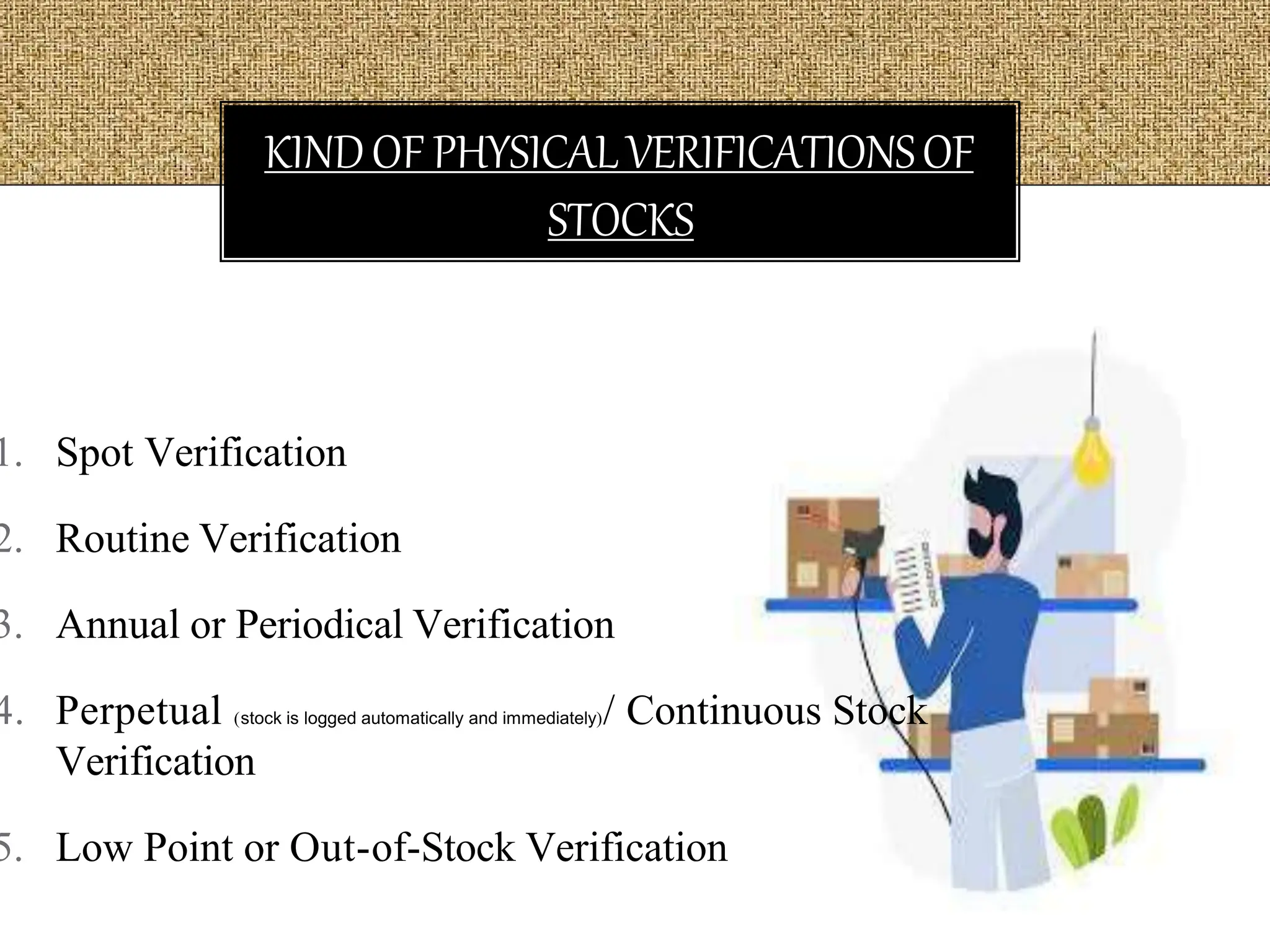
1. Spot Verification
2. Routine Verification
3. Annual or Periodical Verification
4. Perpetual (stock is logged automatically and immediately)/ Continuous Stock
Verification
5. Low Point or Out-of-Stock Verification
KINDOF PHYSICALVERIFICATIONSOF
STOCKS
• While issuing or receiving
• Voluntary, simple, good,
regular
• No official recognition
• Serves as self check
mechanism for internal
procedures of stores
• Always in addition to other
methods
SPOT VERIFICATION
• By store staff for own
satisfaction
• No official recognition
• Mechanism for internal
control
Objectives
• Check store records
• Accuracy of store records &
quantity of stocks
• Detecting theft, wastage etc in
time
• Moral check on staff
• Prepare staff for inspection &
internal audit
ROUTINE VERIFICATION
• Whole stock is physically verified
at the end of the given period,
usually annually at the time of the
ending of the financial year.
• Total official recognition & the a
counting is tallied.
• Small stores can be done in one
day.
• Large stores can be done in few
days.
ANNUAL/ PERIODIC
VERIFICATION
• Simple, convenient &
satisfactory.
• Value of closing stock is
taken into account
• No extra shelf is required
in small stores.
• Authentic verification of
stores.
• Extra staff required for extra
large stores.
• If staff is disinterested or
inexperienced the results are
not satisfactory.
• Discrepancy detected only
once in a given period. Proper
investigation not possible.
• Delay in preparing of final
accounts due to formalities.
Merits Demerits
ANNUAL/ PERIODIC VERIFICATION
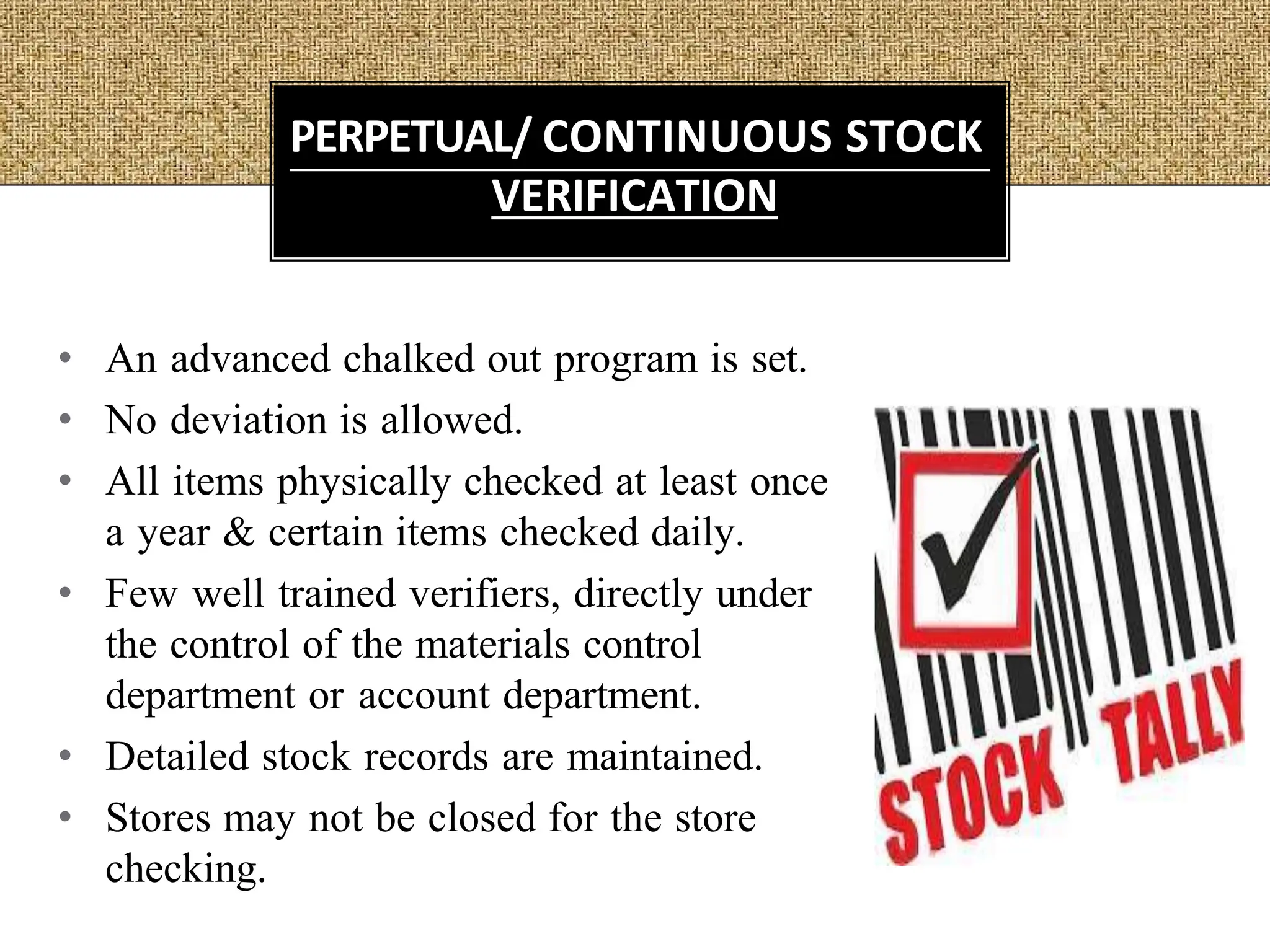
• An advanced chalked out program is set.
• No deviation is allowed.
• All items physically checked at least once
a year & certain items checked daily.
• Few well trained verifiers, directly under
the control of the materials control
department or account department.
• Detailed stock records are maintained.
• Stores may not be closed for the store
checking.
PERPETUAL/ CONTINUOUS STOCK
VERIFICATION
• When particular stock items are on a low point & needs
replenishment.
• When the particular item is out of stock.
Method :
• Done by store staff.
• Records are kept by storekeeper & are used in annual
accounting.
• Records sent to accounts & purchase department.
• Requires greater c-ordination between stores & accounts.
LOW POINT /OUT-OF-STOCK
VERIFICATION
Different types of material losses
Material management involves tracking and monitoring different types of
material losses, including raw materials, work-in-progress, and finished
goods.
Different industries may have specific material management practices and
regulations that vary by type of material. It's important to track these losses
accurately to optimize cost control and resource allocation within your
organization.
Some common types of material losses include waste, overproduction, theft,
and spoilage. Inventory shrinkage
- Purchasing errors
- Supply chain interruptions
- Equipment breakdown
- Misuse and mishandling
Disposal of surplus and scrap
Disposal of surplus and scrap refers to the management of waste materials that
are no longer needed or useful.
This can include proper sorting, recycling, or disposal through a waste
management facility.
It is important to dispose of surplus and scrap responsibly to minimize
environmental impact and promote sustainability. Proper disposal can also
help reduce the risk of injury or harm to individuals handling the waste
materials.
Documentation in stores Management
Documentation in stores management refers to the process of keeping
accurate and organized records of retail sales, inventory, customer
information, and other important business operations.
This information is necessary for
financial reporting,
tracking inventory levels, sales receipts, invoices, purchase orders, inventory
reports, customer accounts, and analyzing sales trends.
Some common ways in which documentation is managed in stores include
using computerized point
Unit 3 stores management.pptx

Unit 3 stores management.pptx

  • 1.
  • 2.
    Stores management Refers tothe efficient organization and operation of retail businesses. It involves overseeing the daily operations of a store, including staff management, inventory management, financial management, and customer service management. Effective stores management can improve sales and profitability by optimizing store layout, product displays, and sales tactics. It also involves analyzing and interpreting data to make informed business decisions.
  • 3.
    Stores' Systems andProcedures Any Stores system starts with planning the need for materials. It is assumed here that the need itself has been forecast with a considerable degree of accuracy. The forecast also must be subjected to periodic review. The art of storekeeping is largely that of optimizing the use of resources to meet actual needs in an efficient manner. Efficiency of Stores function is measured by the number of times the stocks have turned over. That is how much time material spends in the stores. The lesser time it spends the better it is. Stores is a very broad word that indicates a wide variety of materials stored such as chemical, metals, liquids, gases, spare parts, equipment, or finished goods, ranging from engineering components to drugs and pharmaceuticals.
  • 4.
    Meaning of Stores'Systems and Procedures Stores Systems and Procedures refer to the methods and processes implemented by retail establishments to manage their inventory, sales, customer service, and other aspects of their operations. These systems can range from basic manual methods to complex computerized systems that use barcode scanning, RFID (Radio freq ID) tags, and other technologies. Proper implementation of these systems can help stores improve their efficiency, accuracy, and overall profitability.
  • 5.
    Stock verification isa process of physically counting & checking inventory in the unit, against its book balance at least once in a year DEFINITION
  • 6.
    Value of Stocks •better management & control over various activities of production. • goods in process & finished goods. • basis of inventory control by value. Items of Stock • Accounting of all materials received. • Tally of accounts- physical v/s accounting • Determining ordering quality • Stock taking- physical inventory/ stock verification STORES& ACCOUNTING
  • 7.
    Physical verification isnecessary since they are the assets of the organization • Correctness of stocks & values of stocks. • Detection of frauds, thefts, loss & damage – deviation from procedure etc. • Examines the process of storage for any weaknesses. • Moral check on the staff. PURPOSES
  • 8.
    1. Spot Verification 2.Routine Verification 3. Annual or Periodical Verification 4. Perpetual (stock is logged automatically and immediately)/ Continuous Stock Verification 5. Low Point or Out-of-Stock Verification KINDOF PHYSICALVERIFICATIONSOF STOCKS
  • 9.
    • While issuingor receiving • Voluntary, simple, good, regular • No official recognition • Serves as self check mechanism for internal procedures of stores • Always in addition to other methods SPOT VERIFICATION
  • 10.
    • By storestaff for own satisfaction • No official recognition • Mechanism for internal control Objectives • Check store records • Accuracy of store records & quantity of stocks • Detecting theft, wastage etc in time • Moral check on staff • Prepare staff for inspection & internal audit ROUTINE VERIFICATION
  • 11.
    • Whole stockis physically verified at the end of the given period, usually annually at the time of the ending of the financial year. • Total official recognition & the a counting is tallied. • Small stores can be done in one day. • Large stores can be done in few days. ANNUAL/ PERIODIC VERIFICATION
  • 12.
    • Simple, convenient& satisfactory. • Value of closing stock is taken into account • No extra shelf is required in small stores. • Authentic verification of stores. • Extra staff required for extra large stores. • If staff is disinterested or inexperienced the results are not satisfactory. • Discrepancy detected only once in a given period. Proper investigation not possible. • Delay in preparing of final accounts due to formalities. Merits Demerits ANNUAL/ PERIODIC VERIFICATION
  • 13.
    • An advancedchalked out program is set. • No deviation is allowed. • All items physically checked at least once a year & certain items checked daily. • Few well trained verifiers, directly under the control of the materials control department or account department. • Detailed stock records are maintained. • Stores may not be closed for the store checking. PERPETUAL/ CONTINUOUS STOCK VERIFICATION
  • 14.
    • When particularstock items are on a low point & needs replenishment. • When the particular item is out of stock. Method : • Done by store staff. • Records are kept by storekeeper & are used in annual accounting. • Records sent to accounts & purchase department. • Requires greater c-ordination between stores & accounts. LOW POINT /OUT-OF-STOCK VERIFICATION
  • 15.
    Different types ofmaterial losses Material management involves tracking and monitoring different types of material losses, including raw materials, work-in-progress, and finished goods. Different industries may have specific material management practices and regulations that vary by type of material. It's important to track these losses accurately to optimize cost control and resource allocation within your organization. Some common types of material losses include waste, overproduction, theft, and spoilage. Inventory shrinkage - Purchasing errors - Supply chain interruptions - Equipment breakdown - Misuse and mishandling
  • 16.
    Disposal of surplusand scrap Disposal of surplus and scrap refers to the management of waste materials that are no longer needed or useful. This can include proper sorting, recycling, or disposal through a waste management facility. It is important to dispose of surplus and scrap responsibly to minimize environmental impact and promote sustainability. Proper disposal can also help reduce the risk of injury or harm to individuals handling the waste materials.
  • 17.
    Documentation in storesManagement Documentation in stores management refers to the process of keeping accurate and organized records of retail sales, inventory, customer information, and other important business operations. This information is necessary for financial reporting, tracking inventory levels, sales receipts, invoices, purchase orders, inventory reports, customer accounts, and analyzing sales trends. Some common ways in which documentation is managed in stores include using computerized point