STORE MANAGEMENT &
   CODIFICATION
            1

    VARUN VENUGOPALAN
         MD SAJID
Store Management: An Introduction
                                    2

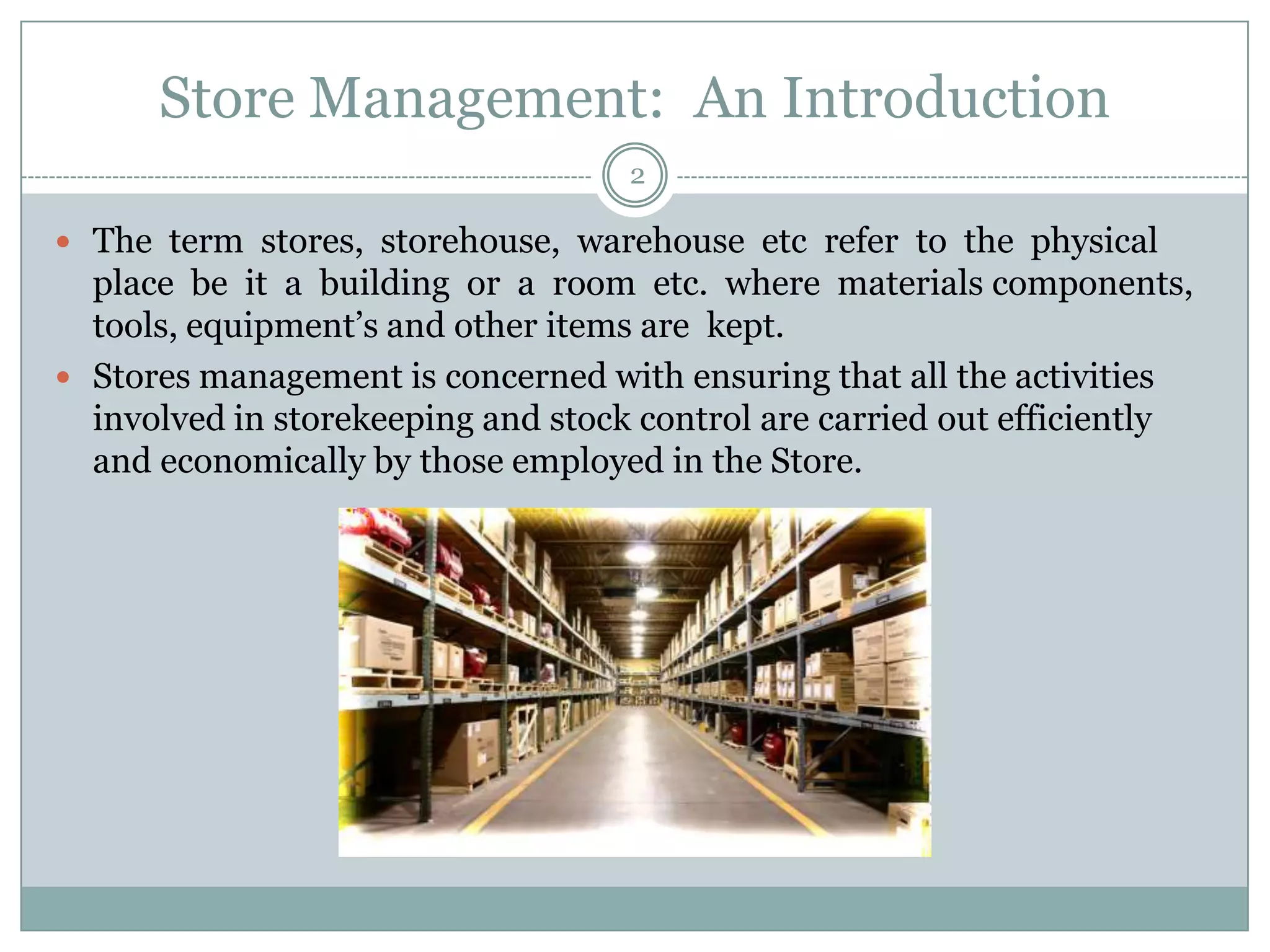
 The term stores, storehouse, warehouse etc refer to the physical
  place be it a building or a room etc. where materials components,
  tools, equipment’s and other items are kept.
 Stores management is concerned with ensuring that all the activities
  involved in storekeeping and stock control are carried out efficiently
  and economically by those employed in the Store.
Function of Stores
                                      3

 Receive raw materials, components, tools, equipment’s and other items
    and account for them.
   Provide adequate and proper storage and preservation to the various
    items.
   Meet the demands of the consuming departments by proper issues and
    account for the consumption.
   Minimize obsolescence, surplus and scrap through proper codification,
    preservation and handling.
   Highlight stock accumulation, discrepancies and abnormal
    consumption and effect control measures.
   Ensure good house keeping so that material handling, material
    preservation, stocking, receipt and issue can be done adequately.
   Assist in verification and provide supporting information for effective
    purchase action.
Relationship with other Departments
                                    4

 The Production Department
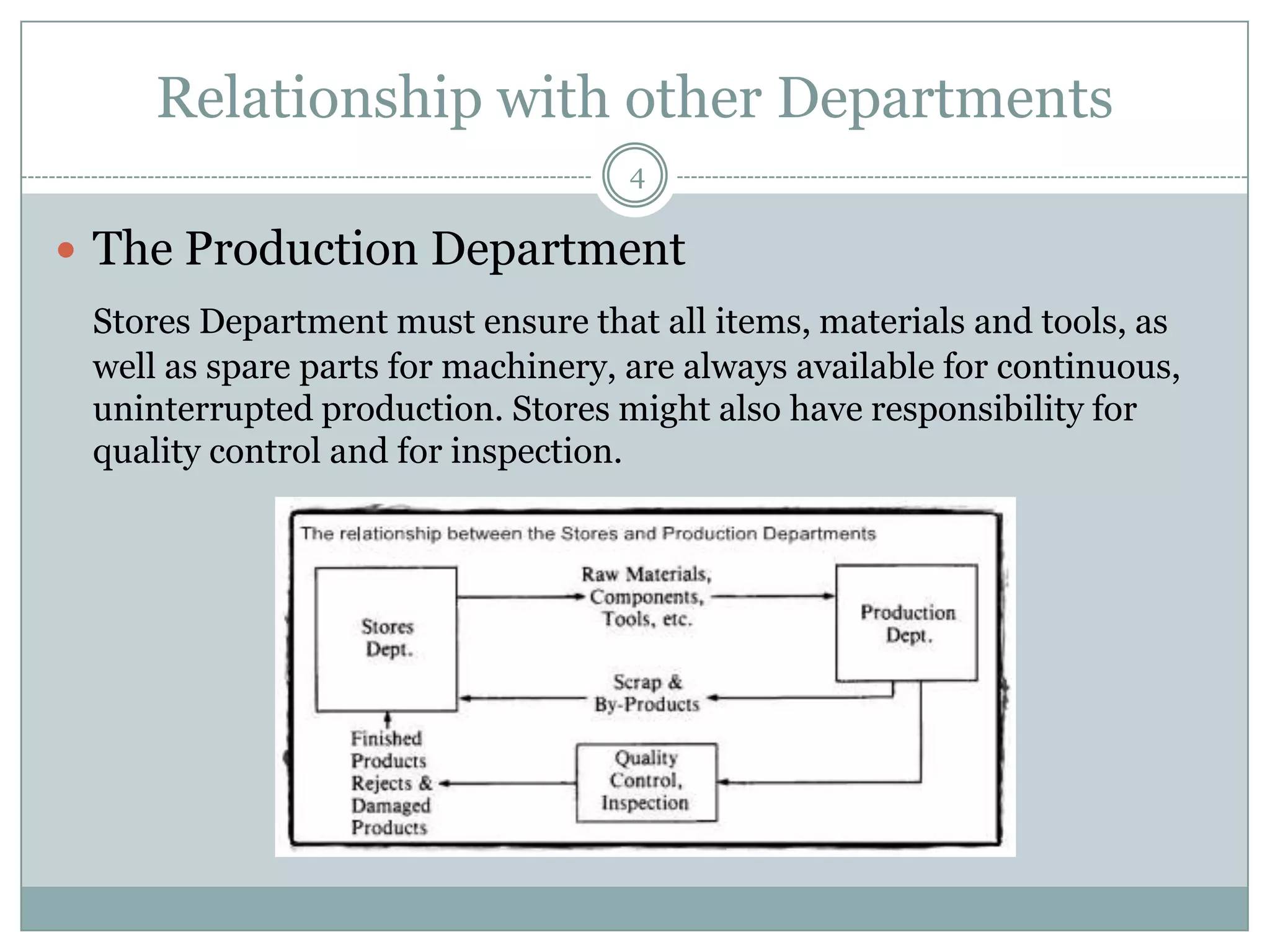
 Stores Department must ensure that all items, materials and tools, as
 well as spare parts for machinery, are always available for continuous,
 uninterrupted production. Stores might also have responsibility for
 quality control and for inspection.
Relationship with other Department
                                    5

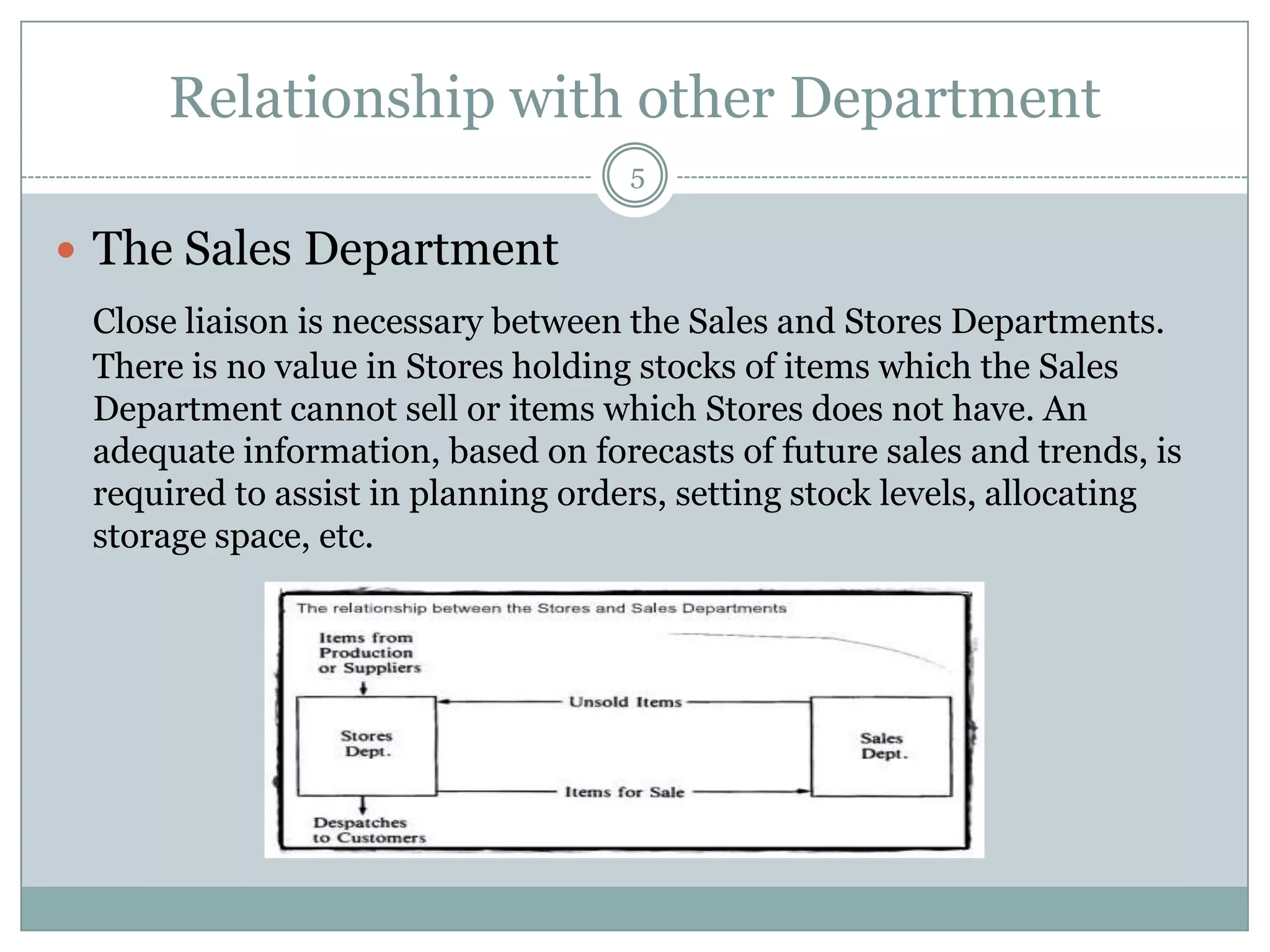
 The Sales Department
 Close liaison is necessary between the Sales and Stores Departments.
 There is no value in Stores holding stocks of items which the Sales
 Department cannot sell or items which Stores does not have. An
 adequate information, based on forecasts of future sales and trends, is
 required to assist in planning orders, setting stock levels, allocating
 storage space, etc.
Relationship with other Departments
                                   6

 The Purchasing Department
 Stores must keep Purchasing up to date with information about stock
 levels, whilst Stores relies on Purchasing to buy all the items and
 materials needed by the enterprise for its operations.
 The Maintenance or Engineering Department
 This department relies on Stores to have available all the spare parts,
 tools, equipment and materials required for maintenance. In return it
 must supply full information to Stores of all long-term and short-term
 maintenance plans and the items which will be needed.
Relationship with other Departments
                                    7

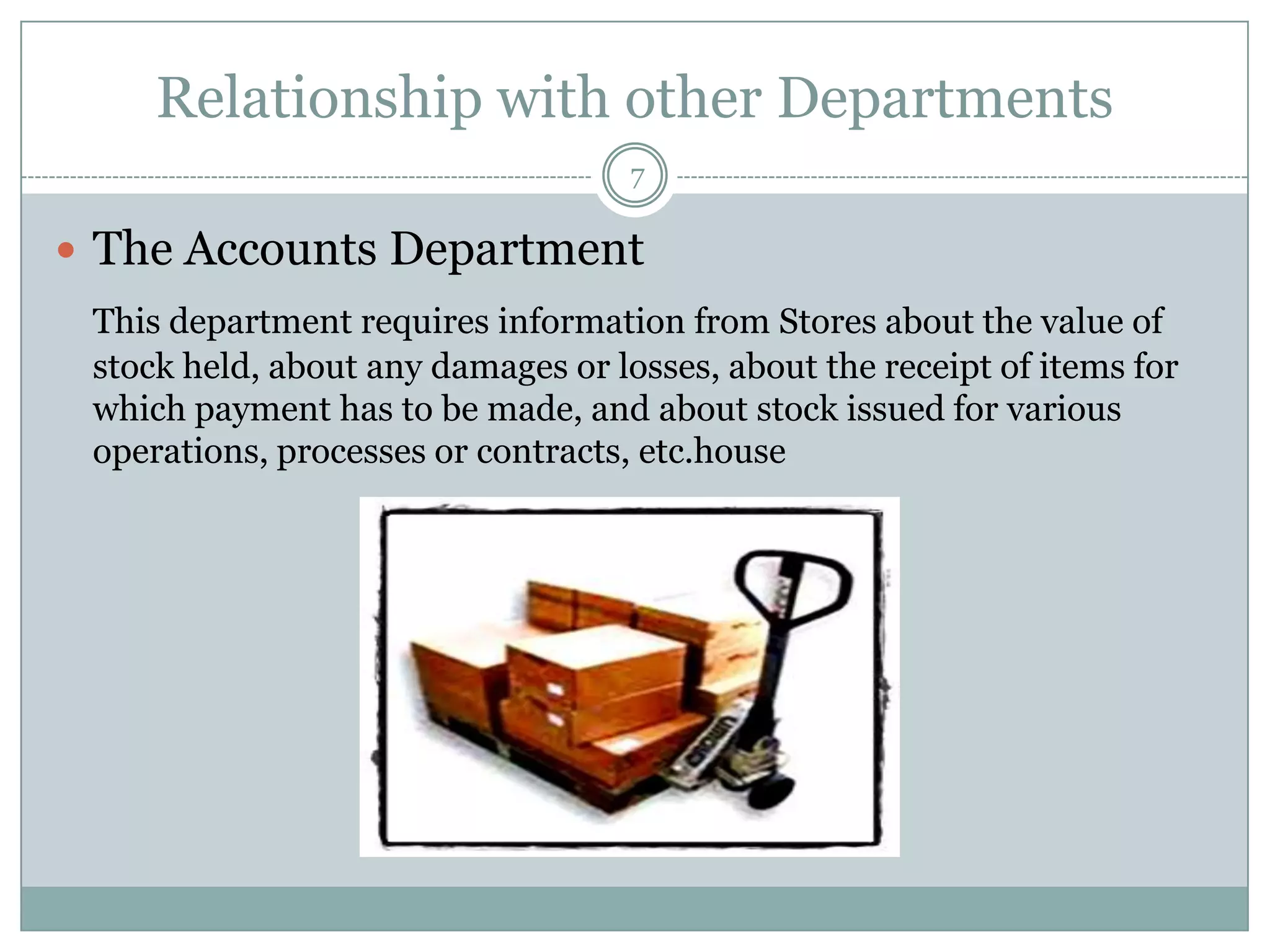
 The Accounts Department
 This department requires information from Stores about the value of
 stock held, about any damages or losses, about the receipt of items for
 which payment has to be made, and about stock issued for various
 operations, processes or contracts, etc.house
Codification
                                    8

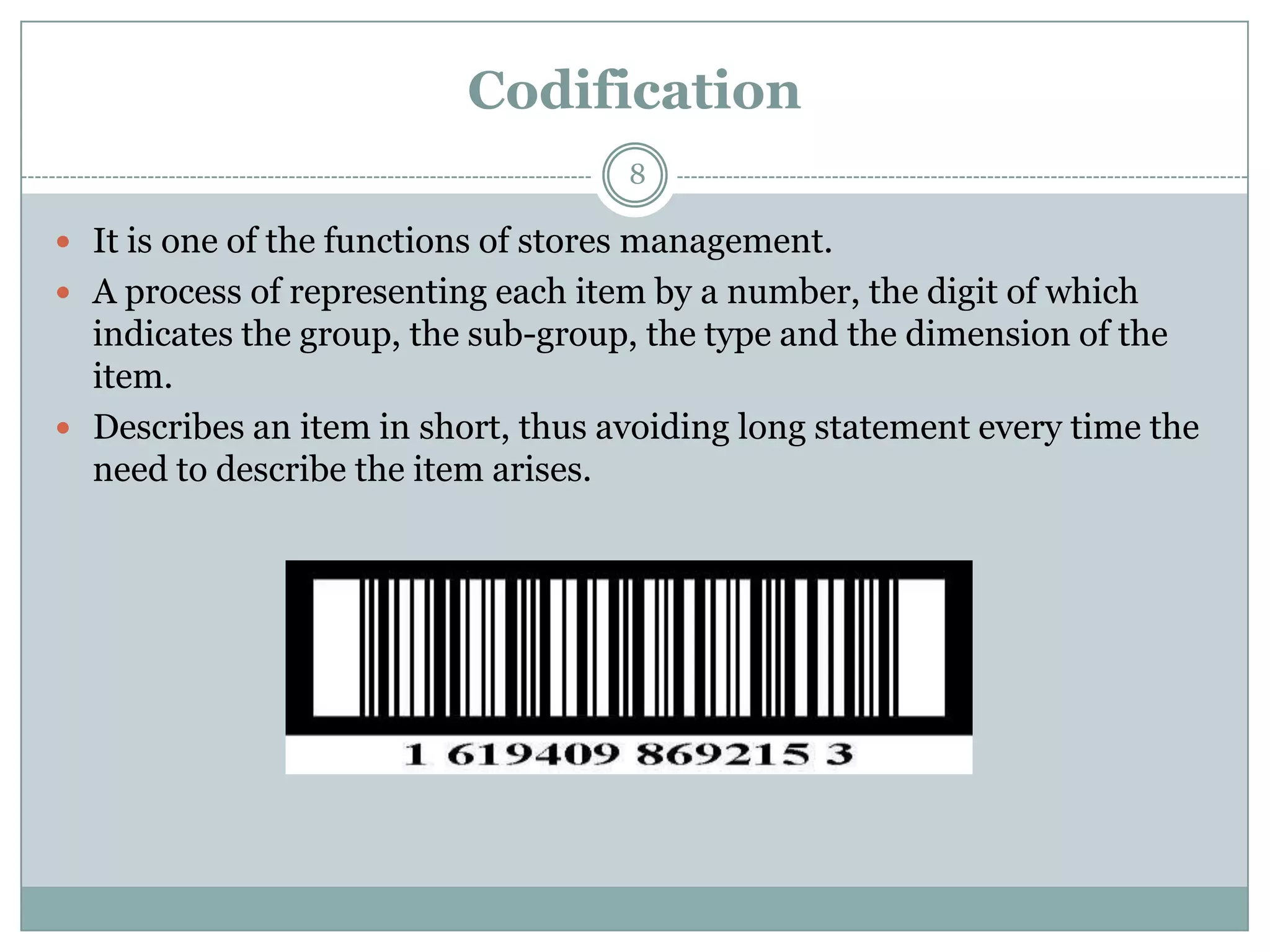
 It is one of the functions of stores management.
 A process of representing each item by a number, the digit of which
  indicates the group, the sub-group, the type and the dimension of the
  item.
 Describes an item in short, thus avoiding long statement every time the
  need to describe the item arises.
Objectives of Codification
                                   9

 Bringing all items together.
 Enable putting up of any future item in its proper place.
 Classify an item according to its characteristics.
 Give an unique code number to each item to avoid duplication
    and ambiguity.
   Reveal excessive variety and promote standardization and
    variety reduction.
   Establish a common language for the identification of an item.
   Fix essential parameters for specifying an item.
   Specify item as per national and international standards.
   Enable data processing and analysis.
Basis of codification
                           10

 Who will be the user?
 To what use is the codification going to be put?
 What kind/degree of mechanization will be needed
 to use the codification system?
Codification by Group Classification

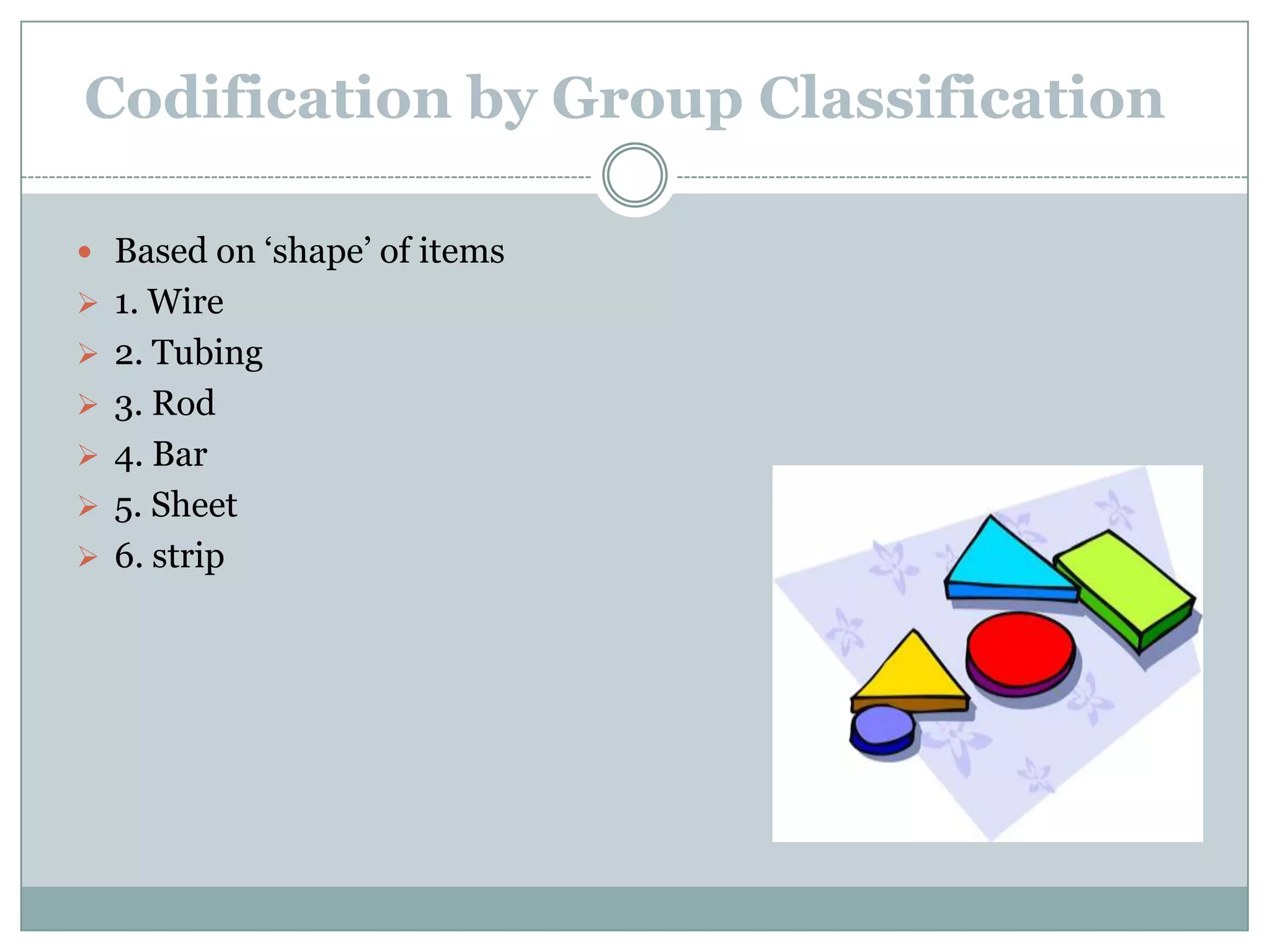
 Based on ‘shape’ of items
 1. Wire
 2. Tubing
 3. Rod
 4. Bar
 5. Sheet
 6. strip
Methods of coding of materials
                              12


 Alphabetical method
 Numerical method
 Alphabetical-cum-Numerical method
Alphabetical method
                                  13


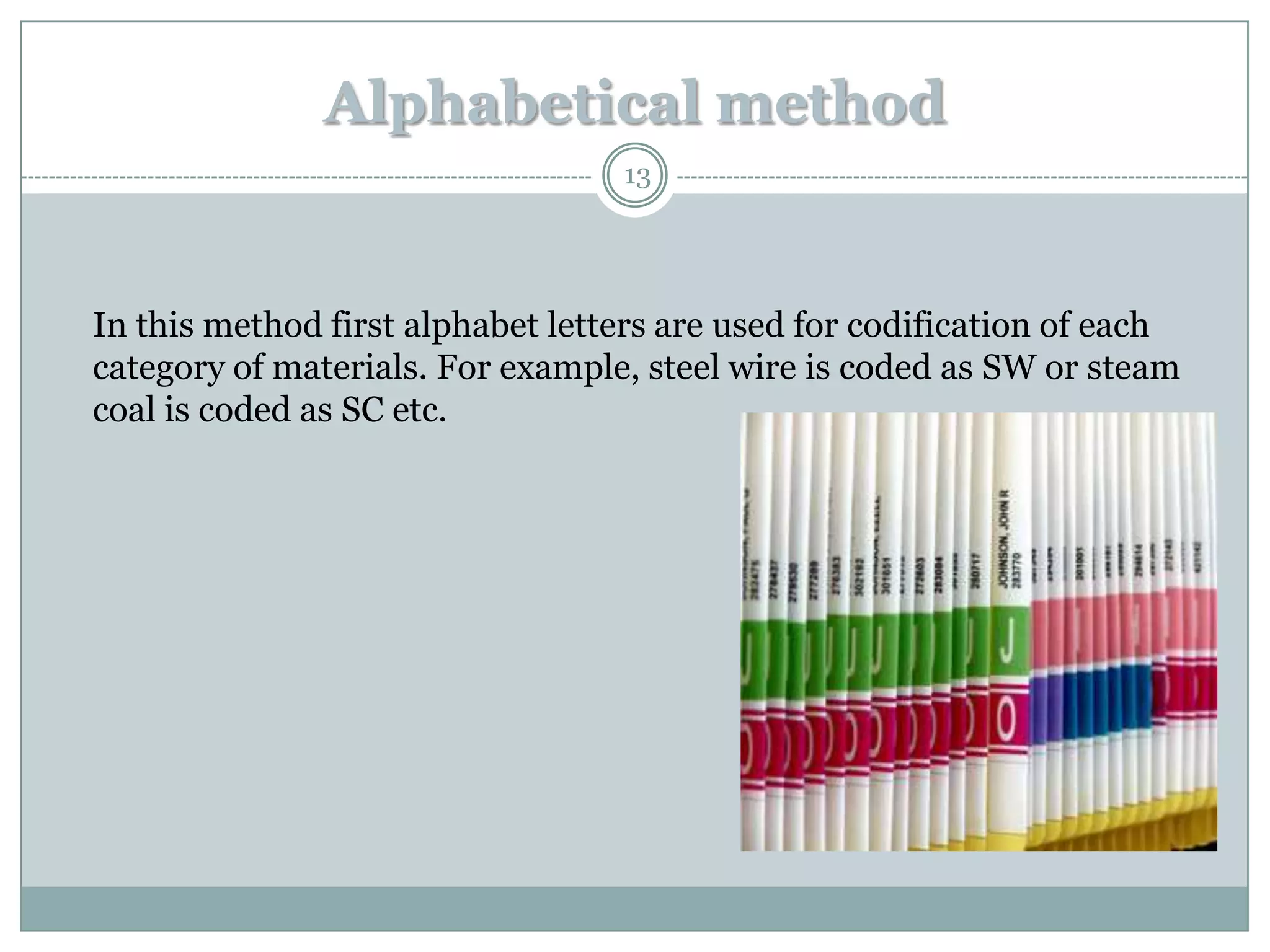
In this method first alphabet letters are used for codification of each
category of materials. For example, steel wire is coded as SW or steam
coal is coded as SC etc.
Alphabetical-cum-Numerical method
                                    14

 In this method, a combination of these two methods is used for coding
  of materials. For example, a steel wire of gauge 4mm quality A stored in
  rack/bin No.22, is given the code number SW4A/22. Such a method
  gives exact information than any of the above two methods.
Numerical method
                                 15

This method is used where materials accounting is to be mechanized by
use of punched cards or computers. For numerical coding a list is
prepared for various departments and allotting to each of them a
suitable number. The first two digits of the code number represent the
department for which the materials are meant and other two digits
state the name of material as mentioned in the standard list or
materials manual. For example, if code is 2341 it means Material No.41
[copper wire] is to be used in Department No.23.
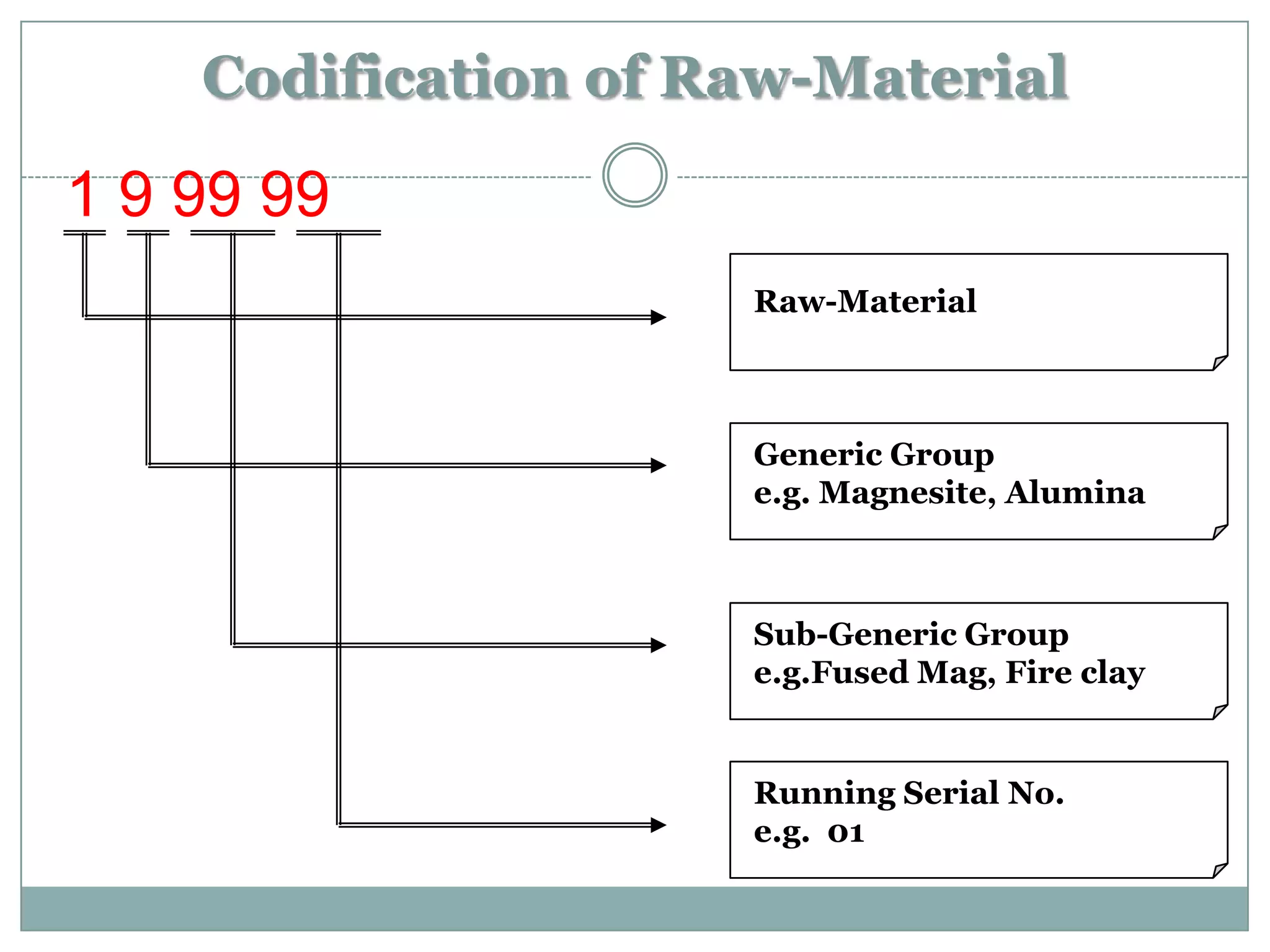
Codification of Raw-Material

1 9 99 99
                     Raw-Material


                     Generic Group
                     e.g. Magnesite, Alumina


                     Sub-Generic Group
                     e.g.Fused Mag, Fire clay


                     Running Serial No.
                     e.g. 01
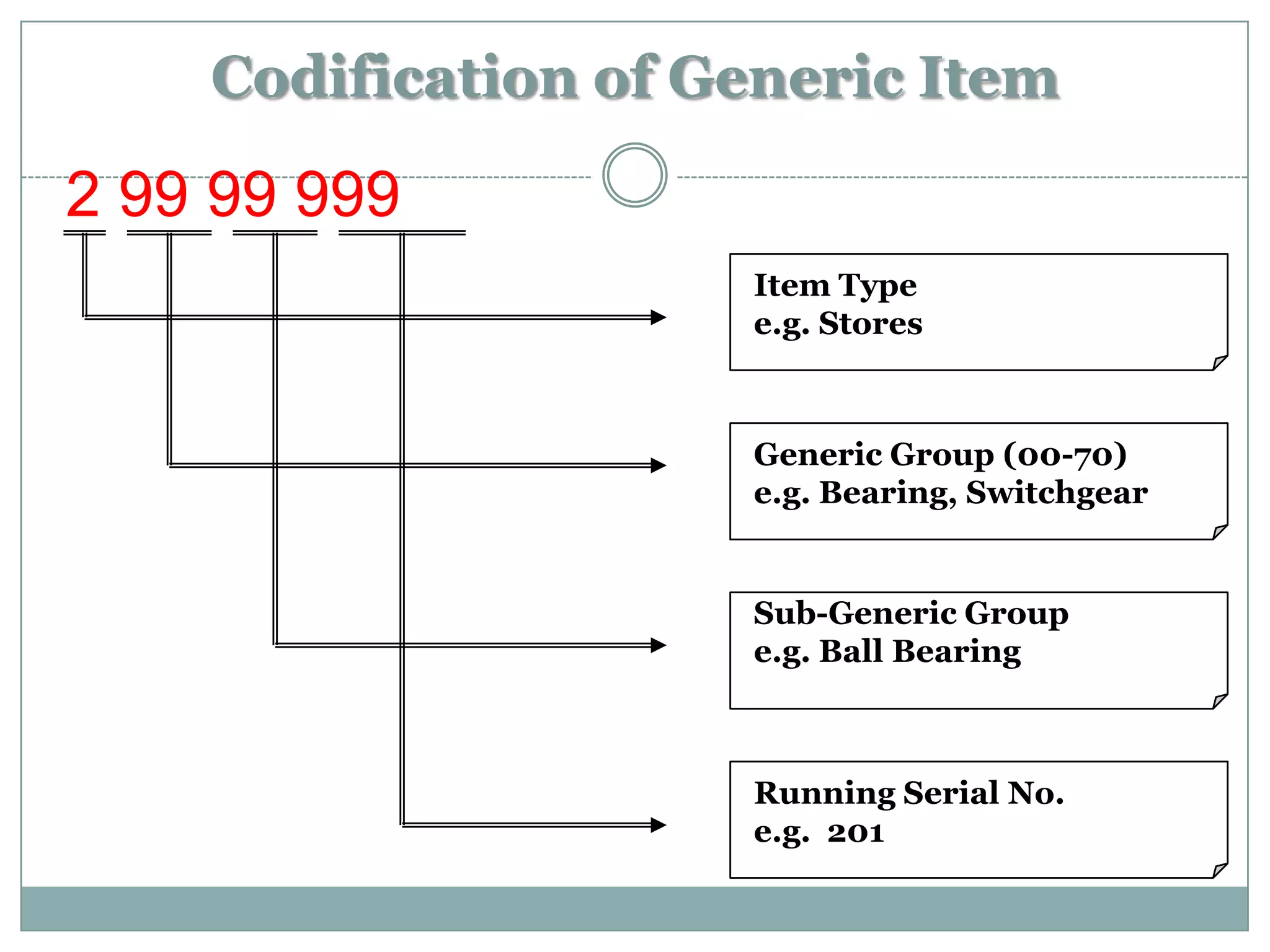
Codification of Generic Item

2 99 99 999
                     Item Type
                     e.g. Stores


                     Generic Group (00-70)
                     e.g. Bearing, Switchgear


                     Sub-Generic Group
                     e.g. Ball Bearing


                     Running Serial No.
                     e.g. 201
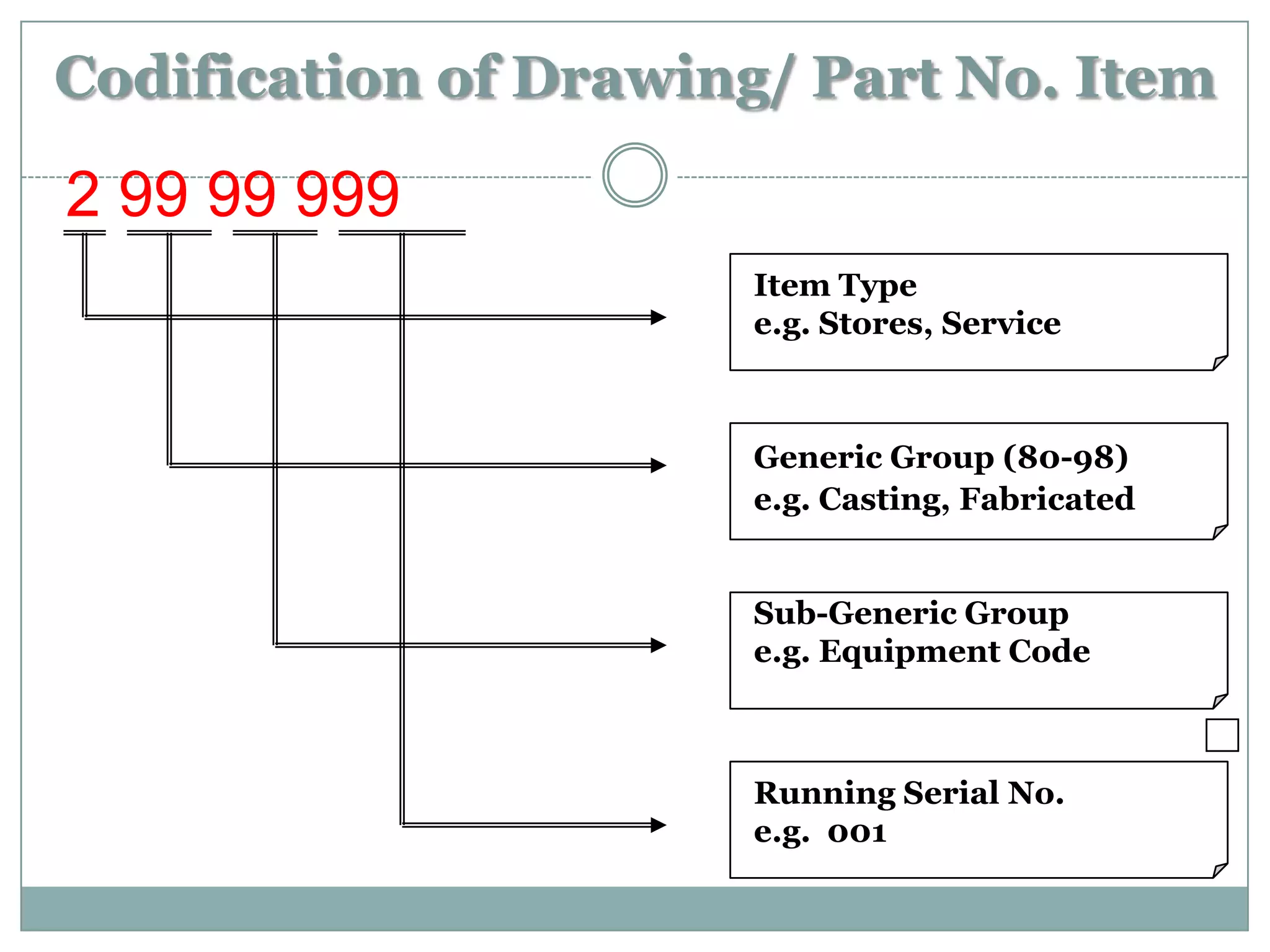
Codification of Drawing/ Part No. Item

2 99 99 999
                      Item Type
                      e.g. Stores, Service


                      Generic Group (80-98)
                      e.g. Casting, Fabricated


                      Sub-Generic Group
                      e.g. Equipment Code


                      Running Serial No.
                      e.g. 001
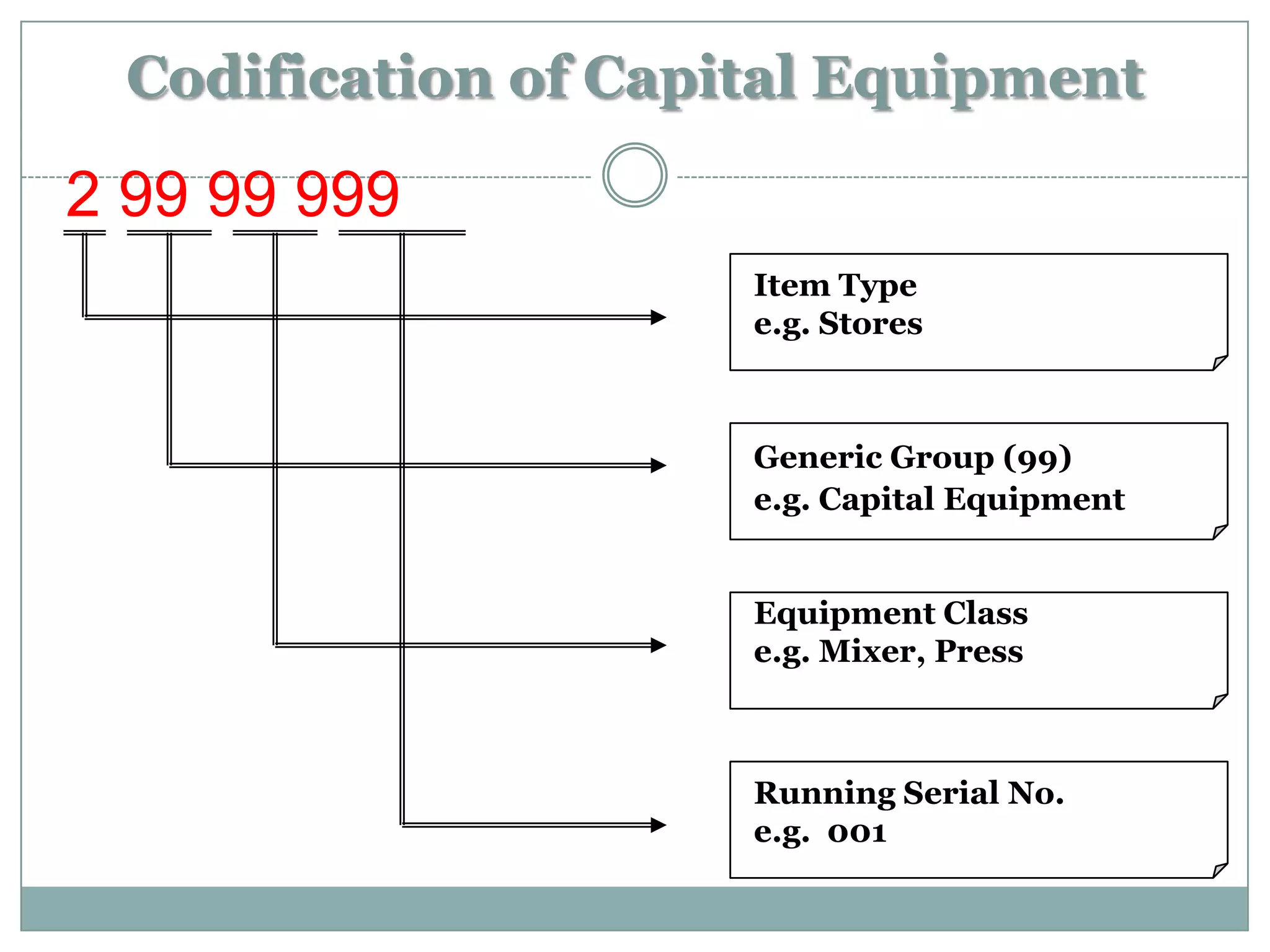
Codification of Capital Equipment

2 99 99 999
                     Item Type
                     e.g. Stores


                     Generic Group (99)
                     e.g. Capital Equipment


                     Equipment Class
                     e.g. Mixer, Press


                     Running Serial No.
                     e.g. 001
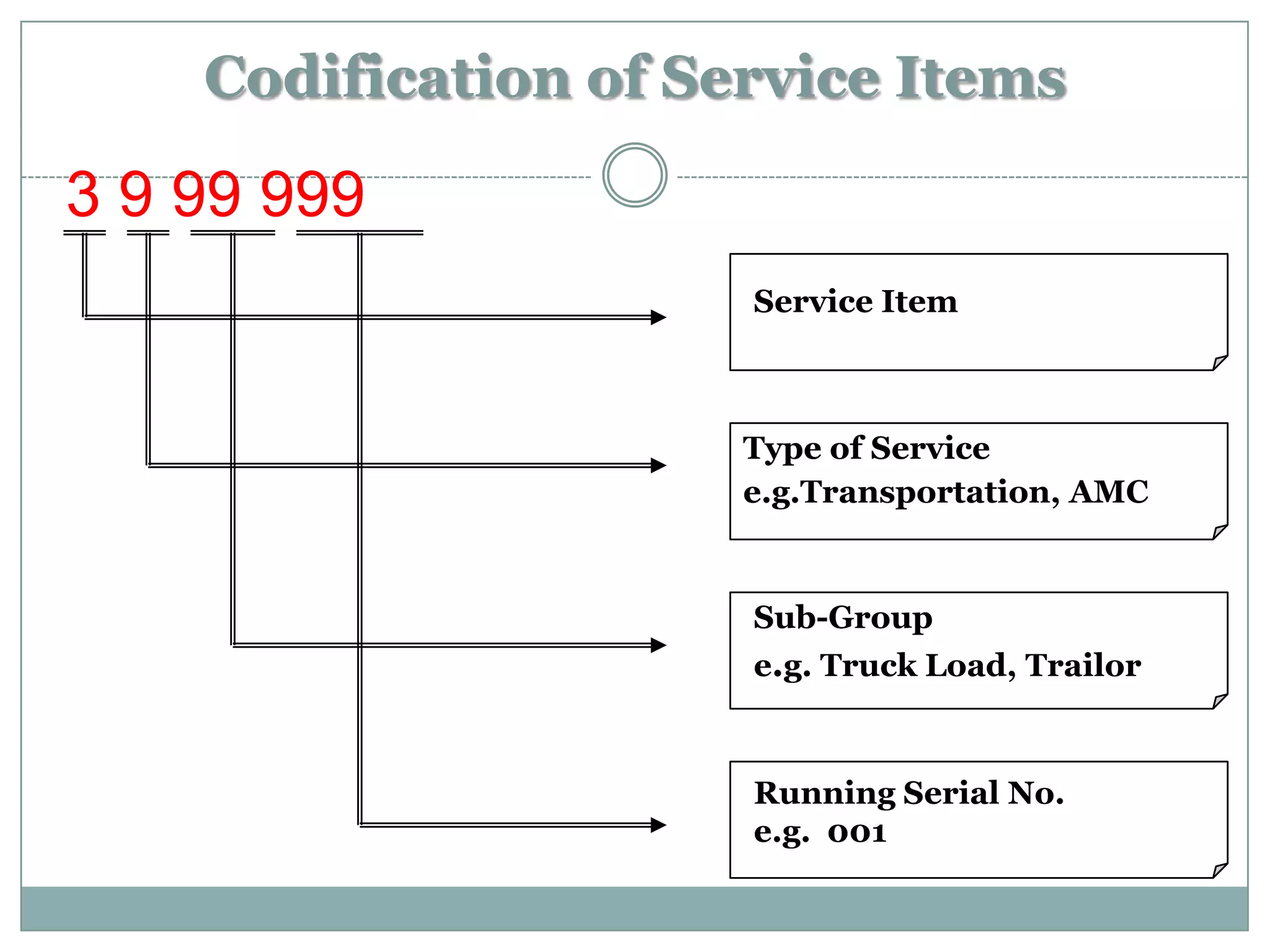
Codification of Service Items

3 9 99 999
                      Service Item


                      Type of Service
                      e.g.Transportation, AMC


                      Sub-Group
                      e.g. Truck Load, Trailor


                      Running Serial No.
                      e.g. 001
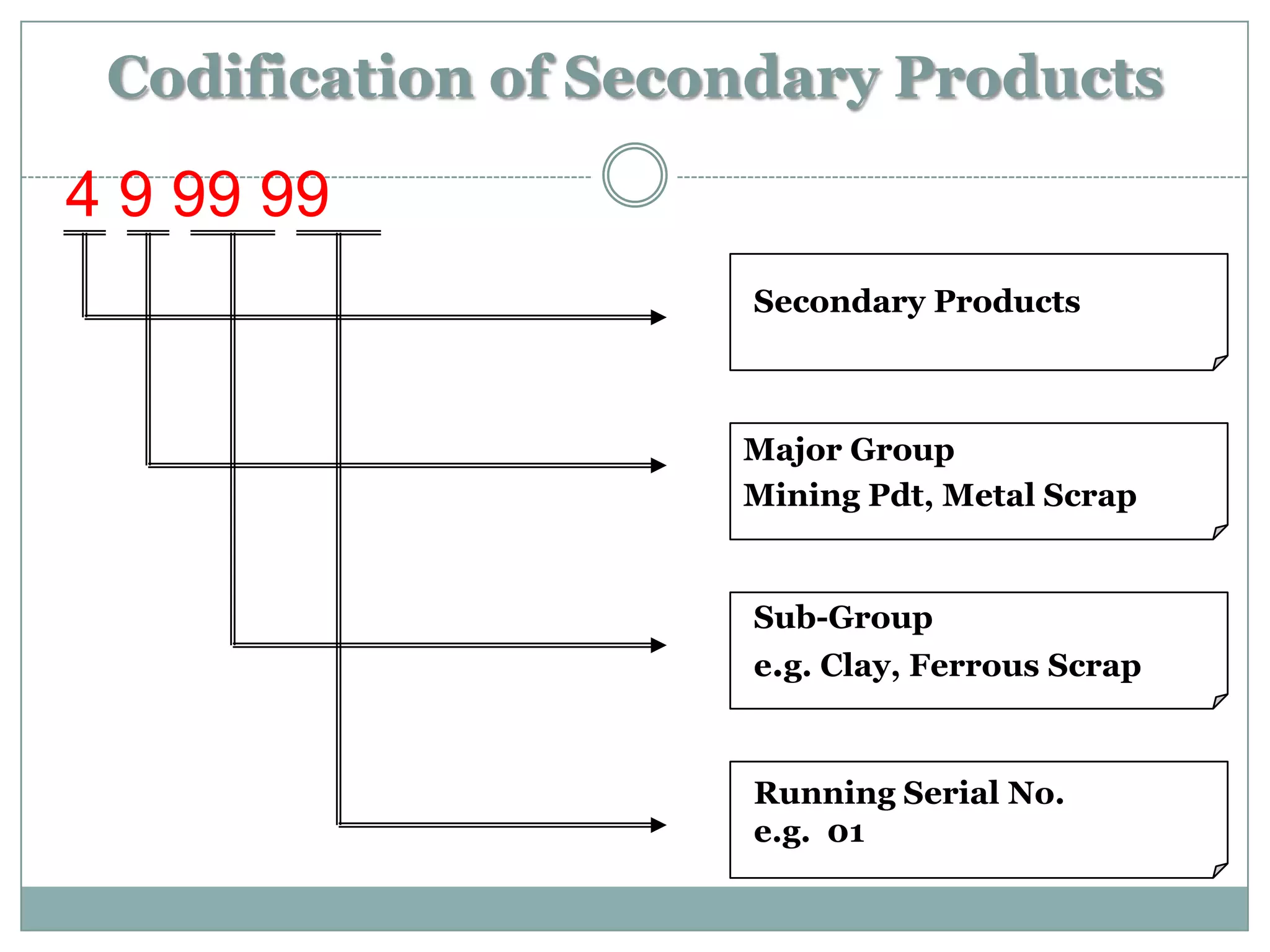
Codification of Secondary Products

4 9 99 99
                     Secondary Products


                     Major Group
                     Mining Pdt, Metal Scrap


                     Sub-Group
                     e.g. Clay, Ferrous Scrap


                     Running Serial No.
                     e.g. 01
Advantages of Codification
                                  22

It enables systematic grouping of similar items and avoids confusion
caused by long description of items since standardization of names is
achieved through codification, it serves as the starting point of
simplification and standardization. It helps in avoiding duplication of
items and results
23

Store management & Codification

  • 1.
    STORE MANAGEMENT & CODIFICATION 1 VARUN VENUGOPALAN MD SAJID
  • 2.
    Store Management: AnIntroduction 2  The term stores, storehouse, warehouse etc refer to the physical place be it a building or a room etc. where materials components, tools, equipment’s and other items are kept.  Stores management is concerned with ensuring that all the activities involved in storekeeping and stock control are carried out efficiently and economically by those employed in the Store.
  • 3.
    Function of Stores 3  Receive raw materials, components, tools, equipment’s and other items and account for them.  Provide adequate and proper storage and preservation to the various items.  Meet the demands of the consuming departments by proper issues and account for the consumption.  Minimize obsolescence, surplus and scrap through proper codification, preservation and handling.  Highlight stock accumulation, discrepancies and abnormal consumption and effect control measures.  Ensure good house keeping so that material handling, material preservation, stocking, receipt and issue can be done adequately.  Assist in verification and provide supporting information for effective purchase action.
  • 4.
    Relationship with otherDepartments 4  The Production Department Stores Department must ensure that all items, materials and tools, as well as spare parts for machinery, are always available for continuous, uninterrupted production. Stores might also have responsibility for quality control and for inspection.
  • 5.
    Relationship with otherDepartment 5  The Sales Department Close liaison is necessary between the Sales and Stores Departments. There is no value in Stores holding stocks of items which the Sales Department cannot sell or items which Stores does not have. An adequate information, based on forecasts of future sales and trends, is required to assist in planning orders, setting stock levels, allocating storage space, etc.
  • 6.
    Relationship with otherDepartments 6  The Purchasing Department Stores must keep Purchasing up to date with information about stock levels, whilst Stores relies on Purchasing to buy all the items and materials needed by the enterprise for its operations.  The Maintenance or Engineering Department This department relies on Stores to have available all the spare parts, tools, equipment and materials required for maintenance. In return it must supply full information to Stores of all long-term and short-term maintenance plans and the items which will be needed.
  • 7.
    Relationship with otherDepartments 7  The Accounts Department This department requires information from Stores about the value of stock held, about any damages or losses, about the receipt of items for which payment has to be made, and about stock issued for various operations, processes or contracts, etc.house
  • 8.
    Codification 8  It is one of the functions of stores management.  A process of representing each item by a number, the digit of which indicates the group, the sub-group, the type and the dimension of the item.  Describes an item in short, thus avoiding long statement every time the need to describe the item arises.
  • 9.
    Objectives of Codification 9  Bringing all items together.  Enable putting up of any future item in its proper place.  Classify an item according to its characteristics.  Give an unique code number to each item to avoid duplication and ambiguity.  Reveal excessive variety and promote standardization and variety reduction.  Establish a common language for the identification of an item.  Fix essential parameters for specifying an item.  Specify item as per national and international standards.  Enable data processing and analysis.
  • 10.
    Basis of codification 10  Who will be the user?  To what use is the codification going to be put?  What kind/degree of mechanization will be needed to use the codification system?
  • 11.
    Codification by GroupClassification  Based on ‘shape’ of items  1. Wire  2. Tubing  3. Rod  4. Bar  5. Sheet  6. strip
  • 12.
    Methods of codingof materials 12  Alphabetical method  Numerical method  Alphabetical-cum-Numerical method
  • 13.
    Alphabetical method 13 In this method first alphabet letters are used for codification of each category of materials. For example, steel wire is coded as SW or steam coal is coded as SC etc.
  • 14.
    Alphabetical-cum-Numerical method 14  In this method, a combination of these two methods is used for coding of materials. For example, a steel wire of gauge 4mm quality A stored in rack/bin No.22, is given the code number SW4A/22. Such a method gives exact information than any of the above two methods.
  • 15.
    Numerical method 15 This method is used where materials accounting is to be mechanized by use of punched cards or computers. For numerical coding a list is prepared for various departments and allotting to each of them a suitable number. The first two digits of the code number represent the department for which the materials are meant and other two digits state the name of material as mentioned in the standard list or materials manual. For example, if code is 2341 it means Material No.41 [copper wire] is to be used in Department No.23.
  • 16.
    Codification of Raw-Material 19 99 99 Raw-Material Generic Group e.g. Magnesite, Alumina Sub-Generic Group e.g.Fused Mag, Fire clay Running Serial No. e.g. 01
  • 17.
    Codification of GenericItem 2 99 99 999 Item Type e.g. Stores Generic Group (00-70) e.g. Bearing, Switchgear Sub-Generic Group e.g. Ball Bearing Running Serial No. e.g. 201
  • 18.
    Codification of Drawing/Part No. Item 2 99 99 999 Item Type e.g. Stores, Service Generic Group (80-98) e.g. Casting, Fabricated Sub-Generic Group e.g. Equipment Code Running Serial No. e.g. 001
  • 19.
    Codification of CapitalEquipment 2 99 99 999 Item Type e.g. Stores Generic Group (99) e.g. Capital Equipment Equipment Class e.g. Mixer, Press Running Serial No. e.g. 001
  • 20.
    Codification of ServiceItems 3 9 99 999 Service Item Type of Service e.g.Transportation, AMC Sub-Group e.g. Truck Load, Trailor Running Serial No. e.g. 001
  • 21.
    Codification of SecondaryProducts 4 9 99 99 Secondary Products Major Group Mining Pdt, Metal Scrap Sub-Group e.g. Clay, Ferrous Scrap Running Serial No. e.g. 01
  • 22.
    Advantages of Codification 22 It enables systematic grouping of similar items and avoids confusion caused by long description of items since standardization of names is achieved through codification, it serves as the starting point of simplification and standardization. It helps in avoiding duplication of items and results
  • 23.