PREPARATION AND IMPORTANCE
OF A STORES MANUAL
Navindu Munidasa
MSc Logistics and Supply Chain (UK) (Reading); BSc Operations and Logistics
Management (UK); Dip in Computer Hardware and Networking ; Certificate in Motor
Mechanism (CGTTI); Certificate in Workshop Practices (CGTTI)
WHAT IS A SOP?
• Standard operating procedures are written, step-by-step instructions that describe how to perform a
routine activity.
• Employees should complete them in the exact same way every time so that the business can remain
consistent. Standard operating procedures help maintain safety and efficiency for departments such
as:
• Production/operations
• Sales and customer service
• Employee training
• Legal
• Financial
• A standing operating procedure should never be difficult to read or vaguely worded. It should be
brief, easy to understand and contain actions steps that are simple follow. A good standard operating
procedure should clearly outline the steps and inform the employee of any safety concerns.
• The standing operating procedures should be the basis for training any new employees. They should
also be updated every year to ensure they stay relevant to the current needs of the organization
KEY BENEFITS OF A SOP
1. Reduced learning curve/training time for new employees
When someone is new on the job, your well-written and researched SOP can be a lifeline to them to
be able to know how things work. For instance, you can ask your new employee to make all the
arrangements for you to organize and attend a workshop in another city. By referring to the SOP,
your new employee will know exactly which travel agency you use with their contact details, which
type of car to hire/service to use, how many quotes to get regarding the venue, how to
communicate with the workshop delegates, etc. without having to ask you about it all. It’s a great
time-saver and confidence booster for the new employee.
2. Ensured business continuity
When a key staff member is on leave or not in the office for some reason, work does not have to
stand still. By referring to the SOP someone else can take over the urgent tasks and do them
correctly the first time.
3. Standardized processes
The SOP makes it easy to find out what policies and procedures are in place to handle repetitive
situations/tasks.
4. Delegating tasks becomes a no-brainer
A good SOP will include the organogram of the business, as well as have a short job
description and contact details for each staff member. If you need to delegate a certain task,
you can see at a glance who will be able to help you or advise you. You can stop
micromanaging, as it is clear who is responsible for what.
5. Ensure that your clients are getting the best possible experience with
you
Because there is a standard way of dealing with client queries, refunds, promotions, follow-
up etc., you can make sure that each client is treated fairly and equally, enhancing their
interactions with you. You thus provide the best possible client service.
A SOP is a living document, which is subject to change. (It is good to review it quarterly). It
is therefore useful to have it in electronic format on a web-based collaborative system so
that all employees have access to the latest version.
EXPECTATIONS
OF A STORES
MANUAL
Guiding the activities of
the stores
Defining the tasks and
responsibilities
Setting out the
procedures for each of the
tasks & activity. (E.g.
sourcing)
As a training manual for
new recruits
As guide in respect of
routine decisions
Set out the limits of
authority of different
hierarchical levels
A guide for relationships
with other units of the
organization
A source book for formats
of all forms & documents
used
A source book of code
numbers & description of
materials
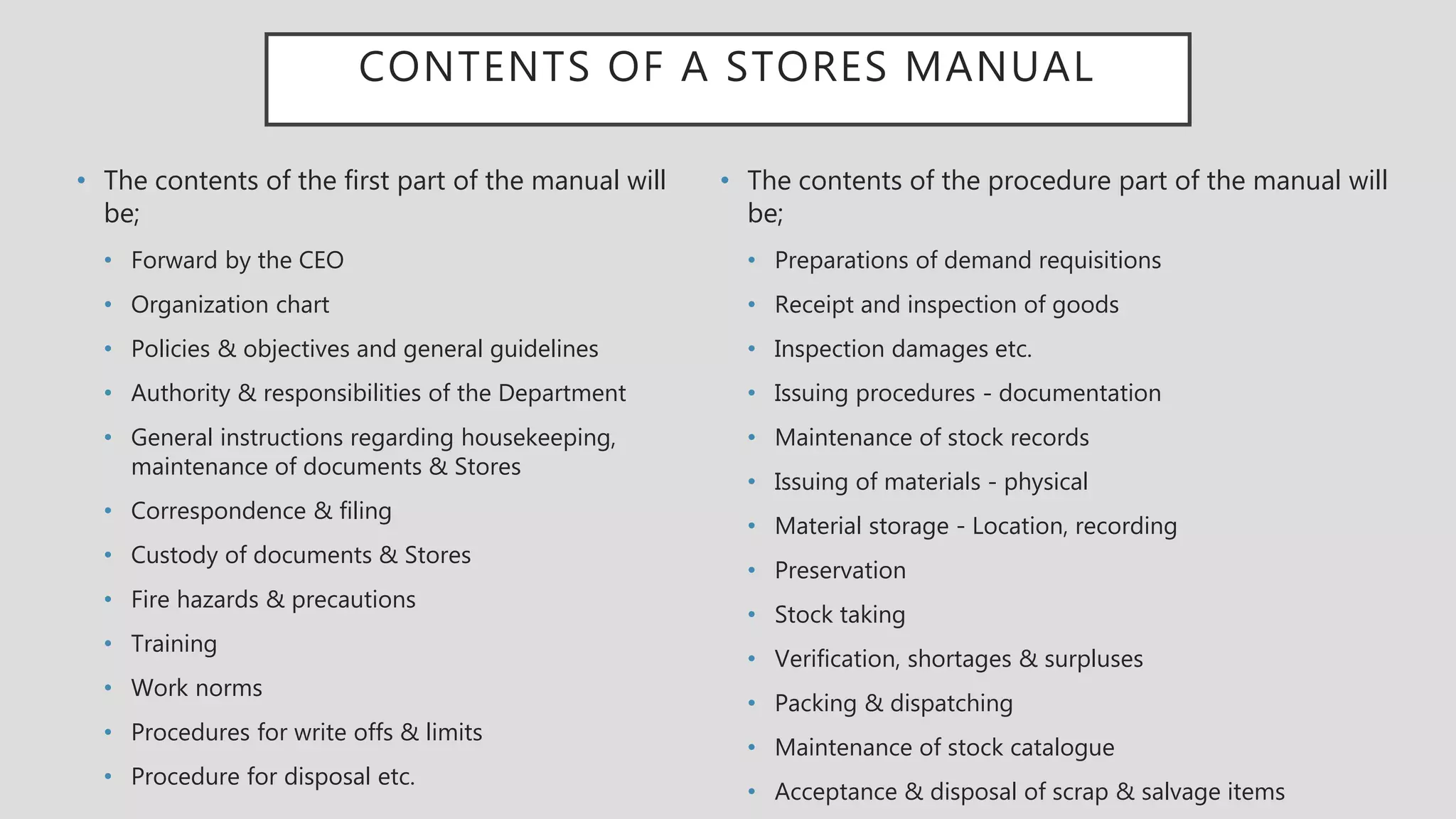
CONTENTS OF A STORES MANUAL
• The contents of the first part of the manual will
be;
• Forward by the CEO
• Organization chart
• Policies & objectives and general guidelines
• Authority & responsibilities of the Department
• General instructions regarding housekeeping,
maintenance of documents & Stores
• Correspondence & filing
• Custody of documents & Stores
• Fire hazards & precautions
• Training
• Work norms
• Procedures for write offs & limits
• Procedure for disposal etc.
• The contents of the procedure part of the manual will
be;
• Preparations of demand requisitions
• Receipt and inspection of goods
• Inspection damages etc.
• Issuing procedures - documentation
• Maintenance of stock records
• Issuing of materials - physical
• Material storage - Location, recording
• Preservation
• Stock taking
• Verification, shortages & surpluses
• Packing & dispatching
• Maintenance of stock catalogue
• Acceptance & disposal of scrap & salvage items
ADDITIONAL ANNEXURES
TO THE STORES MANUAL
• If inventory control comes under the purview of
the stores administration, the procedures for the
following may be included;
• What to stock
• Forecasting & consolidation of requirements
• Determinations of levels
• Recoupment of stock items
• Inventory control by value
• Relationship with purchasing
ADDITIONAL ANNEXURES
TO THE STORES MANUAL
• If stores accounting comes under the purview of
the stores administration, the procedures for the
following may be included;
• Procedures for entering records & filing of
documents
• Pricing for issue
• Reconciling stock records with physical stocks
• Verification / Stocktaking
• Stock adjustments etc.
ANNEXURES TO BE
INCLUDED TO THE
STORES MANUAL
Duties & responsibilities
of personnel
Copies of forms &
documents
Performance Indicator
Flow charts of
procedures
Procedure for retention
& destruction of
documents
Schedule of returns &
reports
IMPLEMENTATION OF THE SOP
• Implementation may be carried out in several stages, without destruction to
the flow of materials or loss of data. If manual systems are computerized, a
period of parallel run should be there and the manual system should cease
operation only if the computer system works satisfactorily. The
implementation need to be planned and effectively supervised.
• Familiarize the contents of the manual by short course of lectures and hands on practices.
• A programme for implementation has to be agreed with those concerned and target
dates fixed.
• Arrange regular progress review meetings and agree on what to do next
• Consider practical problems encountered and decide and agree on changes considered
necessary.
1.Study the nature of the
organization, its policies,
objectives, culture, beliefs etc.
Study the structure of the
whole organization and that
of the stores in particular.
Find out the level of
computerization. What
records and kept in the
computer and what
documents & reports are
generated. Is it a integrated
system or a stand alone
system for the stores only ?
Discuss with the stores
personnel and those in the
interfacing branches, and
ascertain the tasks,
responsibilities &
relationships vis a other
branches and the perceived
difficulties.
If there is an existing manual
get a copy of it & pursue.
Collect copies of all
documents / instructions /
forms / documents used in
the stores. (No. of copies &
distribution). These may be
from Purchasing, Quality
Control, Purchase, Finance
etc.
Study and sort which are
current and obsolete.
Discard obsolete ones.
Discuss with all officials
concerned (e.g. Finance,
Production) the current
documents.
Visit various stores / sub-
stores and note the current
practices and any deviations.
Are any informal documents
maintained ? If so, ascertain
the need for such documents.
Flow charts of different
procedures may be prepared
of the in situ condition.
Check on the format of
existing forms and other
documents. Is there any
possibility of eliminating
them ? Simplify them ? Are
the number of copies
necessary ? What does the
recipient of the copies do
STEPS IN REGARD TO PREPARATION OF A STORES MANUAL
POINTS TO BE NOTED
WHEN PREPARATION
OF FINAL SOP
Use simple clear language
and be precise to suit those
are likely to use the manual
(Sinhala / Tamil)
Follow a logical order
Define technical terms if
necessary
Have an index
Avoid repetitions
Use flow charts wherever
possible
Are the computer
generated documents clear
?
THANK YOU

Preparation and importance of a stores manual

  • 1.
    PREPARATION AND IMPORTANCE OFA STORES MANUAL Navindu Munidasa MSc Logistics and Supply Chain (UK) (Reading); BSc Operations and Logistics Management (UK); Dip in Computer Hardware and Networking ; Certificate in Motor Mechanism (CGTTI); Certificate in Workshop Practices (CGTTI)
  • 2.
    WHAT IS ASOP? • Standard operating procedures are written, step-by-step instructions that describe how to perform a routine activity. • Employees should complete them in the exact same way every time so that the business can remain consistent. Standard operating procedures help maintain safety and efficiency for departments such as: • Production/operations • Sales and customer service • Employee training • Legal • Financial • A standing operating procedure should never be difficult to read or vaguely worded. It should be brief, easy to understand and contain actions steps that are simple follow. A good standard operating procedure should clearly outline the steps and inform the employee of any safety concerns. • The standing operating procedures should be the basis for training any new employees. They should also be updated every year to ensure they stay relevant to the current needs of the organization
  • 3.
    KEY BENEFITS OFA SOP 1. Reduced learning curve/training time for new employees When someone is new on the job, your well-written and researched SOP can be a lifeline to them to be able to know how things work. For instance, you can ask your new employee to make all the arrangements for you to organize and attend a workshop in another city. By referring to the SOP, your new employee will know exactly which travel agency you use with their contact details, which type of car to hire/service to use, how many quotes to get regarding the venue, how to communicate with the workshop delegates, etc. without having to ask you about it all. It’s a great time-saver and confidence booster for the new employee. 2. Ensured business continuity When a key staff member is on leave or not in the office for some reason, work does not have to stand still. By referring to the SOP someone else can take over the urgent tasks and do them correctly the first time. 3. Standardized processes The SOP makes it easy to find out what policies and procedures are in place to handle repetitive situations/tasks.
  • 4.
    4. Delegating tasksbecomes a no-brainer A good SOP will include the organogram of the business, as well as have a short job description and contact details for each staff member. If you need to delegate a certain task, you can see at a glance who will be able to help you or advise you. You can stop micromanaging, as it is clear who is responsible for what. 5. Ensure that your clients are getting the best possible experience with you Because there is a standard way of dealing with client queries, refunds, promotions, follow- up etc., you can make sure that each client is treated fairly and equally, enhancing their interactions with you. You thus provide the best possible client service. A SOP is a living document, which is subject to change. (It is good to review it quarterly). It is therefore useful to have it in electronic format on a web-based collaborative system so that all employees have access to the latest version.
  • 5.
    EXPECTATIONS OF A STORES MANUAL Guidingthe activities of the stores Defining the tasks and responsibilities Setting out the procedures for each of the tasks & activity. (E.g. sourcing) As a training manual for new recruits As guide in respect of routine decisions Set out the limits of authority of different hierarchical levels A guide for relationships with other units of the organization A source book for formats of all forms & documents used A source book of code numbers & description of materials
  • 6.
    CONTENTS OF ASTORES MANUAL • The contents of the first part of the manual will be; • Forward by the CEO • Organization chart • Policies & objectives and general guidelines • Authority & responsibilities of the Department • General instructions regarding housekeeping, maintenance of documents & Stores • Correspondence & filing • Custody of documents & Stores • Fire hazards & precautions • Training • Work norms • Procedures for write offs & limits • Procedure for disposal etc. • The contents of the procedure part of the manual will be; • Preparations of demand requisitions • Receipt and inspection of goods • Inspection damages etc. • Issuing procedures - documentation • Maintenance of stock records • Issuing of materials - physical • Material storage - Location, recording • Preservation • Stock taking • Verification, shortages & surpluses • Packing & dispatching • Maintenance of stock catalogue • Acceptance & disposal of scrap & salvage items
  • 7.
    ADDITIONAL ANNEXURES TO THESTORES MANUAL • If inventory control comes under the purview of the stores administration, the procedures for the following may be included; • What to stock • Forecasting & consolidation of requirements • Determinations of levels • Recoupment of stock items • Inventory control by value • Relationship with purchasing
  • 8.
    ADDITIONAL ANNEXURES TO THESTORES MANUAL • If stores accounting comes under the purview of the stores administration, the procedures for the following may be included; • Procedures for entering records & filing of documents • Pricing for issue • Reconciling stock records with physical stocks • Verification / Stocktaking • Stock adjustments etc.
  • 9.
    ANNEXURES TO BE INCLUDEDTO THE STORES MANUAL Duties & responsibilities of personnel Copies of forms & documents Performance Indicator Flow charts of procedures Procedure for retention & destruction of documents Schedule of returns & reports
  • 10.
    IMPLEMENTATION OF THESOP • Implementation may be carried out in several stages, without destruction to the flow of materials or loss of data. If manual systems are computerized, a period of parallel run should be there and the manual system should cease operation only if the computer system works satisfactorily. The implementation need to be planned and effectively supervised. • Familiarize the contents of the manual by short course of lectures and hands on practices. • A programme for implementation has to be agreed with those concerned and target dates fixed. • Arrange regular progress review meetings and agree on what to do next • Consider practical problems encountered and decide and agree on changes considered necessary.
  • 11.
    1.Study the natureof the organization, its policies, objectives, culture, beliefs etc. Study the structure of the whole organization and that of the stores in particular. Find out the level of computerization. What records and kept in the computer and what documents & reports are generated. Is it a integrated system or a stand alone system for the stores only ? Discuss with the stores personnel and those in the interfacing branches, and ascertain the tasks, responsibilities & relationships vis a other branches and the perceived difficulties. If there is an existing manual get a copy of it & pursue. Collect copies of all documents / instructions / forms / documents used in the stores. (No. of copies & distribution). These may be from Purchasing, Quality Control, Purchase, Finance etc. Study and sort which are current and obsolete. Discard obsolete ones. Discuss with all officials concerned (e.g. Finance, Production) the current documents. Visit various stores / sub- stores and note the current practices and any deviations. Are any informal documents maintained ? If so, ascertain the need for such documents. Flow charts of different procedures may be prepared of the in situ condition. Check on the format of existing forms and other documents. Is there any possibility of eliminating them ? Simplify them ? Are the number of copies necessary ? What does the recipient of the copies do STEPS IN REGARD TO PREPARATION OF A STORES MANUAL
  • 12.
    POINTS TO BENOTED WHEN PREPARATION OF FINAL SOP Use simple clear language and be precise to suit those are likely to use the manual (Sinhala / Tamil) Follow a logical order Define technical terms if necessary Have an index Avoid repetitions Use flow charts wherever possible Are the computer generated documents clear ?
  • 13.