
By
R.PradeepRaj
(pradeeprajr93@gmail.com)







STORAGE DEVICES AND ITS TYPES
HDD AND SSD(FLASH)
INTERFACING
NEW TRENDS
PROS AND CONS
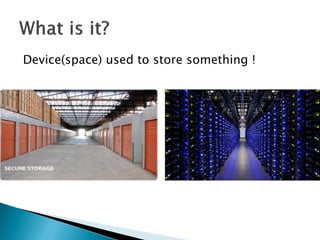
Device(space) used to store something !


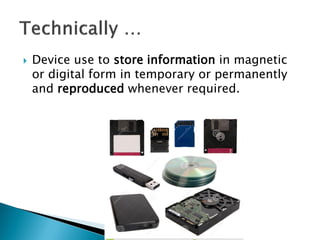
Device use to store information in magnetic
or digital form in temporary or permanently
and reproduced whenever required.
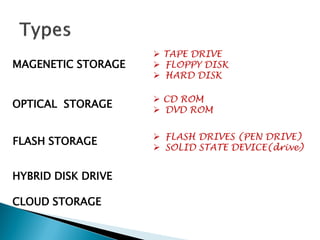
MAGENETIC STORAGE

 TAPE DRIVE
 FLOPPY DISK
 HARD DISK

OPTICAL STORAGE

 CD ROM
 DVD ROM

FLASH STORAGE

 FLASH DRIVES (PEN DRIVE)
 SOLID STATE DEVICE(drive)

HYBRID DISK DRIVE
CLOUD STORAGE
•

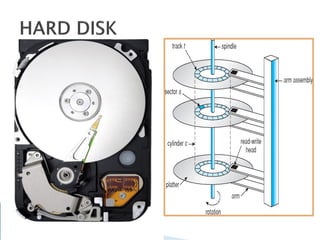
.Disk

spins 120 times per second (7200
RPM/60)

•

Each spin transfers a track of 80 KB (160
sectors x0.5K)

•

Sustained average transfer rate is 120x80 =
9.6MB/s.
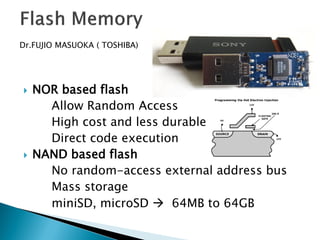
Dr.FUJIO MASUOKA ( TOSHIBA)





NOR based flash
Allow Random Access
High cost and less durable
Direct code execution
NAND based flash
No random-access external address bus
Mass storage
miniSD, microSD  64MB to 64GB


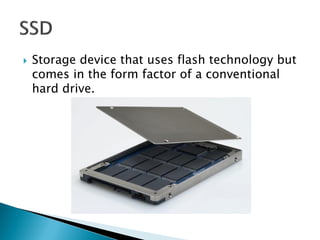
Storage device that uses flash technology but
comes in the form factor of a conventional
hard drive.


Wear levelling
◦ Counting writes & dynamically remapping blocks



Bad block management
◦ Write verification and remapping bad sectors



Multi-Level Cell technology
◦ Memory cells store more than one bit
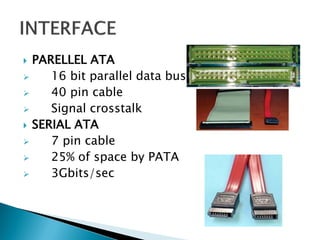
PARELLEL ATA

16 bit parallel data bus

40 pin cable

Signal crosstalk
 SERIAL ATA

7 pin cable

25% of space by PATA

3Gbits/sec



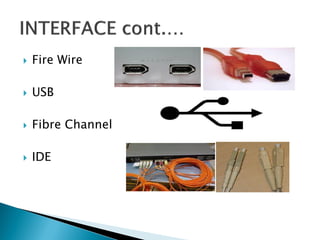
Fire Wire



USB



Fibre Channel



IDE





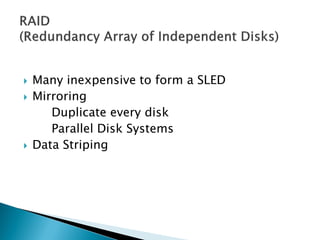
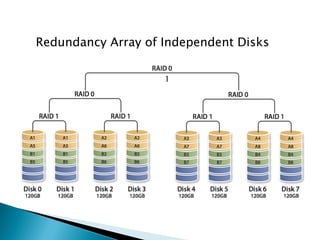
Many inexpensive to form a SLED
Mirroring
Duplicate every disk
Parallel Disk Systems
Data Striping
Selecting a RAID Level
•

RAID 0 – High-Performance applications where
data loss is not critical

•

RAID 1 – High Reliability with fast recovery

•

RAID 5 – Preferred for storing large volumes of
data

•

RAID 10-High fault tolerant & Expensive
Redundancy Array of Independent Disks
1
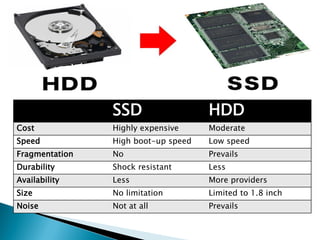
SSD

HDD

Cost

Highly expensive

Moderate

Speed

High boot-up speed

Low speed

Fragmentation

No

Prevails

Durability

Shock resistant

Less

Availability

Less

More providers

Size

No limitation

Limited to 1.8 inch

Noise

Not at all

Prevails


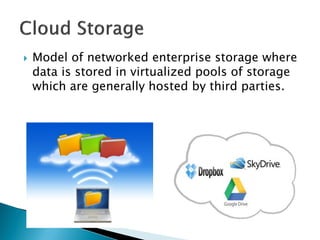
Model of networked enterprise storage where
data is stored in virtualized pools of storage
which are generally hosted by third parties.
PradeepRaj
By R.Pradeepraj
QUESTIONS ?

Storage devices