Storage Devices
Of
Computer
Lecture 8,9,10
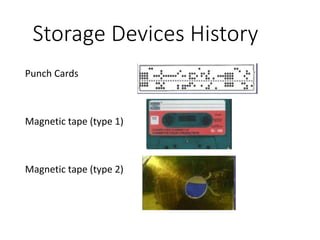
Storage Devices History
Punch Cards
Magnetic tape (type 1)
Magnetic tape (type 2)
Basic unit of data storage
1. Bit
Computer works with binary digits. These digits are in the form of 0's and 1's. A
binary digit is called bit. One bit takes one storage location in memory. It is the
smallest unit for data storage.
2. Byte
A collection of eight bits is called byte. It is used to store single character. The
capacity of the memory or the storage is expressed in terms of bytes.
3. Kilobyte
A kilobyte consists of 1024 bytes. It is denoted by KB.
4. Megabyte
A megabyte consists of 1024 kilobytes. It is denoted by MB.
5. Gigabyte
A gigabyte consists of 1024 megabytes. It is denoted by GB.
6. Terabyte
A terabyte consists of 1024 gigabytes. Itis denoted by TB.
Storage
Computer data storage, often called storage or memory,
is a technology consisting of computer components and
recording media used to retain digital data. It is a core
function and fundamental component of computers
Storage is required for following reason:
• The main memory is temporary memory. the storage is
required to store data and programs permanently.
• The capacity is limited. The storage is required to store a
large amount of data and program.
Types Of Storage Devices
• Primary Storage Devices
RAM
ROM,PROM,EPROM,EEPROM
• Secondary Storage Devices
Hard disk, CD, DVD etc
Data Access Methods
Different methods of accessing data are following:
1-Random access memory.
2-Sequential access memory.
Random access memory:
1. Direct (out of sequence or random) access by a computer
(CPU) means that data
2. can be retrieved directly from any location on a storage
medium in any order.
3. More precisely called Direct Access. A random-access
data file enables you to
4. read or write information anywhere in the file.
5. All storage devices used today are random access devices:
• CD/DVD Drives
• USB Flash Drives
RAM
ROM
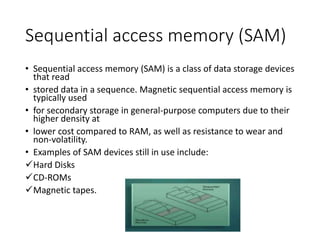
Sequential access memory (SAM)
• Sequential access memory (SAM) is a class of data storage devices
that read
• stored data in a sequence. Magnetic sequential access memory is
typically used
• for secondary storage in general-purpose computers due to their
higher density at
• lower cost compared to RAM, as well as resistance to wear and
non-volatility.
• Examples of SAM devices still in use include:
Hard Disks
CD-ROMs
Magnetic tapes.
HARD DISK
A hard disk is part of a unit, often called a "disk drive," "hard drive,"
or "hard disk drive," that stores and provides relatively quick access
to large amounts of data on an electromagnetically charged surface
or set of surfaces. Today's computers typically come with a hard
disk that contains several billion bytes (gigabytes) of storage.
A hard disk is really a set of stacked "disks," each of which, like
phonograph records, has data recorded electromagnetically in
concentric circles or "tracks" on the disk. AA "head" records or
reads the information on the tracks. Two heads, one on each side of
a disk, read or write the data as the disk spins. Each read or write
operation requires that data be located, which is an operation
called a "seek."
HARD DISK PERFORMNCE
The following factors affect the performance of hard disc
SEEK TIME
It is also called positioning performance. It is time required by
read/write head to reach the correct location on the disk. it is
measured in milliseconds.
SPINDLE SPEED
It is also called transfer performance. It is the speed at which the
drive transfers data.It is measured in revolutions per minute (RPM).
LATENCY
It is the time required by the spinning platter to bring the desired
data to read/write head. It is measured in milliseconds.
EXTERNAL AND REMOVABLE
HARD DISK
An external hard disk is a separate hard disk that is connected to
UsB port or FireWire port on system unit. The advantage of
external hard disk is that it can be installed without opening the
system unit. The storage capacity of external hard disk
is upto 4TB and more.
ADVANTAGES
Some important advantages are as following.
a. These can be used to transfer large number of files from one
place to another.
b. These disk can store large number of audio and video files
easily.
c. These disk can be use ire internal hard disk.
MINIATURE HARD DISKS
The miniature hard disc are very small hard disks. These disks are available
in different sizes such as 0.85 inch or 1 inch or 1.8 inch. Both internal and
external hard disks are available in miniature sizes.
These devices such as portable media player, digital camera, smartphones
usually have internal miniature hard disks. The storage capacity of
miniature hard disk is from
1GB to 320GB.
Magnetic Disks
A magnetic disk is a storage device that uses a magnetization process to
write, rewrite and access data. It is covered with a magnetic coating and
stores data in the form of tracks, spots and sectors. Tracks form circles on
the surface of a magnetic disk. Each track on a disc is divided into two
sectors. Each sector typically stores up to 512 bytes of data. Hard disks, zip
disks and floppy disks are common examples of magnetic disks.
DISK CACHE
Disk caching is often used to speed up magnetic hard drive
performance. Today’s hard drives typically use a disk cache consisting
of memory chips that is located on circuit board inside the hard drive
case.
The computer copies the requested data to the disk cache any time the
hard drive is accessed.
OPTICAL DISC
Optical disc is a form of removable storage. It includes CDs , DVDs and blue
ray discs,Optical drives use a laser to read and write data on optical disc.
The laser stands for Light Amplification through Stimulated Emission of
Radiation. Laser beam writes on the surface by creating small pit (hole) in
the disc. Optical disc commonly store data in single track. Optical disc
storage capacity is from 700 MB to several GB.The main catagories of
optical disc are CD and DVD.
DVD
DVD stands for Digital Video Disc. The storage
capacity of DVD is much greaterthan CD. It can store
up to 17 GB of data. DVDs are available in three
types whichare read-only recordable and rewritable.
TYPES:
1-DVD-ROMDVD-ROM stands for Digital Video Disc
Read Only Memory. It is high capacityoptical disc that
the users can only read but not write or erase.
2-DVD-RDVD-R stands for Digital Video Disc
Recordable. It is similar to CD-R disc. Thewritten data
cannot be erased.
3-DVD-RW
• DVD-RW stands for Digital Video Disc Rewritable.
The user can write data on CD-RW many times by
erasing the existing contents.
BLU-RAY DISC
Blu-Ray disc is a new and more expensive DVD
format. It provides higher capacity and better quality
than standards DVDs especially for high-definition
video. It can store up to 100 GB of data.
CD
• CD stands for Compact Disc. It is mainly used to store photos, audio and computer
software. CDs are available in three types which are read only recordable and
rewriteable. Different types of CDs are as follows.
1-CD-ROM
CD-ROM stands for Compact DISC Read-Only Memory. The data stored on CD-ROMcan
only be read. It cannot be deleted or changed. It can store up to 700MB of data.
USES OF CD-ROM
CD-ROM is mostly used to store photos and audios.It is often used to distribute new
application software and games.
ADVANTGES OF CD-ROM
It is the least expensive way to store data and information.CD-ROM discs are durable
and easy to handle.
DISTAVANTAGES OF CD-ROM
The data cannot be edited.VIt retrieves data and information more slowly than
magnetic hard disk.
2-CD-R
CD-R stands for CD Recordable. The user can write
data on CD-R only once but can read it many times.
The data written on CD-R cannot be erased. CD-R
drives are known as CD burners. The process of
recording data on CD-R is called burning.
CD-R is known as WORM (Write Once Read Many).
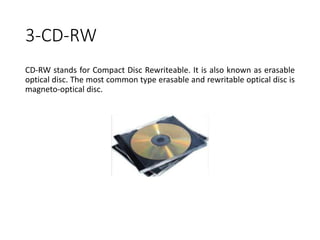
3-CD-RW
CD-RW stands for Compact Disc Rewriteable. It is also known as erasable
optical disc. The most common type erasable and rewritable optical disc is
magneto-optical disc.
Flash memory Storage
Flash memory is a solid-state chip that maintains stored data without any
external power source. It is commonly used in portable electronics and
removable storage devices, and to replace computer hard drive Flash
memory is widely use in smart phone, digital camera, portable media
player.
Types of flash memory:
Solid state drives
The newest flash memory application, SSDs can replace a computer's hard
drive.They have no moving parts, so mechanical failure is near zero. Solid-
state drivesare quieter and smaller than hard drives, and they provide
faster response, accessand boot-up times but consume much less power
and run cooler.
Advantages:
Provide faster data access and data transfer.
They do not generate noise.
Security- allowing a very quick scan of all data stored.
Some of the storage devices are waterproof.
Disadvantages:
Price solid state drives are more expensive than magnetic hard drive.
Recovery of data in case of failure can be more difficult than magnetic
hard drive.
Security digital Memory Cards
SDXC
• Security digital extended capacity is commonly
used in digital cameras. It provides the storage
capacity of 32GB upto2TB.
Secure Digital Card (SD card)
SD cards are used in many small portable devices
such as digital video camcorders, digital cameras,
handheld computers, audio players and mobile
phones.SD Memory Cards are now available in
capacities between 16 Megabytes and 1 Gigabyte,
and still growing. It provide a storage capacity up to
32GB.
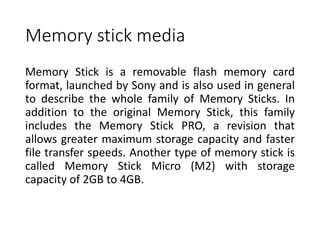
Memory stick media
Memory Stick is a removable flash memory card
format, launched by Sony and is also used in general
to describe the whole family of Memory Sticks. In
addition to the original Memory Stick, this family
includes the Memory Stick PRO, a revision that
allows greater maximum storage capacity and faster
file transfer speeds. Another type of memory stick is
called Memory Stick Micro (M2) with storage
capacity of 2GB to 4GB.
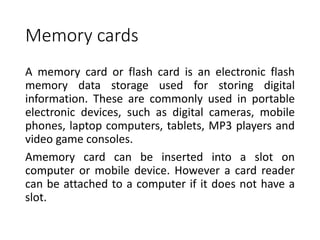
Memory cards
A memory card or flash card is an electronic flash
memory data storage used for storing digital
information. These are commonly used in portable
electronic devices, such as digital cameras, mobile
phones, laptop computers, tablets, MP3 players and
video game consoles.
Amemory card can be inserted into a slot on
computer or mobile device. However a card reader
can be attached to a computer if it does not have a
slot.
Types:
Compact Flash (CF)
Invented by SanDisk Corporation in 1994, Compact Flash cards can support 3.3V
and 5V operation and can switch between the two, in contrast to other small-form
factor flash memory cards that can operate only at one voltage. The storage
capacity of compact flash can be from 8GB to 512GB.
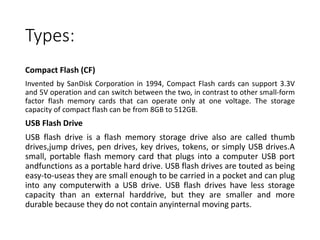
USB Flash Drive
USB flash drive is a flash memory storage drive also are called thumb
drives,jump drives, pen drives, key drives, tokens, or simply USB drives.A
small, portable flash memory card that plugs into a computer USB port
andfunctions as a portable hard drive. USB flash drives are touted as being
easy-to-useas they are small enough to be carried in a pocket and can plug
into any computerwith a USB drive. USB flash drives have less storage
capacity than an external harddrive, but they are smaller and more
durable because they do not contain anyinternal moving parts.
Wireless flash drive
Wireless flash drive is used to store and share data
wirelessly across mobile devices and computers. It is
portable and very easy to use It connects wirelessly
up to eight drives and stream video at the same time
via Wi-Fi. Wireless flash drives are available in 16GB,
32GB and 64GB
Example: San Disk Connect.
Zip Disk
The Zip drive is a medium-to-high-capacity
removable floppy disk storage system (for its period
of contemporary use) that was introduced by lomega
in late 1994.
Originally Zip disks launched with capacities of 100
MB, but later versions increased this to first 250 MB
and then 750 MB.
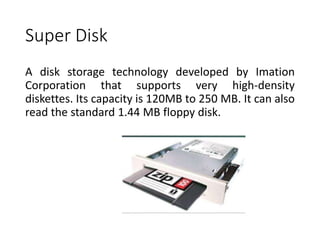
Super Disk
A disk storage technology developed by Imation
Corporation that supports very high-density
diskettes. Its capacity is 120MB to 250 MB. It can also
read the standard 1.44 MB floppy disk.

Storage_Devices-WPS_Office.pptx

  • 1.
  • 2.
    Storage Devices History PunchCards Magnetic tape (type 1) Magnetic tape (type 2)
  • 3.
    Basic unit ofdata storage 1. Bit Computer works with binary digits. These digits are in the form of 0's and 1's. A binary digit is called bit. One bit takes one storage location in memory. It is the smallest unit for data storage. 2. Byte A collection of eight bits is called byte. It is used to store single character. The capacity of the memory or the storage is expressed in terms of bytes. 3. Kilobyte A kilobyte consists of 1024 bytes. It is denoted by KB. 4. Megabyte A megabyte consists of 1024 kilobytes. It is denoted by MB. 5. Gigabyte A gigabyte consists of 1024 megabytes. It is denoted by GB. 6. Terabyte A terabyte consists of 1024 gigabytes. Itis denoted by TB.
  • 4.
    Storage Computer data storage,often called storage or memory, is a technology consisting of computer components and recording media used to retain digital data. It is a core function and fundamental component of computers Storage is required for following reason: • The main memory is temporary memory. the storage is required to store data and programs permanently. • The capacity is limited. The storage is required to store a large amount of data and program.
  • 5.
    Types Of StorageDevices • Primary Storage Devices RAM ROM,PROM,EPROM,EEPROM • Secondary Storage Devices Hard disk, CD, DVD etc
  • 6.
    Data Access Methods Differentmethods of accessing data are following: 1-Random access memory. 2-Sequential access memory.
  • 7.
    Random access memory: 1.Direct (out of sequence or random) access by a computer (CPU) means that data 2. can be retrieved directly from any location on a storage medium in any order. 3. More precisely called Direct Access. A random-access data file enables you to 4. read or write information anywhere in the file. 5. All storage devices used today are random access devices: • CD/DVD Drives • USB Flash Drives
  • 8.
  • 9.
  • 10.
    Sequential access memory(SAM) • Sequential access memory (SAM) is a class of data storage devices that read • stored data in a sequence. Magnetic sequential access memory is typically used • for secondary storage in general-purpose computers due to their higher density at • lower cost compared to RAM, as well as resistance to wear and non-volatility. • Examples of SAM devices still in use include: Hard Disks CD-ROMs Magnetic tapes.
  • 11.
    HARD DISK A harddisk is part of a unit, often called a "disk drive," "hard drive," or "hard disk drive," that stores and provides relatively quick access to large amounts of data on an electromagnetically charged surface or set of surfaces. Today's computers typically come with a hard disk that contains several billion bytes (gigabytes) of storage. A hard disk is really a set of stacked "disks," each of which, like phonograph records, has data recorded electromagnetically in concentric circles or "tracks" on the disk. AA "head" records or reads the information on the tracks. Two heads, one on each side of a disk, read or write the data as the disk spins. Each read or write operation requires that data be located, which is an operation called a "seek."
  • 12.
    HARD DISK PERFORMNCE Thefollowing factors affect the performance of hard disc SEEK TIME It is also called positioning performance. It is time required by read/write head to reach the correct location on the disk. it is measured in milliseconds. SPINDLE SPEED It is also called transfer performance. It is the speed at which the drive transfers data.It is measured in revolutions per minute (RPM). LATENCY It is the time required by the spinning platter to bring the desired data to read/write head. It is measured in milliseconds.
  • 13.
    EXTERNAL AND REMOVABLE HARDDISK An external hard disk is a separate hard disk that is connected to UsB port or FireWire port on system unit. The advantage of external hard disk is that it can be installed without opening the system unit. The storage capacity of external hard disk is upto 4TB and more. ADVANTAGES Some important advantages are as following. a. These can be used to transfer large number of files from one place to another. b. These disk can store large number of audio and video files easily. c. These disk can be use ire internal hard disk.
  • 14.
    MINIATURE HARD DISKS Theminiature hard disc are very small hard disks. These disks are available in different sizes such as 0.85 inch or 1 inch or 1.8 inch. Both internal and external hard disks are available in miniature sizes. These devices such as portable media player, digital camera, smartphones usually have internal miniature hard disks. The storage capacity of miniature hard disk is from 1GB to 320GB.
  • 15.
    Magnetic Disks A magneticdisk is a storage device that uses a magnetization process to write, rewrite and access data. It is covered with a magnetic coating and stores data in the form of tracks, spots and sectors. Tracks form circles on the surface of a magnetic disk. Each track on a disc is divided into two sectors. Each sector typically stores up to 512 bytes of data. Hard disks, zip disks and floppy disks are common examples of magnetic disks.
  • 16.
    DISK CACHE Disk cachingis often used to speed up magnetic hard drive performance. Today’s hard drives typically use a disk cache consisting of memory chips that is located on circuit board inside the hard drive case. The computer copies the requested data to the disk cache any time the hard drive is accessed.
  • 17.
    OPTICAL DISC Optical discis a form of removable storage. It includes CDs , DVDs and blue ray discs,Optical drives use a laser to read and write data on optical disc. The laser stands for Light Amplification through Stimulated Emission of Radiation. Laser beam writes on the surface by creating small pit (hole) in the disc. Optical disc commonly store data in single track. Optical disc storage capacity is from 700 MB to several GB.The main catagories of optical disc are CD and DVD.
  • 18.
    DVD DVD stands forDigital Video Disc. The storage capacity of DVD is much greaterthan CD. It can store up to 17 GB of data. DVDs are available in three types whichare read-only recordable and rewritable. TYPES: 1-DVD-ROMDVD-ROM stands for Digital Video Disc Read Only Memory. It is high capacityoptical disc that the users can only read but not write or erase. 2-DVD-RDVD-R stands for Digital Video Disc Recordable. It is similar to CD-R disc. Thewritten data cannot be erased.
  • 19.
    3-DVD-RW • DVD-RW standsfor Digital Video Disc Rewritable. The user can write data on CD-RW many times by erasing the existing contents.
  • 20.
    BLU-RAY DISC Blu-Ray discis a new and more expensive DVD format. It provides higher capacity and better quality than standards DVDs especially for high-definition video. It can store up to 100 GB of data.
  • 21.
    CD • CD standsfor Compact Disc. It is mainly used to store photos, audio and computer software. CDs are available in three types which are read only recordable and rewriteable. Different types of CDs are as follows. 1-CD-ROM CD-ROM stands for Compact DISC Read-Only Memory. The data stored on CD-ROMcan only be read. It cannot be deleted or changed. It can store up to 700MB of data. USES OF CD-ROM CD-ROM is mostly used to store photos and audios.It is often used to distribute new application software and games. ADVANTGES OF CD-ROM It is the least expensive way to store data and information.CD-ROM discs are durable and easy to handle. DISTAVANTAGES OF CD-ROM The data cannot be edited.VIt retrieves data and information more slowly than magnetic hard disk.
  • 22.
    2-CD-R CD-R stands forCD Recordable. The user can write data on CD-R only once but can read it many times. The data written on CD-R cannot be erased. CD-R drives are known as CD burners. The process of recording data on CD-R is called burning. CD-R is known as WORM (Write Once Read Many).
  • 23.
    3-CD-RW CD-RW stands forCompact Disc Rewriteable. It is also known as erasable optical disc. The most common type erasable and rewritable optical disc is magneto-optical disc.
  • 24.
    Flash memory Storage Flashmemory is a solid-state chip that maintains stored data without any external power source. It is commonly used in portable electronics and removable storage devices, and to replace computer hard drive Flash memory is widely use in smart phone, digital camera, portable media player. Types of flash memory: Solid state drives The newest flash memory application, SSDs can replace a computer's hard drive.They have no moving parts, so mechanical failure is near zero. Solid- state drivesare quieter and smaller than hard drives, and they provide faster response, accessand boot-up times but consume much less power and run cooler.
  • 25.
    Advantages: Provide faster dataaccess and data transfer. They do not generate noise. Security- allowing a very quick scan of all data stored. Some of the storage devices are waterproof. Disadvantages: Price solid state drives are more expensive than magnetic hard drive. Recovery of data in case of failure can be more difficult than magnetic hard drive.
  • 26.
    Security digital MemoryCards SDXC • Security digital extended capacity is commonly used in digital cameras. It provides the storage capacity of 32GB upto2TB.
  • 27.
    Secure Digital Card(SD card) SD cards are used in many small portable devices such as digital video camcorders, digital cameras, handheld computers, audio players and mobile phones.SD Memory Cards are now available in capacities between 16 Megabytes and 1 Gigabyte, and still growing. It provide a storage capacity up to 32GB.
  • 28.
    Memory stick media MemoryStick is a removable flash memory card format, launched by Sony and is also used in general to describe the whole family of Memory Sticks. In addition to the original Memory Stick, this family includes the Memory Stick PRO, a revision that allows greater maximum storage capacity and faster file transfer speeds. Another type of memory stick is called Memory Stick Micro (M2) with storage capacity of 2GB to 4GB.
  • 29.
    Memory cards A memorycard or flash card is an electronic flash memory data storage used for storing digital information. These are commonly used in portable electronic devices, such as digital cameras, mobile phones, laptop computers, tablets, MP3 players and video game consoles. Amemory card can be inserted into a slot on computer or mobile device. However a card reader can be attached to a computer if it does not have a slot.
  • 30.
    Types: Compact Flash (CF) Inventedby SanDisk Corporation in 1994, Compact Flash cards can support 3.3V and 5V operation and can switch between the two, in contrast to other small-form factor flash memory cards that can operate only at one voltage. The storage capacity of compact flash can be from 8GB to 512GB. USB Flash Drive USB flash drive is a flash memory storage drive also are called thumb drives,jump drives, pen drives, key drives, tokens, or simply USB drives.A small, portable flash memory card that plugs into a computer USB port andfunctions as a portable hard drive. USB flash drives are touted as being easy-to-useas they are small enough to be carried in a pocket and can plug into any computerwith a USB drive. USB flash drives have less storage capacity than an external harddrive, but they are smaller and more durable because they do not contain anyinternal moving parts.
  • 31.
    Wireless flash drive Wirelessflash drive is used to store and share data wirelessly across mobile devices and computers. It is portable and very easy to use It connects wirelessly up to eight drives and stream video at the same time via Wi-Fi. Wireless flash drives are available in 16GB, 32GB and 64GB Example: San Disk Connect.
  • 32.
    Zip Disk The Zipdrive is a medium-to-high-capacity removable floppy disk storage system (for its period of contemporary use) that was introduced by lomega in late 1994. Originally Zip disks launched with capacities of 100 MB, but later versions increased this to first 250 MB and then 750 MB.
  • 33.
    Super Disk A diskstorage technology developed by Imation Corporation that supports very high-density diskettes. Its capacity is 120MB to 250 MB. It can also read the standard 1.44 MB floppy disk.