WELCOME
TO OUR
PRESENTATION

Topic: Secondary Storage
OBJE C TIVE OF THE PRE SE NTA TION

 To get general idea about secondary storage.
 To obtain information concerning the advantages and
  disadvantages of secondary storage.
 To obtain general idea about types of secondary storage.
 To know the causes of using secondary storage.


                     CREATED BY HOSSAIN RAJU
OVERVIEW
   Introd uction
   What is Second ary Storage?


                                                C reated by H ossain Raju
   The Ad vantages of Second ary Storage
   The D isad vantages of Second ary Storage
   Evolution of Second ary Storage D evices
   Types of Second ary Storage
   Types of O ptical D isk
   Why we use Second ary Storage D evices
   C onclusion
   References
INTRODUCTION
Every com puter system consists of a variety of d evices
to store the instructions and d ata required for its


                                                           Created by H ossain Raju
operation. The instructions and d ata are stored in the
m em ory (storage) unit of the com puter. The m em ory
com ponents of a com puter system can be d ivid ed into
following m ain groups:
          Prim ary Storage (M ain M em ory),
          Second ary Storage (Auxiliary M em ory), and
          Internal Processor Storage.
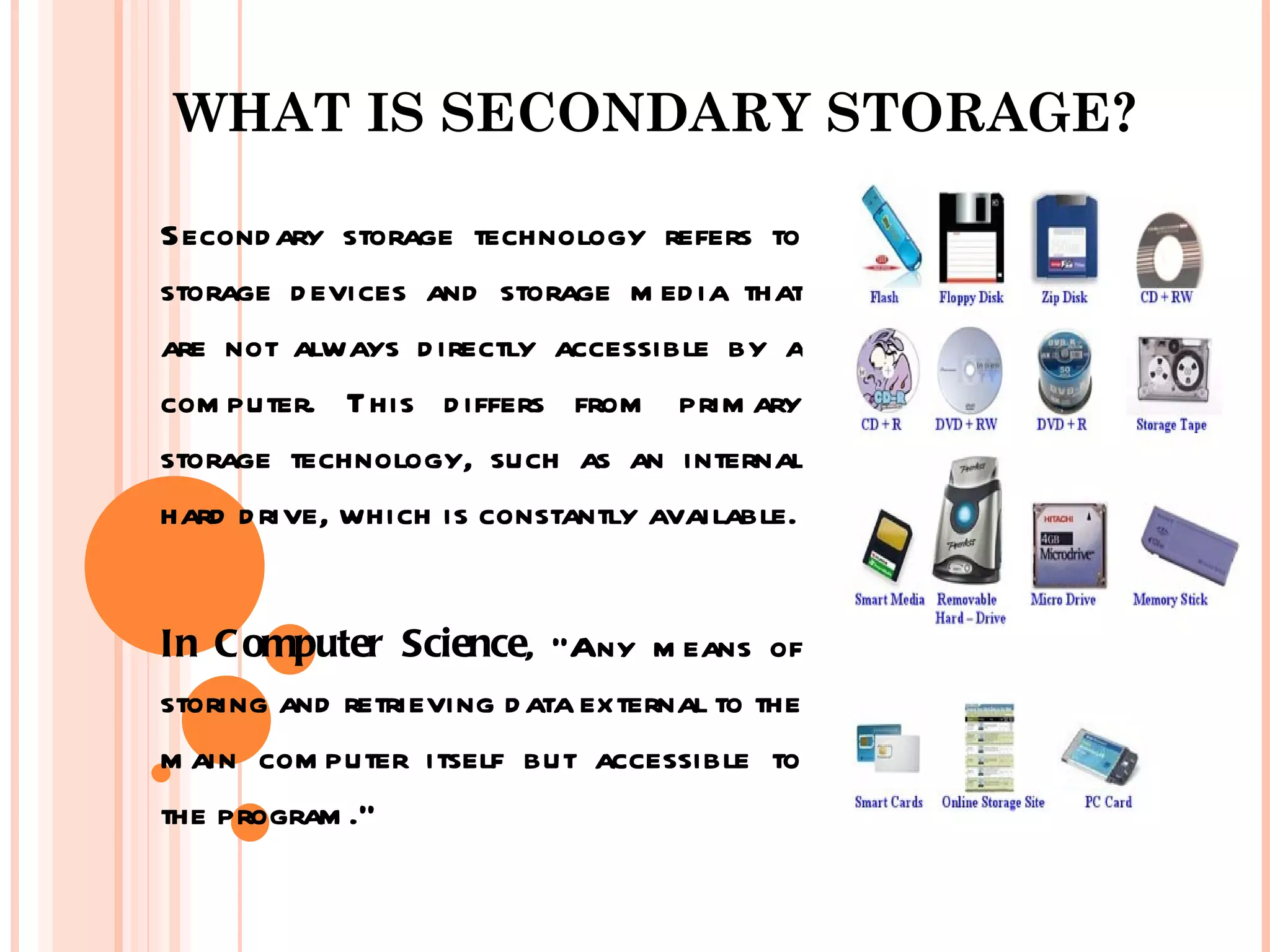
WHAT IS SECONDARY STORAGE?

Second ary storage technology refers to
storage d evices and storage m ed ia that
are not always d irectly accessible by a
com puter. This d iffers from prim ary
storage technology, such as an internal
hard d rive, which is constantly available.


In C omputer Science, “Any m eans of
storing and retrieving d ata external to the
m ain com puter itself but accessible to
the program .”
SECONDARY STORAGE (CONT…)
   U sed in a com puter system to overcom e the lim itations of
    prim ary storage,



                                                                      Created by Hossain Raju
     H as virtually unlim ited capacity because the cost per bit of
    storage is very low,
   H as an operating speed far slower than that of the prim ary
    storage,
    U sed to store large volum es of d ata on a perm anent basis,
   Also known as auxiliary m em ory.
THE ADVANTAGES OF SECONDARY
STORAGE

The ad vantages of Second ary storage are given below:


                                                                   Created by Hossain Raju
 Second ary storage d evices are safe, reliable and perm anent.

 H igh speed storage d evice.

 H uge volum e d ata are stored .

 L ess expensive.

 It is nonvolatile.
THE DISADVANTAGES OF SECONDARY
STORAGE

The D isad vantages of Second ary storage are given below:
 While RAM electronic storage d evices are fast, second ary


                                                            Created by Hossain Raju
  storage d evices are slower because they are electro-
  m echanical.
 The inform ation on the second ary d evice has to be first
  located , then copied and m oved to the prim ary m em ory or
  RAM .
 Takes m ore tim e.
EVOLUTION OF SECONDARY STORAGE
    DEVICES
 The first hard d rive was used in 1 956 which is created by IBM
  and whose capacity was 5 M B.
 In 1 971 , IBM introd uced a technology called the floppy d isk,


                                                                 Created by Hossain Raju
 At the beginning of the 1 980s the first optical d evices were
  released by Sony and Philips. This d rive can store
  approxim ately 650 to 700 of d ata.
 From 1 990 to till now there are m any d evices is created like
  card read er, M em ory Stick, M ultim ed ia C ard etc.
TYPES OF SECONDARY STORAGE

There are three m ain types of second ary storage:


                                                     Created by Hossain Raju
 M agnetic Tape.

 M agnetic D isk.

 O ptical D isk.
TYPES OF SECONDARY STORAGE
             (CONT…)

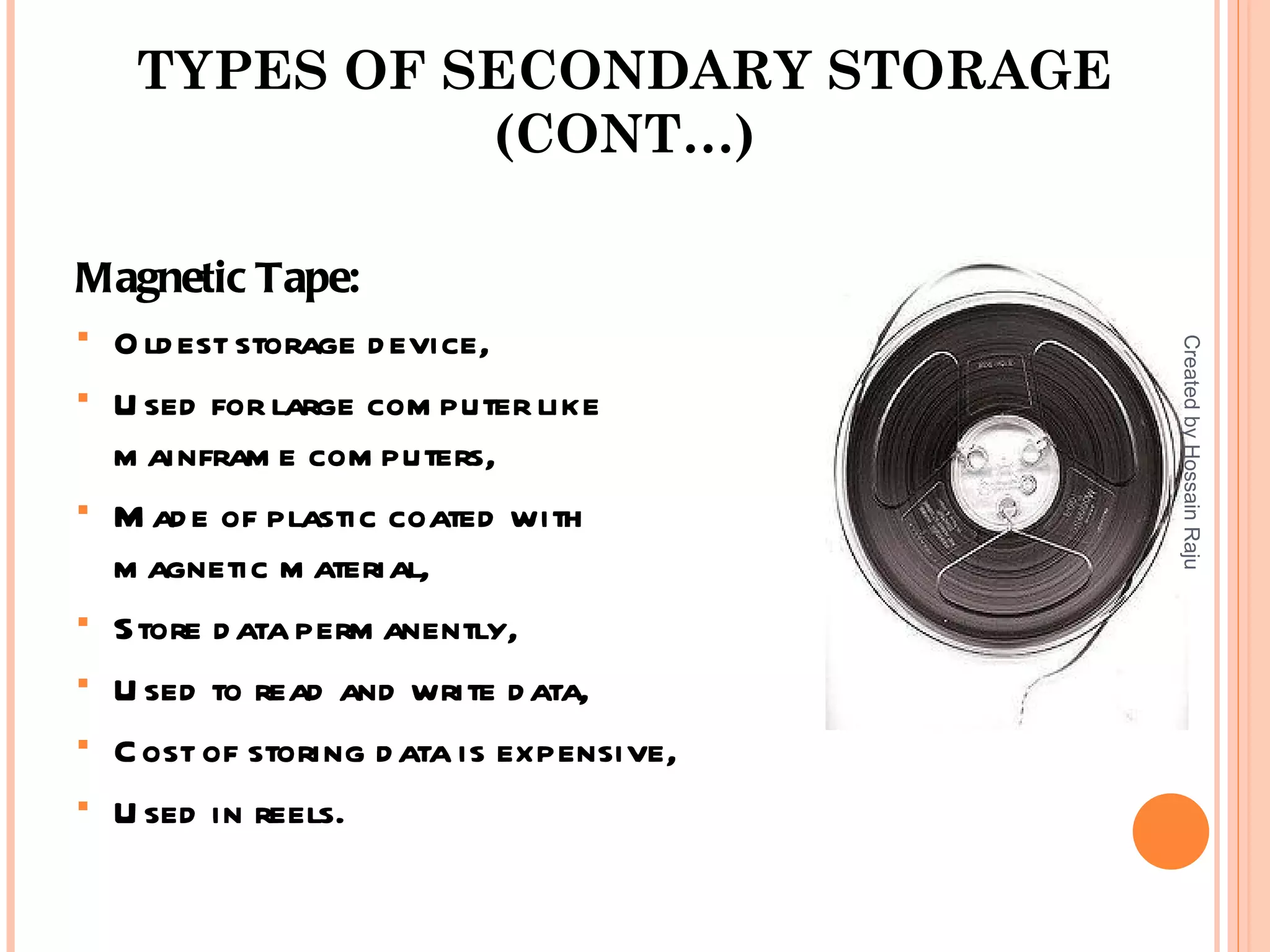
Magnetic Tape:
 O ld est storage d evice,


                                         Created by Hossain Raju
 U sed for large com puter like
  m ainfram e com puters,
 M ad e of plastic coated with
  m agnetic m aterial,
 Store d ata perm anently,

 U sed to read and write d ata,

 C ost of storing d ata is expensive,

 U sed in reels.
TYPES OF SECONDARY STORAGE
             (CONT…)
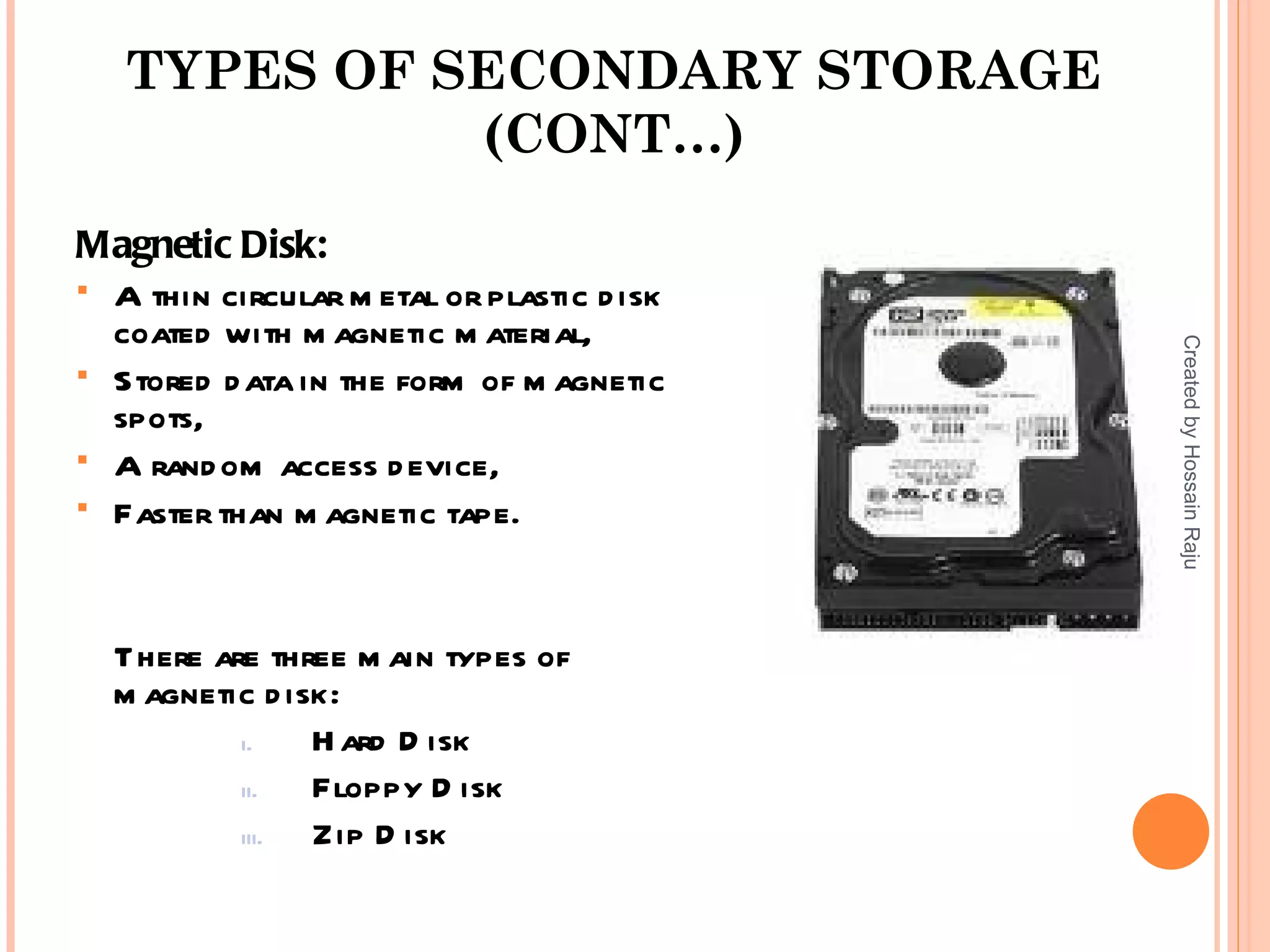
Magnetic Disk:
 A thin circular m etal or plastic d isk
  coated with m agnetic m aterial,


                                            Created by Hossain Raju
 Stored d ata in the form of m agnetic
  spots,
 A rand om access d evice,
 Faster than m agnetic tape.


  There are three m ain types of
  m agnetic d isk:
          i.    H ard D isk
          ii.   Floppy D isk
          iii.  Zip D isk
TYPES OF MAGNETIC DISK

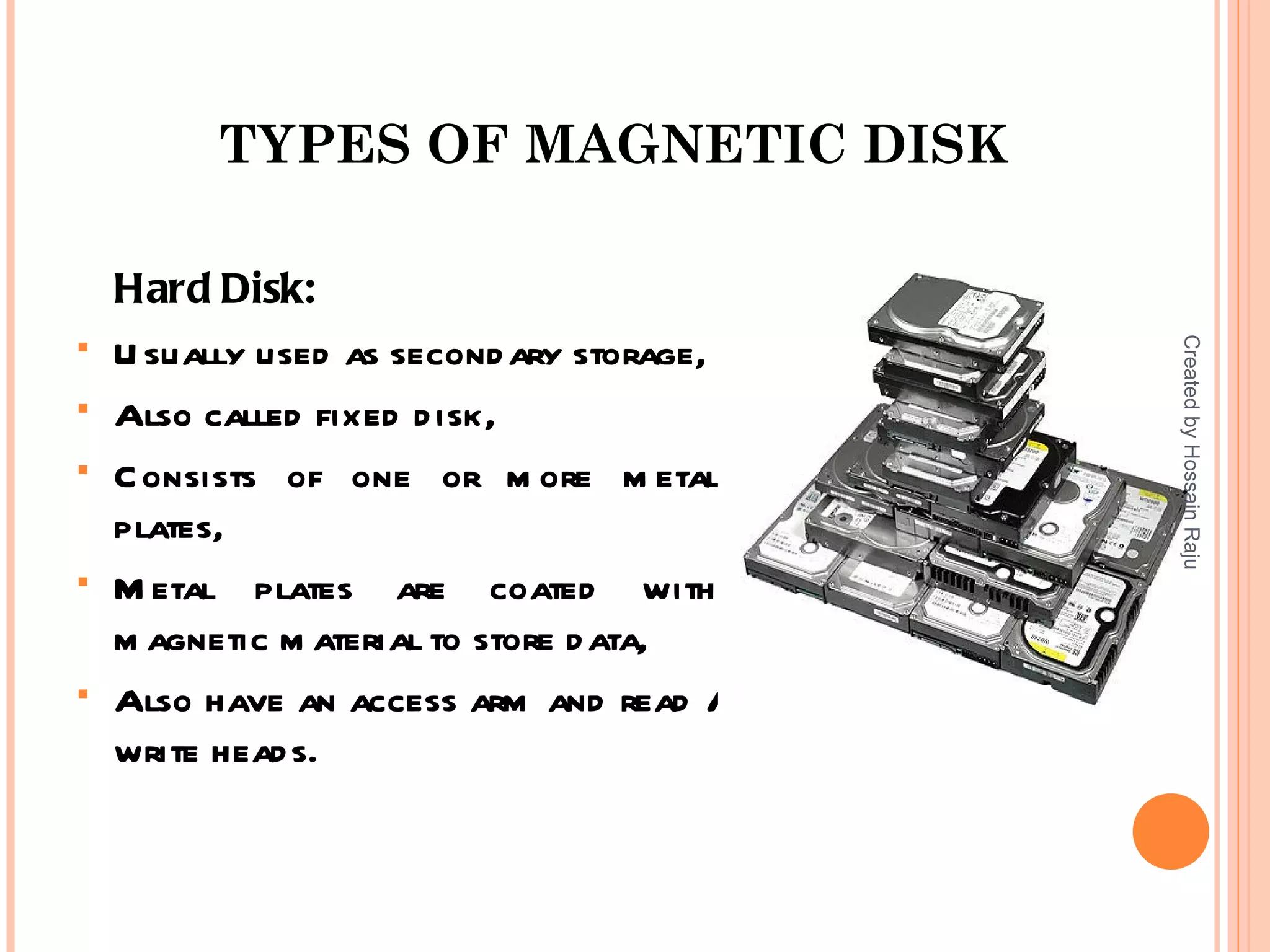
    Hard Disk:



                                           Created by Hossain Raju
    U sually used as second ary storage,
   Also called fixed d isk,
   C onsists of one or m ore m etal
    plates,
   M etal plates are coated with
    m agnetic m aterial to store d ata,
   Also have an access arm and read /
    write head s.
TYPES OF MAGNETIC DISK (CONT...)

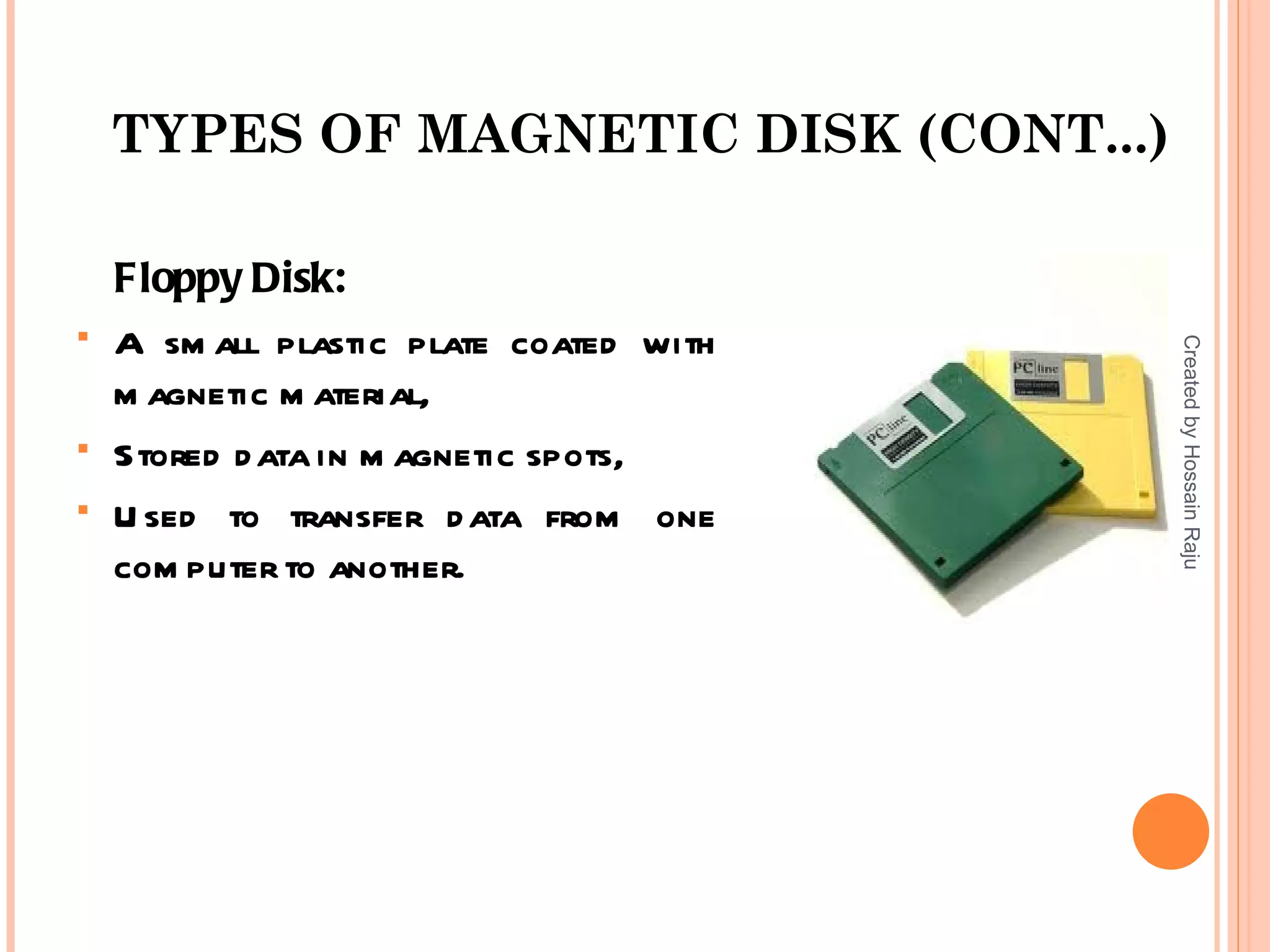
    Floppy Disk:
   A sm all plastic plate coated with


                                         Created by Hossain Raju
    m agnetic m aterial,
   Stored d ata in m agnetic spots,
   U sed to transfer d ata from one
    com puter to another.
TYPES OF MAGNETIC DISK (CONT...)


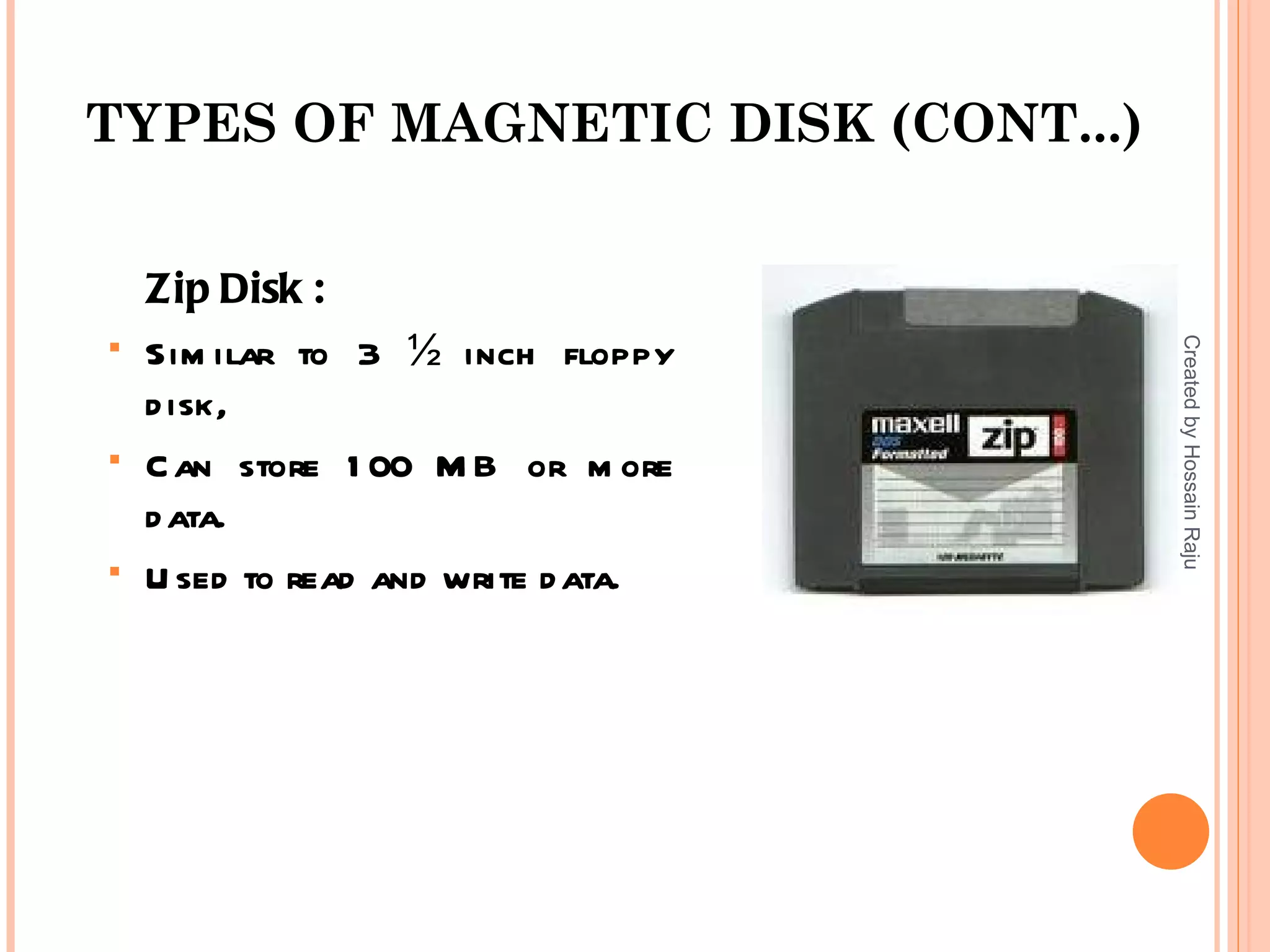
    Zip Disk :
   Sim ilar to 3 ½ inch floppy


                                     Created by Hossain Raju
    d isk,
   C an store 1 00 M B or m ore
    d ata.
   U sed to read and write d ata.
TYPES OF SECONDARY STORAGE
(CONT...)

  Optical Disk:
  U sed L ASER technology to read and write d ata,

  L ASER stand s for L ight Am plification through
  Em ission of Rad iation,
  L aser beam writes on the surface of optical d isk by
  creating very sm all holes.
  The presence of hole represents a O ne, and

  absence of the hole represents a Zero.
TYPES OF OPTICAL DISK
There are following m ain types of optical d isk:
ii. C D -RO M .


                                                    Created by Hossain Raju
iii. C D -R or WO RM

iv. C D -RW

v. D VD -RO M

vi. D VD -R

vii. D VD -RW
TYPES OF OPTICAL DISK (CONT…)


                                             Created by Hossain Raju
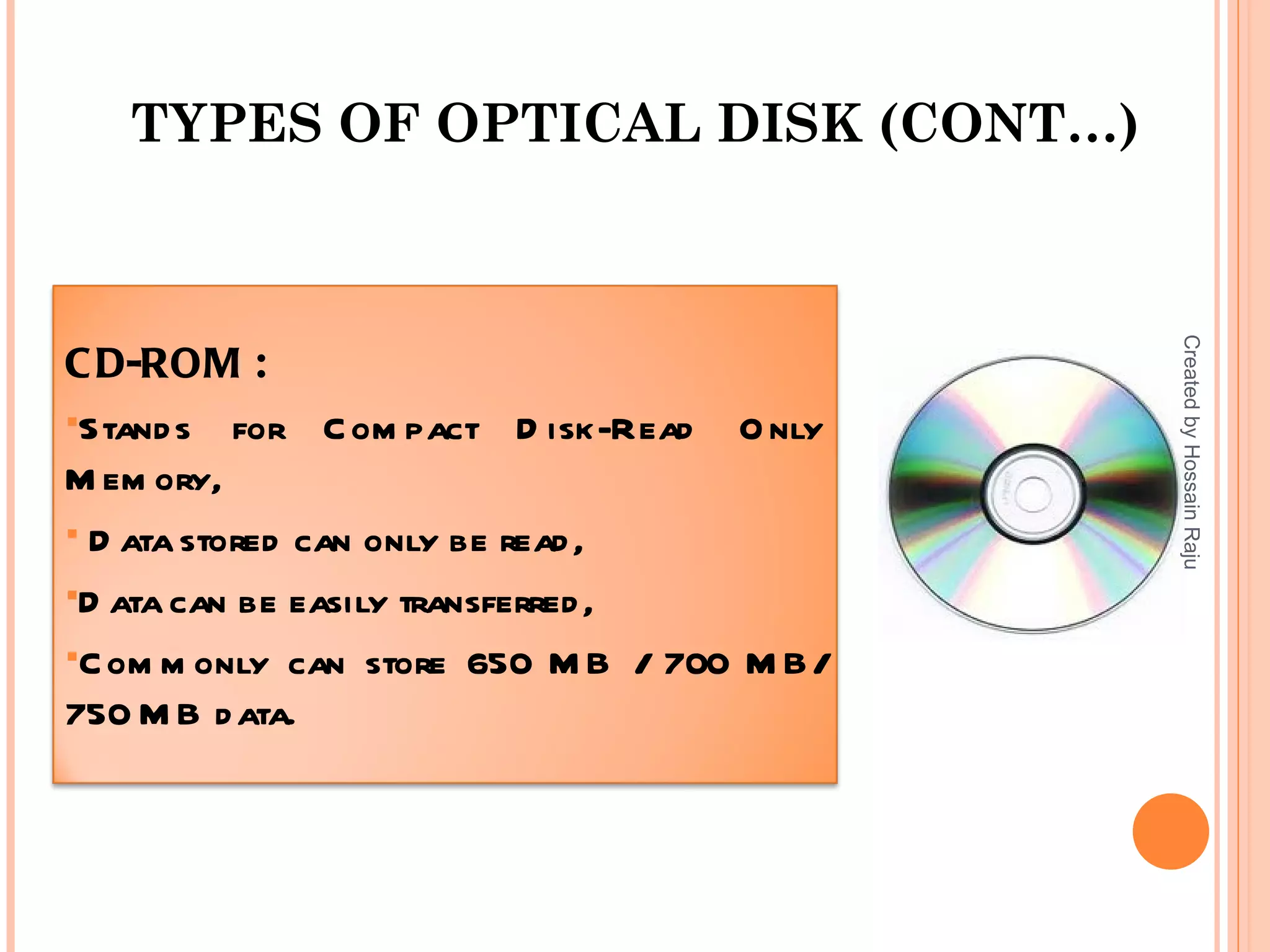
C D-ROM :
Stand s for C om pact D isk-Read    O nly
M em ory,
 D ata stored can only be read ,

D ata can be easily transferred ,

C om m only can store 650 M B / 700 M B/
750 M B d ata.
TYPES OF OPTICAL DISK (CONT…)


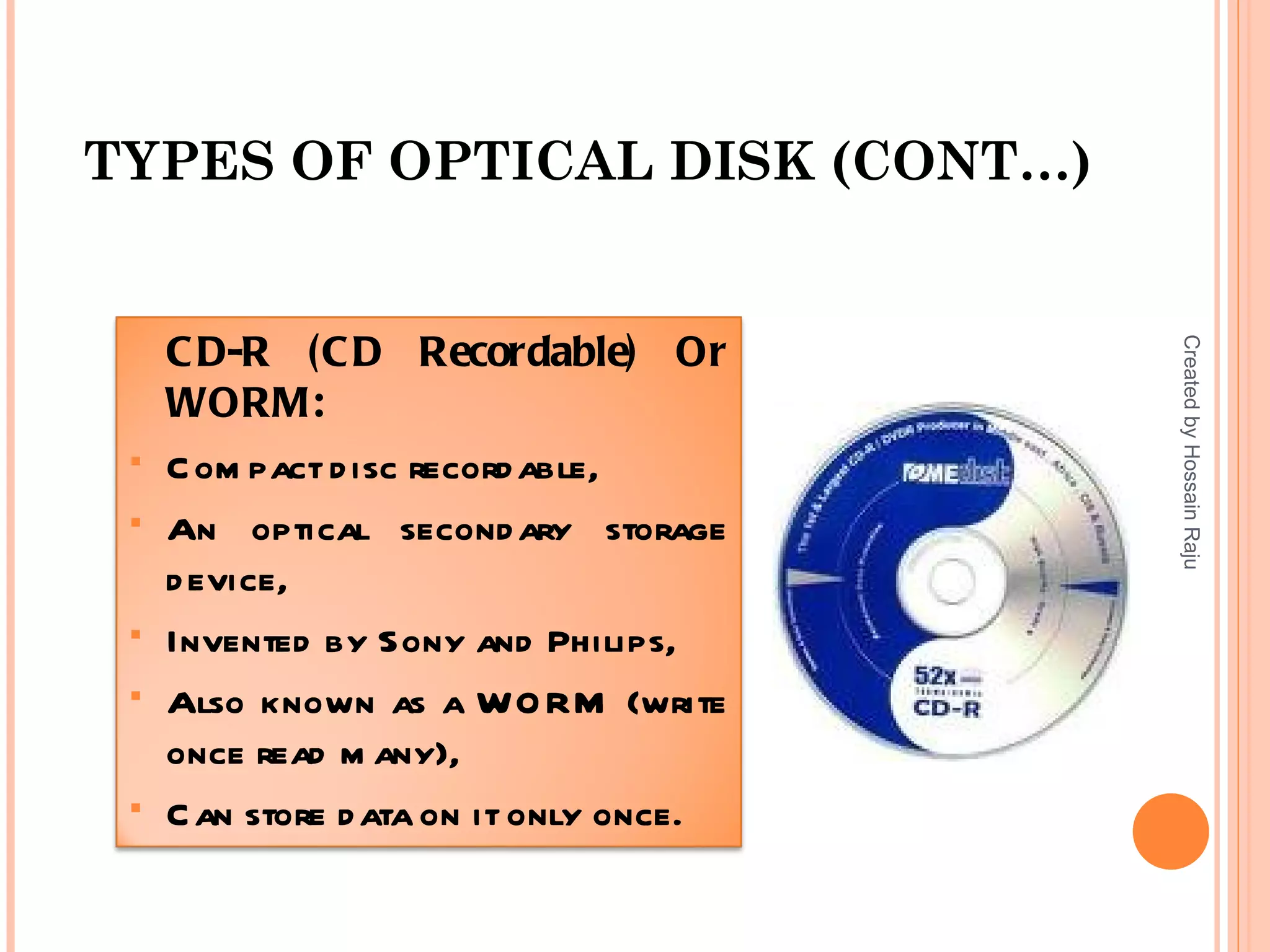
     C D-R (C D Recordable) Or


                                         Created by Hossain Raju
     WORM:
    C om pact d isc record able,
    An optical second ary storage
     d evice,
    Invented by Sony and Philips,
    Also known as a WO RM (write
     once read m any),
    C an store d ata on it only once.
TYPES OF OPTICAL DISK (CONT…)


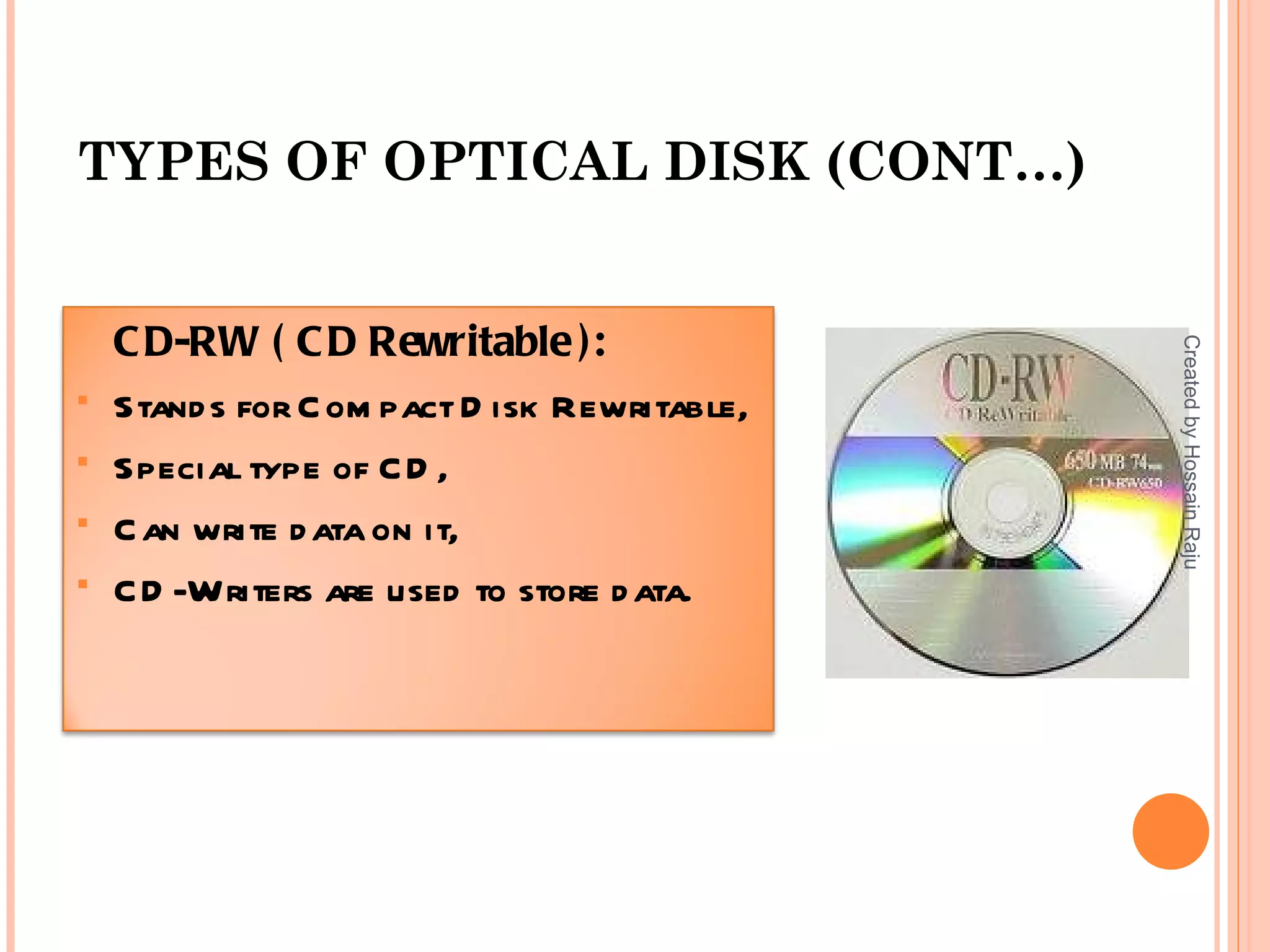
    C D-RW ( C D Rewritable ):


                                              Created by Hossain Raju
   Stand s for C om pact D isk Rewritable,
   Special type of C D ,
   C an write d ata on it,
   C D -Writers are used to store d ata.
TYPES OF OPTICAL DISK (CONT…)

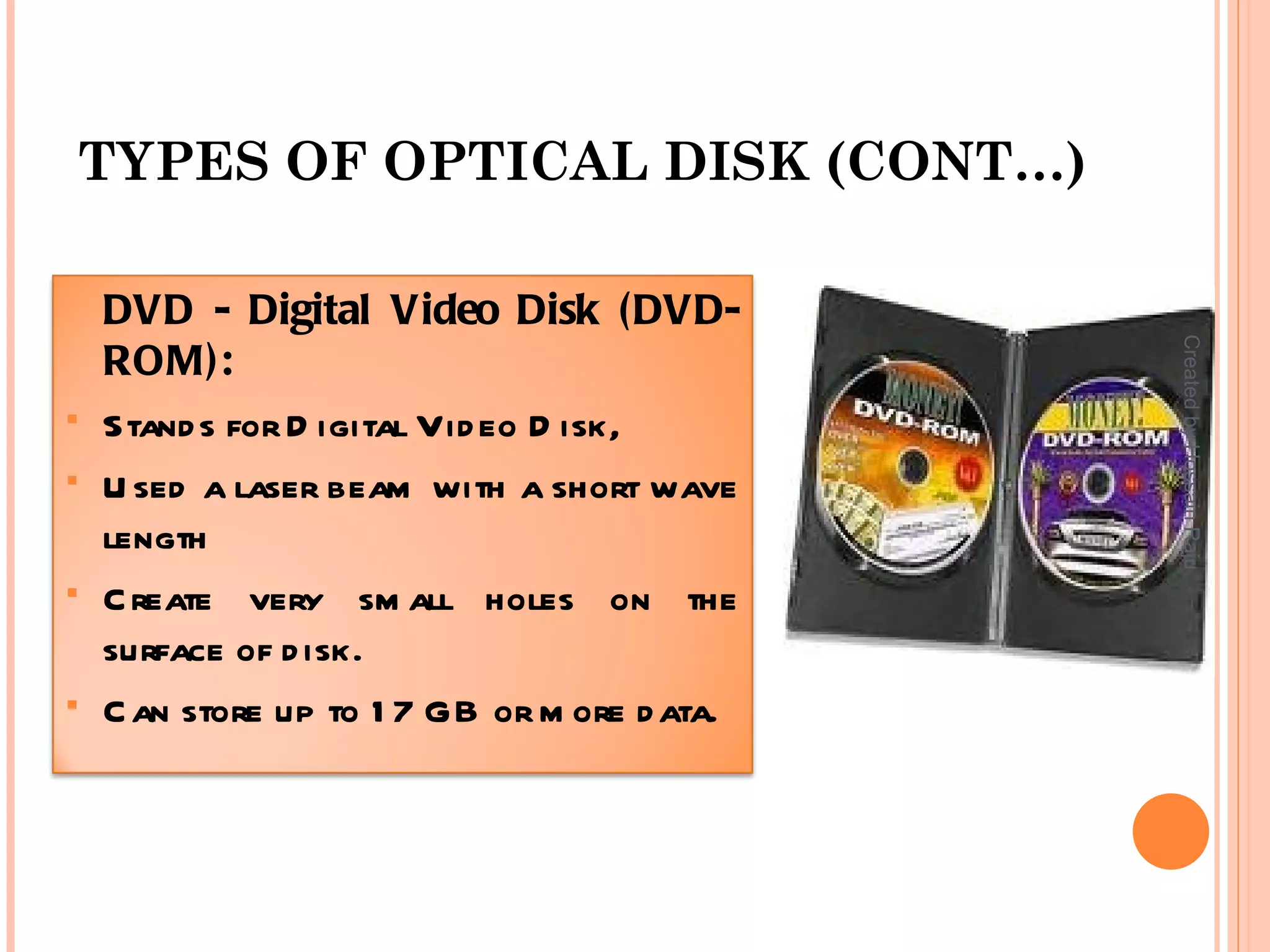
    DVD - Digital Video Disk (DVD-


                                              Created by Hossain Raju
    ROM):
   Stand s for D igital Vid eo D isk,
   U sed a laser beam with a short wave
    length
   C reate very sm all holes on the
    surface of d isk.
   C an store up to 1 7 GB or m ore d ata.
TYPES OF OPTICAL DISK (CONT…)


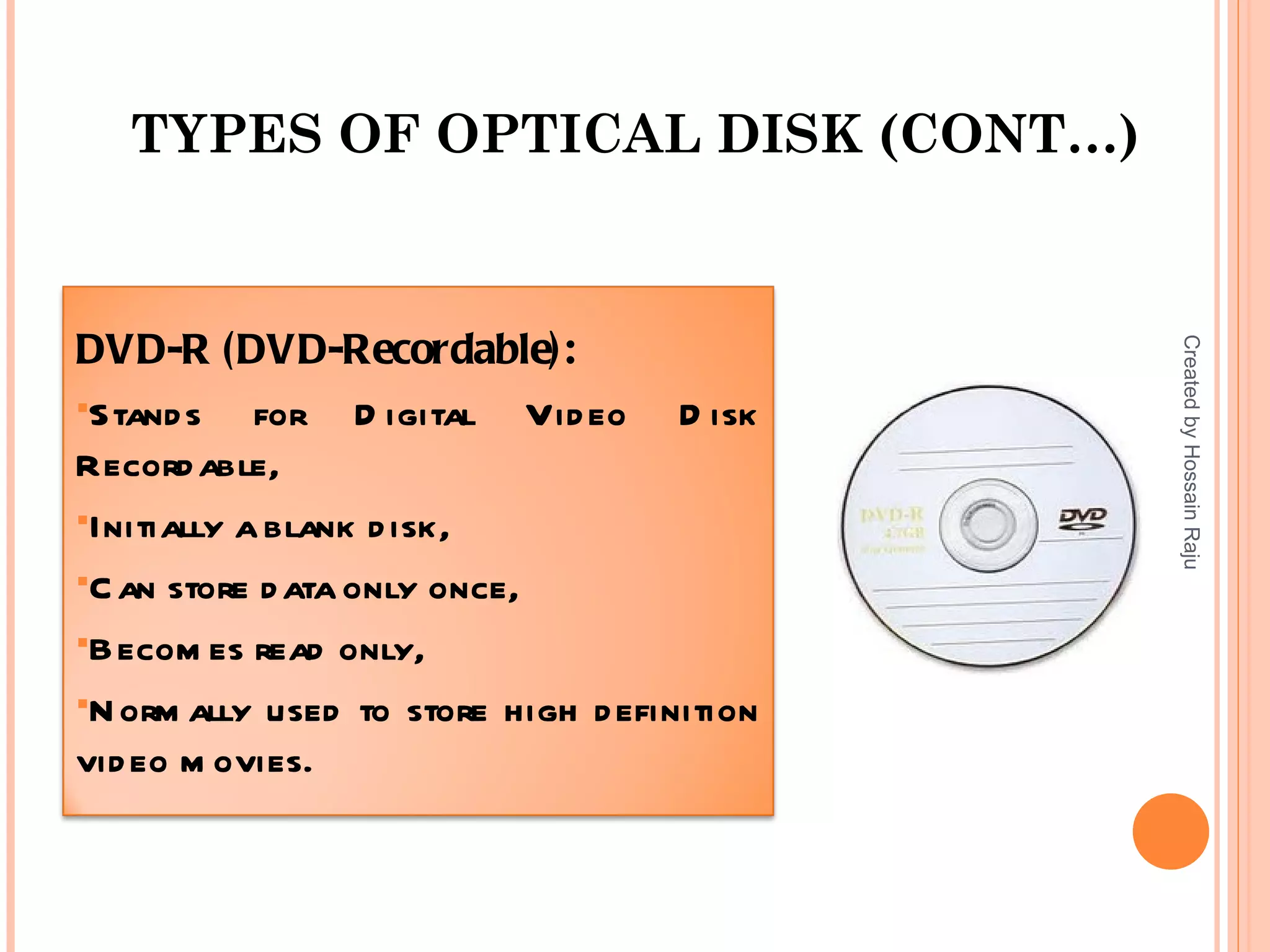
DVD-R (DVD-Recordable):


                                             Created by Hossain Raju
Stand s    for D igital Vid eo D isk
Record able,
Initially a blank d isk,

C an store d ata only once,

Becom es read only,

N orm ally used to store high d efinition
vid eo m ovies.
TYPES OF OPTICAL DISK (CONT…)


                                        Created by Hossain Raju
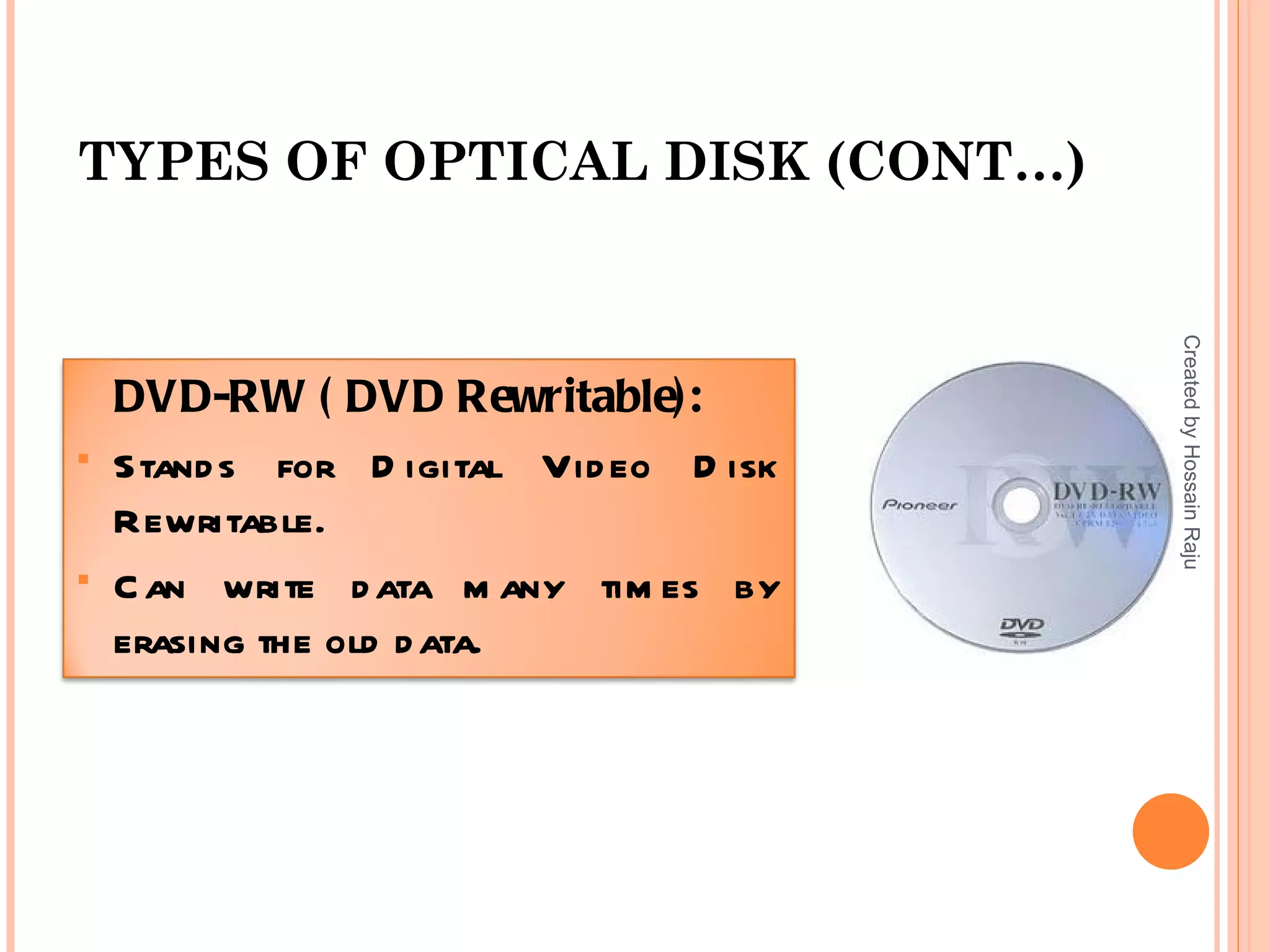
    DVD-RW ( DVD Rewritable):
   Stand s for D igital Vid eo D isk
    Rewritable.
   C an write d ata m any tim es by
    erasing the old d ata.
WHY WE USE SECONDARY STORAGE
           DEVICES
    It isnon volatile and perm anent.
    U sed for a very sim ple task backing up d ata.

    U sed to serve as an external hard d rive.

    Becom ing m ore and m ore portable as technology
    progresses.
    M any businesses will connect second ary storage
    d evices to share files.
     K eep d ata on them for future use.

    Ad d itional space for d ata.
CONCLUSION
The prim ary m em ory is costly, not a perm anent storage
m ed ia and has lim ited capacity. The second ary m em ory


                                                             Created by Hossain Raju
is the storage other than m ain m em ory, and is used for
storing large d ata files, system program s and the like
which are not continuously required by the C PU . It also
serves as an overflow m em ory when the capacity of the
m ain m em ory is exceed ed .
REFERENCES
   Elem ents of C om puter Science by S.K . Sarkar & A. K .
    Gupta


                                                               Created by Hossain Raju
   en.wikiped ia.org
   www.slid eshare.net
   www.techterm s.com
   answers.ask.com
CREATED BY HOSSAIN RAJU

Secondary Storage

  • 1.
  • 2.
    OBJE C TIVEOF THE PRE SE NTA TION  To get general idea about secondary storage.  To obtain information concerning the advantages and disadvantages of secondary storage.  To obtain general idea about types of secondary storage.  To know the causes of using secondary storage. CREATED BY HOSSAIN RAJU
  • 3.
    OVERVIEW  Introd uction  What is Second ary Storage? C reated by H ossain Raju  The Ad vantages of Second ary Storage  The D isad vantages of Second ary Storage  Evolution of Second ary Storage D evices  Types of Second ary Storage  Types of O ptical D isk  Why we use Second ary Storage D evices  C onclusion  References
  • 4.
    INTRODUCTION Every com putersystem consists of a variety of d evices to store the instructions and d ata required for its Created by H ossain Raju operation. The instructions and d ata are stored in the m em ory (storage) unit of the com puter. The m em ory com ponents of a com puter system can be d ivid ed into following m ain groups:  Prim ary Storage (M ain M em ory),  Second ary Storage (Auxiliary M em ory), and  Internal Processor Storage.
  • 5.
    WHAT IS SECONDARYSTORAGE? Second ary storage technology refers to storage d evices and storage m ed ia that are not always d irectly accessible by a com puter. This d iffers from prim ary storage technology, such as an internal hard d rive, which is constantly available. In C omputer Science, “Any m eans of storing and retrieving d ata external to the m ain com puter itself but accessible to the program .”
  • 6.
    SECONDARY STORAGE (CONT…)  U sed in a com puter system to overcom e the lim itations of prim ary storage,  Created by Hossain Raju H as virtually unlim ited capacity because the cost per bit of storage is very low,  H as an operating speed far slower than that of the prim ary storage,  U sed to store large volum es of d ata on a perm anent basis,  Also known as auxiliary m em ory.
  • 7.
    THE ADVANTAGES OFSECONDARY STORAGE The ad vantages of Second ary storage are given below: Created by Hossain Raju  Second ary storage d evices are safe, reliable and perm anent.  H igh speed storage d evice.  H uge volum e d ata are stored .  L ess expensive.  It is nonvolatile.
  • 8.
    THE DISADVANTAGES OFSECONDARY STORAGE The D isad vantages of Second ary storage are given below:  While RAM electronic storage d evices are fast, second ary Created by Hossain Raju storage d evices are slower because they are electro- m echanical.  The inform ation on the second ary d evice has to be first located , then copied and m oved to the prim ary m em ory or RAM .  Takes m ore tim e.
  • 9.
    EVOLUTION OF SECONDARYSTORAGE DEVICES  The first hard d rive was used in 1 956 which is created by IBM and whose capacity was 5 M B.  In 1 971 , IBM introd uced a technology called the floppy d isk, Created by Hossain Raju  At the beginning of the 1 980s the first optical d evices were released by Sony and Philips. This d rive can store approxim ately 650 to 700 of d ata.  From 1 990 to till now there are m any d evices is created like card read er, M em ory Stick, M ultim ed ia C ard etc.
  • 10.
    TYPES OF SECONDARYSTORAGE There are three m ain types of second ary storage: Created by Hossain Raju  M agnetic Tape.  M agnetic D isk.  O ptical D isk.
  • 11.
    TYPES OF SECONDARYSTORAGE (CONT…) Magnetic Tape:  O ld est storage d evice, Created by Hossain Raju  U sed for large com puter like m ainfram e com puters,  M ad e of plastic coated with m agnetic m aterial,  Store d ata perm anently,  U sed to read and write d ata,  C ost of storing d ata is expensive,  U sed in reels.
  • 12.
    TYPES OF SECONDARYSTORAGE (CONT…) Magnetic Disk:  A thin circular m etal or plastic d isk coated with m agnetic m aterial, Created by Hossain Raju  Stored d ata in the form of m agnetic spots,  A rand om access d evice,  Faster than m agnetic tape. There are three m ain types of m agnetic d isk: i. H ard D isk ii. Floppy D isk iii. Zip D isk
  • 13.
    TYPES OF MAGNETICDISK Hard Disk:  Created by Hossain Raju U sually used as second ary storage,  Also called fixed d isk,  C onsists of one or m ore m etal plates,  M etal plates are coated with m agnetic m aterial to store d ata,  Also have an access arm and read / write head s.
  • 14.
    TYPES OF MAGNETICDISK (CONT...) Floppy Disk:  A sm all plastic plate coated with Created by Hossain Raju m agnetic m aterial,  Stored d ata in m agnetic spots,  U sed to transfer d ata from one com puter to another.
  • 15.
    TYPES OF MAGNETICDISK (CONT...) Zip Disk :  Sim ilar to 3 ½ inch floppy Created by Hossain Raju d isk,  C an store 1 00 M B or m ore d ata.  U sed to read and write d ata.
  • 16.
    TYPES OF SECONDARYSTORAGE (CONT...) Optical Disk: U sed L ASER technology to read and write d ata, L ASER stand s for L ight Am plification through Em ission of Rad iation, L aser beam writes on the surface of optical d isk by creating very sm all holes. The presence of hole represents a O ne, and absence of the hole represents a Zero.
  • 17.
    TYPES OF OPTICALDISK There are following m ain types of optical d isk: ii. C D -RO M . Created by Hossain Raju iii. C D -R or WO RM iv. C D -RW v. D VD -RO M vi. D VD -R vii. D VD -RW
  • 18.
    TYPES OF OPTICALDISK (CONT…) Created by Hossain Raju C D-ROM : Stand s for C om pact D isk-Read O nly M em ory,  D ata stored can only be read , D ata can be easily transferred , C om m only can store 650 M B / 700 M B/ 750 M B d ata.
  • 19.
    TYPES OF OPTICALDISK (CONT…) C D-R (C D Recordable) Or Created by Hossain Raju WORM:  C om pact d isc record able,  An optical second ary storage d evice,  Invented by Sony and Philips,  Also known as a WO RM (write once read m any),  C an store d ata on it only once.
  • 20.
    TYPES OF OPTICALDISK (CONT…) C D-RW ( C D Rewritable ): Created by Hossain Raju  Stand s for C om pact D isk Rewritable,  Special type of C D ,  C an write d ata on it,  C D -Writers are used to store d ata.
  • 21.
    TYPES OF OPTICALDISK (CONT…) DVD - Digital Video Disk (DVD- Created by Hossain Raju ROM):  Stand s for D igital Vid eo D isk,  U sed a laser beam with a short wave length  C reate very sm all holes on the surface of d isk.  C an store up to 1 7 GB or m ore d ata.
  • 22.
    TYPES OF OPTICALDISK (CONT…) DVD-R (DVD-Recordable): Created by Hossain Raju Stand s for D igital Vid eo D isk Record able, Initially a blank d isk, C an store d ata only once, Becom es read only, N orm ally used to store high d efinition vid eo m ovies.
  • 23.
    TYPES OF OPTICALDISK (CONT…) Created by Hossain Raju DVD-RW ( DVD Rewritable):  Stand s for D igital Vid eo D isk Rewritable.  C an write d ata m any tim es by erasing the old d ata.
  • 24.
    WHY WE USESECONDARY STORAGE DEVICES It isnon volatile and perm anent. U sed for a very sim ple task backing up d ata. U sed to serve as an external hard d rive. Becom ing m ore and m ore portable as technology progresses. M any businesses will connect second ary storage d evices to share files.  K eep d ata on them for future use. Ad d itional space for d ata.
  • 25.
    CONCLUSION The prim arym em ory is costly, not a perm anent storage m ed ia and has lim ited capacity. The second ary m em ory Created by Hossain Raju is the storage other than m ain m em ory, and is used for storing large d ata files, system program s and the like which are not continuously required by the C PU . It also serves as an overflow m em ory when the capacity of the m ain m em ory is exceed ed .
  • 26.
    REFERENCES  Elem ents of C om puter Science by S.K . Sarkar & A. K . Gupta Created by Hossain Raju  en.wikiped ia.org  www.slid eshare.net  www.techterm s.com  answers.ask.com
  • 27.