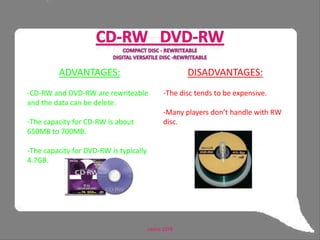
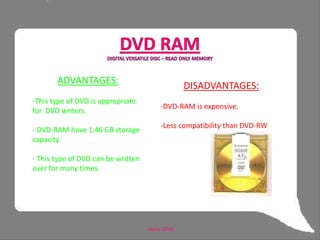
This document discusses and compares various types of optical storage media and solid state storage devices. It covers CDs, DVDs, Blu-ray discs, solid state drives, memory sticks, and flash memory cards. For each type it provides key details like storage capacity, advantages like portability, and disadvantages such as being read-only or breakable.
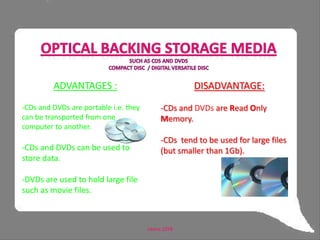
Optical backing storagemediasuch as CDs and DVDsCompact Disc / Digital Versatile DiscADVANTAGES :CDs and DVDs are portable i.e. they can be transported from one computer to another.
DVDs are usedto hold large file such as movie files.DISADVANTAGE:CDs and DVDs are Read Only Memory.-CDs tend to be used for large files (but smaller than 1Gb).neena 10YB
5.
CD-ROM DVD-ROMCompactDisc - Read Only MemoryDigital Versatile Disk – Read Only Memory DISADVANTAGE:- It can’t put data more than once.ADVANTAGES: CD-ROM generally holds about 700MB of data or 74 minutes of audio.- DVD-ROM can hold up to 4.7GB neena 10YB
6.
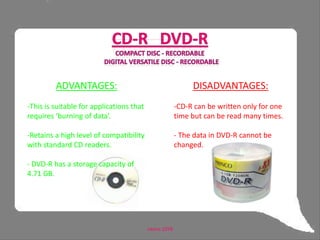
CD-R DVD-RCompact Disc - Recordable Digital Versatile Disc - RecordableADVANTAGES:-This is suitable for applications that requires ‘burning of data’.-Retains a high level of compatibility with standard CD readers.- DVD-R has a storage capacity of 4.71 GB.DISADVANTAGES:CD-R can be written only for one time but can be read many times.
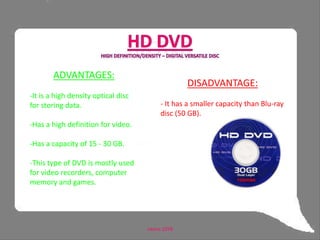
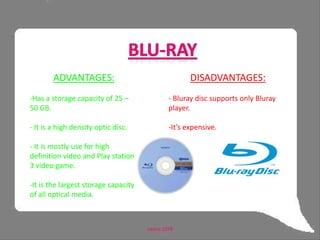
This type ofDVD is mostly used for video recorders, computer memory and games.DISADVANTAGE:- It has a smaller capacity than Blu-ray disc (50 GB).neena 10YB
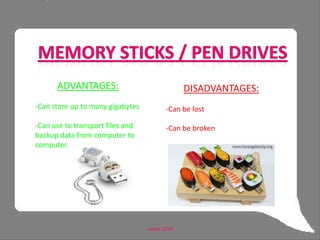
Memory sticks /Pen drivesneena 10YBADVANTAGES:Can store up to many gigabytes
29.
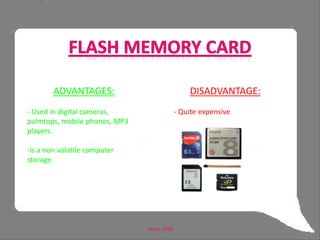
Can use totransport files and backup data from computer to computer. DISADVANTAGES:-Can be lostCan be brokenFlash memory cardneena 10YBADVANTAGES:- Used in digital cameras, palmtops, mobile phones, MP3players.Is a non volatile computer storage.DISADVANTAGE:- Quite expensive