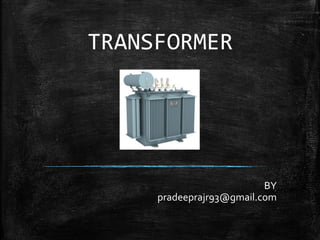
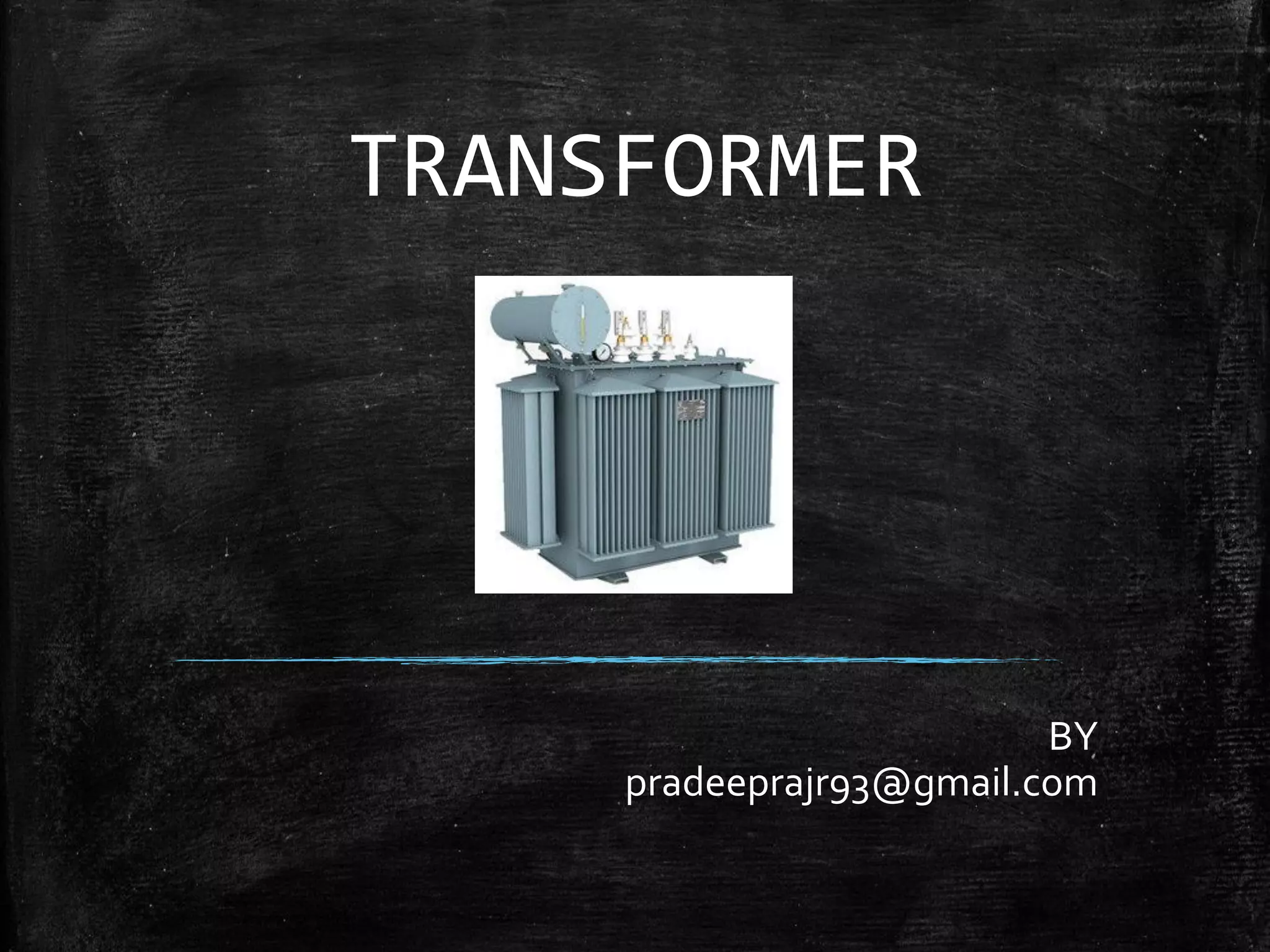
TRANSFORMER
BY
pradeeprajr93@gmail.com
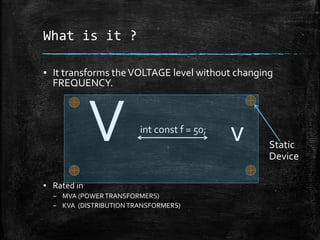
What is it ?
▪ It transforms theVOLTAGE level without changing
FREQUENCY.
V v
▪ Rated in
– MVA (POWERTRANSFORMERS)
– KVA (DISTRIBUTIONTRANSFORMERS)
int const f = 50;
Static
Device
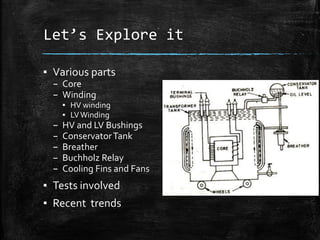
Let’s Explore it
▪ Various parts
– Core
– Winding
▪ HV winding
▪ LVWinding
– HV and LV Bushings
– ConservatorTank
– Breather
– Buchholz Relay
– Cooling Fins and Fans
▪ Tests involved
▪ Recent trends
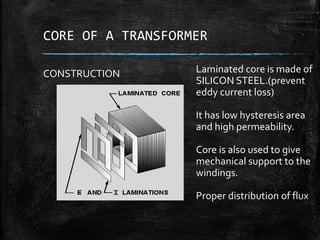
CORE OF A TRANSFORMER
CONSTRUCTION Laminated core is made of
SILICON STEEL.(prevent
eddy current loss)
It has low hysteresis area
and high permeability.
Core is also used to give
mechanical support to the
windings.
Proper distribution of flux
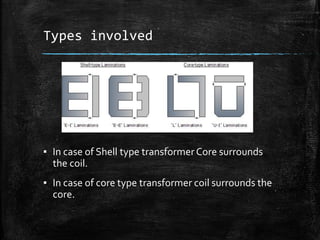
Types involved
▪ In case of Shell type transformer Core surrounds
the coil.
▪ In case of core type transformer coil surrounds the
core.
Transformer Winding
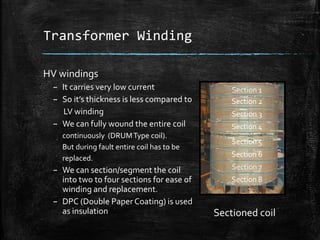
HV windings
– It carries very low current
– So it’s thickness is less compared to
LV winding
– We can fully wound the entire coil
continuously (DRUMType coil).
But during fault entire coil has to be
replaced.
– We can section/segment the coil
into two to four sections for ease of
winding and replacement.
– DPC (Double Paper Coating) is used
as insulation
Section 1
Section 2
Section 3
Section 4
Section 5
Section 6
Section 7
Section 8
Sectioned coil
Transformer Winding
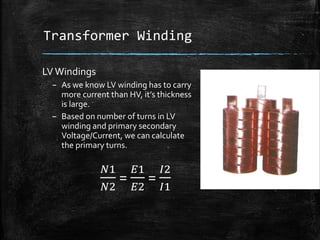
LVWindings
– As we know LV winding has to carry
more current than HV, it’s thickness
is large.
– Based on number of turns in LV
winding and primary secondary
Voltage/Current, we can calculate
the primary turns.
𝑁1
𝑁2
=
𝐸1
𝐸2
=
𝐼2
𝐼1
Transformer Winding
▪ In general, LV windings are wounded around the core
first, then HV windings.
▪ So less amount of insulation is enough.
▪ Every windings in LV have two terminals (Inner and
Outer)
▪ In this case, all inner terminals of three phases(R,Y,B)
are shorted and welded together to form neutral
winding
▪ The remaining three outer terminals forms the phases
R,Y,B.
Transformer Bushings
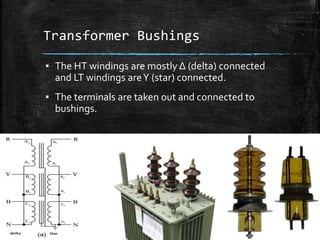
▪ The HT windings are mostly Δ (delta) connected
and LT windings areΥ (star) connected.
▪ The terminals are taken out and connected to
bushings.
Arrangement of Bushings
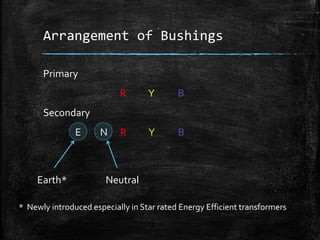
Primary
R Y B
Secondary
E N R Y B
Earth* Neutral
* Newly introduced especially in Star rated Energy Efficient transformers
CONSERVATOR TANK
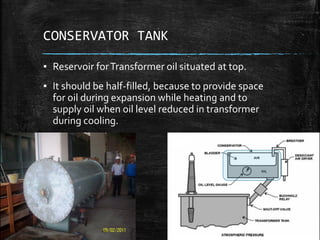
▪ Reservoir forTransformer oil situated at top.
▪ It should be half-filled, because to provide space
for oil during expansion while heating and to
supply oil when oil level reduced in transformer
during cooling.
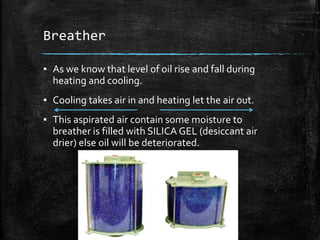
Breather
▪ As we know that level of oil rise and fall during
heating and cooling.
▪ Cooling takes air in and heating let the air out.
▪ This aspirated air contain some moisture to
breather is filled with SILICA GEL (desiccant air
drier) else oil will be deteriorated.
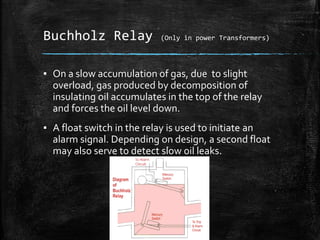
Buchholz Relay (Only in power Transformers)
▪ On a slow accumulation of gas, due to slight
overload, gas produced by decomposition of
insulating oil accumulates in the top of the relay
and forces the oil level down.
▪ A float switch in the relay is used to initiate an
alarm signal. Depending on design, a second float
may also serve to detect slow oil leaks.
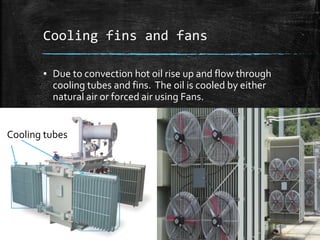
Cooling fins and fans
▪ Due to convection hot oil rise up and flow through
cooling tubes and fins. The oil is cooled by either
natural air or forced air using Fans.
Cooling tubes
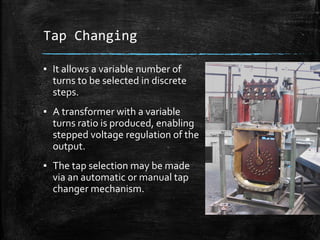
Tap Changing
▪ It allows a variable number of
turns to be selected in discrete
steps.
▪ A transformer with a variable
turns ratio is produced, enabling
stepped voltage regulation of the
output.
▪ The tap selection may be made
via an automatic or manual tap
changer mechanism.
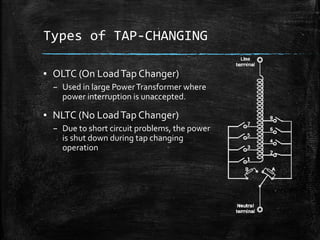
Types of TAP-CHANGING
▪ OLTC (On LoadTap Changer)
– Used in large PowerTransformer where
power interruption is unaccepted.
▪ NLTC (No LoadTap Changer)
– Due to short circuit problems, the power
is shut down during tap changing
operation
Power Transformer Protection
▪ OTA - OilTemperature Alarm (if exceeds 85°C)
▪ WTA- WindingTemperature Alarm (if exceeds 90°C)
▪ WTT- WindingTemperatureTrip
▪ BA – Buchholz Alarm
▪ BT – BuchholzTrip
▪ MOGA- Minimum Oil Gauge Measurement
▪ PRV – Pressure ReleaseValve
▪ OSTC – OLTC Surge RelayTrip
▪ DRT- Differential RelayTrip
Transformer Tests
▪ Short CircuitTest
▪ Open CircuitTest
▪ InducedVoltageTest
▪ Back-to-BackTest
▪ Megger test
– Ground-Ground (zero resistance)
– Line-Ground (infinite resistance)
– Line-Line (infinite resistance)
▪ Heated in HOTAIR CHAMBER at 200°C around 6hours
Transformer Oil Tests
▪ Medium used for cooling and insulation is
hydro carbonatedTransformer oil.
▪ Tests involved are
– BDV (Break DownVoltage test)
– AcidityTest
– InterfacialTensionTest
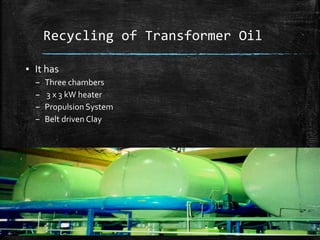
Recycling of Transformer Oil
▪ It has
– Three chambers
– 3 x 3 kW heater
– Propulsion System
– Belt driven Clay
Process in Recycling chamber
▪ Chamber 1 & 2
– Impure oil is circulated inside chamber at 60°C
– Then heated clay at 110°C is mixed and kept circulated for
three hours.
– Leave 16hours for settling of clay with carbon and impurities
(REST PERIOD)
– Pure oil is let out and further filtered using bladder
▪ Chamber 3
– It takes in the pure oil from bladder and mixes with chemicals
and CO2
– This improves the quality of transformer oil and immune to
corrosion problems in transformer.
▪ Finally the output is filtered in cartridge and filled in
Drums for transportation.
Energy Efficient Transformers
▪ In a typical power distribution grid, electric
transformer power loss typically contributes about
40-50% of the total transmission and distribution
loss.
▪ Energy efficient transformers are therefore an
important means to reduce transmission and
distribution loss.
▪ With the improvement of electrical steel (silicon
steel) properties, to achieve higher efficiency
▪ E.g.: Amorphous MetalTransformers
▪ These transformers are star-rated. ✭✭✭
Features of Energy Efficient
Transformers
▪ Addition Earth bushing to ground fault current
instantly, high safety and better efficiency.
▪ Guaranteed maximum temperature rise in
Oil/Winding is 35/40°C.
▪ GuaranteedTotal loss @ 100% loading is 3320watts.
▪ GuaranteedTotal loss @ 50% loading is 1050watts.
▪ These losses are double the amount in case of
ordinary distribution transformers.
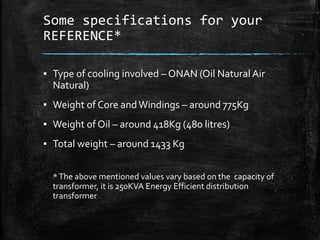
Some specifications for your
REFERENCE*
▪ Type of cooling involved – ONAN (Oil Natural Air
Natural)
▪ Weight of Core andWindings – around 775Kg
▪ Weight of Oil – around 418Kg (480 litres)
▪ Total weight – around 1433 Kg
*The above mentioned values vary based on the capacity of
transformer, it is 250KVA Energy Efficient distribution
transformer
And finally, it’s my turn to

Transformer

  • 1.
  • 2.
    What is it? ▪ It transforms theVOLTAGE level without changing FREQUENCY. V v ▪ Rated in – MVA (POWERTRANSFORMERS) – KVA (DISTRIBUTIONTRANSFORMERS) int const f = 50; Static Device
  • 3.
    Let’s Explore it ▪Various parts – Core – Winding ▪ HV winding ▪ LVWinding – HV and LV Bushings – ConservatorTank – Breather – Buchholz Relay – Cooling Fins and Fans ▪ Tests involved ▪ Recent trends
  • 4.
    CORE OF ATRANSFORMER CONSTRUCTION Laminated core is made of SILICON STEEL.(prevent eddy current loss) It has low hysteresis area and high permeability. Core is also used to give mechanical support to the windings. Proper distribution of flux
  • 5.
    Types involved ▪ Incase of Shell type transformer Core surrounds the coil. ▪ In case of core type transformer coil surrounds the core.
  • 6.
    Transformer Winding HV windings –It carries very low current – So it’s thickness is less compared to LV winding – We can fully wound the entire coil continuously (DRUMType coil). But during fault entire coil has to be replaced. – We can section/segment the coil into two to four sections for ease of winding and replacement. – DPC (Double Paper Coating) is used as insulation Section 1 Section 2 Section 3 Section 4 Section 5 Section 6 Section 7 Section 8 Sectioned coil
  • 7.
    Transformer Winding LVWindings – Aswe know LV winding has to carry more current than HV, it’s thickness is large. – Based on number of turns in LV winding and primary secondary Voltage/Current, we can calculate the primary turns. 𝑁1 𝑁2 = 𝐸1 𝐸2 = 𝐼2 𝐼1
  • 8.
    Transformer Winding ▪ Ingeneral, LV windings are wounded around the core first, then HV windings. ▪ So less amount of insulation is enough. ▪ Every windings in LV have two terminals (Inner and Outer) ▪ In this case, all inner terminals of three phases(R,Y,B) are shorted and welded together to form neutral winding ▪ The remaining three outer terminals forms the phases R,Y,B.
  • 9.
    Transformer Bushings ▪ TheHT windings are mostly Δ (delta) connected and LT windings areΥ (star) connected. ▪ The terminals are taken out and connected to bushings.
  • 10.
    Arrangement of Bushings Primary RY B Secondary E N R Y B Earth* Neutral * Newly introduced especially in Star rated Energy Efficient transformers
  • 11.
    CONSERVATOR TANK ▪ ReservoirforTransformer oil situated at top. ▪ It should be half-filled, because to provide space for oil during expansion while heating and to supply oil when oil level reduced in transformer during cooling.
  • 12.
    Breather ▪ As weknow that level of oil rise and fall during heating and cooling. ▪ Cooling takes air in and heating let the air out. ▪ This aspirated air contain some moisture to breather is filled with SILICA GEL (desiccant air drier) else oil will be deteriorated.
  • 13.
    Buchholz Relay (Onlyin power Transformers) ▪ On a slow accumulation of gas, due to slight overload, gas produced by decomposition of insulating oil accumulates in the top of the relay and forces the oil level down. ▪ A float switch in the relay is used to initiate an alarm signal. Depending on design, a second float may also serve to detect slow oil leaks.
  • 14.
    Cooling fins andfans ▪ Due to convection hot oil rise up and flow through cooling tubes and fins. The oil is cooled by either natural air or forced air using Fans. Cooling tubes
  • 15.
    Tap Changing ▪ Itallows a variable number of turns to be selected in discrete steps. ▪ A transformer with a variable turns ratio is produced, enabling stepped voltage regulation of the output. ▪ The tap selection may be made via an automatic or manual tap changer mechanism.
  • 16.
    Types of TAP-CHANGING ▪OLTC (On LoadTap Changer) – Used in large PowerTransformer where power interruption is unaccepted. ▪ NLTC (No LoadTap Changer) – Due to short circuit problems, the power is shut down during tap changing operation
  • 17.
    Power Transformer Protection ▪OTA - OilTemperature Alarm (if exceeds 85°C) ▪ WTA- WindingTemperature Alarm (if exceeds 90°C) ▪ WTT- WindingTemperatureTrip ▪ BA – Buchholz Alarm ▪ BT – BuchholzTrip ▪ MOGA- Minimum Oil Gauge Measurement ▪ PRV – Pressure ReleaseValve ▪ OSTC – OLTC Surge RelayTrip ▪ DRT- Differential RelayTrip
  • 18.
    Transformer Tests ▪ ShortCircuitTest ▪ Open CircuitTest ▪ InducedVoltageTest ▪ Back-to-BackTest ▪ Megger test – Ground-Ground (zero resistance) – Line-Ground (infinite resistance) – Line-Line (infinite resistance) ▪ Heated in HOTAIR CHAMBER at 200°C around 6hours
  • 19.
    Transformer Oil Tests ▪Medium used for cooling and insulation is hydro carbonatedTransformer oil. ▪ Tests involved are – BDV (Break DownVoltage test) – AcidityTest – InterfacialTensionTest
  • 20.
    Recycling of TransformerOil ▪ It has – Three chambers – 3 x 3 kW heater – Propulsion System – Belt driven Clay
  • 21.
    Process in Recyclingchamber ▪ Chamber 1 & 2 – Impure oil is circulated inside chamber at 60°C – Then heated clay at 110°C is mixed and kept circulated for three hours. – Leave 16hours for settling of clay with carbon and impurities (REST PERIOD) – Pure oil is let out and further filtered using bladder ▪ Chamber 3 – It takes in the pure oil from bladder and mixes with chemicals and CO2 – This improves the quality of transformer oil and immune to corrosion problems in transformer. ▪ Finally the output is filtered in cartridge and filled in Drums for transportation.
  • 22.
    Energy Efficient Transformers ▪In a typical power distribution grid, electric transformer power loss typically contributes about 40-50% of the total transmission and distribution loss. ▪ Energy efficient transformers are therefore an important means to reduce transmission and distribution loss. ▪ With the improvement of electrical steel (silicon steel) properties, to achieve higher efficiency ▪ E.g.: Amorphous MetalTransformers ▪ These transformers are star-rated. ✭✭✭
  • 23.
    Features of EnergyEfficient Transformers ▪ Addition Earth bushing to ground fault current instantly, high safety and better efficiency. ▪ Guaranteed maximum temperature rise in Oil/Winding is 35/40°C. ▪ GuaranteedTotal loss @ 100% loading is 3320watts. ▪ GuaranteedTotal loss @ 50% loading is 1050watts. ▪ These losses are double the amount in case of ordinary distribution transformers.
  • 24.
    Some specifications foryour REFERENCE* ▪ Type of cooling involved – ONAN (Oil Natural Air Natural) ▪ Weight of Core andWindings – around 775Kg ▪ Weight of Oil – around 418Kg (480 litres) ▪ Total weight – around 1433 Kg *The above mentioned values vary based on the capacity of transformer, it is 250KVA Energy Efficient distribution transformer
  • 25.