Electric Circuits
and Networks
------BASICS-----
-
by
pradeeprajr93@gmail.com
OVERVIEW
▪ What’s
– Voltage
– Current
– Energy
– Power
▪ Network Elements
▪ Parameters of Electric circuit
▪ Conclusion
VOLTAGE
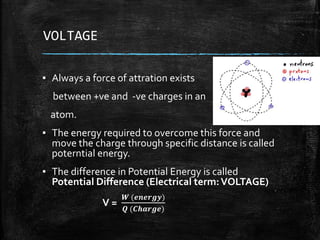
▪ Always a force of attration exists
between +ve and -ve charges in an
atom.
▪ The energy required to overcome this force and
move the charge through specific distance is called
poterntial energy.
▪ The difference in Potential Energy is called
Potential Difference (Electrical term:VOLTAGE)
V =
𝑾 (𝒆𝒏𝒆𝒓𝒈𝒚)
𝑸 (𝑪𝒉𝒂𝒓𝒈𝒆)
CURRENT
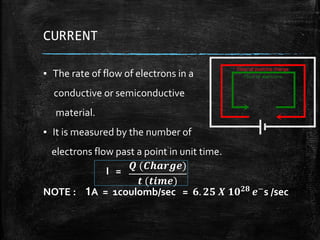
▪ The rate of flow of electrons in a
conductive or semiconductive
material.
▪ It is measured by the number of
electrons flow past a point in unit time.
I =
NOTE : 1A = 1coulomb/sec = 𝟔. 𝟐𝟓 𝑿 𝟏𝟎 𝟐𝟖 𝒆−s /sec
𝑸 (𝑪𝒉𝒂𝒓𝒈𝒆)
𝒕 (𝒕𝒊𝒎𝒆)
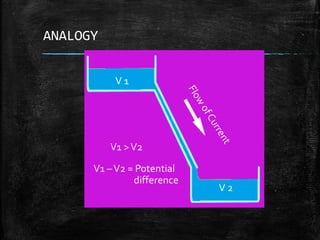
ANALOGY
V 1
V 2
V1 >V2
V1 –V2 = Potential
difference
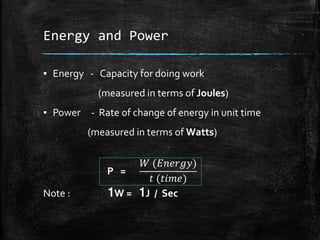
Energy and Power
▪ Energy - Capacity for doing work
(measured in terms of Joules)
▪ Power - Rate of change of energy in unit time
(measured in terms of Watts)
P =
Note : 1W = 1J / Sec
𝑊 (𝐸𝑛𝑒𝑟𝑔𝑦)
𝑡 (𝑡𝑖𝑚𝑒)
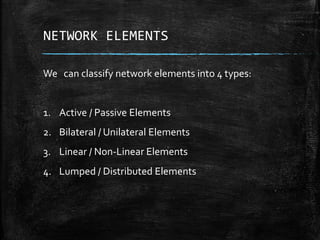
NETWORK ELEMENTS
We can classify network elements into 4 types:
1. Active / Passive Elements
2. Bilateral / Unilateral Elements
3. Linear / Non-Linear Elements
4. Lumped / Distributed Elements
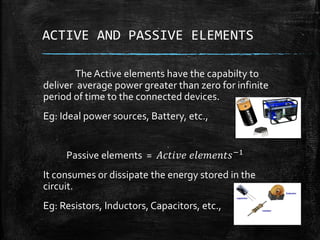
ACTIVE AND PASSIVE ELEMENTS
The Active elements have the capabilty to
deliver average power greater than zero for infinite
period of time to the connected devices.
Eg: Ideal power sources, Battery, etc.,
Passive elements = 𝐴𝑐𝑡𝑖𝑣𝑒 𝑒𝑙𝑒𝑚𝑒𝑛𝑡𝑠−1
It consumes or dissipate the energy stored in the
circuit.
Eg: Resistors, Inductors, Capacitors, etc.,
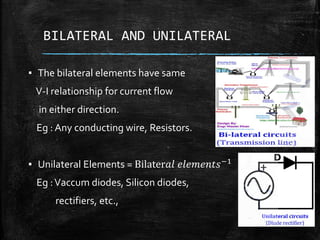
BILATERAL AND UNILATERAL
▪ The bilateral elements have same
V-I relationship for current flow
in either direction.
Eg : Any conducting wire, Resistors.
▪ Unilateral Elements = Bilater𝑎𝑙 𝑒𝑙𝑒𝑚𝑒𝑛𝑡𝑠−1
Eg :Vaccum diodes, Silicon diodes,
rectifiers, etc.,
LINEAR AND NON-LINEAR
▪ Linear elements have linear V-I relationship (i.e.
Straight line) passing through origin.
▪ Linear elements obeys superposition theorem.
Eg: Resistors
▪ Non-Linear Elements = 𝐿𝑖𝑛𝑒𝑎𝑟 𝑒𝑙𝑒𝑚𝑒𝑛𝑡𝑠−1
Eg: SCR,Triac
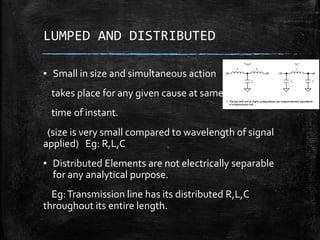
LUMPED AND DISTRIBUTED
▪ Small in size and simultaneous action
takes place for any given cause at same
time of instant.
(size is very small compared to wavelength of signal
applied) Eg: R,L,C
▪ Distributed Elements are not electrically separable
for any analytical purpose.
Eg:Transmission line has its distributed R,L,C
throughout its entire length.
PARAMETERS
▪ Three major parameters used in an electric circuits
are
1. Resistance
2. Inductance
3. Capacitance
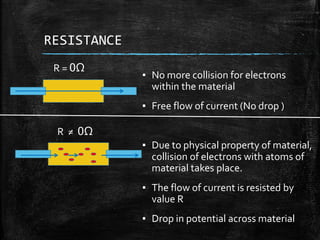
RESISTANCE
▪ No more collision for electrons
within the material
▪ Free flow of current (No drop )
▪ Due to physical property of material,
collision of electrons with atoms of
material takes place.
▪ The flow of current is resisted by
value R
▪ Drop in potential across material
R = 0Ω
R ≠ 0Ω
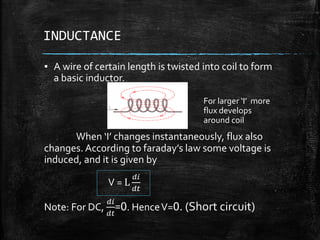
INDUCTANCE
▪ A wire of certain length is twisted into coil to form
a basic inductor.
When ‘I’ changes instantaneously, flux also
changes. According to faraday’s law some voltage is
induced, and it is given by
V = L
𝑑𝑖
𝑑𝑡
Note: For DC,
𝑑𝑖
𝑑𝑡
=0. HenceV=0. (Short circuit)
For larger ‘I’ more
flux develops
around coil
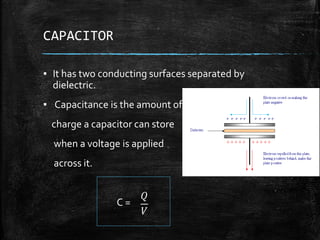
CAPACITOR
▪ It has two conducting surfaces separated by
dielectric.
▪ Capacitance is the amount of
charge a capacitor can store
when a voltage is applied
across it.
C =
𝑄
𝑉
The simple
presentation
ends here
And finally, It’s time to

Electric circuits and networks Basics

  • 1.
  • 2.
    OVERVIEW ▪ What’s – Voltage –Current – Energy – Power ▪ Network Elements ▪ Parameters of Electric circuit ▪ Conclusion
  • 3.
    VOLTAGE ▪ Always aforce of attration exists between +ve and -ve charges in an atom. ▪ The energy required to overcome this force and move the charge through specific distance is called poterntial energy. ▪ The difference in Potential Energy is called Potential Difference (Electrical term:VOLTAGE) V = 𝑾 (𝒆𝒏𝒆𝒓𝒈𝒚) 𝑸 (𝑪𝒉𝒂𝒓𝒈𝒆)
  • 4.
    CURRENT ▪ The rateof flow of electrons in a conductive or semiconductive material. ▪ It is measured by the number of electrons flow past a point in unit time. I = NOTE : 1A = 1coulomb/sec = 𝟔. 𝟐𝟓 𝑿 𝟏𝟎 𝟐𝟖 𝒆−s /sec 𝑸 (𝑪𝒉𝒂𝒓𝒈𝒆) 𝒕 (𝒕𝒊𝒎𝒆)
  • 5.
    ANALOGY V 1 V 2 V1>V2 V1 –V2 = Potential difference
  • 6.
    Energy and Power ▪Energy - Capacity for doing work (measured in terms of Joules) ▪ Power - Rate of change of energy in unit time (measured in terms of Watts) P = Note : 1W = 1J / Sec 𝑊 (𝐸𝑛𝑒𝑟𝑔𝑦) 𝑡 (𝑡𝑖𝑚𝑒)
  • 7.
    NETWORK ELEMENTS We canclassify network elements into 4 types: 1. Active / Passive Elements 2. Bilateral / Unilateral Elements 3. Linear / Non-Linear Elements 4. Lumped / Distributed Elements
  • 8.
    ACTIVE AND PASSIVEELEMENTS The Active elements have the capabilty to deliver average power greater than zero for infinite period of time to the connected devices. Eg: Ideal power sources, Battery, etc., Passive elements = 𝐴𝑐𝑡𝑖𝑣𝑒 𝑒𝑙𝑒𝑚𝑒𝑛𝑡𝑠−1 It consumes or dissipate the energy stored in the circuit. Eg: Resistors, Inductors, Capacitors, etc.,
  • 9.
    BILATERAL AND UNILATERAL ▪The bilateral elements have same V-I relationship for current flow in either direction. Eg : Any conducting wire, Resistors. ▪ Unilateral Elements = Bilater𝑎𝑙 𝑒𝑙𝑒𝑚𝑒𝑛𝑡𝑠−1 Eg :Vaccum diodes, Silicon diodes, rectifiers, etc.,
  • 10.
    LINEAR AND NON-LINEAR ▪Linear elements have linear V-I relationship (i.e. Straight line) passing through origin. ▪ Linear elements obeys superposition theorem. Eg: Resistors ▪ Non-Linear Elements = 𝐿𝑖𝑛𝑒𝑎𝑟 𝑒𝑙𝑒𝑚𝑒𝑛𝑡𝑠−1 Eg: SCR,Triac
  • 11.
    LUMPED AND DISTRIBUTED ▪Small in size and simultaneous action takes place for any given cause at same time of instant. (size is very small compared to wavelength of signal applied) Eg: R,L,C ▪ Distributed Elements are not electrically separable for any analytical purpose. Eg:Transmission line has its distributed R,L,C throughout its entire length.
  • 12.
    PARAMETERS ▪ Three majorparameters used in an electric circuits are 1. Resistance 2. Inductance 3. Capacitance
  • 13.
    RESISTANCE ▪ No morecollision for electrons within the material ▪ Free flow of current (No drop ) ▪ Due to physical property of material, collision of electrons with atoms of material takes place. ▪ The flow of current is resisted by value R ▪ Drop in potential across material R = 0Ω R ≠ 0Ω
  • 14.
    INDUCTANCE ▪ A wireof certain length is twisted into coil to form a basic inductor. When ‘I’ changes instantaneously, flux also changes. According to faraday’s law some voltage is induced, and it is given by V = L 𝑑𝑖 𝑑𝑡 Note: For DC, 𝑑𝑖 𝑑𝑡 =0. HenceV=0. (Short circuit) For larger ‘I’ more flux develops around coil
  • 15.
    CAPACITOR ▪ It hastwo conducting surfaces separated by dielectric. ▪ Capacitance is the amount of charge a capacitor can store when a voltage is applied across it. C = 𝑄 𝑉
  • 16.
  • 17.