ELECTRICAL ENGINEERING
Review
IN THE BEGINNING
The Electrical engineering field flourished in the
beginning as an identical occupation during the latter
half of the 19th century . The field was related to
commercialization of
 Electric telegraph
 Telephone
 Electric power distribution
TODAY THE FOLLOWING BRANCHES HAVE EMERGED
FROM THE ELECTRICAL ENGINEERING
 Electronics
 Digital Computers
 Power plant engineering
 RF Engineering
 Control systems
 Signal processing and
 Telecommunication
ELECTRICAL AND ELECTRONIC ENGINEERS
 The electrical engineers are usually concerned
with the use of electricity to transmit electric
power.
 The electronic engineers are generally interested
in using electricity for the purpose of processing
information.
QUOTE FOR ELECTRICAL ENGINEERS
Give us any form of energy, we (the
electrical engineers) convert it into useful
Electrical energy.
 Electricity
 William Gilbert[95]
Michael Faraday[citation needed]
Thomas Edison[96]
Nikola Tesla[citation needed]Book: De Magnete (1600)
Discovered electromagnetic induction (1831)
Proposed a kite experiment to prove
that lightning is electricity (1750)
Invented many electrical devices, such as
the carbon microphone
Invented alternating current and many other
electrical devices
FEW THEORY
 During these years (1880’s), the study of
electricity was largely considered to be a subfield
of physics.
 It was not until about 1885
that universities and institutes of
technology such as Massachusetts Institute of
Technology (MIT) and Cornell University started
to offer bachelor’s degree in electrical
engineering.
 The Darmstadt University of
Technology founded the first department of
electrical engineering in the world in 1882.
FORERUNNERS
of
EEE
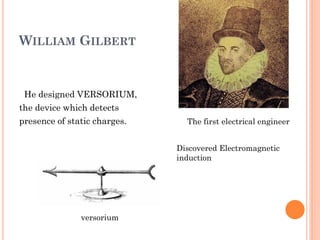
WILLIAM GILBERT
He designed VERSORIUM,
the device which detects
presence of static charges.
versorium
Discovered Electromagnetic
induction
The first electrical engineer
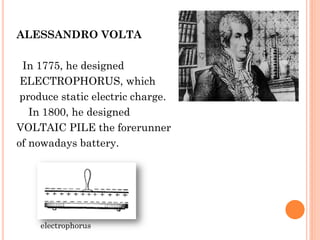
ALESSANDRO VOLTA
In 1775, he designed
ELECTROPHORUS, which
produce static electric charge.
In 1800, he designed
VOLTAIC PILE the forerunner
of nowadays battery.
electrophorus
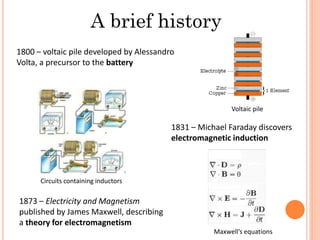
A brief history
1800 – voltaic pile developed by Alessandro
Volta, a precursor to the battery
1831 – Michael Faraday discovers
electromagnetic induction
1873 – Electricity and Magnetism
published by James Maxwell, describing
a theory for electromagnetism
Voltaic pile
Circuits containing inductors
Maxwell’s equations
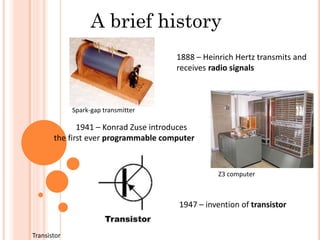
A brief history
1888 – Heinrich Hertz transmits and
receives radio signals
1941 – Konrad Zuse introduces
the first ever programmable computer
1947 – invention of transistor
Spark-gap transmitter
Z3 computer
Transistor
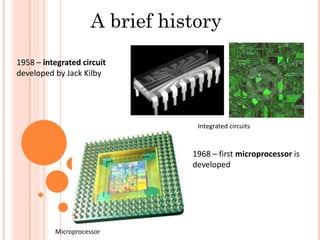
A brief history
1958 – integrated circuit
developed by Jack Kilby
1968 – first microprocessor is
developed
Integrated circuits
Microprocessor
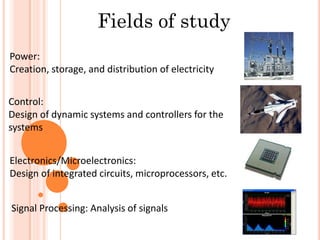
Fields of study
Power:
Creation, storage, and distribution of electricity
Control:
Design of dynamic systems and controllers for the
systems
Electronics/Microelectronics:
Design of integrated circuits, microprocessors, etc.
Signal Processing: Analysis of signals
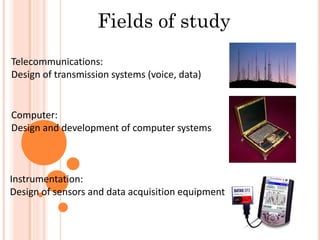
Telecommunications:
Design of transmission systems (voice, data)
Computer:
Design and development of computer systems
Instrumentation:
Design of sensors and data acquisition equipment
Fields of study
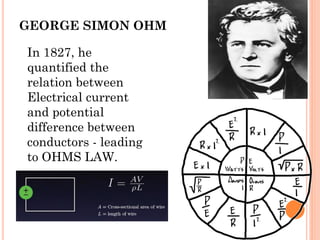
In 1827, he
quantified the
relation between
Electrical current
and potential
difference between
conductors - leading
to OHMS LAW.
GEORGE SIMON OHM
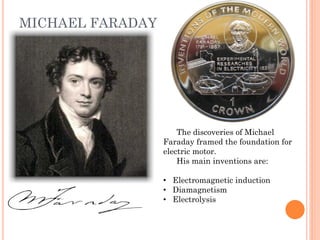
MICHAEL FARADAY
The discoveries of Michael
Faraday framed the foundation for
electric motor.
His main inventions are:
• Electromagnetic induction
• Diamagnetism
• Electrolysis
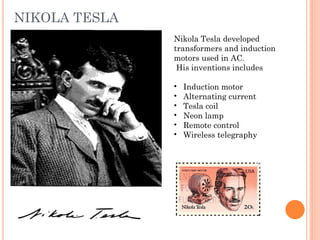
NIKOLA TESLA
Nikola Tesla developed
transformers and induction
motors used in AC.
His inventions includes
• Induction motor
• Alternating current
• Tesla coil
• Neon lamp
• Remote control
• Wireless telegraphy
CHANGES OCCURRED IN THE
FIELD OF ELECTRICITY :
In the beginning of 1830s, efforts were made to
apply electricity in the practices of telegraph.
By the end of the 19th century the world had
been forever changed by the rapid
communication made possible, by engineering
developments of land-lines, submarine cables,
and wireless telegraphy.
STANDARDISATION OF UNITS:
Practical applications and advances in the field
created an increasing need for standardized units
to measure.
It led to the international standardization of
the units volt, ampere, coulomb, ohm, farad,
and Henry.
This was achieved at an international
conference in Chicago 1893.
During these decades the use of electrical
engineering increased dramatically.
In 1882, Thomas Edison switched on the
world's first large-scale electric power network
that provided 110 volts — direct current (DC) —
to 59 customers on Manhattan Island in New
York City.
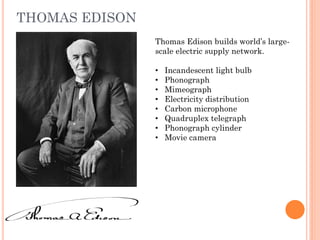
THOMAS EDISON
Thomas Edison builds world’s large-
scale electric supply network.
• Incandescent light bulb
• Phonograph
• Mimeograph
• Electricity distribution
• Carbon microphone
• Quadruplex telegraph
• Phonograph cylinder
• Movie camera
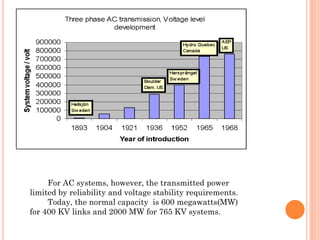
For AC systems, however, the transmitted power
limited by reliability and voltage stability requirements.
Today, the normal capacity is 600 megawatts(MW)
for 400 KV links and 2000 MW for 765 KV systems.
During these years, the study of electricity
was largely considered to be a subfield of physics.
It was not until about 1885 that
universities and institutes of technology
such as Massachusetts Institute of Technology
(MIT) and Cornell University started to offer
bachelor's degrees in electrical engineering.
The Darmstadt University of
Technology founded the first department of
electrical engineering in the world in 1882.
HVDC
The development of HVDC for transmission
purposes began in the mid of 1920s.
The first commercial HVDC link, delivered
by ASEA (Swedish electrical company) in 1954,
carried power between the mainland of Sweeden
and the island of Gotland.
OUR AIM IS TO ATTAIN
 High efficiency
 Minimum transmission loss
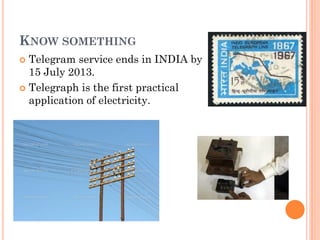
KNOW SOMETHING
 Telegram service ends in INDIA by
15 July 2013.
 Telegraph is the first practical
application of electricity.
TAKE EFFORTS
TO FILL THIS PPT
WITH YOUR INFO.
Electrical engineering history

Electrical engineering history

  • 1.
  • 2.
    IN THE BEGINNING TheElectrical engineering field flourished in the beginning as an identical occupation during the latter half of the 19th century . The field was related to commercialization of  Electric telegraph  Telephone  Electric power distribution
  • 3.
    TODAY THE FOLLOWINGBRANCHES HAVE EMERGED FROM THE ELECTRICAL ENGINEERING  Electronics  Digital Computers  Power plant engineering  RF Engineering  Control systems  Signal processing and  Telecommunication
  • 4.
    ELECTRICAL AND ELECTRONICENGINEERS  The electrical engineers are usually concerned with the use of electricity to transmit electric power.  The electronic engineers are generally interested in using electricity for the purpose of processing information.
  • 5.
    QUOTE FOR ELECTRICALENGINEERS Give us any form of energy, we (the electrical engineers) convert it into useful Electrical energy.
  • 7.
     Electricity  WilliamGilbert[95] Michael Faraday[citation needed] Thomas Edison[96] Nikola Tesla[citation needed]Book: De Magnete (1600) Discovered electromagnetic induction (1831) Proposed a kite experiment to prove that lightning is electricity (1750) Invented many electrical devices, such as the carbon microphone Invented alternating current and many other electrical devices
  • 8.
    FEW THEORY  Duringthese years (1880’s), the study of electricity was largely considered to be a subfield of physics.  It was not until about 1885 that universities and institutes of technology such as Massachusetts Institute of Technology (MIT) and Cornell University started to offer bachelor’s degree in electrical engineering.  The Darmstadt University of Technology founded the first department of electrical engineering in the world in 1882.
  • 9.
  • 10.
    WILLIAM GILBERT He designedVERSORIUM, the device which detects presence of static charges. versorium Discovered Electromagnetic induction The first electrical engineer
  • 11.
    ALESSANDRO VOLTA In 1775,he designed ELECTROPHORUS, which produce static electric charge. In 1800, he designed VOLTAIC PILE the forerunner of nowadays battery. electrophorus
  • 12.
    A brief history 1800– voltaic pile developed by Alessandro Volta, a precursor to the battery 1831 – Michael Faraday discovers electromagnetic induction 1873 – Electricity and Magnetism published by James Maxwell, describing a theory for electromagnetism Voltaic pile Circuits containing inductors Maxwell’s equations
  • 13.
    A brief history 1888– Heinrich Hertz transmits and receives radio signals 1941 – Konrad Zuse introduces the first ever programmable computer 1947 – invention of transistor Spark-gap transmitter Z3 computer Transistor
  • 14.
    A brief history 1958– integrated circuit developed by Jack Kilby 1968 – first microprocessor is developed Integrated circuits Microprocessor
  • 15.
    Fields of study Power: Creation,storage, and distribution of electricity Control: Design of dynamic systems and controllers for the systems Electronics/Microelectronics: Design of integrated circuits, microprocessors, etc. Signal Processing: Analysis of signals
  • 16.
    Telecommunications: Design of transmissionsystems (voice, data) Computer: Design and development of computer systems Instrumentation: Design of sensors and data acquisition equipment Fields of study
  • 17.
    In 1827, he quantifiedthe relation between Electrical current and potential difference between conductors - leading to OHMS LAW. GEORGE SIMON OHM
  • 18.
    MICHAEL FARADAY The discoveriesof Michael Faraday framed the foundation for electric motor. His main inventions are: • Electromagnetic induction • Diamagnetism • Electrolysis
  • 19.
    NIKOLA TESLA Nikola Tesladeveloped transformers and induction motors used in AC. His inventions includes • Induction motor • Alternating current • Tesla coil • Neon lamp • Remote control • Wireless telegraphy
  • 20.
    CHANGES OCCURRED INTHE FIELD OF ELECTRICITY : In the beginning of 1830s, efforts were made to apply electricity in the practices of telegraph. By the end of the 19th century the world had been forever changed by the rapid communication made possible, by engineering developments of land-lines, submarine cables, and wireless telegraphy.
  • 21.
    STANDARDISATION OF UNITS: Practicalapplications and advances in the field created an increasing need for standardized units to measure. It led to the international standardization of the units volt, ampere, coulomb, ohm, farad, and Henry. This was achieved at an international conference in Chicago 1893.
  • 22.
    During these decadesthe use of electrical engineering increased dramatically. In 1882, Thomas Edison switched on the world's first large-scale electric power network that provided 110 volts — direct current (DC) — to 59 customers on Manhattan Island in New York City.
  • 23.
    THOMAS EDISON Thomas Edisonbuilds world’s large- scale electric supply network. • Incandescent light bulb • Phonograph • Mimeograph • Electricity distribution • Carbon microphone • Quadruplex telegraph • Phonograph cylinder • Movie camera
  • 24.
    For AC systems,however, the transmitted power limited by reliability and voltage stability requirements. Today, the normal capacity is 600 megawatts(MW) for 400 KV links and 2000 MW for 765 KV systems.
  • 25.
    During these years,the study of electricity was largely considered to be a subfield of physics. It was not until about 1885 that universities and institutes of technology such as Massachusetts Institute of Technology (MIT) and Cornell University started to offer bachelor's degrees in electrical engineering. The Darmstadt University of Technology founded the first department of electrical engineering in the world in 1882.
  • 26.
    HVDC The development ofHVDC for transmission purposes began in the mid of 1920s. The first commercial HVDC link, delivered by ASEA (Swedish electrical company) in 1954, carried power between the mainland of Sweeden and the island of Gotland.
  • 27.
    OUR AIM ISTO ATTAIN  High efficiency  Minimum transmission loss
  • 28.
    KNOW SOMETHING  Telegramservice ends in INDIA by 15 July 2013.  Telegraph is the first practical application of electricity.
  • 29.
    TAKE EFFORTS TO FILLTHIS PPT WITH YOUR INFO.