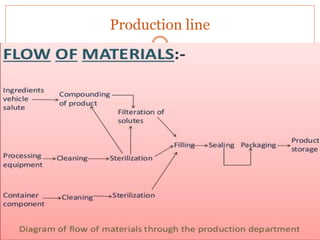
PRODUCTION LINE
SCALING UP , PROCESSING ,
BATCH RECORD DESIGN
Sterile Dosage Forms
Alaa Mohamed deabes
parenteral Ophthalmic
Sterile Dosage Forms
Sterile Pyrogen free
 Sterile products are
dosage forms of
therapeutic agents
that are free of viable
microorganism.
 Sterility is absolute
term.
 Pyrogens are substances
that produce a fever. The
most common pyrogens
are endotoxins, produced
by G-ve bacteria .
 Thermostable
Sterile Dosage Forms
Pyrogen
 Removed by oxidizing to easily eliminated gases or to
non volatile solid easily separated by fractional
distillation .
Several distillation
are done , purified
sterile , pyrogen free
Pyrogen test
In vivo ( rabbit )
In vitro
Limulus amebocyte
lysate LAL
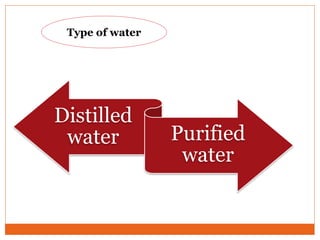
Distilled
water Purified
water
Type of water
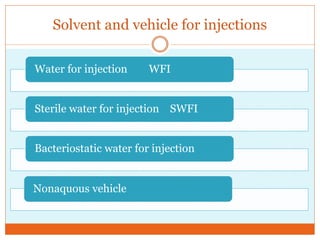
Solvent and vehicle for injections
Water for injection WFI
Sterile water for injection SWFI
Bacteriostatic water for injection
Nonaquous vehicle
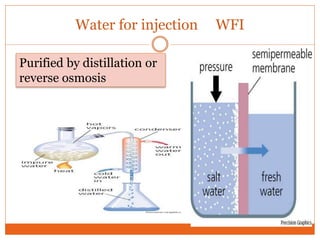
Water for injection WFI
Purified by distillation or
reverse osmosis
Water for injection WFI
 It is not sterile
 No added substance.
 For manufacture of injectable products which are to
be sterilized after preparation.
 Used withen 24 hr after its collection.
 Collected in sterile and pyrogen free container glass
or glass lined.
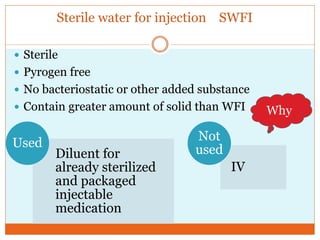
Sterile water for injection SWFI
 Sterile
 Pyrogen free
 No bacteriostatic or other added substance
 Contain greater amount of solid than WFI Why
Diluent for
already sterilized
and packaged
injectable
medication
Used
IV
Not
used
Sterile water for injection SWFI
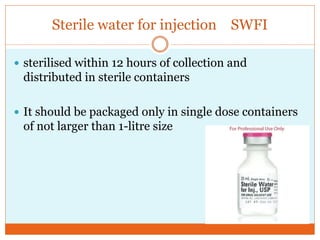
 sterilised within 12 hours of collection and
distributed in sterile containers
 It should be packaged only in single dose containers
of not larger than 1-litre size
Bacteriostatic water for injection
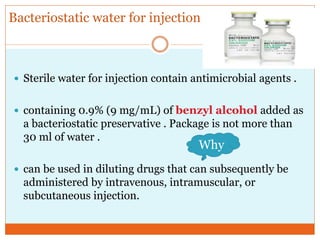
 Sterile water for injection contain antimicrobial agents .
 containing 0.9% (9 mg/mL) of benzyl alcohol added as
a bacteriostatic preservative . Package is not more than
30 ml of water .
 can be used in diluting drugs that can subsequently be
administered by intravenous, intramuscular, or
subcutaneous injection.
Why
Nonaqueous vehicle
 Substance liable to hydrolysis
 Substance insoluble in water
 Must be non toxic , non irritating
 without pharmaceutical activity
 Viscosity & pH must be suitable
 Misciblity with body fluid
Glycerin , PEG , Fixed vegetable oil ,
Alcohol
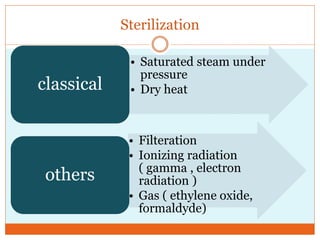
Sterilization
• Saturated steam under
pressure
• Dry heatclassical
• Filteration
• Ionizing radiation
( gamma , electron
radiation )
• Gas ( ethylene oxide,
formaldyde)
others
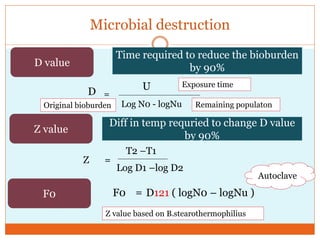
Microbial destruction
D value
Z value
F0
Time required to reduce the bioburden
by 90%
D =
U
Log N0 - logNu
Exposure time
Original bioburden Remaining populaton
Diff in temp requried to change D value
by 90%
Z =
T2 –T1
Log D1 –log D2
F0 = D121 ( logN0 – logNu )
Autoclave
Z value based on B.stearothermophilius
Steam
sterilization
( autoclaving)
1) Mechanism
2) for what
3) Not for
what
4) Air most
removed
115.5 for 30 min
121.5 for 20 min
126.5 for 15 min
temp Time
Most
common
121 ±2 °C
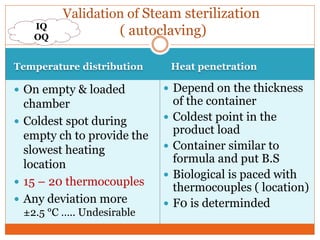
Temperature distribution Heat penetration
 On empty & loaded
chamber
 Coldest spot during
empty ch to provide the
slowest heating
location
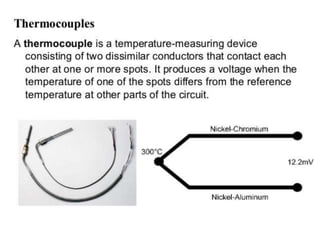
 15 – 20 thermocouples
 Any deviation more
±2.5 °C ….. Undesirable
 Depend on the thickness
of the container
 Coldest point in the
product load
 Container similar to
formula and put B.S
 Biological is paced with
thermocouples ( location)
 F0 is determinded
Validation of Steam sterilization
( autoclaving)IQ
OQ
Dry heat
sterilization
1) Mechanism
2) for what
3) Not for
what
160 for 180 min
170 for 60 min De
pyrogenation
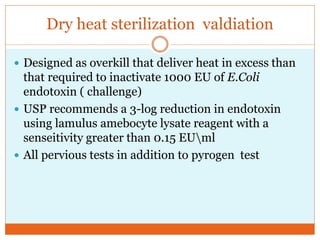
Dry heat sterilization valdiation
 Designed as overkill that deliver heat in excess than
that required to inactivate 1000 EU of E.Coli
endotoxin ( challenge)
 USP recommends a 3-log reduction in endotoxin
using lamulus amebocyte lysate reagent with a
senseitivity greater than 0.15 EUml
 All pervious tests in addition to pyrogen test
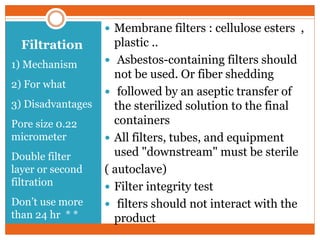
Filtration
1) Mechanism
2) For what
3) Disadvantages
Pore size 0.22
micrometer
Double filter
layer or second
filtration
Don’t use more
than 24 hr * *
 Membrane filters : cellulose esters ,
plastic ..
 Asbestos-containing filters should
not be used. Or fiber shedding
 followed by an aseptic transfer of
the sterilized solution to the final
containers
 All filters, tubes, and equipment
used "downstream" must be sterile
( autoclave)
 Filter integrity test
 filters should not interact with the
product
Radiation
1) Mechanism
2) For what
3) Disadvantages
 Laws and regulations for
protection against radiation must
be respected.
 Radiation doses should be
monitored with specific
dosimeters
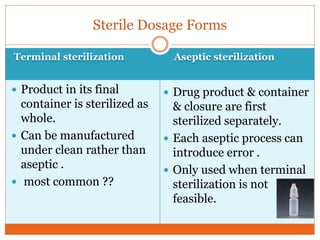
Aseptic sterilizationTerminal sterilization
 Drug product & container
& closure are first
sterilized separately.
 Each aseptic process can
introduce error .
 Only used when terminal
sterilization is not
feasible.
 Product in its final
container is sterilized as
whole.
 Can be manufactured
under clean rather than
aseptic .
 most common ??
Sterile Dosage Forms
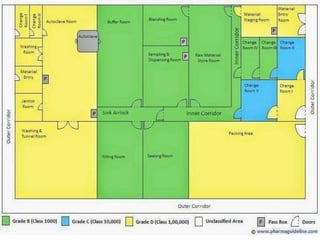
Air classification system
 B at rest = A at operation
 C at rest = B at operation
 D at rest = C at operation
 A for high risk operation
 B surround area A
 C & D for less critical stages
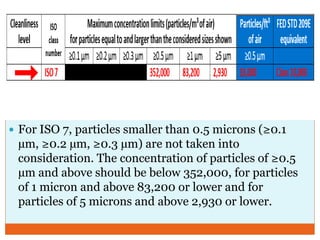
 For ISO 7, particles smaller than 0.5 microns (≥0.1
µm, ≥0.2 µm, ≥0.3 µm) are not taken into
consideration. The concentration of particles of ≥0.5
µm and above should be below 352,000, for particles
of 1 micron and above 83,200 or lower and for
particles of 5 microns and above 2,930 or lower.
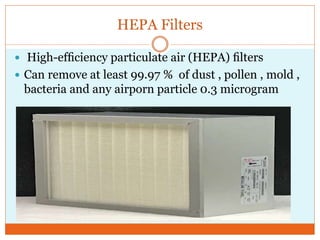
HEPA Filters
 High-efficiency particulate air (HEPA) filters
 Can remove at least 99.97 % of dust , pollen , mold ,
bacteria and any airporn particle 0.3 microgram
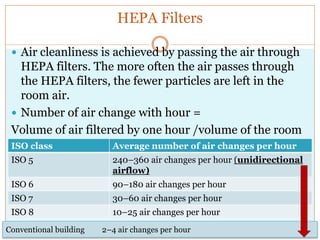
HEPA Filters
 Air cleanliness is achieved by passing the air through
HEPA filters. The more often the air passes through
the HEPA filters, the fewer particles are left in the
room air.
 Number of air change with hour =
Volume of air filtered by one hour /volume of the room
ISO class Average number of air changes per hour
ISO 5 240–360 air changes per hour (unidirectional
airflow)
ISO 6 90–180 air changes per hour
ISO 7 30–60 air changes per hour
ISO 8 10–25 air changes per hour
Conventional building 2–4 air changes per hour
ISO 5 (A) (100)
 use unidirectional airflow
 (not just below a LAFW hood)
 ISO 5 zone | 240–360 air changes per hour
Entry
Air
lock
must be taken into consideration
 the size of the room,
 the number of people in the room,
 the equipment in the room,
 the processes involved,
 the heat gain, etc
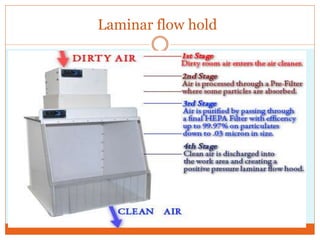
Laminar flow hold
Production line
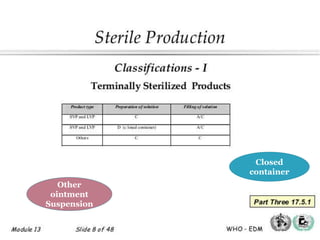
Closed
container
Other
ointment
Suspension
ideal Cost
AB BC
Eye drops
Aseptic
Flow chart of sterile dosage form
IPC
Raw material
AI + additive +pack
Engineering
chart
Sizing and
sieving
Ball mill
Sieving machine
Det of particle
size
Drying Tray dryer
Det of moisture
content
Weighing Electric balance
Douple chek
Wt
WFI Line
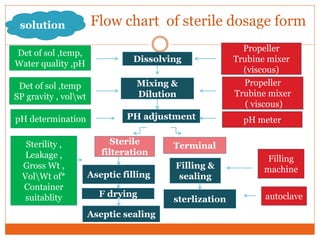
Flow chart of sterile dosage formsolution
Dissolving
Det of sol ,temp,
Water quality ,pH
Mixing &
Dilution
Propeller
Trubine mixer
( viscous)
Propeller
Trubine mixer
(viscous)
Det of sol ,temp
SP gravity , volwt
PH adjustment pH meterpH determination
Filling &
sealing
sterlization
Sterile
filteration
Aseptic filling
F drying
Aseptic sealing
Filling
machine
autoclave
Sterility ,
Leakage ,
Gross Wt ,
VolWt of*
Container
suitablity
Terminal
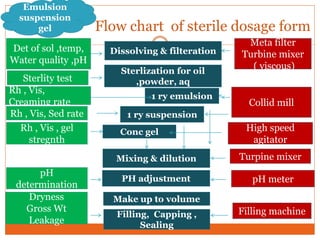
Flow chart of sterile dosage form
Emulsion
suspension
gel
Dissolving & filteration
Meta filter
Turbine mixer
( viscous)
Det of sol ,temp,
Water quality ,pH
1 ry emulsion
1 ry suspension
Conc gel
Collid mill
High speed
agitator
Sterlization for oil
,powder, aq
Mixing & dilution
PH adjustment
Make up to volume
Turpine mixer
pH meter
Filling, Capping ,
Sealing
Rh , Vis,
Creaming rate
Rh , Vis, Sed rate
Rh , Vis , gel
stregnth
pH
determination
Dryness
Gross Wt
Leakage
Sterlity test
Filling machine
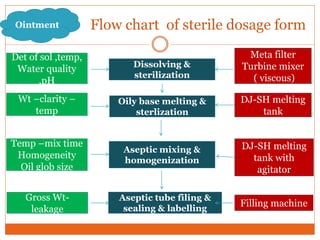
Flow chart of sterile dosage formOintment
Dissolving &
sterilization
Oily base melting &
sterlization
Meta filter
Turbine mixer
( viscous)
Det of sol ,temp,
Water quality
,pH
DJ-SH melting
tank
Aseptic mixing &
homogenization
DJ-SH melting
tank with
agitator
Aseptic tube filing &
sealing & labelling
Filling machine
Gross Wt-
leakage
Temp –mix time
Homogeneity
Oil glob size
Wt –clarity –
temp
Flow chart of sterile dosage form
Packaging
Labelling , cartoning
Package
machine
Recon of label ,
carton data,
good packaging
Inspection of
pamphlet &
leakage test
Intermediate
store
Quality control
Final store
Content uniformty
Volwt check
Viscosity –
rheology Clarity
Sed rate – cream
rate
Gel stregnth
Consistency
Spreading
Gritty sensation
Strility test
 https://www.sciencedirect.com/topics/chemistry/py
rogen
 http://www.authorstream.com/Presentation/tausif1
991-1795419-design-layout-operational-facilities-
sterile-products/
 https://www.slideshare.net/shettyuc/cgmps-for-
sterile-products
 https://www.sciencedirect.com/topics/engineering/
terminal-sterilization
 https://www.sciencedirect.com/topics/agricultural-
and-biological-sciences/aseptic-processing
Reference
 https://www.google.com/search?q=air+classificatio
n+system&source=lnms&tbm=isch&sa=X&ved=0ah
UKEwjq0p2QysXhAhUFxhoKHRy_CaYQ_AUIDigB
&biw=1366&bih=604#imgrc=ij9hpgPzJYLM6M:
 http://www.hefilter.com/Industry-News/Common-
Types-of-HEPA-Filter.shtml
 https://www.mecart-cleanrooms.com/learning-
center/cleanroom-classifications-iso-8-iso-7-iso-6-
iso-5/
 https://www.slideshare.net/yuvas2010/377218gmpt
rainingsterilefacility
Reference
Sterile dosage form

Sterile dosage form

  • 1.
    PRODUCTION LINE SCALING UP, PROCESSING , BATCH RECORD DESIGN Sterile Dosage Forms Alaa Mohamed deabes
  • 2.
  • 3.
    Sterile Pyrogen free Sterile products are dosage forms of therapeutic agents that are free of viable microorganism.  Sterility is absolute term.  Pyrogens are substances that produce a fever. The most common pyrogens are endotoxins, produced by G-ve bacteria .  Thermostable Sterile Dosage Forms
  • 4.
    Pyrogen  Removed byoxidizing to easily eliminated gases or to non volatile solid easily separated by fractional distillation . Several distillation are done , purified sterile , pyrogen free Pyrogen test In vivo ( rabbit ) In vitro Limulus amebocyte lysate LAL
  • 5.
  • 6.
    Solvent and vehiclefor injections Water for injection WFI Sterile water for injection SWFI Bacteriostatic water for injection Nonaquous vehicle
  • 7.
    Water for injectionWFI Purified by distillation or reverse osmosis
  • 8.
    Water for injectionWFI  It is not sterile  No added substance.  For manufacture of injectable products which are to be sterilized after preparation.  Used withen 24 hr after its collection.  Collected in sterile and pyrogen free container glass or glass lined.
  • 9.
    Sterile water forinjection SWFI  Sterile  Pyrogen free  No bacteriostatic or other added substance  Contain greater amount of solid than WFI Why Diluent for already sterilized and packaged injectable medication Used IV Not used
  • 10.
    Sterile water forinjection SWFI  sterilised within 12 hours of collection and distributed in sterile containers  It should be packaged only in single dose containers of not larger than 1-litre size
  • 11.
    Bacteriostatic water forinjection  Sterile water for injection contain antimicrobial agents .  containing 0.9% (9 mg/mL) of benzyl alcohol added as a bacteriostatic preservative . Package is not more than 30 ml of water .  can be used in diluting drugs that can subsequently be administered by intravenous, intramuscular, or subcutaneous injection. Why
  • 12.
    Nonaqueous vehicle  Substanceliable to hydrolysis  Substance insoluble in water  Must be non toxic , non irritating  without pharmaceutical activity  Viscosity & pH must be suitable  Misciblity with body fluid Glycerin , PEG , Fixed vegetable oil , Alcohol
  • 13.
    Sterilization • Saturated steamunder pressure • Dry heatclassical • Filteration • Ionizing radiation ( gamma , electron radiation ) • Gas ( ethylene oxide, formaldyde) others
  • 14.
    Microbial destruction D value Zvalue F0 Time required to reduce the bioburden by 90% D = U Log N0 - logNu Exposure time Original bioburden Remaining populaton Diff in temp requried to change D value by 90% Z = T2 –T1 Log D1 –log D2 F0 = D121 ( logN0 – logNu ) Autoclave Z value based on B.stearothermophilius
  • 15.
    Steam sterilization ( autoclaving) 1) Mechanism 2)for what 3) Not for what 4) Air most removed 115.5 for 30 min 121.5 for 20 min 126.5 for 15 min temp Time Most common 121 ±2 °C
  • 16.
    Temperature distribution Heatpenetration  On empty & loaded chamber  Coldest spot during empty ch to provide the slowest heating location  15 – 20 thermocouples  Any deviation more ±2.5 °C ….. Undesirable  Depend on the thickness of the container  Coldest point in the product load  Container similar to formula and put B.S  Biological is paced with thermocouples ( location)  F0 is determinded Validation of Steam sterilization ( autoclaving)IQ OQ
  • 18.
    Dry heat sterilization 1) Mechanism 2)for what 3) Not for what 160 for 180 min 170 for 60 min De pyrogenation
  • 19.
    Dry heat sterilizationvaldiation  Designed as overkill that deliver heat in excess than that required to inactivate 1000 EU of E.Coli endotoxin ( challenge)  USP recommends a 3-log reduction in endotoxin using lamulus amebocyte lysate reagent with a senseitivity greater than 0.15 EUml  All pervious tests in addition to pyrogen test
  • 20.
    Filtration 1) Mechanism 2) Forwhat 3) Disadvantages Pore size 0.22 micrometer Double filter layer or second filtration Don’t use more than 24 hr * *  Membrane filters : cellulose esters , plastic ..  Asbestos-containing filters should not be used. Or fiber shedding  followed by an aseptic transfer of the sterilized solution to the final containers  All filters, tubes, and equipment used "downstream" must be sterile ( autoclave)  Filter integrity test  filters should not interact with the product
  • 21.
    Radiation 1) Mechanism 2) Forwhat 3) Disadvantages  Laws and regulations for protection against radiation must be respected.  Radiation doses should be monitored with specific dosimeters
  • 22.
    Aseptic sterilizationTerminal sterilization Drug product & container & closure are first sterilized separately.  Each aseptic process can introduce error .  Only used when terminal sterilization is not feasible.  Product in its final container is sterilized as whole.  Can be manufactured under clean rather than aseptic .  most common ?? Sterile Dosage Forms
  • 25.
    Air classification system B at rest = A at operation  C at rest = B at operation  D at rest = C at operation  A for high risk operation  B surround area A  C & D for less critical stages
  • 29.
     For ISO7, particles smaller than 0.5 microns (≥0.1 µm, ≥0.2 µm, ≥0.3 µm) are not taken into consideration. The concentration of particles of ≥0.5 µm and above should be below 352,000, for particles of 1 micron and above 83,200 or lower and for particles of 5 microns and above 2,930 or lower.
  • 30.
    HEPA Filters  High-efficiencyparticulate air (HEPA) filters  Can remove at least 99.97 % of dust , pollen , mold , bacteria and any airporn particle 0.3 microgram
  • 31.
    HEPA Filters  Aircleanliness is achieved by passing the air through HEPA filters. The more often the air passes through the HEPA filters, the fewer particles are left in the room air.  Number of air change with hour = Volume of air filtered by one hour /volume of the room ISO class Average number of air changes per hour ISO 5 240–360 air changes per hour (unidirectional airflow) ISO 6 90–180 air changes per hour ISO 7 30–60 air changes per hour ISO 8 10–25 air changes per hour Conventional building 2–4 air changes per hour
  • 32.
    ISO 5 (A)(100)  use unidirectional airflow  (not just below a LAFW hood)  ISO 5 zone | 240–360 air changes per hour Entry Air lock
  • 33.
    must be takeninto consideration  the size of the room,  the number of people in the room,  the equipment in the room,  the processes involved,  the heat gain, etc
  • 34.
  • 36.
  • 37.
  • 38.
  • 39.
  • 42.
    Flow chart ofsterile dosage form IPC Raw material AI + additive +pack Engineering chart Sizing and sieving Ball mill Sieving machine Det of particle size Drying Tray dryer Det of moisture content Weighing Electric balance Douple chek Wt WFI Line
  • 43.
    Flow chart ofsterile dosage formsolution Dissolving Det of sol ,temp, Water quality ,pH Mixing & Dilution Propeller Trubine mixer ( viscous) Propeller Trubine mixer (viscous) Det of sol ,temp SP gravity , volwt PH adjustment pH meterpH determination Filling & sealing sterlization Sterile filteration Aseptic filling F drying Aseptic sealing Filling machine autoclave Sterility , Leakage , Gross Wt , VolWt of* Container suitablity Terminal
  • 44.
    Flow chart ofsterile dosage form Emulsion suspension gel Dissolving & filteration Meta filter Turbine mixer ( viscous) Det of sol ,temp, Water quality ,pH 1 ry emulsion 1 ry suspension Conc gel Collid mill High speed agitator Sterlization for oil ,powder, aq Mixing & dilution PH adjustment Make up to volume Turpine mixer pH meter Filling, Capping , Sealing Rh , Vis, Creaming rate Rh , Vis, Sed rate Rh , Vis , gel stregnth pH determination Dryness Gross Wt Leakage Sterlity test Filling machine
  • 45.
    Flow chart ofsterile dosage formOintment Dissolving & sterilization Oily base melting & sterlization Meta filter Turbine mixer ( viscous) Det of sol ,temp, Water quality ,pH DJ-SH melting tank Aseptic mixing & homogenization DJ-SH melting tank with agitator Aseptic tube filing & sealing & labelling Filling machine Gross Wt- leakage Temp –mix time Homogeneity Oil glob size Wt –clarity – temp
  • 46.
    Flow chart ofsterile dosage form Packaging Labelling , cartoning Package machine Recon of label , carton data, good packaging Inspection of pamphlet & leakage test Intermediate store Quality control Final store Content uniformty Volwt check Viscosity – rheology Clarity Sed rate – cream rate Gel stregnth Consistency Spreading Gritty sensation Strility test
  • 47.
     https://www.sciencedirect.com/topics/chemistry/py rogen  http://www.authorstream.com/Presentation/tausif1 991-1795419-design-layout-operational-facilities- sterile-products/ https://www.slideshare.net/shettyuc/cgmps-for- sterile-products  https://www.sciencedirect.com/topics/engineering/ terminal-sterilization  https://www.sciencedirect.com/topics/agricultural- and-biological-sciences/aseptic-processing Reference
  • 48.
     https://www.google.com/search?q=air+classificatio n+system&source=lnms&tbm=isch&sa=X&ved=0ah UKEwjq0p2QysXhAhUFxhoKHRy_CaYQ_AUIDigB &biw=1366&bih=604#imgrc=ij9hpgPzJYLM6M:  http://www.hefilter.com/Industry-News/Common- Types-of-HEPA-Filter.shtml https://www.mecart-cleanrooms.com/learning- center/cleanroom-classifications-iso-8-iso-7-iso-6- iso-5/  https://www.slideshare.net/yuvas2010/377218gmpt rainingsterilefacility Reference