Presented by :
Jamdhade Vaishali K.
1st Year M. Pharmacy
(Pharmaceutics)
Guided by :
Dr. Chaudhari Pallavi
Date: 15/11/2017
Semester 1st graded seminar on:
CONTENT
 Introduction
 Method Of Sterilization
Physical Method
Chemical Method
 Selection Process
For Aqueous Product
For Non-aqueous Product
 Specification
 Validation Of Process And Equipment
 References
1
• Sterilization can be defined as any process that
effectively kills or eliminates transmissible agents (such
as fungi, bacteria, viruses) from a surface, equipment,
foods, medications, or biological culture medium.
• Sterilization can be defined as the process through
which all forms of life are destroyed, removed or
permanently inactivated.
INTRODUCTION
2
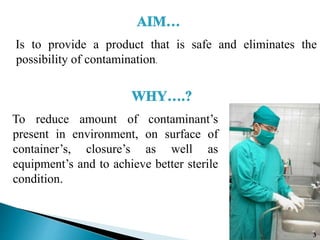
Is to provide a product that is safe and eliminates the
possibility of contamination.
To reduce amount of contaminant’s
present in environment, on surface of
container’s, closure’s as well as
equipment’s and to achieve better sterile
condition.
3
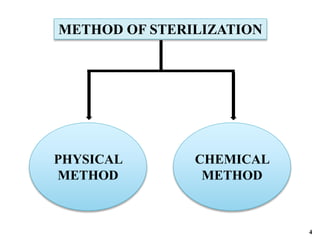
CHEMICAL
METHOD
METHOD OF STERILIZATION
PHYSICAL
METHOD
4
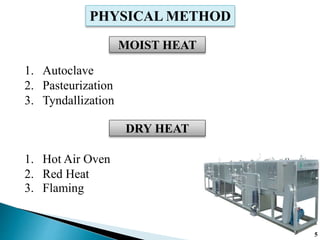
PHYSICAL METHOD
1. Autoclave
2. Pasteurization
3. Tyndallization
MOIST HEAT
DRY HEAT
5
1. Hot Air Oven
2. Red Heat
3. Flaming
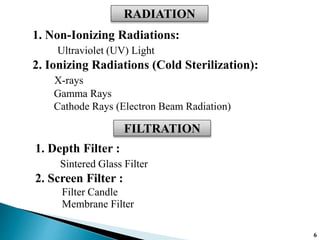
1. Non-Ionizing Radiations:
Ultraviolet (UV) Light
2. Ionizing Radiations (Cold Sterilization):
X-rays
Gamma Rays
Cathode Rays (Electron Beam Radiation)
RADIATION
FILTRATION
6
1. Depth Filter :
Sintered Glass Filter
2. Screen Filter :
Filter Candle
Membrane Filter
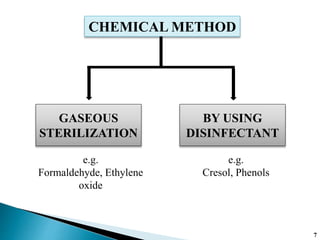
CHEMICAL METHOD
GASEOUS
STERILIZATION
BY USING
DISINFECTANT
e.g.
Formaldehyde, Ethylene
oxide
e.g.
Cresol, Phenols
7
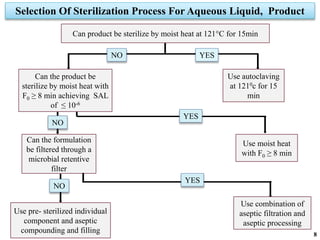
Can product be sterilize by moist heat at 121°C for 15min
Can the product be
sterilize by moist heat with
F0 ≥ 8 min achieving SAL
of ≤ 10-6
NO YES
Use autoclaving
at 1210c for 15
min
Can the formulation
be filtered through a
microbial retentive
filter
YES
Use moist heat
with F0 ≥ 8 min
NO
NO
YES
Use pre- sterilized individual
component and aseptic
compounding and filling
Use combination of
aseptic filtration and
aseptic processing
Selection Of Sterilization Process For Aqueous Liquid, Product
8
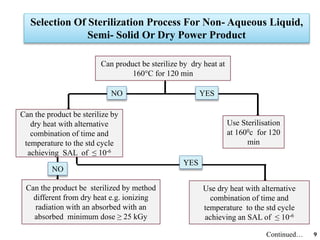
Can product be sterilize by dry heat at
160°C for 120 min
Can the product be sterilize by
dry heat with alternative
combination of time and
temperature to the std cycle
achieving SAL of ≤ 10-6
NO YES
Use Sterilisation
at 1600c for 120
min
Can the product be sterilized by method
different from dry heat e.g. ionizing
radiation with an absorbed with an
absorbed minimum dose ≥ 25 kGy
YES
Use dry heat with alternative
combination of time and
temperature to the std cycle
achieving an SAL of ≤ 10-6
NO
Selection Of Sterilization Process For Non- Aqueous Liquid,
Semi- Solid Or Dry Power Product
9Continued…
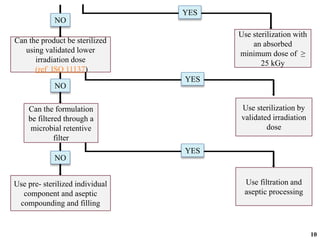
YES
NO
Can the formulation
be filtered through a
microbial retentive
filter
NO
Use sterilization by
validated irradiation
dose
YES
Use filtration and
aseptic processing
Use pre- sterilized individual
component and aseptic
compounding and filling
Can the product be sterilized
using validated lower
irradiation dose
(ref ISO 11137)
NO
YES
Use sterilization with
an absorbed
minimum dose of ≥
25 kGy
10
o Microorganisms destroyed by cellular protein
coagulation.
o The objects to be sterilized are exposed to saturated
steam under 1 atmosphere pressure at a minimum
temperature of 121°C for 15 min.
o An autoclave is commonly used for moist heat
sterilization.
o Because it does not require as high temperature, moist
heat sterilization cause less product and equipment
damage compared to dry heat sterilization.
SPECIFICATION
MOIST HEAT STERILIZATION :
11
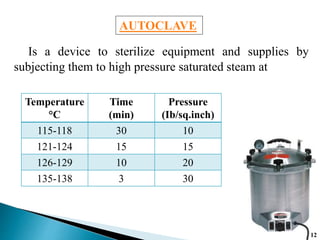
Is a device to sterilize equipment and supplies by
subjecting them to high pressure saturated steam at
Temperature
°C
Time
(min)
Pressure
(Ib/sq.inch)
115-118 30 10
121-124 15 15
126-129 10 20
135-138 3 30
AUTOCLAVE
12
• Lid (door) fitted with clamps and asbestos jacket,
stationary autoclave may be double doors at both ends
one for loading and one for unloading.
• Pressure gauge.
• Thermocouple for measurement of temperature.
• Air vent to remove air before sterilization.
• Safety valve to permit escape of excess steam to prevent
explosion .
• Modern autoclaves are recording (record pressure,
temperature during the whole process) supplied with
timer and are automatically controlled.
Main Features
13
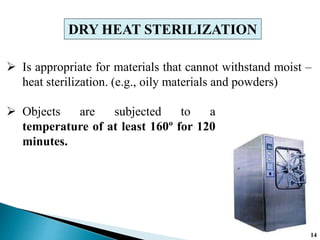
 Is appropriate for materials that cannot withstand moist –
heat sterilization. (e.g., oily materials and powders)
DRY HEAT STERILIZATION
 Objects are subjected to a
temperature of at least 160º for 120
minutes.
14
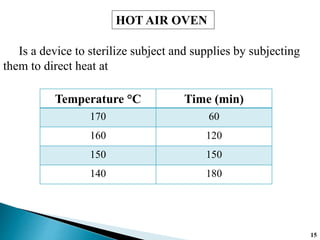
Is a device to sterilize subject and supplies by subjecting
them to direct heat at
Temperature °C Time (min)
170 60
160 120
150 150
140 180
15
HOT AIR OVEN
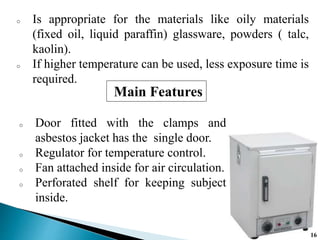
o Is appropriate for the materials like oily materials
(fixed oil, liquid paraffin) glassware, powders ( talc,
kaolin).
o If higher temperature can be used, less exposure time is
required.
o Door fitted with the clamps and
asbestos jacket has the single door.
o Regulator for temperature control.
o Fan attached inside for air circulation.
o Perforated shelf for keeping subject
inside.
Main Features
16
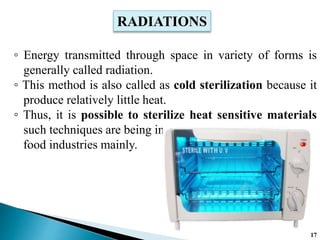
◦ Energy transmitted through space in variety of forms is
generally called radiation.
◦ This method is also called as cold sterilization because it
produce relatively little heat.
◦ Thus, it is possible to sterilize heat sensitive materials
such techniques are being in
food industries mainly.
RADIATIONS
17
◦ UV in region of 2537 A° has been shown to posses the
greatest activity in destroying Microorganisms.
◦ Commonly employed in reduction of airborne
contamination in the maintenance of aseptic areas &
rooms.
◦ Source of artificial UV radiation s is UV lamps (generally
called sterilizing lamp or germicidal lamp).
◦ UV light is absorbed by the nucleic acid of the cell where
it does the greatest damage.
Non Ionizing Radiations (UV)
18
◦ X-rays, gamma rays & cathode rays are lethal to DNA
& other vital cell constituents.
◦ They have high penetration power & considerable
energy.
◦ The factors that effect the lethal activity of ionizing
radiations are oxygen effect, protective compounds,
sensitizing agents, pH of cultures, freezing, moisture &
recovery conditions.
Ionizing Radiations
19
◦ This is a non-thermal method of sterilization used
widely in the pharmaceutical industry where heat labile
solutions are to be sterilized.
◦ This is useful for large volume solutions, eye drops,
antibiotic solutions, sera & carbohydrate solutions.
◦ This also useful for separation of bacteriophages &
bacterial toxins from bacteria for the isolation of
Microorganisms which are scanty in fluids.
FILTRATION
20
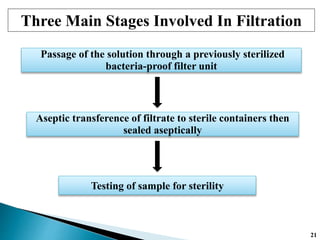
Three Main Stages Involved In Filtration
Passage of the solution through a previously sterilized
bacteria-proof filter unit
Aseptic transference of filtrate to sterile containers then
sealed aseptically
Testing of sample for sterility
21
◦ The destruction of all living Microorganisms with
chemical in gaseous or vapours state.
◦ When material is affected by the dry or moist heat then the
gaseous sterilization is used.
◦ All these gases are toxic to human being above certain
concentration and may exhibit other undesirable side
effect.
◦ Ethylene oxide is most widely used gaseous sterilization
agent in pharmaceutical industry.
◦ In addition to these various glycols, methyl bromide and
alcohol have been used for room sterilization.
GASEOUS STERILIZATION
22
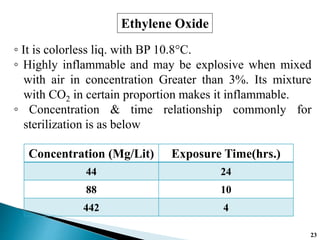
◦ It is colorless liq. with BP 10.8°C.
◦ Highly inflammable and may be explosive when mixed
with air in concentration Greater than 3%. Its mixture
with CO2 in certain proportion makes it inflammable.
◦ Concentration & time relationship commonly for
sterilization is as below
Concentration (Mg/Lit) Exposure Time(hrs.)
44 24
88 10
442 4
Ethylene Oxide
23
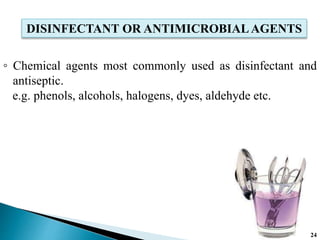
◦ Chemical agents most commonly used as disinfectant and
antiseptic.
e.g. phenols, alcohols, halogens, dyes, aldehyde etc.
DISINFECTANT OR ANTIMICROBIAL AGENTS
24
DEVELOPMENT & VALIDATION OF
PROCESS & EQUIPMENT
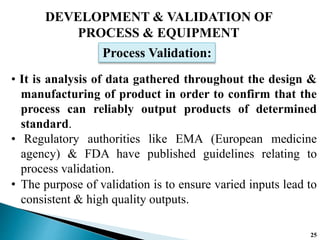
• It is analysis of data gathered throughout the design &
manufacturing of product in order to confirm that the
process can reliably output products of determined
standard.
• Regulatory authorities like EMA (European medicine
agency) & FDA have published guidelines relating to
process validation.
Process Validation:
• The purpose of validation is to ensure varied inputs lead to
consistent & high quality outputs.
25
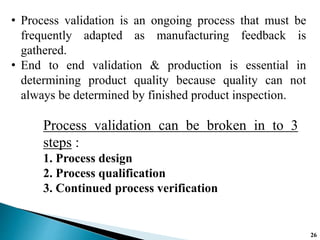
• Process validation is an ongoing process that must be
frequently adapted as manufacturing feedback is
gathered.
• End to end validation & production is essential in
determining product quality because quality can not
always be determined by finished product inspection.
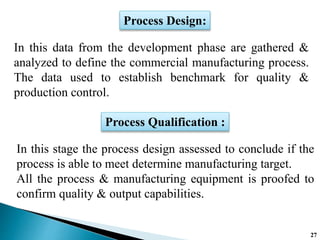
Process validation can be broken in to 3
steps :
1. Process design
2. Process qualification
3. Continued process verification
26
In this data from the development phase are gathered &
analyzed to define the commercial manufacturing process.
The data used to establish benchmark for quality &
production control.
Process Design:
In this stage the process design assessed to conclude if the
process is able to meet determine manufacturing target.
All the process & manufacturing equipment is proofed to
confirm quality & output capabilities.
Process Qualification :
27
Continued Process Validation:
It is the ongoing monitoring of all aspects of production
cycle. It aims to ensure that all levels production are
controlled & regulated.
28
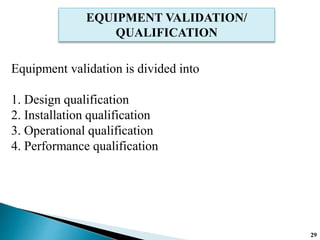
EQUIPMENT VALIDATION/
QUALIFICATION
Equipment validation is divided into
1. Design qualification
2. Installation qualification
3. Operational qualification
4. Performance qualification
29
DQ
It define the functional & operational specification of the
instrument & details for the continues design in selection of
supplier.
IQ
Demonstrates that the process or equipment meets all
specifications, is installed correctly, and all required
components and documentation needed for continued
operation are installed and in place.
30
OQ
Demonstrates that all facets of the process or equipment are
operating correctly.
PQ
It is the process of demonstrating that an instrument
consistently performed according to specification appropriate
for it’s routine work.
31
REFERENCES
 Dr. Kokare “ PHARMACEUTICAL MICROBIOLOGY- Principle
& Application”, 9th edition, reprint 2013, Nirali Prakashan, Pune.
Page No.16.1-16.28.
 Lachman, Lieberman’s “The Theory & Practice of Industrial
Pharmacy” 4th edition, CBS Publisher Pvt ltd, New Delhi.
Page No.804-827.
 Cooper and Gunn’s “Dispensing for Pharmaceutical Student ”
Indian edition 2007 CBS Publisher, New Delhi.
Page No. 395,614,623,663.
 http://www.ema.europa.eu/docs/en_GB/document_library/Scientifi
c_guideline/2009/09/WC500003520.pdf
 https://en.wikipedia.org/wiki/Sterilization
32
34
THANK YOU

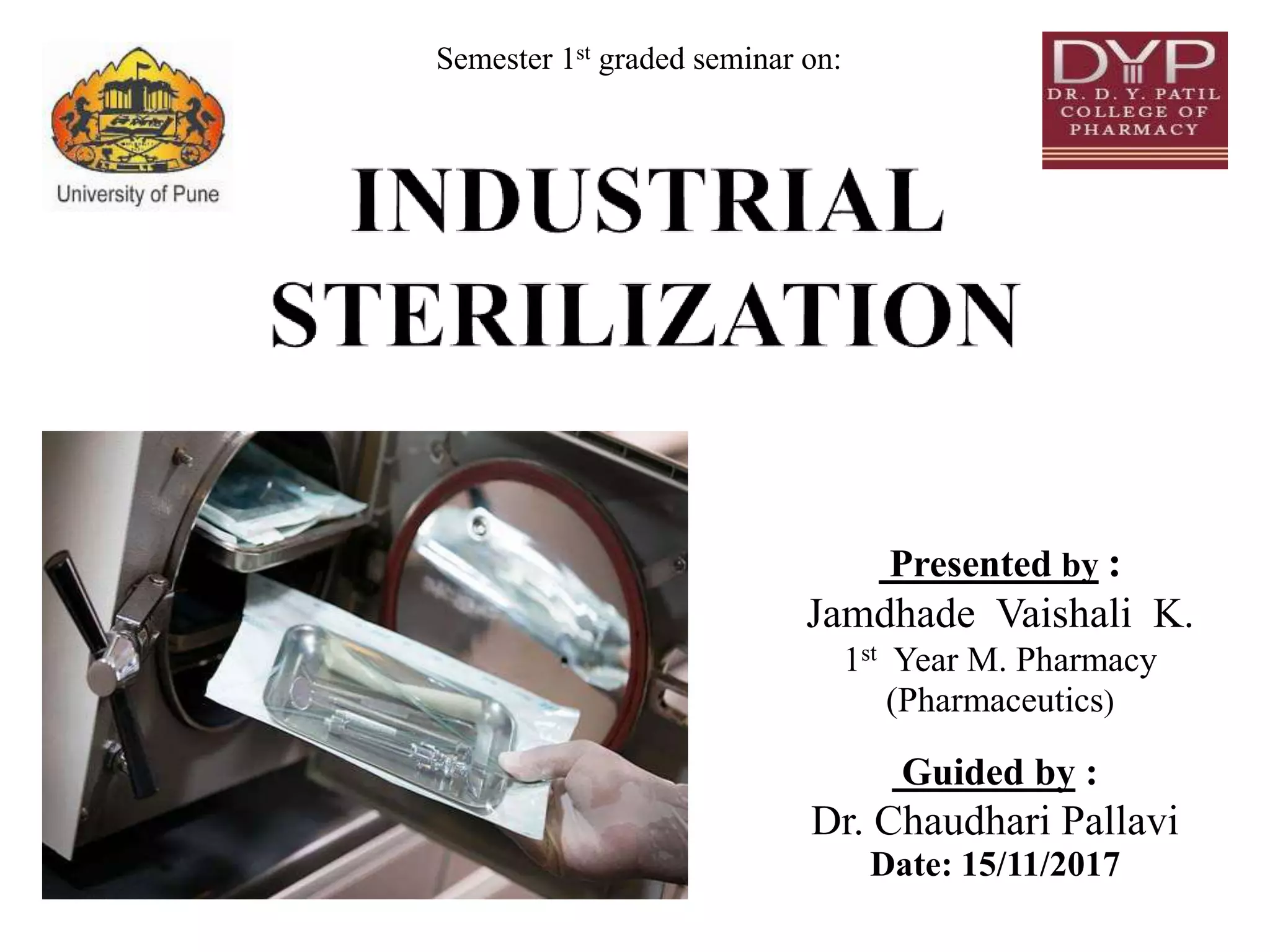
Industrial sterilization

  • 1.
    Presented by : JamdhadeVaishali K. 1st Year M. Pharmacy (Pharmaceutics) Guided by : Dr. Chaudhari Pallavi Date: 15/11/2017 Semester 1st graded seminar on:
  • 2.
    CONTENT  Introduction  MethodOf Sterilization Physical Method Chemical Method  Selection Process For Aqueous Product For Non-aqueous Product  Specification  Validation Of Process And Equipment  References 1
  • 3.
    • Sterilization canbe defined as any process that effectively kills or eliminates transmissible agents (such as fungi, bacteria, viruses) from a surface, equipment, foods, medications, or biological culture medium. • Sterilization can be defined as the process through which all forms of life are destroyed, removed or permanently inactivated. INTRODUCTION 2
  • 4.
    Is to providea product that is safe and eliminates the possibility of contamination. To reduce amount of contaminant’s present in environment, on surface of container’s, closure’s as well as equipment’s and to achieve better sterile condition. 3
  • 5.
  • 6.
    PHYSICAL METHOD 1. Autoclave 2.Pasteurization 3. Tyndallization MOIST HEAT DRY HEAT 5 1. Hot Air Oven 2. Red Heat 3. Flaming
  • 7.
    1. Non-Ionizing Radiations: Ultraviolet(UV) Light 2. Ionizing Radiations (Cold Sterilization): X-rays Gamma Rays Cathode Rays (Electron Beam Radiation) RADIATION FILTRATION 6 1. Depth Filter : Sintered Glass Filter 2. Screen Filter : Filter Candle Membrane Filter
  • 8.
  • 9.
    Can product besterilize by moist heat at 121°C for 15min Can the product be sterilize by moist heat with F0 ≥ 8 min achieving SAL of ≤ 10-6 NO YES Use autoclaving at 1210c for 15 min Can the formulation be filtered through a microbial retentive filter YES Use moist heat with F0 ≥ 8 min NO NO YES Use pre- sterilized individual component and aseptic compounding and filling Use combination of aseptic filtration and aseptic processing Selection Of Sterilization Process For Aqueous Liquid, Product 8
  • 10.
    Can product besterilize by dry heat at 160°C for 120 min Can the product be sterilize by dry heat with alternative combination of time and temperature to the std cycle achieving SAL of ≤ 10-6 NO YES Use Sterilisation at 1600c for 120 min Can the product be sterilized by method different from dry heat e.g. ionizing radiation with an absorbed with an absorbed minimum dose ≥ 25 kGy YES Use dry heat with alternative combination of time and temperature to the std cycle achieving an SAL of ≤ 10-6 NO Selection Of Sterilization Process For Non- Aqueous Liquid, Semi- Solid Or Dry Power Product 9Continued…
  • 11.
    YES NO Can the formulation befiltered through a microbial retentive filter NO Use sterilization by validated irradiation dose YES Use filtration and aseptic processing Use pre- sterilized individual component and aseptic compounding and filling Can the product be sterilized using validated lower irradiation dose (ref ISO 11137) NO YES Use sterilization with an absorbed minimum dose of ≥ 25 kGy 10
  • 12.
    o Microorganisms destroyedby cellular protein coagulation. o The objects to be sterilized are exposed to saturated steam under 1 atmosphere pressure at a minimum temperature of 121°C for 15 min. o An autoclave is commonly used for moist heat sterilization. o Because it does not require as high temperature, moist heat sterilization cause less product and equipment damage compared to dry heat sterilization. SPECIFICATION MOIST HEAT STERILIZATION : 11
  • 13.
    Is a deviceto sterilize equipment and supplies by subjecting them to high pressure saturated steam at Temperature °C Time (min) Pressure (Ib/sq.inch) 115-118 30 10 121-124 15 15 126-129 10 20 135-138 3 30 AUTOCLAVE 12
  • 14.
    • Lid (door)fitted with clamps and asbestos jacket, stationary autoclave may be double doors at both ends one for loading and one for unloading. • Pressure gauge. • Thermocouple for measurement of temperature. • Air vent to remove air before sterilization. • Safety valve to permit escape of excess steam to prevent explosion . • Modern autoclaves are recording (record pressure, temperature during the whole process) supplied with timer and are automatically controlled. Main Features 13
  • 15.
     Is appropriatefor materials that cannot withstand moist – heat sterilization. (e.g., oily materials and powders) DRY HEAT STERILIZATION  Objects are subjected to a temperature of at least 160º for 120 minutes. 14
  • 16.
    Is a deviceto sterilize subject and supplies by subjecting them to direct heat at Temperature °C Time (min) 170 60 160 120 150 150 140 180 15 HOT AIR OVEN
  • 17.
    o Is appropriatefor the materials like oily materials (fixed oil, liquid paraffin) glassware, powders ( talc, kaolin). o If higher temperature can be used, less exposure time is required. o Door fitted with the clamps and asbestos jacket has the single door. o Regulator for temperature control. o Fan attached inside for air circulation. o Perforated shelf for keeping subject inside. Main Features 16
  • 18.
    ◦ Energy transmittedthrough space in variety of forms is generally called radiation. ◦ This method is also called as cold sterilization because it produce relatively little heat. ◦ Thus, it is possible to sterilize heat sensitive materials such techniques are being in food industries mainly. RADIATIONS 17
  • 19.
    ◦ UV inregion of 2537 A° has been shown to posses the greatest activity in destroying Microorganisms. ◦ Commonly employed in reduction of airborne contamination in the maintenance of aseptic areas & rooms. ◦ Source of artificial UV radiation s is UV lamps (generally called sterilizing lamp or germicidal lamp). ◦ UV light is absorbed by the nucleic acid of the cell where it does the greatest damage. Non Ionizing Radiations (UV) 18
  • 20.
    ◦ X-rays, gammarays & cathode rays are lethal to DNA & other vital cell constituents. ◦ They have high penetration power & considerable energy. ◦ The factors that effect the lethal activity of ionizing radiations are oxygen effect, protective compounds, sensitizing agents, pH of cultures, freezing, moisture & recovery conditions. Ionizing Radiations 19
  • 21.
    ◦ This isa non-thermal method of sterilization used widely in the pharmaceutical industry where heat labile solutions are to be sterilized. ◦ This is useful for large volume solutions, eye drops, antibiotic solutions, sera & carbohydrate solutions. ◦ This also useful for separation of bacteriophages & bacterial toxins from bacteria for the isolation of Microorganisms which are scanty in fluids. FILTRATION 20
  • 22.
    Three Main StagesInvolved In Filtration Passage of the solution through a previously sterilized bacteria-proof filter unit Aseptic transference of filtrate to sterile containers then sealed aseptically Testing of sample for sterility 21
  • 23.
    ◦ The destructionof all living Microorganisms with chemical in gaseous or vapours state. ◦ When material is affected by the dry or moist heat then the gaseous sterilization is used. ◦ All these gases are toxic to human being above certain concentration and may exhibit other undesirable side effect. ◦ Ethylene oxide is most widely used gaseous sterilization agent in pharmaceutical industry. ◦ In addition to these various glycols, methyl bromide and alcohol have been used for room sterilization. GASEOUS STERILIZATION 22
  • 24.
    ◦ It iscolorless liq. with BP 10.8°C. ◦ Highly inflammable and may be explosive when mixed with air in concentration Greater than 3%. Its mixture with CO2 in certain proportion makes it inflammable. ◦ Concentration & time relationship commonly for sterilization is as below Concentration (Mg/Lit) Exposure Time(hrs.) 44 24 88 10 442 4 Ethylene Oxide 23
  • 25.
    ◦ Chemical agentsmost commonly used as disinfectant and antiseptic. e.g. phenols, alcohols, halogens, dyes, aldehyde etc. DISINFECTANT OR ANTIMICROBIAL AGENTS 24
  • 26.
    DEVELOPMENT & VALIDATIONOF PROCESS & EQUIPMENT • It is analysis of data gathered throughout the design & manufacturing of product in order to confirm that the process can reliably output products of determined standard. • Regulatory authorities like EMA (European medicine agency) & FDA have published guidelines relating to process validation. Process Validation: • The purpose of validation is to ensure varied inputs lead to consistent & high quality outputs. 25
  • 27.
    • Process validationis an ongoing process that must be frequently adapted as manufacturing feedback is gathered. • End to end validation & production is essential in determining product quality because quality can not always be determined by finished product inspection. Process validation can be broken in to 3 steps : 1. Process design 2. Process qualification 3. Continued process verification 26
  • 28.
    In this datafrom the development phase are gathered & analyzed to define the commercial manufacturing process. The data used to establish benchmark for quality & production control. Process Design: In this stage the process design assessed to conclude if the process is able to meet determine manufacturing target. All the process & manufacturing equipment is proofed to confirm quality & output capabilities. Process Qualification : 27
  • 29.
    Continued Process Validation: Itis the ongoing monitoring of all aspects of production cycle. It aims to ensure that all levels production are controlled & regulated. 28
  • 30.
    EQUIPMENT VALIDATION/ QUALIFICATION Equipment validationis divided into 1. Design qualification 2. Installation qualification 3. Operational qualification 4. Performance qualification 29
  • 31.
    DQ It define thefunctional & operational specification of the instrument & details for the continues design in selection of supplier. IQ Demonstrates that the process or equipment meets all specifications, is installed correctly, and all required components and documentation needed for continued operation are installed and in place. 30
  • 32.
    OQ Demonstrates that allfacets of the process or equipment are operating correctly. PQ It is the process of demonstrating that an instrument consistently performed according to specification appropriate for it’s routine work. 31
  • 33.
    REFERENCES  Dr. Kokare“ PHARMACEUTICAL MICROBIOLOGY- Principle & Application”, 9th edition, reprint 2013, Nirali Prakashan, Pune. Page No.16.1-16.28.  Lachman, Lieberman’s “The Theory & Practice of Industrial Pharmacy” 4th edition, CBS Publisher Pvt ltd, New Delhi. Page No.804-827.  Cooper and Gunn’s “Dispensing for Pharmaceutical Student ” Indian edition 2007 CBS Publisher, New Delhi. Page No. 395,614,623,663.  http://www.ema.europa.eu/docs/en_GB/document_library/Scientifi c_guideline/2009/09/WC500003520.pdf  https://en.wikipedia.org/wiki/Sterilization 32
  • 34.