By
DUVVU CHANDINI, M PHARM
(DEPARTMENTOF PHARMACEUTICALTECHNOLOGY)
UNDER GUIDANCE OF
DR K.L.DEEPTHI
( ASSOCIATE PROFESSOR)
RAGHU COLLEGE OF PHARMACY
1
OBJECTIVE
 INTRODUCTION
 ROUTES OF ADMINISTRATION
 ADVANTAGES
 DISADVANTAGES
 CATEGORIES
 FORMULATION OF SMALL VOLUME PARENTERALS
AND LARGE VOLUME PARENTERALS
 DEVELOPMENT OF PARENTERAL PRODUCTS
 QUALITY CONTROL REQUIREMENTS FOR
PARENTERALS
2
INTRODUCTION
➢The term “Parenteral” derived from Greek word “Para
"means “outside” and “Enterone” means “Intestine”.
➢These are sterile solutions or suspensionsof drug in
aqueous or oily phase.
➢The term “Parenteral” literally means “to avoid the gut”
(GI Tract) and its deliverydoesn’t utilizethe
alimentarycanal and other body tissues.
3
➢ These are administered directly into the vein,
muscles or under skin, or more specializedtissues
such as spinal cord.
➢Parenteral route of administration usually have more
rapid onset of action compared to other routes as
they are directly administered into the circulation
and do not have any GI absorption
4
GENERAL REQUIREMENTS FOR PRODUCT
DOSAGE FORMS
❑ stability
❑ Sterility
❑ Free from pyrogens, toxins, foreign particles
❑ Isotonic in condition
❑ Chemical purity
5
ROUTES OF ADMINISTRATION
❑ Intravenous
❑ Intramuscular
❑ Subcutaneous
❑ Intra dermal
❑ Intra arterial
❑ Intra cardiac
❑ Peri dermal
❑ Intra cerebral
❑ Intra cisternal
❑ Intra articular
6
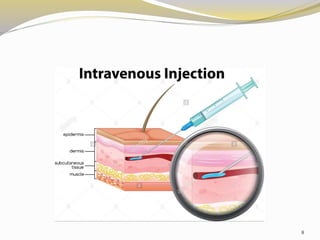
1. Intravenous
➢Most rapid onset of action as the drug is injected
directly into the vein of the patient.
➢The term intravenous means “into the vein”.
➢IV infusion is slow and constant volumeof deliveryof a
drug into patientvein over a given period of time.
➢The main purposeof IV infusion is :
❑Quick action
❑More reliable
❑Can administer large amount
❑Medication sent directly into blood stream
7
8
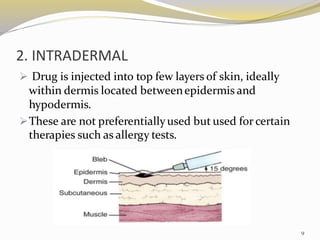
2. INTRADERMAL
➢ Drug is injected into top few layers of skin, ideally
within dermis located betweenepidermis and
hypodermis.
➢These are not preferentiallyused but used for certain
therapies such as allergy tests.
9
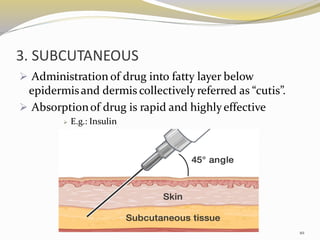
3. SUBCUTANEOUS
➢ Administration of drug into fatty layer below
epidermisand dermis collectivelyreferred as “cutis”.
➢ Absorptionof drug is rapid and highlyeffective
➢ E.g.: Insulin
10
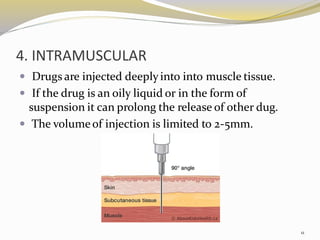
4. INTRAMUSCULAR
 Drugs are injected deeplyinto into muscle tissue.
 If the drug is an oily liquid or in the form of
suspension it can prolong the release of other dug.
 The volumeof injection is limited to 2-5mm.
11
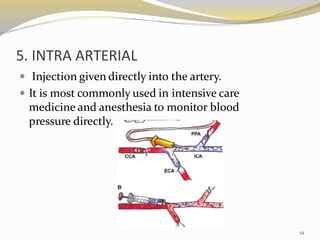
5. INTRA ARTERIAL
 Injection given directly into the artery.
 It is most commonly used in intensive care
medicine and anesthesia to monitor blood
pressure directly.
12
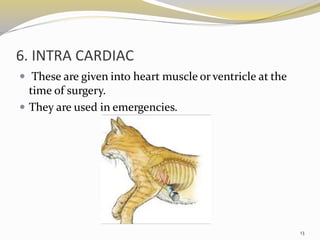
6. INTRA CARDIAC
 These are given into heart muscle or ventricle at the
time of surgery.
 They are used in emergencies.
13
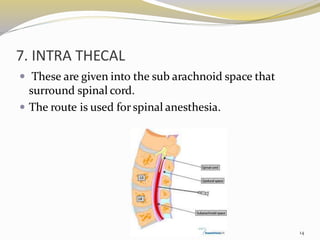
7. INTRA THECAL
 These are given into the sub arachnoid space that
surround spinal cord.
 The route is used for spinal anesthesia.
14
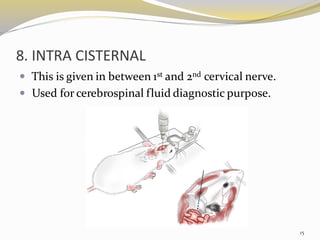
8. INTRA CISTERNAL
 This is given in between 1st and 2nd cervical nerve.
 Used for cerebrospinal fluid diagnostic purpose.
15
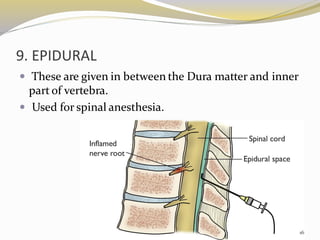
9. EPIDURAL
 These are given in between the Dura matter and inner
part of vertebra.
 Used for spinal anesthesia.
16
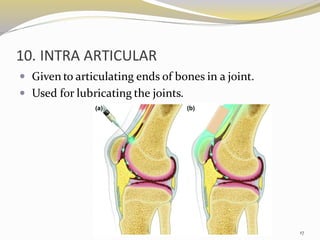
10. INTRA ARTICULAR
 Given to articulating ends of bones in a joint.
 Used for lubricating the joints.
17
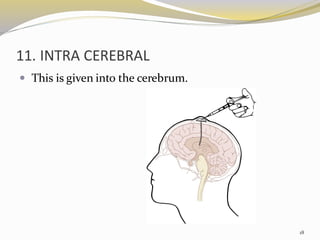
11. INTRA CEREBRAL
 This is given into the cerebrum.
18
ADVANTAGES
1. Rapid onset of action.
2. Useful for emergency situations.
3. For patients whocannot take orally.
4. Providing sustained drug delivery(implants).
5. Avoid 1st pass metabolism.
6. Drug injected directly into tissue(TDDS).
7. Complete bioavailability.
8. For deliveryof fluids, electrolytes and nutrients.
9. Can be done in hospitalsand health care centres.
19
DISADVANTAGES
1. Pain when inserting the needle.
2. Hypersensitivityreactions.
3. Trained person required.
4. Require control of sterility and non pyrogenecity.
5. More expensiveand costly to produce.
6. Require specializedequipment, devices and
techniques.
20
CATEGORIES
▪ BASED ON VOLUME :
➢ Based on production and control, the categories are
divided into :
1) Small volume parenterals(vol<100ml)
2) Large volume parenterals(vol>100ml)
1) SMALL VOLUME PARENTERALS:
➢ it usuallyranges from 1 to 30ml in volume.
➢ Mostlygiven in multiple dose.
21
➢ There are different types :
❑Ampoules
❑Vials
❑Dry powders
❑Pre filled syringes
❑Ampoules :
➢ These are sealed glass containers with an elongated neck
that is to be broken off.
➢ These contain coloured band around the neck.
❑Vials :
➢ Drugs and other additives are packed in vials as liquid or
lyophilized products.
22
➢Madeof glass or plasticand are sealed with rubber
stoppers.
➢May be designed for singleor multipledose.
➢Multipledose vials contain a preservativeto prevent
bacterial contamination once the vial has been used.
❑Dry powders:
➢These are lyophilizedor freeze dried powders that are
reconstituted with some solvent to make a liquid
formulation.
➢Most common solvents are sterile water for injection,
bacteriostatic water for injection, sodium chloride
injection.
23
❑Prefilled syringes :
➢ Consist of syringes which are prefilled with the drug
solution.
➢ 2 varieties of syringes :
▪ Type-1 : cartridge type package is a single syringe and
needle unit which is to be placed in a special h older
before use.
➢ Once the syringe and needle used they are discarded but
the holder is used again.
▪ Type-2 : consists of a glass tube closed at both ends with
rubber stoppers.
➢ The prefilled tube is placed into a specially designed
syringe that has a needle attached to it.
➢ These should be discarded after use.
24
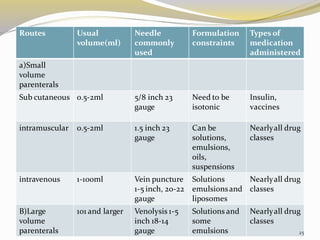
Routes Usual
volume(ml)
Needle
commonly
used
Formulation
constraints
Types of
medication
administered
a)Small
volume
parenterals
Sub cutaneous 0.5-2ml 5/8 inch 23
gauge
Need to be
isotonic
Insulin,
vaccines
intramuscular 0.5-2ml 1.5 inch 23
gauge
Can be
solutions,
emulsions,
oils,
suspensions
Nearlyall drug
classes
intravenous 1-100ml Vein puncture
1-5 inch, 20-22
gauge
Solutions
emulsionsand
liposomes
Nearlyall drug
classes
B)Large
volume
parenterals
101 and larger Venolysis 1-5
inch 18-14
gauge
Solutions and
some
emulsions
Nearlyall drug
classes
25
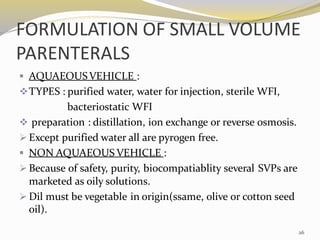
FORMULATION OF SMALL VOLUME
PARENTERALS
▪ AQUAEOUSVEHICLE :
❖TYPES : purified water, water for injection, sterile WFI,
bacteriostatic WFI
❖ preparation : distillation, ion exchange or reverse osmosis.
➢ Except purified water all are pyrogen free.
▪ NON AQUAEOUS VEHICLE :
➢ Because of safety, purity, biocompatiablity several SVPs are
marketed as oily solutions.
➢ Dil must be vegetable in origin(ssame, olive or cotton seed
oil).
26
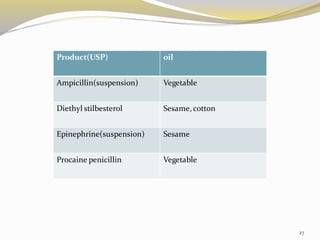
Product(USP) oil
Ampicillin(suspension) Vegetable
Diethyl stilbesterol Sesame, cotton
Epinephrine(suspension) Sesame
Procaine penicillin Vegetable
27
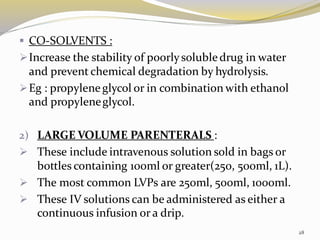
▪ CO-SOLVENTS :
➢Increase the stability of poorlysolubledrug in water
and prevent chemical degradation by hydrolysis.
➢Eg : propyleneglycol or in combination with ethanol
and propyleneglycol.
2) LARGE VOLUME PARENTERALS :
➢ These include intravenous solution sold in bags or
bottles containing 100ml or greater(250, 500ml, 1L).
➢ The most common LVPs are 250ml, 500ml, 1000ml.
➢ These IV solutions can be administered as either a
continuous infusion or a drip.
28
 Continuous infusion:
➢It is also called maintenance infusion, replacement
infusion or hydration infusion consisting of base with
additives.
➢A continuous infusion is used to :
➢Prevent or correct dehydration and restore electrolyte
balance.
➢Replace fluids within a patient who has expierienced
significant blood loss from trauma or surgical
procedure.
➢Provide easy vein access for blood draw and
medication administration in a patient during hospital
stay.
29
DEVELOPMENT OF PARENTERAL
PRODUCTS
➢Parenteral formulationsare broadlycharacterized as
sterile solutions, suspensions, emulsions, powders for
reconstitution for injection or infusion.
➢They are administered directly to subjects, entering
systemic circulation and typicallyproviding rapid
onset of action in comparison to orallyadministered
ones.
30
FORMULATION OF PARENTERAL
PRODUCTS
 In preparation of parenteral products the followingare
added to make a stablepreparation
I. The active drug
II. Vehicles
III. Adjuvants
▪ Production facilities :
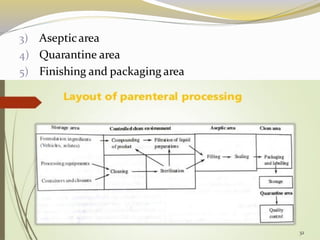
➢ The production area where the parenteral are
manufactured is divided into fivesections :
1) Clean-uparea
2) Preparation area
31
3) Asepticarea
4) Quarantine area
5) Finishing and packaging area
32
QUALITY CONTROL
REQUIREMENTS FOR PARENTERALS
➢ There are 3 general areas of quality control :
a) Incoming stock(routine work testing)
b) Manufacturing(include numerable tests, observations
throughout the process)
c) Finished products(sterility test, pyrogen test, clarity test,
leaker test)
o In process quality control test:
❑ Conductivity measurement
❑ Volume filled
❑ Temperature for heat sterilized product
❑ Environment control test
❑ Visual inspection
33
➢The actual tests for parenterals i.e. finished products
are :
1. Leaker test
2. Clarity test
3. Pyrogen test
4. Sterility test
5. Content uniformity test
34
1. LEAKER TEST
➢Leakage occurs when a discontinuity exists in the wall
of the packagethat can allow the passageof a gas
under the action of pressure or concentration
difference across the wall.
➢Presence of capillarypores or tiny cracks can cause3
microbes or other dangerous contaminants to enter
ampoulesor packageor may lead to leakageof
contents outside.
➢This may cause contamination or spoilageof
appearanceof package.
35
➢ Changes in temperature during storage cause expansion
and contraction of ampoule or package and thereby
causing interchange of its contents if an opening exists.
➢ It is employed to detect incompletely sealed ampoule so
that it can be discarded.
➢ To test package integrity.
➢ Package integrity reflects its ability to keep the product
safe.
➢ Leaker tests are 4 types :
a) Visual inspection
b) Bubble test
c) Dye test
d) Vacuum ionization
36
a) Visual inspection :
➢ Easy method.
➢ Used for evaluationof large volume parenterals.
➢ Sample container may be coupled with applicationof
vacuum to make ;leakagemore readily observable.
➢ Simple, inexpensive,less sensitive.
➢ Sensitivity increased by applyingvacuum.
b) Bubble test :
➢ Test package is submerged in liquid.
➢ Different pressure appliedon container.
37
➢ Container observed for bubbles.
➢ Sometimes surfactant liquid is used for submersion of
package.
➢ Any leakage after immersion generates foaming.
➢ This method is simple and inexpensive.
➢ Location of leaks can be observed.
c) Dye test :
➢ The test container is immersed in a dye ball.
➢ Vacuum and pressure applied for some time.
➢ Container removed from dye bath and washed.
➢ It is then inspected for the presence of dye either visually
or by UV spectroscopy.
38
➢The dye is usually 0.5% to 1% methylene blue.
➢It can be optimised by luse of a surfactant or alow
viscous fluid.
➢It is widelyaccepted in industry and approved in drug
use.
➢This test is inexpensiveand require no special
equipment.
➢It is qualitativedestructive and slow.
➢Used for ampoules.
39
2. CLARITY TEST(PARTICLE CONTAMINANT
TEST)
➢Clarity means a clear solution having high polish,
conveys to observer that the product is of exceptional
quality and purity.
➢This is carried out to check particulate matter in
sample.
➢USP limits for large volume infusion
 10 micrometer or larger/ml 50 particle limit
 25 micrometer or larger/ml 5 particle limit
➢Particulate matter can be detected in parenteral
product by 2 ways
40
▪ Test for viableparticles (visual inspection by naked
eye) :
➢This is visualizedagainst the black and white
backgrounds.
➢White detection of dark colored particles.
➢Light/reflectiveparticles against black background.
▪ Test for sub visibleparticles :
➢To check particulate contamination of injections and
infusions consisting of undissolved particles other
than gas bubblesunintentionally present in solution.
➢2 types
➢ 1) Light obscuration particle count
➢ 2) Microscopic particle count test
41
3. PYROGEN TEST
➢Pyrogens are fever producing substances.
➢During processing of these pyrogens may come from
water or active constituent or excipientor from the
equipment.
➢Parenteral solutions are officiallytested for presence of
pyrogens by a biologicaltest in which ”FEVER”
response of rabbits is taken into account.
▪ Depyrogenation :
➢It is the removal of pyrogens.
42
▪ Inactivation : applicationof very dry heat (250
degrees) for not less than 30min.
▪ In vivo pyrogen testing(rabbit testing)
▪ In vitro pyrogen testing(limulus amoebocyte lysate
test)
43
4. CONTENT UNIFORMITY TEST
➢This is for single dose preparation based on assay of
individualcontents of active substances of a no of
single dose units to determine whether individual
contents are within the limits set with reference to
average content of sample.
➢Test is not required for multivitaminand trace element
preparations and in other justified and authorized
circumstances.
44
5. TEST FOR STERILITY
➢Test is appliedto substances, preparations or articles
which according to pharmacopeiaare required to be
sterile.
➢This test is carried out under asepticconditions
➢Followingculture media have been found to be
suitable for test of sterility
➢Fluid thiogycollate medium
➢Soybean casein digest medium
45
FOR ANY QUIERIES
46
THANK YOU
47

PARENTERALS PPT

  • 1.
    By DUVVU CHANDINI, MPHARM (DEPARTMENTOF PHARMACEUTICALTECHNOLOGY) UNDER GUIDANCE OF DR K.L.DEEPTHI ( ASSOCIATE PROFESSOR) RAGHU COLLEGE OF PHARMACY 1
  • 2.
    OBJECTIVE  INTRODUCTION  ROUTESOF ADMINISTRATION  ADVANTAGES  DISADVANTAGES  CATEGORIES  FORMULATION OF SMALL VOLUME PARENTERALS AND LARGE VOLUME PARENTERALS  DEVELOPMENT OF PARENTERAL PRODUCTS  QUALITY CONTROL REQUIREMENTS FOR PARENTERALS 2
  • 3.
    INTRODUCTION ➢The term “Parenteral”derived from Greek word “Para "means “outside” and “Enterone” means “Intestine”. ➢These are sterile solutions or suspensionsof drug in aqueous or oily phase. ➢The term “Parenteral” literally means “to avoid the gut” (GI Tract) and its deliverydoesn’t utilizethe alimentarycanal and other body tissues. 3
  • 4.
    ➢ These areadministered directly into the vein, muscles or under skin, or more specializedtissues such as spinal cord. ➢Parenteral route of administration usually have more rapid onset of action compared to other routes as they are directly administered into the circulation and do not have any GI absorption 4
  • 5.
    GENERAL REQUIREMENTS FORPRODUCT DOSAGE FORMS ❑ stability ❑ Sterility ❑ Free from pyrogens, toxins, foreign particles ❑ Isotonic in condition ❑ Chemical purity 5
  • 6.
    ROUTES OF ADMINISTRATION ❑Intravenous ❑ Intramuscular ❑ Subcutaneous ❑ Intra dermal ❑ Intra arterial ❑ Intra cardiac ❑ Peri dermal ❑ Intra cerebral ❑ Intra cisternal ❑ Intra articular 6
  • 7.
    1. Intravenous ➢Most rapidonset of action as the drug is injected directly into the vein of the patient. ➢The term intravenous means “into the vein”. ➢IV infusion is slow and constant volumeof deliveryof a drug into patientvein over a given period of time. ➢The main purposeof IV infusion is : ❑Quick action ❑More reliable ❑Can administer large amount ❑Medication sent directly into blood stream 7
  • 8.
  • 9.
    2. INTRADERMAL ➢ Drugis injected into top few layers of skin, ideally within dermis located betweenepidermis and hypodermis. ➢These are not preferentiallyused but used for certain therapies such as allergy tests. 9
  • 10.
    3. SUBCUTANEOUS ➢ Administrationof drug into fatty layer below epidermisand dermis collectivelyreferred as “cutis”. ➢ Absorptionof drug is rapid and highlyeffective ➢ E.g.: Insulin 10
  • 11.
    4. INTRAMUSCULAR  Drugsare injected deeplyinto into muscle tissue.  If the drug is an oily liquid or in the form of suspension it can prolong the release of other dug.  The volumeof injection is limited to 2-5mm. 11
  • 12.
    5. INTRA ARTERIAL Injection given directly into the artery.  It is most commonly used in intensive care medicine and anesthesia to monitor blood pressure directly. 12
  • 13.
    6. INTRA CARDIAC These are given into heart muscle or ventricle at the time of surgery.  They are used in emergencies. 13
  • 14.
    7. INTRA THECAL These are given into the sub arachnoid space that surround spinal cord.  The route is used for spinal anesthesia. 14
  • 15.
    8. INTRA CISTERNAL This is given in between 1st and 2nd cervical nerve.  Used for cerebrospinal fluid diagnostic purpose. 15
  • 16.
    9. EPIDURAL  Theseare given in between the Dura matter and inner part of vertebra.  Used for spinal anesthesia. 16
  • 17.
    10. INTRA ARTICULAR Given to articulating ends of bones in a joint.  Used for lubricating the joints. 17
  • 18.
    11. INTRA CEREBRAL This is given into the cerebrum. 18
  • 19.
    ADVANTAGES 1. Rapid onsetof action. 2. Useful for emergency situations. 3. For patients whocannot take orally. 4. Providing sustained drug delivery(implants). 5. Avoid 1st pass metabolism. 6. Drug injected directly into tissue(TDDS). 7. Complete bioavailability. 8. For deliveryof fluids, electrolytes and nutrients. 9. Can be done in hospitalsand health care centres. 19
  • 20.
    DISADVANTAGES 1. Pain wheninserting the needle. 2. Hypersensitivityreactions. 3. Trained person required. 4. Require control of sterility and non pyrogenecity. 5. More expensiveand costly to produce. 6. Require specializedequipment, devices and techniques. 20
  • 21.
    CATEGORIES ▪ BASED ONVOLUME : ➢ Based on production and control, the categories are divided into : 1) Small volume parenterals(vol<100ml) 2) Large volume parenterals(vol>100ml) 1) SMALL VOLUME PARENTERALS: ➢ it usuallyranges from 1 to 30ml in volume. ➢ Mostlygiven in multiple dose. 21
  • 22.
    ➢ There aredifferent types : ❑Ampoules ❑Vials ❑Dry powders ❑Pre filled syringes ❑Ampoules : ➢ These are sealed glass containers with an elongated neck that is to be broken off. ➢ These contain coloured band around the neck. ❑Vials : ➢ Drugs and other additives are packed in vials as liquid or lyophilized products. 22
  • 23.
    ➢Madeof glass orplasticand are sealed with rubber stoppers. ➢May be designed for singleor multipledose. ➢Multipledose vials contain a preservativeto prevent bacterial contamination once the vial has been used. ❑Dry powders: ➢These are lyophilizedor freeze dried powders that are reconstituted with some solvent to make a liquid formulation. ➢Most common solvents are sterile water for injection, bacteriostatic water for injection, sodium chloride injection. 23
  • 24.
    ❑Prefilled syringes : ➢Consist of syringes which are prefilled with the drug solution. ➢ 2 varieties of syringes : ▪ Type-1 : cartridge type package is a single syringe and needle unit which is to be placed in a special h older before use. ➢ Once the syringe and needle used they are discarded but the holder is used again. ▪ Type-2 : consists of a glass tube closed at both ends with rubber stoppers. ➢ The prefilled tube is placed into a specially designed syringe that has a needle attached to it. ➢ These should be discarded after use. 24
  • 25.
    Routes Usual volume(ml) Needle commonly used Formulation constraints Types of medication administered a)Small volume parenterals Subcutaneous 0.5-2ml 5/8 inch 23 gauge Need to be isotonic Insulin, vaccines intramuscular 0.5-2ml 1.5 inch 23 gauge Can be solutions, emulsions, oils, suspensions Nearlyall drug classes intravenous 1-100ml Vein puncture 1-5 inch, 20-22 gauge Solutions emulsionsand liposomes Nearlyall drug classes B)Large volume parenterals 101 and larger Venolysis 1-5 inch 18-14 gauge Solutions and some emulsions Nearlyall drug classes 25
  • 26.
    FORMULATION OF SMALLVOLUME PARENTERALS ▪ AQUAEOUSVEHICLE : ❖TYPES : purified water, water for injection, sterile WFI, bacteriostatic WFI ❖ preparation : distillation, ion exchange or reverse osmosis. ➢ Except purified water all are pyrogen free. ▪ NON AQUAEOUS VEHICLE : ➢ Because of safety, purity, biocompatiablity several SVPs are marketed as oily solutions. ➢ Dil must be vegetable in origin(ssame, olive or cotton seed oil). 26
  • 27.
    Product(USP) oil Ampicillin(suspension) Vegetable Diethylstilbesterol Sesame, cotton Epinephrine(suspension) Sesame Procaine penicillin Vegetable 27
  • 28.
    ▪ CO-SOLVENTS : ➢Increasethe stability of poorlysolubledrug in water and prevent chemical degradation by hydrolysis. ➢Eg : propyleneglycol or in combination with ethanol and propyleneglycol. 2) LARGE VOLUME PARENTERALS : ➢ These include intravenous solution sold in bags or bottles containing 100ml or greater(250, 500ml, 1L). ➢ The most common LVPs are 250ml, 500ml, 1000ml. ➢ These IV solutions can be administered as either a continuous infusion or a drip. 28
  • 29.
     Continuous infusion: ➢Itis also called maintenance infusion, replacement infusion or hydration infusion consisting of base with additives. ➢A continuous infusion is used to : ➢Prevent or correct dehydration and restore electrolyte balance. ➢Replace fluids within a patient who has expierienced significant blood loss from trauma or surgical procedure. ➢Provide easy vein access for blood draw and medication administration in a patient during hospital stay. 29
  • 30.
    DEVELOPMENT OF PARENTERAL PRODUCTS ➢Parenteralformulationsare broadlycharacterized as sterile solutions, suspensions, emulsions, powders for reconstitution for injection or infusion. ➢They are administered directly to subjects, entering systemic circulation and typicallyproviding rapid onset of action in comparison to orallyadministered ones. 30
  • 31.
    FORMULATION OF PARENTERAL PRODUCTS In preparation of parenteral products the followingare added to make a stablepreparation I. The active drug II. Vehicles III. Adjuvants ▪ Production facilities : ➢ The production area where the parenteral are manufactured is divided into fivesections : 1) Clean-uparea 2) Preparation area 31
  • 32.
    3) Asepticarea 4) Quarantinearea 5) Finishing and packaging area 32
  • 33.
    QUALITY CONTROL REQUIREMENTS FORPARENTERALS ➢ There are 3 general areas of quality control : a) Incoming stock(routine work testing) b) Manufacturing(include numerable tests, observations throughout the process) c) Finished products(sterility test, pyrogen test, clarity test, leaker test) o In process quality control test: ❑ Conductivity measurement ❑ Volume filled ❑ Temperature for heat sterilized product ❑ Environment control test ❑ Visual inspection 33
  • 34.
    ➢The actual testsfor parenterals i.e. finished products are : 1. Leaker test 2. Clarity test 3. Pyrogen test 4. Sterility test 5. Content uniformity test 34
  • 35.
    1. LEAKER TEST ➢Leakageoccurs when a discontinuity exists in the wall of the packagethat can allow the passageof a gas under the action of pressure or concentration difference across the wall. ➢Presence of capillarypores or tiny cracks can cause3 microbes or other dangerous contaminants to enter ampoulesor packageor may lead to leakageof contents outside. ➢This may cause contamination or spoilageof appearanceof package. 35
  • 36.
    ➢ Changes intemperature during storage cause expansion and contraction of ampoule or package and thereby causing interchange of its contents if an opening exists. ➢ It is employed to detect incompletely sealed ampoule so that it can be discarded. ➢ To test package integrity. ➢ Package integrity reflects its ability to keep the product safe. ➢ Leaker tests are 4 types : a) Visual inspection b) Bubble test c) Dye test d) Vacuum ionization 36
  • 37.
    a) Visual inspection: ➢ Easy method. ➢ Used for evaluationof large volume parenterals. ➢ Sample container may be coupled with applicationof vacuum to make ;leakagemore readily observable. ➢ Simple, inexpensive,less sensitive. ➢ Sensitivity increased by applyingvacuum. b) Bubble test : ➢ Test package is submerged in liquid. ➢ Different pressure appliedon container. 37
  • 38.
    ➢ Container observedfor bubbles. ➢ Sometimes surfactant liquid is used for submersion of package. ➢ Any leakage after immersion generates foaming. ➢ This method is simple and inexpensive. ➢ Location of leaks can be observed. c) Dye test : ➢ The test container is immersed in a dye ball. ➢ Vacuum and pressure applied for some time. ➢ Container removed from dye bath and washed. ➢ It is then inspected for the presence of dye either visually or by UV spectroscopy. 38
  • 39.
    ➢The dye isusually 0.5% to 1% methylene blue. ➢It can be optimised by luse of a surfactant or alow viscous fluid. ➢It is widelyaccepted in industry and approved in drug use. ➢This test is inexpensiveand require no special equipment. ➢It is qualitativedestructive and slow. ➢Used for ampoules. 39
  • 40.
    2. CLARITY TEST(PARTICLECONTAMINANT TEST) ➢Clarity means a clear solution having high polish, conveys to observer that the product is of exceptional quality and purity. ➢This is carried out to check particulate matter in sample. ➢USP limits for large volume infusion  10 micrometer or larger/ml 50 particle limit  25 micrometer or larger/ml 5 particle limit ➢Particulate matter can be detected in parenteral product by 2 ways 40
  • 41.
    ▪ Test forviableparticles (visual inspection by naked eye) : ➢This is visualizedagainst the black and white backgrounds. ➢White detection of dark colored particles. ➢Light/reflectiveparticles against black background. ▪ Test for sub visibleparticles : ➢To check particulate contamination of injections and infusions consisting of undissolved particles other than gas bubblesunintentionally present in solution. ➢2 types ➢ 1) Light obscuration particle count ➢ 2) Microscopic particle count test 41
  • 42.
    3. PYROGEN TEST ➢Pyrogensare fever producing substances. ➢During processing of these pyrogens may come from water or active constituent or excipientor from the equipment. ➢Parenteral solutions are officiallytested for presence of pyrogens by a biologicaltest in which ”FEVER” response of rabbits is taken into account. ▪ Depyrogenation : ➢It is the removal of pyrogens. 42
  • 43.
    ▪ Inactivation :applicationof very dry heat (250 degrees) for not less than 30min. ▪ In vivo pyrogen testing(rabbit testing) ▪ In vitro pyrogen testing(limulus amoebocyte lysate test) 43
  • 44.
    4. CONTENT UNIFORMITYTEST ➢This is for single dose preparation based on assay of individualcontents of active substances of a no of single dose units to determine whether individual contents are within the limits set with reference to average content of sample. ➢Test is not required for multivitaminand trace element preparations and in other justified and authorized circumstances. 44
  • 45.
    5. TEST FORSTERILITY ➢Test is appliedto substances, preparations or articles which according to pharmacopeiaare required to be sterile. ➢This test is carried out under asepticconditions ➢Followingculture media have been found to be suitable for test of sterility ➢Fluid thiogycollate medium ➢Soybean casein digest medium 45
  • 46.
  • 47.