PARENTERALS
Presenter:
Amruta Balekundri
M.Pharm 2nd semester,
Department of Pharmaceutical
Quality Assurance,
KLE College of Pharmacy, Belagavi.
1
CONTENTS
 Definition
 Advantages
 Disadvantages
 Routes of administration
 Types of Parenterals
 Formulation of parenterals
 Layout of parenterals
 Quality control tests for parenterals
2
Parenterals
 The term of parenteral is derived from Greek word Para
meaning beside and enteron meaning the intestine.
 Thus parenterals administration should include the
administration of drug by any route other than
intestine.
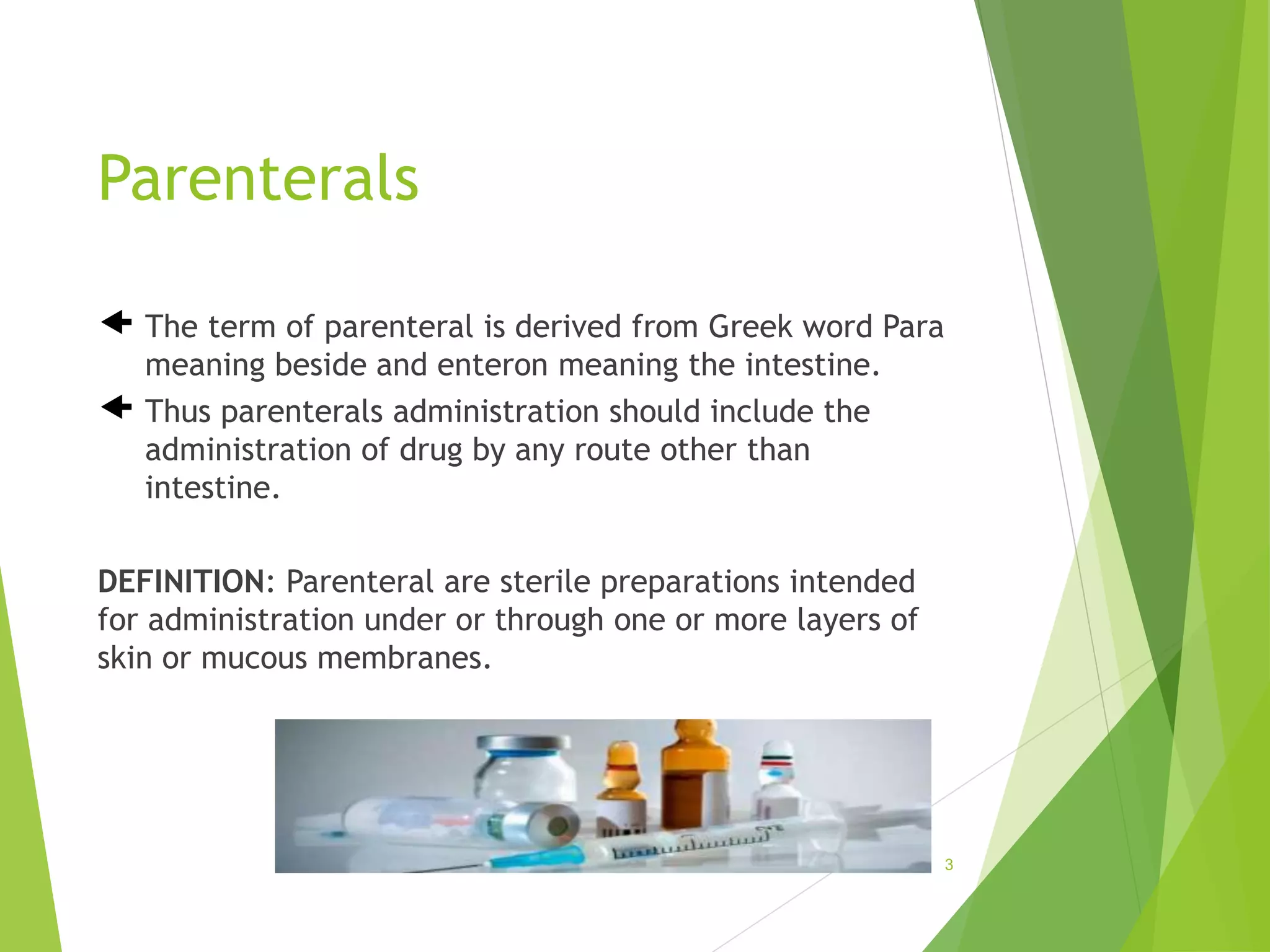
DEFINITION: Parenteral are sterile preparations intended
for administration under or through one or more layers of
skin or mucous membranes.
3
ADVANTAGES
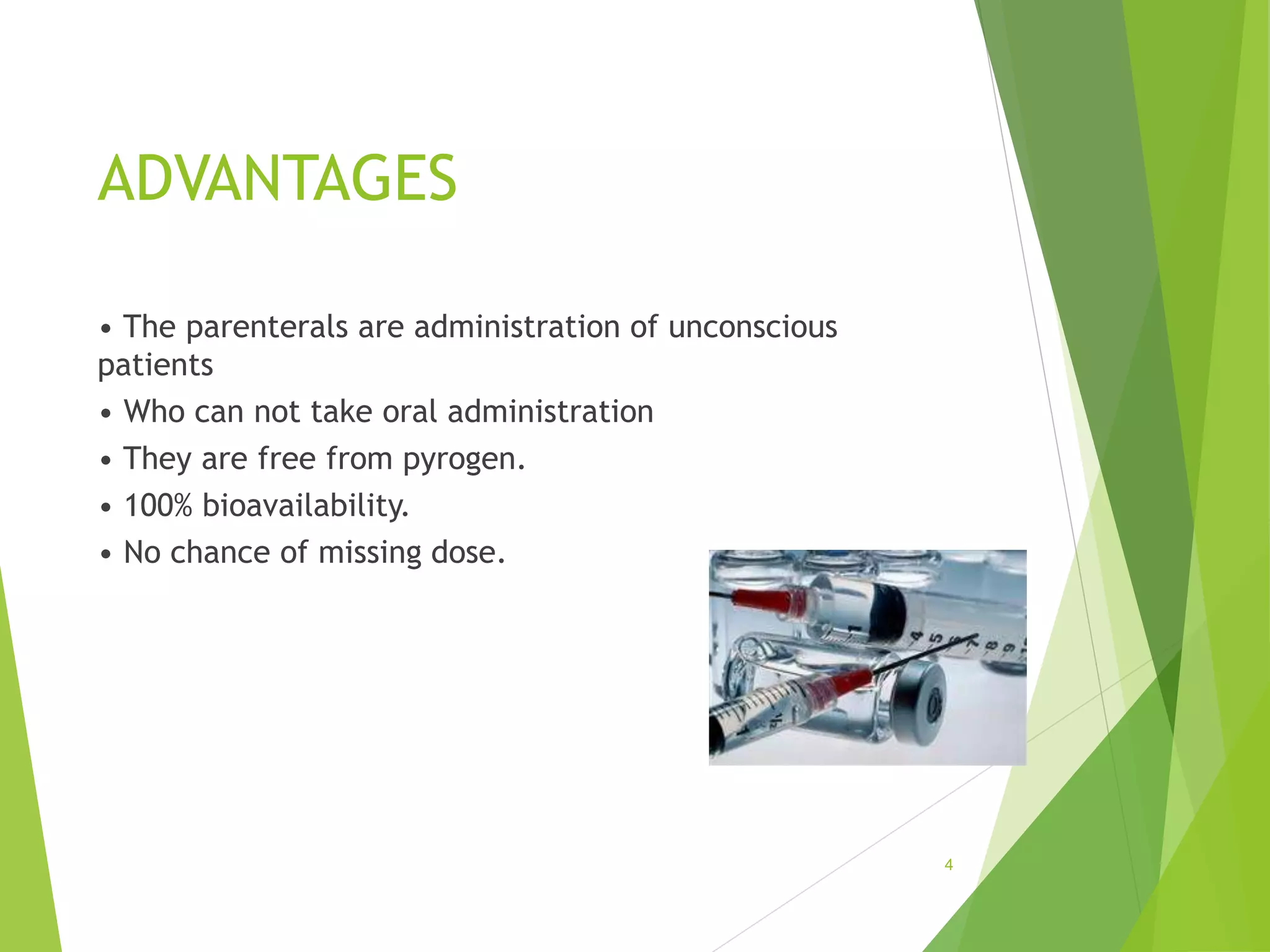
• The parenterals are administration of unconscious
patients
• Who can not take oral administration
• They are free from pyrogen.
• 100% bioavailability.
• No chance of missing dose.
4
DISADVANTAGES
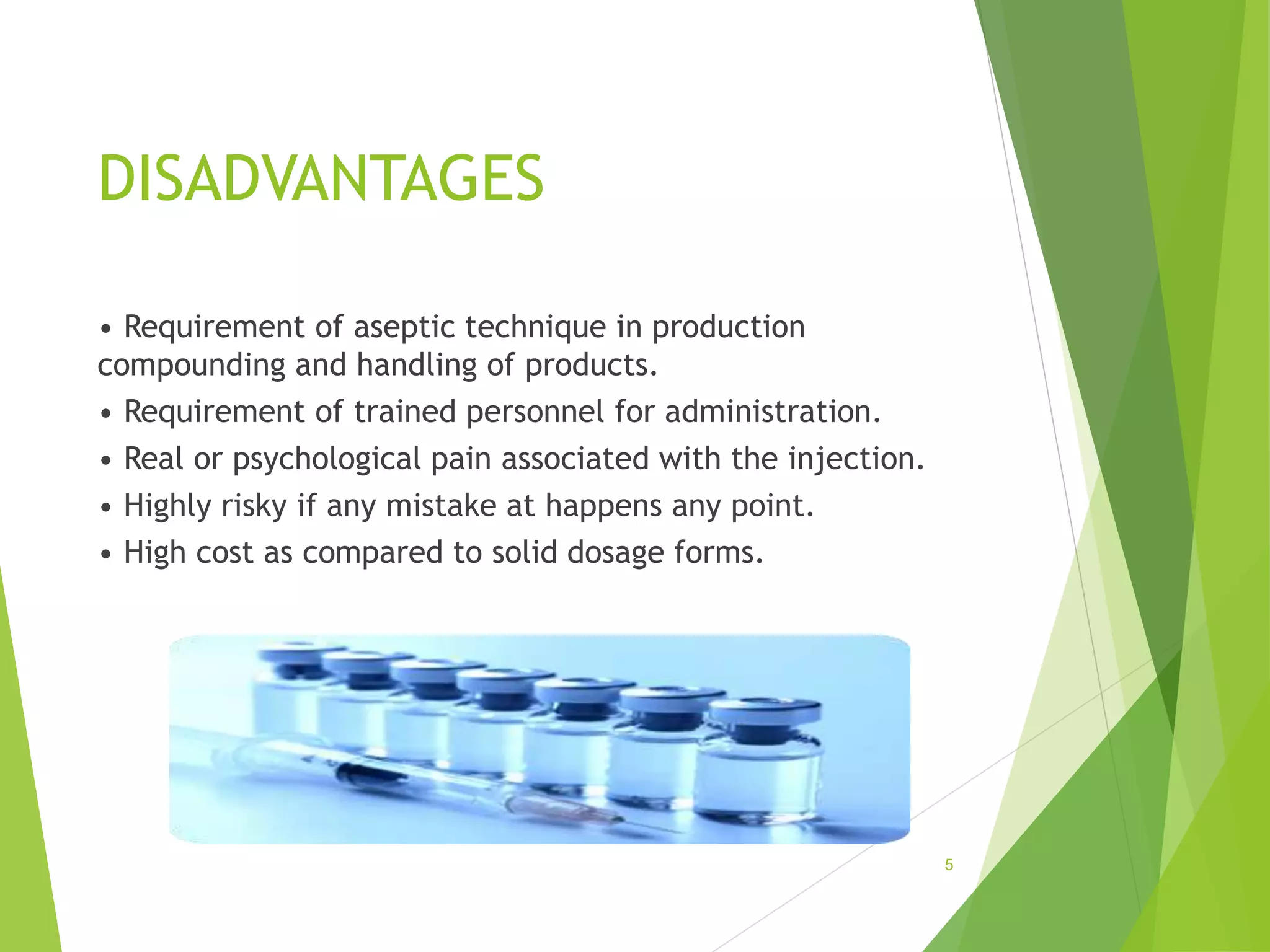
• Requirement of aseptic technique in production
compounding and handling of products.
• Requirement of trained personnel for administration.
• Real or psychological pain associated with the injection.
• Highly risky if any mistake at happens any point.
• High cost as compared to solid dosage forms.
5
ROUTE OF ADMINISTRATION
 Intra Muscular (IM)
 Intra dermal (ID)
 Intravenous (IV)
 Subcutaneous / Hypodermic (SC)
 Intra articular
 Intra synovial
 Intra spinal
 Intrathecal
 Intrarterial
 Intra cardiac
 Intra cisternal
 Intra peritonial
 Intraplueral
6
TYPES OF PARENTERALS
 Powder for injection ‐Eg. Cefuroxime for injection
 Colloidal solution ‐ Eg. Iron dextran
 Injectable emulsion ‐Eg. Propofol USP
 Injectable suspension –Eg. Methylprednisolone acetate
 Oily injection (solution) ‐Eg. Dimercaprol injection.
 Infusion fluid
7
8
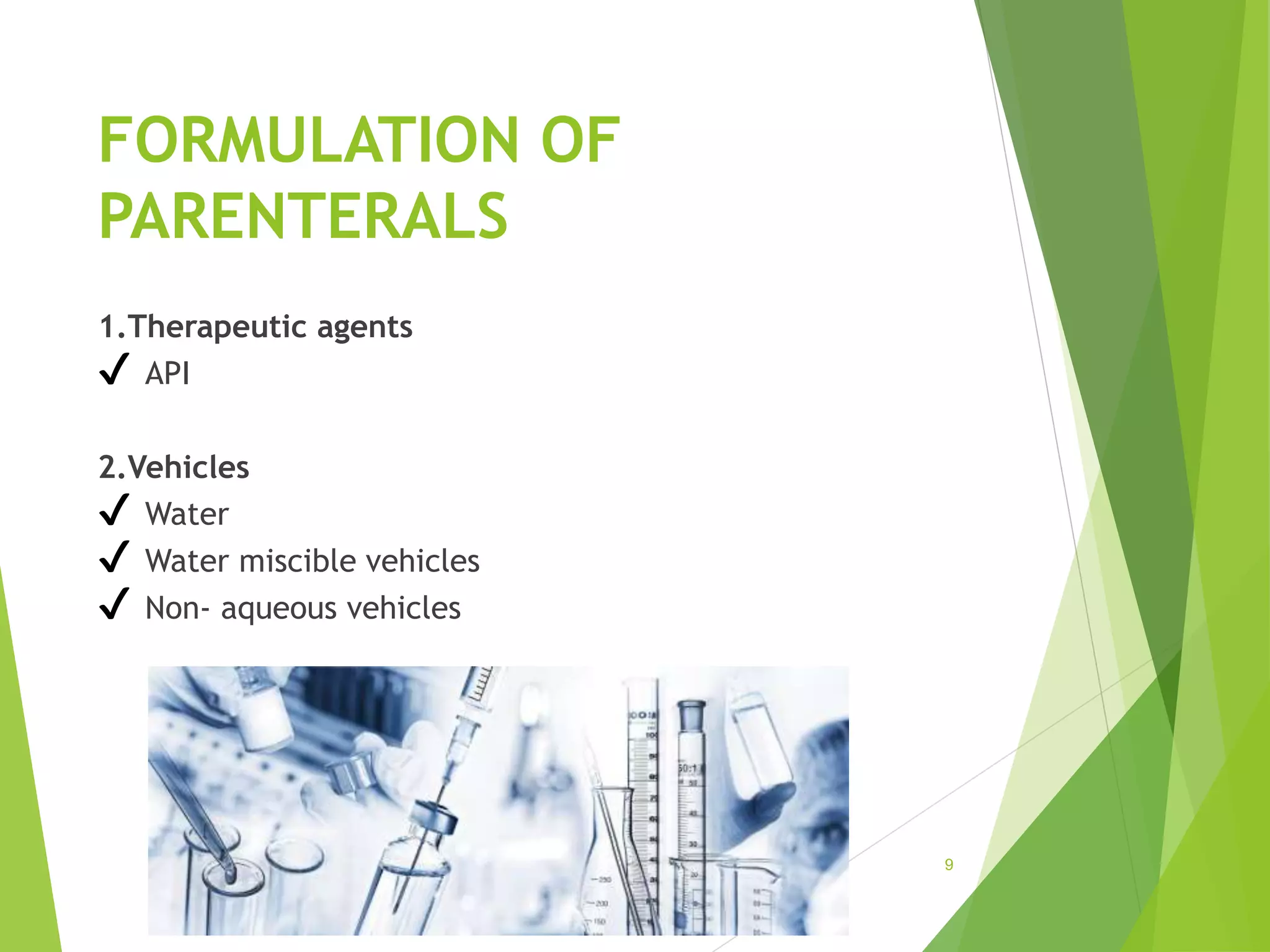
FORMULATION OF
PARENTERALS
1.Therapeutic agents
✔ API
2.Vehicles
✔ Water
✔ Water miscible vehicles
✔ Non- aqueous vehicles
9
FORMULATION OF
PARENTERALS
3.Added substances(Additives)
✔ Antimicrobials
✔ Antioxidants
✔ Buffers
✔ Bulking agents
✔ Chelating agents
✔ Protectants
✔ Solubilizing agents
✔ Surfactants
✔ Tonicity- adjusting agents
10
1.Active Pharmaceutical
Ingredients(API):
Active Pharmaceutical Ingredient: Any substance or
mixture of substances intended to be used in the
manufacture of a drug (medicinal) product and that, when
used in the production of a drug, becomes an active
ingredient of the drug product. Such substances are
intended to furnish pharmacological activity or other direct
effect in the diagnosis, cure, mitigation, treatment, or
prevention of disease or to affect the structure or function
of the body.
They may be Antibiotics, Anticancer, Steroids, Vaccines,
Anti-pyretic, Analgesics, Anti- inflammatory,.etc
11
2.Solvents:
Water: Water Should meet compendial requirements
Water miscible vehicles: Ethyl alcohol PEG PG
Non aqueous vehicles: Fixed oils
 Solvents used must be: Non-irritating ,Non-toxic ,
Non-sensitizing No pharmacological activity of its own.
12
3. Added substances
(Additives)
I. Antimicrobials: Added for fungistatic or bacteriostatic
action or Used to prevent the multiplication of micro-
organisms ;
Concentration--
Benzyl alcohol –0.5- 10 %
Benzethonium chloride 0.01%
Methyl paraben – 0.01-0.18 %
Propyl paraben –0.005-0.035 %
Phenol –0.065- 0.5 %
13
3. Added substances
(Additives)
II.Antioxidants: Used to protect product from oxidation
Acts as reducing agent or prevents oxidation
Ex: A) Reducing agent:--Ascorbic acid –0.02- 0.1 %
Sodium bisulphite –0.1- 0.15 %
Sodium metabisulphite –0.1- 0.15
%
Thiourea – 0.005%
B) Blocking agents:--Ascorbic acid esters – 0.01-0.015%
BHT –0.05- 0.02 %
C) Synergistic:-Ascorbic acid , Citric acid , Tartaric acid
D) Chelating agent: EDTA 0.01-0.075 %
14
3. Added substances
(Additives)
III.Buffers: Added to maintain pH, Change in pH may
causes degradation of the products.
 Factors affecting selection of buffers: Effective range,
Concentration ,Chemical effect on the total product
 Used in the conc. of 0.1 to 5.0 %
 Ex: Acetic acid
Citric acid
Benzoic acid
15
3. Added substances
(Additives)
IV.Chelating agents:
Used to form the complex with the metallic ions present in
the formulation so that the ions will not interfere during
manufacturing of formulation.
They form a complex which gets dissolved in the solvents.
Examples: Disodium edetate 0.00386-0.05%
Disodium calcium edetate 0.04%
Tetrasodium edetate 0.01%
16
3. Added substances
(Additives)
V.Stabilizers:
 As parenterals are available in solution form they are
most prone to unstabilize.
 Used to stabilize the formulation
Examples:Creatinine – 0.5-0.8 %
Glycerin – 1.5 – 2.25 %
Niacinamide – 1.25-2.5%
Sodium saccharin – 0.03%
Sodium caprylate – 0.4 %
17
3. Added substances
(Additives)
VI. Solubilizing agents:
 Used to increase solubility of slightly soluble
drugs
 They acts by any one of the following:
solubilizers,emulsifiers or wetting agents.
 Examples: Dimethylacetamide,
Ethyl alcohol
Glycerin
Lecithin
PEG – 40 castor oil
PEG – 300
Polysorbate 20, 40, 80
18
3. Added substances
(Additives)
VII. Tonicity- adjusting agents:
 Buffers may acts as tonicity contributor as well as stabilizers
for the pH.
 Isotonicity depends on permeability of a living semi-permeable
membrane
⮚ Hypotonic : swelling of cells (enlargement)
⮚ Hypertonic: shrinking of cells (reduction)
Example: Glycerin
Lactose
Mannitol
Dextrose
Sodium chloride
19
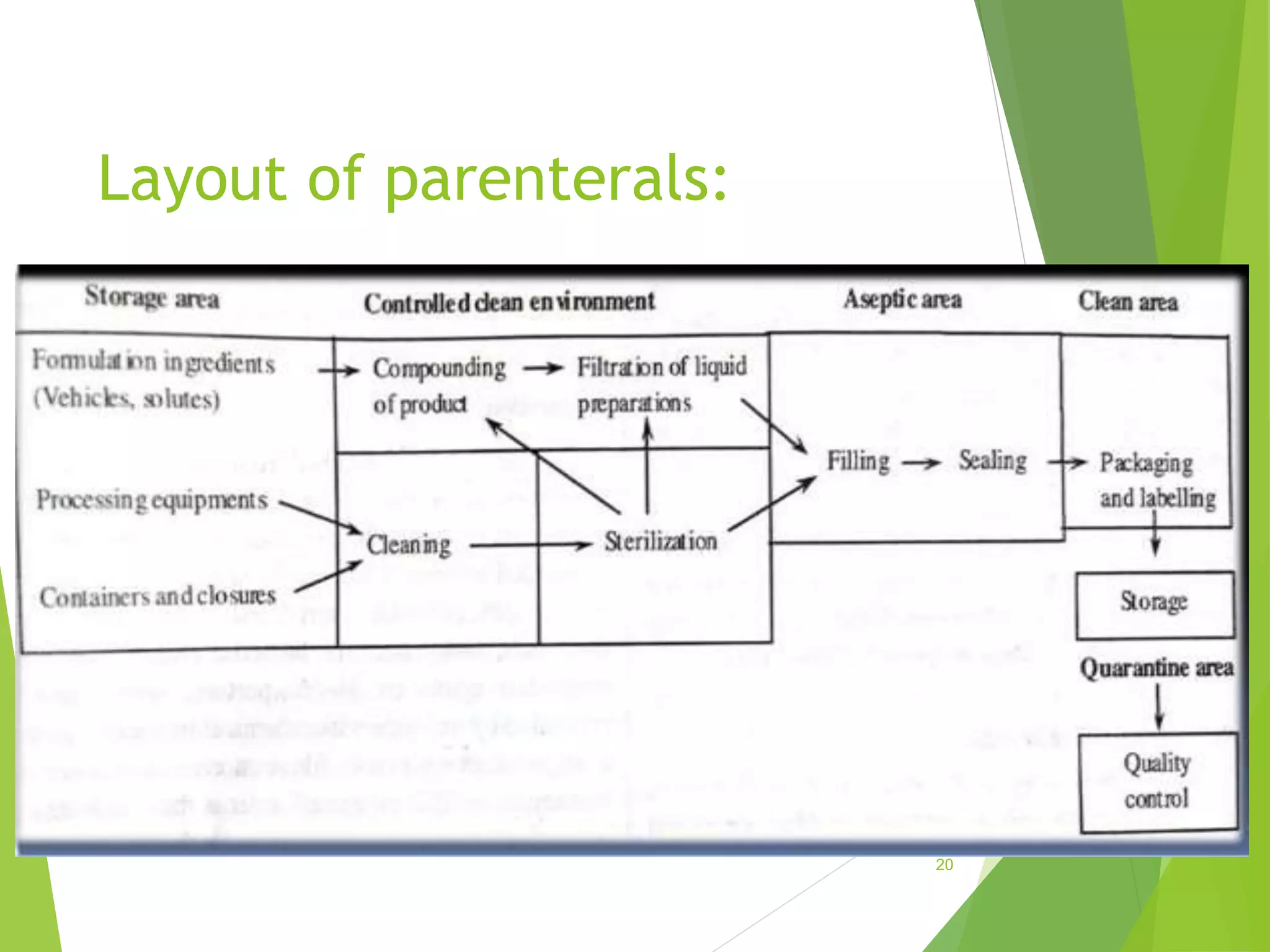
Layout of parenterals:
20
Clean- up area
 Non aseptic area
 Free from dust ,fibres & micro-organisms.
 Constructed in such a way that should withstand
moisture, steam & detergent.
 Ceiling & walls are coated with material to prevent
accumulation of dust & micro-organisms .
 Exhaust fans are fitted to remove heat & humidity.
 The area should be kept clean so that to avoid
contamination to aseptic area .
 The containers & closures are washed & dried in this
area.
21
Preparation area
 The ingredients are mixed & preparation is prepared for
filling
 Not essential that the area is aseptic .
 Strict precaution is taken to prevent contamination
from outside .
 Ceiling & walls : sealed & painted
22
Aseptic area
 Filtration & filling into final containers & sealing is done
.
 The entry of outside person is strictly prohibited To
maintain sterility, special trained persons are only
allowed to enter & work .
 Person who worked should wear sterile cloths
 Should be subjected for physical examination to ensure
the fitness
 Minimum movement should be there in this area
 Ceiling & walls & floors : sealed & painted or treated
with aseptic solution and there should not be any toxic
effect of this treatment .
23
Aseptic area
 Cabinets & counters: Smooth Surface
 AIR: Free from fibres, dust & micro organisms.
 HEPA filters are used which removes particles upto 0.3
micron
 Fitted in laminar air flow system, in which air is free
from dust & micro organisms flows with uniform velocity
.
 Air supplied is under positive pressure which prevents
particulate contamination from sweeping .
 UV lamps are fitted to maintain sterility
24
25
Quarantine area
 After filling, sealing & sterilization the products or
batch is kept in this area .
 The random samples are chosen and given for analysis
to QC dept.
 The batch is send to packing after issuing satisfactory
reports of analysis from QC If any problem is observed in
above analysis the decision is to be taken for
reprocessing or others.
26
Finishing and packaging area:
 After proper label, the product is given for packing.
 Packing is done to protect the product from external
environment .
 The ideal Packing is that which protects the product
during transportation, storage, shipping & handling.
 The labeled container should be packed in cardboard or
plastic containers Ampoules should be packed in
partitioned boxes.
27
Classification of Parenterals
 Based on Volume—
⮚ Small Volume Parenterals(SVP) - Volume ranges from 1-
30 ml May be given single dose or multiple dose.
⮚ Large Volume Parenterals(LVP) Volume ranges from 100-
1000 ml. Mostly given as single dose.
28
Small Volume
Parenterals(SVP)
 Usually range 1-30 ml in volume.
 Mostly given as multiple doses.
Different types are:
 Ampules
 Vials
 Dry powders
 Prefilled syringes
29
Ampules:
 Sealed glass containers with an elongated neck that must be broken off.
 Most ampules are weakened around the neck for easy breaking; these will
have a coloured band around the neck.
 A 5 micron filter needle should be used when drawing the contents of an
ampule into a syringe since glass particles may have fallen inside the
ampule when the top was snapped off.
 In addition, it is useful to wrap an alcohol wipe or small piece of gauze
around the top of the ampule before breaking it. This will provide some
protection to the fingers if the ampule shatters and will also reduce the
possibility of glass splinters becoming airborne.
30
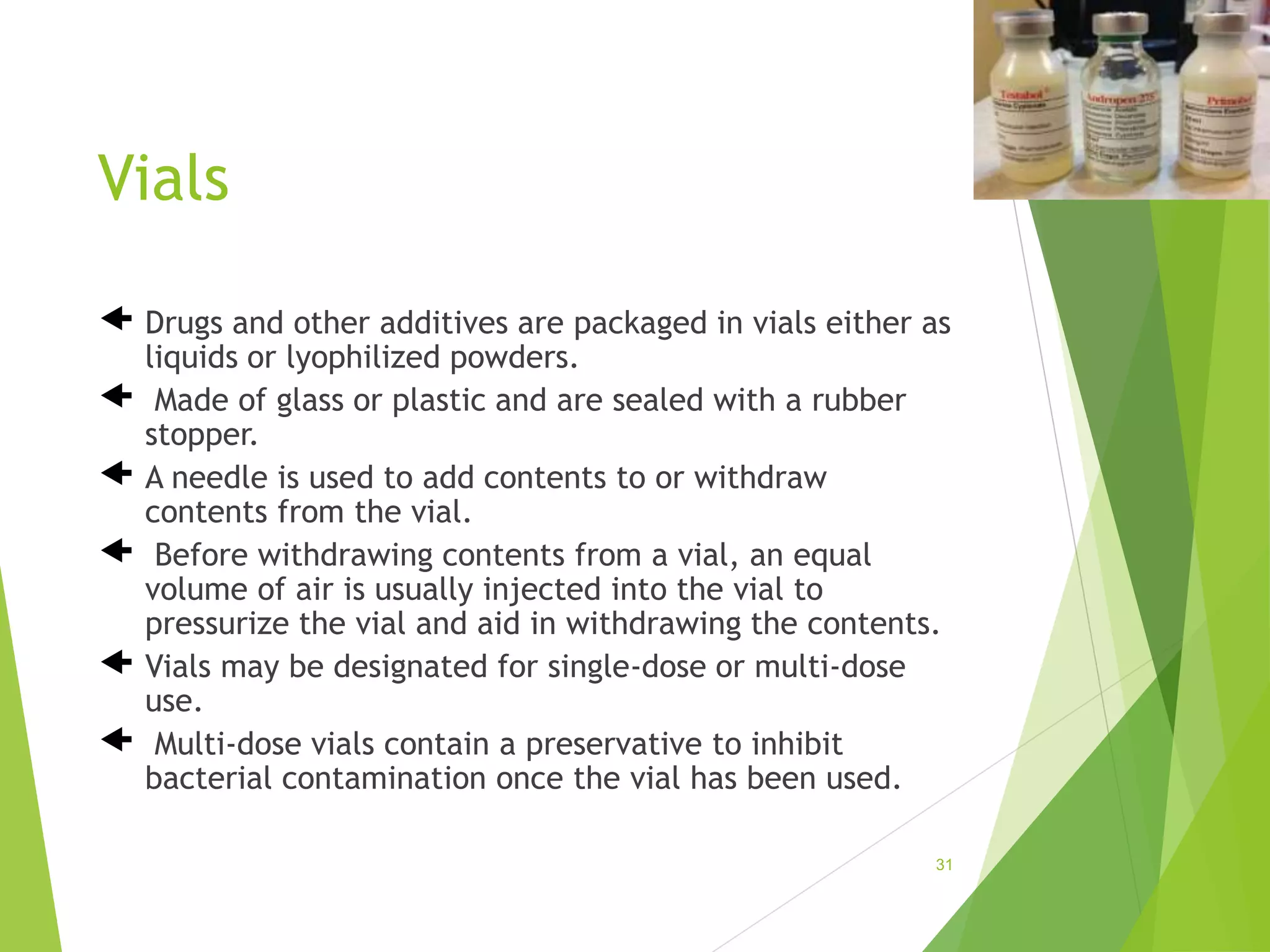
Vials
 Drugs and other additives are packaged in vials either as
liquids or lyophilized powders.
 Made of glass or plastic and are sealed with a rubber
stopper.
 A needle is used to add contents to or withdraw
contents from the vial.
 Before withdrawing contents from a vial, an equal
volume of air is usually injected into the vial to
pressurize the vial and aid in withdrawing the contents.
 Vials may be designated for single-dose or multi-dose
use.
 Multi-dose vials contain a preservative to inhibit
bacterial contamination once the vial has been used.
31
Dry powders
 Dry powder formulations are lyophilized or freeze-dried
powders that must be reconstituted with some suitable
solvent to make a liquid formulation before being
withdrawn from the vial.
 Some drugs are not stable in liquid form and so these
drugs are put into the powder form and reconstituted
just prior to use.
 There are several solvents that might be used to
reconstitute the dry powders; The most common
solvents are Sterile Water for Injection, Bacteriostatic
Water for Injection, Sodium Chloride Injection
32
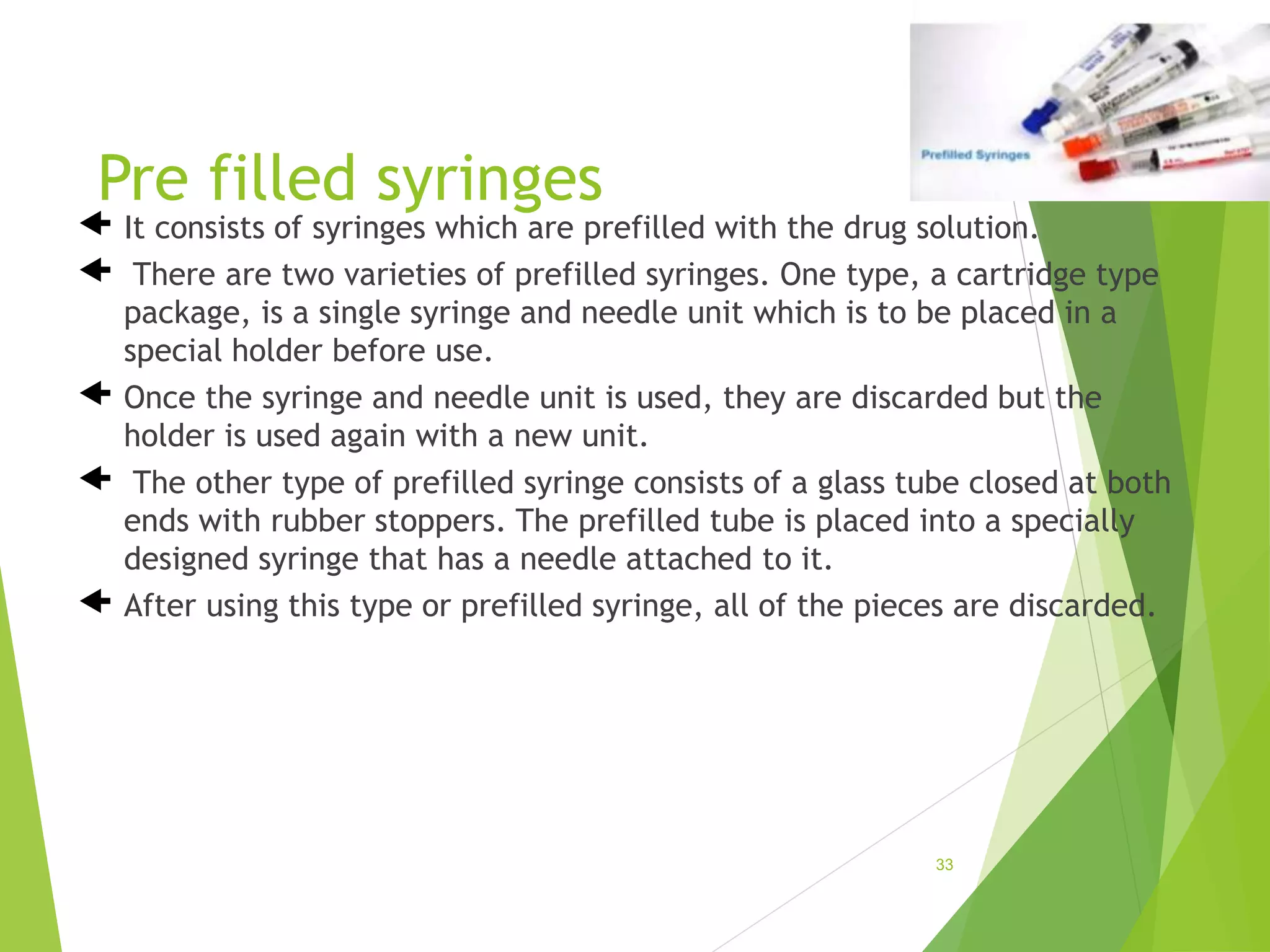
Pre filled syringes
 It consists of syringes which are prefilled with the drug solution.
 There are two varieties of prefilled syringes. One type, a cartridge type
package, is a single syringe and needle unit which is to be placed in a
special holder before use.
 Once the syringe and needle unit is used, they are discarded but the
holder is used again with a new unit.
 The other type of prefilled syringe consists of a glass tube closed at both
ends with rubber stoppers. The prefilled tube is placed into a specially
designed syringe that has a needle attached to it.
 After using this type or prefilled syringe, all of the pieces are discarded.
33
Large Volume Parenterals
 LVP are Parenterals designed to provide
-Fluid(water),
-Calories(Dextrose soln ),
-Electrolytes(Saline soln ),
 Volume 101-1000mL
 IV infusion technique is “Venoclysis
34
Requirements for LVP
1. Sterile, Non Pyrogenic, Free from Particulate matter
2. Volume 101-1000mL,
3. Single dose unit,
4. No Preservative,
5. Clear solution except Fat Emulsion,
6. Isotonic, but Hypertonic also administered in TPN.
35
Types of LVP
36
1.Hyperalimentation Solution
 Adm. Of large amt. of nutrients to patients who unable
to take food orally, at caloric intake of 4000 kCal/day.
 Subclavian vein cannulation : Infusion of Hypertonic
soln.
 Formulation : mix. Of Dextrose, Amino acids, Lipids,
Electrolytes, & Vitamins.
 Use:
1.Adm. of Life saving/sustaining drug to Comatose patient.
2.Patient undergoing t/t of GI disease
37
Total Parenterals Nutrition
 Modified term for Hyperalimentation
 IV administration Of Caloric, Nitrogen, & other
nutrients in sufficient qt. to achieve tissue synthesis &
anabolism
38
Indication For Use of TPN
1. GI disease,
2. Major trauma, Septicemia,
3. Major Abdominal Surgery,
4. Malignancy of Small Bowel,
5. Radiation Enteritis,
6. Chemotherapy & Radiotherapy,
7. Bone Marrow Transplantation,
8. Prolonged Coma
39
2. Cardioplegic Solutions
 Are LVP used in Heart surgery to prevent injury to
myocardium during reperfusion, as well as to maintain
bloodless operating field.
 Maintains the Diastolic arrest.
 Adm. In cold form.
 Slightly alkaline to compensate Metabolic acidosis, •
Hypertonic
Use: To minimize reperfusion injury resulting from tissue
edema
40
3. Peritoneal Dialysis Solution
Infused continuously into abdominal cavity, bathing
peritoneum & are then continuously withdrawn.
Formulation:- Glucose , - Antibiotics as Prophylactic
Use: 1. Removal of toxic substances from body.
2. To aid & accelerate excretion normal.
3. To treat acute renal insufficiency
41
4.Irrigating solutions
 To irrigate, flush & aid in cleansing body cavities &
wounds.
 Certain IV soln(Normal Saline) may be used as irrigating
soln, but soln designed as Irrigating soln should not be
used Paretentrally.
Use: treatment of serious wounds infused into blood
stream.
42
Difference Between SVP &
LVP
43
Q.C TESTS FOR PARENTERALS
 Finished product Quality control tests: There are
mainly five Quality control test for the parenterals are
performed.
1) LEAKER TEST
2) CLARITY TEST
3) PYROGEN TEST
4) STERILITY TEST
5) CONTENT UNIFORMITY TEST
44
1) LEAKER TEST
 Leakage occurs when a discontinuity exists in the wall
of a package that can allow the passage of gas under
the action of a pressure or concentration differential
existing across the wall.
 Presence of capillary pores or tiny cracks can cause
microbes or other dangerous contaminants to enter the
ampoules or package or may lead to the leakage of
contents to outside. This may cause contamination of
the sterile contents and also spoilage of appearance of
the package.
 Changes in temperature during storage can cause
expansion and contraction of the ampoule or package
and thereby causing interchange of its contents if an
opening exists.
45
1) LEAKER TEST
 Leaker test is employed to detect incompletely sealed
ampoule so that they may be discarded.
 To test the package integrity.
 Package integrity reflects its ability to keep the product
in and to keep potential contamination out.
 Leaker tests are 4 types
a) visual inspection
b) bubble test
c) dye test
d) vacuum ionization test
46
a) Visual inspection
 Visual inspection is the easiest leaker test method to
perform.
 The method is used for the evaluation of large volume
parenterals.
 To increase the sensitivity of the method the visual
inspection of the sample container may be coupled with
the application of vacuum to make leakage more readily
observable.
 This method is simple and inexpensive.
 Disadvantage: less sensitive
 Sensitivity is increased by applying pressure/vacuum.
47
b)Bubble test
 The test package is submerged in liquids.
 A differential pressure is applied on the container.
 The container is observed for bubbles.
 Sometimes, surfactant added liquid is used for
immersion of test package.
 Any leakage is evident after the application of
differential pressure as the generation of foaming in
immersion liquid.
 The method is simple and inexpensive.
 The location of the leaks can be observed in this
method.
48
b)Bubble test
 Generation of a differential positive pressure of 3 psi
inside the vial and observation of any leakage using
magnifying glass within a maximum test time of 15
minutes.
 However, it is relatively insensitive and the findings are
operator dependent and are qualitative.
 The optimized conditions can be achieved using a
surfactant immersion fluid along with the dark
background and High intensity lighting.
49
C)Dye test
 The test container is immersed in a dye bath.
 Vacuum and pressure is applied for sometime.
 The container is removed from the dye bath and
washed.
 The container is then inspected for the presence of dye
either visually or by means of UV spectroscopy.
 The dye used is usually 0.5% to 1% methylene blue.
50
C)Dye test
 The dye test is widely accepted in industry and is
approved in drug use.
 The test is inexpensive and is requires no special
equipment required for visual dye detection.
 However, the test is qualitative, destructive and slow.
 The test is used for ampoules.
51
D)Vacuum ionization test
 Vacuum ionization test is useful for testing leakage in the vials or bottled
sealed under vacuum.
 This test is used for testing of the lyophilized products.
 High voltage, high frequency field is applied to vials which to cause
residual gas, if present to glow.
 Glow intensity is the function of headspace vacuum level.
 The blue glow is the indicative of vacuum while the purple glow
indicative of no vacuum.
 The sensitivity of the method is not documented.
 This test is rapid and is non destructive test.
 However, the proteins present in the test sample may be decomposed.
52
2.Clarity Test
Test to detect the particulate matter.
A. Visual method :The containers are examined against strong illuminated
screen. Black background is for light colored particles and white
background for dark colored particles. Permissible limits Particle size ( ≥
µm) Max. no. of particles per mL 10 50 25 5 50 Nil
B.Light obstruction method:Light obstruction method This method uses a
light beam of high intensity. The solution is allowed to pass under this
bright light. A shadow is formed if a particle is present. The particles are
counted by the no. of shadows. Limits for sub visible particulate matter as
prescribed in USP Particle size SVP LVP ≥ 10µm 6000/container
25/ml ≥ 20µm 600/container 3/ mL
53
2.Clarity Test
C.Coulter Counter method:The sample solution is added to
an electrolyte solution which is drawn through a small
orifice. As particle passes through the orifice it
displaces its own volume of electrolyte. Particle
detected by the increase in electrical resistance.
Voltage pulses are proportional to the particle size.
Particles below 0.2 µm can also be detected.
54
3.Pyrogen test:
Limulus Amoebocyte Lysate Test :
 To detect or quantify endotoxins of gram-negative
bacterial origin Reagent: Amoebocyte lysate from
horseshoe crab ( Limulus polyphemus or Tachypleus
tridentatus ).
 Bacterial Endotoxin test (BET) Monocyte Activation Test
(MAT)
55
56
4) Uniformity of contents
 30 sterile units are selected from each batch.
 The weight of 10 individual sterile units is noted and
the content is removed from them and empty individual
sterile unit is weighed accurately again.
 Then net weight is calculated by subtracting empty
sterile unit weight from gross weight.
 The dose uniformity is met if the amount of active
ingredient is within the range of 85-115.0% of label
claim.
57
4) Uniformity of contents
• If one unit is outside the range of 85-115.0%, and none of
the sterile unit is outside the range of 75-125.0% or if
the relative standard deviation of the resultant is
greater than 6.0% ,or if both condition prevail, an
additional 20 sterile unit should be tested.
 The sterile units meet the requirements if not more
than one unit is out side the range of 85-115%, no unit is
outside the range of 75-125.0% and the calculated
relative standard deviation is 7.8%.
58
5) TEST FOR STERILITY
PRINCIPLE:
When microorganisms are supplied with nutrient medium
and water, and incubated at favourable temperatures,
they multiply. The presence of micro organisms can be
identified by turbidity in the clear medium.
Test methods
A.Membrane filtration method
B.Direct inoculation method
59
A.Membrane Filtration Method:
 Membrane Filtration Method Selection of the filters Pore
size of 0.45µm Effectiveness established in the
retention of micro-organisms Appropriate composition .
 The size of filter discs is about 50 mm in diameter
Procedure: Sterilization of filtration system and membrane
Filtration of examined solution under aseptic
conditions. The membrane is removed, aseptically
transferred to container of appropriate culture medium.
60
B.Direct inoculation of the
culture medium
 Direct inoculation of the culture medium Suitable
quantity of the preparation to be examined is
transferred directly into the appropriate culture
medium .
 Volume of the product is not more than 10% of the
volume of the medium Suitable method for aqueous
solutions, oily liquids, ointments an creams
61
Result of sterility:
The culture media is examined during and after the
incubation period to detect the possible microbial
growth.
a) the sample passes the test if microbial growth is not
found.
b) If microbial growth is present, a retest is performed. If
growth absent. Then sample passes the test.
 If microbial growth is present in the retest also, identify
the organisms. If same organisms are found as in the
first test, then the sample fails the test. If different
organisms are found, retest is performed using twice
the number of samples.
 Passes if microbial growth is not found.
62
References:
 Ansel's Pharmaceutical Dosage Forms and Drug Delivery
Systems.By Loyd V.Allen.
 lachman/lieberman's the theory and practice of
industrial pharmacy.
 Remington s –The Science and pratice of Pharmacy.
63
64

Parenterals

  • 1.
    PARENTERALS Presenter: Amruta Balekundri M.Pharm 2ndsemester, Department of Pharmaceutical Quality Assurance, KLE College of Pharmacy, Belagavi. 1
  • 2.
    CONTENTS  Definition  Advantages Disadvantages  Routes of administration  Types of Parenterals  Formulation of parenterals  Layout of parenterals  Quality control tests for parenterals 2
  • 3.
    Parenterals  The termof parenteral is derived from Greek word Para meaning beside and enteron meaning the intestine.  Thus parenterals administration should include the administration of drug by any route other than intestine. DEFINITION: Parenteral are sterile preparations intended for administration under or through one or more layers of skin or mucous membranes. 3
  • 4.
    ADVANTAGES • The parenteralsare administration of unconscious patients • Who can not take oral administration • They are free from pyrogen. • 100% bioavailability. • No chance of missing dose. 4
  • 5.
    DISADVANTAGES • Requirement ofaseptic technique in production compounding and handling of products. • Requirement of trained personnel for administration. • Real or psychological pain associated with the injection. • Highly risky if any mistake at happens any point. • High cost as compared to solid dosage forms. 5
  • 6.
    ROUTE OF ADMINISTRATION Intra Muscular (IM)  Intra dermal (ID)  Intravenous (IV)  Subcutaneous / Hypodermic (SC)  Intra articular  Intra synovial  Intra spinal  Intrathecal  Intrarterial  Intra cardiac  Intra cisternal  Intra peritonial  Intraplueral 6
  • 7.
    TYPES OF PARENTERALS Powder for injection ‐Eg. Cefuroxime for injection  Colloidal solution ‐ Eg. Iron dextran  Injectable emulsion ‐Eg. Propofol USP  Injectable suspension –Eg. Methylprednisolone acetate  Oily injection (solution) ‐Eg. Dimercaprol injection.  Infusion fluid 7
  • 8.
  • 9.
    FORMULATION OF PARENTERALS 1.Therapeutic agents ✔API 2.Vehicles ✔ Water ✔ Water miscible vehicles ✔ Non- aqueous vehicles 9
  • 10.
    FORMULATION OF PARENTERALS 3.Added substances(Additives) ✔Antimicrobials ✔ Antioxidants ✔ Buffers ✔ Bulking agents ✔ Chelating agents ✔ Protectants ✔ Solubilizing agents ✔ Surfactants ✔ Tonicity- adjusting agents 10
  • 11.
    1.Active Pharmaceutical Ingredients(API): Active PharmaceuticalIngredient: Any substance or mixture of substances intended to be used in the manufacture of a drug (medicinal) product and that, when used in the production of a drug, becomes an active ingredient of the drug product. Such substances are intended to furnish pharmacological activity or other direct effect in the diagnosis, cure, mitigation, treatment, or prevention of disease or to affect the structure or function of the body. They may be Antibiotics, Anticancer, Steroids, Vaccines, Anti-pyretic, Analgesics, Anti- inflammatory,.etc 11
  • 12.
    2.Solvents: Water: Water Shouldmeet compendial requirements Water miscible vehicles: Ethyl alcohol PEG PG Non aqueous vehicles: Fixed oils  Solvents used must be: Non-irritating ,Non-toxic , Non-sensitizing No pharmacological activity of its own. 12
  • 13.
    3. Added substances (Additives) I.Antimicrobials: Added for fungistatic or bacteriostatic action or Used to prevent the multiplication of micro- organisms ; Concentration-- Benzyl alcohol –0.5- 10 % Benzethonium chloride 0.01% Methyl paraben – 0.01-0.18 % Propyl paraben –0.005-0.035 % Phenol –0.065- 0.5 % 13
  • 14.
    3. Added substances (Additives) II.Antioxidants:Used to protect product from oxidation Acts as reducing agent or prevents oxidation Ex: A) Reducing agent:--Ascorbic acid –0.02- 0.1 % Sodium bisulphite –0.1- 0.15 % Sodium metabisulphite –0.1- 0.15 % Thiourea – 0.005% B) Blocking agents:--Ascorbic acid esters – 0.01-0.015% BHT –0.05- 0.02 % C) Synergistic:-Ascorbic acid , Citric acid , Tartaric acid D) Chelating agent: EDTA 0.01-0.075 % 14
  • 15.
    3. Added substances (Additives) III.Buffers:Added to maintain pH, Change in pH may causes degradation of the products.  Factors affecting selection of buffers: Effective range, Concentration ,Chemical effect on the total product  Used in the conc. of 0.1 to 5.0 %  Ex: Acetic acid Citric acid Benzoic acid 15
  • 16.
    3. Added substances (Additives) IV.Chelatingagents: Used to form the complex with the metallic ions present in the formulation so that the ions will not interfere during manufacturing of formulation. They form a complex which gets dissolved in the solvents. Examples: Disodium edetate 0.00386-0.05% Disodium calcium edetate 0.04% Tetrasodium edetate 0.01% 16
  • 17.
    3. Added substances (Additives) V.Stabilizers: As parenterals are available in solution form they are most prone to unstabilize.  Used to stabilize the formulation Examples:Creatinine – 0.5-0.8 % Glycerin – 1.5 – 2.25 % Niacinamide – 1.25-2.5% Sodium saccharin – 0.03% Sodium caprylate – 0.4 % 17
  • 18.
    3. Added substances (Additives) VI.Solubilizing agents:  Used to increase solubility of slightly soluble drugs  They acts by any one of the following: solubilizers,emulsifiers or wetting agents.  Examples: Dimethylacetamide, Ethyl alcohol Glycerin Lecithin PEG – 40 castor oil PEG – 300 Polysorbate 20, 40, 80 18
  • 19.
    3. Added substances (Additives) VII.Tonicity- adjusting agents:  Buffers may acts as tonicity contributor as well as stabilizers for the pH.  Isotonicity depends on permeability of a living semi-permeable membrane ⮚ Hypotonic : swelling of cells (enlargement) ⮚ Hypertonic: shrinking of cells (reduction) Example: Glycerin Lactose Mannitol Dextrose Sodium chloride 19
  • 20.
  • 21.
    Clean- up area Non aseptic area  Free from dust ,fibres & micro-organisms.  Constructed in such a way that should withstand moisture, steam & detergent.  Ceiling & walls are coated with material to prevent accumulation of dust & micro-organisms .  Exhaust fans are fitted to remove heat & humidity.  The area should be kept clean so that to avoid contamination to aseptic area .  The containers & closures are washed & dried in this area. 21
  • 22.
    Preparation area  Theingredients are mixed & preparation is prepared for filling  Not essential that the area is aseptic .  Strict precaution is taken to prevent contamination from outside .  Ceiling & walls : sealed & painted 22
  • 23.
    Aseptic area  Filtration& filling into final containers & sealing is done .  The entry of outside person is strictly prohibited To maintain sterility, special trained persons are only allowed to enter & work .  Person who worked should wear sterile cloths  Should be subjected for physical examination to ensure the fitness  Minimum movement should be there in this area  Ceiling & walls & floors : sealed & painted or treated with aseptic solution and there should not be any toxic effect of this treatment . 23
  • 24.
    Aseptic area  Cabinets& counters: Smooth Surface  AIR: Free from fibres, dust & micro organisms.  HEPA filters are used which removes particles upto 0.3 micron  Fitted in laminar air flow system, in which air is free from dust & micro organisms flows with uniform velocity .  Air supplied is under positive pressure which prevents particulate contamination from sweeping .  UV lamps are fitted to maintain sterility 24
  • 25.
  • 26.
    Quarantine area  Afterfilling, sealing & sterilization the products or batch is kept in this area .  The random samples are chosen and given for analysis to QC dept.  The batch is send to packing after issuing satisfactory reports of analysis from QC If any problem is observed in above analysis the decision is to be taken for reprocessing or others. 26
  • 27.
    Finishing and packagingarea:  After proper label, the product is given for packing.  Packing is done to protect the product from external environment .  The ideal Packing is that which protects the product during transportation, storage, shipping & handling.  The labeled container should be packed in cardboard or plastic containers Ampoules should be packed in partitioned boxes. 27
  • 28.
    Classification of Parenterals Based on Volume— ⮚ Small Volume Parenterals(SVP) - Volume ranges from 1- 30 ml May be given single dose or multiple dose. ⮚ Large Volume Parenterals(LVP) Volume ranges from 100- 1000 ml. Mostly given as single dose. 28
  • 29.
    Small Volume Parenterals(SVP)  Usuallyrange 1-30 ml in volume.  Mostly given as multiple doses. Different types are:  Ampules  Vials  Dry powders  Prefilled syringes 29
  • 30.
    Ampules:  Sealed glasscontainers with an elongated neck that must be broken off.  Most ampules are weakened around the neck for easy breaking; these will have a coloured band around the neck.  A 5 micron filter needle should be used when drawing the contents of an ampule into a syringe since glass particles may have fallen inside the ampule when the top was snapped off.  In addition, it is useful to wrap an alcohol wipe or small piece of gauze around the top of the ampule before breaking it. This will provide some protection to the fingers if the ampule shatters and will also reduce the possibility of glass splinters becoming airborne. 30
  • 31.
    Vials  Drugs andother additives are packaged in vials either as liquids or lyophilized powders.  Made of glass or plastic and are sealed with a rubber stopper.  A needle is used to add contents to or withdraw contents from the vial.  Before withdrawing contents from a vial, an equal volume of air is usually injected into the vial to pressurize the vial and aid in withdrawing the contents.  Vials may be designated for single-dose or multi-dose use.  Multi-dose vials contain a preservative to inhibit bacterial contamination once the vial has been used. 31
  • 32.
    Dry powders  Drypowder formulations are lyophilized or freeze-dried powders that must be reconstituted with some suitable solvent to make a liquid formulation before being withdrawn from the vial.  Some drugs are not stable in liquid form and so these drugs are put into the powder form and reconstituted just prior to use.  There are several solvents that might be used to reconstitute the dry powders; The most common solvents are Sterile Water for Injection, Bacteriostatic Water for Injection, Sodium Chloride Injection 32
  • 33.
    Pre filled syringes It consists of syringes which are prefilled with the drug solution.  There are two varieties of prefilled syringes. One type, a cartridge type package, is a single syringe and needle unit which is to be placed in a special holder before use.  Once the syringe and needle unit is used, they are discarded but the holder is used again with a new unit.  The other type of prefilled syringe consists of a glass tube closed at both ends with rubber stoppers. The prefilled tube is placed into a specially designed syringe that has a needle attached to it.  After using this type or prefilled syringe, all of the pieces are discarded. 33
  • 34.
    Large Volume Parenterals LVP are Parenterals designed to provide -Fluid(water), -Calories(Dextrose soln ), -Electrolytes(Saline soln ),  Volume 101-1000mL  IV infusion technique is “Venoclysis 34
  • 35.
    Requirements for LVP 1.Sterile, Non Pyrogenic, Free from Particulate matter 2. Volume 101-1000mL, 3. Single dose unit, 4. No Preservative, 5. Clear solution except Fat Emulsion, 6. Isotonic, but Hypertonic also administered in TPN. 35
  • 36.
  • 37.
    1.Hyperalimentation Solution  Adm.Of large amt. of nutrients to patients who unable to take food orally, at caloric intake of 4000 kCal/day.  Subclavian vein cannulation : Infusion of Hypertonic soln.  Formulation : mix. Of Dextrose, Amino acids, Lipids, Electrolytes, & Vitamins.  Use: 1.Adm. of Life saving/sustaining drug to Comatose patient. 2.Patient undergoing t/t of GI disease 37
  • 38.
    Total Parenterals Nutrition Modified term for Hyperalimentation  IV administration Of Caloric, Nitrogen, & other nutrients in sufficient qt. to achieve tissue synthesis & anabolism 38
  • 39.
    Indication For Useof TPN 1. GI disease, 2. Major trauma, Septicemia, 3. Major Abdominal Surgery, 4. Malignancy of Small Bowel, 5. Radiation Enteritis, 6. Chemotherapy & Radiotherapy, 7. Bone Marrow Transplantation, 8. Prolonged Coma 39
  • 40.
    2. Cardioplegic Solutions Are LVP used in Heart surgery to prevent injury to myocardium during reperfusion, as well as to maintain bloodless operating field.  Maintains the Diastolic arrest.  Adm. In cold form.  Slightly alkaline to compensate Metabolic acidosis, • Hypertonic Use: To minimize reperfusion injury resulting from tissue edema 40
  • 41.
    3. Peritoneal DialysisSolution Infused continuously into abdominal cavity, bathing peritoneum & are then continuously withdrawn. Formulation:- Glucose , - Antibiotics as Prophylactic Use: 1. Removal of toxic substances from body. 2. To aid & accelerate excretion normal. 3. To treat acute renal insufficiency 41
  • 42.
    4.Irrigating solutions  Toirrigate, flush & aid in cleansing body cavities & wounds.  Certain IV soln(Normal Saline) may be used as irrigating soln, but soln designed as Irrigating soln should not be used Paretentrally. Use: treatment of serious wounds infused into blood stream. 42
  • 43.
  • 44.
    Q.C TESTS FORPARENTERALS  Finished product Quality control tests: There are mainly five Quality control test for the parenterals are performed. 1) LEAKER TEST 2) CLARITY TEST 3) PYROGEN TEST 4) STERILITY TEST 5) CONTENT UNIFORMITY TEST 44
  • 45.
    1) LEAKER TEST Leakage occurs when a discontinuity exists in the wall of a package that can allow the passage of gas under the action of a pressure or concentration differential existing across the wall.  Presence of capillary pores or tiny cracks can cause microbes or other dangerous contaminants to enter the ampoules or package or may lead to the leakage of contents to outside. This may cause contamination of the sterile contents and also spoilage of appearance of the package.  Changes in temperature during storage can cause expansion and contraction of the ampoule or package and thereby causing interchange of its contents if an opening exists. 45
  • 46.
    1) LEAKER TEST Leaker test is employed to detect incompletely sealed ampoule so that they may be discarded.  To test the package integrity.  Package integrity reflects its ability to keep the product in and to keep potential contamination out.  Leaker tests are 4 types a) visual inspection b) bubble test c) dye test d) vacuum ionization test 46
  • 47.
    a) Visual inspection Visual inspection is the easiest leaker test method to perform.  The method is used for the evaluation of large volume parenterals.  To increase the sensitivity of the method the visual inspection of the sample container may be coupled with the application of vacuum to make leakage more readily observable.  This method is simple and inexpensive.  Disadvantage: less sensitive  Sensitivity is increased by applying pressure/vacuum. 47
  • 48.
    b)Bubble test  Thetest package is submerged in liquids.  A differential pressure is applied on the container.  The container is observed for bubbles.  Sometimes, surfactant added liquid is used for immersion of test package.  Any leakage is evident after the application of differential pressure as the generation of foaming in immersion liquid.  The method is simple and inexpensive.  The location of the leaks can be observed in this method. 48
  • 49.
    b)Bubble test  Generationof a differential positive pressure of 3 psi inside the vial and observation of any leakage using magnifying glass within a maximum test time of 15 minutes.  However, it is relatively insensitive and the findings are operator dependent and are qualitative.  The optimized conditions can be achieved using a surfactant immersion fluid along with the dark background and High intensity lighting. 49
  • 50.
    C)Dye test  Thetest container is immersed in a dye bath.  Vacuum and pressure is applied for sometime.  The container is removed from the dye bath and washed.  The container is then inspected for the presence of dye either visually or by means of UV spectroscopy.  The dye used is usually 0.5% to 1% methylene blue. 50
  • 51.
    C)Dye test  Thedye test is widely accepted in industry and is approved in drug use.  The test is inexpensive and is requires no special equipment required for visual dye detection.  However, the test is qualitative, destructive and slow.  The test is used for ampoules. 51
  • 52.
    D)Vacuum ionization test Vacuum ionization test is useful for testing leakage in the vials or bottled sealed under vacuum.  This test is used for testing of the lyophilized products.  High voltage, high frequency field is applied to vials which to cause residual gas, if present to glow.  Glow intensity is the function of headspace vacuum level.  The blue glow is the indicative of vacuum while the purple glow indicative of no vacuum.  The sensitivity of the method is not documented.  This test is rapid and is non destructive test.  However, the proteins present in the test sample may be decomposed. 52
  • 53.
    2.Clarity Test Test todetect the particulate matter. A. Visual method :The containers are examined against strong illuminated screen. Black background is for light colored particles and white background for dark colored particles. Permissible limits Particle size ( ≥ µm) Max. no. of particles per mL 10 50 25 5 50 Nil B.Light obstruction method:Light obstruction method This method uses a light beam of high intensity. The solution is allowed to pass under this bright light. A shadow is formed if a particle is present. The particles are counted by the no. of shadows. Limits for sub visible particulate matter as prescribed in USP Particle size SVP LVP ≥ 10µm 6000/container 25/ml ≥ 20µm 600/container 3/ mL 53
  • 54.
    2.Clarity Test C.Coulter Countermethod:The sample solution is added to an electrolyte solution which is drawn through a small orifice. As particle passes through the orifice it displaces its own volume of electrolyte. Particle detected by the increase in electrical resistance. Voltage pulses are proportional to the particle size. Particles below 0.2 µm can also be detected. 54
  • 55.
    3.Pyrogen test: Limulus AmoebocyteLysate Test :  To detect or quantify endotoxins of gram-negative bacterial origin Reagent: Amoebocyte lysate from horseshoe crab ( Limulus polyphemus or Tachypleus tridentatus ).  Bacterial Endotoxin test (BET) Monocyte Activation Test (MAT) 55
  • 56.
  • 57.
    4) Uniformity ofcontents  30 sterile units are selected from each batch.  The weight of 10 individual sterile units is noted and the content is removed from them and empty individual sterile unit is weighed accurately again.  Then net weight is calculated by subtracting empty sterile unit weight from gross weight.  The dose uniformity is met if the amount of active ingredient is within the range of 85-115.0% of label claim. 57
  • 58.
    4) Uniformity ofcontents • If one unit is outside the range of 85-115.0%, and none of the sterile unit is outside the range of 75-125.0% or if the relative standard deviation of the resultant is greater than 6.0% ,or if both condition prevail, an additional 20 sterile unit should be tested.  The sterile units meet the requirements if not more than one unit is out side the range of 85-115%, no unit is outside the range of 75-125.0% and the calculated relative standard deviation is 7.8%. 58
  • 59.
    5) TEST FORSTERILITY PRINCIPLE: When microorganisms are supplied with nutrient medium and water, and incubated at favourable temperatures, they multiply. The presence of micro organisms can be identified by turbidity in the clear medium. Test methods A.Membrane filtration method B.Direct inoculation method 59
  • 60.
    A.Membrane Filtration Method: Membrane Filtration Method Selection of the filters Pore size of 0.45µm Effectiveness established in the retention of micro-organisms Appropriate composition .  The size of filter discs is about 50 mm in diameter Procedure: Sterilization of filtration system and membrane Filtration of examined solution under aseptic conditions. The membrane is removed, aseptically transferred to container of appropriate culture medium. 60
  • 61.
    B.Direct inoculation ofthe culture medium  Direct inoculation of the culture medium Suitable quantity of the preparation to be examined is transferred directly into the appropriate culture medium .  Volume of the product is not more than 10% of the volume of the medium Suitable method for aqueous solutions, oily liquids, ointments an creams 61
  • 62.
    Result of sterility: Theculture media is examined during and after the incubation period to detect the possible microbial growth. a) the sample passes the test if microbial growth is not found. b) If microbial growth is present, a retest is performed. If growth absent. Then sample passes the test.  If microbial growth is present in the retest also, identify the organisms. If same organisms are found as in the first test, then the sample fails the test. If different organisms are found, retest is performed using twice the number of samples.  Passes if microbial growth is not found. 62
  • 63.
    References:  Ansel's PharmaceuticalDosage Forms and Drug Delivery Systems.By Loyd V.Allen.  lachman/lieberman's the theory and practice of industrial pharmacy.  Remington s –The Science and pratice of Pharmacy. 63
  • 64.