STERILE DOSAGE FORM (PARENTRALS)
Prepared by: Mr. Avinash B. Thalkari M. Pharm
Assistant Professor
SHRI BALAJI SHIKSHAN PRASARAK MANDAL B
PHARMACY COLLEGE, AMBAJOGAI
PARENTRALS: Parenterals are sterile details that are controlled into the body by courses other
than oral course which incorporates infusion, mixture and implantation.
OR
PARENTRAL PRODUCTS: Parenteral items are considered as sterile arrangements,
suspension or emulsions that are administrated by hypodermic infusion either in the structure in
which they are provided or after the expansion of appropriate dissolvable or suspending
specialist.
GENERAL REQUIREMENTS FOR PARENTRAL DOSAGE FORMS.
1. It must be sterile.
2. It must be free from Pyrogen and practical microorganism.
3. It must be isotonic with blood plasma.
4. Its explicit gravity must be like blood plasma.
5. It ought to have a pH like blood plasma.
6. It must be non dangerous, non aggravation to the body.
7. It must be free from physical and compound contaminants.
8. It must be free from residue and earth particles.
9. It must be compound latent in nature.
Focal points / Advantages
1. Useful for patients who can't take medicates orally
2. Rapid beginning of activity
3. Useful for crisis circumstances
4. Providing continued medication conveyance (inserts, im warehouse inj)
5. Avoid first pass digestion
6. Can infuse tranquilize straightforwardly in to a tissue (target sedate conveyance)
7. Useful for conveying liquids, electrolytes, or supplements (TPN)
8. Can be done in emergency clinics, mobile imbuement focuses and home human services focuses
9. Complete (100%) bioavailability conceivable.
Impediments / Disadvantages
1. Pain on infusion
2. Difficult to switch a directed medication's impact.
3. Sensitivity or unfavorably susceptible response at the site of infusion.
4. Requires exacting control of sterility and non pyrogenicity than other plan.
5. Trained individual is required.
6. Require particular gear, gadgets, and systems to get ready and direct medications.
7. More costly and expensive to deliver
PARENTERAL ROUTES
1. Intradermal 2. Subcutaneous 3. Intramuscular
4. Intravenous 5. Intra-arterial 6. Intracardiac
7. Intrathecal 8. Intracisternal 9. Peridural
10.Intraarticular 11.Intracerebral1.
1. Intradermal (Intracutaneous) infusions:
a) The sedate is infused in the middle of the dermis and epidermis.
b) The skin of left lower arm is typically chosen for giving the infusion.
c) Usual portion is about 0.1ml to 0.2ml arrangement is infused by this course.
d) This course is utilized for analytic reason and testing the affectability of injectables.
2. Subcutaneous:
a) The tranquilize infused under the skin, into the subcutaneous tissue.
b) Upper arm is generally chosen for giving the infusion.
c) Usual portion is about 1.0ml or less is infused by this course.
d) This is the most advantageous course for patient and specialist.
3. Intramuscular infusions:
a) Drugs are infused profoundly into muscle tissue.
b) The muscles of shoulder, thigh generally chose for giving the infusion.
c) Usual portion is about 2ml is infused by this course however ought
not surpass 4.0ml at one site.
d) If the medication is in fluid (water) arrangement, ingestion is fast.
e) However, if the medication is in a sleek fluid or as a suspension, it can draw out the arrival
of the medication.
4. Intravenous infusions:
a) The infusion of a medication legitimately into the patient's veins, bringing about the most
fast beginning of activity.
b) The suspension and slick arrangement can't be regulated by this course.
c) The middle essential vein close to the foremost surface of the elbow is generally chosen,
since it is effectively found and associates with significant veins of the arm.
d) LVP arrangements from 1 ml to 500ml or beyond what that can be regulated by
intravenous course are generally called intravenous liquids.
e) IV course typically utilized for following reason.
Employments:
 To right electrolyte irregular characteristics.
 To convey meds,
 For blood transfusion.
 For Fluid substitution to address, for instance, lack of hydration.
 Used for chemotherapy.
 To convey Blood substitute.
5. Intra-blood vessel infusions:
a) These are like IV infusion.
b) The infusion are straightforwardly infused into supply route.
6. Intracardiac infusions:
a) The infusion are straightforwardly infused into the heart muscles or ventricles in a crisis
just; for example as invigorate following heart failure.
7. Intrathecal infusions:
a) Injection are legitimately infused into the subarchnoid space
that encompasses the spinal rope.
b) This course is utilized for giving spinal anesthesia.
8. Intracisternal infusions:
a) Thes are given in the middle of the first and second cervical vertebrae.
b) This course is utilized to pull back C.S.F. for symptomatic reason.
9. Peridural infusions:
a) These are given in the middle of the duramater and the internal parts of the vertebra.
b) This course is in some cases utilized for giving spinal anesthesia in spinal cases.
10. Intraarticular infusions:
a) Injection are given are into the fluid that grease up the articulating closures of bones
in a joint.
11.Intracerebral infusions: These infusions are surrendered to cerebrum
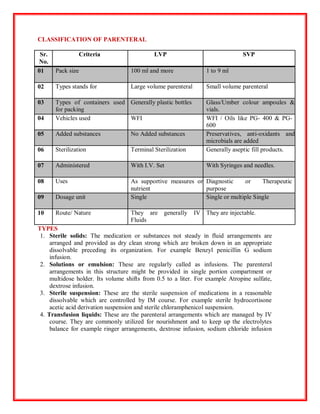
CLASSIFICATION OF PARENTERAL
Sr.
No.
Criteria LVP SVP
01 Pack size 100 ml and more 1 to 9 ml
02 Types stands for Large volume parenteral Small volume parenteral
03 Types of containers used
for packing
Generally plastic bottles Glass/Umber colour ampoules &
vials.
04 Vehicles used WFI WFI / Oils like PG- 400 & PG-
600
05 Added substances No Added substances Preservatives, anti-oxidants and
microbials are added
06 Sterilization Terminal Sterilization Generally aseptic fill products.
07 Administered With I.V. Set With Syringes and needles.
08 Uses As supportive measures or
nutrient
Diagnostic or Therapeutic
purpose
09 Dosage unit Single Single or multiple Single
10 Route/ Nature They are generally IV
Fluids
They are injectable.
TYPES
1. Sterile solids: The medication or substances not steady in fluid arrangements are
arranged and provided as dry clean strong which are broken down in an appropriate
dissolvable preceding its organization. For example Benzyl penicillin G sodium
infusion.
2. Solutions or emulsion: These are regularly called as infusions. The parenteral
arrangements in this structure might be provided in single portion compartment or
multidose holder. Its volume shifts from 0.5 to a liter. For example Atropine sulfate,
dextrose infusion.
3. Sterile suspension: These are the sterile suspension of medications in a reasonable
dissolvable which are controlled by IM course. For example sterile hydrocortisone
acetic acid derivation suspension and sterile chloramphenicol suspension.
4. Transfusion liquids: These are the parenteral arrangements which are managed by IV
course. They are commonly utilized for nourishment and to keep up the electrolytes
balance for example ringer arrangements, dextrose infusion, sodium chloride infusion
FORMULATION OF PARENTRALS:
It is nothing but additives added in formulation. Following are the additives used to prepare the
Parentrals:
Different Adjutants Used In Parenteral Preparations.
A) Vehicles- Two type of vehicle used in parenteral as followes
1) Aqueous vehicle:
a) Water for injection:
 WFI may be prepared by either distillation or reverse osmosis.
 Stored in chemically resistant tank.
b) Sterile water for injection
 SWFI containing one or more suitable bacteriostatic agent.
 Multiple – dose containers not exceeding 30 ml.
 They are permitted to contain higher levels of solid than WFI because ofpossible leaching.
 Used for washing wounds, surgical incisions, or body tissues.
b) Bacteriostatic water for injection
 This type of water used for making parenteral solutions prepared under aseptic
conditions and not terminally sterilized.
 Need to meet USP sterility test.
 It can contain an added bacteriostatic agent when in containers of 30 ml or less. 2
2. Non-watery vehicles/solvents-Commonly utilized fixed oil are shelled nut oil, cotton seed
oil, corn oil, arachis oil and almond oil. Another non watery dissolvable, significantly
utilized is liquor, i.e., ethyl liquor. Propylene glycol and Glycerin
B) Adjuvant: These substances are added to expands strength or nature of item.
1) Solubilising operators: These are utilized to expand solvency of medications which are somewhat
dissolvable in water. Eg surface dynamic operators like tweens and polysorbates
2) Stabilizers: The medication as arrangements is progressively at risk to disintegrate because of
oxidation and hydrolysis. The oxidation can be avoided by including cancer prevention agents like
thiourea ascorbic acids and so forth and hydrolysis can be averted by utilizing non.aq. vehicle or by
altering pH of the planning.
3) Antibacterial operator: These substances are included satisfactory amount to keep the development
microorganism amid capacity, so these substances go about as additive. Utilized in Multidose holders
and Single portion items those are not terminally cleaned. for example Methyl paraben and propyl
paraben
4) Buffering specialist: Many medications require a specific pH range to keep up item solidness.
Parenteral items planned to have adequate cushion ability to keep up appropriate pH. e.g.:- Sodium
citrate, acidic corrosive, citrus extract, sodium acetic acid derivation.
5) Tonicity modification operators Parenteral arrangement ought to be isotonic with blood plasma and
other body liquids. Isotonicity of the arrangement might be balanced by including sodium chloride,
dextrose and boric corrosive in appropriate amounts.
6) Chelating specialist: Chelating operators, for example, EDTA and its salt, sodium or potassium salts
of citrus extract are included the definitions to chelate the metallic particles present in the detailing.
7) Suspending: Suspending operators are utilized to improve the consistency and to suspend the particles
for long time. Ex. Methyl cellulose, carboxymethyl cellulose and so forth.
8) Emulsifying operators: are utilized in sterile emulsions. Ex.lecithin
9) Wetting operators: are utilized to diminish the interfacial strain between the strong particles and
fluids.
STEPS INVOLVED IN PROCESSING OF PARENTAL PREPARATION
Steps engaged with parental arrangement
1. Cleaning of compartments, terminations and gear.
2. Collection of materials.
3. Preparation of parentral items.
4. Filtration.
5. Filling the arrangement in definite compartments.
6. Sterilisation.
7. Evaluation of parenteral arrangements.
8. Labelling and bundling.
1. Cleaning of compartments, terminations and gear: All the holders, terminations and hardware
which are required for the readiness are cleaned completely with cleanser and washing is finished with
faucet water pursued by refined water lastly flushed with water for infusion. Elastic terminations are
washed with hot arrangement of 0.5% sodium pyrophosphate in water, than washed with water and
flushed with water for infusion.
2. Collection of materials: Ingredients of parental readiness are gauged and gathered in planning room
every one of the fixings must be of pharmacopial guidelines Water for infusion which is free from
pyrogen must be utilized for arrangement.
3. Preparation of parenteral item: The drug specialist ought to choose the request of blending and
accurate technique for readiness to be pursued before setting up the parenteral item, the parental
arrangements must be set up under severe aseptic conditions. =
4. Filtration: The parental arrangement so framed is gone through microbes verification channel, the
essential goal is to illuminate the arrangement by evacuating remote particles, if the readiness must be
disinfected by filtration than it must be done in severe aseptic conditions before it is moved into
conclusive compartment and fixed.
5. Filling the arrangement in conclusive compartments: The sifted item is filled into definite holder,
which are cleaned dried and disinfected on little scale hypodermic syringe and needle are utilized and
on vast scale programmed filling machine are utilized. The sterile powders are filled into the holder by
individual gauging or by utilizing programmed or self-loader gadgets. The filling task is conveyed
under severe aseptic safeguards.
6. Sealing the holder: Sealing ought to be done following filling. Ampoules are fixed physically on a
little scale, yet on a huge scale ampoule fixing machine is utilized. Vials and transfusion bottles are
fixed by shutting its opening with elastic terminations, and afterward pleating of aluminum top is done
physically or mechanical methods.
7. Sterilization: The parental arrangement ought to be promptly sanitized subsequent to fixing any
strategy for sanitization can be utilized relying upon nature of medicaments present in the readiness.
8. Evaluation of parenteral arrangements: The completed items are exposed to following tests so as
to keep up quality control a) sterility test b) lucidity test c) spillage test d) pyrogen test e) article.
TESTS USED FOR EVALUATION OF PARENTERAL PRODUCT
1. Sterility test.
2. Clarity test.
3. Leakage test.
4. Pyrogen test
5. Assay.
1. STERILITY TEST:- Standard : The fundamental point of the test is to distinguish nearness or
nonattendance of organisms. Test immunized in medium under aseptic condition to give great
condition to microorganism to develop. Nearness of turbidity demonstrates nearness of organisms.
Steps involved in sterility testing:
 Selection of the sample size
 Selection of the quantity of the product to be used
 Method of testing
 Observation and result
General Test:
 The item to be tried is moved aseptically in clean supplement media and hatched for a particular
timeframe at an ideal temperature.
 If living organisms are available, development happens in the media and if missing no
development.
 Products containing antimicrobials gives false negative test.
 Hence such item is weakened to make the bacteriostatic operator incapable and after that the test is
completed.
 Product containing antimicrobial medications, for example, penicillin, sulfa drugs must be tried in
nearness of opposing materials for example penicillin in nearness of penicillinase and sulfa sedates
in nearness of PABA.
 The supplement medium must be sterile and ready to deliver microbial development.
 If the test for sterility demonstrates no microbial development, the item is viewed as sterile.
 If the test indicates microbial development, the test is rehashed twice of thrice to check for
inadvertent defilement. On the off chance that again the test comes up short the item is non-sterile.
 The test is performed under aseptic conditions under laminar wind current.
 The culture media utilized are:
 Fluid thioglycollate mechanism for anaerobic microorganisms Soyabean-casein digest mechanism
for parasites and oxygen consuming microorganisms
Tests for sterility might be done by:
1. Direct vaccination strategy
2. Membrane filtration technique
1. Direct INOCULATION strategy
 Culture medium is taken under sterile condition.
 Sample to be tried is straightforwardly immunized in culture medium under aseptic condition.
 Quantity of test withdrawal according to indicated in pharmacopeia.
 Incubate the blend of test and culture for at the very least 14 days
 Observe the development in medium.
 If the test for sterility demonstrates no microbial development, the item is viewed as sterile.
 If the test demonstrates microbial development, the test is rehashed twice of thrice to check for
inadvertent tainting. In the event that again the test fizzles the item is non-sterile.
2. Membrane filtration method:
This strategy is performed in oil or slick planning, a salve can change over into arrangement, non-
bacteriostatic strong not solvent in culture medium
 Take an example and disintegrate in WFI.
 Transfer it in film channel having typical porosity of 0.45micron and a breadth of 47mm.
 After the filtration the film is expelled assepticallyfrom the metallic holder and isolated in two
parts.
 The first parts moved into 100ml of culture media implied for parasites and hatched at 20 to 25 c
for NLT 7 days.
 The different parts is moved into 100ml of liquid thioglycollate medium and hatched at 30 to 35 c
for NLT 7 days.
 Observe the development in medium.
 If the test for sterility demonstrates no microbial development, the item is viewed as sterile.
 If the test indicates microbial development, the test is rehashed twice of thrice to check for
incidental pollution. On the off chance that again the test falls flat the item is non-sterile.
PYROGENS TEST:
Pyrogens are result of bacterial digestion, pyrogens are polysaccharides, thermostable, dissolvable in
water, unaffected by bactericide and can go through bacterial evidence channels.
Rule: The test includes the estimation of the ascent in the body temperature of rabbit following i.v.
infusion of a sterile arrangement of a substance being inspected. Rabbits are utilized to play out this test
since they are progressively delicate to pyrogen.
Material Used:
 Temperature recording gadget, glass products, syringe& needles.
 Three sound grown-up rabbits of either sex, each weighing at the very least 1.5kg.
 Do not utilize any rabbit having a temperature higher than 39.8°c.
Strategy for testing : Sham Test:
 Pyrogen testing perform on rabbit: The test includes the estimation of ascend in body temp of rabbit
following intravenous infusion of a sterile arrangement of a substance being inspected.
 Three sound rabbits ,each weighing at the very least 1.5 kg are chosen.
 They are kept on adjusted diet.& are not demonstrating any misfortune in body weight .
 The arrangement under test is infused gradually through ear vein in a volume of 0.5 to 10 ml/body
weight.
 Record the temperature of each rabbit in an interim of 30 mins for three hrs. after the infusion.
 The distinction between starting temp and the greatest recorded as reaction.
 If no rabbit demonstrates an individual ascent in temperature of 0.6 °C or increasingly over its
separate control temperature, and if the whole of the 3 temperature rises does not surpass 1.4 °C, the
tried material meets the necessities for the nonappearance of pyrogen.
 If 1 or 2 rabbits demonstrate a temperature ascent of 0.6 °C or more, or if the aggregate of the
temperature rises surpasses 1.4 °C, proceed with the test utilizing 5 different rabbits.
 If not more than 3 of the 8 rabbits show singular ascents in temperature of 0.6 °C or and total of
gathering most extreme temp rises doesn't surpass 3.7°c.
LAL test (Limulus amebocyte lysate):
 LAL test is utilized for the identification and evaluation of bacterial endotoxins.
 Limulus amebocyte lysate (LAL) is a watery concentrate of platelets (amoebocytes) from the
horseshoe crab, Limulus polyphemus. LAL responds with bacterial endotoxin or lipopolysaccharide
(LPS), which is a film part of Gram negative microscopic organisms.
 The arrangement of endotoxins containing readiness is added to the lysate got from heamolymph
cells of horseshoe crab (limulus Polyphemus).
 The aftereffect of the response is turbidity or precipitation or gelation of the blend.
 This is utilized as a quantitative measure to appraise the endotoxin content.
 The rate of response relies on conc. of endotoxins, pH, temperature and nearness of thickening
chemical framework and clottable proteins from lysate
(Bacterial endotoxin test is utilized for pyrogen testing according to USP. )
A concentrate from the platelets of the pony shoe crab contains and catalyst and protein framework that
coagulates within the sight of low dimension of lipopolysaccharides. This disclosure prompted the
advancement of the limulus ameboytes lysat LAL test for the nearness of bacterial endotoxin. The
bacterial endotoxin test USP utilizes LAL test as it is viewed as commonly increasingly delicate to
endotoxin then the rabbit test. NOTE: The benefit of this test is that it is increasingly touchy test then the
rabbit test use for identification of pyrogen.
PARTICULATE MATTER MONITORING: Definition: Particulate issue is undesirable versatile
insoluble issue other than gas bubbles present in the given item. Allowed particulate issues as
recommended in I.P
Particles size in micro meter
(equal to or larger than)
Maximum no. of
particles per ml
10 50
25 05
50 Nil
Criticalness: Presence of particulate issue in IV arrangements may prompt septicemia, fever and
blockage of little veins. The nearness of undissolve particles make question about the nature of
item
Testing:
1. Visual strategy
2. Coulter counter strategy
3. Filtration strategy
4. Light blockage
1. Visual Method:
 It is an old yet solid technique.
 The filled compartments are inspected against solid lit up screen by holding the necklace turning
it gradually or transformed it to reject the likelihood of remote particles.
 If any particulate issue is obvious, that compartment is rejected.
2. Coulter Counter Method:
 The technique depends on the rule that expansion in opposition is seen between two cathodes,
as the molecule methodologies and goes through the hole.
 An electrolyte is required to be incorporated into the readiness before its assessment.
 The particles with breadth underneath 0.1/um can be identified by this technique.
3. Filtration technique:
 The fluid example is gone through a channel and the material gathered on the outside of the
channel
 It is inspected under magnifying lens.
4. Light blockage technique:
 It permits a flood of the liquid under test to go between a brilliant white light source and
photodiode sensor.
 It is conceivable to identify cross sectional region in this instrument since it hinders the way of
light and size of the molecule is consider as a measurement of a hover of proportionate region
TOTAL PARENTERAL NUTRIENT (TPN):
Defination:- Intravenous admn of calories, Nitrogen and different supplements in adequate qty to
deliver tissue blend of anabolism is called as parentral nourishment.
 TPN soln comprise of mixt of amino corrosive, lipid emulsion electrolytes, and nutrients with
follow components.
 These solns are regulated gradually through a fringe rein, where it is weakened by huge vol. of
blood in order to limit the danger of tissue or cell harm.
 TPN are by and large directed to maintain a strategic distance from different infusions of
sustenance required by patients by IV course.
 TPN is given to satisfy the wholesome necessities in pre-employable and post usable
conditions.
Essential; It is important when the GIT is nonfunctional in light of the fact that its absorptive limit is
impeded
Types
1. TPN liquid containing protein hydrolysate.
2. TPN liquid containing amino corrosive.
Prerequisites
1. Water-30 to 40ml/kg/day
2. Energy-30 to 60kcal/kg/day, relies upon vitality expenduture
3. Amino acids-1 to 2g/kg/day, relies upon level of catabolism.
4. Essential unsaturated fats
5. Vitamins
6. Minerals
MOST IMPORTANT QUESTIONS: (for D. PHARM)
1. Define parentral products? Give their advantages and disadvantages. 3/4Marks
2. Define parentral products? Enlist general requirements of parenteral preparation.3/4M
3. Give the difference between LVP & SVP. 3 Marks
4. What are different adjutants used in parenteral preparations. 3/4 Marks
5. Describe steps involved in processing of parenteral preparation. 4 Marks
6. Define pyrogen. Explain principle and method for pyrogen testing.3/4 Marks
7. Why Bacterial endotoxin test is used for pyrogen testing as per USP. 2 Marks
8. Enlist various steps involved in processing of parentral products. 2 Marks
9. Name any four tests used for evaluation of parenteral product.2 Marks
10. Explain basic principal of test for pyrogen on rabbits. 2 Marks
11.Define pyrogens ?Describe procedure for pyrogen testing? 3 Marks
12. What are intravenous fluids? Write there uses. 2 Marks
13. Define particulate matter in parenteral. What is its significance .Explain any one
method of detection of particulate matter. 3/4 Marks
14.Write a short note on TPN.2/3 Marks
15. Explain the principle and methods for sterility testing.3/4 Marks
All the best
Mr. Avinash B. Thalkari M. Pharm
Assistant Professor
Pharmaceutics Department
Contact-9960944354
E-Mail: avinashthalkari@rediffmail.com
SHRI BALAJI SHIKSHAN PRASARAK MANDAL B
PHARMACY COLLEGE, AMBAJOGA
PARENTRAL DOSAGE FORM OR  STERILE DOSAGE FORM

PARENTRAL DOSAGE FORM OR STERILE DOSAGE FORM

  • 1.
    STERILE DOSAGE FORM(PARENTRALS) Prepared by: Mr. Avinash B. Thalkari M. Pharm Assistant Professor SHRI BALAJI SHIKSHAN PRASARAK MANDAL B PHARMACY COLLEGE, AMBAJOGAI PARENTRALS: Parenterals are sterile details that are controlled into the body by courses other than oral course which incorporates infusion, mixture and implantation. OR PARENTRAL PRODUCTS: Parenteral items are considered as sterile arrangements, suspension or emulsions that are administrated by hypodermic infusion either in the structure in which they are provided or after the expansion of appropriate dissolvable or suspending specialist. GENERAL REQUIREMENTS FOR PARENTRAL DOSAGE FORMS. 1. It must be sterile. 2. It must be free from Pyrogen and practical microorganism. 3. It must be isotonic with blood plasma. 4. Its explicit gravity must be like blood plasma. 5. It ought to have a pH like blood plasma. 6. It must be non dangerous, non aggravation to the body. 7. It must be free from physical and compound contaminants. 8. It must be free from residue and earth particles. 9. It must be compound latent in nature. Focal points / Advantages 1. Useful for patients who can't take medicates orally 2. Rapid beginning of activity 3. Useful for crisis circumstances 4. Providing continued medication conveyance (inserts, im warehouse inj) 5. Avoid first pass digestion 6. Can infuse tranquilize straightforwardly in to a tissue (target sedate conveyance) 7. Useful for conveying liquids, electrolytes, or supplements (TPN) 8. Can be done in emergency clinics, mobile imbuement focuses and home human services focuses 9. Complete (100%) bioavailability conceivable. Impediments / Disadvantages 1. Pain on infusion 2. Difficult to switch a directed medication's impact. 3. Sensitivity or unfavorably susceptible response at the site of infusion. 4. Requires exacting control of sterility and non pyrogenicity than other plan. 5. Trained individual is required. 6. Require particular gear, gadgets, and systems to get ready and direct medications. 7. More costly and expensive to deliver PARENTERAL ROUTES 1. Intradermal 2. Subcutaneous 3. Intramuscular 4. Intravenous 5. Intra-arterial 6. Intracardiac 7. Intrathecal 8. Intracisternal 9. Peridural 10.Intraarticular 11.Intracerebral1. 1. Intradermal (Intracutaneous) infusions: a) The sedate is infused in the middle of the dermis and epidermis. b) The skin of left lower arm is typically chosen for giving the infusion. c) Usual portion is about 0.1ml to 0.2ml arrangement is infused by this course.
  • 2.
    d) This courseis utilized for analytic reason and testing the affectability of injectables. 2. Subcutaneous: a) The tranquilize infused under the skin, into the subcutaneous tissue. b) Upper arm is generally chosen for giving the infusion. c) Usual portion is about 1.0ml or less is infused by this course. d) This is the most advantageous course for patient and specialist. 3. Intramuscular infusions: a) Drugs are infused profoundly into muscle tissue. b) The muscles of shoulder, thigh generally chose for giving the infusion. c) Usual portion is about 2ml is infused by this course however ought not surpass 4.0ml at one site. d) If the medication is in fluid (water) arrangement, ingestion is fast. e) However, if the medication is in a sleek fluid or as a suspension, it can draw out the arrival of the medication. 4. Intravenous infusions: a) The infusion of a medication legitimately into the patient's veins, bringing about the most fast beginning of activity. b) The suspension and slick arrangement can't be regulated by this course. c) The middle essential vein close to the foremost surface of the elbow is generally chosen, since it is effectively found and associates with significant veins of the arm. d) LVP arrangements from 1 ml to 500ml or beyond what that can be regulated by intravenous course are generally called intravenous liquids. e) IV course typically utilized for following reason. Employments:  To right electrolyte irregular characteristics.  To convey meds,  For blood transfusion.  For Fluid substitution to address, for instance, lack of hydration.  Used for chemotherapy.  To convey Blood substitute. 5. Intra-blood vessel infusions: a) These are like IV infusion. b) The infusion are straightforwardly infused into supply route. 6. Intracardiac infusions: a) The infusion are straightforwardly infused into the heart muscles or ventricles in a crisis just; for example as invigorate following heart failure. 7. Intrathecal infusions: a) Injection are legitimately infused into the subarchnoid space that encompasses the spinal rope. b) This course is utilized for giving spinal anesthesia. 8. Intracisternal infusions: a) Thes are given in the middle of the first and second cervical vertebrae. b) This course is utilized to pull back C.S.F. for symptomatic reason. 9. Peridural infusions: a) These are given in the middle of the duramater and the internal parts of the vertebra. b) This course is in some cases utilized for giving spinal anesthesia in spinal cases. 10. Intraarticular infusions: a) Injection are given are into the fluid that grease up the articulating closures of bones in a joint. 11.Intracerebral infusions: These infusions are surrendered to cerebrum
  • 3.
    CLASSIFICATION OF PARENTERAL Sr. No. CriteriaLVP SVP 01 Pack size 100 ml and more 1 to 9 ml 02 Types stands for Large volume parenteral Small volume parenteral 03 Types of containers used for packing Generally plastic bottles Glass/Umber colour ampoules & vials. 04 Vehicles used WFI WFI / Oils like PG- 400 & PG- 600 05 Added substances No Added substances Preservatives, anti-oxidants and microbials are added 06 Sterilization Terminal Sterilization Generally aseptic fill products. 07 Administered With I.V. Set With Syringes and needles. 08 Uses As supportive measures or nutrient Diagnostic or Therapeutic purpose 09 Dosage unit Single Single or multiple Single 10 Route/ Nature They are generally IV Fluids They are injectable. TYPES 1. Sterile solids: The medication or substances not steady in fluid arrangements are arranged and provided as dry clean strong which are broken down in an appropriate dissolvable preceding its organization. For example Benzyl penicillin G sodium infusion. 2. Solutions or emulsion: These are regularly called as infusions. The parenteral arrangements in this structure might be provided in single portion compartment or multidose holder. Its volume shifts from 0.5 to a liter. For example Atropine sulfate, dextrose infusion. 3. Sterile suspension: These are the sterile suspension of medications in a reasonable dissolvable which are controlled by IM course. For example sterile hydrocortisone acetic acid derivation suspension and sterile chloramphenicol suspension. 4. Transfusion liquids: These are the parenteral arrangements which are managed by IV course. They are commonly utilized for nourishment and to keep up the electrolytes balance for example ringer arrangements, dextrose infusion, sodium chloride infusion
  • 4.
    FORMULATION OF PARENTRALS: Itis nothing but additives added in formulation. Following are the additives used to prepare the Parentrals: Different Adjutants Used In Parenteral Preparations. A) Vehicles- Two type of vehicle used in parenteral as followes 1) Aqueous vehicle: a) Water for injection:  WFI may be prepared by either distillation or reverse osmosis.  Stored in chemically resistant tank. b) Sterile water for injection  SWFI containing one or more suitable bacteriostatic agent.  Multiple – dose containers not exceeding 30 ml.  They are permitted to contain higher levels of solid than WFI because ofpossible leaching.  Used for washing wounds, surgical incisions, or body tissues. b) Bacteriostatic water for injection  This type of water used for making parenteral solutions prepared under aseptic conditions and not terminally sterilized.  Need to meet USP sterility test.  It can contain an added bacteriostatic agent when in containers of 30 ml or less. 2 2. Non-watery vehicles/solvents-Commonly utilized fixed oil are shelled nut oil, cotton seed oil, corn oil, arachis oil and almond oil. Another non watery dissolvable, significantly utilized is liquor, i.e., ethyl liquor. Propylene glycol and Glycerin B) Adjuvant: These substances are added to expands strength or nature of item. 1) Solubilising operators: These are utilized to expand solvency of medications which are somewhat dissolvable in water. Eg surface dynamic operators like tweens and polysorbates 2) Stabilizers: The medication as arrangements is progressively at risk to disintegrate because of oxidation and hydrolysis. The oxidation can be avoided by including cancer prevention agents like thiourea ascorbic acids and so forth and hydrolysis can be averted by utilizing non.aq. vehicle or by altering pH of the planning. 3) Antibacterial operator: These substances are included satisfactory amount to keep the development microorganism amid capacity, so these substances go about as additive. Utilized in Multidose holders and Single portion items those are not terminally cleaned. for example Methyl paraben and propyl paraben 4) Buffering specialist: Many medications require a specific pH range to keep up item solidness. Parenteral items planned to have adequate cushion ability to keep up appropriate pH. e.g.:- Sodium citrate, acidic corrosive, citrus extract, sodium acetic acid derivation. 5) Tonicity modification operators Parenteral arrangement ought to be isotonic with blood plasma and other body liquids. Isotonicity of the arrangement might be balanced by including sodium chloride, dextrose and boric corrosive in appropriate amounts. 6) Chelating specialist: Chelating operators, for example, EDTA and its salt, sodium or potassium salts of citrus extract are included the definitions to chelate the metallic particles present in the detailing. 7) Suspending: Suspending operators are utilized to improve the consistency and to suspend the particles for long time. Ex. Methyl cellulose, carboxymethyl cellulose and so forth. 8) Emulsifying operators: are utilized in sterile emulsions. Ex.lecithin 9) Wetting operators: are utilized to diminish the interfacial strain between the strong particles and fluids.
  • 5.
    STEPS INVOLVED INPROCESSING OF PARENTAL PREPARATION Steps engaged with parental arrangement 1. Cleaning of compartments, terminations and gear. 2. Collection of materials. 3. Preparation of parentral items. 4. Filtration. 5. Filling the arrangement in definite compartments. 6. Sterilisation. 7. Evaluation of parenteral arrangements. 8. Labelling and bundling. 1. Cleaning of compartments, terminations and gear: All the holders, terminations and hardware which are required for the readiness are cleaned completely with cleanser and washing is finished with faucet water pursued by refined water lastly flushed with water for infusion. Elastic terminations are washed with hot arrangement of 0.5% sodium pyrophosphate in water, than washed with water and flushed with water for infusion. 2. Collection of materials: Ingredients of parental readiness are gauged and gathered in planning room every one of the fixings must be of pharmacopial guidelines Water for infusion which is free from pyrogen must be utilized for arrangement. 3. Preparation of parenteral item: The drug specialist ought to choose the request of blending and accurate technique for readiness to be pursued before setting up the parenteral item, the parental arrangements must be set up under severe aseptic conditions. = 4. Filtration: The parental arrangement so framed is gone through microbes verification channel, the essential goal is to illuminate the arrangement by evacuating remote particles, if the readiness must be disinfected by filtration than it must be done in severe aseptic conditions before it is moved into conclusive compartment and fixed. 5. Filling the arrangement in conclusive compartments: The sifted item is filled into definite holder, which are cleaned dried and disinfected on little scale hypodermic syringe and needle are utilized and on vast scale programmed filling machine are utilized. The sterile powders are filled into the holder by individual gauging or by utilizing programmed or self-loader gadgets. The filling task is conveyed under severe aseptic safeguards. 6. Sealing the holder: Sealing ought to be done following filling. Ampoules are fixed physically on a little scale, yet on a huge scale ampoule fixing machine is utilized. Vials and transfusion bottles are fixed by shutting its opening with elastic terminations, and afterward pleating of aluminum top is done physically or mechanical methods. 7. Sterilization: The parental arrangement ought to be promptly sanitized subsequent to fixing any strategy for sanitization can be utilized relying upon nature of medicaments present in the readiness. 8. Evaluation of parenteral arrangements: The completed items are exposed to following tests so as to keep up quality control a) sterility test b) lucidity test c) spillage test d) pyrogen test e) article. TESTS USED FOR EVALUATION OF PARENTERAL PRODUCT 1. Sterility test. 2. Clarity test. 3. Leakage test. 4. Pyrogen test 5. Assay. 1. STERILITY TEST:- Standard : The fundamental point of the test is to distinguish nearness or nonattendance of organisms. Test immunized in medium under aseptic condition to give great condition to microorganism to develop. Nearness of turbidity demonstrates nearness of organisms.
  • 6.
    Steps involved insterility testing:  Selection of the sample size  Selection of the quantity of the product to be used  Method of testing  Observation and result General Test:  The item to be tried is moved aseptically in clean supplement media and hatched for a particular timeframe at an ideal temperature.  If living organisms are available, development happens in the media and if missing no development.  Products containing antimicrobials gives false negative test.  Hence such item is weakened to make the bacteriostatic operator incapable and after that the test is completed.  Product containing antimicrobial medications, for example, penicillin, sulfa drugs must be tried in nearness of opposing materials for example penicillin in nearness of penicillinase and sulfa sedates in nearness of PABA.  The supplement medium must be sterile and ready to deliver microbial development.  If the test for sterility demonstrates no microbial development, the item is viewed as sterile.  If the test indicates microbial development, the test is rehashed twice of thrice to check for inadvertent defilement. On the off chance that again the test comes up short the item is non-sterile.  The test is performed under aseptic conditions under laminar wind current.  The culture media utilized are:  Fluid thioglycollate mechanism for anaerobic microorganisms Soyabean-casein digest mechanism for parasites and oxygen consuming microorganisms Tests for sterility might be done by: 1. Direct vaccination strategy 2. Membrane filtration technique 1. Direct INOCULATION strategy  Culture medium is taken under sterile condition.  Sample to be tried is straightforwardly immunized in culture medium under aseptic condition.  Quantity of test withdrawal according to indicated in pharmacopeia.  Incubate the blend of test and culture for at the very least 14 days  Observe the development in medium.  If the test for sterility demonstrates no microbial development, the item is viewed as sterile.  If the test demonstrates microbial development, the test is rehashed twice of thrice to check for inadvertent tainting. In the event that again the test fizzles the item is non-sterile. 2. Membrane filtration method: This strategy is performed in oil or slick planning, a salve can change over into arrangement, non- bacteriostatic strong not solvent in culture medium  Take an example and disintegrate in WFI.  Transfer it in film channel having typical porosity of 0.45micron and a breadth of 47mm.  After the filtration the film is expelled assepticallyfrom the metallic holder and isolated in two parts.  The first parts moved into 100ml of culture media implied for parasites and hatched at 20 to 25 c for NLT 7 days.  The different parts is moved into 100ml of liquid thioglycollate medium and hatched at 30 to 35 c for NLT 7 days.  Observe the development in medium.  If the test for sterility demonstrates no microbial development, the item is viewed as sterile.  If the test indicates microbial development, the test is rehashed twice of thrice to check for
  • 7.
    incidental pollution. Onthe off chance that again the test falls flat the item is non-sterile. PYROGENS TEST: Pyrogens are result of bacterial digestion, pyrogens are polysaccharides, thermostable, dissolvable in water, unaffected by bactericide and can go through bacterial evidence channels. Rule: The test includes the estimation of the ascent in the body temperature of rabbit following i.v. infusion of a sterile arrangement of a substance being inspected. Rabbits are utilized to play out this test since they are progressively delicate to pyrogen. Material Used:  Temperature recording gadget, glass products, syringe& needles.  Three sound grown-up rabbits of either sex, each weighing at the very least 1.5kg.  Do not utilize any rabbit having a temperature higher than 39.8°c. Strategy for testing : Sham Test:  Pyrogen testing perform on rabbit: The test includes the estimation of ascend in body temp of rabbit following intravenous infusion of a sterile arrangement of a substance being inspected.  Three sound rabbits ,each weighing at the very least 1.5 kg are chosen.  They are kept on adjusted diet.& are not demonstrating any misfortune in body weight .  The arrangement under test is infused gradually through ear vein in a volume of 0.5 to 10 ml/body weight.  Record the temperature of each rabbit in an interim of 30 mins for three hrs. after the infusion.  The distinction between starting temp and the greatest recorded as reaction.  If no rabbit demonstrates an individual ascent in temperature of 0.6 °C or increasingly over its separate control temperature, and if the whole of the 3 temperature rises does not surpass 1.4 °C, the tried material meets the necessities for the nonappearance of pyrogen.  If 1 or 2 rabbits demonstrate a temperature ascent of 0.6 °C or more, or if the aggregate of the temperature rises surpasses 1.4 °C, proceed with the test utilizing 5 different rabbits.  If not more than 3 of the 8 rabbits show singular ascents in temperature of 0.6 °C or and total of gathering most extreme temp rises doesn't surpass 3.7°c. LAL test (Limulus amebocyte lysate):  LAL test is utilized for the identification and evaluation of bacterial endotoxins.  Limulus amebocyte lysate (LAL) is a watery concentrate of platelets (amoebocytes) from the horseshoe crab, Limulus polyphemus. LAL responds with bacterial endotoxin or lipopolysaccharide (LPS), which is a film part of Gram negative microscopic organisms.  The arrangement of endotoxins containing readiness is added to the lysate got from heamolymph cells of horseshoe crab (limulus Polyphemus).  The aftereffect of the response is turbidity or precipitation or gelation of the blend.  This is utilized as a quantitative measure to appraise the endotoxin content.  The rate of response relies on conc. of endotoxins, pH, temperature and nearness of thickening chemical framework and clottable proteins from lysate (Bacterial endotoxin test is utilized for pyrogen testing according to USP. ) A concentrate from the platelets of the pony shoe crab contains and catalyst and protein framework that coagulates within the sight of low dimension of lipopolysaccharides. This disclosure prompted the advancement of the limulus ameboytes lysat LAL test for the nearness of bacterial endotoxin. The bacterial endotoxin test USP utilizes LAL test as it is viewed as commonly increasingly delicate to endotoxin then the rabbit test. NOTE: The benefit of this test is that it is increasingly touchy test then the rabbit test use for identification of pyrogen. PARTICULATE MATTER MONITORING: Definition: Particulate issue is undesirable versatile insoluble issue other than gas bubbles present in the given item. Allowed particulate issues as recommended in I.P
  • 8.
    Particles size inmicro meter (equal to or larger than) Maximum no. of particles per ml 10 50 25 05 50 Nil Criticalness: Presence of particulate issue in IV arrangements may prompt septicemia, fever and blockage of little veins. The nearness of undissolve particles make question about the nature of item Testing: 1. Visual strategy 2. Coulter counter strategy 3. Filtration strategy 4. Light blockage 1. Visual Method:  It is an old yet solid technique.  The filled compartments are inspected against solid lit up screen by holding the necklace turning it gradually or transformed it to reject the likelihood of remote particles.  If any particulate issue is obvious, that compartment is rejected. 2. Coulter Counter Method:  The technique depends on the rule that expansion in opposition is seen between two cathodes, as the molecule methodologies and goes through the hole.  An electrolyte is required to be incorporated into the readiness before its assessment.  The particles with breadth underneath 0.1/um can be identified by this technique. 3. Filtration technique:  The fluid example is gone through a channel and the material gathered on the outside of the channel  It is inspected under magnifying lens. 4. Light blockage technique:  It permits a flood of the liquid under test to go between a brilliant white light source and photodiode sensor.  It is conceivable to identify cross sectional region in this instrument since it hinders the way of light and size of the molecule is consider as a measurement of a hover of proportionate region TOTAL PARENTERAL NUTRIENT (TPN): Defination:- Intravenous admn of calories, Nitrogen and different supplements in adequate qty to deliver tissue blend of anabolism is called as parentral nourishment.  TPN soln comprise of mixt of amino corrosive, lipid emulsion electrolytes, and nutrients with follow components.  These solns are regulated gradually through a fringe rein, where it is weakened by huge vol. of blood in order to limit the danger of tissue or cell harm.  TPN are by and large directed to maintain a strategic distance from different infusions of sustenance required by patients by IV course.  TPN is given to satisfy the wholesome necessities in pre-employable and post usable conditions. Essential; It is important when the GIT is nonfunctional in light of the fact that its absorptive limit is impeded Types 1. TPN liquid containing protein hydrolysate. 2. TPN liquid containing amino corrosive.
  • 9.
    Prerequisites 1. Water-30 to40ml/kg/day 2. Energy-30 to 60kcal/kg/day, relies upon vitality expenduture 3. Amino acids-1 to 2g/kg/day, relies upon level of catabolism. 4. Essential unsaturated fats 5. Vitamins 6. Minerals MOST IMPORTANT QUESTIONS: (for D. PHARM) 1. Define parentral products? Give their advantages and disadvantages. 3/4Marks 2. Define parentral products? Enlist general requirements of parenteral preparation.3/4M 3. Give the difference between LVP & SVP. 3 Marks 4. What are different adjutants used in parenteral preparations. 3/4 Marks 5. Describe steps involved in processing of parenteral preparation. 4 Marks 6. Define pyrogen. Explain principle and method for pyrogen testing.3/4 Marks 7. Why Bacterial endotoxin test is used for pyrogen testing as per USP. 2 Marks 8. Enlist various steps involved in processing of parentral products. 2 Marks 9. Name any four tests used for evaluation of parenteral product.2 Marks 10. Explain basic principal of test for pyrogen on rabbits. 2 Marks 11.Define pyrogens ?Describe procedure for pyrogen testing? 3 Marks 12. What are intravenous fluids? Write there uses. 2 Marks 13. Define particulate matter in parenteral. What is its significance .Explain any one method of detection of particulate matter. 3/4 Marks 14.Write a short note on TPN.2/3 Marks 15. Explain the principle and methods for sterility testing.3/4 Marks All the best Mr. Avinash B. Thalkari M. Pharm Assistant Professor Pharmaceutics Department Contact-9960944354 E-Mail: avinashthalkari@rediffmail.com SHRI BALAJI SHIKSHAN PRASARAK MANDAL B PHARMACY COLLEGE, AMBAJOGA