Glycolysis
Rahman R Hillol
KGHS,Dhaka.
What is Glycolysis
Glycolysis (from the Greek glykos, meaning sweet, and
lysis, meaning splitting) involves the breakdown of
glucose, a simple sugar. This process can occur in the
presence or absence of oxygen, that is, under aerobic
or anaerobic conditions.
History of Glycolysis
During the 1930s, the efforts of several German
biochemists, including Gustav Embden, Otto Meyerhof,
and Jacob Parnas, determined that glycolysis involves
10 steps, each one catalyzed by a different enzyme.
Concept of Glycolysis

Glycolysis
Step 1
Glucose is phosphorylated by ATP. Glucose-6-phosphate
is more easily trapped in the cell compared to glucose.

ATP

ADP

Hexokinase

Glucose

Glucose-6-Phosphate
Step 2
The structure of glucose-6-phosphate is rearranged to
fructose-6-phosphate.

Phosphogluco
isomerase

Glucose-6-Phosphate

Fructose-6-phosphate
Step 3
Fructose-6-phosphate is phosphorylated
to make fructose-1,6-bisphosphate.

ATP

ADP

Phosphofructo
kinase

Fructose-6-phosphate

Fructose-1,6-bisphosphate
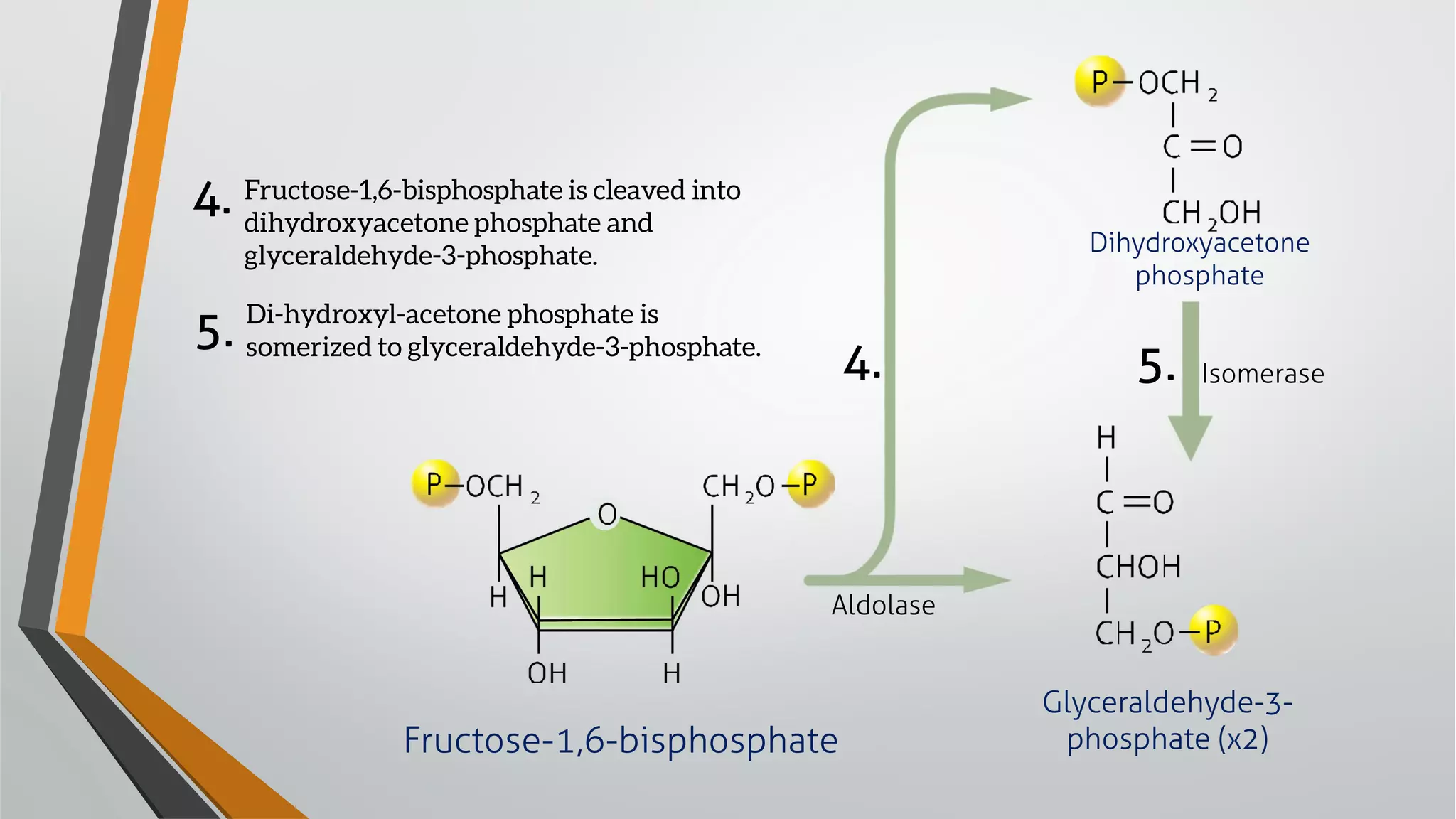
4. Fructose-1,6-bisphosphate is cleaved into
dihydroxyacetone phosphate and

Dihydroxyacetone
phosphate

glyceraldehyde-3-phosphate.

5.

Di-hydroxyl-acetone phosphate is
somerized to glyceraldehyde-3-phosphate.

4.

5.

Isomerase

Aldolase

Fructose-1,6-bisphosphate

Glyceraldehyde-3phosphate (x2)
6.

Glyceraldehyde-3-phosphate is oxidized to 1,3bisphosphoglycerate. NADH is produced. In 1,3-bisphospho-glycerate,the phosphate group in the upper left
is destabilized, meaning that the bond will break in a
highly exergonic reaction.
Unstable Phosphate
Bond
2NADH

2 NAD+

Glyceraldehyde-3phosphate (x2)

+2H+

Glyceraldehyde-3phosphate
dehydrogenase

1,3-bisphosphoglycerate (x2)
7.

A phosphate is removed from 1,3-bis-phospho-glycerate
to form 3-phosphor-glycerate. The removed phosphate is
transferred to ADP to make ATP via substrate-level
phosphorylation.
Unstable Phosphate
Bond

2ATP

2ADP

Phosphoglycero–
kinase
1,3-bisphosphoglycerate (x2)

3-phosphoglycerate(x2)
8.

The phosphate group in 3 phosphoglycerate
is moved to a new location, creating 2phosphoglycerate

Phosphoglycero–
mutase
3-phosphoglycerate(x2)

2-phosphoglycerate(x2)
9.

A water molecule is removed from 2-phosphor-glycerate to
form phosphor-enol-pyruvate. In phosphor-enol-pyruvate,
the phosphate group is destabilized, meaning that the bond
will break in a highly exergonic reaction.
Unstable phosphate
bond

Enolase

2-phosphoglycerate(x2)

Phosphoenolpyruvate(x2)
10.

A phosphate is removed from phosphor-enol-pyruvate
to form pyruvate. The removed phosphate is transferred
to ADP to make ATP via substrate-level phosphorylation.
Unstable phosphate
bond

2ADP

2ATP

Pyruvate Kinase
Phosphoenolpyruvate(x2)

pyruvate(x2)
:p

Thanks God!
It’s over at last!!

Steps of Glycolysis in a brief

  • 1.
  • 2.
    What is Glycolysis Glycolysis(from the Greek glykos, meaning sweet, and lysis, meaning splitting) involves the breakdown of glucose, a simple sugar. This process can occur in the presence or absence of oxygen, that is, under aerobic or anaerobic conditions.
  • 3.
    History of Glycolysis Duringthe 1930s, the efforts of several German biochemists, including Gustav Embden, Otto Meyerhof, and Jacob Parnas, determined that glycolysis involves 10 steps, each one catalyzed by a different enzyme.
  • 4.
  • 5.
    Step 1 Glucose isphosphorylated by ATP. Glucose-6-phosphate is more easily trapped in the cell compared to glucose. ATP ADP Hexokinase Glucose Glucose-6-Phosphate
  • 6.
    Step 2 The structureof glucose-6-phosphate is rearranged to fructose-6-phosphate. Phosphogluco isomerase Glucose-6-Phosphate Fructose-6-phosphate
  • 7.
    Step 3 Fructose-6-phosphate isphosphorylated to make fructose-1,6-bisphosphate. ATP ADP Phosphofructo kinase Fructose-6-phosphate Fructose-1,6-bisphosphate
  • 8.
    4. Fructose-1,6-bisphosphate iscleaved into dihydroxyacetone phosphate and Dihydroxyacetone phosphate glyceraldehyde-3-phosphate. 5. Di-hydroxyl-acetone phosphate is somerized to glyceraldehyde-3-phosphate. 4. 5. Isomerase Aldolase Fructose-1,6-bisphosphate Glyceraldehyde-3phosphate (x2)
  • 9.
    6. Glyceraldehyde-3-phosphate is oxidizedto 1,3bisphosphoglycerate. NADH is produced. In 1,3-bisphospho-glycerate,the phosphate group in the upper left is destabilized, meaning that the bond will break in a highly exergonic reaction. Unstable Phosphate Bond 2NADH 2 NAD+ Glyceraldehyde-3phosphate (x2) +2H+ Glyceraldehyde-3phosphate dehydrogenase 1,3-bisphosphoglycerate (x2)
  • 10.
    7. A phosphate isremoved from 1,3-bis-phospho-glycerate to form 3-phosphor-glycerate. The removed phosphate is transferred to ADP to make ATP via substrate-level phosphorylation. Unstable Phosphate Bond 2ATP 2ADP Phosphoglycero– kinase 1,3-bisphosphoglycerate (x2) 3-phosphoglycerate(x2)
  • 11.
    8. The phosphate groupin 3 phosphoglycerate is moved to a new location, creating 2phosphoglycerate Phosphoglycero– mutase 3-phosphoglycerate(x2) 2-phosphoglycerate(x2)
  • 12.
    9. A water moleculeis removed from 2-phosphor-glycerate to form phosphor-enol-pyruvate. In phosphor-enol-pyruvate, the phosphate group is destabilized, meaning that the bond will break in a highly exergonic reaction. Unstable phosphate bond Enolase 2-phosphoglycerate(x2) Phosphoenolpyruvate(x2)
  • 13.
    10. A phosphate isremoved from phosphor-enol-pyruvate to form pyruvate. The removed phosphate is transferred to ADP to make ATP via substrate-level phosphorylation. Unstable phosphate bond 2ADP 2ATP Pyruvate Kinase Phosphoenolpyruvate(x2) pyruvate(x2)
  • 14.