Downloaded 35 times
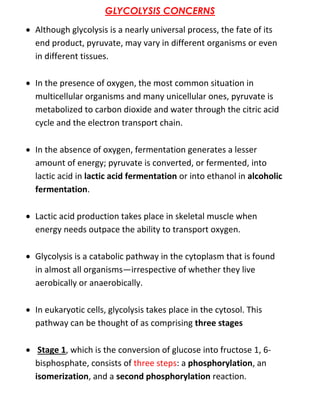
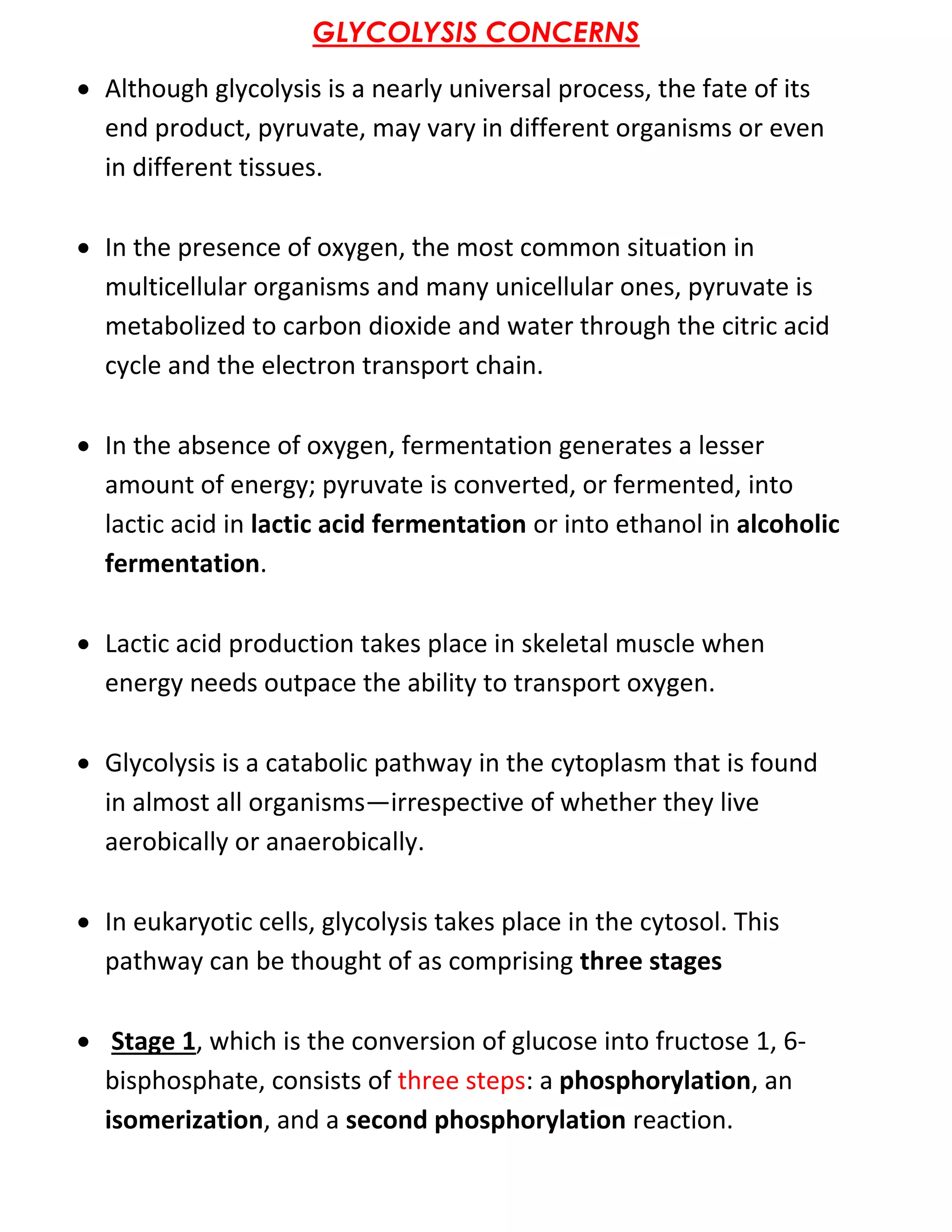
![ The strategy of these initial steps in glycolysis is to trap the
glucose in the cell and form a compound that can be readily
cleaved into phosphorylated three-carbon units.
Stage 2 is the cleavage of the fructose 1,6-bisphosphate into
two three-carbon fragments. These resulting three-carbon units
are readily interconvertible.
In stage 3, ATP is harvested when the three carbon fragments
are oxidized to pyruvate.
Glycolysis involves ten individual steps, including three
isomerizations and four phosphate transfers. The only redox
reaction takes place in step [6].
[1] Glucose, which is taken up by animal cells from the blood
and other sources, is first phosphorylated to glucose 6-
phosphate, with ATP being consumed. The glucose 6-phosphate
is not capable of leaving the cell.
[2] In the next step, glucose 6-phosphate is isomerized into
fructose 6-phosphate.
[3] Using ATP again, another phosphorylation takes place, giving
rise to fructose 1,6-bisphosphate. Phosphofructokinase is the
most important key enzyme in glycolysis.](https://image.slidesharecdn.com/glycolysis-150519183717-lva1-app6891/85/Glycolysis-2-320.jpg)
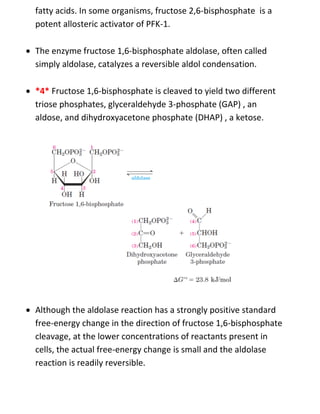
![ [4] Fructose 1,6-bisphosphate is broken down by aldolase into
the C3 compounds glyceraldehyde3-phosphate (also known as
glyceral3-phosphate) and glycerone3-phosphate
(dihydroxyacetone 3-phosphate).
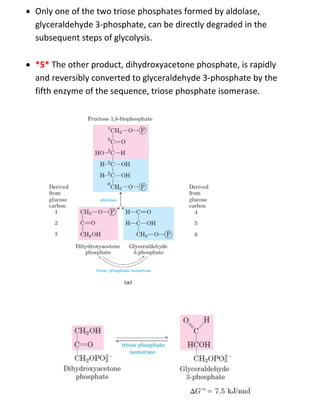
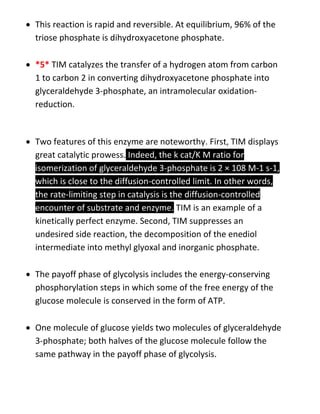
[5] The latter two products are placed in fast equilibrium by
triosephosphate isomerase.
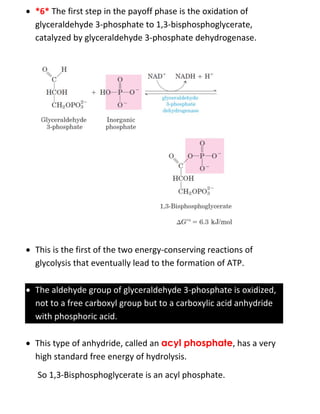
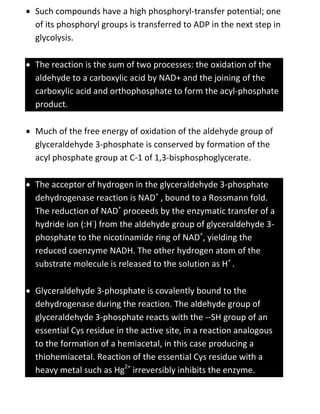
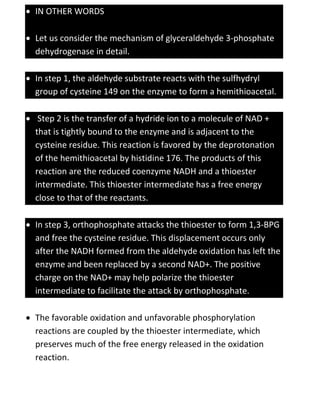
[6] Glyceraldehyde 3-phosphate is now oxidized by
glyceraldehyde-3-phosphate dehydrogenase, with NADH + H
+
being formed. In this reaction, inorganic phosphate is taken up
into the molecule (substrate-level phosphorylation;and 1,3-
bisphosphoglycerate is produced. This intermediate contains a
mixed acid–anhydride bond, the phosphate part of which is at a
high chemical potential.
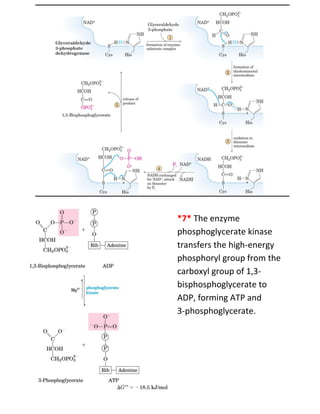
[7] Catalyzed by phosphoglycerate kinase, this phosphate
residue is transferred to ADP, producing 3-phosphoglycerate and
ATP. The ATP balance is thus once again in equilibrium.
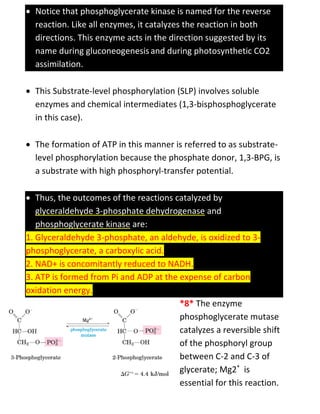
[8] As a result of shifting of the remaining phosphate residue
within the molecule, the isomer 2-phosphoglycerate is formed.
[10] In the last step, pyruvate kinase transfers this residue to
ADP. The remaining enol pyruvate is immediately rearranged
into pyruvate, which is much more stable.](https://image.slidesharecdn.com/glycolysis-150519183717-lva1-app6891/85/Glycolysis-3-320.jpg)
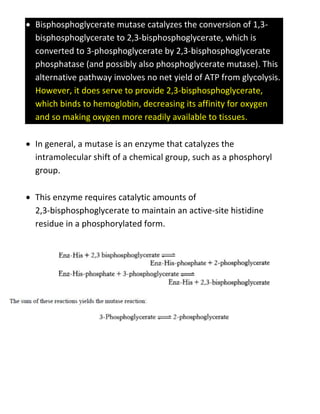
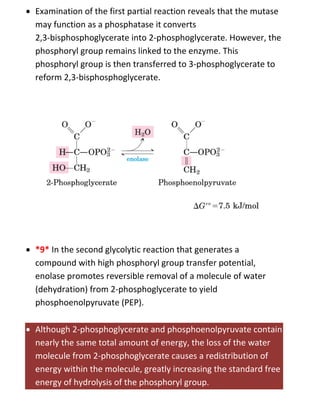
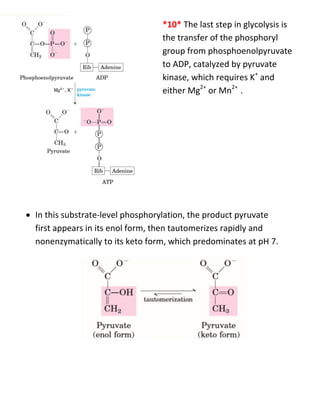
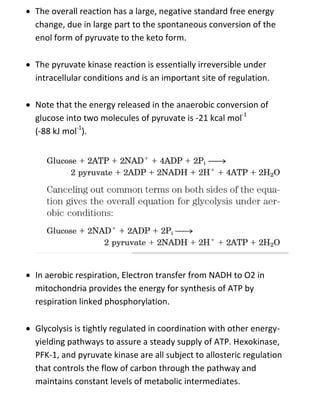

Glycolysis is a universal metabolic pathway that converts glucose into pyruvate, with variable outcomes such as generating carbon dioxide and water in the presence of oxygen or forming lactic acid or ethanol during fermentation. The process consists of three stages: the conversion of glucose to fructose 1,6-bisphosphate, the cleavage into two three-carbon units, and the oxidation to pyruvate, involving ten enzymatic steps. Key regulatory points include the enzyme phosphofructokinase-1, which is crucial for controlling glycolysis based on the cell's energy needs.


![ANIMAL_CELL_,_TISSUE_AND_ORGAN_CULTURE[1].pptx](https://cdn.slidesharecdn.com/ss_thumbnails/animalcelltissueandorganculture1-260204172026-4462b440-thumbnail.jpg?width=640&height=640&fit=bounds)


![Polymer [ बहुलक ] Chemistry Notes PDF - Irfanullah Mehar - JJ Sir Chemistry.pdf](https://cdn.slidesharecdn.com/ss_thumbnails/polymerchemistrynotespdf-irfanullahmehar-jjsirchemistry-260210172118-3f9b37f7-thumbnail.jpg?width=640&height=640&fit=bounds)


