GLYCOLYSIS
Glycolysis comes from a merger of two Greek words:
Glykys = sweet
Lysis = breakdown/ splitting
It is also known as Embden-Meyerhof-Parnas pathway
or EMP pathway.
INTRODUCTION
• GLYCOLYSIS is the sequence of 10 enzyme-catalyzed
reactions that converts glucose into pyruvate with
simultaneous production on of ATP.
• In this oxidative process, 1mol of glucose is partially
oxidised to 2 moles of pyruvate.
• This major pathway of glucose metabolism occurs in
the cytosol of all cell.
• This unique pathway occurs aerobically as well as
anaerobically & doesn’t involve molecular oxygen.
• It also includes formation of Lactate from Pyruvate.
• The glycolytic sequence of reactions differ from
species to species only in the mechanism of its
regulation & in the subsequent metabolic fate of
the pyruvate formed.
• In aerobic organisms, glycolysis is the prelude to
Citric acid cycle and ETC.
• Glycolysis is the central pathway for Glucose
catabolism.
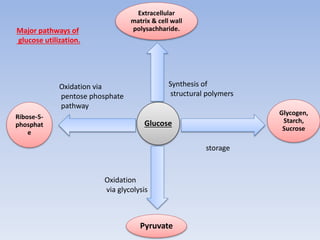
Glucose
Extracellular
matrix & cell wall
polysachharide.
Glycogen,
Starch,
Sucrose
Pyruvate
Ribose-5-
phosphat
e
Oxidation via
pentose phosphate
pathway
Synthesis of
structural polymers
storage
Oxidation
via glycolysis
Major pathways of
glucose utilization.
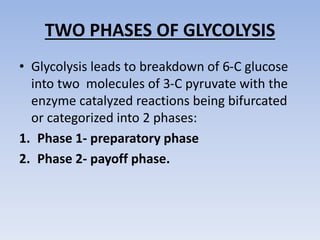
TWO PHASES OF GLYCOLYSIS
• Glycolysis leads to breakdown of 6-C glucose
into two molecules of 3-C pyruvate with the
enzyme catalyzed reactions being bifurcated
or categorized into 2 phases:
1. Phase 1- preparatory phase
2. Phase 2- payoff phase.
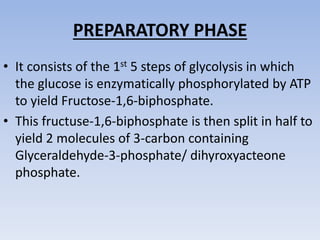
PREPARATORY PHASE
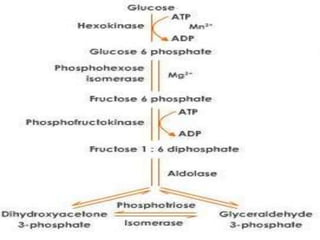
• It consists of the 1st 5 steps of glycolysis in which
the glucose is enzymatically phosphorylated by ATP
to yield Fructose-1,6-biphosphate.
• This fructuse-1,6-biphosphate is then split in half to
yield 2 molecules of 3-carbon containing
Glyceraldehyde-3-phosphate/ dihyroxyacteone
phosphate.
• Thus the first phase results in cleavage of the
hexose chain.
• This cleavage requires an investment of 2 ATP
molecules to activate the glucose mole and prepare
it for its cleavage into 3-carbon compound.
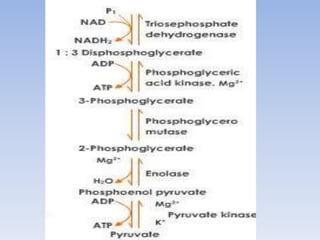
PAYOFF PHASE
• This phase constitutes the last 5 reactions of
Glycolysis.
• This phase marks the release of ATP molecules
during conversion of Glyceraldehyde-3-phosphtae
to 2 moles of Pyruvate.
• Here 4 moles of ADP are phosphorylated to ATP.
Although 4 moles of ATP are formed, the net result
is only 2 moles of ATP per mole of Glucose oxidized,
since 2 moles of ATP are utilized in Phase 1.
STEPWISE EXPLAINATION OF
GLYCOLYSIS
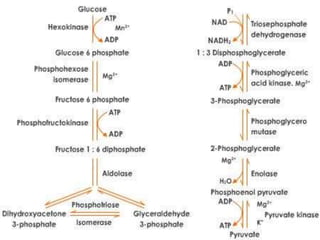
STEP 1: PHOSPHORYLATION
• Glucose is phosphorylated by ATP to form sugar
phosphate.
• This is an irreversible reaction & is catalyzed by
hexokinase.
• Thus the reaction can be represented as follows:
Glucose
Glucose-6-phosphate
Hexokinase
ATP
ADP
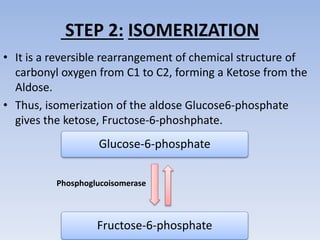
STEP 2: ISOMERIZATION
• It is a reversible rearrangement of chemical structure of
carbonyl oxygen from C1 to C2, forming a Ketose from the
Aldose.
• Thus, isomerization of the aldose Glucose6-phosphate
gives the ketose, Fructose-6-phoshphate.
Glucose-6-phosphate
Fructose-6-phosphate
Phosphoglucoisomerase
STEP 3: PHOPHORYLATION
• Here the Fructose-6-phosphate is phosphorylated
by ATP to fructose-1,6-bisphosphate.
• This is an irreversible reaction and is catalyzed by
phosphofructokinase enzyme.
Fructose-6-phosphate
Fructose-1,6-bisphosphate
ATP
ADP
Phosphofructokinase
STEP 4: BREAKDOWN
• This six carbon sugar is cleaved to produce two 3-C
molecules: glyceradldehyde-3-phosphate (GAP) &
dihydroxyacetone phosphate(DHAP).
• This reaction is catalyzed by Aldolase.
Fructose-1,6-
bisphosphate
Glyceraldehyde-3-
phosphate
Dihydroxyacetone
phosphate
Triose phosphate
isomerase
Aldolase
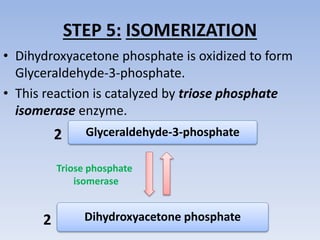
STEP 5: ISOMERIZATION
• Dihydroxyacetone phosphate is oxidized to form
Glyceraldehyde-3-phosphate.
• This reaction is catalyzed by triose phosphate
isomerase enzyme.
Glyceraldehyde-3-phosphate
Dihydroxyacetone phosphate
Triose phosphate
isomerase
2
2
STEP 6
• 2 molecules of Glyceraldehyde-3-phosphate are
oxidized.
• Glyceraldehyde-3-phosphate dehydrogenase
catalyzes the conversion of Glyceraldehyde3-
phosphate into 1,3-bisphosphoglycerate.
Aldehyde Carboxylic acid
Carboxylic
acid
Ortho-
phosphate
Acyl-
phosphate
product
Joining)
Resultant reaction
Glyceraldehyde-3-phosphate
1,3-bisphosphoglycerate
Glyceraldehyde-3-phosphate
dehydrogenase
2NAD⁺ + 2Pi
2NADH + 2H⁺
2
2
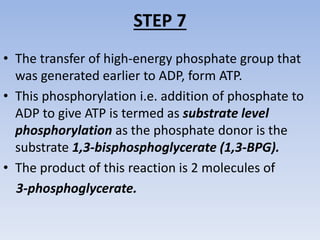
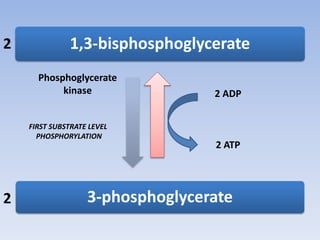
STEP 7
• The transfer of high-energy phosphate group that
was generated earlier to ADP, form ATP.
• This phosphorylation i.e. addition of phosphate to
ADP to give ATP is termed as substrate level
phosphorylation as the phosphate donor is the
substrate 1,3-bisphosphoglycerate (1,3-BPG).
• The product of this reaction is 2 molecules of
3-phosphoglycerate.
1,3-bisphosphoglycerate
3-phosphoglycerate
Phosphoglycerate
kinase 2 ADP
2 ATP
FIRST SUBSTRATE LEVEL
PHOSPHORYLATION
2
2
STEP 8
• The remaining phosphate-ester linkage in 3-
phosphoglycerate, is moved from carbon 3 to
carbon 2 ,because of relatively low free energy of
hydrolysis, to form 2-phosphoglycerate(2-PG).
3-phosphoglycerate
2-phosphoglycerate
Phosphoglycerate
mutase
2
2
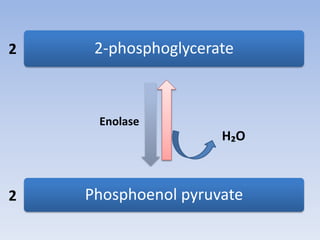
STEP 9: DEHYDRATION OF 2-PG
• This is the second reaction in glycolysis where a
high-energy phosphate compound is formed.
• The 2-phosphoglycerate is dehydrated by the action
of enolase to phosphoenolpyruvate(PEP). This
compound is the phosphate ester of the enol
tautomer of pyruvate.
• This is a reversible reaction.
2-phosphoglycerate
Phosphoenol pyruvate
H₂O
Enolase
2
2
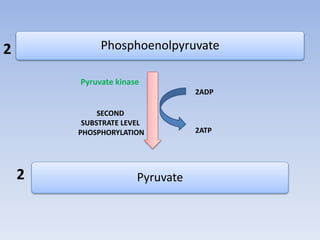
STEP 10: TRANSFER OF PHOSPHATE
FROM PEP to ADP
• This last step is the irreversible transfer of high
energy phosphoryl group from
phosphoenolpuruvate to ADP.
• This reaction is catalyzed by pyruvate kinase.
• This is the 2nd substrate level phosphorylation
reaction in glycolysis which yields ATP.
• This is a non-oxidative phosphorylation reaction.
Phosphoenolpyruvate
Pyruvate
2
2
Pyruvate kinase
SECOND
SUBSTRATE LEVEL
PHOSPHORYLATION
2ADP
2ATP
OVERALL BALANCE SHEET OF
GLYCOLYSIS
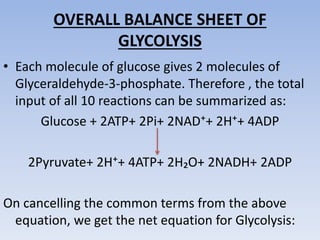
• Each molecule of glucose gives 2 molecules of
Glyceraldehyde-3-phosphate. Therefore , the total
input of all 10 reactions can be summarized as:
Glucose + 2ATP+ 2Pi+ 2NAD⁺+ 2H⁺+ 4ADP
2Pyruvate+ 2H⁺+ 4ATP+ 2H₂O+ 2NADH+ 2ADP
On cancelling the common terms from the above
equation, we get the net equation for Glycolysis:
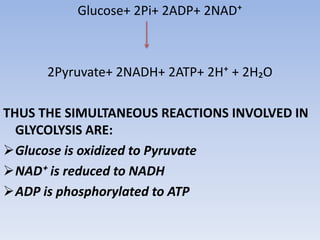
Glucose+ 2Pi+ 2ADP+ 2NAD⁺
2Pyruvate+ 2NADH+ 2ATP+ 2H⁺ + 2H₂O
THUS THE SIMULTANEOUS REACTIONS INVOLVED IN
GLYCOLYSIS ARE:
Glucose is oxidized to Pyruvate
NAD⁺ is reduced to NADH
ADP is phosphorylated to ATP
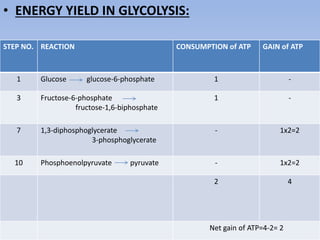
• ENERGY YIELD IN GLYCOLYSIS:
STEP NO. REACTION CONSUMPTION of ATP GAIN of ATP
1 Glucose glucose-6-phosphate 1 -
3 Fructose-6-phosphate
fructose-1,6-biphosphate
1 -
7 1,3-diphosphoglycerate
3-phosphoglycerate
- 1x2=2
10 Phosphoenolpyruvate pyruvate - 1x2=2
2 4
Net gain of ATP=4-2= 2
glycolysis.pdf
glycolysis.pdf
glycolysis.pdf
glycolysis.pdf
glycolysis.pdf
glycolysis.pdf

glycolysis.pdf

  • 2.
    GLYCOLYSIS Glycolysis comes froma merger of two Greek words: Glykys = sweet Lysis = breakdown/ splitting It is also known as Embden-Meyerhof-Parnas pathway or EMP pathway.
  • 3.
    INTRODUCTION • GLYCOLYSIS isthe sequence of 10 enzyme-catalyzed reactions that converts glucose into pyruvate with simultaneous production on of ATP. • In this oxidative process, 1mol of glucose is partially oxidised to 2 moles of pyruvate. • This major pathway of glucose metabolism occurs in the cytosol of all cell. • This unique pathway occurs aerobically as well as anaerobically & doesn’t involve molecular oxygen.
  • 4.
    • It alsoincludes formation of Lactate from Pyruvate. • The glycolytic sequence of reactions differ from species to species only in the mechanism of its regulation & in the subsequent metabolic fate of the pyruvate formed. • In aerobic organisms, glycolysis is the prelude to Citric acid cycle and ETC. • Glycolysis is the central pathway for Glucose catabolism.
  • 5.
    Glucose Extracellular matrix & cellwall polysachharide. Glycogen, Starch, Sucrose Pyruvate Ribose-5- phosphat e Oxidation via pentose phosphate pathway Synthesis of structural polymers storage Oxidation via glycolysis Major pathways of glucose utilization.
  • 7.
    TWO PHASES OFGLYCOLYSIS • Glycolysis leads to breakdown of 6-C glucose into two molecules of 3-C pyruvate with the enzyme catalyzed reactions being bifurcated or categorized into 2 phases: 1. Phase 1- preparatory phase 2. Phase 2- payoff phase.
  • 8.
    PREPARATORY PHASE • Itconsists of the 1st 5 steps of glycolysis in which the glucose is enzymatically phosphorylated by ATP to yield Fructose-1,6-biphosphate. • This fructuse-1,6-biphosphate is then split in half to yield 2 molecules of 3-carbon containing Glyceraldehyde-3-phosphate/ dihyroxyacteone phosphate.
  • 9.
    • Thus thefirst phase results in cleavage of the hexose chain. • This cleavage requires an investment of 2 ATP molecules to activate the glucose mole and prepare it for its cleavage into 3-carbon compound.
  • 11.
    PAYOFF PHASE • Thisphase constitutes the last 5 reactions of Glycolysis. • This phase marks the release of ATP molecules during conversion of Glyceraldehyde-3-phosphtae to 2 moles of Pyruvate. • Here 4 moles of ADP are phosphorylated to ATP. Although 4 moles of ATP are formed, the net result is only 2 moles of ATP per mole of Glucose oxidized, since 2 moles of ATP are utilized in Phase 1.
  • 13.
  • 14.
    STEP 1: PHOSPHORYLATION •Glucose is phosphorylated by ATP to form sugar phosphate. • This is an irreversible reaction & is catalyzed by hexokinase. • Thus the reaction can be represented as follows: Glucose Glucose-6-phosphate Hexokinase ATP ADP
  • 15.
    STEP 2: ISOMERIZATION •It is a reversible rearrangement of chemical structure of carbonyl oxygen from C1 to C2, forming a Ketose from the Aldose. • Thus, isomerization of the aldose Glucose6-phosphate gives the ketose, Fructose-6-phoshphate. Glucose-6-phosphate Fructose-6-phosphate Phosphoglucoisomerase
  • 16.
    STEP 3: PHOPHORYLATION •Here the Fructose-6-phosphate is phosphorylated by ATP to fructose-1,6-bisphosphate. • This is an irreversible reaction and is catalyzed by phosphofructokinase enzyme. Fructose-6-phosphate Fructose-1,6-bisphosphate ATP ADP Phosphofructokinase
  • 17.
    STEP 4: BREAKDOWN •This six carbon sugar is cleaved to produce two 3-C molecules: glyceradldehyde-3-phosphate (GAP) & dihydroxyacetone phosphate(DHAP). • This reaction is catalyzed by Aldolase. Fructose-1,6- bisphosphate Glyceraldehyde-3- phosphate Dihydroxyacetone phosphate Triose phosphate isomerase Aldolase
  • 18.
    STEP 5: ISOMERIZATION •Dihydroxyacetone phosphate is oxidized to form Glyceraldehyde-3-phosphate. • This reaction is catalyzed by triose phosphate isomerase enzyme. Glyceraldehyde-3-phosphate Dihydroxyacetone phosphate Triose phosphate isomerase 2 2
  • 19.
    STEP 6 • 2molecules of Glyceraldehyde-3-phosphate are oxidized. • Glyceraldehyde-3-phosphate dehydrogenase catalyzes the conversion of Glyceraldehyde3- phosphate into 1,3-bisphosphoglycerate. Aldehyde Carboxylic acid Carboxylic acid Ortho- phosphate Acyl- phosphate product Joining)
  • 20.
  • 21.
    STEP 7 • Thetransfer of high-energy phosphate group that was generated earlier to ADP, form ATP. • This phosphorylation i.e. addition of phosphate to ADP to give ATP is termed as substrate level phosphorylation as the phosphate donor is the substrate 1,3-bisphosphoglycerate (1,3-BPG). • The product of this reaction is 2 molecules of 3-phosphoglycerate.
  • 22.
  • 23.
    STEP 8 • Theremaining phosphate-ester linkage in 3- phosphoglycerate, is moved from carbon 3 to carbon 2 ,because of relatively low free energy of hydrolysis, to form 2-phosphoglycerate(2-PG). 3-phosphoglycerate 2-phosphoglycerate Phosphoglycerate mutase 2 2
  • 24.
    STEP 9: DEHYDRATIONOF 2-PG • This is the second reaction in glycolysis where a high-energy phosphate compound is formed. • The 2-phosphoglycerate is dehydrated by the action of enolase to phosphoenolpyruvate(PEP). This compound is the phosphate ester of the enol tautomer of pyruvate. • This is a reversible reaction.
  • 25.
  • 26.
    STEP 10: TRANSFEROF PHOSPHATE FROM PEP to ADP • This last step is the irreversible transfer of high energy phosphoryl group from phosphoenolpuruvate to ADP. • This reaction is catalyzed by pyruvate kinase. • This is the 2nd substrate level phosphorylation reaction in glycolysis which yields ATP. • This is a non-oxidative phosphorylation reaction.
  • 27.
  • 28.
    OVERALL BALANCE SHEETOF GLYCOLYSIS • Each molecule of glucose gives 2 molecules of Glyceraldehyde-3-phosphate. Therefore , the total input of all 10 reactions can be summarized as: Glucose + 2ATP+ 2Pi+ 2NAD⁺+ 2H⁺+ 4ADP 2Pyruvate+ 2H⁺+ 4ATP+ 2H₂O+ 2NADH+ 2ADP On cancelling the common terms from the above equation, we get the net equation for Glycolysis:
  • 29.
    Glucose+ 2Pi+ 2ADP+2NAD⁺ 2Pyruvate+ 2NADH+ 2ATP+ 2H⁺ + 2H₂O THUS THE SIMULTANEOUS REACTIONS INVOLVED IN GLYCOLYSIS ARE: Glucose is oxidized to Pyruvate NAD⁺ is reduced to NADH ADP is phosphorylated to ATP
  • 30.
    • ENERGY YIELDIN GLYCOLYSIS: STEP NO. REACTION CONSUMPTION of ATP GAIN of ATP 1 Glucose glucose-6-phosphate 1 - 3 Fructose-6-phosphate fructose-1,6-biphosphate 1 - 7 1,3-diphosphoglycerate 3-phosphoglycerate - 1x2=2 10 Phosphoenolpyruvate pyruvate - 1x2=2 2 4 Net gain of ATP=4-2= 2