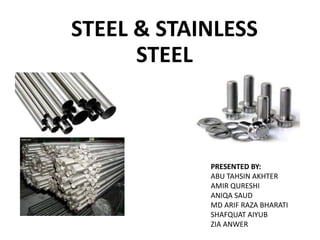


STEEL & STAINLESS
STEEL
PRESENTED BY:
ABU TAHSIN AKHTER
AMIR QURESHI
ANIQA SAUD
MD ARIF RAZA BHARATI
SHAFQUAT AIYUB
ZIA ANWER
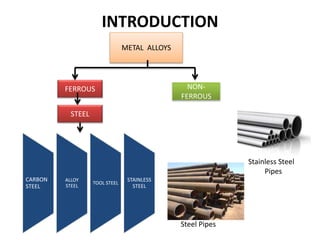
INTRODUCTION
METAL ALLOYS
FERROUS NON-
FERROUS
CARBON
STEEL
ALLOY
STEEL
TOOL STEEL
STAINLESS
STEEL
STEEL
Steel Pipes
Stainless Steel
Pipes
STEEL
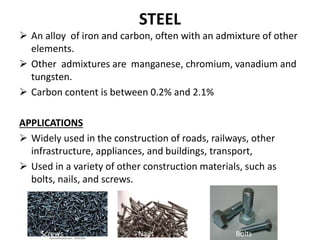
 An alloy of iron and carbon, often with an admixture of other
elements.
 Other admixtures are manganese, chromium, vanadium and
tungsten.
 Carbon content is between 0.2% and 2.1%
APPLICATIONS
 Widely used in the construction of roads, railways, other
infrastructure, appliances, and buildings, transport,
 Used in a variety of other construction materials, such as
bolts, nails, and screws.
Screwss Nails Bolts
 Light in weight, but offers great strength.
 It is durable & malleable.
 It is ductile, can be moulded easily to form any desired shape.
 It starts to corrode, on being exposed to moisture and water.
 It is a good conductor of electricity.
PHYSICAL PROPERTIES
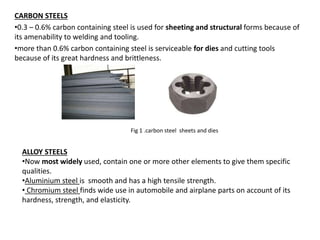
CARBON STEELS
•0.3 – 0.6% carbon containing steel is used for sheeting and structural forms because of
its amenability to welding and tooling.
•more than 0.6% carbon containing steel is serviceable for dies and cutting tools
because of its great hardness and brittleness.
ALLOY STEELS
•Now most widely used, contain one or more other elements to give them specific
qualities.
•Aluminium steel is smooth and has a high tensile strength.
• Chromium steel finds wide use in automobile and airplane parts on account of its
hardness, strength, and elasticity.
Fig 1 .carbon steel sheets and dies
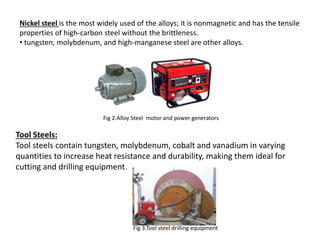
Nickel steel is the most widely used of the alloys; it is nonmagnetic and has the tensile
properties of high-carbon steel without the brittleness.
• tungsten, molybdenum, and high-manganese steel are other alloys.
Fig 2.Alloy Steel motor and power generators
Tool Steels:
Tool steels contain tungsten, molybdenum, cobalt and vanadium in varying
quantities to increase heat resistance and durability, making them ideal for
cutting and drilling equipment.
Fig 3.Tool steel drilling equipment
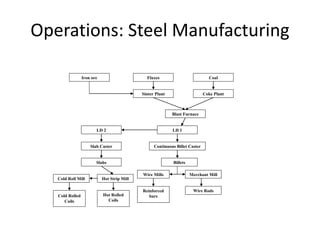
Operations: Steel Manufacturing
Iron ore Fluxes Coal
LD 2
Sinter Plant Coke Plant
Blast Furnace
LD 1
Continuous Billet CasterSlab Caster
Billets
Wire Mills Merchant Mill
Slabs
Wire RodsReinforced
bars
Cold Roll Mill Hot Strip Mill
Cold Rolled
Coils
Hot Rolled
Coils
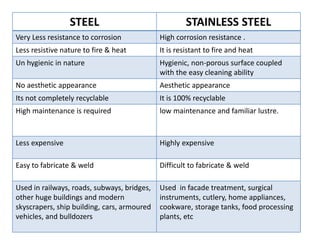
STEEL STAINLESS STEEL
Very Less resistance to corrosion High corrosion resistance .
Less resistive nature to fire & heat It is resistant to fire and heat
Un hygienic in nature Hygienic, non-porous surface coupled
with the easy cleaning ability
No aesthetic appearance Aesthetic appearance
Its not completely recyclable It is 100% recyclable
High maintenance is required low maintenance and familiar lustre.
Less expensive Highly expensive
Easy to fabricate & weld Difficult to fabricate & weld
Used in railways, roads, subways, bridges,
other huge buildings and modern
skyscrapers, ship building, cars, armoured
vehicles, and bulldozers
Used in facade treatment, surgical
instruments, cutlery, home appliances,
cookware, storage tanks, food processing
plants, etc
STAINLESS STEEL
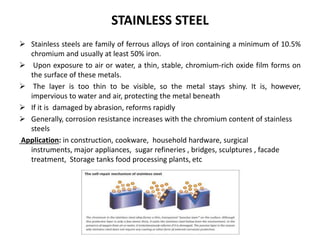
 Stainless steels are family of ferrous alloys of iron containing a minimum of 10.5%
chromium and usually at least 50% iron.
 Upon exposure to air or water, a thin, stable, chromium-rich oxide film forms on
the surface of these metals.
 The layer is too thin to be visible, so the metal stays shiny. It is, however,
impervious to water and air, protecting the metal beneath
 If it is damaged by abrasion, reforms rapidly
 Generally, corrosion resistance increases with the chromium content of stainless
steels
Application: in construction, cookware, household hardware, surgical
instruments, major appliances, sugar refineries , bridges, sculptures , facade
treatment, Storage tanks food processing plants, etc
Chromium: Forms a protective layer
Nickel: content beyond 8-9% further improves both corrosion resistance
(especially in acid environments) and workability
Molybdenum: is added to improve high temperature strength.
Nitrogen: increases strength and enhances resistance to localised corrosion.
Copper: increases general corrosion resistance to acids
Carbon: enhances hardenablity
Silicon: improves resistance to oxidation and is also used in special stainless steels
PHYSICAL PROPERTIES
 It is ductile , malleable & durable.
 Excellent resistance to corrosion
 Excellent fire resistance with critical temperature above
1500OC.
 Easy to clean and suitable for hygienic uses.
 Totally recyclable.
 High tensile strength.
 Retention of strength at elevated temperature.
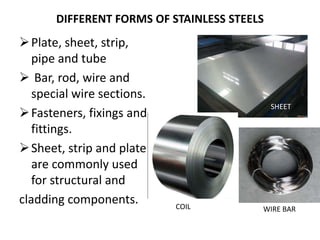
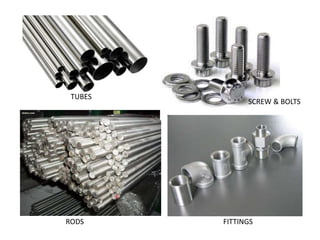
DIFFERENT FORMS OF STAINLESS STEELS
Plate, sheet, strip,
pipe and tube
 Bar, rod, wire and
special wire sections.
Fasteners, fixings and
fittings.
Sheet, strip and plate
are commonly used
for structural and
cladding components.
SHEET
COIL WIRE BAR
TUBES
SCREW & BOLTS
RODS FITTINGS
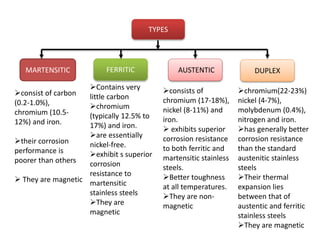
TYPES
FERRITICMARTENSITIC AUSTENTIC DUPLEX
Contains very
little carbon
chromium
(typically 12.5% to
17%) and iron.
are essentially
nickel-free.
exhibit s superior
corrosion
resistance to
martensitic
stainless steels
They are
magnetic
consist of carbon
(0.2-1.0%),
chromium (10.5-
12%) and iron.
their corrosion
performance is
poorer than others
 They are magnetic
consists of
chromium (17-18%),
nickel (8-11%) and
iron.
 exhibits superior
corrosion resistance
to both ferritic and
martensitic stainless
steels.
Better toughness
at all temperatures.
They are non-
magnetic
chromium(22-23%)
nickel (4-7%),
molybdenum (0.4%),
nitrogen and iron.
has generally better
corrosion resistance
than the standard
austenitic stainless
steels
Their thermal
expansion lies
between that of
austentic and ferritic
stainless steels
They are magnetic
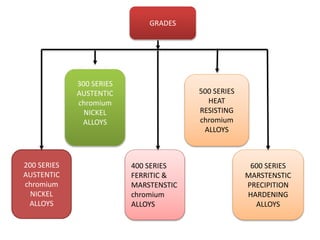
GRADES
300 SERIES
AUSTENTIC
chromium
NICKEL
ALLOYS
200 SERIES
AUSTENTIC
chromium
NICKEL
ALLOYS
400 SERIES
FERRITIC &
MARSTENSTIC
chromium
ALLOYS
600 SERIES
MARSTENSTIC
PRECIPITION
HARDENING
ALLOYS
500 SERIES
HEAT
RESISTING
chromium
ALLOYS
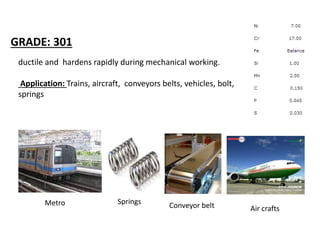
GRADE: 301
Metro Springs Conveyor belt Air crafts
ductile and hardens rapidly during mechanical working.
Application: Trains, aircraft, conveyors belts, vehicles, bolt,
springs
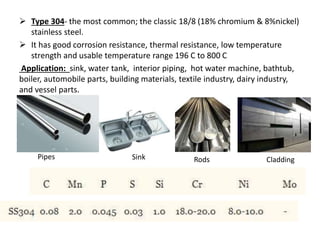
 Type 304- the most common; the classic 18/8 (18% chromium & 8%nickel)
stainless steel.
 It has good corrosion resistance, thermal resistance, low temperature
strength and usable temperature range 196 C to 800 C
Application: sink, water tank, interior piping, hot water machine, bathtub,
boiler, automobile parts, building materials, textile industry, dairy industry,
and vessel parts.
Pipes Sink Rods Cladding
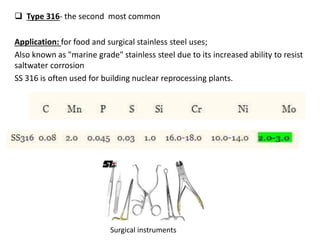
 Type 316- the second most common
Application: for food and surgical stainless steel uses;
Also known as "marine grade" stainless steel due to its increased ability to resist
saltwater corrosion
SS 316 is often used for building nuclear reprocessing plants.
Surgical instruments
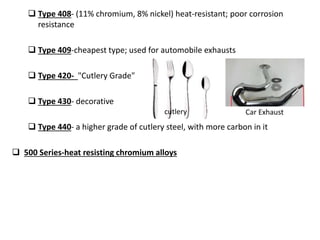
 Type 408- (11% chromium, 8% nickel) heat-resistant; poor corrosion
resistance
 Type 409-cheapest type; used for automobile exhausts
 Type 420- "Cutlery Grade"
 Type 430- decorative
 Type 440- a higher grade of cutlery steel, with more carbon in it
 500 Series-heat resisting chromium alloys
cutlery Car Exhaust
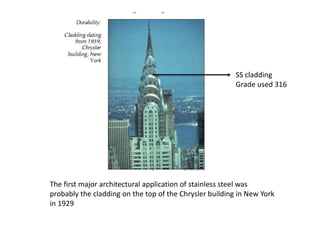
The first major architectural application of stainless steel was
probably the cladding on the top of the Chrysler building in New York
in 1929
SS cladding
Grade used 316
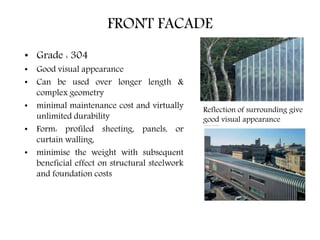
FRONT FACADE
• Grade : 304
• Good visual appearance
• Can be used over longer length &
complex geometry
• minimal maintenance cost and virtually
unlimited durability
• Form: profiled sheeting, panels, or
curtain walling,
• minimise the weight with subsequent
beneficial effect on structural steelwork
and foundation costs
Reflection of surrounding give
good visual appearance
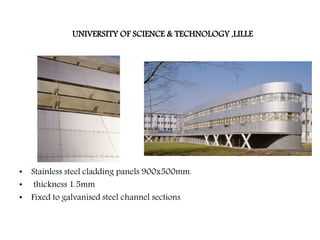
UNIVERSITY OF SCIENCE & TECHNOLOGY ,LILLE
• Stainless steel cladding panels 900x500mm.
• thickness 1.5mm
• Fixed to galvanised steel channel sections
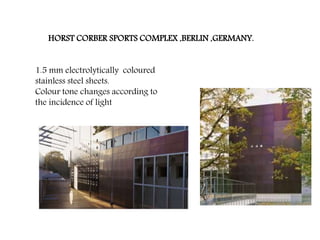
HORST CORBER SPORTS COMPLEX ,BERLIN ,GERMANY.
1.5 mm electrolytically coloured
stainless steel sheets.
Colour tone changes according to
the incidence of light
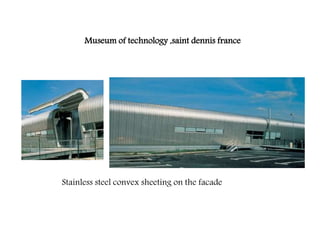
Museum of technology ,saint dennis france
Stainless steel convex sheeting on the facade
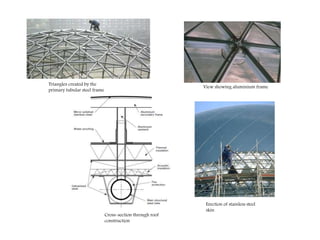
LA GEODE, PARIS, FRANCE
The cladding is a mosaic of 6433 doubly-curved triangular plates in
grade 1.4401 (316) stainless steel. The plates are 1.5 mm thick and
1.2 m along their edges.
Cross-section through roof
construction
Triangles created by the
primary tubular steel frame
View showing aluminium frame
Erection of stainless steel
skin
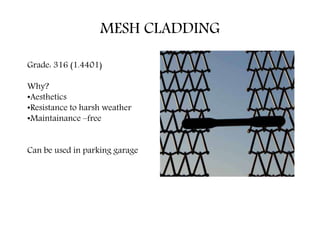
MESH CLADDING
Grade: 316 (1.4401)
Why?
•Aesthetics
•Resistance to harsh weather
•Maintainance –free
Can be used in parking garage
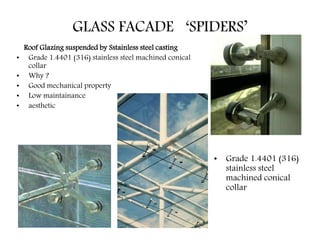
GLASS FACADE ‘SPIDERS’
Roof Glazing suspended by Sstainless steel casting
• Grade 1.4401 (316) stainless steel machined conical
collar
• Why ?
• Good mechanical property
• Low maintainance
• aesthetic
• Grade 1.4401 (316)
stainless steel
machined conical
collar
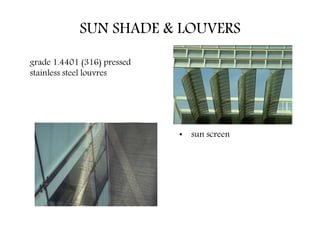
SUN SHADE & LOUVERS
• sun screen
grade 1.4401 (316) pressed
stainless steel louvres
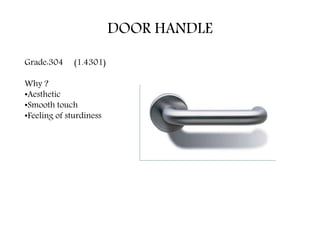
DOOR HANDLE
Grade:304 (1.4301)
Why ?
•Aesthetic
•Smooth touch
•Feeling of sturdiness
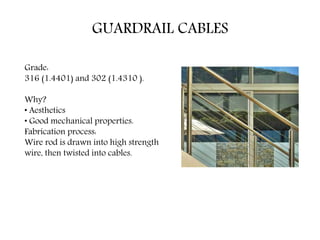
GUARDRAIL CABLES
Grade:
316 (1.4401) and 302 (1.4310 ).
Why?
• Aesthetics
• Good mechanical properties.
Fabrication process:
Wire rod is drawn into high strength
wire, then twisted into cables.
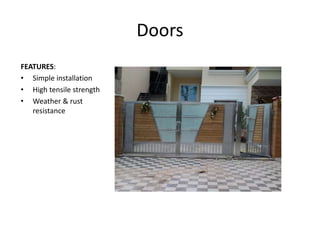
Doors
FEATURES:
• Simple installation
• High tensile strength
• Weather & rust
resistance
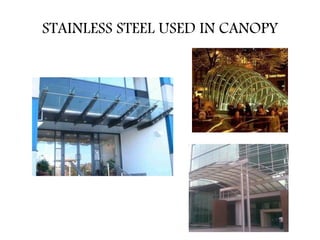
STAINLESS STEEL USED IN CANOPY
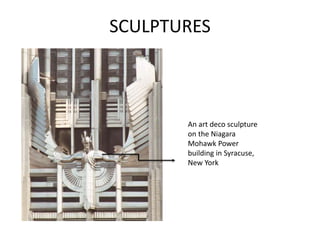
SCULPTURES
An art deco sculpture
on the Niagara
Mohawk Power
building in Syracuse,
New York
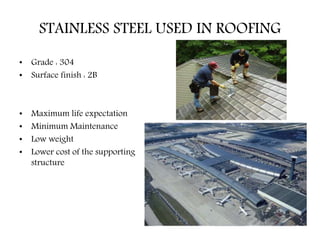
STAINLESS STEEL USED IN ROOFING
• Grade : 304
• Surface finish : 2B
• Maximum life expectation
• Minimum Maintenance
• Low weight
• Lower cost of the supporting
structure
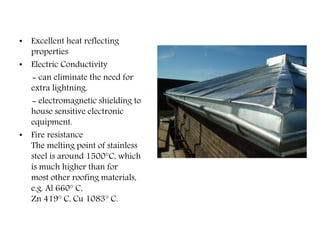
• Excellent heat reflecting
properties
• Electric Conductivity
- can eliminate the need for
extra lightning.
- electromagnetic shielding to
house sensitive electronic
equipment.
• Fire resistance
The melting point of stainless
steel is around 1500°C, which
is much higher than for
most other roofing materials,
e.g. Al 660° C,
Zn 419° C, Cu 1083° C.
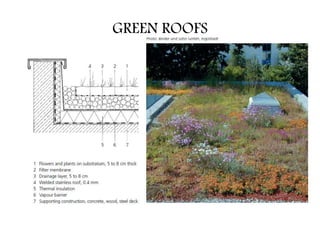
GREEN ROOFS
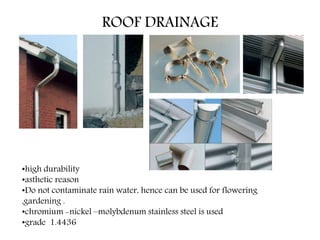
ROOF DRAINAGE
•high durability
•asthetic reason
•Do not contaminate rain water, hence can be used for flowering
,gardening .
•chromium -nickel –molybdenum stainless steel is used
•grade 1.4436
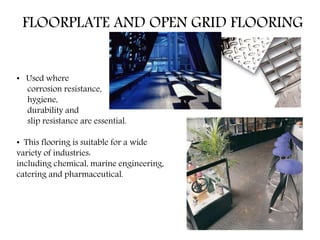
FLOORPLATE AND OPEN GRID FLOORING
• Used where
corrosion resistance,
hygiene,
durability and
slip resistance are essential.
• This flooring is suitable for a wide
variety of industries:
including chemical, marine engineering,
catering and pharmaceutical.
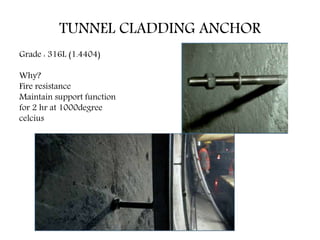
TUNNEL CLADDING ANCHOR
Grade : 316L (1.4404)
Why?
Fire resistance
Maintain support function
for 2 hr at 1000degree
celcius
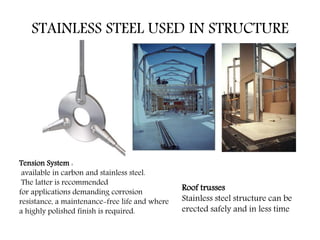
STAINLESS STEEL USED IN STRUCTURE
Tension System :
available in carbon and stainless steel.
The latter is recommended
for applications demanding corrosion
resistance, a maintenance-free life and where
a highly polished finish is required.
Roof trusses
Stainless steel structure can be
erected safely and in less time
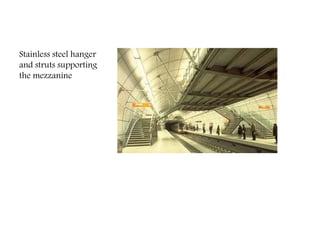
Stainless steel hanger
and struts supporting
the mezzanine
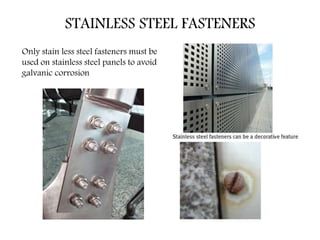
STAINLESS STEEL FASTENERS
Only stain less steel fasteners must be
used on stainless steel panels to avoid
galvanic corrosion
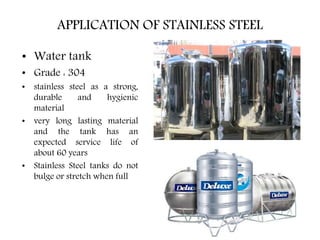
• Water tank
• Grade : 304
• stainless steel as a strong,
durable and hygienic
material
• very long lasting material
and the tank has an
expected service life of
about 60 years
• Stainless Steel tanks do not
bulge or stretch when full
APPLICATION OF STAINLESS STEEL
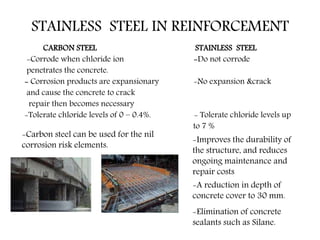
CARBON STEEL STAINLESS STEEL
-Corrode when chloride ion -Do not corrode
penetrates the concrete.
- Corrosion products are expansionary -No expansion &crack
and cause the concrete to crack
repair then becomes necessary
-Tolerate chloride levels of 0 – 0.4%. - Tolerate chloride levels up
to 7 %
STAINLESS STEEL IN REINFORCEMENT
-Improves the durability of
the structure, and reduces
ongoing maintenance and
repair costs
-A reduction in depth of
concrete cover to 30 mm.
-Carbon steel can be used for the nil
corrosion risk elements.
-Elimination of concrete
sealants such as Silane.
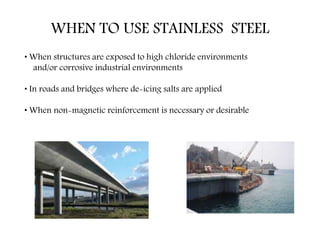
WHEN TO USE STAINLESS STEEL
• When structures are exposed to high chloride environments
and/or corrosive industrial environments
• In roads and bridges where de-icing salts are applied
• When non-magnetic reinforcement is necessary or desirable
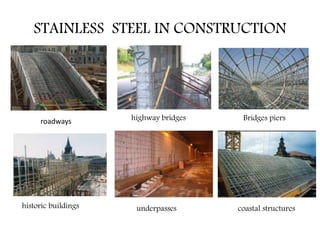
STAINLESS STEEL IN CONSTRUCTION
coastal structureshistoric buildings underpasses
highway bridgesroadways Bridges piers
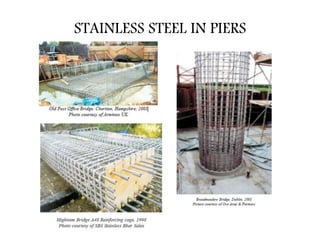
STAINLESS STEEL IN PIERS
CASE STUDY
•High energy-absorption at impact
•A greater level of fire-resistance
•Less likely than carbon steel to be weakened
by corrosion.
•To create railcars increases the sustainability
lightweight yet durable profile of the rail
industry
BENEFITS: IN METRO
Fig 4 .Delhi Metro
railcars of stainless steel
Poles
seats
Escalators
& lifts
Fig 6. inside railcarFig 5. inside metro station
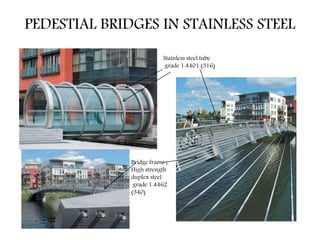
PEDESTIAL BRIDGES IN STAINLESS STEEL
Stainless steel tube
grade 1.4401 (316)
Bridge frame ;
High strength
duplex steel
grade 1.4462
(340)
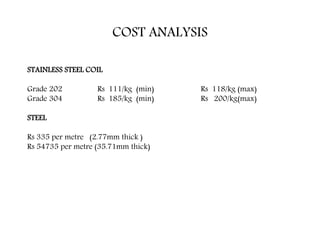
COST ANALYSIS
STAINLESS STEEL COIL
Grade 202 Rs 111/kg (min) Rs 118/kg (max)
Grade 304 Rs 185/kg (min) Rs 200/kg(max)
STEEL
Rs 335 per metre (2.77mm thick )
Rs 54735 per metre (35.71mm thick)
BIBLIOGRAPHY
 Book:- Engineering materials by Rangwala
 Internet sources:
 http://www.lenntech.com/stainless-steel.htm#ixzz2IK1uvqUD
 http://crimsafe.com.au/304-stainless-steel-vs-316-stainless-steel
 http://www.azom.com/article.aspx?ArticleID=965
 http://www.falcon-metals.com/stainlessandalloys/stainlesssteel/meta-
physical-properties-stainless-steel.htm
 http://en.wikipedia.org/wiki/Stainless_steel
 http://www.differencebetween.com/difference-between-steel-and-
stainless-steel/
 http://www.engineeringtoolbox.com/compositions-steel-d_1494.html
 http://www.engineersedge.com/stainless_steel.htm

Steel final

  • 1.
    STEEL & STAINLESS STEEL PRESENTEDBY: ABU TAHSIN AKHTER AMIR QURESHI ANIQA SAUD MD ARIF RAZA BHARATI SHAFQUAT AIYUB ZIA ANWER
  • 2.
    INTRODUCTION METAL ALLOYS FERROUS NON- FERROUS CARBON STEEL ALLOY STEEL TOOLSTEEL STAINLESS STEEL STEEL Steel Pipes Stainless Steel Pipes
  • 3.
    STEEL  An alloyof iron and carbon, often with an admixture of other elements.  Other admixtures are manganese, chromium, vanadium and tungsten.  Carbon content is between 0.2% and 2.1% APPLICATIONS  Widely used in the construction of roads, railways, other infrastructure, appliances, and buildings, transport,  Used in a variety of other construction materials, such as bolts, nails, and screws. Screwss Nails Bolts
  • 4.
     Light inweight, but offers great strength.  It is durable & malleable.  It is ductile, can be moulded easily to form any desired shape.  It starts to corrode, on being exposed to moisture and water.  It is a good conductor of electricity. PHYSICAL PROPERTIES
  • 5.
    CARBON STEELS •0.3 –0.6% carbon containing steel is used for sheeting and structural forms because of its amenability to welding and tooling. •more than 0.6% carbon containing steel is serviceable for dies and cutting tools because of its great hardness and brittleness. ALLOY STEELS •Now most widely used, contain one or more other elements to give them specific qualities. •Aluminium steel is smooth and has a high tensile strength. • Chromium steel finds wide use in automobile and airplane parts on account of its hardness, strength, and elasticity. Fig 1 .carbon steel sheets and dies
  • 6.
    Nickel steel isthe most widely used of the alloys; it is nonmagnetic and has the tensile properties of high-carbon steel without the brittleness. • tungsten, molybdenum, and high-manganese steel are other alloys. Fig 2.Alloy Steel motor and power generators Tool Steels: Tool steels contain tungsten, molybdenum, cobalt and vanadium in varying quantities to increase heat resistance and durability, making them ideal for cutting and drilling equipment. Fig 3.Tool steel drilling equipment
  • 7.
    Operations: Steel Manufacturing Ironore Fluxes Coal LD 2 Sinter Plant Coke Plant Blast Furnace LD 1 Continuous Billet CasterSlab Caster Billets Wire Mills Merchant Mill Slabs Wire RodsReinforced bars Cold Roll Mill Hot Strip Mill Cold Rolled Coils Hot Rolled Coils
  • 8.
    STEEL STAINLESS STEEL VeryLess resistance to corrosion High corrosion resistance . Less resistive nature to fire & heat It is resistant to fire and heat Un hygienic in nature Hygienic, non-porous surface coupled with the easy cleaning ability No aesthetic appearance Aesthetic appearance Its not completely recyclable It is 100% recyclable High maintenance is required low maintenance and familiar lustre. Less expensive Highly expensive Easy to fabricate & weld Difficult to fabricate & weld Used in railways, roads, subways, bridges, other huge buildings and modern skyscrapers, ship building, cars, armoured vehicles, and bulldozers Used in facade treatment, surgical instruments, cutlery, home appliances, cookware, storage tanks, food processing plants, etc
  • 9.
    STAINLESS STEEL  Stainlesssteels are family of ferrous alloys of iron containing a minimum of 10.5% chromium and usually at least 50% iron.  Upon exposure to air or water, a thin, stable, chromium-rich oxide film forms on the surface of these metals.  The layer is too thin to be visible, so the metal stays shiny. It is, however, impervious to water and air, protecting the metal beneath  If it is damaged by abrasion, reforms rapidly  Generally, corrosion resistance increases with the chromium content of stainless steels Application: in construction, cookware, household hardware, surgical instruments, major appliances, sugar refineries , bridges, sculptures , facade treatment, Storage tanks food processing plants, etc
  • 10.
    Chromium: Forms aprotective layer Nickel: content beyond 8-9% further improves both corrosion resistance (especially in acid environments) and workability Molybdenum: is added to improve high temperature strength. Nitrogen: increases strength and enhances resistance to localised corrosion. Copper: increases general corrosion resistance to acids Carbon: enhances hardenablity Silicon: improves resistance to oxidation and is also used in special stainless steels
  • 11.
    PHYSICAL PROPERTIES  Itis ductile , malleable & durable.  Excellent resistance to corrosion  Excellent fire resistance with critical temperature above 1500OC.  Easy to clean and suitable for hygienic uses.  Totally recyclable.  High tensile strength.  Retention of strength at elevated temperature.
  • 12.
    DIFFERENT FORMS OFSTAINLESS STEELS Plate, sheet, strip, pipe and tube  Bar, rod, wire and special wire sections. Fasteners, fixings and fittings. Sheet, strip and plate are commonly used for structural and cladding components. SHEET COIL WIRE BAR
  • 13.
  • 14.
    TYPES FERRITICMARTENSITIC AUSTENTIC DUPLEX Containsvery little carbon chromium (typically 12.5% to 17%) and iron. are essentially nickel-free. exhibit s superior corrosion resistance to martensitic stainless steels They are magnetic consist of carbon (0.2-1.0%), chromium (10.5- 12%) and iron. their corrosion performance is poorer than others  They are magnetic consists of chromium (17-18%), nickel (8-11%) and iron.  exhibits superior corrosion resistance to both ferritic and martensitic stainless steels. Better toughness at all temperatures. They are non- magnetic chromium(22-23%) nickel (4-7%), molybdenum (0.4%), nitrogen and iron. has generally better corrosion resistance than the standard austenitic stainless steels Their thermal expansion lies between that of austentic and ferritic stainless steels They are magnetic
  • 15.
    GRADES 300 SERIES AUSTENTIC chromium NICKEL ALLOYS 200 SERIES AUSTENTIC chromium NICKEL ALLOYS 400SERIES FERRITIC & MARSTENSTIC chromium ALLOYS 600 SERIES MARSTENSTIC PRECIPITION HARDENING ALLOYS 500 SERIES HEAT RESISTING chromium ALLOYS
  • 16.
    GRADE: 301 Metro SpringsConveyor belt Air crafts ductile and hardens rapidly during mechanical working. Application: Trains, aircraft, conveyors belts, vehicles, bolt, springs
  • 17.
     Type 304-the most common; the classic 18/8 (18% chromium & 8%nickel) stainless steel.  It has good corrosion resistance, thermal resistance, low temperature strength and usable temperature range 196 C to 800 C Application: sink, water tank, interior piping, hot water machine, bathtub, boiler, automobile parts, building materials, textile industry, dairy industry, and vessel parts. Pipes Sink Rods Cladding
  • 18.
     Type 316-the second most common Application: for food and surgical stainless steel uses; Also known as "marine grade" stainless steel due to its increased ability to resist saltwater corrosion SS 316 is often used for building nuclear reprocessing plants. Surgical instruments
  • 19.
     Type 408-(11% chromium, 8% nickel) heat-resistant; poor corrosion resistance  Type 409-cheapest type; used for automobile exhausts  Type 420- "Cutlery Grade"  Type 430- decorative  Type 440- a higher grade of cutlery steel, with more carbon in it  500 Series-heat resisting chromium alloys cutlery Car Exhaust
  • 20.
    The first majorarchitectural application of stainless steel was probably the cladding on the top of the Chrysler building in New York in 1929 SS cladding Grade used 316
  • 21.
    FRONT FACADE • Grade: 304 • Good visual appearance • Can be used over longer length & complex geometry • minimal maintenance cost and virtually unlimited durability • Form: profiled sheeting, panels, or curtain walling, • minimise the weight with subsequent beneficial effect on structural steelwork and foundation costs Reflection of surrounding give good visual appearance
  • 22.
    UNIVERSITY OF SCIENCE& TECHNOLOGY ,LILLE • Stainless steel cladding panels 900x500mm. • thickness 1.5mm • Fixed to galvanised steel channel sections
  • 23.
    HORST CORBER SPORTSCOMPLEX ,BERLIN ,GERMANY. 1.5 mm electrolytically coloured stainless steel sheets. Colour tone changes according to the incidence of light
  • 24.
    Museum of technology,saint dennis france Stainless steel convex sheeting on the facade
  • 25.
    LA GEODE, PARIS,FRANCE The cladding is a mosaic of 6433 doubly-curved triangular plates in grade 1.4401 (316) stainless steel. The plates are 1.5 mm thick and 1.2 m along their edges.
  • 26.
    Cross-section through roof construction Trianglescreated by the primary tubular steel frame View showing aluminium frame Erection of stainless steel skin
  • 27.
    MESH CLADDING Grade: 316(1.4401) Why? •Aesthetics •Resistance to harsh weather •Maintainance –free Can be used in parking garage
  • 28.
    GLASS FACADE ‘SPIDERS’ RoofGlazing suspended by Sstainless steel casting • Grade 1.4401 (316) stainless steel machined conical collar • Why ? • Good mechanical property • Low maintainance • aesthetic • Grade 1.4401 (316) stainless steel machined conical collar
  • 29.
    SUN SHADE &LOUVERS • sun screen grade 1.4401 (316) pressed stainless steel louvres
  • 30.
    DOOR HANDLE Grade:304 (1.4301) Why? •Aesthetic •Smooth touch •Feeling of sturdiness
  • 31.
    GUARDRAIL CABLES Grade: 316 (1.4401)and 302 (1.4310 ). Why? • Aesthetics • Good mechanical properties. Fabrication process: Wire rod is drawn into high strength wire, then twisted into cables.
  • 33.
    Doors FEATURES: • Simple installation •High tensile strength • Weather & rust resistance
  • 34.
  • 35.
    SCULPTURES An art decosculpture on the Niagara Mohawk Power building in Syracuse, New York
  • 36.
    STAINLESS STEEL USEDIN ROOFING • Grade : 304 • Surface finish : 2B • Maximum life expectation • Minimum Maintenance • Low weight • Lower cost of the supporting structure
  • 37.
    • Excellent heatreflecting properties • Electric Conductivity - can eliminate the need for extra lightning. - electromagnetic shielding to house sensitive electronic equipment. • Fire resistance The melting point of stainless steel is around 1500°C, which is much higher than for most other roofing materials, e.g. Al 660° C, Zn 419° C, Cu 1083° C.
  • 38.
  • 39.
    ROOF DRAINAGE •high durability •astheticreason •Do not contaminate rain water, hence can be used for flowering ,gardening . •chromium -nickel –molybdenum stainless steel is used •grade 1.4436
  • 40.
    FLOORPLATE AND OPENGRID FLOORING • Used where corrosion resistance, hygiene, durability and slip resistance are essential. • This flooring is suitable for a wide variety of industries: including chemical, marine engineering, catering and pharmaceutical.
  • 41.
    TUNNEL CLADDING ANCHOR Grade: 316L (1.4404) Why? Fire resistance Maintain support function for 2 hr at 1000degree celcius
  • 42.
    STAINLESS STEEL USEDIN STRUCTURE Tension System : available in carbon and stainless steel. The latter is recommended for applications demanding corrosion resistance, a maintenance-free life and where a highly polished finish is required. Roof trusses Stainless steel structure can be erected safely and in less time
  • 43.
    Stainless steel hanger andstruts supporting the mezzanine
  • 44.
    STAINLESS STEEL FASTENERS Onlystain less steel fasteners must be used on stainless steel panels to avoid galvanic corrosion
  • 45.
    • Water tank •Grade : 304 • stainless steel as a strong, durable and hygienic material • very long lasting material and the tank has an expected service life of about 60 years • Stainless Steel tanks do not bulge or stretch when full APPLICATION OF STAINLESS STEEL
  • 46.
    CARBON STEEL STAINLESSSTEEL -Corrode when chloride ion -Do not corrode penetrates the concrete. - Corrosion products are expansionary -No expansion &crack and cause the concrete to crack repair then becomes necessary -Tolerate chloride levels of 0 – 0.4%. - Tolerate chloride levels up to 7 % STAINLESS STEEL IN REINFORCEMENT -Improves the durability of the structure, and reduces ongoing maintenance and repair costs -A reduction in depth of concrete cover to 30 mm. -Carbon steel can be used for the nil corrosion risk elements. -Elimination of concrete sealants such as Silane.
  • 47.
    WHEN TO USESTAINLESS STEEL • When structures are exposed to high chloride environments and/or corrosive industrial environments • In roads and bridges where de-icing salts are applied • When non-magnetic reinforcement is necessary or desirable
  • 48.
    STAINLESS STEEL INCONSTRUCTION coastal structureshistoric buildings underpasses highway bridgesroadways Bridges piers
  • 49.
  • 50.
    CASE STUDY •High energy-absorptionat impact •A greater level of fire-resistance •Less likely than carbon steel to be weakened by corrosion. •To create railcars increases the sustainability lightweight yet durable profile of the rail industry BENEFITS: IN METRO Fig 4 .Delhi Metro railcars of stainless steel Poles seats Escalators & lifts Fig 6. inside railcarFig 5. inside metro station
  • 51.
    PEDESTIAL BRIDGES INSTAINLESS STEEL Stainless steel tube grade 1.4401 (316) Bridge frame ; High strength duplex steel grade 1.4462 (340)
  • 52.
    COST ANALYSIS STAINLESS STEELCOIL Grade 202 Rs 111/kg (min) Rs 118/kg (max) Grade 304 Rs 185/kg (min) Rs 200/kg(max) STEEL Rs 335 per metre (2.77mm thick ) Rs 54735 per metre (35.71mm thick)
  • 53.
    BIBLIOGRAPHY  Book:- Engineeringmaterials by Rangwala  Internet sources:  http://www.lenntech.com/stainless-steel.htm#ixzz2IK1uvqUD  http://crimsafe.com.au/304-stainless-steel-vs-316-stainless-steel  http://www.azom.com/article.aspx?ArticleID=965  http://www.falcon-metals.com/stainlessandalloys/stainlesssteel/meta- physical-properties-stainless-steel.htm  http://en.wikipedia.org/wiki/Stainless_steel  http://www.differencebetween.com/difference-between-steel-and- stainless-steel/  http://www.engineeringtoolbox.com/compositions-steel-d_1494.html  http://www.engineersedge.com/stainless_steel.htm