PROTO-GERMANIC
Which means ‘standing firm’
Definition:
Steel is an alloy of IRON and CARBON and sometimes with other
elements like Mn,Cr,Ni…etc. It is a hard ,strong grey or bluish grey alloy
which is widely used as a structural and fabricating member.
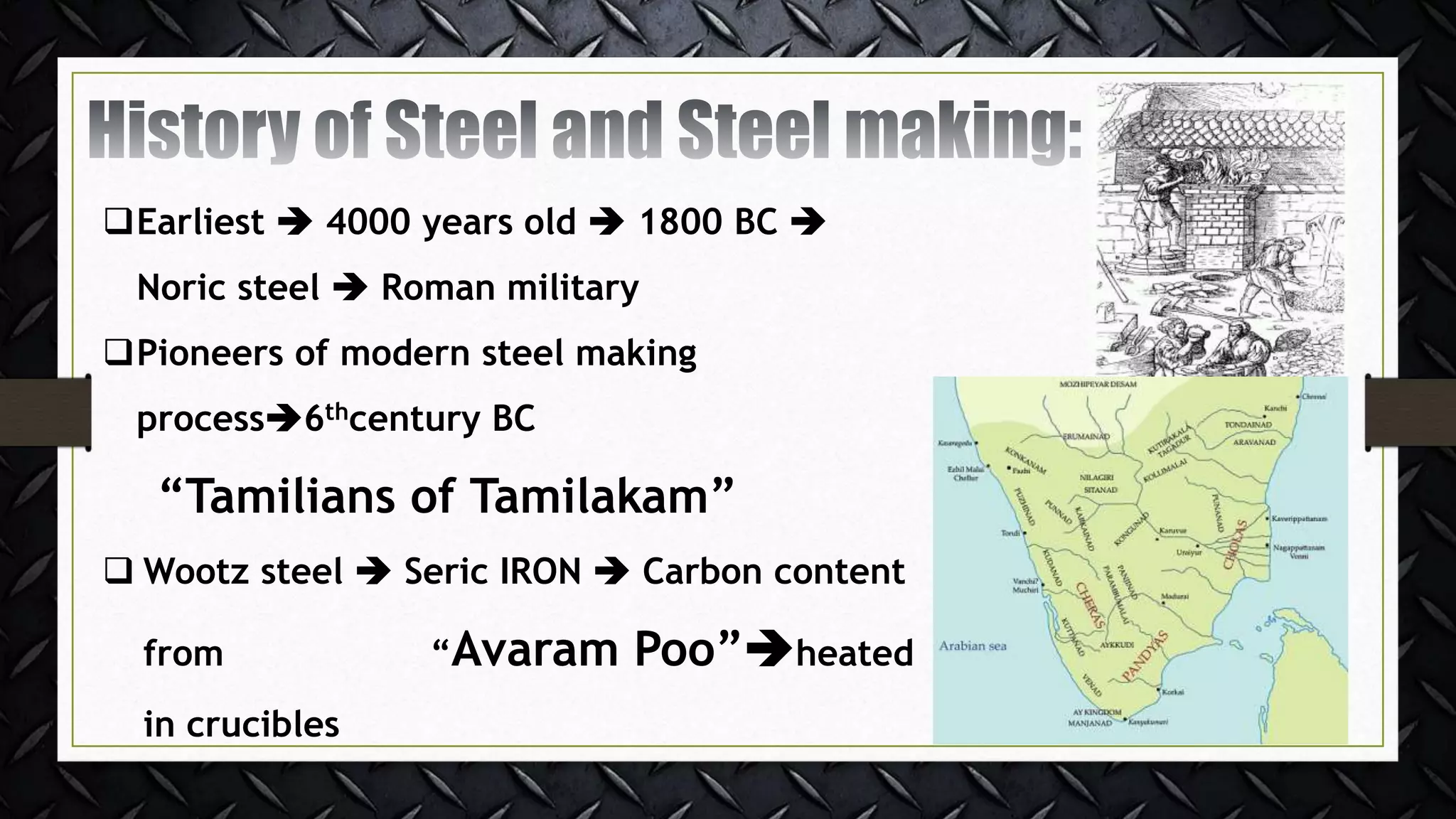
Earliest  4000 years old  1800 BC 
Noric steel  Roman military
Pioneers of modern steel making
process6thcentury BC
“Tamilians of Tamilakam”
 Wootz steel  Seric IRON  Carbon content
from “Avaram Poo”heated
in crucibles
The CHINESE of the WARRING
states  quenched hardened
steel 403-221 BC
The Chinese of HAN dynasty
 created steel  by
melting wrought iron with
cast iron 202BC-220AD
Avaram poo – Cassia auriculata
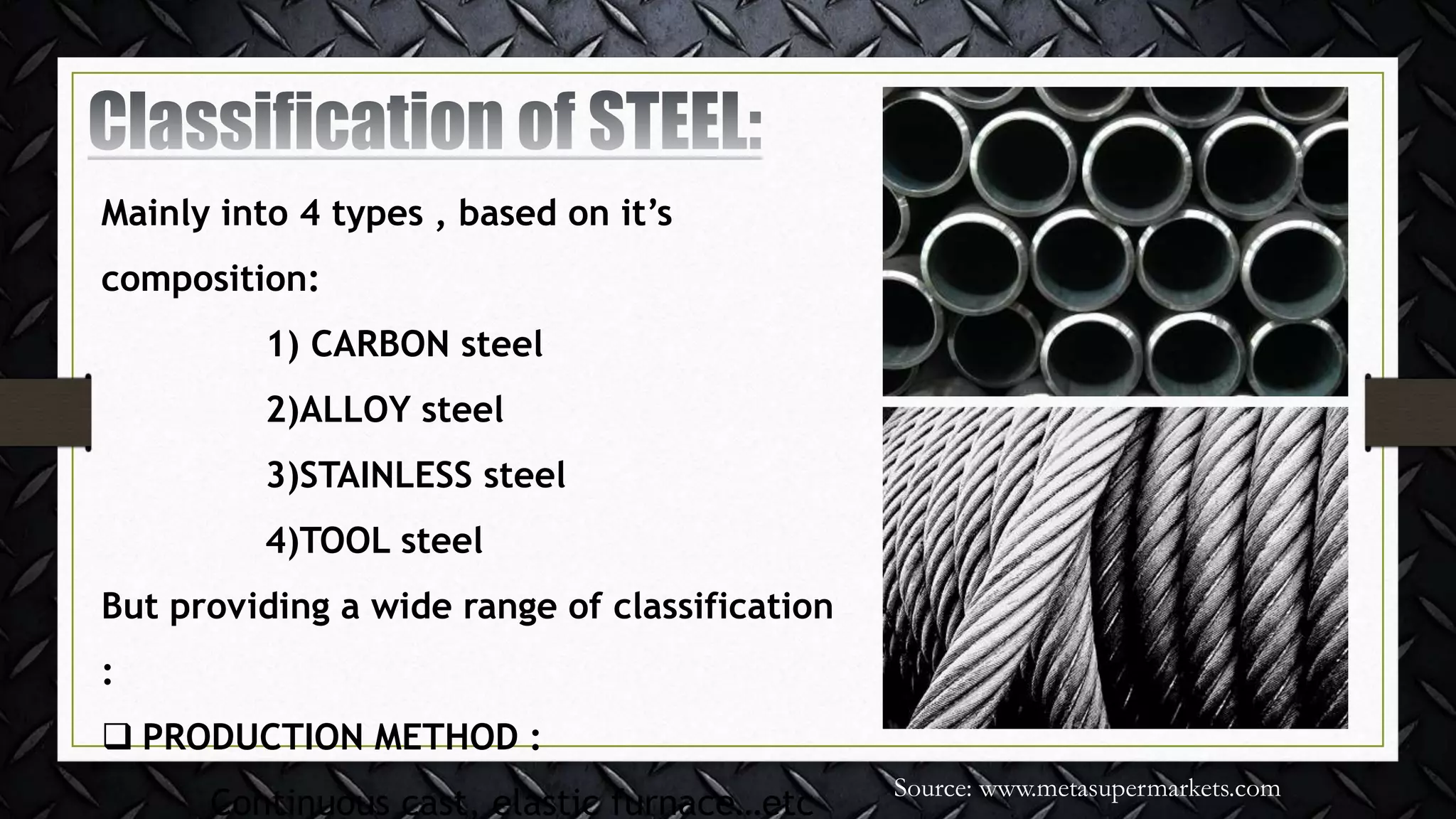
Mainly into 4 types , based on it’s
composition:
1) CARBON steel
2)ALLOY steel
3)STAINLESS steel
4)TOOL steel
But providing a wide range of classification
:
 PRODUCTION METHOD :
Continuous cast, elastic furnace…etc
Source: www.metasupermarkets.com
 FINISHING METHOD:
Cold rolled, hot rolled, cold
drawn…etc
 FORM OR SHAPE:
Bar, Rod, tube, pipe, plate,
sheet…etc
 DE-OXIDATION PROCESS:
Killed and semi killed steel…etc
 MICROSTRUCTURE:
Ferritic, Pearlitic, Martensitic…etc
 HEAT TREATMENT: Source: www.metasupermarkets.com
 Properties of STEEL can be varied by
VARYING the CARBON content in it.
 Increase in carbon content increases
the SHEAR STRESS and HARDNESS, at
the same time decreases the
DUCTILITY and TOUGHNESS.
 Composition : 0.05% - 2.1% of
Carbon
 Melting point : 1300-1400 C
 Can be hardened and tempered
 Compressive strength : 4.75 – 25.2
tonnes/sq.m
 Ultimate tensile strength : 5.51-11.02
tonnes/sq.m
 It rusts easily
 It’s TOUGH , Mallaeble and Ductile
 It absorbs SHOCKS
 It can be rapidly forged or welded
Commonly USED as a REINFORCEMENT for
RCC , in Steel structures, bolts, rivets and
sheets. For making cutlery, files and
Based on the carbon content steel is of
the following types:
 Dead Mild Steel ( less than 0.15% of C)
 Mild Steel (0.05-0.25% of C)
 Medium carbon steel (0.30-0.60% of
C)
 High carbon steel (0.60 – 1.50% of C)
 Cast steel or Carbon steel ( more than
1.50%)
 Also known as PLAIN CARBON steel
 Most common form of steel
 Material properties acceptable for many
applications
 CARBON CONTENT : 0.05 – 0.25 %
 DENSITY : 7850 kg/m3 (or)
7.85 g/cm3
 YOUNG’S MODULUS: 210 Gpa or
30,000,000psi
Characteristic STRESS-STRAIN curve for MILD
STEEL
As per Indian Standards(IS)
2062, there are 9 mild steel
grades as :
 Fe 250
 Fe 275
 Fe 300
 Fe 350
 Fe 410
 Fe 450
 Fe 550
 Fe 600
 Fe 650
Where NUMBER denotes the
value ofTENSILE STRENGTHS
of the variant.
 Carbon content : 0.3% - 0.6%
 Manganese content : 0.60% -
1.65%
 Ductile
 Strong
 Long wearing properties
 USES : Large parts of
machinery, forging
and automotive
 Carbon content : 0.60% -
1.70%
 Manganese content : 0.30% -
0.90%
 High CARBON content STRONG
 Holds SHAPE MEMORY well
 Uses : Springs , swords,
high strength wires
and sheets…etc
Cold Twisted Deformed(CTD) Bars
commonly known as TOR steel
named after TORisteg Steel
Corporation of LUXEMBORG – 1975
Thermo Mechanically Treated
(TMT) :
Hard outer surface with a
softer core. ManufacturedHot
rolled steel wires Water
Surface harder and core softer
 Steel wasn’t made economically till 19th
century
 Began in 1855 Introduction of
BESSEMER’S PROCESS
 Raw material PIG iron  Bessemer
converter
 CHEAP and produced LARGE quantities
Bessemer converter - 1855
 19th century  SIEMENS-MARTIN
process  co-melting of bar
iron with pig iron
Open hearth furnace
 Linz-Donawitz process of BASIC
OXYGEN STEEL (BOS) making 
developed in 1950’s  superior
to all
SOURCE:
Hyundai steel
corporation
web
Source : DISCOVERY channel
 High Strength and Light weight :
Weight of structure made of steel will
be small
 Uniformity :
Properties of Steel does not change as
opposite to concrete.
 Elasticity:
Steel follows Hooke’s law accurately
 Ductility:
Steel can withstand extensive
deformation without failure under
high tensile stress (ie) it gives WARNING
before failure takes place.
 Toughness :
Steel has both STRENGTH and
Burj
Khalifa
,
Dubai
Sometimes R/C structures are preferred to steel structures because
sometimes steel structures cannot provide the necessary strength due to
BUCKLING, whereas R/C columns are generally sturdy and massive (ie) no
buckling occurs.
The other disadvantages maybe:
Maintenance Cost : Steel structures
 Corrosion  Air,water & Humidity
 Painted regularly
Fire proofing cost:
SteelIncombustible  But at HIGH
temperatures Strength reduced
 Susceptibility to Buckling :
As the length and slenderness of a
compressive column increases, the
danger of buckling increases.
 Fatigue :
Strength of Steel gets reduced due
to cyclic loading(ie) repeated loading in
regular time intervals
 Brittle fracture:
Under certain conditions Steel
loses DUCTILITY Fracture Stress
concentrated areas  Fatigue type
Howrah Bridge Pamban Bridge
Chennai Airport Bengaluru International
Airport
Wankhede Cricket stadium Chennai Chepauk
CricKet Stadium
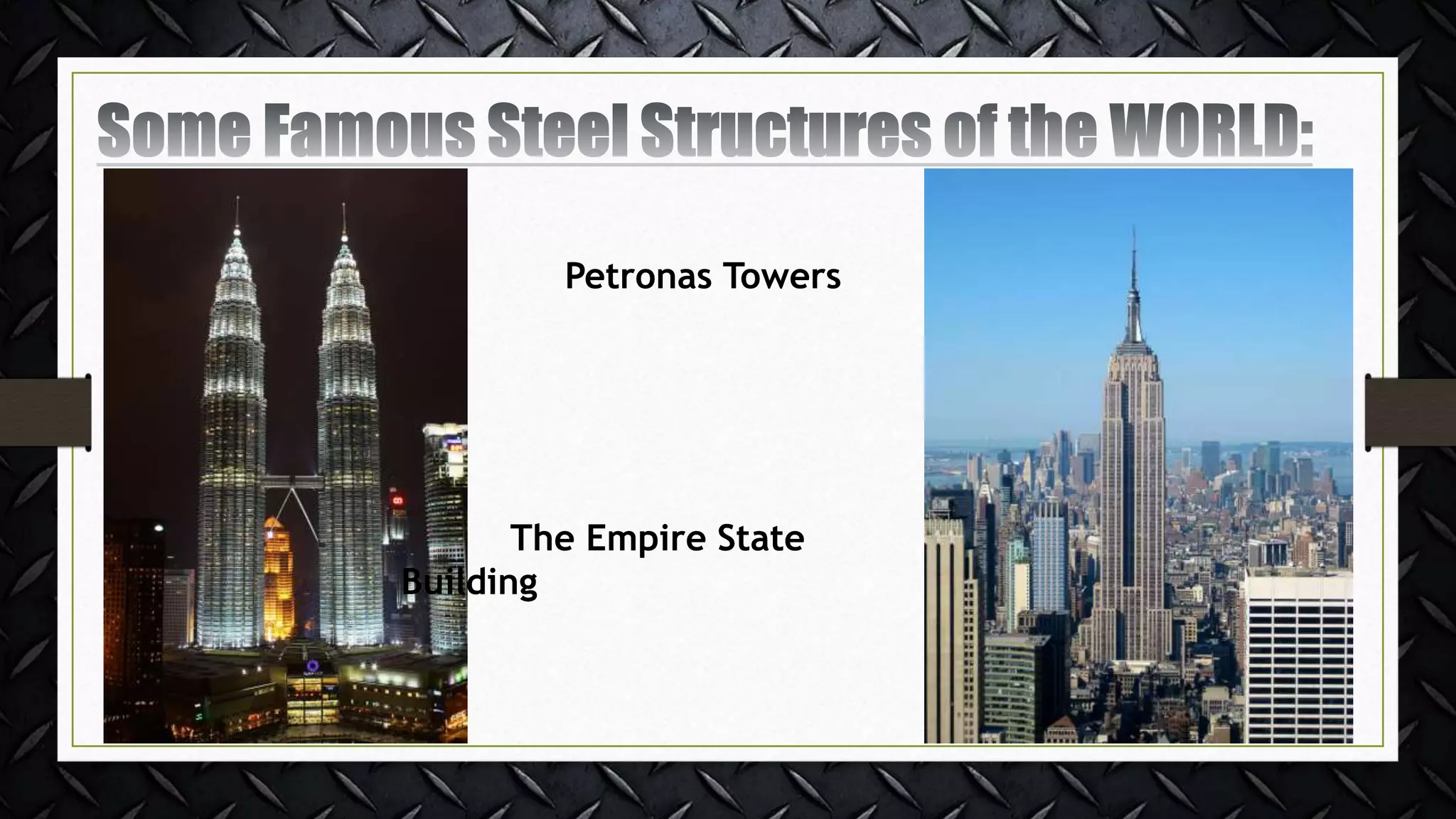
Petronas Towers
The Empire State
Building
Eiffel Tower Burj Khalifa Sears Towers
Taipei 101
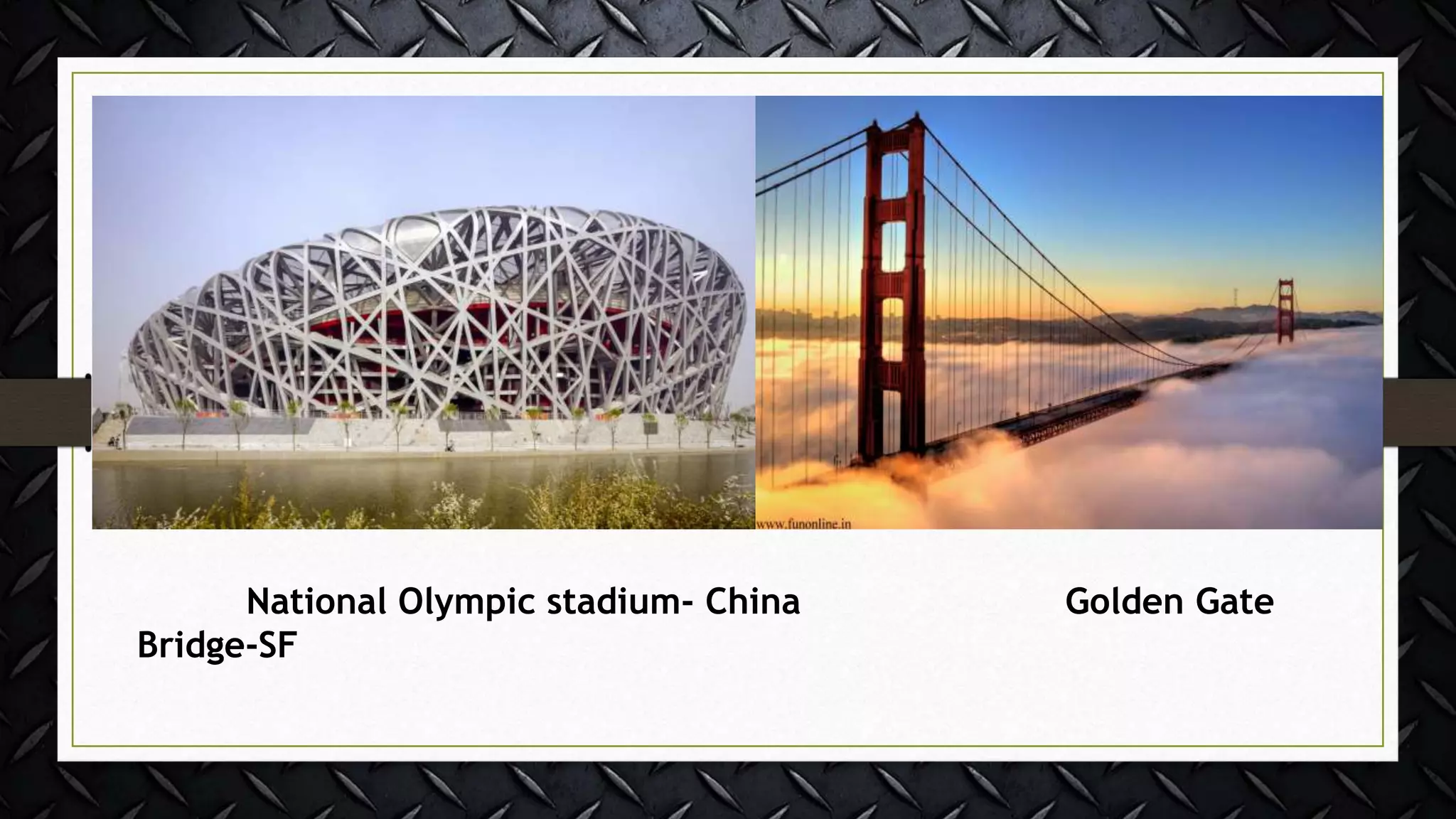
National Olympic stadium- China Golden Gate
Bridge-SF
The LOUVRE
pyramid,
Paris
Disney Concert Hall, Los Angeles Montreal Biosphere -
Fuller
Steel - As a Building material

Steel - As a Building material

  • 2.
    PROTO-GERMANIC Which means ‘standingfirm’ Definition: Steel is an alloy of IRON and CARBON and sometimes with other elements like Mn,Cr,Ni…etc. It is a hard ,strong grey or bluish grey alloy which is widely used as a structural and fabricating member.
  • 3.
    Earliest  4000years old  1800 BC  Noric steel  Roman military Pioneers of modern steel making process6thcentury BC “Tamilians of Tamilakam”  Wootz steel  Seric IRON  Carbon content from “Avaram Poo”heated in crucibles
  • 4.
    The CHINESE ofthe WARRING states  quenched hardened steel 403-221 BC The Chinese of HAN dynasty  created steel  by melting wrought iron with cast iron 202BC-220AD Avaram poo – Cassia auriculata
  • 5.
    Mainly into 4types , based on it’s composition: 1) CARBON steel 2)ALLOY steel 3)STAINLESS steel 4)TOOL steel But providing a wide range of classification :  PRODUCTION METHOD : Continuous cast, elastic furnace…etc Source: www.metasupermarkets.com
  • 6.
     FINISHING METHOD: Coldrolled, hot rolled, cold drawn…etc  FORM OR SHAPE: Bar, Rod, tube, pipe, plate, sheet…etc  DE-OXIDATION PROCESS: Killed and semi killed steel…etc  MICROSTRUCTURE: Ferritic, Pearlitic, Martensitic…etc  HEAT TREATMENT: Source: www.metasupermarkets.com
  • 7.
     Properties ofSTEEL can be varied by VARYING the CARBON content in it.  Increase in carbon content increases the SHEAR STRESS and HARDNESS, at the same time decreases the DUCTILITY and TOUGHNESS.  Composition : 0.05% - 2.1% of Carbon  Melting point : 1300-1400 C  Can be hardened and tempered
  • 8.
     Compressive strength: 4.75 – 25.2 tonnes/sq.m  Ultimate tensile strength : 5.51-11.02 tonnes/sq.m  It rusts easily  It’s TOUGH , Mallaeble and Ductile  It absorbs SHOCKS  It can be rapidly forged or welded Commonly USED as a REINFORCEMENT for RCC , in Steel structures, bolts, rivets and sheets. For making cutlery, files and
  • 9.
    Based on thecarbon content steel is of the following types:  Dead Mild Steel ( less than 0.15% of C)  Mild Steel (0.05-0.25% of C)  Medium carbon steel (0.30-0.60% of C)  High carbon steel (0.60 – 1.50% of C)  Cast steel or Carbon steel ( more than 1.50%)
  • 10.
     Also knownas PLAIN CARBON steel  Most common form of steel  Material properties acceptable for many applications  CARBON CONTENT : 0.05 – 0.25 %  DENSITY : 7850 kg/m3 (or) 7.85 g/cm3  YOUNG’S MODULUS: 210 Gpa or 30,000,000psi
  • 11.
    Characteristic STRESS-STRAIN curvefor MILD STEEL As per Indian Standards(IS) 2062, there are 9 mild steel grades as :  Fe 250  Fe 275  Fe 300  Fe 350  Fe 410  Fe 450  Fe 550  Fe 600  Fe 650 Where NUMBER denotes the value ofTENSILE STRENGTHS of the variant.
  • 12.
     Carbon content: 0.3% - 0.6%  Manganese content : 0.60% - 1.65%  Ductile  Strong  Long wearing properties  USES : Large parts of machinery, forging and automotive
  • 13.
     Carbon content: 0.60% - 1.70%  Manganese content : 0.30% - 0.90%  High CARBON content STRONG  Holds SHAPE MEMORY well  Uses : Springs , swords, high strength wires and sheets…etc
  • 14.
    Cold Twisted Deformed(CTD)Bars commonly known as TOR steel named after TORisteg Steel Corporation of LUXEMBORG – 1975 Thermo Mechanically Treated (TMT) : Hard outer surface with a softer core. ManufacturedHot rolled steel wires Water Surface harder and core softer
  • 15.
     Steel wasn’tmade economically till 19th century  Began in 1855 Introduction of BESSEMER’S PROCESS  Raw material PIG iron  Bessemer converter  CHEAP and produced LARGE quantities Bessemer converter - 1855
  • 16.
     19th century SIEMENS-MARTIN process  co-melting of bar iron with pig iron Open hearth furnace
  • 17.
     Linz-Donawitz processof BASIC OXYGEN STEEL (BOS) making  developed in 1950’s  superior to all SOURCE: Hyundai steel corporation web
  • 18.
  • 19.
     High Strengthand Light weight : Weight of structure made of steel will be small  Uniformity : Properties of Steel does not change as opposite to concrete.  Elasticity: Steel follows Hooke’s law accurately  Ductility: Steel can withstand extensive deformation without failure under high tensile stress (ie) it gives WARNING before failure takes place.  Toughness : Steel has both STRENGTH and Burj Khalifa , Dubai
  • 20.
    Sometimes R/C structuresare preferred to steel structures because sometimes steel structures cannot provide the necessary strength due to BUCKLING, whereas R/C columns are generally sturdy and massive (ie) no buckling occurs. The other disadvantages maybe: Maintenance Cost : Steel structures  Corrosion  Air,water & Humidity  Painted regularly Fire proofing cost: SteelIncombustible  But at HIGH temperatures Strength reduced
  • 21.
     Susceptibility toBuckling : As the length and slenderness of a compressive column increases, the danger of buckling increases.  Fatigue : Strength of Steel gets reduced due to cyclic loading(ie) repeated loading in regular time intervals  Brittle fracture: Under certain conditions Steel loses DUCTILITY Fracture Stress concentrated areas  Fatigue type
  • 22.
  • 23.
    Chennai Airport BengaluruInternational Airport
  • 24.
    Wankhede Cricket stadiumChennai Chepauk CricKet Stadium
  • 25.
  • 26.
    Eiffel Tower BurjKhalifa Sears Towers Taipei 101
  • 27.
    National Olympic stadium-China Golden Gate Bridge-SF
  • 28.
  • 29.
    Disney Concert Hall,Los Angeles Montreal Biosphere - Fuller