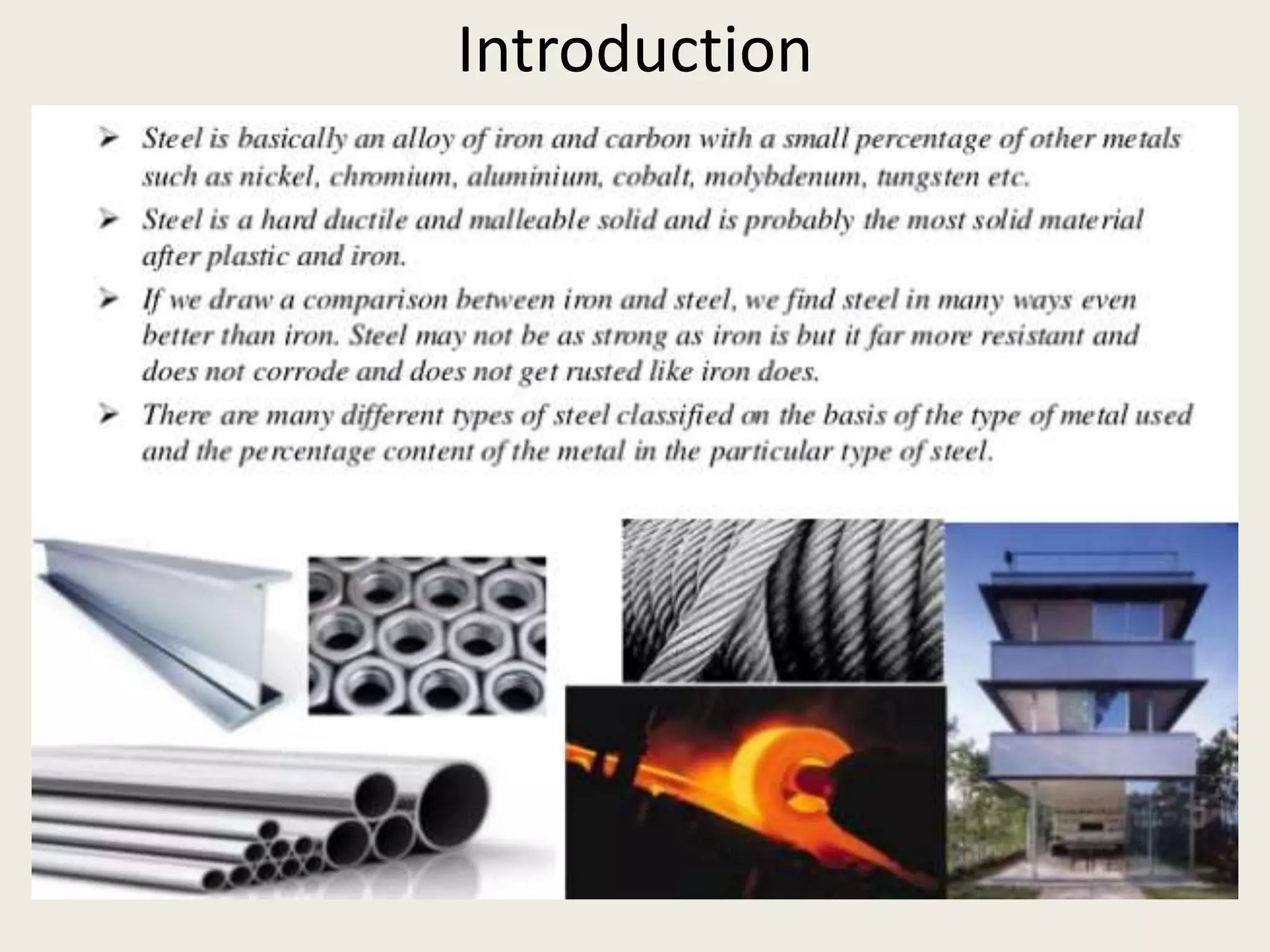
STEEL
• INTRODUCTION
• PHYSICAL PROPERTIES OF STRUCTURAL STEEL
• GARDES OF STEEL
Prof. Suyash Awasthi
Deptt of Civil Engineering
GGITS, JBP
Introduction
Physical properties of Structural Steel
• Steel is an alloy of iron and carbon and other
elements. Because of its high tensile strength
and low cost, it is a major component used in
buildings, infrastructure, tools, ships,
automobiles, machines, appliances and
weapons
• Chemical Composition: C=0.45%, Mn=0.75%,
P=0.04% max, S=0.05% max
• Density : 7.872* 10³ kg/m³
• Modulus of elasticity : 201 GPa (kN/mm2)
• Thermal expansion (20 ºC) : 11.7*10-6 ºCˉ¹
Physical properties of Structural Steel cont…
• Specific heat capacity : 486 J/(kg*K)
• Thermal conductivity : 50.9 W/(m*K)
• Electric resistivity: 1.62*10-7 Ohm*m
• Tensile strength (hot rolled) : 565 MPa (N/mm2)
• Yield strength (hot rolled) : 310 MPa
• Elongation (hot rolled) : 16%
• Hardness (hot rolled) : 84 RB (Brinell / Rockwell
Hardness)
GRADES OF STEEL
GRADES OF CONCRETE
Low Carbon Steel
• Plain carbon steels - very low content of alloying
elements and small amounts of Mn
• Most abundant grade of steel is low carbon steel
- greatest quantity produced; least expensive.
• Not responsive to heat treatment; cold working
needed to improve the strength.
• Good Weldability and machinability
• High Strength, Low Alloy (HSLA) steels - alloying
elements (like Cu, V, Ni and Mo) up to 10 wt %;
have higher strengths and may be heat treated.
Medium Carbon Steel
• Carbon content in the range of 0.3 – 0.6%.
• Can be heat treated - austenitizing, quenching
and then tempering.
• Most often used in tempered condition –
tempered at site
• Medium carbon steels have low hardenability
• Addition of Cr, Ni, Mo improves the heat treating
capacity
• Heat treated alloys are stronger but have lower
ductility
• Typical applications – Railway wheels and tracks,
gears, crankshafts.
High Carbon Steel
• High carbon steels – Carbon content 0.6 –
1.4%
• High C content provides high hardness and
strength. Hardest and least ductile.
• Used in hardened and tempered condition
• Strong carbide formers like Cr, V, W are added
as alloying elements to from carbides of these
metals.
• Used as tool and die steels owing to the high
hardness and wear resistance property
TOOL STEEL
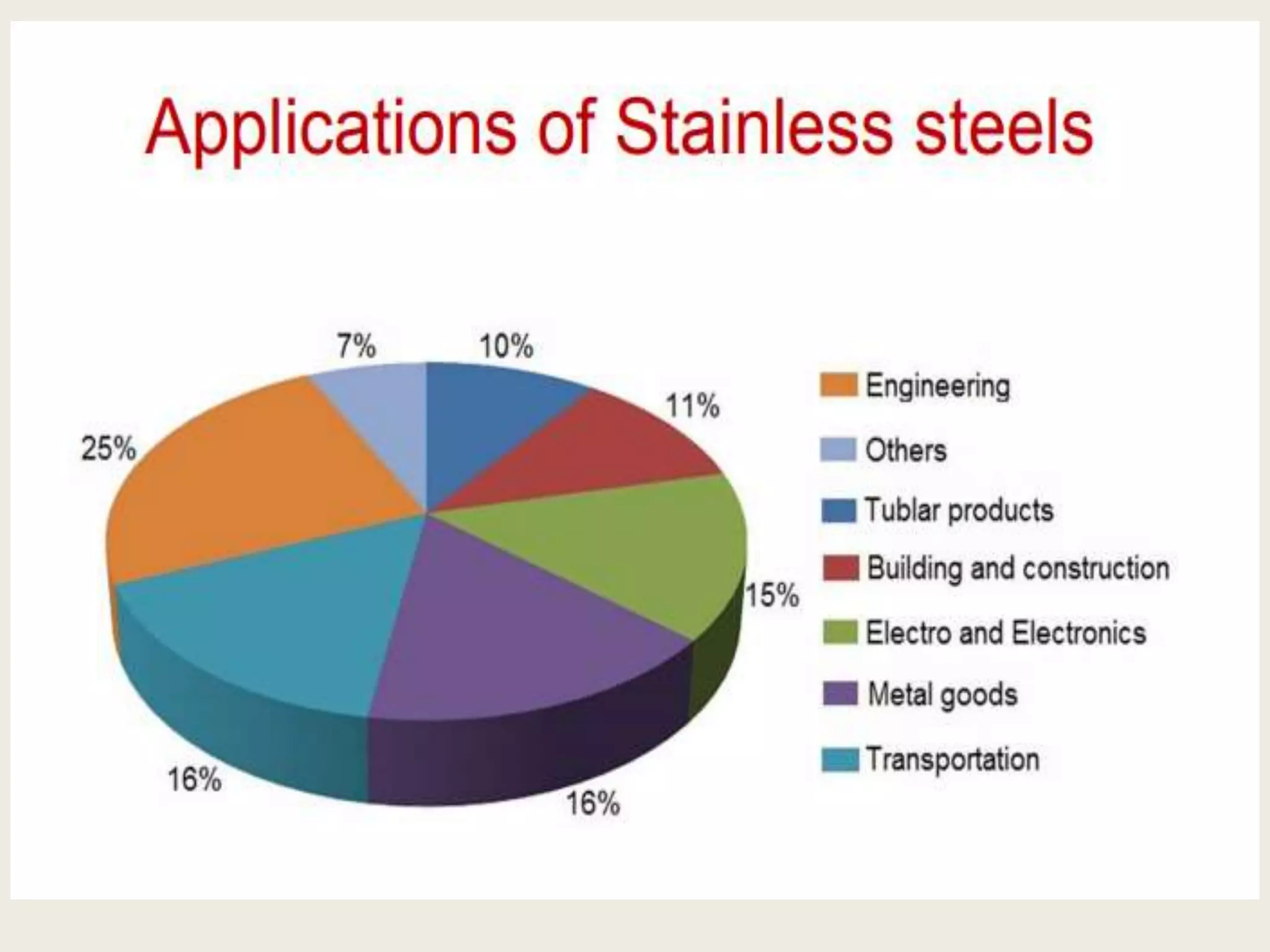
STAINLESS STEEL
• Stainless steels - A group of steels that contain at
least 11% Cr. Exhibits extraordinary corrosion
resistance due to formation of a very thin layer of
Cr2O3 on the surface.
• Categories of stainless steels:
– Ferritic Stainless Steels – Composed of α ferrite (BCC)
– Martensitic Stainless Steels – Can be heat treated.
– Austenitic Stainless Steels – Austenite (ϒ) phase field is
extended to room temperature. Most corrosion
resistant.
– Precipitation-Hardening (PH) Stainless Steels – Ultra
high strength due to precipitation hardening.
– Duplex Stainless Steels – Ferrite + Austenite
Properties and Uses of Various Stainless steels
Thank You…

STEEL PPT SA

  • 1.
    STEEL • INTRODUCTION • PHYSICALPROPERTIES OF STRUCTURAL STEEL • GARDES OF STEEL Prof. Suyash Awasthi Deptt of Civil Engineering GGITS, JBP
  • 2.
  • 3.
    Physical properties ofStructural Steel • Steel is an alloy of iron and carbon and other elements. Because of its high tensile strength and low cost, it is a major component used in buildings, infrastructure, tools, ships, automobiles, machines, appliances and weapons • Chemical Composition: C=0.45%, Mn=0.75%, P=0.04% max, S=0.05% max • Density : 7.872* 10³ kg/m³ • Modulus of elasticity : 201 GPa (kN/mm2) • Thermal expansion (20 ºC) : 11.7*10-6 ºCˉ¹
  • 4.
    Physical properties ofStructural Steel cont… • Specific heat capacity : 486 J/(kg*K) • Thermal conductivity : 50.9 W/(m*K) • Electric resistivity: 1.62*10-7 Ohm*m • Tensile strength (hot rolled) : 565 MPa (N/mm2) • Yield strength (hot rolled) : 310 MPa • Elongation (hot rolled) : 16% • Hardness (hot rolled) : 84 RB (Brinell / Rockwell Hardness)
  • 5.
  • 8.
  • 9.
    Low Carbon Steel •Plain carbon steels - very low content of alloying elements and small amounts of Mn • Most abundant grade of steel is low carbon steel - greatest quantity produced; least expensive. • Not responsive to heat treatment; cold working needed to improve the strength. • Good Weldability and machinability • High Strength, Low Alloy (HSLA) steels - alloying elements (like Cu, V, Ni and Mo) up to 10 wt %; have higher strengths and may be heat treated.
  • 12.
    Medium Carbon Steel •Carbon content in the range of 0.3 – 0.6%. • Can be heat treated - austenitizing, quenching and then tempering. • Most often used in tempered condition – tempered at site • Medium carbon steels have low hardenability • Addition of Cr, Ni, Mo improves the heat treating capacity • Heat treated alloys are stronger but have lower ductility • Typical applications – Railway wheels and tracks, gears, crankshafts.
  • 13.
    High Carbon Steel •High carbon steels – Carbon content 0.6 – 1.4% • High C content provides high hardness and strength. Hardest and least ductile. • Used in hardened and tempered condition • Strong carbide formers like Cr, V, W are added as alloying elements to from carbides of these metals. • Used as tool and die steels owing to the high hardness and wear resistance property
  • 14.
  • 15.
    STAINLESS STEEL • Stainlesssteels - A group of steels that contain at least 11% Cr. Exhibits extraordinary corrosion resistance due to formation of a very thin layer of Cr2O3 on the surface. • Categories of stainless steels: – Ferritic Stainless Steels – Composed of α ferrite (BCC) – Martensitic Stainless Steels – Can be heat treated. – Austenitic Stainless Steels – Austenite (ϒ) phase field is extended to room temperature. Most corrosion resistant. – Precipitation-Hardening (PH) Stainless Steels – Ultra high strength due to precipitation hardening. – Duplex Stainless Steels – Ferrite + Austenite
  • 16.
    Properties and Usesof Various Stainless steels
  • 18.