STEEL AND
ITS ALLOYS
DEVESH TRIPATHI
What is STEEL ALLOY?
 Steel is an alloy that consists mostly of iron and has a
carbon content between 0.2% and 2.1% by weight,
depending on the grade. Carbon is the most common
alloying material for iron, but various other alloying
elements are used, such as manganese, chromium,
vanadium, and tungsten.[1] Carbon and other elements
act as a hardening agent, preventing dislocations in
the iron atom crystal lattice from sliding past one
another. Varying the amount of alloying elements and
the form of their presence in the steel (solute
elements, precipitated phase) controls qualities such
as the hardness, ductility, and tensile strength of the
resulting steel. Steel with increased carbon content
can be made harder and stronger than iron, but such
steel is also less ductile than iron.
 Alloys with a higher than 2.1% carbon content
are known as cast iron because of their lower
melting point and good castability.[1] Steel is
also distinguishable from wrought iron, which
can contain a small amount of carbon, but it is
included in the form of slag inclusions. Two
distinguishing factors are steel's increased rust
resistance and better weldability.
 Though steel had been produced by various
inefficient methods long before the Renaissance, its
use became more common after more-efficient
production methods were devised in the 17th
century. With the invention of the Bessemer process
in the mid-19th century, steel became an
inexpensive mass-produced material. Further
refinements in the process, such as basic oxygen
steelmaking (BOS), lowered the cost of production
while increasing the quality of the metal. Today,
steel is one of the most common materials in the
world, with more than 1.3 billion tons produced
annually. It is a major component in buildings,
infrastructure, tools, ships, automobiles, machines,
appliances, and weapons. Modern steel is generally
identified by various grades defined by assorted
STAINLESS STEEL
Stainless steels are distinguished from other
steels by a minimum chromium content of
10.5%, which makes them more resistant to
corrosive aqueous environments and to
oxidation. Although there are exceptions,
stainless steel castings are classified as
"corrosion resistant" when used in aqueous
environments and vapors below 1200°F (650°C)
and "heat resistant" when used above this
temperature.
The usual distinction between the heat and
corrosion resistant casting grades is carbon
content. For a stainless steel casting to perform
well in a corrosive environment, the carbon
content must be low. Heat resistant grades have
higher carbon contents to improve elevated
temperature strength
WHY TO MIX OTHER
ELEMENTS??
Chromium, nickel, and molybdenum are
the primary alloying elements that
determine the structure, mechanical
properties, and corrosion resistance of
steel
Nickel and chromium have the greatest
influence on heat resistant castings.
Intentional additions of less than 1
%carbon, nitrogen, niobium, tantalum,
titanium, sulfur, and slightly larger
additions of copper, manganese, silicon,
and aluminum are used to modify
properties. Some minor elements can
have a positive or negative effect on
properties depending on the application.
PRODUCTS OF
STEEL USED IN
CONSTRUCTION
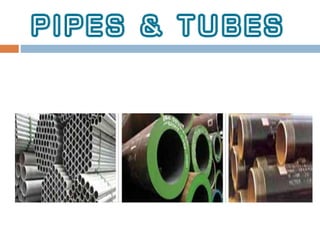
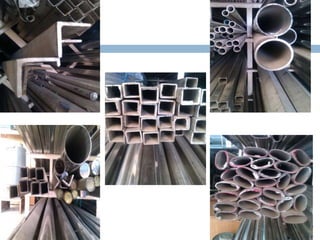
 TYPES: Seamless & Welded In shape of
Round, Square, Rectangular.
 SIZES: 1/2"NB TO 32" NB. (Seamless) &
1/2"NB TO 48"NB. (ERW/Spiral) in Sch 10 to
Sch XXS
 MATERIALS:
Stainless Steel, Carbon Steel, Low
Temperature Carbon Steel, Alloy Steel, Steam
Boiler Quality, Plus "Exotic" Materials I.E
Various Grades Nickel, Monel, Incoloy,
Hastealloy, Inconel, Cupronickel & Titanium
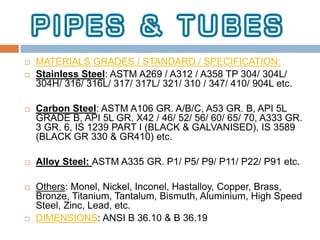
 MATERIALS GRADES / STANDARD / SPECIFICATION:
 Stainless Steel: ASTM A269 / A312 / A358 TP 304/ 304L/
304H/ 316/ 316L/ 317/ 317L/ 321/ 310 / 347/ 410/ 904L etc.
 Carbon Steel: ASTM A106 GR. A/B/C, A53 GR. B, API 5L
GRADE B, API 5L GR. X42 / 46/ 52/ 56/ 60/ 65/ 70, A333 GR.
3 GR. 6, IS 1239 PART I (BLACK & GALVANISED), IS 3589
(BLACK GR 330 & GR410) etc.
 Alloy Steel: ASTM A335 GR. P1/ P5/ P9/ P11/ P22/ P91 etc.
 Others: Monel, Nickel, Inconel, Hastalloy, Copper, Brass,
Bronze, Titanium, Tantalum, Bismuth, Aluminium, High Speed
Steel, Zinc, Lead, etc.
 DIMENSIONS: ANSI B 36.10 & B 36.19
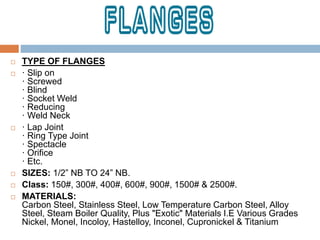
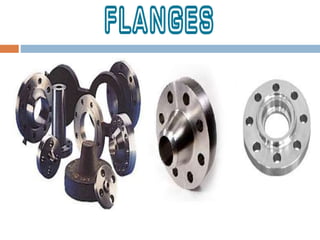
 TYPE OF FLANGES
 · Slip on
· Screwed
· Blind
· Socket Weld
· Reducing
· Weld Neck
 · Lap Joint
· Ring Type Joint
· Spectacle
· Orifice
· Etc.
 SIZES: 1/2” NB TO 24” NB.
 Class: 150#, 300#, 400#, 600#, 900#, 1500# & 2500#.
 MATERIALS:
Carbon Steel, Stainless Steel, Low Temperature Carbon Steel, Alloy
Steel, Steam Boiler Quality, Plus "Exotic" Materials I.E Various Grades
Nickel, Monel, Incoloy, Hastelloy, Inconel, Cupronickel & Titanium

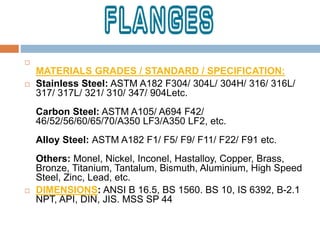
MATERIALS GRADES / STANDARD / SPECIFICATION:
 Stainless Steel: ASTM A182 F304/ 304L/ 304H/ 316/ 316L/
317/ 317L/ 321/ 310/ 347/ 904Letc.
Carbon Steel: ASTM A105/ A694 F42/
46/52/56/60/65/70/A350 LF3/A350 LF2, etc.
Alloy Steel: ASTM A182 F1/ F5/ F9/ F11/ F22/ F91 etc.
Others: Monel, Nickel, Inconel, Hastalloy, Copper, Brass,
Bronze, Titanium, Tantalum, Bismuth, Aluminium, High Speed
Steel, Zinc, Lead, etc.
 DIMENSIONS: ANSI B 16.5, BS 1560. BS 10, IS 6392, B-2.1
NPT, API, DIN, JIS. MSS SP 44
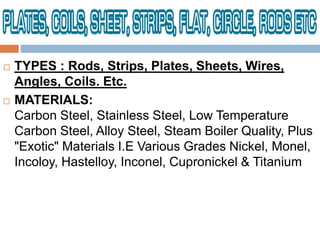
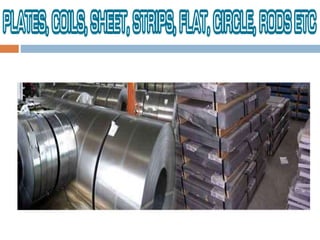
 TYPES : Rods, Strips, Plates, Sheets, Wires,
Angles, Coils. Etc.
 MATERIALS:
Carbon Steel, Stainless Steel, Low Temperature
Carbon Steel, Alloy Steel, Steam Boiler Quality, Plus
"Exotic" Materials I.E Various Grades Nickel, Monel,
Incoloy, Hastelloy, Inconel, Cupronickel & Titanium
 MATERIALS GRADES / STANDARD /
SPECIFICATION:
 Stainless Steel: ASTM A182/A240 TP304/ 304L/
304H/ 316/ 316L/ 317/ 317L/ 321/ 310/ 347/ 904Letc.
Carbon Steel: A515 GR 60/70, A 516 GR. 60/70, / IS
2062 / A36, A
Alloy Steel: ASTM A182/387 F/P 1/5/ 9/11/22/91
& etc.
Others: Monel, Nickel, Inconel, Hastalloy, Copper,
Brass, Bronze, Titanium, Tantalum, Bismuth,
Aluminium, High Speed Steel, Zinc, Lead, etc.
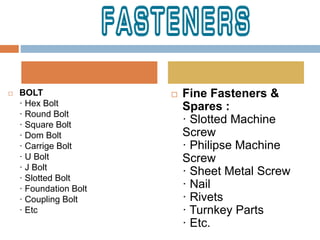
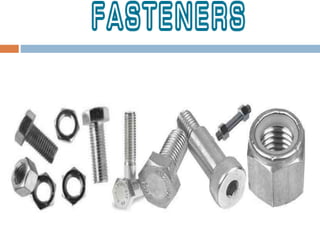
 BOLT
· Hex Bolt
· Round Bolt
· Square Bolt
· Dom Bolt
· Carrige Bolt
· U Bolt
· J Bolt
· Slotted Bolt
· Foundation Bolt
· Coupling Bolt
· Etc
 Fine Fasteners &
Spares :
· Slotted Machine
Screw
· Philipse Machine
Screw
· Sheet Metal Screw
· Nail
· Rivets
· Turnkey Parts
· Etc.
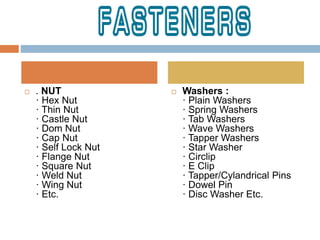
 . NUT
· Hex Nut
· Thin Nut
· Castle Nut
· Dom Nut
· Cap Nut
· Self Lock Nut
· Flange Nut
· Square Nut
· Weld Nut
· Wing Nut
· Etc.
 Washers :
· Plain Washers
· Spring Washers
· Tab Washers
· Wave Washers
· Tapper Washers
· Star Washer
· Circlip
· E Clip
· Tapper/Cylandrical Pins
· Dowel Pin
· Disc Washer Etc.
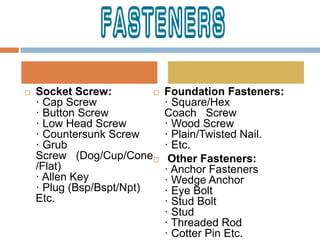
 Socket Screw:
· Cap Screw
· Button Screw
· Low Head Screw
· Countersunk Screw
· Grub
Screw (Dog/Cup/Cone
/Flat)
· Allen Key
· Plug (Bsp/Bspt/Npt)
Etc.
 Foundation Fasteners:
· Square/Hex
Coach Screw
· Wood Screw
· Plain/Twisted Nail.
· Etc.
 Other Fasteners:
· Anchor Fasteners
· Wedge Anchor
· Eye Bolt
· Stud Bolt
· Stud
· Threaded Rod
· Cotter Pin Etc.
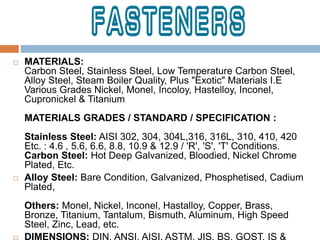
 MATERIALS:
Carbon Steel, Stainless Steel, Low Temperature Carbon Steel,
Alloy Steel, Steam Boiler Quality, Plus "Exotic" Materials I.E
Various Grades Nickel, Monel, Incoloy, Hastelloy, Inconel,
Cupronickel & Titanium
MATERIALS GRADES / STANDARD / SPECIFICATION :
Stainless Steel: AISI 302, 304, 304L,316, 316L, 310, 410, 420
Etc. : 4.6 , 5.6, 6.6, 8.8, 10.9 & 12.9 / 'R', 'S', 'T' Conditions.
Carbon Steel: Hot Deep Galvanized, Bloodied, Nickel Chrome
Plated, Etc.
 Alloy Steel: Bare Condition, Galvanized, Phosphetised, Cadium
Plated,
Others: Monel, Nickel, Inconel, Hastalloy, Copper, Brass,
Bronze, Titanium, Tantalum, Bismuth, Aluminum, High Speed
Steel, Zinc, Lead, etc.
 DIMENSIONS: DIN, ANSI, AISI, ASTM, JIS, BS, GOST, IS &
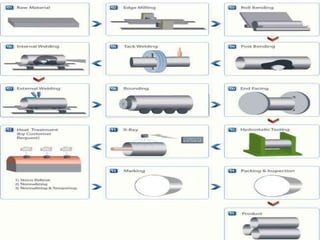
MANUFACTURI
NG PROCESS
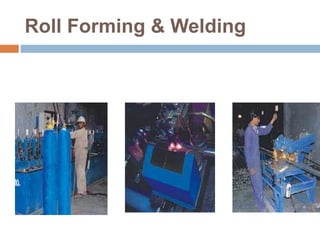
Roll Forming & Welding

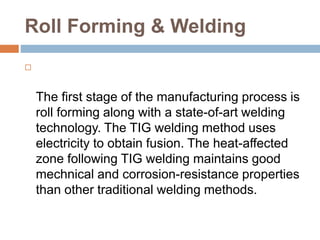
The first stage of the manufacturing process is
roll forming along with a state-of-art welding
technology. The TIG welding method uses
electricity to obtain fusion. The heat-affected
zone following TIG welding maintains good
mechnical and corrosion-resistance properties
than other traditional welding methods.
Roll Forming & Welding
Pickling

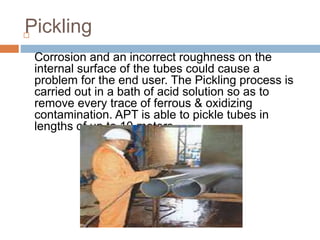
Corrosion and an incorrect roughness on the
internal surface of the tubes could cause a
problem for the end user. The Pickling process is
carried out in a bath of acid solution so as to
remove every trace of ferrous & oxidizing
contamination. APT is able to pickle tubes in
lengths of up to 10 meters.
Solution Annealing

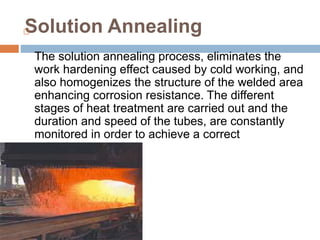
The solution annealing process, eliminates the
work hardening effect caused by cold working, and
also homogenizes the structure of the welded area
enhancing corrosion resistance. The different
stages of heat treatment are carried out and the
duration and speed of the tubes, are constantly
monitored in order to achieve a correct
solubilization.


Polishing

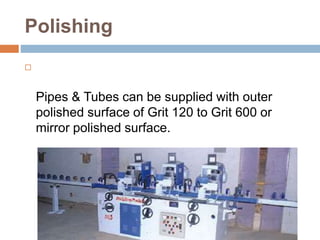
Pipes & Tubes can be supplied with outer
polished surface of Grit 120 to Grit 600 or
mirror polished surface.
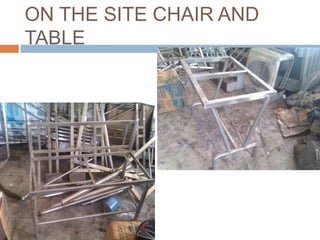
ON THE SITE CHAIR AND
TABLE
Steel
Steel
Steel

Steel

  • 1.
  • 2.
    What is STEELALLOY?  Steel is an alloy that consists mostly of iron and has a carbon content between 0.2% and 2.1% by weight, depending on the grade. Carbon is the most common alloying material for iron, but various other alloying elements are used, such as manganese, chromium, vanadium, and tungsten.[1] Carbon and other elements act as a hardening agent, preventing dislocations in the iron atom crystal lattice from sliding past one another. Varying the amount of alloying elements and the form of their presence in the steel (solute elements, precipitated phase) controls qualities such as the hardness, ductility, and tensile strength of the resulting steel. Steel with increased carbon content can be made harder and stronger than iron, but such steel is also less ductile than iron.
  • 3.
     Alloys witha higher than 2.1% carbon content are known as cast iron because of their lower melting point and good castability.[1] Steel is also distinguishable from wrought iron, which can contain a small amount of carbon, but it is included in the form of slag inclusions. Two distinguishing factors are steel's increased rust resistance and better weldability.
  • 4.
     Though steelhad been produced by various inefficient methods long before the Renaissance, its use became more common after more-efficient production methods were devised in the 17th century. With the invention of the Bessemer process in the mid-19th century, steel became an inexpensive mass-produced material. Further refinements in the process, such as basic oxygen steelmaking (BOS), lowered the cost of production while increasing the quality of the metal. Today, steel is one of the most common materials in the world, with more than 1.3 billion tons produced annually. It is a major component in buildings, infrastructure, tools, ships, automobiles, machines, appliances, and weapons. Modern steel is generally identified by various grades defined by assorted
  • 5.
    STAINLESS STEEL Stainless steelsare distinguished from other steels by a minimum chromium content of 10.5%, which makes them more resistant to corrosive aqueous environments and to oxidation. Although there are exceptions, stainless steel castings are classified as "corrosion resistant" when used in aqueous environments and vapors below 1200°F (650°C) and "heat resistant" when used above this temperature.
  • 6.
    The usual distinctionbetween the heat and corrosion resistant casting grades is carbon content. For a stainless steel casting to perform well in a corrosive environment, the carbon content must be low. Heat resistant grades have higher carbon contents to improve elevated temperature strength
  • 7.
    WHY TO MIXOTHER ELEMENTS?? Chromium, nickel, and molybdenum are the primary alloying elements that determine the structure, mechanical properties, and corrosion resistance of steel
  • 8.
    Nickel and chromiumhave the greatest influence on heat resistant castings. Intentional additions of less than 1 %carbon, nitrogen, niobium, tantalum, titanium, sulfur, and slightly larger additions of copper, manganese, silicon, and aluminum are used to modify properties. Some minor elements can have a positive or negative effect on properties depending on the application.
  • 9.
    PRODUCTS OF STEEL USEDIN CONSTRUCTION
  • 10.
     TYPES: Seamless& Welded In shape of Round, Square, Rectangular.  SIZES: 1/2"NB TO 32" NB. (Seamless) & 1/2"NB TO 48"NB. (ERW/Spiral) in Sch 10 to Sch XXS  MATERIALS: Stainless Steel, Carbon Steel, Low Temperature Carbon Steel, Alloy Steel, Steam Boiler Quality, Plus "Exotic" Materials I.E Various Grades Nickel, Monel, Incoloy, Hastealloy, Inconel, Cupronickel & Titanium
  • 11.
     MATERIALS GRADES/ STANDARD / SPECIFICATION:  Stainless Steel: ASTM A269 / A312 / A358 TP 304/ 304L/ 304H/ 316/ 316L/ 317/ 317L/ 321/ 310 / 347/ 410/ 904L etc.  Carbon Steel: ASTM A106 GR. A/B/C, A53 GR. B, API 5L GRADE B, API 5L GR. X42 / 46/ 52/ 56/ 60/ 65/ 70, A333 GR. 3 GR. 6, IS 1239 PART I (BLACK & GALVANISED), IS 3589 (BLACK GR 330 & GR410) etc.  Alloy Steel: ASTM A335 GR. P1/ P5/ P9/ P11/ P22/ P91 etc.  Others: Monel, Nickel, Inconel, Hastalloy, Copper, Brass, Bronze, Titanium, Tantalum, Bismuth, Aluminium, High Speed Steel, Zinc, Lead, etc.  DIMENSIONS: ANSI B 36.10 & B 36.19
  • 13.
     TYPE OFFLANGES  · Slip on · Screwed · Blind · Socket Weld · Reducing · Weld Neck  · Lap Joint · Ring Type Joint · Spectacle · Orifice · Etc.  SIZES: 1/2” NB TO 24” NB.  Class: 150#, 300#, 400#, 600#, 900#, 1500# & 2500#.  MATERIALS: Carbon Steel, Stainless Steel, Low Temperature Carbon Steel, Alloy Steel, Steam Boiler Quality, Plus "Exotic" Materials I.E Various Grades Nickel, Monel, Incoloy, Hastelloy, Inconel, Cupronickel & Titanium
  • 14.
     MATERIALS GRADES /STANDARD / SPECIFICATION:  Stainless Steel: ASTM A182 F304/ 304L/ 304H/ 316/ 316L/ 317/ 317L/ 321/ 310/ 347/ 904Letc. Carbon Steel: ASTM A105/ A694 F42/ 46/52/56/60/65/70/A350 LF3/A350 LF2, etc. Alloy Steel: ASTM A182 F1/ F5/ F9/ F11/ F22/ F91 etc. Others: Monel, Nickel, Inconel, Hastalloy, Copper, Brass, Bronze, Titanium, Tantalum, Bismuth, Aluminium, High Speed Steel, Zinc, Lead, etc.  DIMENSIONS: ANSI B 16.5, BS 1560. BS 10, IS 6392, B-2.1 NPT, API, DIN, JIS. MSS SP 44
  • 16.
     TYPES :Rods, Strips, Plates, Sheets, Wires, Angles, Coils. Etc.  MATERIALS: Carbon Steel, Stainless Steel, Low Temperature Carbon Steel, Alloy Steel, Steam Boiler Quality, Plus "Exotic" Materials I.E Various Grades Nickel, Monel, Incoloy, Hastelloy, Inconel, Cupronickel & Titanium
  • 17.
     MATERIALS GRADES/ STANDARD / SPECIFICATION:  Stainless Steel: ASTM A182/A240 TP304/ 304L/ 304H/ 316/ 316L/ 317/ 317L/ 321/ 310/ 347/ 904Letc. Carbon Steel: A515 GR 60/70, A 516 GR. 60/70, / IS 2062 / A36, A Alloy Steel: ASTM A182/387 F/P 1/5/ 9/11/22/91 & etc. Others: Monel, Nickel, Inconel, Hastalloy, Copper, Brass, Bronze, Titanium, Tantalum, Bismuth, Aluminium, High Speed Steel, Zinc, Lead, etc.
  • 19.
     BOLT · HexBolt · Round Bolt · Square Bolt · Dom Bolt · Carrige Bolt · U Bolt · J Bolt · Slotted Bolt · Foundation Bolt · Coupling Bolt · Etc  Fine Fasteners & Spares : · Slotted Machine Screw · Philipse Machine Screw · Sheet Metal Screw · Nail · Rivets · Turnkey Parts · Etc.
  • 20.
     . NUT ·Hex Nut · Thin Nut · Castle Nut · Dom Nut · Cap Nut · Self Lock Nut · Flange Nut · Square Nut · Weld Nut · Wing Nut · Etc.  Washers : · Plain Washers · Spring Washers · Tab Washers · Wave Washers · Tapper Washers · Star Washer · Circlip · E Clip · Tapper/Cylandrical Pins · Dowel Pin · Disc Washer Etc.
  • 21.
     Socket Screw: ·Cap Screw · Button Screw · Low Head Screw · Countersunk Screw · Grub Screw (Dog/Cup/Cone /Flat) · Allen Key · Plug (Bsp/Bspt/Npt) Etc.  Foundation Fasteners: · Square/Hex Coach Screw · Wood Screw · Plain/Twisted Nail. · Etc.  Other Fasteners: · Anchor Fasteners · Wedge Anchor · Eye Bolt · Stud Bolt · Stud · Threaded Rod · Cotter Pin Etc.
  • 22.
     MATERIALS: Carbon Steel,Stainless Steel, Low Temperature Carbon Steel, Alloy Steel, Steam Boiler Quality, Plus "Exotic" Materials I.E Various Grades Nickel, Monel, Incoloy, Hastelloy, Inconel, Cupronickel & Titanium MATERIALS GRADES / STANDARD / SPECIFICATION : Stainless Steel: AISI 302, 304, 304L,316, 316L, 310, 410, 420 Etc. : 4.6 , 5.6, 6.6, 8.8, 10.9 & 12.9 / 'R', 'S', 'T' Conditions. Carbon Steel: Hot Deep Galvanized, Bloodied, Nickel Chrome Plated, Etc.  Alloy Steel: Bare Condition, Galvanized, Phosphetised, Cadium Plated, Others: Monel, Nickel, Inconel, Hastalloy, Copper, Brass, Bronze, Titanium, Tantalum, Bismuth, Aluminum, High Speed Steel, Zinc, Lead, etc.  DIMENSIONS: DIN, ANSI, AISI, ASTM, JIS, BS, GOST, IS &
  • 24.
  • 26.
    Roll Forming &Welding  The first stage of the manufacturing process is roll forming along with a state-of-art welding technology. The TIG welding method uses electricity to obtain fusion. The heat-affected zone following TIG welding maintains good mechnical and corrosion-resistance properties than other traditional welding methods.
  • 27.
  • 28.
    Pickling  Corrosion and anincorrect roughness on the internal surface of the tubes could cause a problem for the end user. The Pickling process is carried out in a bath of acid solution so as to remove every trace of ferrous & oxidizing contamination. APT is able to pickle tubes in lengths of up to 10 meters.
  • 29.
    Solution Annealing  The solutionannealing process, eliminates the work hardening effect caused by cold working, and also homogenizes the structure of the welded area enhancing corrosion resistance. The different stages of heat treatment are carried out and the duration and speed of the tubes, are constantly monitored in order to achieve a correct solubilization.  
  • 30.
    Polishing  Pipes & Tubescan be supplied with outer polished surface of Grit 120 to Grit 600 or mirror polished surface.
  • 32.
    ON THE SITECHAIR AND TABLE