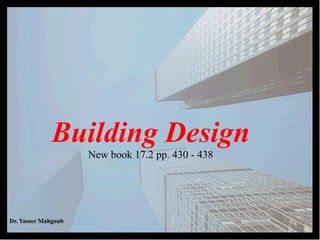

Building Design New book 17.2 pp. 430 - 438
Introduction Dr. Yasser Mahgoub
 
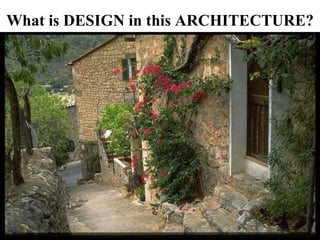
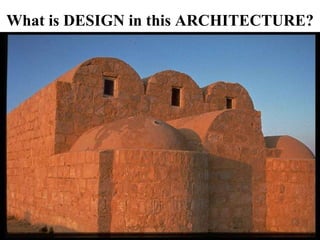
What is DESIGN in this ARCHITECTURE?
What is design in these buildings?
ANTONI GAUDI (1852-1926)   . Ronchamp Casa Batllo Teulada Casa Lleo Morera La Pedrera The Residential Tower
Le Corbusier The house is a machine to live in. Ronchamp Unité d'habitation Villa Savoye Reinforced Concrete Principles The Residential Tower
Frank Lloyd Wright . Johnson Wax Robie House Prairie Houses Guggenheim Museum Falling Water
Richard Meier . Ulm Exhibition And Assembly Building J. Paul Getty Center  Frankfurt Museum for Decorative Arts The High Museum Of Art Smith House
FRANK O. GEHRY "As soon as I understand the scale of the building and the relationship to the site and the relationship to the client, as it becomes more and more clear to me, I start doing sketches". GUGGENHEIM MUSEUM NEW YORK  GUGGENHEIM MUSEUM BILBAO  WALT DISNEY CONCERT HALL  MAGGIE’S CENTRE  SCHOOL OF MANAGEMENT
Peter Eisenman . Emory Center for the Arts  Columbus Convention Center Bibliothèque de L'IHUEI   Wexner Center  Aronoff Center for Design and Art
Zaha Hadid  . LANDESGARTENSCHAU CARDIFF BAY OPERA HOUSE Vitra fire station  HABITABLE BRIDGE SCHOOL OF MANAGEMENT
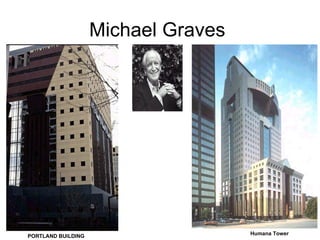
Michael Graves  . PORTLAND BUILDING Humana Tower  HABITABLE BRIDGE
Introduction Contracts between clients and architects identify types of building design services  (e.g., schematic documents, design development documents, construction documents, etc.) and the tasks contained in each.  Dr. Yasser Mahgoub
Introduction Several trends are affecting how architects approach and carry out building design: First is the fact that  clients continue to seek greater value from design services . Dr. Yasser Mahgoub
Introduction Clients who are  more sophisticated ; and  better informed  increasingly expect their building facilities to fulfill a range of needs beyond those mandated in health and safety regulations. Dr. Yasser Mahgoub
Introduction This expectation challenge's architects to be cognizant of those client needs and to respond to them  creatively .  Dr. Yasser Mahgoub
Introduction Other trends present opportunities for architects to  increase their design capabilities and expand their range of creativity.   In the  technology arena ,  software advances  are giving architects more powerful tools to shape and evaluate design solutions. Dr. Yasser Mahgoub
Introduction In the  regulatory arena , the growing use of  performance-based building codes  promises to provide architects with more freedom in meeting regulatory requirements.  Dr. Yasser Mahgoub
Summary:  BUILDING DESIGN SERVICES  Why a Client May Need These Services To  respond to rapid or sudden growth To  move to a new location To  update or replace older facilities To  improve productivity in operations To  implement major organizational restructuring To bring an existing facility up to  current regulatory standards To transform or create a  new image  or brand identity  Dr. Yasser Mahgoub
Summary:  BUILDING DESIGN SERVICES  Knowledge and Skills Required Ability to  evaluate program  requirements critically Ability to  create concepts  that respond to program requirements Ability to delineate concepts and  design solutions Understanding of  building materials, components, and systems Understanding of  building codes, standards, and regulations Familiarity with  contracts and construction documentation Ability to  communicate concepts  to the client and consultants Knowledge of  construction costs   Dr. Yasser Mahgoub
Summary:  BUILDING DESIGN SERVICES  Representative Process Tasks Develop  project understanding Develop  schematic design documents Develop  design development documents  Dr. Yasser Mahgoub
Introduction Architects don't  make  buildings perse.  Using professional knowledge and skills,  architects translate   abstract ideas into building form  expressed by the architect in sketches, plans, models, and specifications. Dr. Yasser Mahgoub
Introduction The design process is  difficult to map .  It is  nonlinear and highly interactive , embracing a mix of rational and intuitive decision making. Despite the lack of cookbook-style directions and definitive step-by-step procedures,  architects successfully apply design thinking everyday in providing building design services to their clients.   Dr. Yasser Mahgoub
Lecture 1 Dr. Yasser Mahgoub
Building design is the  keystone  of architecture practice.  Translating   needs and aspirations ,  theories and technologies , and  schedules and budgets   into   appropriate and exciting places and buildings  requires great  skill  as well as attention to broader  concerns . Design
Design has moments of great inspiration and deep insight - but most of all it required hours, months, and years of hard work. Complex and Inaccessible      yet      Taught to and practiced by thousands Design Private and Intuitive      yet    Broadly discussed and rationally analyzed
Design is a continiuous activity. Beginning          (no end) Design
Design Influences Every project  situation  is different Different  requirements  and  limitations Cultural, environmental, technological, aesthetic  contexts Challenges and opportunities . Design
It is both  problem-seeking   and problem-solving  process. Design
Program Requirements and Limitations General or Specific descriptive of needs Suggestive solutions Design Influences
Community Desires Public agency (ies) approvals To meet objections or to gain support. Design Influences
Codes and Regulations Safety requirements Minimal land use Light and air zoning A major force in design that regulates every aspect of design and construction Design Influences
Site and Climate Physical characteristics:  size, configuration, topography, geotechnical, etc. Climate : wind, solar orientation, temperatures, humidity, precipitation, etc. Environmental Factors : view, existing vegetation, drainage, etc. Access Adjacent land uses and other site factors. Design Influences
Building context and existing fabric The surrounding environment Influence: Materials Fenestration Color Detailing Existing structures Design Influences
Building Technology Building configuration, materials, and systems  are  rarely arbitrarily chosen  and are only  partially based on aesthetic criteria . Dimensions  may be dictated largely by  mechanical systems  or even by the knowledge and preferences of the local  construction industry . Design Influences
Sustainability The ability of a society, ecosystem, or any such ongoing system to  continue functioning into the indefinite future , without being forced into decline through exhaustion or overloading of the key resources on which that system depends. For architecture, this means  design that delivers buildings and communities with lower environmental impacts   while   enhancing health, productivity, community, and quality of life. Design Influences
Cost Projects have  limited budgets . Cost considerations significantly influence almost all issues  from building size and configuration to material selection and detailing. Budget:  Fixed or flexible Schedule Design decisions out of sequence Design Influences
The client The Good client : Is there such a thing as "good client"? Some  clients have a  clear idea  of program, budget, and other project objectives, including the final appearance of the building. Others  look to the architect to  help them  define the project objectives, as well as to design a building that meets theses goals. Design Influences
Lecture 2 Dr. Yasser Mahgoub
The Value of Pre-design Extend  "pre-design" as long as possible. It is defense mechanism against those  "hot ideas"  that will come up midway through the project. Invent ways to  force yourself not to dive into design  immediately Find ways of getting the client involved in this  "discovery phase" Identify and achieve consensus on  the five or six real issues the project  brings you to solve Pre-Design
The Value of Pre-design Challenge the design team to find as many ways as it can to  translate constraints into three-dimensional potential forms   without  actually designing the building Look for ways -  writing, diagrams, mass models, etc.  - for describing both the minimum and requirements and your highest aspirations for the project. Pre-Design
The Value of Pre-design Ask yourself:  How will you know later that you succeeded? Describe  - again  without designing the building  - the strongest, best formal concepts to be explored in the design. Involve the client  in the program, budget, and expectations. Pre-Design
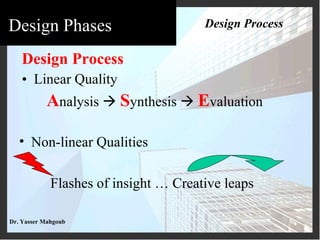
Design Process Linear Quality A nalysis     S ynthesis     E valuation Design Process Non-linear Qualities Flashes of insight … Creative leaps
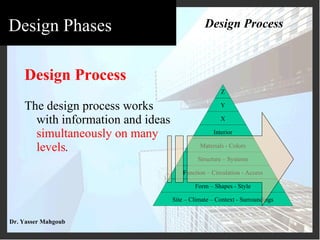
Design Process The design process works with information and ideas  simultaneously on many levels . Design Process Z Y X Interior Materials - Colors Structure – Systems Function – Circulation - Access Form – Shapes - Style Site – Climate – Context - Surroundings
Design Process Designing is a reciprocal Action and Reflection . Dr. Yasser Mahgoub
Analysis An initial step of design is to  identify, analyze, confirm, and organize  the  factors  that will influence the development of design concept. Analysis
Data  From: Economic feasibility studies Programming Site analysis To  a form that allows the information to be used in building design. Analysis
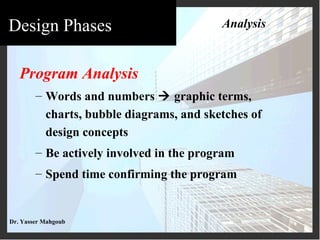
Analysis Program Analysis Words and numbers    graphic terms, charts, bubble diagrams, and sketches of design concepts Be actively involved in the program Spend time confirming the program
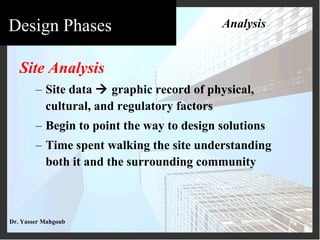
Site Analysis Site data    graphic record of physical, cultural, and regulatory factors Begin to point the way to design solutions Time spent walking the site understanding both it and the surrounding community Analysis
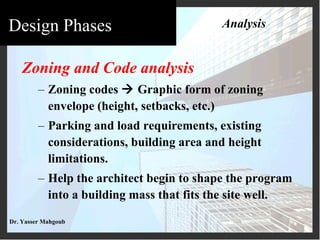
Zoning and Code analysis Zoning codes    Graphic form of zoning envelope (height, setbacks, etc.) Parking and load requirements, existing considerations, building area and height limitations. Help the architect begin to shape the program into a building mass that fits the site well. Analysis
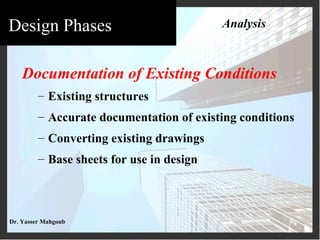
Documentation of Existing Conditions Existing structures Accurate documentation of existing conditions Converting existing drawings Base sheets for use in design Analysis
Analysis Scheduling Project phasing Time it takes to seek variances Sequencing of design decisions to accommodate fast-track construction
Cost Project budget and its implications for the building design Project budgets are limited Careful use of funds Analysis
Analysis Construction industry practice Local construction industry practice:  Availability of materials and labor Commonly used materials, systems, and detailing
Design precedents Relevant precedents from projects facing similar or related program, site, context, cost, or other design issues. It is common for architects to familiarize themselves with the design of buildings that deal with similar issues to stimulate solutions for their own design problems. Analysis
Synthesis The combination of all analysis, understanding, and response to base data collected and analyzed into a unified solution is the SYNTHESIS that is the core concept of design. Synthesis
The synthesis process Most architects start with an  analysis of the base data  and then work through  sketches ,  talking , and  thinking  until they  reach the level of understanding  necessary to form a concept. Synthesis
Aspects of design unique to a particular architect or firm Particular design stimuli Organizing principles Areas of emphasis Aesthetic vocabularies Synthesis
The Common Tasks of Design Establishing Design Goals Expressed  formally or informally Create functional and aesthetic  guidelines for judging design decisions Project objectives  help establish  priorities Synthesis
The Common Tasks of Design Evolving Design Concept (s) Plan concept Geometric form Mass the building vertically or horizontally Use of an organizing element Particular image Historic precedent "Design Vocabulary" of formal and aesthetic ideas Synthesis
The Common Tasks of Design Evaluating Concept Alternative Point-by-point evaluation against the original design objectives Intuitive judgment based on experience Combination of both Synthesis
Contractual Framework Agreement between owner and architect Outlines  design tasks and requirements Identifies  specific responsibilities  for design, including those of the architect, of the owner, and possibly of third parties Establishes  a schedule , including starting and completion dates Often defines design phases with interim milestone  dates  and own approvals to proceed Synthesis
End Dr. Yasser Mahgoub
Five Project Phases Schematic Design Design Development Construction Documents Bidding or Negotiation Construction Contract Administration Project Phases
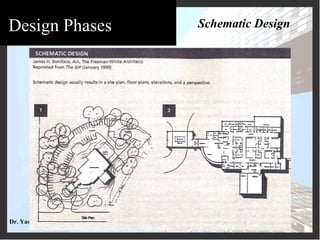
Schematic Design General scope, conceptual design and scale and relationships among the components of the project. Objectives arrive at clearly defined and feasible  concept present  it in a form that achieves client understanding and acceptance clarify the project  program explore the most promising  alternative  design solutions provide a reasonable basis for analyzing the  cost  of the project Schematic Design
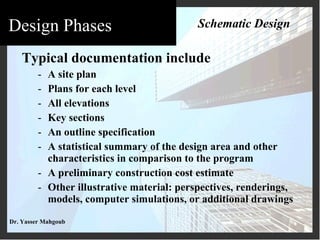
Typical documentation include A site plan Plans for each level All elevations Key sections An outline specification A statistical summary of the design area and other characteristics in comparison to the program A preliminary construction cost estimate Other illustrative material: perspectives, renderings, models, computer simulations, or additional drawings Schematic Design
Drawings 1:200 for large buildings 1:100 or 1:50 for smaller buildings and interiors Outline specifications General description of the work that indicates the major  systems and materials  choices for the project and provides the information necessary to communicate the  appearance and function  of the building. Schematic Design
Preliminary estimate of construction cost Preliminary area analysis Preliminary construction cost estimate Limited details: only major trades and systems  Preliminary analysis of owner's budget Recommendations for changes  Schematic Design
Schematic Design
Schematic Design
Schematic Design
Other services Life cycle cost analysis Energy studies Tenant-related design studies Economic studies Special renderings Models Brochures and promotional materials Schematic Design
Approvals Obtain formal client approval ( in writing  if all possible) If approval is given  verbally ,  send the client a letter confirming the architect's understanding of the approval and ask the client to initial the letter and return a copy . Schematic Design
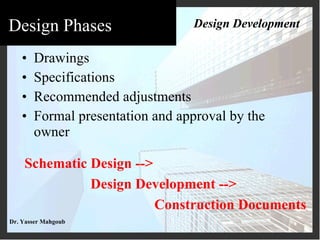
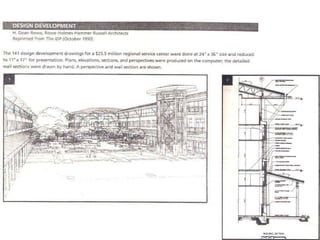
Design Development Refinement an coordination A really polished work of architecture minimizes the possibility of major modifications during the construction contract documents phase Define and describe all important aspects of the project so that what remains is the formal documentation step of construction contract documents. Clear, coordinated description of all aspects of the design. Fully developed floor plans, sections, exterior elevations, interior elevations, reflected ceiling plans, wall sections, and key details. Design Development
Drawings Specifications Recommended adjustments Formal presentation and approval by the owner Design Development Schematic Design -->  Design Development -->  Construction Documents
 
Design During the Implementation Phases During construction documents, bidding and negotiation, and construction contract administration phases of the project. Design continues even through the construction phase and everyday use of buildings and facilities..  "Design never really stops" Design Development
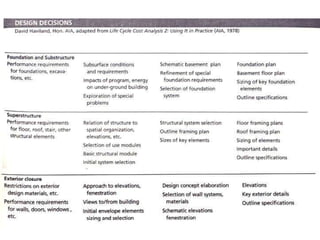
Design Decisions
Design Decisions

Architectural Professional Practice - Design

  • 1.
    Building Design Newbook 17.2 pp. 430 - 438
  • 2.
  • 3.
  • 4.
    What is DESIGNin this ARCHITECTURE?
  • 5.
    What is DESIGNin this ARCHITECTURE?
  • 6.
    What is DESIGNin this ARCHITECTURE?
  • 7.
    What is DESIGNin this ARCHITECTURE?
  • 8.
    What is DESIGNin this ARCHITECTURE?
  • 9.
    What is DESIGNin this ARCHITECTURE?
  • 10.
    What is DESIGNin this ARCHITECTURE?
  • 11.
    What is designin these buildings?
  • 12.
    What is designin these buildings?
  • 13.
    What is designin these buildings?
  • 14.
    What is designin these buildings?
  • 15.
    What is designin these buildings?
  • 16.
    What is designin these buildings?
  • 17.
    What is designin these buildings?
  • 18.
    What is designin these buildings?
  • 19.
    ANTONI GAUDI (1852-1926) . Ronchamp Casa Batllo Teulada Casa Lleo Morera La Pedrera The Residential Tower
  • 20.
    Le Corbusier Thehouse is a machine to live in. Ronchamp Unité d'habitation Villa Savoye Reinforced Concrete Principles The Residential Tower
  • 21.
    Frank Lloyd Wright. Johnson Wax Robie House Prairie Houses Guggenheim Museum Falling Water
  • 22.
    Richard Meier .Ulm Exhibition And Assembly Building J. Paul Getty Center Frankfurt Museum for Decorative Arts The High Museum Of Art Smith House
  • 23.
    FRANK O. GEHRY"As soon as I understand the scale of the building and the relationship to the site and the relationship to the client, as it becomes more and more clear to me, I start doing sketches". GUGGENHEIM MUSEUM NEW YORK GUGGENHEIM MUSEUM BILBAO WALT DISNEY CONCERT HALL MAGGIE’S CENTRE SCHOOL OF MANAGEMENT
  • 24.
    Peter Eisenman .Emory Center for the Arts Columbus Convention Center Bibliothèque de L'IHUEI Wexner Center Aronoff Center for Design and Art
  • 25.
    Zaha Hadid . LANDESGARTENSCHAU CARDIFF BAY OPERA HOUSE Vitra fire station HABITABLE BRIDGE SCHOOL OF MANAGEMENT
  • 26.
    Michael Graves . PORTLAND BUILDING Humana Tower HABITABLE BRIDGE
  • 27.
    Introduction Contracts betweenclients and architects identify types of building design services (e.g., schematic documents, design development documents, construction documents, etc.) and the tasks contained in each. Dr. Yasser Mahgoub
  • 28.
    Introduction Several trendsare affecting how architects approach and carry out building design: First is the fact that clients continue to seek greater value from design services . Dr. Yasser Mahgoub
  • 29.
    Introduction Clients whoare more sophisticated ; and better informed increasingly expect their building facilities to fulfill a range of needs beyond those mandated in health and safety regulations. Dr. Yasser Mahgoub
  • 30.
    Introduction This expectationchallenge's architects to be cognizant of those client needs and to respond to them creatively . Dr. Yasser Mahgoub
  • 31.
    Introduction Other trendspresent opportunities for architects to increase their design capabilities and expand their range of creativity. In the technology arena , software advances are giving architects more powerful tools to shape and evaluate design solutions. Dr. Yasser Mahgoub
  • 32.
    Introduction In the regulatory arena , the growing use of performance-based building codes promises to provide architects with more freedom in meeting regulatory requirements. Dr. Yasser Mahgoub
  • 33.
    Summary: BUILDINGDESIGN SERVICES Why a Client May Need These Services To respond to rapid or sudden growth To move to a new location To update or replace older facilities To improve productivity in operations To implement major organizational restructuring To bring an existing facility up to current regulatory standards To transform or create a new image or brand identity Dr. Yasser Mahgoub
  • 34.
    Summary: BUILDINGDESIGN SERVICES Knowledge and Skills Required Ability to evaluate program requirements critically Ability to create concepts that respond to program requirements Ability to delineate concepts and design solutions Understanding of building materials, components, and systems Understanding of building codes, standards, and regulations Familiarity with contracts and construction documentation Ability to communicate concepts to the client and consultants Knowledge of construction costs Dr. Yasser Mahgoub
  • 35.
    Summary: BUILDINGDESIGN SERVICES Representative Process Tasks Develop project understanding Develop schematic design documents Develop design development documents Dr. Yasser Mahgoub
  • 36.
    Introduction Architects don't make buildings perse. Using professional knowledge and skills, architects translate abstract ideas into building form expressed by the architect in sketches, plans, models, and specifications. Dr. Yasser Mahgoub
  • 37.
    Introduction The designprocess is difficult to map . It is nonlinear and highly interactive , embracing a mix of rational and intuitive decision making. Despite the lack of cookbook-style directions and definitive step-by-step procedures, architects successfully apply design thinking everyday in providing building design services to their clients. Dr. Yasser Mahgoub
  • 38.
    Lecture 1 Dr.Yasser Mahgoub
  • 39.
    Building design isthe keystone of architecture practice. Translating needs and aspirations , theories and technologies , and schedules and budgets into appropriate and exciting places and buildings requires great skill as well as attention to broader concerns . Design
  • 40.
    Design has momentsof great inspiration and deep insight - but most of all it required hours, months, and years of hard work. Complex and Inaccessible  yet  Taught to and practiced by thousands Design Private and Intuitive  yet  Broadly discussed and rationally analyzed
  • 41.
    Design is acontiniuous activity. Beginning    (no end) Design
  • 42.
    Design Influences Everyproject situation is different Different requirements and limitations Cultural, environmental, technological, aesthetic contexts Challenges and opportunities . Design
  • 43.
    It is both problem-seeking and problem-solving process. Design
  • 44.
    Program Requirements andLimitations General or Specific descriptive of needs Suggestive solutions Design Influences
  • 45.
    Community Desires Publicagency (ies) approvals To meet objections or to gain support. Design Influences
  • 46.
    Codes and RegulationsSafety requirements Minimal land use Light and air zoning A major force in design that regulates every aspect of design and construction Design Influences
  • 47.
    Site and ClimatePhysical characteristics: size, configuration, topography, geotechnical, etc. Climate : wind, solar orientation, temperatures, humidity, precipitation, etc. Environmental Factors : view, existing vegetation, drainage, etc. Access Adjacent land uses and other site factors. Design Influences
  • 48.
    Building context andexisting fabric The surrounding environment Influence: Materials Fenestration Color Detailing Existing structures Design Influences
  • 49.
    Building Technology Buildingconfiguration, materials, and systems are rarely arbitrarily chosen and are only partially based on aesthetic criteria . Dimensions may be dictated largely by mechanical systems or even by the knowledge and preferences of the local construction industry . Design Influences
  • 50.
    Sustainability The abilityof a society, ecosystem, or any such ongoing system to continue functioning into the indefinite future , without being forced into decline through exhaustion or overloading of the key resources on which that system depends. For architecture, this means design that delivers buildings and communities with lower environmental impacts while enhancing health, productivity, community, and quality of life. Design Influences
  • 51.
    Cost Projects have limited budgets . Cost considerations significantly influence almost all issues from building size and configuration to material selection and detailing. Budget: Fixed or flexible Schedule Design decisions out of sequence Design Influences
  • 52.
    The client TheGood client : Is there such a thing as "good client"? Some clients have a clear idea of program, budget, and other project objectives, including the final appearance of the building. Others look to the architect to help them define the project objectives, as well as to design a building that meets theses goals. Design Influences
  • 53.
    Lecture 2 Dr.Yasser Mahgoub
  • 54.
    The Value ofPre-design Extend "pre-design" as long as possible. It is defense mechanism against those "hot ideas" that will come up midway through the project. Invent ways to force yourself not to dive into design immediately Find ways of getting the client involved in this "discovery phase" Identify and achieve consensus on the five or six real issues the project brings you to solve Pre-Design
  • 55.
    The Value ofPre-design Challenge the design team to find as many ways as it can to translate constraints into three-dimensional potential forms without actually designing the building Look for ways - writing, diagrams, mass models, etc. - for describing both the minimum and requirements and your highest aspirations for the project. Pre-Design
  • 56.
    The Value ofPre-design Ask yourself: How will you know later that you succeeded? Describe - again without designing the building - the strongest, best formal concepts to be explored in the design. Involve the client in the program, budget, and expectations. Pre-Design
  • 57.
    Design Process LinearQuality A nalysis  S ynthesis  E valuation Design Process Non-linear Qualities Flashes of insight … Creative leaps
  • 58.
    Design Process Thedesign process works with information and ideas simultaneously on many levels . Design Process Z Y X Interior Materials - Colors Structure – Systems Function – Circulation - Access Form – Shapes - Style Site – Climate – Context - Surroundings
  • 59.
    Design Process Designingis a reciprocal Action and Reflection . Dr. Yasser Mahgoub
  • 60.
    Analysis An initialstep of design is to identify, analyze, confirm, and organize the factors that will influence the development of design concept. Analysis
  • 61.
    Data From:Economic feasibility studies Programming Site analysis To a form that allows the information to be used in building design. Analysis
  • 62.
    Analysis Program AnalysisWords and numbers  graphic terms, charts, bubble diagrams, and sketches of design concepts Be actively involved in the program Spend time confirming the program
  • 63.
    Site Analysis Sitedata  graphic record of physical, cultural, and regulatory factors Begin to point the way to design solutions Time spent walking the site understanding both it and the surrounding community Analysis
  • 64.
    Zoning and Codeanalysis Zoning codes  Graphic form of zoning envelope (height, setbacks, etc.) Parking and load requirements, existing considerations, building area and height limitations. Help the architect begin to shape the program into a building mass that fits the site well. Analysis
  • 65.
    Documentation of ExistingConditions Existing structures Accurate documentation of existing conditions Converting existing drawings Base sheets for use in design Analysis
  • 66.
    Analysis Scheduling Projectphasing Time it takes to seek variances Sequencing of design decisions to accommodate fast-track construction
  • 67.
    Cost Project budgetand its implications for the building design Project budgets are limited Careful use of funds Analysis
  • 68.
    Analysis Construction industrypractice Local construction industry practice: Availability of materials and labor Commonly used materials, systems, and detailing
  • 69.
    Design precedents Relevantprecedents from projects facing similar or related program, site, context, cost, or other design issues. It is common for architects to familiarize themselves with the design of buildings that deal with similar issues to stimulate solutions for their own design problems. Analysis
  • 70.
    Synthesis The combinationof all analysis, understanding, and response to base data collected and analyzed into a unified solution is the SYNTHESIS that is the core concept of design. Synthesis
  • 71.
    The synthesis processMost architects start with an analysis of the base data and then work through sketches , talking , and thinking until they reach the level of understanding necessary to form a concept. Synthesis
  • 72.
    Aspects of designunique to a particular architect or firm Particular design stimuli Organizing principles Areas of emphasis Aesthetic vocabularies Synthesis
  • 73.
    The Common Tasksof Design Establishing Design Goals Expressed formally or informally Create functional and aesthetic guidelines for judging design decisions Project objectives help establish priorities Synthesis
  • 74.
    The Common Tasksof Design Evolving Design Concept (s) Plan concept Geometric form Mass the building vertically or horizontally Use of an organizing element Particular image Historic precedent "Design Vocabulary" of formal and aesthetic ideas Synthesis
  • 75.
    The Common Tasksof Design Evaluating Concept Alternative Point-by-point evaluation against the original design objectives Intuitive judgment based on experience Combination of both Synthesis
  • 76.
    Contractual Framework Agreementbetween owner and architect Outlines design tasks and requirements Identifies specific responsibilities for design, including those of the architect, of the owner, and possibly of third parties Establishes a schedule , including starting and completion dates Often defines design phases with interim milestone dates and own approvals to proceed Synthesis
  • 77.
  • 78.
    Five Project PhasesSchematic Design Design Development Construction Documents Bidding or Negotiation Construction Contract Administration Project Phases
  • 79.
    Schematic Design Generalscope, conceptual design and scale and relationships among the components of the project. Objectives arrive at clearly defined and feasible concept present it in a form that achieves client understanding and acceptance clarify the project program explore the most promising alternative design solutions provide a reasonable basis for analyzing the cost of the project Schematic Design
  • 80.
    Typical documentation includeA site plan Plans for each level All elevations Key sections An outline specification A statistical summary of the design area and other characteristics in comparison to the program A preliminary construction cost estimate Other illustrative material: perspectives, renderings, models, computer simulations, or additional drawings Schematic Design
  • 81.
    Drawings 1:200 forlarge buildings 1:100 or 1:50 for smaller buildings and interiors Outline specifications General description of the work that indicates the major systems and materials choices for the project and provides the information necessary to communicate the appearance and function of the building. Schematic Design
  • 82.
    Preliminary estimate ofconstruction cost Preliminary area analysis Preliminary construction cost estimate Limited details: only major trades and systems Preliminary analysis of owner's budget Recommendations for changes Schematic Design
  • 83.
  • 84.
  • 85.
  • 86.
    Other services Lifecycle cost analysis Energy studies Tenant-related design studies Economic studies Special renderings Models Brochures and promotional materials Schematic Design
  • 87.
    Approvals Obtain formalclient approval ( in writing if all possible) If approval is given verbally , send the client a letter confirming the architect's understanding of the approval and ask the client to initial the letter and return a copy . Schematic Design
  • 88.
    Design Development Refinementan coordination A really polished work of architecture minimizes the possibility of major modifications during the construction contract documents phase Define and describe all important aspects of the project so that what remains is the formal documentation step of construction contract documents. Clear, coordinated description of all aspects of the design. Fully developed floor plans, sections, exterior elevations, interior elevations, reflected ceiling plans, wall sections, and key details. Design Development
  • 89.
    Drawings Specifications Recommendedadjustments Formal presentation and approval by the owner Design Development Schematic Design --> Design Development --> Construction Documents
  • 90.
  • 91.
    Design During theImplementation Phases During construction documents, bidding and negotiation, and construction contract administration phases of the project. Design continues even through the construction phase and everyday use of buildings and facilities.. "Design never really stops" Design Development
  • 92.
  • 93.