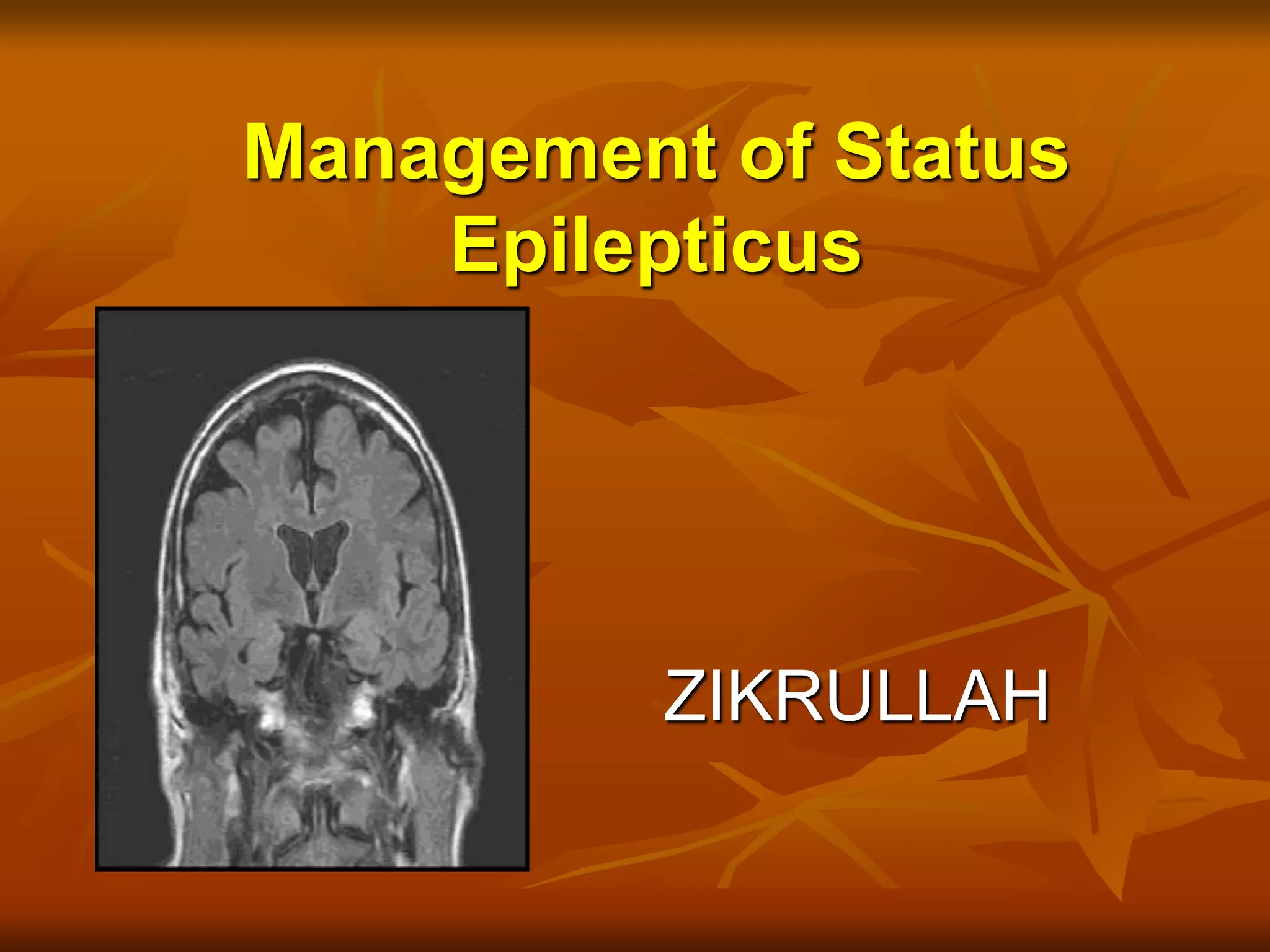

Management of Status
Epilepticus
ZIKRULLAH
Status Epilepticus-Definition
 Status epilepticus is defined as more than 30
minutes of continuous seizure activity
OR
 recurrent seizure activity without an
intervening period of consciousness
 more practical definition: since isolated tonic -
clonic seizures rarely last > few minutes ...
consider Status if sz > 5 min or 2 discrete sz with
no regaining of consciousness between
Types of status epilepticus
Generalized convulsive status epilepticus
-Most common form
Non-convulsive generalized status epilepticus
(subtle status epilepticus )
-requires electroencephalography for diagnosis
Refractory status epilepticus(>60 min )
- or is refractory to therapy with 2 or 3
anticonvulsant agents
Myoclonic status epilepticus
- characterized by irregular and repetitive
movements of the face and extremities
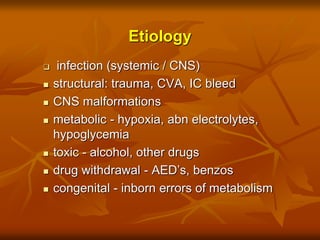
Etiology
 infection (systemic / CNS)
 structural: trauma, CVA, IC bleed
 CNS malformations
 metabolic - hypoxia, abn electrolytes,
hypoglycemia
 toxic - alcohol, other drugs
 drug withdrawal - AED’s, benzos
 congenital - inborn errors of metabolism
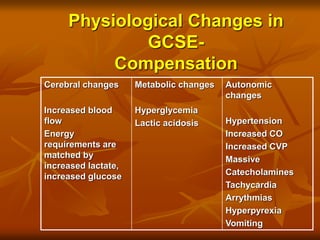
Physiological Changes in
GCSE-
Compensation
Cerebral changes
Increased blood
flow
Energy
requirements are
matched by
increased lactate,
increased glucose
Metabolic changes
Hyperglycemia
Lactic acidosis
Autonomic
changes
Hypertension
Increased CO
Increased CVP
Massive
Catecholamines
Tachycardia
Arrythmias
Hyperpyrexia
Vomiting
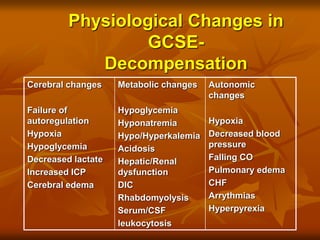
Physiological Changes in
GCSE-
Decompensation
Cerebral changes
Failure of
autoregulation
Hypoxia
Hypoglycemia
Decreased lactate
Increased ICP
Cerebral edema
Metabolic changes
Hypoglycemia
Hyponatremia
Hypo/Hyperkalemia
Acidosis
Hepatic/Renal
dysfunction
DIC
Rhabdomyolysis
Serum/CSF
leukocytosis
Autonomic
changes
Hypoxia
Decreased blood
pressure
Falling CO
Pulmonary edema
CHF
Arrythmias
Hyperpyrexia
Status epilepticus
 It is a medical emergency – requires prompt and
aggressive treatment
 Therapy should be aimed at:
 Rapid termination of status epilepticus
 Prevention of seizure recurrence
 Treatment of underlying cause
Management of SE General
measures
 ABC (Airway ,breathing, and circulation) is
the first priority
 Protect airway, tongue, head
 insert nasal airway or intubate if needed
 Check blood pressure.
 Begin nasal oxygen.
 Monitor ECG and respiration.
 Check temperature frequently.
 Obtain history.
 Perform neurologic examination.
 Send blood for evaluation of electrolytes, BUN,
glucose level, CBC, toxic drug screen, and AED
level and ABG
 Start EEG recording as soon as feasible.
 Imaging with computed tomography is
recommended
 If imaging is negative, lumbar puncture is
required to rule out infectious etiologies.
 Start IV line containing isotonic saline at a
low infusion rate.
 Inject 50 mL of 50 percent glucose IV and
100 mg of thiamine IV or IM.
 Correct electrolyte imbalance - acidosis lowers
seizure threshold, treat with bicarbonate if pH<7.1
 Treatment of underlying cause may proceed
concurrently with drug therapy, e.g., neurosurgical
decompression.
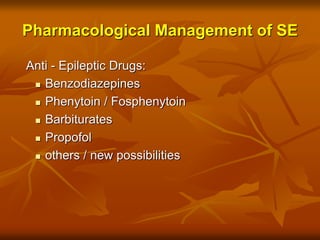
Pharmacological Management of SE
Anti - Epileptic Drugs:
 Benzodiazepines
 Phenytoin / Fosphenytoin
 Barbiturates
 Propofol
 others / new possibilities
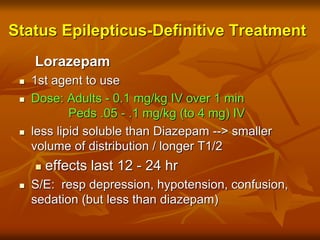
Status Epilepticus-Definitive Treatment
Lorazepam
 1st agent to use
 Dose: Adults - 0.1 mg/kg IV over 1 min
Peds .05 - .1 mg/kg (to 4 mg) IV
 less lipid soluble than Diazepam --> smaller
volume of distribution / longer T1/2
 effects last 12 - 24 hr
 S/E: resp depression, hypotension, confusion,
sedation (but less than diazepam)
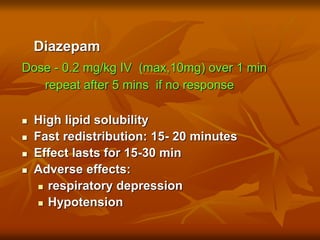
Diazepam
Dose - 0.2 mg/kg IV (max,10mg) over 1 min
repeat after 5 mins if no response
 High lipid solubility
 Fast redistribution: 15- 20 minutes
 Effect lasts for 15-30 min
 Adverse effects:
 respiratory depression
 Hypotension
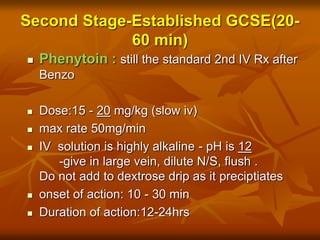
Second Stage-Established GCSE(20-
60 min)
 Phenytoin : still the standard 2nd IV Rx after
Benzo
 Dose:15 - 20 mg/kg (slow iv)
 max rate 50mg/min
 IV solution is highly alkaline - pH is 12
-give in large vein, dilute N/S, flush .
Do not add to dextrose drip as it preciptiates
 onset of action: 10 - 30 min
 Duration of action:12-24hrs
Phenytoin continued
 S/E - (most avoided if slower administration)
 hypotension
 arrhythmias - (must monitor ECG )
 respiratory depression
 extravasation -->tissue injury / necrosis
 C/I- in pt with second degree heart block
or severe hypotension
Fosphenytoin
 a prodrug of Phenytoin
 it has no anticonvulsant action itself, but is
rapidly converted to Phenytoin
 Dosage: in “Phenytoin Equivalents” to
attempt to avoid confusion
 15-18 phenytoin equivalent (PE)/kg iv/im at
max rate of 150 mg PE/min
 Molecular wt = 1.5 x Phenytoin ... so
1.5 mg Fosphen --> 1 mg Phenytoin
delivered
Fosphenytoin
 Advantages over Phenytoin:
 pH 8 (vs Phenytoin pH 12)
 does not require solvent (Phenytoin is dissolved
in propylene glycol)
 can give IM when no IV access
 IV: - less potential for irritation - can give faster
- no risk of tissue necrosis if goes interstitial
- does not precipitate in IV solutions
 lower risk of hypotension and dysrhythmias
Alternative therapeutic option
 Sodium Valproate: 25-35 mg/kg iv at max rate
of 6mg/kg/hr
S/E -Local irritation ,GI distress, Lethargy
 Phenobarbitone: 20 mg/kg iv at 60 mg/min
 S/E: profound hypotension
respiratory depression
 patient will likely need intubation & ventilation at
this point; (and will need ICU admission and
continuous EEG monitoring if SE persists)
Refractory Status Epilepticus
(>60min)
 Admit the pt in ICU
 Prepare to mechanically ventilate
 If intubating / ventilating - avoid long-acting n-m
blockers - masks sz activity
 Obtain central venous acces
 Continuous hemodynamic monitoring through
arterial line
 Start EEG monitoring
Refractory SE T/t
 Midazolam: 0.2 mg/kg iv (max 10 mg) bolus over
2 min followed by 0.1-0.4 mg/kg/h continuous iv
infusion
 Continue pharmacologic coma for 12 hrs after
last seizures with EEG goal of burst suppression
Thiopental
 Thiopental :10-20 mg/kg iv bolus followed by
0.5-1 mg/kg/h iv infusion
 rapid onset: 30 - 60 sec
 short duration: 20 - 30 min
 Thiopental - negative aspects:
 accumulates in fatty tissues
 long recovery time after infusion
 hemodynamic instability - CV depression,
hypotension, arrhythmias
Propofol
 Dose : 2-5mg/kg iv bolus
 Rate: 5-10 mg/kg/hr
 Onset: 2-4 min
 Half-life: 30-60 min
 does not accumulate --> rapid recovery
 Mechanism:
 stimulates GABA receptors (like
Benzos/Bbts)
 suppresses CNS metabolism
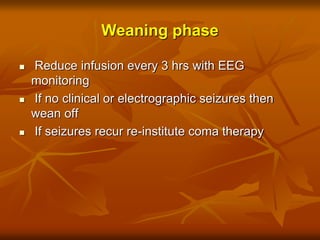
Weaning phase
 Reduce infusion every 3 hrs with EEG
monitoring
 If no clinical or electrographic seizures then
wean off
 If seizures recur re-institute coma therapy
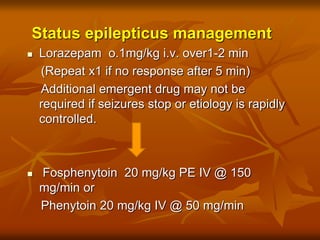
Status epilepticus management
 Lorazepam o.1mg/kg i.v. over1-2 min
(Repeat x1 if no response after 5 min)
Additional emergent drug may not be
required if seizures stop or etiology is rapidly
controlled.
 Fosphenytoin 20 mg/kg PE IV @ 150
mg/min or
Phenytoin 20 mg/kg IV @ 50 mg/min
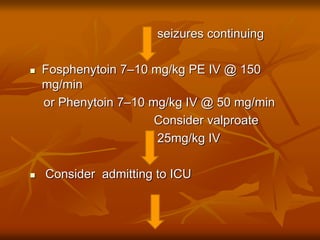
seizures continuing
 Fosphenytoin 7–10 mg/kg PE IV @ 150
mg/min
or Phenytoin 7–10 mg/kg IV @ 50 mg/min
Consider valproate
25mg/kg IV
 Consider admitting to ICU
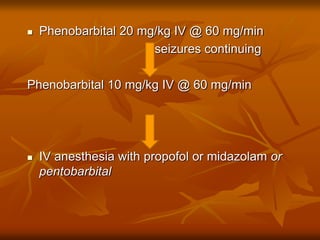
 Phenobarbital 20 mg/kg IV @ 60 mg/min
seizures continuing
Phenobarbital 10 mg/kg IV @ 60 mg/min
 IV anesthesia with propofol or midazolam or
pentobarbital
Maintenance AED treatment
 To prevent recurrence of seizures
 In known case of epilepsy, usual AEDs
maintained and dose adjusted depending on
serum AED levels
 In patients presenting for the first time drugs like
PHT or VPA used to control the status continued
as oral maintenance therapy
Possible new drugs for Status
 Lidocaine - some positive trials
 Gabapentin / Vigabatrin / Lamotrigine
 Felbamate - blocks NMDA receptors
 Ketamine - blocks NMDA receptors
Ketamine in SE
 blocks NMDA receptors - this may protect
brain from effects of excitatory NT’s
 may be neuroprotective as well as
antiepileptic
 some animal studies have demonstrated
control of refractory SE with Ketamine:
 more efffective than Phenobarb in LATE
SE (>60 min); not as effective in EARLY
SE
THANK YOU.

Status epilepticus management treatment

  • 1.
  • 2.
    Status Epilepticus-Definition  Statusepilepticus is defined as more than 30 minutes of continuous seizure activity OR  recurrent seizure activity without an intervening period of consciousness  more practical definition: since isolated tonic - clonic seizures rarely last > few minutes ... consider Status if sz > 5 min or 2 discrete sz with no regaining of consciousness between
  • 3.
    Types of statusepilepticus Generalized convulsive status epilepticus -Most common form Non-convulsive generalized status epilepticus (subtle status epilepticus ) -requires electroencephalography for diagnosis Refractory status epilepticus(>60 min ) - or is refractory to therapy with 2 or 3 anticonvulsant agents Myoclonic status epilepticus - characterized by irregular and repetitive movements of the face and extremities
  • 4.
    Etiology  infection (systemic/ CNS)  structural: trauma, CVA, IC bleed  CNS malformations  metabolic - hypoxia, abn electrolytes, hypoglycemia  toxic - alcohol, other drugs  drug withdrawal - AED’s, benzos  congenital - inborn errors of metabolism
  • 5.
    Physiological Changes in GCSE- Compensation Cerebralchanges Increased blood flow Energy requirements are matched by increased lactate, increased glucose Metabolic changes Hyperglycemia Lactic acidosis Autonomic changes Hypertension Increased CO Increased CVP Massive Catecholamines Tachycardia Arrythmias Hyperpyrexia Vomiting
  • 6.
    Physiological Changes in GCSE- Decompensation Cerebralchanges Failure of autoregulation Hypoxia Hypoglycemia Decreased lactate Increased ICP Cerebral edema Metabolic changes Hypoglycemia Hyponatremia Hypo/Hyperkalemia Acidosis Hepatic/Renal dysfunction DIC Rhabdomyolysis Serum/CSF leukocytosis Autonomic changes Hypoxia Decreased blood pressure Falling CO Pulmonary edema CHF Arrythmias Hyperpyrexia
  • 7.
    Status epilepticus  Itis a medical emergency – requires prompt and aggressive treatment  Therapy should be aimed at:  Rapid termination of status epilepticus  Prevention of seizure recurrence  Treatment of underlying cause
  • 8.
    Management of SEGeneral measures  ABC (Airway ,breathing, and circulation) is the first priority  Protect airway, tongue, head  insert nasal airway or intubate if needed  Check blood pressure.  Begin nasal oxygen.  Monitor ECG and respiration.  Check temperature frequently.  Obtain history.  Perform neurologic examination.
  • 9.
     Send bloodfor evaluation of electrolytes, BUN, glucose level, CBC, toxic drug screen, and AED level and ABG  Start EEG recording as soon as feasible.  Imaging with computed tomography is recommended  If imaging is negative, lumbar puncture is required to rule out infectious etiologies.
  • 10.
     Start IVline containing isotonic saline at a low infusion rate.  Inject 50 mL of 50 percent glucose IV and 100 mg of thiamine IV or IM.  Correct electrolyte imbalance - acidosis lowers seizure threshold, treat with bicarbonate if pH<7.1  Treatment of underlying cause may proceed concurrently with drug therapy, e.g., neurosurgical decompression.
  • 11.
    Pharmacological Management ofSE Anti - Epileptic Drugs:  Benzodiazepines  Phenytoin / Fosphenytoin  Barbiturates  Propofol  others / new possibilities
  • 12.
    Status Epilepticus-Definitive Treatment Lorazepam 1st agent to use  Dose: Adults - 0.1 mg/kg IV over 1 min Peds .05 - .1 mg/kg (to 4 mg) IV  less lipid soluble than Diazepam --> smaller volume of distribution / longer T1/2  effects last 12 - 24 hr  S/E: resp depression, hypotension, confusion, sedation (but less than diazepam)
  • 13.
    Diazepam Dose - 0.2mg/kg IV (max,10mg) over 1 min repeat after 5 mins if no response  High lipid solubility  Fast redistribution: 15- 20 minutes  Effect lasts for 15-30 min  Adverse effects:  respiratory depression  Hypotension
  • 14.
    Second Stage-Established GCSE(20- 60min)  Phenytoin : still the standard 2nd IV Rx after Benzo  Dose:15 - 20 mg/kg (slow iv)  max rate 50mg/min  IV solution is highly alkaline - pH is 12 -give in large vein, dilute N/S, flush . Do not add to dextrose drip as it preciptiates  onset of action: 10 - 30 min  Duration of action:12-24hrs
  • 15.
    Phenytoin continued  S/E- (most avoided if slower administration)  hypotension  arrhythmias - (must monitor ECG )  respiratory depression  extravasation -->tissue injury / necrosis  C/I- in pt with second degree heart block or severe hypotension
  • 16.
    Fosphenytoin  a prodrugof Phenytoin  it has no anticonvulsant action itself, but is rapidly converted to Phenytoin  Dosage: in “Phenytoin Equivalents” to attempt to avoid confusion  15-18 phenytoin equivalent (PE)/kg iv/im at max rate of 150 mg PE/min  Molecular wt = 1.5 x Phenytoin ... so 1.5 mg Fosphen --> 1 mg Phenytoin delivered
  • 17.
    Fosphenytoin  Advantages overPhenytoin:  pH 8 (vs Phenytoin pH 12)  does not require solvent (Phenytoin is dissolved in propylene glycol)  can give IM when no IV access  IV: - less potential for irritation - can give faster - no risk of tissue necrosis if goes interstitial - does not precipitate in IV solutions  lower risk of hypotension and dysrhythmias
  • 18.
    Alternative therapeutic option Sodium Valproate: 25-35 mg/kg iv at max rate of 6mg/kg/hr S/E -Local irritation ,GI distress, Lethargy  Phenobarbitone: 20 mg/kg iv at 60 mg/min  S/E: profound hypotension respiratory depression  patient will likely need intubation & ventilation at this point; (and will need ICU admission and continuous EEG monitoring if SE persists)
  • 19.
    Refractory Status Epilepticus (>60min) Admit the pt in ICU  Prepare to mechanically ventilate  If intubating / ventilating - avoid long-acting n-m blockers - masks sz activity  Obtain central venous acces  Continuous hemodynamic monitoring through arterial line  Start EEG monitoring
  • 20.
    Refractory SE T/t Midazolam: 0.2 mg/kg iv (max 10 mg) bolus over 2 min followed by 0.1-0.4 mg/kg/h continuous iv infusion  Continue pharmacologic coma for 12 hrs after last seizures with EEG goal of burst suppression
  • 21.
    Thiopental  Thiopental :10-20mg/kg iv bolus followed by 0.5-1 mg/kg/h iv infusion  rapid onset: 30 - 60 sec  short duration: 20 - 30 min  Thiopental - negative aspects:  accumulates in fatty tissues  long recovery time after infusion  hemodynamic instability - CV depression, hypotension, arrhythmias
  • 22.
    Propofol  Dose :2-5mg/kg iv bolus  Rate: 5-10 mg/kg/hr  Onset: 2-4 min  Half-life: 30-60 min  does not accumulate --> rapid recovery  Mechanism:  stimulates GABA receptors (like Benzos/Bbts)  suppresses CNS metabolism
  • 23.
    Weaning phase  Reduceinfusion every 3 hrs with EEG monitoring  If no clinical or electrographic seizures then wean off  If seizures recur re-institute coma therapy
  • 24.
    Status epilepticus management Lorazepam o.1mg/kg i.v. over1-2 min (Repeat x1 if no response after 5 min) Additional emergent drug may not be required if seizures stop or etiology is rapidly controlled.  Fosphenytoin 20 mg/kg PE IV @ 150 mg/min or Phenytoin 20 mg/kg IV @ 50 mg/min
  • 25.
    seizures continuing  Fosphenytoin7–10 mg/kg PE IV @ 150 mg/min or Phenytoin 7–10 mg/kg IV @ 50 mg/min Consider valproate 25mg/kg IV  Consider admitting to ICU
  • 26.
     Phenobarbital 20mg/kg IV @ 60 mg/min seizures continuing Phenobarbital 10 mg/kg IV @ 60 mg/min  IV anesthesia with propofol or midazolam or pentobarbital
  • 27.
    Maintenance AED treatment To prevent recurrence of seizures  In known case of epilepsy, usual AEDs maintained and dose adjusted depending on serum AED levels  In patients presenting for the first time drugs like PHT or VPA used to control the status continued as oral maintenance therapy
  • 28.
    Possible new drugsfor Status  Lidocaine - some positive trials  Gabapentin / Vigabatrin / Lamotrigine  Felbamate - blocks NMDA receptors  Ketamine - blocks NMDA receptors
  • 29.
    Ketamine in SE blocks NMDA receptors - this may protect brain from effects of excitatory NT’s  may be neuroprotective as well as antiepileptic  some animal studies have demonstrated control of refractory SE with Ketamine:  more efffective than Phenobarb in LATE SE (>60 min); not as effective in EARLY SE
  • 30.