
STATUS EPILEPTICUS
DEFINITION: 
• SE is a common neurological emergency. 
• SE is defined as continues seizure activity 
lasting more than 30 min or 2 or more seizures 
in this duration without gaining consciousness 
between them. 
• However the operational definition has brought 
the time down to 5 min. 
• Recent data suggests that neuronal damage 
starts much early than 30 minuts.
TERMINOLOGY: 
• IMPENDING SE : Term used for seizures 
between 5 and 30 minuts. 
• CONVULSIVE SE : Manifests as GTCS, clonic 
or tonic-clonic seizures. 
• NON-CONVULSIVE SE : Manifests as 
confusional state,dementia,hyperactivity with 
behavioral problems, fluctuating impairment of 
consciousness with at times unsteady sitting 
and walking (absence status), hallucinations, 
paranoia.
TERMINOLOGY Contd.. 
• REFRACTORY SE: SE that has failed to 
respond to therapy, usually with at least 2 
(some have specified 3) medications. 
• NEW-ONSET REFRACTORY SE (NORSE) : A 
distinct entity that can be caused by almost any 
of the causes of SE in a patient without prior 
epilepsy. It is often of unknown etiology, 
presumed to be encephalitic or post-encephalitic, 
can last for several weeks or 
longer and often has a poor prognosis.
ETIOLOGY: 
• New onset epilepsy of any type. 
• Drug intoxication (eg. TCA’s), drug withdrawl and 
abuse. 
• Electrolyte imbalance, 
• Acute head trauma. 
• Encephalitis, Meningitis,Stroke. 
• HIE, Brain tumors. 
• IEM (nonketotic hyperglycenemia, MELAS). 
• Neurodegenerative diseases.
ETIOLOGICAL CLASSIFICATION OF SE: 
• CRYPTOGENIC: SE in absence of an acute precipitating CNS 
insult or metabolic dysfunction in a patient without a pre-existing 
neurologic abnormality. 
• REMOTE SYMPTOMATIC: SE in a patient with a known 
history of a neurologic insult asociated with an increased risk 
of seizures(Stroke,TBI,static encephalopathy). 
• FEBRILE: THE MOST COMMON TYPE IN CHILDREN. SE 
provoked solely by fever in a patient without a history of 
afebrile seizures. 
• ACUTE SYMPTOMATIC: SE during an acute illness involving 
a known neurologic insult or metabolic dysfunction. 
• PROGRESSIVE ENCEPHALOPATHY: SE in a pt. with a 
progressive neurologic disease.
MECHANISM OF SE: 
• Desensitization of AMPA glutamate receptors, thus 
persistant electrical activity. 
• Reduction of GABA mediated inhibition due to 
intracellular internalization of GABA-A receptors, thus 
SE is often refractory to BZD’s. 
• SE can cause both neuronal necrosis and apoptosis.
MANAGEMENT PROTOCOL: 
• Initial stabilization. 
• Seizure termination. 
• Pharmacotherapy.
MANAGEMENT: 
• INITIAL STABILIZATION: 
• Airway,Breathing,Circulation. 
• Rapid sequence intubation to be don when- GCS<8 
or respiratory failure develops. 
• SEIZURE TERMINATION: 
• Achieved by pharmacotherapy. 
• Diagnostic evaluation and seizure termination should 
be achieved simultaneously.
PHARMACOTHERAPY: 
• BENZODIAZEPINES: 
• First line drugs. 
• Acts on GABA-a receptors and inhibit neuronal 
transmission. 
• However as seizure progresses, these receptors 
are internalized resulting in lower efficacy of 
these drugs in prolonged seizures. 
• Eg. Lorazepam (0.1mg/kg IV), Diazepam (0.2-0.5 
mg/kg IV or 0.5 mg/kg rectal), Midazolam (0.15- 
0.2 mg/kg IV; 0.2 mg/kg IM; 0.3 mg/kg buccal or 
nasal). 
• BZD’s may be repeated after 3-5 min. if required.
PHARMACOTHERAPY contd.. 
• PHENYTOIN: 
• Second line agent. 
• Indicated when seizures are not controlled by one or more 
dose of BZD’s. 
• Acts by slowing the rate of recovery of voltage gated 
sodium channels. 
• Phenytoin – LD 20 mg/kg (NOT compatible with dextrose); 
additional 10mg/kg may be required. 
• Phosphenytoin- water soluble phosphate ester of 
phenytoin hence can be administered 3 times faster than 
phenytoin. LD- 20 mg/kg Phenytoin equivalent.
PHARMACOTHERAPY contd.. 
• PHENOBARBITONE: 
• First line agent in neonatal seizures. 
• A potent AED, acts by enhancing GABA-A activity. 
• Dose- 20 mg/kg infused at no more than 30 mg/min. 
• Unacceptably high incidence of sedation and respiratory 
depression and it may be difficult to perform neurological 
assesment upto 24-36 hrs.
PHARMACOTHERAPY contd.. 
• VALPROATE: 
• Acts through several mechanisms including modulation of 
sodium and calcium currents and increasing inhibitory 
GABA transmission. 
• Variable doses ranging from 20-40 mg/kg have been used 
with success. 
• Rare side effects- Hepatotoxicity, Encephalopathy, 
hyperammonemia. 
• Broad spectrum, low incidence of adverse effects, ability 
to administer rapidly and ease of conversion to oral 
therapy makes it a good choice as second line AED after 
BZD’s.
PHARMACOTHERAPY contd.. 
• LEVETIRACETAM: 
• New broad spectrum anticonvulsant, recently been used 
with success in acute seizures and SE. 
• Renal excretion, free from any significant drug 
interactions, neuroprotective effects demonstrated. 
• Multiple sites of action- Ca, glutamate receptors and 
GABA modulation. 
• LD- 20-30 mg/kg @ 5 mg/kg/min.
PHARMACOTHERAPY contd.. 
• MIDAZOLAM INFUSION: 
• Effective both as bolus dose in initial m/g and refractory 
SE when second line drugs have failed. 
• Water soluble BZD with rapid action and short halflife. 
• Started at 1mcg/kg/min increasing by 1mcg/kg/min every 
5 min, max dose upto 32mcg/kg/min have been used with 
no serious side effects.
REFRACTORY SE (RSE) : 
• Various definitions used- some suggests duration of 
seizures> 1 or 2 hrs but a widely acceptable definition is 
saizure (clinical or electrographic) persisting despite use 
of two or more AED. 
• Often have systemic complications of SE, require hemo-dynamic- 
respiratory support, continous EEG monitoring 
and have poor outcome. 
• Drugs used in m/g of RSE- Levetiracitam, Valproate, 
Midazolam infusion, Anaesthetic agents (phenibarbital, 
thiopentone,propofol, inhaled anesthetics). High dose 
phenobarbitone, Ketamine and Topiramate.
BARBITURATE COMA: 
• THIOPENTAL AND PHENOBARBITAL: 
• Good efficacy in RSE, short half-life, penetrates CNS 
quickly, gets deposited in fat and released slowly. 
• Thiopental - LD- 3-5 mg/kg f/b further boluses of 1-2 
mg/kg within 3-5 min till seizure cessation. 
• Phenobarbital – 10-15 mg/kg initial bolus f/b further 2-5 
mg/kg boluses q 5 min till seizure control f/b infusion of 1- 
3 mg/kg/hr. 
• Serious side-effects – hypotension, respiratory depression 
and decreased cardiac contractility, suppression of 
lymphocyte activation.
PROPOFOL: 
• An IV GA- acts through GABA-A receptors via a 
mechanism probably different from BZD’s and 
barbiturates. 
• Short half life and does not gets accumulated in fat so 
rapid awakening after discontinuation. 
• Can cause “Propofol infusion syndrome” in children 
characterized by cardiac failure,rhabdomyolysis, 
metabolic acidosis, RF, death. 
• Hence NOT recommended in children <16 yrs of age. 
• Dose- bolus 1-2 mg/kg f/b infusion of 1-2 mg/kg/hr to a 
max of 5mg/kg/hr.
INHALED ANAESTHETICS: 
• Used when all other drugs fail. 
• Desflurane and Isoflurane are preferred. 
• Side effects- hypotension requiring fluids and 
vasopressors.
HIGH DOSE PHENOBARBITINE: 
• Phenobarbitone has significantly longer half life as 
compared to phenobarbital and thiopental. 
• In RSE doses upto 80mg/kg have been used resulting in 
serum levels >1000 mcg/ml.
KETAMINE: 
• Acts independent of GABA pathway. 
• Non- competitive NMDA receptor antagonist with 
additional neuro-protective effect. 
• In RSE give IV. Dose- Bolus 1.5 mg/kg f/b infusion @ 
0.01-0.05 mg/kg/hr. 
• Caution in patients with increased ICP. Ketamine 
increases ICP. 
• Rule out SOL.
TOPIRAMATE: 
• Oral novel anticonvulsant. 
• Multiple sites of action- potentiates GABA activity, reduces 
Glutamate release and blockade of voltage sensitive 
sodium and calcium channels. 
• Effective in controlling seizures while weaning of coma 
inducing drugs is being done. 
• Side effects- lethargy, ataxia and metabolic acidosis.
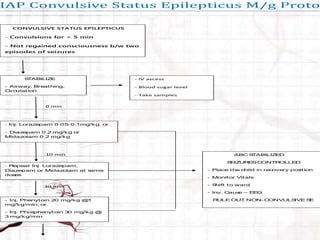
IAP Convulsive Status Epilepticus M/g Protocol 
CONVULSIVE STATUS EPILEPTICUS 
- Convulsions for > 5 min 
- Not regained consciousness b/w two 
episodes of seizures 
STABILIZE 
- Airway, Breathing, 
Circulation 
0 min 
10 min 
30 min 
- IV ascess 
- Blood sugar level 
- Take samples 
- Inj. Lorazepam 0.05-0.1 mg/kg, or 
- Diazepam 0.2 mg/kg or 
Midazolam 0.2 mg/kg 
- Repeat Inj. Lorazepam, 
Diazepam or Midazolam at same 
doses 
- Inj. Phenytoin 20 mg/kg @ 1 
mg/kg/min; or 
- Inj. Phosphenytoin 30 mg/kg @ 
3 mg/kg/min 
ABC STABILIZED 
SEIZURES CONTROLLED 
- Place the child in recovery position 
- Monitor Vitals 
- Shift to ward 
- Inv. Cause – EEG 
RULE OUT NON-CONVULSIVE SE
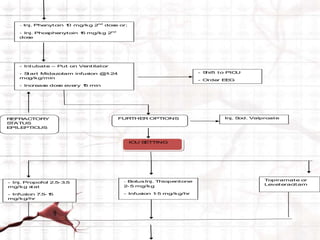
- Inj. Phenytoin 10 mg/kg 2nd dose or; 
- Inj. Phosphenytoin 15 mg/kg 2nd 
dose 
- Intubate – Put on Ventilator 
- Start Midazolam infusion @ 1-24 
mcg/kg/min 
- Increase dose every 15 min 
- Shift to PICU 
- Order EEG 
REFRACTORY FURTHER OPTIONS 
STATUS 
EPILEPTICUS 
Inj. Sod. Valproate 
ICU SETTING 
- Inj. Propofol 2.5-3.5 
mg/kg stat 
- Infusion 7.5-15 
mg/kg/hr 
- Bolus Inj. Thiopentone 
2-5 mg/kg 
- Infusion 1-5 mg/kg/hr 
Topiramate or 
Leveteracitam
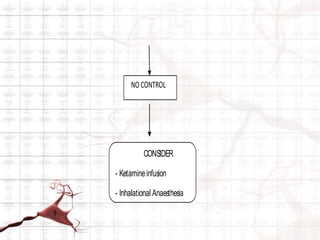
NO CONTROL 
CONSIDER 
- Ketamine infusion 
- Inhalational Anaesthesia
EVALATION AND T/T OF UNDERLYING 
CAUSE: 
• A good history and general physical examination gives 
important clues to diagnosis. 
• S.electrolytes, Blood sugar, BUN, toxic screen, CBC, LP, 
Neuroradiological examinations are warrented if required.
COMPLICATIONS OF SE: 
• Initial phase- tachycardia, hypertension and increased 
cardiac output are present due to increased sympathetic 
discharge. 
• With ongoing seizure hypotension develops. 
• Hypoxia, metabolic acidosis,hyperpyrexia,hyperglycemia 
and later hypolycemia. 
• Less common- neurogenic pulmonary edema, renal 
failure due to rhabdomyolysis, aspiration pneumonia and 
shock.
OUTCOME: 
• Prolonged SE is associated with higher mortality and 
morbidity. 
• Long term neurological sequele- Epilepsy, behavioural 
problems, cognitive decline and focal neurological deficits.
Status epilepticus

Status epilepticus

  • 1.
  • 2.
    DEFINITION: • SEis a common neurological emergency. • SE is defined as continues seizure activity lasting more than 30 min or 2 or more seizures in this duration without gaining consciousness between them. • However the operational definition has brought the time down to 5 min. • Recent data suggests that neuronal damage starts much early than 30 minuts.
  • 3.
    TERMINOLOGY: • IMPENDINGSE : Term used for seizures between 5 and 30 minuts. • CONVULSIVE SE : Manifests as GTCS, clonic or tonic-clonic seizures. • NON-CONVULSIVE SE : Manifests as confusional state,dementia,hyperactivity with behavioral problems, fluctuating impairment of consciousness with at times unsteady sitting and walking (absence status), hallucinations, paranoia.
  • 4.
    TERMINOLOGY Contd.. •REFRACTORY SE: SE that has failed to respond to therapy, usually with at least 2 (some have specified 3) medications. • NEW-ONSET REFRACTORY SE (NORSE) : A distinct entity that can be caused by almost any of the causes of SE in a patient without prior epilepsy. It is often of unknown etiology, presumed to be encephalitic or post-encephalitic, can last for several weeks or longer and often has a poor prognosis.
  • 5.
    ETIOLOGY: • Newonset epilepsy of any type. • Drug intoxication (eg. TCA’s), drug withdrawl and abuse. • Electrolyte imbalance, • Acute head trauma. • Encephalitis, Meningitis,Stroke. • HIE, Brain tumors. • IEM (nonketotic hyperglycenemia, MELAS). • Neurodegenerative diseases.
  • 6.
    ETIOLOGICAL CLASSIFICATION OFSE: • CRYPTOGENIC: SE in absence of an acute precipitating CNS insult or metabolic dysfunction in a patient without a pre-existing neurologic abnormality. • REMOTE SYMPTOMATIC: SE in a patient with a known history of a neurologic insult asociated with an increased risk of seizures(Stroke,TBI,static encephalopathy). • FEBRILE: THE MOST COMMON TYPE IN CHILDREN. SE provoked solely by fever in a patient without a history of afebrile seizures. • ACUTE SYMPTOMATIC: SE during an acute illness involving a known neurologic insult or metabolic dysfunction. • PROGRESSIVE ENCEPHALOPATHY: SE in a pt. with a progressive neurologic disease.
  • 7.
    MECHANISM OF SE: • Desensitization of AMPA glutamate receptors, thus persistant electrical activity. • Reduction of GABA mediated inhibition due to intracellular internalization of GABA-A receptors, thus SE is often refractory to BZD’s. • SE can cause both neuronal necrosis and apoptosis.
  • 8.
    MANAGEMENT PROTOCOL: •Initial stabilization. • Seizure termination. • Pharmacotherapy.
  • 9.
    MANAGEMENT: • INITIALSTABILIZATION: • Airway,Breathing,Circulation. • Rapid sequence intubation to be don when- GCS<8 or respiratory failure develops. • SEIZURE TERMINATION: • Achieved by pharmacotherapy. • Diagnostic evaluation and seizure termination should be achieved simultaneously.
  • 10.
    PHARMACOTHERAPY: • BENZODIAZEPINES: • First line drugs. • Acts on GABA-a receptors and inhibit neuronal transmission. • However as seizure progresses, these receptors are internalized resulting in lower efficacy of these drugs in prolonged seizures. • Eg. Lorazepam (0.1mg/kg IV), Diazepam (0.2-0.5 mg/kg IV or 0.5 mg/kg rectal), Midazolam (0.15- 0.2 mg/kg IV; 0.2 mg/kg IM; 0.3 mg/kg buccal or nasal). • BZD’s may be repeated after 3-5 min. if required.
  • 11.
    PHARMACOTHERAPY contd.. •PHENYTOIN: • Second line agent. • Indicated when seizures are not controlled by one or more dose of BZD’s. • Acts by slowing the rate of recovery of voltage gated sodium channels. • Phenytoin – LD 20 mg/kg (NOT compatible with dextrose); additional 10mg/kg may be required. • Phosphenytoin- water soluble phosphate ester of phenytoin hence can be administered 3 times faster than phenytoin. LD- 20 mg/kg Phenytoin equivalent.
  • 12.
    PHARMACOTHERAPY contd.. •PHENOBARBITONE: • First line agent in neonatal seizures. • A potent AED, acts by enhancing GABA-A activity. • Dose- 20 mg/kg infused at no more than 30 mg/min. • Unacceptably high incidence of sedation and respiratory depression and it may be difficult to perform neurological assesment upto 24-36 hrs.
  • 13.
    PHARMACOTHERAPY contd.. •VALPROATE: • Acts through several mechanisms including modulation of sodium and calcium currents and increasing inhibitory GABA transmission. • Variable doses ranging from 20-40 mg/kg have been used with success. • Rare side effects- Hepatotoxicity, Encephalopathy, hyperammonemia. • Broad spectrum, low incidence of adverse effects, ability to administer rapidly and ease of conversion to oral therapy makes it a good choice as second line AED after BZD’s.
  • 14.
    PHARMACOTHERAPY contd.. •LEVETIRACETAM: • New broad spectrum anticonvulsant, recently been used with success in acute seizures and SE. • Renal excretion, free from any significant drug interactions, neuroprotective effects demonstrated. • Multiple sites of action- Ca, glutamate receptors and GABA modulation. • LD- 20-30 mg/kg @ 5 mg/kg/min.
  • 15.
    PHARMACOTHERAPY contd.. •MIDAZOLAM INFUSION: • Effective both as bolus dose in initial m/g and refractory SE when second line drugs have failed. • Water soluble BZD with rapid action and short halflife. • Started at 1mcg/kg/min increasing by 1mcg/kg/min every 5 min, max dose upto 32mcg/kg/min have been used with no serious side effects.
  • 16.
    REFRACTORY SE (RSE): • Various definitions used- some suggests duration of seizures> 1 or 2 hrs but a widely acceptable definition is saizure (clinical or electrographic) persisting despite use of two or more AED. • Often have systemic complications of SE, require hemo-dynamic- respiratory support, continous EEG monitoring and have poor outcome. • Drugs used in m/g of RSE- Levetiracitam, Valproate, Midazolam infusion, Anaesthetic agents (phenibarbital, thiopentone,propofol, inhaled anesthetics). High dose phenobarbitone, Ketamine and Topiramate.
  • 17.
    BARBITURATE COMA: •THIOPENTAL AND PHENOBARBITAL: • Good efficacy in RSE, short half-life, penetrates CNS quickly, gets deposited in fat and released slowly. • Thiopental - LD- 3-5 mg/kg f/b further boluses of 1-2 mg/kg within 3-5 min till seizure cessation. • Phenobarbital – 10-15 mg/kg initial bolus f/b further 2-5 mg/kg boluses q 5 min till seizure control f/b infusion of 1- 3 mg/kg/hr. • Serious side-effects – hypotension, respiratory depression and decreased cardiac contractility, suppression of lymphocyte activation.
  • 18.
    PROPOFOL: • AnIV GA- acts through GABA-A receptors via a mechanism probably different from BZD’s and barbiturates. • Short half life and does not gets accumulated in fat so rapid awakening after discontinuation. • Can cause “Propofol infusion syndrome” in children characterized by cardiac failure,rhabdomyolysis, metabolic acidosis, RF, death. • Hence NOT recommended in children <16 yrs of age. • Dose- bolus 1-2 mg/kg f/b infusion of 1-2 mg/kg/hr to a max of 5mg/kg/hr.
  • 19.
    INHALED ANAESTHETICS: •Used when all other drugs fail. • Desflurane and Isoflurane are preferred. • Side effects- hypotension requiring fluids and vasopressors.
  • 20.
    HIGH DOSE PHENOBARBITINE: • Phenobarbitone has significantly longer half life as compared to phenobarbital and thiopental. • In RSE doses upto 80mg/kg have been used resulting in serum levels >1000 mcg/ml.
  • 21.
    KETAMINE: • Actsindependent of GABA pathway. • Non- competitive NMDA receptor antagonist with additional neuro-protective effect. • In RSE give IV. Dose- Bolus 1.5 mg/kg f/b infusion @ 0.01-0.05 mg/kg/hr. • Caution in patients with increased ICP. Ketamine increases ICP. • Rule out SOL.
  • 22.
    TOPIRAMATE: • Oralnovel anticonvulsant. • Multiple sites of action- potentiates GABA activity, reduces Glutamate release and blockade of voltage sensitive sodium and calcium channels. • Effective in controlling seizures while weaning of coma inducing drugs is being done. • Side effects- lethargy, ataxia and metabolic acidosis.
  • 23.
    IAP Convulsive StatusEpilepticus M/g Protocol CONVULSIVE STATUS EPILEPTICUS - Convulsions for > 5 min - Not regained consciousness b/w two episodes of seizures STABILIZE - Airway, Breathing, Circulation 0 min 10 min 30 min - IV ascess - Blood sugar level - Take samples - Inj. Lorazepam 0.05-0.1 mg/kg, or - Diazepam 0.2 mg/kg or Midazolam 0.2 mg/kg - Repeat Inj. Lorazepam, Diazepam or Midazolam at same doses - Inj. Phenytoin 20 mg/kg @ 1 mg/kg/min; or - Inj. Phosphenytoin 30 mg/kg @ 3 mg/kg/min ABC STABILIZED SEIZURES CONTROLLED - Place the child in recovery position - Monitor Vitals - Shift to ward - Inv. Cause – EEG RULE OUT NON-CONVULSIVE SE
  • 24.
    - Inj. Phenytoin10 mg/kg 2nd dose or; - Inj. Phosphenytoin 15 mg/kg 2nd dose - Intubate – Put on Ventilator - Start Midazolam infusion @ 1-24 mcg/kg/min - Increase dose every 15 min - Shift to PICU - Order EEG REFRACTORY FURTHER OPTIONS STATUS EPILEPTICUS Inj. Sod. Valproate ICU SETTING - Inj. Propofol 2.5-3.5 mg/kg stat - Infusion 7.5-15 mg/kg/hr - Bolus Inj. Thiopentone 2-5 mg/kg - Infusion 1-5 mg/kg/hr Topiramate or Leveteracitam
  • 25.
    NO CONTROL CONSIDER - Ketamine infusion - Inhalational Anaesthesia
  • 26.
    EVALATION AND T/TOF UNDERLYING CAUSE: • A good history and general physical examination gives important clues to diagnosis. • S.electrolytes, Blood sugar, BUN, toxic screen, CBC, LP, Neuroradiological examinations are warrented if required.
  • 27.
    COMPLICATIONS OF SE: • Initial phase- tachycardia, hypertension and increased cardiac output are present due to increased sympathetic discharge. • With ongoing seizure hypotension develops. • Hypoxia, metabolic acidosis,hyperpyrexia,hyperglycemia and later hypolycemia. • Less common- neurogenic pulmonary edema, renal failure due to rhabdomyolysis, aspiration pneumonia and shock.
  • 28.
    OUTCOME: • ProlongedSE is associated with higher mortality and morbidity. • Long term neurological sequele- Epilepsy, behavioural problems, cognitive decline and focal neurological deficits.