PHYSIOLOGICAL FUNCTIONS
OF THE LIVER
DR ZIKRULLAH MALLICK
Department of Anaesthesiology & critical Care
JAWAHARLAL NEHRU MEDICAL
COLLEGE,ALIGARH
• Liver is the largest internal organ & largest gland in
the human body.
• Liver is at the epicenter of intermediary metabolism.
• It performs versatile & massive biochemical pathways.
• It destroys bacteria, inactivate antigens, detoxify harmful
chemicals.
• Thus multiple & diverse functions of liver have an
impact on every tissue in the body.
Physiological functions of liver
• Intermediary metabolism
a. Carbohydrate metabolism
b. Lipid metabolism
c. Bile metabolsim and entero- hepatic circulation
d. Protein metabolism
• Coagulation
• Heme metabolism
• Bilirubin metabolism
• Xenobiotics metabolism
• Storage
• Endocrine functions
• Immune & inflammatory response
• Blood reservoir
Carbohydrate metabolism
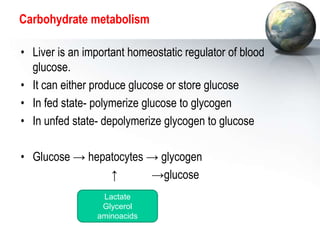
• Liver is an important homeostatic regulator of blood
glucose.
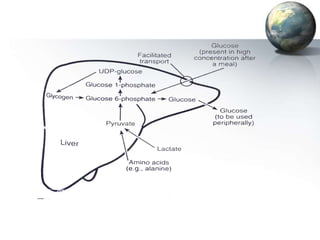
• It can either produce glucose or store glucose
• In fed state- polymerize glucose to glycogen
• In unfed state- depolymerize glycogen to glucose
• Glucose → hepatocytes → glycogen
↑ →glucose
Lactate
Glycerol
aminoacids
Carbohydrate metabolism
• Glycogen metabolism
• Regulation – 2 rate limiting enzymes
1. Glycogen synthase- synthesis of glycogen from monomers of
UDP glucose.
2. Glycogen phosphorylase- clevage of glycogen to glucose-1-
phosphate.
Carbohydrate metabolism
Gluconeogenesis
• Liver glycogen stores depleted - hepatic gluconeogenesis
to replenish blood glucose.
• Substrates-
- lactate
- glycerol from hydrolysis of triglycerides
- gluconeogenic amino acid , alanine , glutamine
• Blood glucose regulation within a narrow limit (70-100 mg/dl) 
not affected in liver disease due to large reserve of hepatic
function
 Effects of anaesthesia on carbohydrate metabolism
• Halothane
–  release of insulin
–  rate of glycogenolysis
– Inhibition of gluconeogenic response
• Isoflurane
– Impaired insulin secretion
Lipid Metabolism
•  Oxidation of fatty acids
• Fatty acids derived from plasma

• Enter into mitochondria

•  oxidation: fatty acids  AcetylCoA  citric acid cycle
• Regulators
- Glucagon - activates
- Insulin - inhibits
• Synthesis of lipoproteins
• One of the major functions of the liver
• Major classes
– VLDL
– LDL
– HDL
• VLDL
• Acute or chronic liver disease – ability to produce VLDL is
markedly compromised
• Liver VLDLs are associated with an important class of
proteins, the apo B protein
• Apo B100 - important for hepatic secretion of VLDL.
• Decreased in ABETALIPOPROTEINEMIA
• LDLs and HDLs
• Liver produces them in a small amount
• Production of ketone bodies
• Most organs except the liver- use ketone bodies as fuel
• Ketone bodies – acetoacetic acid, acetone,
 hydroxybutyrate
• Their formation by the liver is normal and physiologically important,
e.g.
– Fasting  rapid depletion of glycogen stores in the liver 
shortage of substrates for citric acid cycle
– AcetylCoA formed from  oxidation  ketone bodies
• Ketosis -  conc. of ketone bodies in blood
– Starvation
– DM
– After high fat diet
• Synthesis of cholesterol
• Important role in cholesterol homeostasis
• Liver cholesterol has both exogenous and endogenous source
Uses of hepatic cholesterol
• Formation of bile acids- conjugated with other substances to form cholic
acid.
• Synthesis of VLDLs
Bile metabolism & enterohepatic circulation
• Bile salts are end products of cholesterol synthesis
• Daily production – 600- 800 ml/d
• Functions-
- activate lipase
- promote micelle formation
- intestinal uptake of fat soluble vitamins, cholesterol
& lipids
- facilitate excretion of xenobiotics, lipophillic
substances, bilirubin, amphipathic steroid hormone
derivative
• Bile salts undergo enterohepatic circulation (20-30 times/day)
intrahepatic bile duct
↓
common hepatic duct
cystic duct CBD
↓ ↓
gall bladder small intestine ( terminal ileum)
• Clinical implication
– Opioids can induce spasm of bile duct & spinter of oddi
– Reversed by – glucagon, opioid antagonists ( naloxone),
smooth muscle relaxant (NTG), antimuscarinic
drugs( atropine), volatile anaesthetics.
Protein and amino acid metabolism
• Deamination of amino acids
– Required before they can be used for energy or before they can be
converted into carbohydrates or fats
• Formation of urea for removal of ammonia from the body fluids
• Production of proteins and peptides.
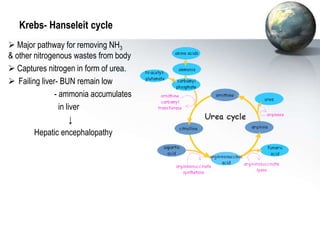
Krebs- Hanseleit cycle
 Major pathway for removing NH3
& other nitrogenous wastes from body
 Captures nitrogen in form of urea.
 Failing liver- BUN remain low
- ammonia accumulates
in liver
↓
Hepatic encephalopathy
Proteins & peptides
Albumin
• Most abundant protein
• Normal plasma conc- 3 - 5 g%
• Daily production -12-15 g/d
• Plasma half life – 15-20 days
• Functions –
• maintains plasma oncotic pressure (80% by albumin)
• binds ions, bilirubin, hormones & drugs
• Hypoalbuminemia –  Colloid oncotic pressure  edema
ᾳ- feto protein
• Resembles albumin genetically & functionally
• Formation sites- yolksac, hepatocytes, enterocytes
• Fetal & neonatal life- major determinant of plasma oncotic
pressure
• 1 year of age- albumin largely replaces AFP
• ↑ ↑ AFP- HCC
Fibrinogen
• Synthesized exclusively by hepatocytes
• Plasma fibrinogen – 100-700 mg/dl
• Functions – polymerizes into long fibrin threads by the action of
thrombin  formation of clot
• Haptoglobins
– Forms stable complexes with free Hb  prevents loss of iron through
urinary excretion, protects kidney from damage
• Ceruloplasmin – binds with copper and helps in its transport
and storage
• Wilson’s disease
– Deficiency of ceruloplasmin  free Cu2+  in circulation  deposited in
brain and liver
Coagulation
• Synthesize most of the procoagulants except-
a. factor III ( tissue thromboplastin)
b. Factor IV ( calcium)
c. Factor VIII ( von Willebrand factor )
• Produce protein regulators of coagulation & fibrinolytic
pathways
– Protein C, protein S ( protein C – inactivate F VIIIa- Va complex)
– protein Z ( degradation of Factor Xa )
– plasminogen activator inhibitor (PAI) ( inhibits tissue plasminogen
activators to convert plasminogen to plasmin )
– antithrombin III
Liver as a Storage Organ
• Vitamin A
• Important role in the uptake, storage and maintenance of vitamin A
levels by mobilizing its vitamin A store
• Vitamin K
• Vitamin K dependent factors II, VII, IX, X
• Absorption of Vit K depends on normal fat absorption: any mal-
absorption of lipid  vitamin K deficiency
• Storage in liver- limited  hypoprothrombinemia can develop within a
few weeks.
• Treatment –
• FFP
• Antidote- parenteral vit K
Vitamin K cofactor & ỳ- carboxylation
– Factor II, VII., IX, X , protein C & S- undergo Vit K
dependent post translational modifications
– Enables procoagulants to form complexes with
calcium or other divalent cations for participation in
the clotting cascade.
Clinical implication
Warfarin inhibits vit K epoxide reductase
↓
traps Vit K in epoxide form
↓
Inhibits y- carboxylation
T/T- Enteral / parenteral Vit K.
Storage & Homeostasis of Iron
• Major site of synthesis of proteins (Transferrin, Ferritin) involved in iron
transport & metabolism.
 Heme metabolism
Clinical implication
• Porphyrias
• Acute Intermittent Porphyria – commonest
– Defects in the heme pathway- accumulation of porphyrinogens
– Trigger substances- barbiturates, sex hormones, glucocorticoides,
cigarette smoke, CYP inducers.
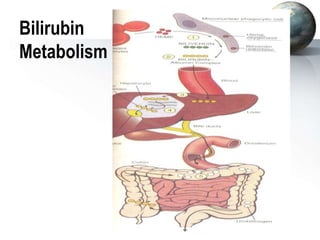
Bilirubin
Metabolism
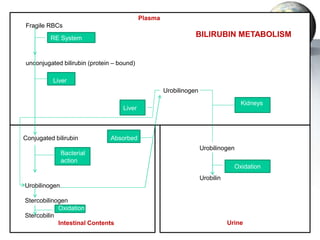
Plasma
Fragile RBCs
RE System
unconjugated bilirubin (protein – bound)
Liver
Liver
Kidneys
Urobilinogen
Conjugated bilirubin Absorbed
Bacterial
action
Urobilinogen
Stercobilinogen
Stercobilin
Intestinal Contents
Oxidation
Urobilinogen
Urobilin
Urine
Oxidation
BILIRUBIN METABOLISM
Metabolism of Drugs (Xenobiotics)
 Phase-I reactions
• Alter the parent drug by inserting or unmasking a polar group
• Converts drugs to more polar compounds
• Reactions – oxidations, reduction, hydrolysis
• Cytochrome P450 – substrate binding site, located in the
endoplasmic reticulum
• Drugs– barbiturates, benzodiazepines, halogenated volatile
anaesthetics, pethidine etc.
• Phase-II reactions
• Creates conjugates of parent compound or its metabolite with
endogenous hydrophilic substrate
Reactions
• Glucoronidation
• Sulphation
• Methylation
• Acetylation
Glucoronidation
• Most common type
• Hepatic microsomal enzyme, UDPglucuronyl transferase mediates
the transfer of glucoronic acid from UDP glucuronic acid to the
functional group on the xenobiotics
• Drug handled by phase-II – morphine, propofol, thiopentone
(initially oxidized subsequently conjugated)
Phase-I reaction enzymes – more susceptible to destruction in
cirrhosis
Phase-II reactions enzymes – more resistant, function even in
advanced liver disease
Phase-III reactions
• Involves ATP-binding cassette transport proteins (ABC)
• These proteins use the energy of ATP hydrolysis to drive molecular
transport
• Dysfunction of ABC proteins hinders flow of bile  predisposing to
drug accumulation and cholestatic liver injury
Microsomal enzyme induction
• Anticonvulsants, rifampicin, isoniazid, glucocorticoids, chronic
alcohol consumption
Consequences of enzyme induction
  duration of action of drugs that are inactivated by metabolism
  intensity of action of drugs that are activated by metabolism
Endocrine functions
• Liver can modify or amplify hormone action
• Metabolic conversion of Vitamin D to form 25(OH)D
• 25(OH)D  1,25(OH)2D in kidney
• Peripheral conversion of T4 to T3
 Pseudocholinesterase
• Hydrolysis of succinylcholine
• Plasma t½ - 14 days
• Severe liver disease   duration of action of succinylcholine
• Insulin-like growth factors or somatomedins – growth hormone like

action
• Important role in cartilage function by promoting uptake of sulphate
and synthesis of collagen
 Removes circulating hormones
• Insulin, glucagon, growth hormone, gastrointestinal hormones, e.g.
gastrin
• Blood reservoir
– Liver is an expandable organ
– 10 -15 % of total blood volume can be sequestered and quickly
released after sympathetic stimulation .
• Immune & inflammatory responses
– kuffer cells protect against foreign intrutions, degrade toxins,
process antigens, and phagocytose bacteria.
– Induce & intensify inflammation by recruiting neutrophils
– Release proinflammatory mediators
Signs of Liver Disease
• Jaundice
• Hepatomegaly
• Spider Naevi
• Splenomegaly
• Scratch Marks
• Ascites
• Palmer Erythema
• Dilated Abdominal
Veins
• Peripheral Oedema
• Finger Clubbing
• Testicular Atrophy
• Bruising
• Gynaecomastia
• Confusion/Coma
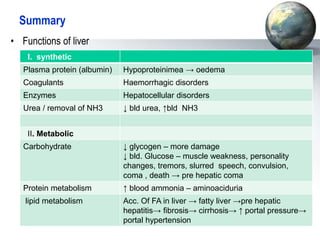
Summary
• Functions of liver
I. synthetic
Plasma protein (albumin) Hypoproteinimea → oedema
Coagulants Haemorrhagic disorders
Enzymes Hepatocellular disorders
Urea / removal of NH3 ↓ bld urea, ↑bld NH3
II. Metabolic
Carbohydrate ↓ glycogen – more damage
↓ bld. Glucose – muscle weakness, personality
changes, tremors, slurred speech, convulsion,
coma , death → pre hepatic coma
Protein metabolism ↑ blood ammonia – aminoaciduria
lipid metabolism Acc. Of FA in liver → fatty liver →pre hepatic
hepatitis→ fibrosis→ cirrhosis→ ↑ portal pressure→
portal hypertension
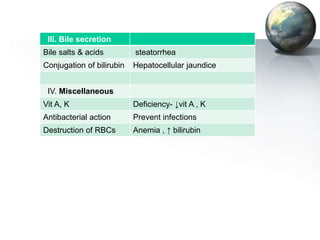
III. Bile secretion
Bile salts & acids steatorrhea
Conjugation of bilirubin Hepatocellular jaundice
IV. Miscellaneous
Vit A, K Deficiency- ↓vit A , K
Antibacterial action Prevent infections
Destruction of RBCs Anemia , ↑ bilirubin
THANK YOU

Physiological functions of liver - and liver function test

  • 1.
    PHYSIOLOGICAL FUNCTIONS OF THELIVER DR ZIKRULLAH MALLICK Department of Anaesthesiology & critical Care JAWAHARLAL NEHRU MEDICAL COLLEGE,ALIGARH
  • 2.
    • Liver isthe largest internal organ & largest gland in the human body. • Liver is at the epicenter of intermediary metabolism. • It performs versatile & massive biochemical pathways. • It destroys bacteria, inactivate antigens, detoxify harmful chemicals. • Thus multiple & diverse functions of liver have an impact on every tissue in the body.
  • 3.
    Physiological functions ofliver • Intermediary metabolism a. Carbohydrate metabolism b. Lipid metabolism c. Bile metabolsim and entero- hepatic circulation d. Protein metabolism • Coagulation • Heme metabolism • Bilirubin metabolism • Xenobiotics metabolism • Storage • Endocrine functions • Immune & inflammatory response • Blood reservoir
  • 4.
    Carbohydrate metabolism • Liveris an important homeostatic regulator of blood glucose. • It can either produce glucose or store glucose • In fed state- polymerize glucose to glycogen • In unfed state- depolymerize glycogen to glucose • Glucose → hepatocytes → glycogen ↑ →glucose Lactate Glycerol aminoacids
  • 5.
    Carbohydrate metabolism • Glycogenmetabolism • Regulation – 2 rate limiting enzymes 1. Glycogen synthase- synthesis of glycogen from monomers of UDP glucose. 2. Glycogen phosphorylase- clevage of glycogen to glucose-1- phosphate.
  • 6.
    Carbohydrate metabolism Gluconeogenesis • Liverglycogen stores depleted - hepatic gluconeogenesis to replenish blood glucose. • Substrates- - lactate - glycerol from hydrolysis of triglycerides - gluconeogenic amino acid , alanine , glutamine
  • 8.
    • Blood glucoseregulation within a narrow limit (70-100 mg/dl)  not affected in liver disease due to large reserve of hepatic function  Effects of anaesthesia on carbohydrate metabolism • Halothane –  release of insulin –  rate of glycogenolysis – Inhibition of gluconeogenic response • Isoflurane – Impaired insulin secretion
  • 9.
    Lipid Metabolism • Oxidation of fatty acids • Fatty acids derived from plasma  • Enter into mitochondria  •  oxidation: fatty acids  AcetylCoA  citric acid cycle • Regulators - Glucagon - activates - Insulin - inhibits
  • 10.
    • Synthesis oflipoproteins • One of the major functions of the liver • Major classes – VLDL – LDL – HDL
  • 11.
    • VLDL • Acuteor chronic liver disease – ability to produce VLDL is markedly compromised • Liver VLDLs are associated with an important class of proteins, the apo B protein • Apo B100 - important for hepatic secretion of VLDL. • Decreased in ABETALIPOPROTEINEMIA • LDLs and HDLs • Liver produces them in a small amount
  • 12.
    • Production ofketone bodies • Most organs except the liver- use ketone bodies as fuel • Ketone bodies – acetoacetic acid, acetone,  hydroxybutyrate • Their formation by the liver is normal and physiologically important, e.g. – Fasting  rapid depletion of glycogen stores in the liver  shortage of substrates for citric acid cycle – AcetylCoA formed from  oxidation  ketone bodies • Ketosis -  conc. of ketone bodies in blood – Starvation – DM – After high fat diet
  • 13.
    • Synthesis ofcholesterol • Important role in cholesterol homeostasis • Liver cholesterol has both exogenous and endogenous source Uses of hepatic cholesterol • Formation of bile acids- conjugated with other substances to form cholic acid. • Synthesis of VLDLs
  • 14.
    Bile metabolism &enterohepatic circulation • Bile salts are end products of cholesterol synthesis • Daily production – 600- 800 ml/d • Functions- - activate lipase - promote micelle formation - intestinal uptake of fat soluble vitamins, cholesterol & lipids - facilitate excretion of xenobiotics, lipophillic substances, bilirubin, amphipathic steroid hormone derivative
  • 15.
    • Bile saltsundergo enterohepatic circulation (20-30 times/day) intrahepatic bile duct ↓ common hepatic duct cystic duct CBD ↓ ↓ gall bladder small intestine ( terminal ileum) • Clinical implication – Opioids can induce spasm of bile duct & spinter of oddi – Reversed by – glucagon, opioid antagonists ( naloxone), smooth muscle relaxant (NTG), antimuscarinic drugs( atropine), volatile anaesthetics.
  • 16.
    Protein and aminoacid metabolism • Deamination of amino acids – Required before they can be used for energy or before they can be converted into carbohydrates or fats • Formation of urea for removal of ammonia from the body fluids • Production of proteins and peptides.
  • 17.
    Krebs- Hanseleit cycle Major pathway for removing NH3 & other nitrogenous wastes from body  Captures nitrogen in form of urea.  Failing liver- BUN remain low - ammonia accumulates in liver ↓ Hepatic encephalopathy
  • 18.
    Proteins & peptides Albumin •Most abundant protein • Normal plasma conc- 3 - 5 g% • Daily production -12-15 g/d • Plasma half life – 15-20 days • Functions – • maintains plasma oncotic pressure (80% by albumin) • binds ions, bilirubin, hormones & drugs • Hypoalbuminemia –  Colloid oncotic pressure  edema
  • 19.
    ᾳ- feto protein •Resembles albumin genetically & functionally • Formation sites- yolksac, hepatocytes, enterocytes • Fetal & neonatal life- major determinant of plasma oncotic pressure • 1 year of age- albumin largely replaces AFP • ↑ ↑ AFP- HCC
  • 20.
    Fibrinogen • Synthesized exclusivelyby hepatocytes • Plasma fibrinogen – 100-700 mg/dl • Functions – polymerizes into long fibrin threads by the action of thrombin  formation of clot
  • 21.
    • Haptoglobins – Formsstable complexes with free Hb  prevents loss of iron through urinary excretion, protects kidney from damage • Ceruloplasmin – binds with copper and helps in its transport and storage • Wilson’s disease – Deficiency of ceruloplasmin  free Cu2+  in circulation  deposited in brain and liver
  • 22.
    Coagulation • Synthesize mostof the procoagulants except- a. factor III ( tissue thromboplastin) b. Factor IV ( calcium) c. Factor VIII ( von Willebrand factor ) • Produce protein regulators of coagulation & fibrinolytic pathways – Protein C, protein S ( protein C – inactivate F VIIIa- Va complex) – protein Z ( degradation of Factor Xa ) – plasminogen activator inhibitor (PAI) ( inhibits tissue plasminogen activators to convert plasminogen to plasmin ) – antithrombin III
  • 23.
    Liver as aStorage Organ • Vitamin A • Important role in the uptake, storage and maintenance of vitamin A levels by mobilizing its vitamin A store • Vitamin K • Vitamin K dependent factors II, VII, IX, X • Absorption of Vit K depends on normal fat absorption: any mal- absorption of lipid  vitamin K deficiency • Storage in liver- limited  hypoprothrombinemia can develop within a few weeks. • Treatment – • FFP • Antidote- parenteral vit K
  • 24.
    Vitamin K cofactor& ỳ- carboxylation – Factor II, VII., IX, X , protein C & S- undergo Vit K dependent post translational modifications – Enables procoagulants to form complexes with calcium or other divalent cations for participation in the clotting cascade. Clinical implication Warfarin inhibits vit K epoxide reductase ↓ traps Vit K in epoxide form ↓ Inhibits y- carboxylation T/T- Enteral / parenteral Vit K.
  • 25.
    Storage & Homeostasisof Iron • Major site of synthesis of proteins (Transferrin, Ferritin) involved in iron transport & metabolism.  Heme metabolism Clinical implication • Porphyrias • Acute Intermittent Porphyria – commonest – Defects in the heme pathway- accumulation of porphyrinogens – Trigger substances- barbiturates, sex hormones, glucocorticoides, cigarette smoke, CYP inducers.
  • 26.
  • 27.
    Plasma Fragile RBCs RE System unconjugatedbilirubin (protein – bound) Liver Liver Kidneys Urobilinogen Conjugated bilirubin Absorbed Bacterial action Urobilinogen Stercobilinogen Stercobilin Intestinal Contents Oxidation Urobilinogen Urobilin Urine Oxidation BILIRUBIN METABOLISM
  • 28.
    Metabolism of Drugs(Xenobiotics)  Phase-I reactions • Alter the parent drug by inserting or unmasking a polar group • Converts drugs to more polar compounds • Reactions – oxidations, reduction, hydrolysis • Cytochrome P450 – substrate binding site, located in the endoplasmic reticulum • Drugs– barbiturates, benzodiazepines, halogenated volatile anaesthetics, pethidine etc.
  • 29.
    • Phase-II reactions •Creates conjugates of parent compound or its metabolite with endogenous hydrophilic substrate Reactions • Glucoronidation • Sulphation • Methylation • Acetylation Glucoronidation • Most common type • Hepatic microsomal enzyme, UDPglucuronyl transferase mediates the transfer of glucoronic acid from UDP glucuronic acid to the functional group on the xenobiotics
  • 30.
    • Drug handledby phase-II – morphine, propofol, thiopentone (initially oxidized subsequently conjugated) Phase-I reaction enzymes – more susceptible to destruction in cirrhosis Phase-II reactions enzymes – more resistant, function even in advanced liver disease Phase-III reactions • Involves ATP-binding cassette transport proteins (ABC) • These proteins use the energy of ATP hydrolysis to drive molecular transport • Dysfunction of ABC proteins hinders flow of bile  predisposing to drug accumulation and cholestatic liver injury
  • 31.
    Microsomal enzyme induction •Anticonvulsants, rifampicin, isoniazid, glucocorticoids, chronic alcohol consumption Consequences of enzyme induction   duration of action of drugs that are inactivated by metabolism   intensity of action of drugs that are activated by metabolism
  • 32.
    Endocrine functions • Livercan modify or amplify hormone action • Metabolic conversion of Vitamin D to form 25(OH)D • 25(OH)D  1,25(OH)2D in kidney • Peripheral conversion of T4 to T3  Pseudocholinesterase • Hydrolysis of succinylcholine • Plasma t½ - 14 days • Severe liver disease   duration of action of succinylcholine
  • 33.
    • Insulin-like growthfactors or somatomedins – growth hormone like action • Important role in cartilage function by promoting uptake of sulphate and synthesis of collagen  Removes circulating hormones • Insulin, glucagon, growth hormone, gastrointestinal hormones, e.g. gastrin
  • 34.
    • Blood reservoir –Liver is an expandable organ – 10 -15 % of total blood volume can be sequestered and quickly released after sympathetic stimulation . • Immune & inflammatory responses – kuffer cells protect against foreign intrutions, degrade toxins, process antigens, and phagocytose bacteria. – Induce & intensify inflammation by recruiting neutrophils – Release proinflammatory mediators
  • 35.
    Signs of LiverDisease • Jaundice • Hepatomegaly • Spider Naevi • Splenomegaly • Scratch Marks • Ascites • Palmer Erythema • Dilated Abdominal Veins • Peripheral Oedema • Finger Clubbing • Testicular Atrophy • Bruising • Gynaecomastia • Confusion/Coma
  • 36.
    Summary • Functions ofliver I. synthetic Plasma protein (albumin) Hypoproteinimea → oedema Coagulants Haemorrhagic disorders Enzymes Hepatocellular disorders Urea / removal of NH3 ↓ bld urea, ↑bld NH3 II. Metabolic Carbohydrate ↓ glycogen – more damage ↓ bld. Glucose – muscle weakness, personality changes, tremors, slurred speech, convulsion, coma , death → pre hepatic coma Protein metabolism ↑ blood ammonia – aminoaciduria lipid metabolism Acc. Of FA in liver → fatty liver →pre hepatic hepatitis→ fibrosis→ cirrhosis→ ↑ portal pressure→ portal hypertension
  • 37.
    III. Bile secretion Bilesalts & acids steatorrhea Conjugation of bilirubin Hepatocellular jaundice IV. Miscellaneous Vit A, K Deficiency- ↓vit A , K Antibacterial action Prevent infections Destruction of RBCs Anemia , ↑ bilirubin
  • 38.