STATUS EPILEPTICUSDR.SRIRAMA.ANJANEYULU
INTRODUCTIONMedical emergencyHunter  noted that SE was rare before the advent of powerful antiepileptic drugs, and the consequent risk of drug withdrawal.Incidence of SE have varied from 10 to 60 per 100000 person-years.The annual incidence in the UK is about     9000–14 000 new cases per year.Accounts for 3.5% of admissions to emergency departments in the developed nations and for 11% in a developing country.(MEENA   AK,2000).
INCIDENCEAbout 5% of all epileptic adult clinic patients will have at least one episode of SE in the course of their epilepsy , and in children the proportion is higher (10-25%).Mortality for SE is about 20%-30% (dying of the underlying condition, rather than the SE itself.) Mortality is age related, and is much lower in children and higher in the elderly. The risks of morbidity are greatly increased the longer the duration of the SE episode .
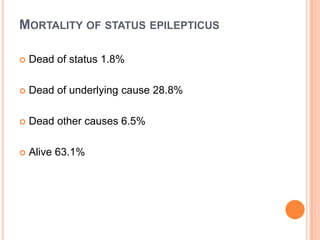
Mortality of status epilepticusDead of status 1.8% Dead of underlying cause 28.8% Dead other causes 6.5% Alive 63.1%
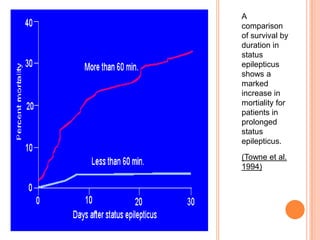
A comparison of survival by duration in status epilepticus shows a marked increase in mortiality for patients in prolonged status epilepticus.  (Towne et al. 1994)
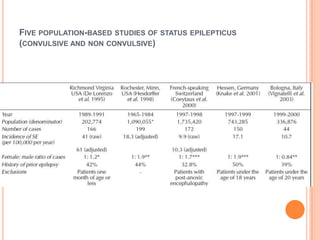
Five population-based studies of status epilepticus (convulsive and non convulsive)
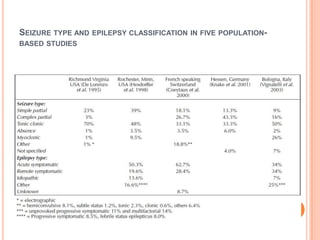
Seizure type and epilepsy classification in five population-based studies
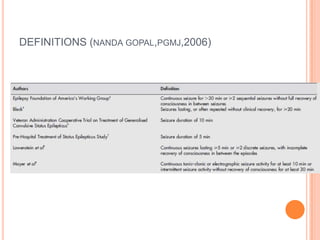
DEFINITIONS (nanda gopal,pgmj,2006)
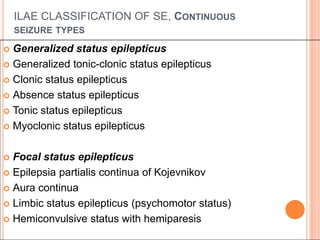
ILAE CLASSIFICATION OF SE, Continuous seizure types Generalized status epilepticusGeneralized tonic-clonic status epilepticusClonic status epilepticusAbsence status epilepticusTonic status epilepticusMyoclonic status epilepticusFocal status epilepticusEpilepsiapartialis continua of KojevnikovAura continuaLimbic status epilepticus (psychomotor status)Hemiconvulsive status with hemiparesis
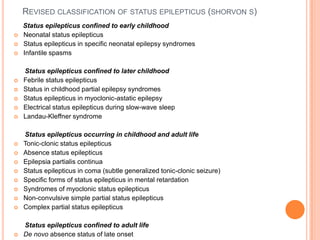
Revised classification of status epilepticus (shorvon s)     Status epilepticus confined to early childhoodNeonatal status epilepticusStatus epilepticus in specific neonatal epilepsy syndromesInfantile spasms      Status epilepticus confined to later childhoodFebrile status epilepticusStatus in childhood partial epilepsy syndromesStatus epilepticus in myoclonic-astatic epilepsyElectrical status epilepticus during slow-wave sleepLandau-Kleffner syndrome      Status epilepticus occurring in childhood and adult lifeTonic-clonic status epilepticusAbsence status epilepticusEpilepsiapartialis continuaStatus epilepticus in coma (subtle generalized tonic-clonic seizure)Specific forms of status epilepticus in mental retardationSyndromes of myoclonic status epilepticusNon-convulsive simple partial status epilepticusComplex partial status epilepticus      Status epilepticus confined to adult lifeDe novo absence status of late onset
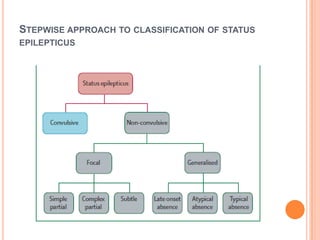
Stepwise approach to classification of status epilepticus
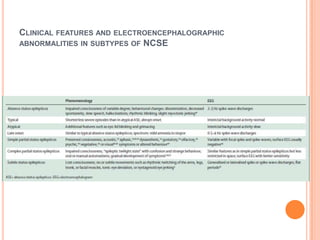
Clinical features and electroencephalographic abnormalities in subtypes of NCSE
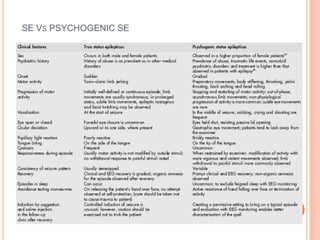
SE Vs PSYCHOGENIC SE
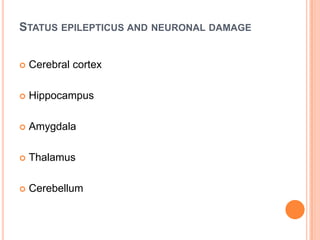
Status epilepticus and neuronal damageCerebral cortex Hippocampus AmygdalaThalamus Cerebellum
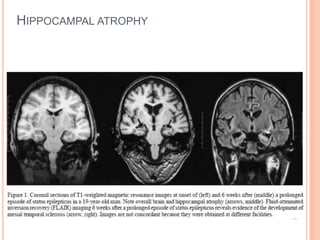
Hippocampal atrophy
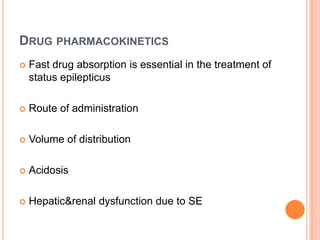
Drug pharmacokinetics Fast drug absorption is essential in the treatment of status epilepticusRoute of administrationVolume of distributionAcidosisHepatic&renal dysfunction due to SE
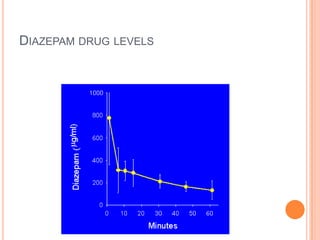
Diazepam drug levels
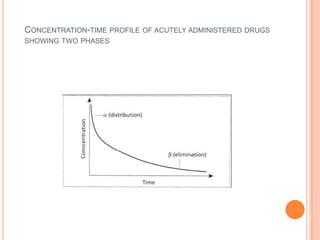
Concentration-time profile of acutely administered drugs showing two phases
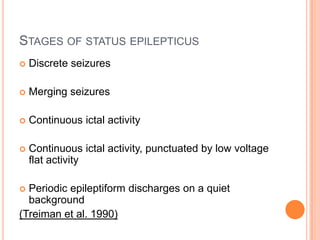
Stages of status epilepticusDiscrete seizures Merging seizures Continuous ictal activityContinuous ictal activity, punctuated by low voltage flat activity Periodic epileptiform discharges on a quiet background (Treiman et al. 1990)
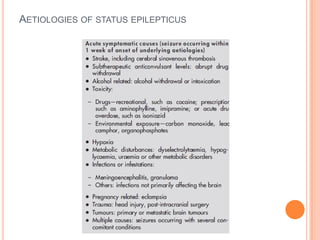
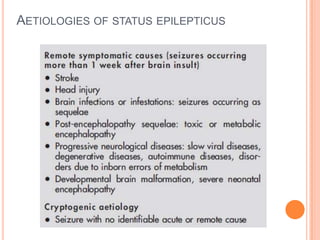
Aetiologies of status epilepticus
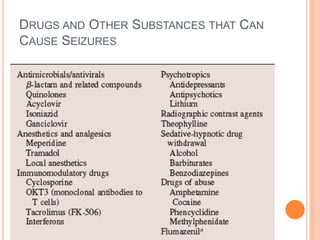
Drugs and Other Substances that Can Cause Seizures
Aetiologies of status epilepticus
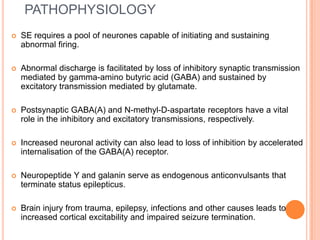
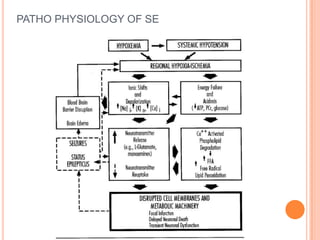
PATHOPHYSIOLOGYSE requires a pool of neurones capable of initiating and sustaining abnormal firing.Abnormal discharge is facilitated by loss of inhibitory synaptic transmission mediated by gamma-amino butyric acid (GABA) and sustained by excitatory transmission mediated by glutamate.Postsynaptic GABA(A) and N-methyl-D-aspartate receptors have a vital role in the inhibitory and excitatory transmissions, respectively.Increased neuronal activity can also lead to loss of inhibition by accelerated internalisation of the GABA(A) receptor.Neuropeptide Y and galanin serve as endogenous anticonvulsants that terminate status epilepticus.Brain injury from trauma, epilepsy, infections and other causes leads to increased cortical excitability and impaired seizure termination.
PATHO PHYSIOLOGY OF SE
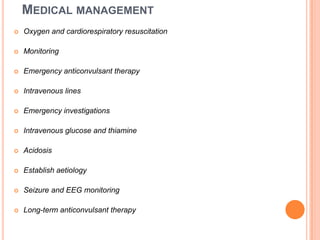
Medical management Oxygen and cardiorespiratory resuscitationMonitoringEmergency anticonvulsant therapyIntravenous linesEmergency investigationsIntravenous glucose and thiamineAcidosisEstablish aetiologySeizure and EEG monitoringLong-term anticonvulsant therapy
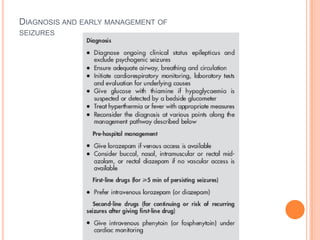
Diagnosis and early management ofseizures
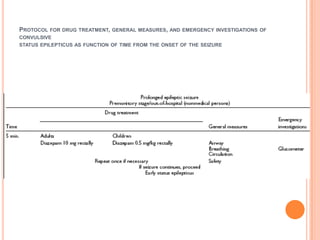
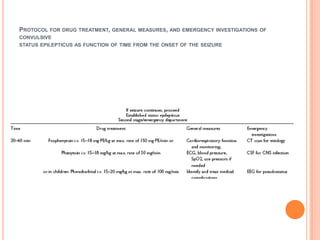
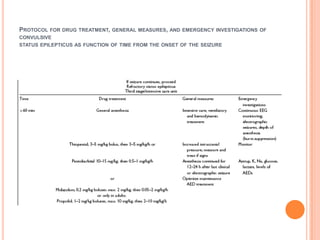
Protocol for drug treatment, general measures, and emergency investigations of convulsivestatus epilepticus as function of time from the onset of the seizure
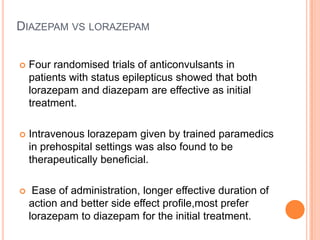
Diazepam vslorazepamFour randomised trials of anticonvulsants in patients with status epilepticus showed that both lorazepam and diazepam are effective as initial treatment.Intravenous lorazepam given by trained paramedics in prehospital settings was also found to be therapeutically beneficial. Ease of administration, longer effective duration of action and better side effect profile,most prefer lorazepam to diazepam for the initial treatment.
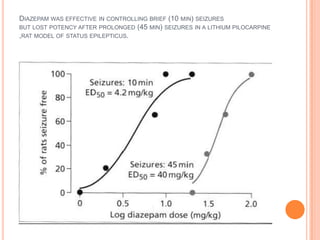
Diazepam was effective in controlling brief (10 min) seizuresbut lost potency after prolonged (45 min) seizures in a lithium pilocarpine ,rat model of status epilepticus.
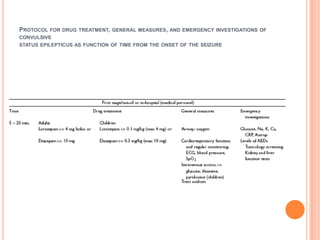
Protocol for drug treatment, general measures, and emergency investigations of convulsivestatus epilepticus as function of time from the onset of the seizure
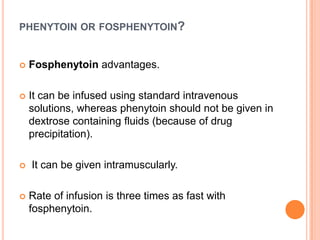
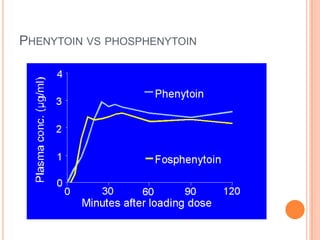
phenytoin or fosphenytoin?Fosphenytoin advantages.It can be infused using standard intravenous solutions, whereas phenytoin should not be given in dextrose containing fluids (because of drug precipitation). It can be given intramuscularly.Rate of infusion is three times as fast with fosphenytoin.
Phenytoinvsphosphenytoin
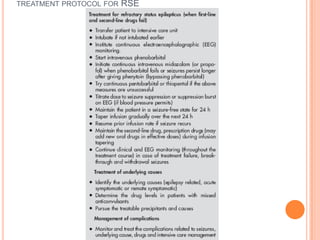
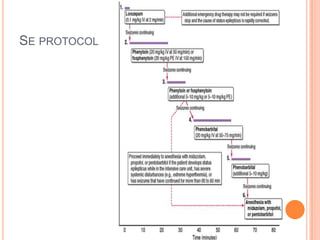
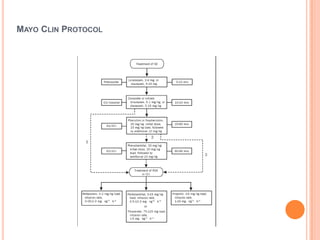
treatment protocol for RSE
Protocol for drug treatment, general measures, and emergency investigations of convulsivestatus epilepticus as function of time from the onset of the seizure
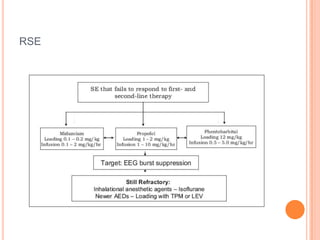
rse
Se protocol
Mayo Clin Protocol
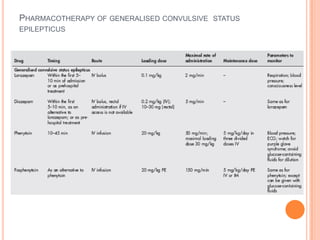
Pharmacotherapy of generalised convulsive  status epilepticus
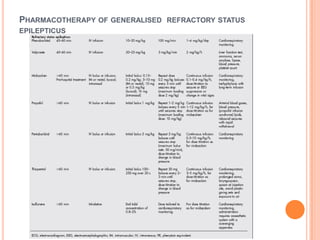
Pharmacotherapy of generalised  refractory status epilepticus
Non-convulsive status epilepticus1/3rd of all cases of SE.14-24 per 100000 population per year.The diagnosis of non-convulsive status epilepticus is critically dependent on EEG.In patients of epilepsy,any prolonged change in personality, prolonged postictal confusion (greater than 30 min) or recent onset psychosis should be investigated.Subtle manifestations such as twitching of the limbs, or facial muscles or nystagmoid eye jerking.
definitions of nonconvulsivestatus epilepticus (a) Unequivocal electrographic seizure activity. (b) Periodic epileptiform discharges or rhythmic discharge with clinical seizure activity. (c) Rhythmic discharge with either clinical or electrographic response to treatment.
Typical absence status epilepticusProlonged absence attacks with continuous or discontinuous 3 Hz spike and wave occurring in patients with primary generalized epilepsy.    Absence status epilepticus can be divided intoChildhood absence status epilepticus (those usually already receiving treatment). Late onset absence status epilepticus  with a history of primary generalized history (often a history of absences in childhood) . Late onset absence status epilepticus developing de novo (usually following drug or alcohol withdrawal). No evidence that absence status induces neuronal damage,and thus aggressive treatment is not warranted. Responds rapidly to intravenous benzodiazepines.Sodium valproate is one of the alternative.
Complex partial status epilepticus‘A prolonged epileptic episode in which focal fluctuating or frequently recurring electrographic epileptic discharges, arising in temporal or extratemporal regions, result in a confusional state with variable clinical symptoms‘.Oral clobazam over a period of 2-3 days given early at home.Persistent or resistant complex partial status epilepticus  intravenous therapy should be used , and lorazepam followed by phenytoin (or fosphenytoin) are the drugs of choice.
Non-convulsive status epilepticus in comaElectrographic status epilepticus in coma is not uncommon and is seen in up to 8% of patients in coma with no clinical evidence of seizure activity.Non-convulsive status epilepticus in coma consists of three groups: Those who had convulsive status epilepticus. Those who have subtle clinical signs of seizure activity .Those with no clinical signs.Should be treated aggressively with deep anaesthesia and concomitant antiepileptic drugs.
Atypical absence status epilepticusAssociated with the epileptic encephalopathies such as Lennox-Gastaut syndrome.Should be considered if there is change in behaviour, personality, cognition or increased confusion in a patient with one of these epilepsies.The EEG characteristics are usually that of continuous or frequent slow (<2.5Hz) spike and wave.Oral rather than intravenous treatment is usually more appropriate, and the drugs of choice are valproate, lamotrigine,clonazepam, clobazam and topiramate.
Tonic status epilepticusTonic status epilepticus is not uncommon in patients with syndromes such as Lennox-Gastaut.Tonic status epilepticus can also rarely occur in the setting of normal premorbid intelligence.The tonic seizures may not necessarily be clinically apparent; the EEG, however, demonstrates bursts of paroxysmal, generalized fast discharges.Worsened with benzodiazepines.Stimulants such as methylphenidate can be effective.Oral lamotrigine, ACTH and corticosteroids can be helpful.
Epilepsiapartialis continuaStatus equivalent of simple partial motor seizures.Defined as regular or irregular clonic muscular twitching affecting a limited part of the body, occurring for a minimum of 1 h, and recurring at intervals of no more than 10 s.Can result from structural abnormalities such as stroke, trauma, cerebral infarction, cerebral abscess, neuronal migration disorders and vascular malformation.50% of cases, the MRI is normal.Associated with a variety of encephalitides, commonly Rasmussen's encephalitis, but also SSPE,CJD.Treatment is best targeted at the underlying cause.Oral corticosteroid, nimodipine.Neurosurgical resection.
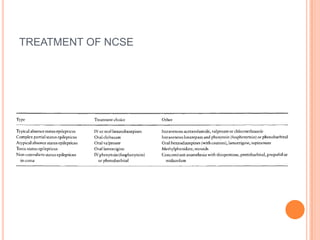
TREATMENT OF NCSE
The use of valproate and new antiepileptic drugs in status epilepticusVALPROATELEVETIRACETAMTOPIRAMATE

Status epilepticus

  • 1.
  • 2.
    INTRODUCTIONMedical emergencyHunter noted that SE was rare before the advent of powerful antiepileptic drugs, and the consequent risk of drug withdrawal.Incidence of SE have varied from 10 to 60 per 100000 person-years.The annual incidence in the UK is about 9000–14 000 new cases per year.Accounts for 3.5% of admissions to emergency departments in the developed nations and for 11% in a developing country.(MEENA AK,2000).
  • 3.
    INCIDENCEAbout 5% ofall epileptic adult clinic patients will have at least one episode of SE in the course of their epilepsy , and in children the proportion is higher (10-25%).Mortality for SE is about 20%-30% (dying of the underlying condition, rather than the SE itself.) Mortality is age related, and is much lower in children and higher in the elderly. The risks of morbidity are greatly increased the longer the duration of the SE episode .
  • 4.
    Mortality of statusepilepticusDead of status 1.8% Dead of underlying cause 28.8% Dead other causes 6.5% Alive 63.1%
  • 5.
    A comparison ofsurvival by duration in status epilepticus shows a marked increase in mortiality for patients in prolonged status epilepticus.  (Towne et al. 1994)
  • 6.
    Five population-based studiesof status epilepticus (convulsive and non convulsive)
  • 7.
    Seizure type andepilepsy classification in five population-based studies
  • 8.
  • 9.
    ILAE CLASSIFICATION OFSE, Continuous seizure types Generalized status epilepticusGeneralized tonic-clonic status epilepticusClonic status epilepticusAbsence status epilepticusTonic status epilepticusMyoclonic status epilepticusFocal status epilepticusEpilepsiapartialis continua of KojevnikovAura continuaLimbic status epilepticus (psychomotor status)Hemiconvulsive status with hemiparesis
  • 10.
    Revised classification ofstatus epilepticus (shorvon s) Status epilepticus confined to early childhoodNeonatal status epilepticusStatus epilepticus in specific neonatal epilepsy syndromesInfantile spasms Status epilepticus confined to later childhoodFebrile status epilepticusStatus in childhood partial epilepsy syndromesStatus epilepticus in myoclonic-astatic epilepsyElectrical status epilepticus during slow-wave sleepLandau-Kleffner syndrome Status epilepticus occurring in childhood and adult lifeTonic-clonic status epilepticusAbsence status epilepticusEpilepsiapartialis continuaStatus epilepticus in coma (subtle generalized tonic-clonic seizure)Specific forms of status epilepticus in mental retardationSyndromes of myoclonic status epilepticusNon-convulsive simple partial status epilepticusComplex partial status epilepticus Status epilepticus confined to adult lifeDe novo absence status of late onset
  • 11.
    Stepwise approach toclassification of status epilepticus
  • 12.
    Clinical features andelectroencephalographic abnormalities in subtypes of NCSE
  • 13.
  • 14.
    Status epilepticus andneuronal damageCerebral cortex Hippocampus AmygdalaThalamus Cerebellum
  • 15.
  • 16.
    Drug pharmacokinetics Fastdrug absorption is essential in the treatment of status epilepticusRoute of administrationVolume of distributionAcidosisHepatic&renal dysfunction due to SE
  • 17.
  • 18.
    Concentration-time profile ofacutely administered drugs showing two phases
  • 19.
    Stages of statusepilepticusDiscrete seizures Merging seizures Continuous ictal activityContinuous ictal activity, punctuated by low voltage flat activity Periodic epileptiform discharges on a quiet background (Treiman et al. 1990)
  • 20.
  • 21.
    Drugs and OtherSubstances that Can Cause Seizures
  • 22.
  • 23.
    PATHOPHYSIOLOGYSE requires apool of neurones capable of initiating and sustaining abnormal firing.Abnormal discharge is facilitated by loss of inhibitory synaptic transmission mediated by gamma-amino butyric acid (GABA) and sustained by excitatory transmission mediated by glutamate.Postsynaptic GABA(A) and N-methyl-D-aspartate receptors have a vital role in the inhibitory and excitatory transmissions, respectively.Increased neuronal activity can also lead to loss of inhibition by accelerated internalisation of the GABA(A) receptor.Neuropeptide Y and galanin serve as endogenous anticonvulsants that terminate status epilepticus.Brain injury from trauma, epilepsy, infections and other causes leads to increased cortical excitability and impaired seizure termination.
  • 24.
  • 25.
    Medical management Oxygenand cardiorespiratory resuscitationMonitoringEmergency anticonvulsant therapyIntravenous linesEmergency investigationsIntravenous glucose and thiamineAcidosisEstablish aetiologySeizure and EEG monitoringLong-term anticonvulsant therapy
  • 26.
    Diagnosis and earlymanagement ofseizures
  • 27.
    Protocol for drugtreatment, general measures, and emergency investigations of convulsivestatus epilepticus as function of time from the onset of the seizure
  • 28.
    Protocol for drugtreatment, general measures, and emergency investigations of convulsivestatus epilepticus as function of time from the onset of the seizure
  • 29.
    Diazepam vslorazepamFour randomisedtrials of anticonvulsants in patients with status epilepticus showed that both lorazepam and diazepam are effective as initial treatment.Intravenous lorazepam given by trained paramedics in prehospital settings was also found to be therapeutically beneficial. Ease of administration, longer effective duration of action and better side effect profile,most prefer lorazepam to diazepam for the initial treatment.
  • 30.
    Diazepam was effectivein controlling brief (10 min) seizuresbut lost potency after prolonged (45 min) seizures in a lithium pilocarpine ,rat model of status epilepticus.
  • 31.
    Protocol for drugtreatment, general measures, and emergency investigations of convulsivestatus epilepticus as function of time from the onset of the seizure
  • 32.
    phenytoin or fosphenytoin?Fosphenytoinadvantages.It can be infused using standard intravenous solutions, whereas phenytoin should not be given in dextrose containing fluids (because of drug precipitation). It can be given intramuscularly.Rate of infusion is three times as fast with fosphenytoin.
  • 33.
  • 34.
  • 35.
    Protocol for drugtreatment, general measures, and emergency investigations of convulsivestatus epilepticus as function of time from the onset of the seizure
  • 36.
  • 37.
  • 38.
  • 39.
    Pharmacotherapy of generalisedconvulsive status epilepticus
  • 40.
    Pharmacotherapy of generalised refractory status epilepticus
  • 41.
    Non-convulsive status epilepticus1/3rdof all cases of SE.14-24 per 100000 population per year.The diagnosis of non-convulsive status epilepticus is critically dependent on EEG.In patients of epilepsy,any prolonged change in personality, prolonged postictal confusion (greater than 30 min) or recent onset psychosis should be investigated.Subtle manifestations such as twitching of the limbs, or facial muscles or nystagmoid eye jerking.
  • 42.
    definitions of nonconvulsivestatusepilepticus (a) Unequivocal electrographic seizure activity. (b) Periodic epileptiform discharges or rhythmic discharge with clinical seizure activity. (c) Rhythmic discharge with either clinical or electrographic response to treatment.
  • 43.
    Typical absence statusepilepticusProlonged absence attacks with continuous or discontinuous 3 Hz spike and wave occurring in patients with primary generalized epilepsy. Absence status epilepticus can be divided intoChildhood absence status epilepticus (those usually already receiving treatment). Late onset absence status epilepticus with a history of primary generalized history (often a history of absences in childhood) . Late onset absence status epilepticus developing de novo (usually following drug or alcohol withdrawal). No evidence that absence status induces neuronal damage,and thus aggressive treatment is not warranted. Responds rapidly to intravenous benzodiazepines.Sodium valproate is one of the alternative.
  • 44.
    Complex partial statusepilepticus‘A prolonged epileptic episode in which focal fluctuating or frequently recurring electrographic epileptic discharges, arising in temporal or extratemporal regions, result in a confusional state with variable clinical symptoms‘.Oral clobazam over a period of 2-3 days given early at home.Persistent or resistant complex partial status epilepticus intravenous therapy should be used , and lorazepam followed by phenytoin (or fosphenytoin) are the drugs of choice.
  • 45.
    Non-convulsive status epilepticusin comaElectrographic status epilepticus in coma is not uncommon and is seen in up to 8% of patients in coma with no clinical evidence of seizure activity.Non-convulsive status epilepticus in coma consists of three groups: Those who had convulsive status epilepticus. Those who have subtle clinical signs of seizure activity .Those with no clinical signs.Should be treated aggressively with deep anaesthesia and concomitant antiepileptic drugs.
  • 46.
    Atypical absence statusepilepticusAssociated with the epileptic encephalopathies such as Lennox-Gastaut syndrome.Should be considered if there is change in behaviour, personality, cognition or increased confusion in a patient with one of these epilepsies.The EEG characteristics are usually that of continuous or frequent slow (<2.5Hz) spike and wave.Oral rather than intravenous treatment is usually more appropriate, and the drugs of choice are valproate, lamotrigine,clonazepam, clobazam and topiramate.
  • 47.
    Tonic status epilepticusTonicstatus epilepticus is not uncommon in patients with syndromes such as Lennox-Gastaut.Tonic status epilepticus can also rarely occur in the setting of normal premorbid intelligence.The tonic seizures may not necessarily be clinically apparent; the EEG, however, demonstrates bursts of paroxysmal, generalized fast discharges.Worsened with benzodiazepines.Stimulants such as methylphenidate can be effective.Oral lamotrigine, ACTH and corticosteroids can be helpful.
  • 48.
    Epilepsiapartialis continuaStatus equivalentof simple partial motor seizures.Defined as regular or irregular clonic muscular twitching affecting a limited part of the body, occurring for a minimum of 1 h, and recurring at intervals of no more than 10 s.Can result from structural abnormalities such as stroke, trauma, cerebral infarction, cerebral abscess, neuronal migration disorders and vascular malformation.50% of cases, the MRI is normal.Associated with a variety of encephalitides, commonly Rasmussen's encephalitis, but also SSPE,CJD.Treatment is best targeted at the underlying cause.Oral corticosteroid, nimodipine.Neurosurgical resection.
  • 49.
  • 50.
    The use ofvalproate and new antiepileptic drugs in status epilepticusVALPROATELEVETIRACETAMTOPIRAMATE