SHAKE 
and BAKE 
SAMIR SHAHANI PGY-3
Time is Brain
Why should you Care? 
- Prevalence: 1 out of 100 people 
- 1-2% of all ED visits 
- 3 million people in US 
- 200,000 new cases each year 
- Overall Mortality of Status is 20%
Differential 
• Syncope 
• Metabolic Conditions 
• Migraine 
• Vascular Conditions 
• Sleep Disorders 
• Paroxysmal Movement Disorders 
• Psychological Disorders 
• Infection 
• Trauma 
• Malignancy
Seizure Classification 
• Provoked Seizure 
– Electrolyte Abnormalities 
– Withdrawal vs Toxic Ingestion 
– Infection 
– CNS Mass 
– Pregnancy 
– Trauma 
• Unprovoked Seizures
The Basics 
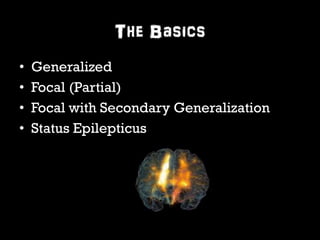
• Generalized 
• Focal (Partial) 
• Focal with Secondary Generalization 
• Status Epilepticus
Status Epilepticus Definition 
• Epidemiologic 
• ≥ 30 minutes 
• New Definition 
• ≥ 5 minutes 
• 2 or more seizures without recovery of 
consciousness 
• Pathological 
• Failure of inhibitory pathways (GABA)
The Assessment
History 
• First Time Seizure vs Recurrence? 
• Describe Event 
– Movement 
– Eye Deviation 
– Duration 
• Medications 
• Social History 
• Review of Systems
Physical 
• Vitals 
• General 
• Eyes 
• Neck 
• Neurological
Labs 
• Glucose 
• Electrolytes 
• Pregnancy Test 
• Toxicology Studies 
• CSF Studies 
• Lactate 
• Prolactin 
• Antiepilectic Drug (AED) Levels 
• Blood Gas
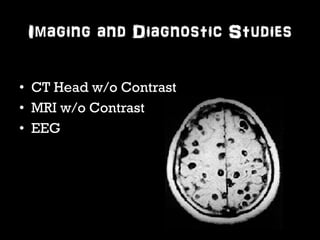
Imaging and Diagnostic Studies 
• CT Head w/o Contrast 
• MRI w/o Contrast 
• EEG
Management
New Onset Seizures 
CT Head Without Contrast 
– Easy to obtain 
– First Time Seizures in setting of Etoh or Etoh 
Withdrawal: 6.2% had significant finding 
Lumbar Puncture 
– Fever, Immunocompromised, AMS, severe HA
New Onset Seizures 
Should I Start AED? 
– Recurrence Rate < 30-50% 
– Consider Starting If: 
• Structural lesion on CT 
• Focal Deficit 
• Positive EEG
Abortive Therapies
Benzodiazpines 
• Diazepam 
– Quickest Onset 
– Dose: 10 mg PR, IM 
• Midazolam 
– Fast Onset 
– Dose: 
• 2-4 mg IV, IM 
• 5 mg per nostril IN
Benzodiazpines 
• Lorazepam 
– Longer Duration of Action 
– Can be used alone 
– Dose: 2-4 mg IV, IM
Phenytoin vs Fosphenytoin 
• No studies have compared efficacy 
• Phenytoin is generally cheaper 
• Fosphenytoin is well tolerated 
• Fosphenytoin reaches the Brain Faster
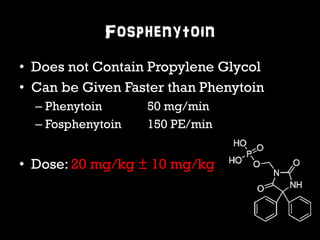
Fosphenytoin 
• Does not Contain Propylene Glycol 
• Can be Given Faster than Phenytoin 
– Phenytoin 50 mg/min 
– Fosphenytoin 150 PE/min 
• Dose: 20 mg/kg ± 10 mg/kg
Phenobarbital 
• 20 mg/kg over 20 minutes 
• Risk of Apnea and Hypotension 
• Get Ready To Intubate
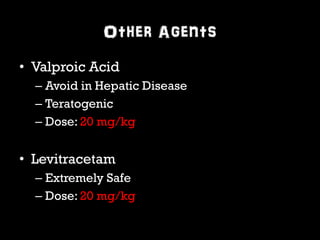
Other Agents 
• Valproic Acid 
– Avoid in Hepatic Disease 
– Teratogenic 
– Dose: 20 mg/kg 
• Levitracetam 
– Extremely Safe 
– Dose: 20 mg/kg
“The Longer A seizure Persists, 
the more refractory to treatment 
it will become” 
Wheless, 1996
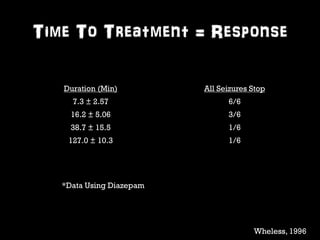
Time To Treatment = Response 
Duration (Min) All Seizures Stop 
7.3 ± 2.57 6/6 
16.2 ± 5.06 3/6 
38.7 ± 15.5 1/6 
127.0 ± 10.3 1/6 
Wheless, 1996 
*Data Using Diazepam
Seizures Simplified
Seizures Simplified 
Stabilize the Patient
Seizures Simplified 
Finger Stick Blood Glucose
Seizures Simplified 
Time Seizure 
Monitor Vital Signs
Seizures Simplified 
Attempt IV Access 
Collect Blood
Seizures Simplified 
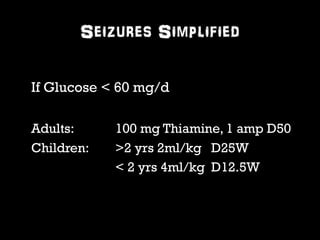
If Glucose < 60 mg/d 
Adults: 100 mg Thiamine, 1 amp D50 
Children: >2 yrs 2ml/kg D25W 
< 2 yrs 4ml/kg D12.5W
Seizures Simplified 
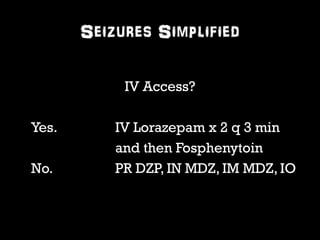
IV Access? 
Yes. IV Lorazepam x 2 q 3 min 
and then Fosphenytoin 
No. PR DZP, IN MDZ, IM MDZ, IO
Seizures Simplified 
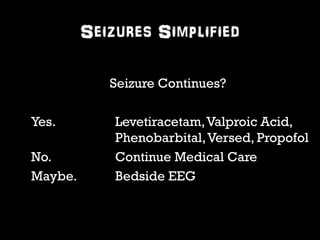
Seizure Continues? 
Yes. Levetiracetam, Valproic Acid, 
Phenobarbital, Versed, Propofol 
No. Continue Medical Care 
Maybe. Bedside EEG
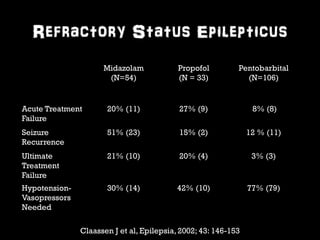
Refractory Status Epilepticus 
Midazolam 
(N=54) 
Propofol 
(N = 33) 
Pentobarbital 
Claassen J et al, Epilepsia, 2002; 43: 146-153 
(N=106) 
Acute Treatment 
Failure 
20% (11) 27% (9) 8% (8) 
Seizure 
Recurrence 
51% (23) 15% (2) 12 % (11) 
Ultimate 
Treatment 
Failure 
21% (10) 20% (4) 3% (3) 
Hypotension- 
Vasopressors 
Needed 
30% (14) 42% (10) 77% (79)
Evidence Based 
Medicine
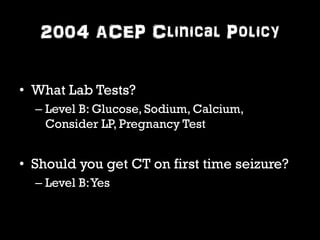
2004 ACEP Clinical Policy 
• What Lab Tests? 
– Level B: Glucose, Sodium, Calcium, 
Consider LP, Pregnancy Test 
• Should you get CT on first time seizure? 
– Level B: Yes
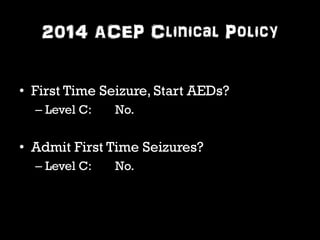
2014 ACEP Clinical Policy 
• First Time Seizure, Start AEDs? 
– Level C: No. 
• Admit First Time Seizures? 
– Level C: No.
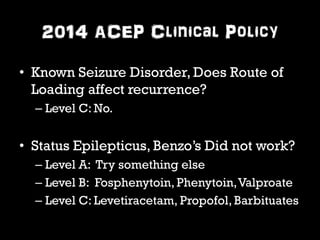
2014 ACEP Clinical Policy 
• Known Seizure Disorder, Does Route of 
Loading affect recurrence? 
– Level C: No. 
• Status Epilepticus, Benzo’s Did not work? 
– Level A: Try something else 
– Level B: Fosphenytoin, Phenytoin, Valproate 
– Level C: Levetiracetam, Propofol, Barbituates
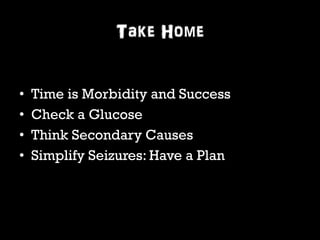
Take Home 
• Time is Morbidity and Success 
• Check a Glucose 
• Think Secondary Causes 
• Simplify Seizures: Have a Plan
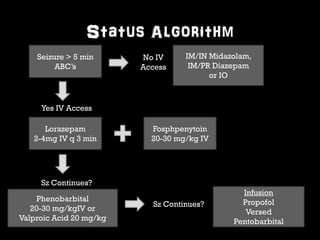
Status Algorithm 
Seizure > 5 min 
ABC’s 
No IV 
Access 
IM/IN Midazolam, 
IM/PR Diazepam 
or IO 
Yes IV Access 
Lorazepam 
2-4mg IV q 3 min 
Fosphpenytoin 
20-30 mg/kg IV 
Sz Continues? 
Phenobarbital 
20-30 mg/kgIV or 
Valproic Acid 20 mg/kg 
Infusion 
Propofol 
Versed 
Pentobarbital 
Sz Continues?
Thanks and ?’s 
Special Thanks Dr. Williams
Resources 
• Dodson WE et al, JAMA, 1993; 270: 854-859. 
• Lowenstein DH et al, Epilepsia; 1999; 40: 120-122. 
• Corey LA et al, Neurology, 1998; 50: 558-560. 
• Hauser WA, Hesdorffer DC. Epilepsy: frequency, causes, and consequences. 
New York: Demos Publications; 1990. 
• EarnestMP,Etal.Neurology 1988; 38: 1561-5 
• Prasad K, Al-Roomi K, Krishnan PR, et al. Anticonvulsant therapy for status 
epilepticus.Cochrane Database Syst. Rev. 2005, Issue 4. Art No.:CD003723. DOI: 
10.1002/14651858.CD003723.pub2. 
• American College of Emergency Physicians. Clinical policy: critical issues in 
the evaluation and management of adult patients presenting to the 
emergency department with seizures.Ann Emerg Med. May 2004;43(5):605-25 
• Claassen J, Hirsch LJ, Emerson RG, Mayer SA. Treatment of refractory status 
epilepticus with pentobarbital, propofol, or midazolam: a systematic 
review. Epilepsia. Feb 2002;43(2):146-53.

Seizures Dr. Samir Shahani

  • 1.
    SHAKE and BAKE SAMIR SHAHANI PGY-3
  • 3.
  • 4.
    Why should youCare? - Prevalence: 1 out of 100 people - 1-2% of all ED visits - 3 million people in US - 200,000 new cases each year - Overall Mortality of Status is 20%
  • 5.
    Differential • Syncope • Metabolic Conditions • Migraine • Vascular Conditions • Sleep Disorders • Paroxysmal Movement Disorders • Psychological Disorders • Infection • Trauma • Malignancy
  • 6.
    Seizure Classification •Provoked Seizure – Electrolyte Abnormalities – Withdrawal vs Toxic Ingestion – Infection – CNS Mass – Pregnancy – Trauma • Unprovoked Seizures
  • 7.
    The Basics •Generalized • Focal (Partial) • Focal with Secondary Generalization • Status Epilepticus
  • 8.
    Status Epilepticus Definition • Epidemiologic • ≥ 30 minutes • New Definition • ≥ 5 minutes • 2 or more seizures without recovery of consciousness • Pathological • Failure of inhibitory pathways (GABA)
  • 9.
  • 10.
    History • FirstTime Seizure vs Recurrence? • Describe Event – Movement – Eye Deviation – Duration • Medications • Social History • Review of Systems
  • 11.
    Physical • Vitals • General • Eyes • Neck • Neurological
  • 12.
    Labs • Glucose • Electrolytes • Pregnancy Test • Toxicology Studies • CSF Studies • Lactate • Prolactin • Antiepilectic Drug (AED) Levels • Blood Gas
  • 13.
    Imaging and DiagnosticStudies • CT Head w/o Contrast • MRI w/o Contrast • EEG
  • 14.
  • 15.
    New Onset Seizures CT Head Without Contrast – Easy to obtain – First Time Seizures in setting of Etoh or Etoh Withdrawal: 6.2% had significant finding Lumbar Puncture – Fever, Immunocompromised, AMS, severe HA
  • 16.
    New Onset Seizures Should I Start AED? – Recurrence Rate < 30-50% – Consider Starting If: • Structural lesion on CT • Focal Deficit • Positive EEG
  • 17.
  • 18.
    Benzodiazpines • Diazepam – Quickest Onset – Dose: 10 mg PR, IM • Midazolam – Fast Onset – Dose: • 2-4 mg IV, IM • 5 mg per nostril IN
  • 19.
    Benzodiazpines • Lorazepam – Longer Duration of Action – Can be used alone – Dose: 2-4 mg IV, IM
  • 20.
    Phenytoin vs Fosphenytoin • No studies have compared efficacy • Phenytoin is generally cheaper • Fosphenytoin is well tolerated • Fosphenytoin reaches the Brain Faster
  • 21.
    Fosphenytoin • Doesnot Contain Propylene Glycol • Can be Given Faster than Phenytoin – Phenytoin 50 mg/min – Fosphenytoin 150 PE/min • Dose: 20 mg/kg ± 10 mg/kg
  • 22.
    Phenobarbital • 20mg/kg over 20 minutes • Risk of Apnea and Hypotension • Get Ready To Intubate
  • 23.
    Other Agents •Valproic Acid – Avoid in Hepatic Disease – Teratogenic – Dose: 20 mg/kg • Levitracetam – Extremely Safe – Dose: 20 mg/kg
  • 24.
    “The Longer Aseizure Persists, the more refractory to treatment it will become” Wheless, 1996
  • 25.
    Time To Treatment= Response Duration (Min) All Seizures Stop 7.3 ± 2.57 6/6 16.2 ± 5.06 3/6 38.7 ± 15.5 1/6 127.0 ± 10.3 1/6 Wheless, 1996 *Data Using Diazepam
  • 27.
  • 28.
  • 29.
    Seizures Simplified FingerStick Blood Glucose
  • 30.
    Seizures Simplified TimeSeizure Monitor Vital Signs
  • 31.
    Seizures Simplified AttemptIV Access Collect Blood
  • 32.
    Seizures Simplified IfGlucose < 60 mg/d Adults: 100 mg Thiamine, 1 amp D50 Children: >2 yrs 2ml/kg D25W < 2 yrs 4ml/kg D12.5W
  • 33.
    Seizures Simplified IVAccess? Yes. IV Lorazepam x 2 q 3 min and then Fosphenytoin No. PR DZP, IN MDZ, IM MDZ, IO
  • 34.
    Seizures Simplified SeizureContinues? Yes. Levetiracetam, Valproic Acid, Phenobarbital, Versed, Propofol No. Continue Medical Care Maybe. Bedside EEG
  • 35.
    Refractory Status Epilepticus Midazolam (N=54) Propofol (N = 33) Pentobarbital Claassen J et al, Epilepsia, 2002; 43: 146-153 (N=106) Acute Treatment Failure 20% (11) 27% (9) 8% (8) Seizure Recurrence 51% (23) 15% (2) 12 % (11) Ultimate Treatment Failure 21% (10) 20% (4) 3% (3) Hypotension- Vasopressors Needed 30% (14) 42% (10) 77% (79)
  • 36.
  • 37.
    2004 ACEP ClinicalPolicy • What Lab Tests? – Level B: Glucose, Sodium, Calcium, Consider LP, Pregnancy Test • Should you get CT on first time seizure? – Level B: Yes
  • 38.
    2014 ACEP ClinicalPolicy • First Time Seizure, Start AEDs? – Level C: No. • Admit First Time Seizures? – Level C: No.
  • 39.
    2014 ACEP ClinicalPolicy • Known Seizure Disorder, Does Route of Loading affect recurrence? – Level C: No. • Status Epilepticus, Benzo’s Did not work? – Level A: Try something else – Level B: Fosphenytoin, Phenytoin, Valproate – Level C: Levetiracetam, Propofol, Barbituates
  • 40.
    Take Home •Time is Morbidity and Success • Check a Glucose • Think Secondary Causes • Simplify Seizures: Have a Plan
  • 41.
    Status Algorithm Seizure> 5 min ABC’s No IV Access IM/IN Midazolam, IM/PR Diazepam or IO Yes IV Access Lorazepam 2-4mg IV q 3 min Fosphpenytoin 20-30 mg/kg IV Sz Continues? Phenobarbital 20-30 mg/kgIV or Valproic Acid 20 mg/kg Infusion Propofol Versed Pentobarbital Sz Continues?
  • 42.
    Thanks and ?’s Special Thanks Dr. Williams
  • 43.
    Resources • DodsonWE et al, JAMA, 1993; 270: 854-859. • Lowenstein DH et al, Epilepsia; 1999; 40: 120-122. • Corey LA et al, Neurology, 1998; 50: 558-560. • Hauser WA, Hesdorffer DC. Epilepsy: frequency, causes, and consequences. New York: Demos Publications; 1990. • EarnestMP,Etal.Neurology 1988; 38: 1561-5 • Prasad K, Al-Roomi K, Krishnan PR, et al. Anticonvulsant therapy for status epilepticus.Cochrane Database Syst. Rev. 2005, Issue 4. Art No.:CD003723. DOI: 10.1002/14651858.CD003723.pub2. • American College of Emergency Physicians. Clinical policy: critical issues in the evaluation and management of adult patients presenting to the emergency department with seizures.Ann Emerg Med. May 2004;43(5):605-25 • Claassen J, Hirsch LJ, Emerson RG, Mayer SA. Treatment of refractory status epilepticus with pentobarbital, propofol, or midazolam: a systematic review. Epilepsia. Feb 2002;43(2):146-53.

Editor's Notes

  • #3 22 yo M who arrives to ED unresponsive. Family reportedly saw him shake for several minutes and fall to the ground. Family states he has no past medical history. EMS states last episode was 3 minutes ago. He starts to have full body convulsions again, this time it’s not stopping. He is foaming at the mouth, O2 sats are dropping.
  • #4 A good analogy for seizures are to think of them as an oven Irreversible Neuronal Damage occurs at 20-60 minutes The longer you shake, the more you bake.
  • #5 1 in 10 will have a seizure, 1 in 100 will have epilepsy 15.5 billion annual in direct and indirect costs
  • #6 Shout Out Things That can Mimic Seizures These Things Mimic Syncope: EKG dysrhthmia, prolonged intervals, rapid return to baseline mental status Migraine: aura Vascular: stroke Sleep Disorders: cataplexy, narcoplepsy, night terrors
  • #7 Alcohol Withdrawal: Large doses of benzos and occasionally Phenobarbital as second line Toxic Ingestion: Isoniazid (Pyridoxine Vit B6) Alcohol: seizures usally occure within 6-48 hours and can occur at any blood etoh level Lithium/Buproprion/Aspirin/TCA (HD), TCA and Aspirin, alkalize the urine Pregnancy: Treat with Magnesium, 4-6 g over 20 minutes with 1-2 g/hr maintenance, can use benzo Trauma: 4% of epilepsy, directly related to injury, but not affected by early use of AED
  • #8 Generalized -Both hemispheres, almost always effect level of concisousness
  • #9 neuronal damage at 5 minutes, although most agree that non-reversible damage occurs at 1 hour 1998: 30 minutes 2012: 5 minutes
  • #10 Both hemispheres
  • #11 Eye Deviation indicates focal onset, straight ahead or upwards generalized 85% of Real Seizures have eyes open
  • #12 Vital signs could be hypertensive first, febrile Although physical exam is rarely definitive wether seizures are pseudo or not. Pupils, Papilledema- increased ICP, deviated Nuchal RigidityFever, Stiff Neck, Menigitis/Encephalitis Focal Neurologic Finding or Mental Status PSEUDOSIEZURES TEND TO LAST LONGER, they resist passive eye opening. Limited post-ictal confusion. Intensity may wax and wane. Vital signs usually remain normal. Hand its face pseudosiezure
  • #13 In general lab test show low yield, one study showed only 15% abnormal Tox: acohol and drugs CSF elevated WBC can be normal without meningoencephalitis Prolactin: drawn within 20-60 minutes, one meta analaysis showed that prolactin level > 3 x normal had positive liklihood ratio of 9 to differentiate between generalized seizure and psuedosiezure. bedside EEG is gold standard
  • #14 First time seizure, trauma, immunocompromised state, history of malignancy, anticoagulation, fever, new type of seizure MRI is diagnostic imaging test of choice, but is not standard of care EEG high yield to predict seizure recurrence, one study showed in 24 hours 48% of people had subtle sz on EEG even though no clinical convulsions
  • #18 Both hemispheres
  • #19 A pre-hospital study compared 10 mg IM diazepam to 4 mg IV ativan in adults and children > 40 kg and noted equivalent efficacy.
  • #20 Lorazepam 12-24 hours, and diazepam 15-30 minutes duration of anti-seizure effect, lorazepam is preferable to diazepam. However
  • #21 Fosphenytoin is pro-drug of phenytoin Phenytoin max brain concentration is 20-25 min at max rate Fosphenytoin max brain concentration is 10 min at max rate
  • #22 Propylene Glycol is main limiting factor for rate of treatment that has CV effects
  • #23 Max 1 gm, 20 mg-30 mg/kg Risk of apnea is especially presents with BZD’s Highly effective
  • #24 Although we don’t all it Highly effective American Academy of Neurology in 2013 came out and stated. Valproate: Hepatotoxicity, pancreatitis
  • #26 This is a fancy slide to back up that quote, Longer seizure lasts its harder to treat
  • #27 Lets go back to our patient. How do we start.
  • #29 ABC’s, assess oxygenation low threshold to intubate,RSI should be short acting paralytic and caution with etomidate
  • #31 Goal is cessation of seizure within 30 minutes
  • #32 Electrolytes, Hematology, Toxicology, AED Levels, Prolactin (20 minutes from event), Lactate IO: Hgb, Hct, Glucose, Na, Cl, BUN, Creatinine good correlation WBC, Platelets, Potassium, Bicarb not so much
  • #33 Thiamine for Werineke Korsakoff in Adults
  • #34 If seizure > 5minutes Diazepam, can be given
  • #35 Yes. If failure to respond to benzo and phosphenytoin defines refractory status epilepticus, approx 9-30% of status becomes refractory, mortality jumps to 50%
  • #36 PB, myocardial depression, vasodilation, decreased venous return, decreased cardiac perfusion Propofol Risk of hypotension, lipidemia, metabolic acidosis Midazolam has least side effects but highest breakthrough rates My opinion is to use the highest does of infusion until seizures can be ruled out
  • #37 Both hemispheres
  • #38 Level A  recommendations. reflect a high degree of clinical certainty Level B recommendations.  Recommendations that reflect moderate clinical certainty (ie, based on strength of evidence Level C: based on consensus of panel, absent of quality literature
  • #39 1.Unless Trauma or Brain Disease 2. If returned to baseline
  • #41 Secondary: Toxins, Pregnancy, Trauma