


Status Epilepticus
Dr. Ravindra K. Sharma
Pediatric Specialist
Fujairah Hospital,UAE
TAJ MAHAL, AGRA, INDIA
“Status

epilepticus is a medical
emergency that requires an
organized and skillful approach to
minimize the associated mortality
and morbidity”
 Status

epilepticus (SE) presents in a multitude
of forms, dependent on etiology and patient
age (myoclonic, tonic, subtle, tonic-clonic,
absence, complex partial etc.)
 Generalized, tonic-clonic SE is the most
common form of SE.
Definition:
 Conventional definition:
 Single

 Series

seizure > 30 minutes

of seizures > 30 minutes without
full recovery
Definition:….
“If appropriate therapy is delayed, SE can
cause permanent neurologic sequelae or
death …”
thus




“ … any child who presents actively convulsing
should be assumed to have SE.”

Haafiz A. Pediatr Emerg Care 1999;15(2):119-29
The longer SE persists,
the lower is the likelihood of spontaneous
cessation
the harder is it to control
the higher is the risk of morbidity and mortality
Treatment for most seizures needs to be
instituted after > 5 minutes of seizure activity
Bleck TP. Epilepsia 1999;40(1):S64-6
But
 This

is not practical operational definition.
 Longer periods with uncontrolled seizure
activity, more likely to develop a RSE
syndrome.
 More practical guidelines needed to draw that
arbitrary ‘line in sand’, beyond which
substantial risk of developing clinical SE exists.
Operational Definition:

“Continuous seizures lasting at least 5 minutes
or two or more discrete seizures between which
there is an incomplete recovery of
consciousness”
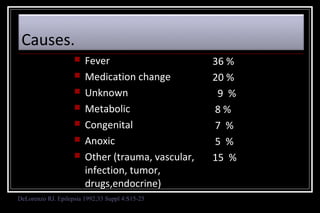
Causes.








Fever
Medication change
Unknown
Metabolic
Congenital
Anoxic
Other (trauma, vascular,
infection, tumor,
drugs,endocrine)

DeLorenzo RJ. Epilepsia 1992;33 Suppl 4:S15-25

36 %
20 %
9 %
8%
7 %
5 %
15 %
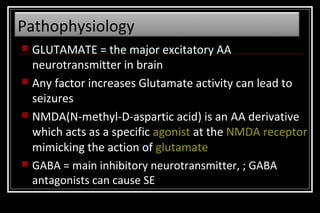
Pathophysiology
GLUTAMATE = the major excitatory AA
neurotransmitter in brain
 Any factor increases Glutamate activity can lead to
seizures
 NMDA(N-methyl-D-aspartic acid) is an AA derivative
which acts as a specific agonist at the NMDA receptor
mimicking the action of glutamate
 GABA = main inhibitory neurotransmitter, ; GABA
antagonists can cause SE

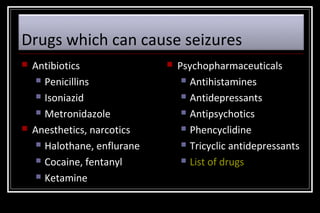
Drugs which can cause seizures




Antibiotics
 Penicillins
 Isoniazid
 Metronidazole
Anesthetics, narcotics
 Halothane, enflurane
 Cocaine, fentanyl
 Ketamine



Psychopharmaceuticals
 Antihistamines
 Antidepressants
 Antipsychotics
 Phencyclidine
 Tricyclic antidepressants
 List of drugs
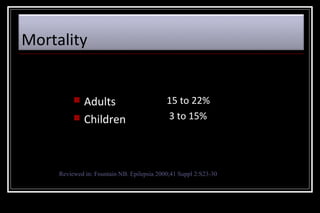
Mortality




Adults
Children

15 to 22%
3 to 15%

Reviewed in: Fountain NB. Epilepsia 2000;41 Suppl 2:S23-30
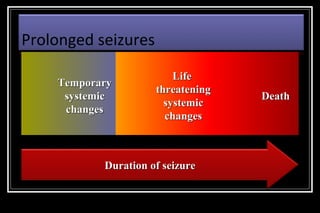
Prolonged seizures
Temporary
systemic
changes

Life
threatening
systemic
changes

Duration of seizure

Death
Respiratory


Hypoxia and hypercarbia
-

⇓ ventilation (chest rigidity from muscle spasm)
Hypermetabolism (⇑ O2 consumption, ⇑ CO2 production)

-

Poor handling of secretions

-

Neurogenic pulmonary edema?
Hypoxia




Hypoxia/anoxia markedly increase the risk of
mortality in SE
Seizures (without hypoxia) are much less dangerous
than seizures and hypoxia

Towne AR. Epilepsia 1994;35(1):27-34
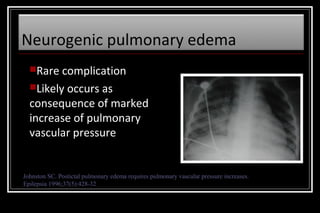
Neurogenic pulmonary edema
Rare complication
Likely

occurs as
consequence of marked
increase of pulmonary
vascular pressure

Johnston SC. Postictal pulmonary edema requires pulmonary vascular pressure increases.
Epilepsia 1996;37(5):428-32
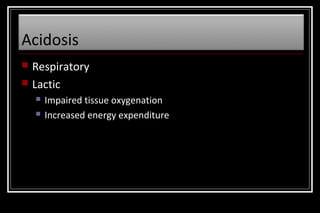
Acidosis



Respiratory
Lactic



Impaired tissue oxygenation
Increased energy expenditure
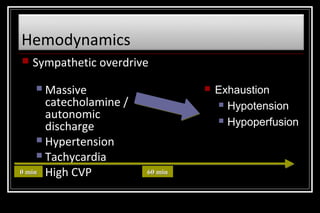
Hemodynamics


Sympathetic overdrive

Massive
catecholamine /
autonomic
discharge
 Hypertension
 Tachycardia
0 min High CVP




60 min

Exhaustion
 Hypotension
 Hypoperfusion
COMMON WEALTH GAMES, DELHI 2010.
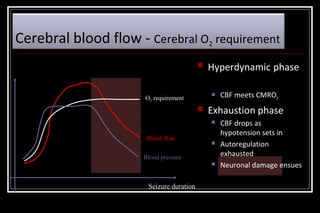
Cerebral blood flow - Cerebral O2 requirement


Hyperdynamic phase


O2 requirement



Exhaustion phase


Blood flow



Blood pressure


Seizure duration

CBF meets CMRO2
CBF drops as
hypotension sets in
Autoregulation
exhausted
Neuronal damage ensues
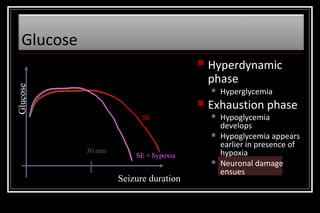
Glucose
Glucose



Hyperdynamic
phase



SE

Exhaustion phase



30 min

SE + hypoxia


Seizure duration

Hyperglycemia

Hypoglycemia
develops
Hypoglycemia appears
earlier in presence of
hypoxia
Neuronal damage
ensues
Hyperpyrexia
 Hyperpyrexia

may develop during protracted
SE, and aggravate possible mismatch of
cerebral metabolic requirement and substrate
delivery
 Treat hyperpyrexia aggressively
 Antipyretics, external cooling
Other alterations
 Blood

leukocytosis (50% of children)
 Spinal fluid leukocytosis (15% of children)
 ⇑ K+
 ⇑ creatine kinase
 Myoglobinuria
Boring!
Acute Management of Seizures
Common Sense:0-5 minutes
Stabilize the patient-

A

Oxygen, oral airway. Avoid hypoxia!

B

Consider bag-valve mask ventilation. Consider
intubation

C

IV/IO access. Treat hypotension, but NOT
hypertension
(0-5 minutes)…
 Arterial


blood gas?

All children in SE have acidosis. It often resolves rapidly with
termination of SE

 Intubate?




It may be difficult to intubate the actively seizing child
Stop or slow seizures first, give O2, consider BVM ventilation
If using paralytic agent to intubate, assume that SE continues
0-5 minutes….
 Give glucose (2-4 ml/kg D25%, infants 5 ml/kg D10%),

unless

normo- or hyperglycemic
 Hyperglycemia has no negative effect in SE
(as long as significant hyperosmolality is being avoided)

 Adoloscent-Thiamin

100 mg IV first
Initial investigations(0-5 minutes)….


Labs


Na,K, Ca, Mg, PO4 , BUN, Cret, glucose



CBC
Liver function tests, ammonia
Anticonvulsant level
Toxicology
Blood C/S








Initial screening history and Physical examination
Work-Up (when stable)


Lumbar puncture




CT scan/MRI scan




Always defer LP in unstable patient, but never delay
antibiotic/antiviral rx if indicated
Indicated for focal seizures or deficit, history of trauma or
bleeding d/o

EEG
Treatment (Pharmacotheraqpy)
5-15 minutes..
 The

longer we wait with anticonvulsant, the
more anticonvulsant we will need to stop SE

 Most

common mistake is ineffective dose
Anticonvulsants


Rapid acting

plus


Long acting
Anticonvulsants - Rapid acting


Benzodiazepines








Lorazepam 0.05- 0.1 mg/kg i.v.(rectal dose same) upto 4-6
mg over 1-2 minutes
or
Diazepam 0.2- 0.5 mg/kg i.v. upto 6-10mg over 1-2 minutes
Diazepam 0.5 mg/kg rectally
Midazolam 0.15-0.3 mg/kg IV ; nasal or Buccal (0.5 mg/kg)
is used if no IV line
If SE persists, repeat every 5-10 minutes
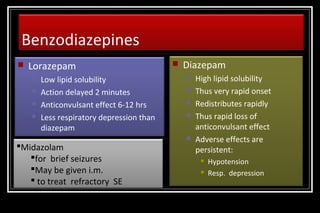
Benzodiazepines


Lorazepam





Low lipid solubility
Action delayed 2 minutes
Anticonvulsant effect 6-12 hrs
Less respiratory depression than
diazepam

Midazolam
for brief seizures
May be given i.m.
 to treat refractory SE



Diazepam







High lipid solubility
Thus very rapid onset
Redistributes rapidly
Thus rapid loss of
anticonvulsant effect
Adverse effects are
persistent:



Hypotension
Resp. depression
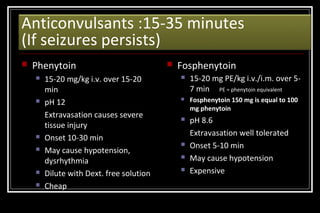
Anticonvulsants :15-35 minutes
(If seizures persists)


Phenytoin










15-20 mg/kg i.v. over 15-20
min
pH 12
Extravasation causes severe
tissue injury
Onset 10-30 min
May cause hypotension,
dysrhythmia
Dilute with Dext. free solution
Cheap



Fosphenytoin


15-20 mg PE/kg i.v./i.m. over 57 min PE = phenytoin equivalent



Fosphenytoin 150 mg is equal to 100
mg phenytoin



pH 8.6
Extravasation well tolerated
Onset 5-10 min
May cause hypotension
Expensive




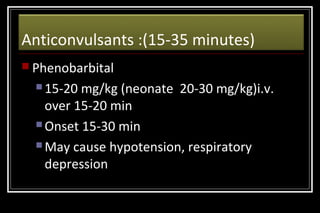
Anticonvulsants :(15-35 minutes)
 Phenobarbital
 15-20

mg/kg (neonate 20-30 mg/kg)i.v.
over 15-20 min
 Onset 15-30 min
 May cause hypotension, respiratory
depression
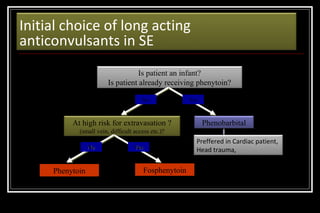
Initial choice of long acting
anticonvulsants in SE
Is patient an infant?
Is patient already receiving phenytoin?
No

At high risk for extravasation ?

Yes

Phenobarbital

(small vein, difficult access etc.)?
No

Phenytoin

Preffered in Cardiac patient,
Head trauma,

Yes

Fosphenytoin
If SE persists (45 minutes)








Phenobarbital if Phenytoin used
Additional phenytoin or FP 5 mg/kg (Nelson 10 mg/kg
increment) max upto 30 mg ,
Additional phenobarbital 5 mg/kg/dose every 15–30
min (max total dose of 30 mg/kg)
be prepared to support respirations
Consider IV valproate, especially for partial status
epilepticus
Seizures Persists (60 minutes)
 Consider

Diazepam infusion, pentobarbital
(Barbiturate coma), midazolam, paraldehyde
or general anesthesia infusion in PICU
 Midazolam 0.2 mg/kg bolus & 20-400
mcg/kg/hr infusion
 Propofol 1-2 mg/kg then 2-10 mg/kg/hr
infusion
 Avoid paralytics
Still Seizures Persists….







Induction of Barbiturate coma for 48 hrs
IV loading thiopental 2–4 mg/kg till a burst
suppression EEG pattern till 48 hrs
check phenobarbital level to be normal.
Paraldehyde :loading 150–200 mg/kg IV for 15–20
min, then 20 mg/kg/hr in a 5% concentration in a
glass bottle freshly prepared
Still Seizures Persists….


General anesthesia: if barbiturate coma is not
option.
 halothane and Isoflurane.
 Acts by reversing cerebral anoxia and metabolic
abnormalities, allowing the previously
administered anticonvulsants to exert their
effect.
Possible new drugs for Status







Lidocaine - some positive trials
Valproate - IV form available
 10-15 mg/kg IV.
Gabapentin / Vigabatrin / Lamotrigine
Felbamate - blocks NMDA receptors
Ketamine - blocks NMDA receptors

Use of AED after status episode is controversial especially
idiopathic or febrile seizure.
Non - convulsive status epilepticus?
 NCSE

is a term used to denote a range
of conditions in which electrographic
seizure activity is prolonged and results
in non convulsive clinical symptoms.
Non - convulsive SE ?



Up to 20 % of children with SE have non convulsive SE after tonic - clonic SE
Non - convulsive SE ?
 If

child does not begin to respond to painful
stimuli within 20 - 30 minutes after tonic clonic SE, suspect non - convulsive SE
 Urgent EEG
Summary
Status Epilepticus is >5 min of seizures or two seizures
without return to consciousness
 Status Epilepticus is common
 Delay in therapy makes SE harder to rest
 Mortality and morbidity is increased in prolonged SE
 BZD, Pheny/Pheno, Call for PICU
 Status Epilepticus needs a DIAGNOSIS

Take-Home points 







Better outcome if seizure stopped earlier, so no need to
wait
Always ABC D FIRST
Lorazepam - best 1st line Rx
Fosphenytoin - surpasses Phenytoin for SE, and can be
given IM in difficult situation
Propofol - advantages over barbiturates for resistant SE,
low toxicity , quick action, and fast recovery upon
discontinuation
Status epilapticus

Status epilapticus

  • 1.
    Status Epilepticus Dr. RavindraK. Sharma Pediatric Specialist Fujairah Hospital,UAE
  • 2.
    TAJ MAHAL, AGRA,INDIA TAJ MAHAL, AGRA, INDIA
  • 3.
    “Status epilepticus is amedical emergency that requires an organized and skillful approach to minimize the associated mortality and morbidity”
  • 4.
     Status epilepticus (SE)presents in a multitude of forms, dependent on etiology and patient age (myoclonic, tonic, subtle, tonic-clonic, absence, complex partial etc.)  Generalized, tonic-clonic SE is the most common form of SE.
  • 5.
    Definition:  Conventional definition: Single  Series seizure > 30 minutes of seizures > 30 minutes without full recovery
  • 6.
    Definition:…. “If appropriate therapyis delayed, SE can cause permanent neurologic sequelae or death …” thus   “ … any child who presents actively convulsing should be assumed to have SE.” Haafiz A. Pediatr Emerg Care 1999;15(2):119-29
  • 7.
    The longer SEpersists, the lower is the likelihood of spontaneous cessation the harder is it to control the higher is the risk of morbidity and mortality Treatment for most seizures needs to be instituted after > 5 minutes of seizure activity Bleck TP. Epilepsia 1999;40(1):S64-6
  • 8.
    But  This is notpractical operational definition.  Longer periods with uncontrolled seizure activity, more likely to develop a RSE syndrome.  More practical guidelines needed to draw that arbitrary ‘line in sand’, beyond which substantial risk of developing clinical SE exists.
  • 9.
    Operational Definition: “Continuous seizureslasting at least 5 minutes or two or more discrete seizures between which there is an incomplete recovery of consciousness”
  • 10.
    Causes.        Fever Medication change Unknown Metabolic Congenital Anoxic Other (trauma,vascular, infection, tumor, drugs,endocrine) DeLorenzo RJ. Epilepsia 1992;33 Suppl 4:S15-25 36 % 20 % 9 % 8% 7 % 5 % 15 %
  • 11.
    Pathophysiology GLUTAMATE = themajor excitatory AA neurotransmitter in brain  Any factor increases Glutamate activity can lead to seizures  NMDA(N-methyl-D-aspartic acid) is an AA derivative which acts as a specific agonist at the NMDA receptor mimicking the action of glutamate  GABA = main inhibitory neurotransmitter, ; GABA antagonists can cause SE 
  • 12.
    Drugs which cancause seizures   Antibiotics  Penicillins  Isoniazid  Metronidazole Anesthetics, narcotics  Halothane, enflurane  Cocaine, fentanyl  Ketamine  Psychopharmaceuticals  Antihistamines  Antidepressants  Antipsychotics  Phencyclidine  Tricyclic antidepressants  List of drugs
  • 13.
    Mortality   Adults Children 15 to 22% 3to 15% Reviewed in: Fountain NB. Epilepsia 2000;41 Suppl 2:S23-30
  • 14.
  • 15.
    Respiratory  Hypoxia and hypercarbia - ⇓ventilation (chest rigidity from muscle spasm) Hypermetabolism (⇑ O2 consumption, ⇑ CO2 production) - Poor handling of secretions - Neurogenic pulmonary edema?
  • 16.
    Hypoxia   Hypoxia/anoxia markedly increasethe risk of mortality in SE Seizures (without hypoxia) are much less dangerous than seizures and hypoxia Towne AR. Epilepsia 1994;35(1):27-34
  • 17.
    Neurogenic pulmonary edema Rarecomplication Likely occurs as consequence of marked increase of pulmonary vascular pressure Johnston SC. Postictal pulmonary edema requires pulmonary vascular pressure increases. Epilepsia 1996;37(5):428-32
  • 18.
  • 19.
    Hemodynamics  Sympathetic overdrive Massive catecholamine / autonomic discharge Hypertension  Tachycardia 0 min High CVP   60 min Exhaustion  Hypotension  Hypoperfusion
  • 20.
  • 21.
    Cerebral blood flow- Cerebral O2 requirement  Hyperdynamic phase  O2 requirement  Exhaustion phase  Blood flow  Blood pressure  Seizure duration CBF meets CMRO2 CBF drops as hypotension sets in Autoregulation exhausted Neuronal damage ensues
  • 22.
    Glucose Glucose  Hyperdynamic phase   SE Exhaustion phase   30 min SE+ hypoxia  Seizure duration Hyperglycemia Hypoglycemia develops Hypoglycemia appears earlier in presence of hypoxia Neuronal damage ensues
  • 23.
    Hyperpyrexia  Hyperpyrexia may developduring protracted SE, and aggravate possible mismatch of cerebral metabolic requirement and substrate delivery  Treat hyperpyrexia aggressively  Antipyretics, external cooling
  • 24.
    Other alterations  Blood leukocytosis(50% of children)  Spinal fluid leukocytosis (15% of children)  ⇑ K+  ⇑ creatine kinase  Myoglobinuria
  • 25.
  • 26.
  • 27.
    Common Sense:0-5 minutes Stabilizethe patient- A Oxygen, oral airway. Avoid hypoxia! B Consider bag-valve mask ventilation. Consider intubation C IV/IO access. Treat hypotension, but NOT hypertension
  • 28.
    (0-5 minutes)…  Arterial  bloodgas? All children in SE have acidosis. It often resolves rapidly with termination of SE  Intubate?    It may be difficult to intubate the actively seizing child Stop or slow seizures first, give O2, consider BVM ventilation If using paralytic agent to intubate, assume that SE continues
  • 29.
    0-5 minutes….  Giveglucose (2-4 ml/kg D25%, infants 5 ml/kg D10%), unless normo- or hyperglycemic  Hyperglycemia has no negative effect in SE (as long as significant hyperosmolality is being avoided)  Adoloscent-Thiamin 100 mg IV first
  • 30.
    Initial investigations(0-5 minutes)….  Labs  Na,K,Ca, Mg, PO4 , BUN, Cret, glucose  CBC Liver function tests, ammonia Anticonvulsant level Toxicology Blood C/S      Initial screening history and Physical examination
  • 31.
    Work-Up (when stable)  Lumbarpuncture   CT scan/MRI scan   Always defer LP in unstable patient, but never delay antibiotic/antiviral rx if indicated Indicated for focal seizures or deficit, history of trauma or bleeding d/o EEG
  • 32.
    Treatment (Pharmacotheraqpy) 5-15 minutes.. The longer we wait with anticonvulsant, the more anticonvulsant we will need to stop SE  Most common mistake is ineffective dose
  • 33.
  • 34.
    Anticonvulsants - Rapidacting  Benzodiazepines      Lorazepam 0.05- 0.1 mg/kg i.v.(rectal dose same) upto 4-6 mg over 1-2 minutes or Diazepam 0.2- 0.5 mg/kg i.v. upto 6-10mg over 1-2 minutes Diazepam 0.5 mg/kg rectally Midazolam 0.15-0.3 mg/kg IV ; nasal or Buccal (0.5 mg/kg) is used if no IV line If SE persists, repeat every 5-10 minutes
  • 35.
    Benzodiazepines  Lorazepam     Low lipid solubility Actiondelayed 2 minutes Anticonvulsant effect 6-12 hrs Less respiratory depression than diazepam Midazolam for brief seizures May be given i.m.  to treat refractory SE  Diazepam      High lipid solubility Thus very rapid onset Redistributes rapidly Thus rapid loss of anticonvulsant effect Adverse effects are persistent:   Hypotension Resp. depression
  • 36.
    Anticonvulsants :15-35 minutes (Ifseizures persists)  Phenytoin       15-20 mg/kg i.v. over 15-20 min pH 12 Extravasation causes severe tissue injury Onset 10-30 min May cause hypotension, dysrhythmia Dilute with Dext. free solution Cheap  Fosphenytoin  15-20 mg PE/kg i.v./i.m. over 57 min PE = phenytoin equivalent  Fosphenytoin 150 mg is equal to 100 mg phenytoin  pH 8.6 Extravasation well tolerated Onset 5-10 min May cause hypotension Expensive   
  • 37.
    Anticonvulsants :(15-35 minutes) Phenobarbital  15-20 mg/kg (neonate 20-30 mg/kg)i.v. over 15-20 min  Onset 15-30 min  May cause hypotension, respiratory depression
  • 38.
    Initial choice oflong acting anticonvulsants in SE Is patient an infant? Is patient already receiving phenytoin? No At high risk for extravasation ? Yes Phenobarbital (small vein, difficult access etc.)? No Phenytoin Preffered in Cardiac patient, Head trauma, Yes Fosphenytoin
  • 39.
    If SE persists(45 minutes)      Phenobarbital if Phenytoin used Additional phenytoin or FP 5 mg/kg (Nelson 10 mg/kg increment) max upto 30 mg , Additional phenobarbital 5 mg/kg/dose every 15–30 min (max total dose of 30 mg/kg) be prepared to support respirations Consider IV valproate, especially for partial status epilepticus
  • 40.
    Seizures Persists (60minutes)  Consider Diazepam infusion, pentobarbital (Barbiturate coma), midazolam, paraldehyde or general anesthesia infusion in PICU  Midazolam 0.2 mg/kg bolus & 20-400 mcg/kg/hr infusion  Propofol 1-2 mg/kg then 2-10 mg/kg/hr infusion  Avoid paralytics
  • 41.
    Still Seizures Persists….     Inductionof Barbiturate coma for 48 hrs IV loading thiopental 2–4 mg/kg till a burst suppression EEG pattern till 48 hrs check phenobarbital level to be normal. Paraldehyde :loading 150–200 mg/kg IV for 15–20 min, then 20 mg/kg/hr in a 5% concentration in a glass bottle freshly prepared
  • 42.
    Still Seizures Persists….  Generalanesthesia: if barbiturate coma is not option.  halothane and Isoflurane.  Acts by reversing cerebral anoxia and metabolic abnormalities, allowing the previously administered anticonvulsants to exert their effect.
  • 43.
    Possible new drugsfor Status      Lidocaine - some positive trials Valproate - IV form available  10-15 mg/kg IV. Gabapentin / Vigabatrin / Lamotrigine Felbamate - blocks NMDA receptors Ketamine - blocks NMDA receptors Use of AED after status episode is controversial especially idiopathic or febrile seizure.
  • 44.
    Non - convulsivestatus epilepticus?  NCSE is a term used to denote a range of conditions in which electrographic seizure activity is prolonged and results in non convulsive clinical symptoms.
  • 45.
    Non - convulsiveSE ?  Up to 20 % of children with SE have non convulsive SE after tonic - clonic SE
  • 46.
    Non - convulsiveSE ?  If child does not begin to respond to painful stimuli within 20 - 30 minutes after tonic clonic SE, suspect non - convulsive SE  Urgent EEG
  • 47.
    Summary Status Epilepticus is>5 min of seizures or two seizures without return to consciousness  Status Epilepticus is common  Delay in therapy makes SE harder to rest  Mortality and morbidity is increased in prolonged SE  BZD, Pheny/Pheno, Call for PICU  Status Epilepticus needs a DIAGNOSIS 
  • 48.
    Take-Home points      Betteroutcome if seizure stopped earlier, so no need to wait Always ABC D FIRST Lorazepam - best 1st line Rx Fosphenytoin - surpasses Phenytoin for SE, and can be given IM in difficult situation Propofol - advantages over barbiturates for resistant SE, low toxicity , quick action, and fast recovery upon discontinuation

Editor's Notes

  • #10 Based on a number of small studies mainly in children, felt that once these clinical parameters reached less likely for seizures to self-terminate. Still no generally accepted definition though.