Presented by
Dr. R. RAJA, M.E., Ph.D.,
Associate Professor, Department of EEE,
Muthayammal Engineering College, (Autonomous)
Namakkal (Dt), Rasipuram – 637408
MUTHAYAMMAL ENGINEERING COLLEGE
(An Autonomous Institution)
(Approved by AICTE, New Delhi, Accredited by NAAC, NBA & Affiliated to Anna University),
Rasipuram - 637 408, Namakkal Dist., Tamil Nadu, India.
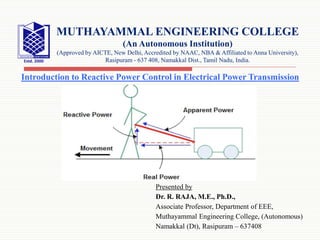
Introduction to Reactive Power Control in Electrical Power Transmission
Reactive Power Control in Electrical Power
Transmission Lines
Reactive power in transmission line :
Reactive Power is one of the total power components in an AC circuit that has its
origin in the phase shift between a sinusoidal voltage and current waveforms. Over a
long distance power transmission, additional reactive power losses occur due to the
large reactive impedance of high voltage transmission system.
Reactive power control :
Reactive power production and consumption by generators allows the network
operator to control voltages throughout their system.
3/28/2021 2
Reactive power and its importance :
Reactive power is used to provide the voltage levels necessary for active power to do
useful work. Reactive power is essential to move active power through the
transmission and distribution system to the customer.
3/28/2021 3
Contd..
Contd..
Apparent Power :
The power which is actually consumed or utilised in an AC Circuit is called True
power or Active power or Real power. It is measured in kilowatt (kW) or MW. It is
the actual outcomes of the electrical system which runs the electric circuits or load.
Reactive Power :
The power which flows back and forth that means it moves in both the directions in
the circuit or reacts upon itself, is called Reactive Power. The reactive power is
measured in kilo volt-ampere reactive (kVAR) or MVAR.
Apparent Power :
The product of root mean square (RMS) value of voltage and current is known as
Apparent Power. This power is measured in kVA or MVA.
3/28/2021 4
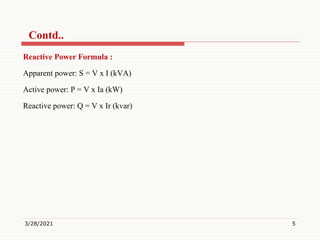
Reactive Power Formula :
Apparent power: S = V x I (kVA)
Active power: P = V x Ia (kW)
Reactive power: Q = V x Ir (kvar)
3/28/2021 5
Contd..
 It has been seen that power is consumed only in resistance. A pure inductor and
a pure capacitor do not consume any power since in a half cycle whatever
power is received from the source by these components, the same power is
returned to the source.
 This power which returns and flows in both the direction in the circuit, is called
Reactive power. This reactive power does not perform any useful work in the
circuit.
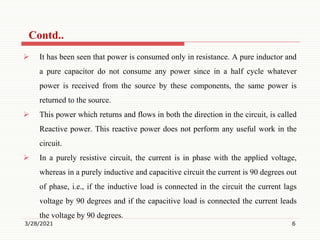
 In a purely resistive circuit, the current is in phase with the applied voltage,
whereas in a purely inductive and capacitive circuit the current is 90 degrees out
of phase, i.e., if the inductive load is connected in the circuit the current lags
voltage by 90 degrees and if the capacitive load is connected the current leads
the voltage by 90 degrees.
3/28/2021 6
Contd..
 Hence, from all the above discussion, it is concluded that the current in phase
with the voltage produces true or active power, whereas, the current 90 degrees
out of phase with the voltage contributes to reactive power in the circuit.
Therefore,
True power = voltage x current in phase with the voltage
Reactive power = voltage x current out of phase with the voltage
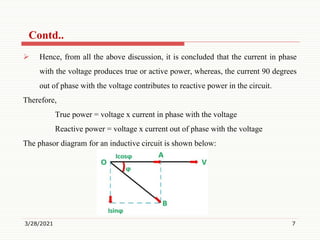
The phasor diagram for an inductive circuit is shown below:
3/28/2021 7
Contd..
 Taking voltage V as reference, the current I lags behind the voltage V by an
angle ϕ. The current I is divided into two components:
I Cos ϕ in phase with the voltage V
I Sin ϕ which is 90 degrees out of phase with the voltage V
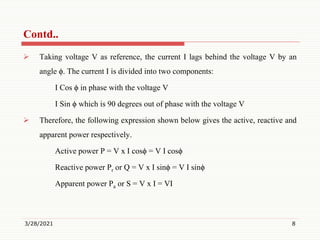
 Therefore, the following expression shown below gives the active, reactive and
apparent power respectively.
Active power P = V x I cosϕ = V I cosϕ
Reactive power Pr or Q = V x I sinϕ = V I sinϕ
Apparent power Pa or S = V x I = VI
3/28/2021 8
Contd..
Active component of the current :
 The current component, which is in phase with the circuit voltage and
contributes to the active or true power of the circuit, is called an active
component or watt-full component or in-phase component of the current.
Reactive component of the current :
 The current component, which is in quadrature or 90 degrees out of phase to the
circuit voltage and contributes to the reactive power of the circuit, is called a
reactive component of the current.
3/28/2021 9
Contd..
Thank You
3/28/2021 10

Introduction to reactive power control in electrical power

  • 1.
    Presented by Dr. R.RAJA, M.E., Ph.D., Associate Professor, Department of EEE, Muthayammal Engineering College, (Autonomous) Namakkal (Dt), Rasipuram – 637408 MUTHAYAMMAL ENGINEERING COLLEGE (An Autonomous Institution) (Approved by AICTE, New Delhi, Accredited by NAAC, NBA & Affiliated to Anna University), Rasipuram - 637 408, Namakkal Dist., Tamil Nadu, India. Introduction to Reactive Power Control in Electrical Power Transmission
  • 2.
    Reactive Power Controlin Electrical Power Transmission Lines Reactive power in transmission line : Reactive Power is one of the total power components in an AC circuit that has its origin in the phase shift between a sinusoidal voltage and current waveforms. Over a long distance power transmission, additional reactive power losses occur due to the large reactive impedance of high voltage transmission system. Reactive power control : Reactive power production and consumption by generators allows the network operator to control voltages throughout their system. 3/28/2021 2
  • 3.
    Reactive power andits importance : Reactive power is used to provide the voltage levels necessary for active power to do useful work. Reactive power is essential to move active power through the transmission and distribution system to the customer. 3/28/2021 3 Contd..
  • 4.
    Contd.. Apparent Power : Thepower which is actually consumed or utilised in an AC Circuit is called True power or Active power or Real power. It is measured in kilowatt (kW) or MW. It is the actual outcomes of the electrical system which runs the electric circuits or load. Reactive Power : The power which flows back and forth that means it moves in both the directions in the circuit or reacts upon itself, is called Reactive Power. The reactive power is measured in kilo volt-ampere reactive (kVAR) or MVAR. Apparent Power : The product of root mean square (RMS) value of voltage and current is known as Apparent Power. This power is measured in kVA or MVA. 3/28/2021 4
  • 5.
    Reactive Power Formula: Apparent power: S = V x I (kVA) Active power: P = V x Ia (kW) Reactive power: Q = V x Ir (kvar) 3/28/2021 5 Contd..
  • 6.
     It hasbeen seen that power is consumed only in resistance. A pure inductor and a pure capacitor do not consume any power since in a half cycle whatever power is received from the source by these components, the same power is returned to the source.  This power which returns and flows in both the direction in the circuit, is called Reactive power. This reactive power does not perform any useful work in the circuit.  In a purely resistive circuit, the current is in phase with the applied voltage, whereas in a purely inductive and capacitive circuit the current is 90 degrees out of phase, i.e., if the inductive load is connected in the circuit the current lags voltage by 90 degrees and if the capacitive load is connected the current leads the voltage by 90 degrees. 3/28/2021 6 Contd..
  • 7.
     Hence, fromall the above discussion, it is concluded that the current in phase with the voltage produces true or active power, whereas, the current 90 degrees out of phase with the voltage contributes to reactive power in the circuit. Therefore, True power = voltage x current in phase with the voltage Reactive power = voltage x current out of phase with the voltage The phasor diagram for an inductive circuit is shown below: 3/28/2021 7 Contd..
  • 8.
     Taking voltageV as reference, the current I lags behind the voltage V by an angle ϕ. The current I is divided into two components: I Cos ϕ in phase with the voltage V I Sin ϕ which is 90 degrees out of phase with the voltage V  Therefore, the following expression shown below gives the active, reactive and apparent power respectively. Active power P = V x I cosϕ = V I cosϕ Reactive power Pr or Q = V x I sinϕ = V I sinϕ Apparent power Pa or S = V x I = VI 3/28/2021 8 Contd..
  • 9.
    Active component ofthe current :  The current component, which is in phase with the circuit voltage and contributes to the active or true power of the circuit, is called an active component or watt-full component or in-phase component of the current. Reactive component of the current :  The current component, which is in quadrature or 90 degrees out of phase to the circuit voltage and contributes to the reactive power of the circuit, is called a reactive component of the current. 3/28/2021 9 Contd..
  • 10.