Downloaded 12 times
![
Abstract—In recent advancements in electric machine and drives,
wound rotor motor is extensively used. The merit of using wound
rotor induction motor is to control speed/torque characteristics by
inserting external resistance. Wound rotor induction motor can be
used in the cases such as (a) low inrush current, (b) load requiring
high starting torque, (c) lower starting current is required, (d) loads
having high inertia, and (e) gradual built up of torque. Examples
include conveyers, cranes, pumps, elevators, and compressors. This
paper includes speed control of wound induction motor using
MATLAB/Simulink for rotor resistance and slip power recovery
method. The characteristics of these speed control methods are hence
analyzed.
Keywords—Wound rotor induction motor, MATLAB/Simulink,
rotor resistance method, slip power recovery method.
I. INTRODUCTION
PEED control of induction motor is achieved by adding
resistance at the rotor side traditionally [2]. The rotor has
three-phase winding connected in star [2]. Separate slip rings
are connected to the three terminals of the rotor winding. Due
to these slip rings, external resistance can be connected, which
helps in speed control of wound rotor induction motor. Speed,
at which maximum torque occurs for the motor, changes by
adding resistance to the rotor circuit [1]. Hence, at low speeds,
high torques can be produced. This is helpful for starting loads
with high breakaway torque requirements. For an ordinary
wound rotor induction motor, the closed loop control system
thyristors are used in secondary side. Slip frequency voltage at
the rotor side is rectified and is fed to a thyristor; a variable on
time results in variable speed [1]. Torque varies widely with
on time depending upon the following conditions: (a) when
thyristor is parallel with the source and external resistance and
(b) when the thyristor is in series with source and external
resistance. Speed control of induction motor can be done
majorly by two schemes:
1. Stator side control
2. Rotor side control
Where rotor side control includes slip power recovery
mechanism and non-slip power recovery mechanism,
respectively. The speed of induction motor can also be varied
from the stator side and methods of speed control from the
stator side includes (a) V/f control or frequency control (b)
Rajesh Kumar is with the Maharishi Markandeshwar University, Mullana,
133203, Haryana, India (corresponding author, phone: +918398069447, e-
mail: rjesh10391@gmail.com).
Roopali Dogra is with the Maharishi Markandeshwar University (phone:
+919622731576, e-mail: roopalidogra5@gmail.com).
PuneetAggrawal is with the Maharishi Markandeshwar University (phone:
+918059931096, e-mail: puneet241@gmail.com).
varying number of stator poles (c) Steering the supply voltage
and varying the resistance using the rheostat on the stator side.
Speed control methods from the stator side have many
limitations considering the constructional aspects of machine
hence rotor speed control method is a better alternative for
speed control. The authors have used MATLAB/Simulink as a
tool to understand characteristics of speed control of wound
rotor induction motor. The characteristics studied here are of
rotor side control using single thyristor, external resistance,
and slip power recovery scheme, respectively. These methods
of speed control are analyzed in the following sections.
II.ROTOR SIDE CONTROL USING SINGLE THYRISTOR
The circuit used for the implementation of rotor side control
of wound rotor induction motor using single thyristor is shown
in Fig. 1 [1].
The addition of external resistance to the rotor of wound
rotor induction motor makes the rotor resistance high during
the starting, hence the rotor current is low, and starting torque
is at maximum [6].Also, rotor resistance is directly
proportional to slip necessary to generate maximum torque. In
wound rotor motors, the rotor resistance is increased by
adding an external resistance [1]. It is possible to achieve pull-
out torque even at low speeds, since slip is more due to
increase in rotor resistance [7].
A. Rotor Resistance Control (Single Thyristor Control)
Using Simulink
The Simulink diagram for the implementation of rotor
resistance control (single thyristor control) using Simulink is
shown in Fig. 2. The asynchronous motor block in Simulink
diagram as shown in Fig. 2 can be modeled according to the
values as shown in Table I.
TABLE I
PARAMETER SPECIFICATIONS
PARAMETER VALUES
Nominal Power(L-L), Voltage and
Frequency
2250*746 VA, 2400V,
60Hz
Stator(R1,L1) 0.029Ω, 0.226/377H
Rotor(R2,L2) 0.022Ω, 0.226/377H
Mutual Inductance Lm 13.04/377H
Inertia, Friction, and Pair of Poles 63.87kgm2
, 0 Nms, 2
The circuit basically consists of three-phase AC supply fed
asynchronous machine. The output of the machine is fed to
bus selector, which helps us to plot the characteristics of
machine. A simple resistive load is used for the analysis of the
output of wound rotor induction machine. To establish desired
speed, control of a thyristor of considerable value is
Rotor Side Speed Control Methods Using
MATLAB/Simulink for Wound Induction Motor
Rajesh Kumar, Roopali Dogra, Puneet Aggarwal
S
World Academy of Science, Engineering and Technology
International Journal of Mechanical, Aerospace, Industrial, Mechatronic and Manufacturing Engineering Vol:11, No:7, 2017
1302International Scholarly and Scientific Research & Innovation 11(7) 2017 scholar.waset.org/1999.8/10007647
InternationalScienceIndex,MechanicalandMechatronicsEngineeringVol:11,No:7,2017waset.org/Publication/10007647](https://image.slidesharecdn.com/rotor-side-speed-control-methods-using-matlabsimulink-for-wound-induction-motor-170723171923/85/Rotor-side-speed-control-methods-using-matlab-simulink-for-wound-induction-motor-1-320.jpg)
![established in parallel acting as load manipulator
Fig. 1 Experimental setup rotor resistance control using Simulink
Fig. 2 Control (single thyristor control) using Simulink
III. ROTOR RESISTANCE METHOD
In the following method, a resistor bank is attached to the
rotor side of wound rotor machine along with breaker. The
breaker helps in changing resistances in different intervals of
time. The variation in speed is hence observed with change in
resistance at different intervals of time. The Simulink diagram
for the following method is shown in Fig. 3 [2].
The asynchronous machine block can be modeled according
to the parameters as tabulated in Table II.
IV. SLIP POWER RECOVERY SCHEME
The most common example of slip power recovery scheme
is Scherbius drive system. It provides control of slip ring
induction motor below synchronous speed [2]. Here, the rotor
AC power is converted using diode rectifier to DC. Further, it
is converted back to AC and feedback to source of power
supply using controlled rectifier [2]. The power supply can be
controlled by varying inverter counter EMF, (V2) which is
controlled by controlling firing angle [2]. To reduce ripple in
DC link current (Id), DC link inductor is provided. The
schematic of slip power recovery scheme is shown in Fig. 3
[2].
TABLE II
PARAMETER SPECIFICATIONS
PARAMETER VALUES
Nominal Power(L-L), Voltage
and Frequency
2250*746VA, 6300, 50
Stator(R1,L1) 0.0859Ω, 0.0051228H
Rotor(R2,L2) 0.0826Ω, 0.003714H
Mutual Inductance Lm 0.23984H
Inertia, Friction, and Pair of Poles 50kgm2
, 0 Nms, 4
World Academy of Science, Engineering and Technology
International Journal of Mechanical, Aerospace, Industrial, Mechatronic and Manufacturing Engineering Vol:11, No:7, 2017
1303International Scholarly and Scientific Research & Innovation 11(7) 2017 scholar.waset.org/1999.8/10007647
InternationalScienceIndex,MechanicalandMechatronicsEngineeringVol:11,No:7,2017waset.org/Publication/10007647](https://image.slidesharecdn.com/rotor-side-speed-control-methods-using-matlabsimulink-for-wound-induction-motor-170723171923/85/Rotor-side-speed-control-methods-using-matlab-simulink-for-wound-induction-motor-2-320.jpg)
![Fig. 3 Experimental setup for rotor resistance method
Fig. 4 Schematic diagram of slip-power recovery scheme
Neglecting stator and rotor resistance voltage drops we have
[5],
V
∗√
π
∗ (1)
and
V
∗√
π
∗ cos α (2)
m (3)
where, V stator voltage, V rotor voltage where α is
the firing angle of the inverter, n and m are respectively the
stator to rotor turns ratio of motor and source side to converter
side ratio of the transformer. The drop across the inverter is
neglected.
V V 0 (4)
s cos α α cos α (5)
Maximum value of α is restricted to 150 for safe
commutation [2].
To match the voltages V1and V2, transformer is used. At
lowest speed required from the drive, V1 will have the
maximum value V1m given by
V nVs (6)
where smaxis the value of slip at lowest speed if α is restricted
to 150, m is chosen such that the inverter voltage has a value
V1m, when α is 150 [8].
mV cos 150 nVs (7)
m (8)
If rotor copper loss is neglected
sP |V | ∗ I (9)
A. Slip Power Recovery Scheme Using SIMULINK
The Simulink diagram for the implementation of slip power
recovery scheme is shown in Fig. 5 [2].
The asynchronous machine block is modeled according to
the parameters as shown in Table II [2]. The transformer in the
Simulink diagram shown in Fig. 5 is modeled according to the
parameters shown in Table III [2].
TABLE III
PARAMETER SPECIFICATIONS
PARAMETER VALUES
Nominal Power 0.055 MVA
Frequency 50 Hz
V1 for winding 1 440 V
V2 for winding 2 6300 V
Magnetizing Resistance Rm 1 Ω
Magnetizing Inductance Lm 1 H
World Academy of Science, Engineering and Technology
International Journal of Mechanical, Aerospace, Industrial, Mechatronic and Manufacturing Engineering Vol:11, No:7, 2017
1304International Scholarly and Scientific Research & Innovation 11(7) 2017 scholar.waset.org/1999.8/10007647
InternationalScienceIndex,MechanicalandMechatronicsEngineeringVol:11,No:7,2017waset.org/Publication/10007647](https://image.slidesharecdn.com/rotor-side-speed-control-methods-using-matlabsimulink-for-wound-induction-motor-170723171923/85/Rotor-side-speed-control-methods-using-matlab-simulink-for-wound-induction-motor-3-320.jpg)
![The slip power in the Simulink is feedback to the supply [4].
Fig. 5 Slip power recovery scheme using Simulink
Fig. 6 Speed-time characteristics of single thyristor control
V.RESULTS AND CONCLUSIONS
After successful implementation of rotor resistance method
using SIMULINK diagram as shown in Fig. 2, the following
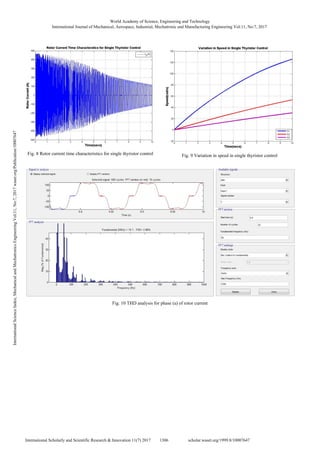
characteristics are yielded as shown in Figs. 6, 7, and 8,
respectively [3].
With the change in resistance the speed variation can be
observed as in Fig. 9.
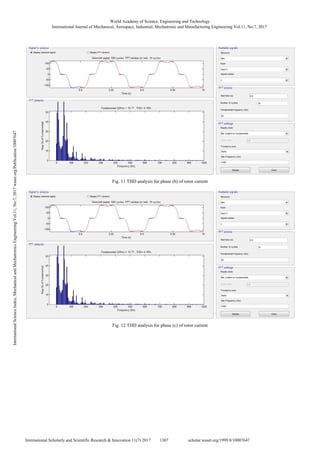
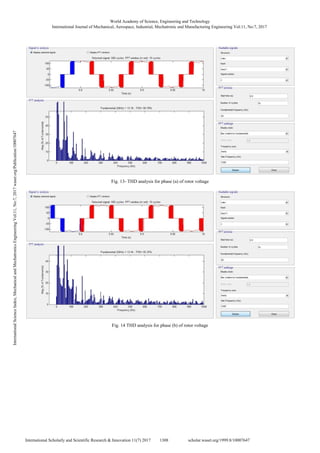
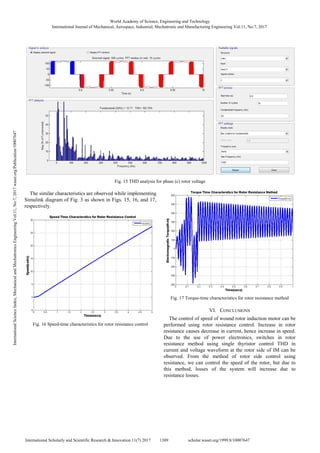
The Total Harmonic Distortion (THD) of the rotor
resistance method using single thyristor control can be
analyzed as in Figs. 10-12 for current waveform and voltage
waveform in Figs. 13, 14, and 15, respectively.
Fig. 7 Torque-time characteristics for single thyristor control
World Academy of Science, Engineering and Technology
International Journal of Mechanical, Aerospace, Industrial, Mechatronic and Manufacturing Engineering Vol:11, No:7, 2017
1305International Scholarly and Scientific Research & Innovation 11(7) 2017 scholar.waset.org/1999.8/10007647
InternationalScienceIndex,MechanicalandMechatronicsEngineeringVol:11,No:7,2017waset.org/Publication/10007647](https://image.slidesharecdn.com/rotor-side-speed-control-methods-using-matlabsimulink-for-wound-induction-motor-170723171923/85/Rotor-side-speed-control-methods-using-matlab-simulink-for-wound-induction-motor-4-320.jpg)
![Fig. 18 Rotor current-time characteristics for rotor resistance control
REFERENCES
[1] V.V. Maruti Prasad, W. Prasanna Narasimham, G. Sai Raghu Ram,
“Rotor Side Control of High Power Slip Ring Induction Motor Using
Single Thyristor”, IOSR Journal of Electrical and Electronics
Engineering, Vol 9, Issue 2 Ver. VII (Mar-Apr 2014), PP 49-53.
[2] Dhaval D. Mer, Rakesh Kumar A. Patel, Manish G. Prajapati,
“Comprehensive Study of Speed Control and Power Loss Analysis
Using Rotor Resistance and Slip Power Recovery Method”,
International Journal of Innovative Research in Electrical, Electronics,
Instrumentation and Control Engineering, Vol 2. Issue 3, Marh 2014.
[3] “MATLAB Documentation”. Mathsworks. Retrieved 14th
Aug 2013.
[4] G.D. Marques and Pedro Verdelho(2000), “A Simple Slip Power
Recovery System with DC voltage intermediate Circuit and Reduced
Harmonics on the Mains”, IEEE Transaction on Industrial Electronics
47(1), 123-232.
[5] IsikCadirci, GokhanAkcam, and MuammerErmi(2005), “Effects of
Instantaneous Power-Supply Failure on the Operation of Slip Energy
Recovery Drives”, IEEE Transaction on Energy Conversion 20(1), 7-15.
[6] Pragasen Pillay, and Larbi Refoufi, “Calculation of Slip Energy
Recovery Induction Motor Drive Behavior Using The Equivalent
Circuit”, IEEE Trans. on Ind. App., Vol.30, No-1, pp-154-163, Jan1994.
[7] William Shepherd and Jack Stanway, “Slip Power Recovery in an
Induction Motor by the Use of Thyristor Inverter”, IEEE Transactions
on Industry and General Applications, vol.5, no.1,PP 74-82, Jan 1969.
[8] J.Faiz, H. Barati, and E.Akpinar, “Harmonic Analysis and Performance
Improvement of Slip Energy Recovery Induction Motor Drives”, IEEE
Transactions on Power Electronics, Vol. 16, Issue 3, pp 410-417,May
2001.
Rajesh Kumar born in Kural, Bhiwani, Haryana, India on 10th
March 1992. He is currently pursuing Masters in Technology
on Electrical Engineering, MaharishiMarkandeshwar
University, Mullana, Haryana, India He completed his B.Tech
on 2014 from National Institute of Technology Goa, Ponda,
Goa, India.
He did training on “Embedded Systems” from International Institute of
Information Technology, Pune. Mr. Kumar was a student Member of
IEEE.Mr. Kumar was Editor-In-Chief of The Electrical Student Luminous
Association (TESLA), National Institute of Technology Goa. He was Campus
Ambassador of Innovians Technology Greater Noida and organized National
Level Workshop on “Industrial Automation”. His areas of interest include
Control System, Power systems, Renewable energy, Power Electronics and
Drives.
Roopali Dogra born in Jammu, India on 6th
May 1988. She
completed her Bachelor of Technology and Masters (M.Tech)
in the years 2013 and 2015 respectively. Her area of interests
includes Machines, Control System and Power Systems.
PuneetAggrawalborn in Ambala Cantt., Haryana, India on 24th
November 1981. He is currently working as an A.P. in
Electrical Department, Maharishi Markandeshwar Engineering
College, Mullana, India. He completed his Bachelor of
Technology and Masters (M.Tech) in the years 2003 and 2010
respectively. Hisarea of interest includes Power Electronics and Drives,
Networks, Operation Research, and Application to Power Electronics and
Power Systems.
World Academy of Science, Engineering and Technology
International Journal of Mechanical, Aerospace, Industrial, Mechatronic and Manufacturing Engineering Vol:11, No:7, 2017
1310International Scholarly and Scientific Research & Innovation 11(7) 2017 scholar.waset.org/1999.8/10007647
InternationalScienceIndex,MechanicalandMechatronicsEngineeringVol:11,No:7,2017waset.org/Publication/10007647](https://image.slidesharecdn.com/rotor-side-speed-control-methods-using-matlabsimulink-for-wound-induction-motor-170723171923/85/Rotor-side-speed-control-methods-using-matlab-simulink-for-wound-induction-motor-9-320.jpg)

The paper discusses the speed control of wound rotor induction motors using various methods, particularly focusing on rotor resistance and slip power recovery techniques, implemented through MATLAB/Simulink. These methods allow for improved control over starting torque and current, making them ideal for applications requiring high starting torque and gradual torque buildup. The authors analyze the characteristics and performance of these control methods, highlighting the potential benefits and challenges associated with each approach.


