STATCOM
SWITFHING CONVERTER TYPE
VAR GENERATOR
Himal Chaulagain
Institute of Engineering
Paschimanchal Campus
8/14/2017 STATCOM 1
INTRODUCTION
• The Tennessee Valley Authority (TVA) installed the first ±100MVA STATCOM in 1995 for reducing
the TVA’s need for load tap changers, thus achieving savings by minimizing the potential for
transformer failure.
• STATCOM is a shunt connected reactive power compensation device that is capable of generating
and/or absorbing reactive power and in which the output can be varied to control the specific
parameters of an electric power system.
• It is a solid state switching converter capable of generating or absorbing independently
controllable real and reactive power at its output terminal when fed from a energy source.
• A STATCOM is analogous to an ideal synchronous machine which generates a balanced set of
three sinusoidal voltage at the fundamental frequency with controllable amplitude and phase
angle.
• STATCOM controller provides voltage support by generating or absorbing reactive power at the
point of common coupling without the need of large external reactors or capacitor banks.
8/14/2017 STATCOM 2
STATCOM can improve power system performance in the following aspects:
• Dynamic voltage control in T&D system.
• Power-oscillation damping in a power transmission system.
• Transient stability
• Voltage flickering control
• Control of not only reactive power but also active power, if necessary, in the connected line
requiring of DC energy source.
• Occupying small footprint as it replaces passive banks of circuit elements by compact electronic
converters.
• Offers modular, factory built equipment so that it reduces site work and commissioning time.
• Uses encapsulated electronic converters, thereby minimizing its environmental impact.
8/14/2017 STATCOM 3
PRINCIPLE OF OPERATION
• Provides the desired reactive power generation and absorption entirely by means of electronic
processing of the voltage and current waveforms in a voltage source converter (VSC).
• VSC is connected to a utility bus through magnetic coupling.
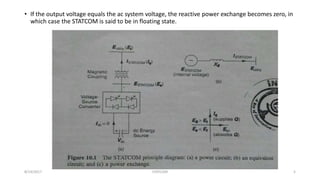
• In figure (b) a STATCOM is seen as an adjustable voltage source behind a reactance meaning that
capacitor banks and shunt reactors are not needed for reactive power generation and absorption,
thereby giving a STATCOM a compact design, or small footprint as well as low noise and magnetic
impact.
• The exchange of reactive power between the converter and the ac system can be controlled by
varying the amplitude of the 3-phase output voltage, Es ,of the converter i.e if the amplitude of
the output voltage is increased above that of the utility bus voltage, Et , then a current flows
through the reactance from the converter to the ac system and the converter generates
capacitive reactive power for the ac system.
• If the amplitude of the output voltage is decreased below the utility bus voltage then the current
flows from the ac system to the converter and the converter absorbs the inductive-reactive
power.
8/14/2017 STATCOM 4
• If the output voltage equals the ac system voltage, the reactive power exchange becomes zero, in
which case the STATCOM is said to be in floating state.
8/14/2017 STATCOM 5
• Adjusting the phase shift between the converter output voltage and the ac system voltage can
similarly control real power exchange between the converter and the ac system.
• Converter can supply real power to the ac system from its dc energy storage if the converter
output voltage is made to lead the ac-system voltage. On the other hand, it can absorb real power
from the ac system for the dc system if its voltage lags behind the ac system voltage.
• Provides the desired reactive power by exchanging the instantaneous reactive power among the
phases of the ac system.
• The mechanism by which the converter initially generates and/or absorbs the reactive power can
be understood by considering the relationship between the output and the input power of the
converter. The converter switches connects the dc input circuit directly to the ac output circuits.
Thus, the net instantaneous power at the ac output terminal must always be equal to net
instantaneous power at the dc input terminal.
8/14/2017 STATCOM 6
Assuming that the converter is operated to supply reactive output power.
• In this case the real power provided by the dc source as input to the converter must be zero.
Furthermore, because the reactive power at zero frequency is by definition is zero: the dc source
supplies no reactive power as input to the converter and thus clearly plays no part in the
generation of reactive output power by the converter.
• The converter simply interconnects 3-output terminal so that the reactive output current can flow
freely among them. If the terminal of the ac system are regarded in this context, the converter
establishes a circulating reactive power exchange among the phases.
• The real power that the converter exchanges at its ac terminals with ac system must of course be
supplied to or absorbed from its dc terminal by the dc capacitor.
• Reactive power is generated internally by the action of converter, a dc capacitor must still be
connected across the input terminals of the converter. The primary need for the capacitor is to
provide a circulating current path as well as a voltage source.
• Not to violate the instantaneous power equality constraint at its input and output terminals, the
converter must draw a fluctuating current from its dc source.
8/14/2017 STATCOM 7
• The VSC has the same rated current capability when it operates with the capacitive or inductive
reactive current. Therefore, a VSC having a certain MVA rating gives the STATCOM twice the
dynamic range in MVAR (contributes to compact design). A dc capacitor bank is used to support
the controlled dc voltage needed for the operation of VSC.
• The reactive power of a STATCOM is produced by means of power electronic equipment of the
VSC type.
• The VSC maybe a two-level or three-level type, depending on the required output power and
voltage.
• Number of VSCs are combined in a multi-pulse connection to form the STATCOM.
• During transient conditions caused by the line faults, a PWM mode is used to prevent the fault
current from entering the VSCs.
• In this way, the STATCOM is able to withstand transients on the ac side without blocking.
8/14/2017 STATCOM 8
V-I CHARACTERISTICS
• A STATCOM is capable of yielding the full output of capacitive generation almost independently of
the system voltage (constant-current output at lower voltages).
• The capability is particularly useful for situations in which the STATCOM is needed to support the
system voltage during and after faults where the voltage collapse would otherwise, be a limiting
factor.
• The figure also illustrates that the STATCOM has an increased transient-rating in both the
capacitive and the inductive operating regions.
• The maximum attainable transient over current in the capacitive region is determined by the
maximum current turn off capability of the converter switches.
• In inductive region, the converter are naturally commutated; therefore the transient current
rating of the STATCOM is limited by the maximum allowable junction temperature of the
converter switches.
8/14/2017 STATCOM 9
• In practice, the semi-conductor switches of the converter are not lossless. So, the energy stored in
the dc capacitor is eventually used to meet the internal losses of the converter and the dc
capacitor voltage diminishes.
• When the STATCOM is used for reactive power generation, the converter itself can keep the
capacitor charge to required voltage level accomplished by making the output voltage of the
converter lag behind the ac system voltage by small angle 0.1-0.2. In this way, the converter
absorbs a small amount of real power from the ac system to meet its internal losses and keep the
capacitor voltage at the desired level. Same mechanism can be used to increase or decrease
capacitor voltage and thus the amplitude of the converter output voltage to control the VAR
generation or absorption.
8/14/2017 STATCOM 10
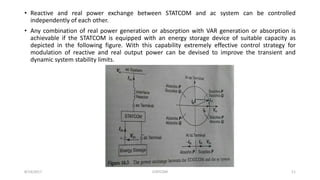
• Reactive and real power exchange between STATCOM and ac system can be controlled
independently of each other.
• Any combination of real power generation or absorption with VAR generation or absorption is
achievable if the STATCOM is equipped with an energy storage device of suitable capacity as
depicted in the following figure. With this capability extremely effective control strategy for
modulation of reactive and real output power can be devised to improve the transient and
dynamic system stability limits.
8/14/2017 STATCOM 11
HARMONIC PERFORMANCE
8/14/2017 STATCOM 12
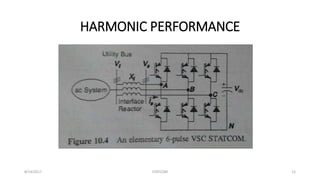
• An elementary six pulse VSC STATCOM consisting of six self commutated semiconductor switches
with anti-parallel diodes.
• In this converter configuration, IGBTs constitute the switching devices.
• With a dc voltage source (which maybe a charged capacitor) the converter can produce a
balanced set of 3 quasi square voltage waveforms of a given frequency by connecting a dc source
sequentially to the three output terminal via the appropriate converter switches.
• The power quality embraces issues such as voltage flicker, voltage dip & voltage rise, as well as,
harmonic performance and high frequency noise.
• The power electronics devices distorts voltage and current waveforms in a power network
influencing power facilities and customers equipment in a diverse manner.
• Harmonic current induce abnormal noise and parasitic losses, and harmonic voltages cause a loss
of accuracy in measurement instruments and the faulty operation of relays and control system.
• Electromagnetic noise, caused by the noise of high frequency, EM waves emitted from power-
electronics circuits affects electronics devices used in business & industry and often induces
interfering voltage in communication lines.
• The corrective measure generally recommended for mitigating harmonics and high frequency
noise is to limit their generation at source.
8/14/2017 STATCOM 13
• In general, the STATCOM output voltage wave is a staircase type wave synthesized from the dc
input voltage with appropriate combinations of converter switches.
• For example: A six pulse converter as shown is operated typically with either a 120˚ or 180˚
conduction sequence for converter switches.
• For a 180˚ conduction sequence, three switches conduct at a time.
• For a 120˚ conduction sequence, two switches conduct at a time.
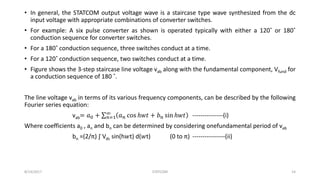
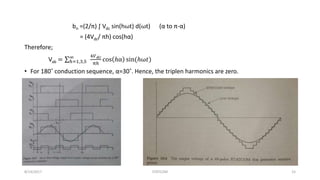
• Figure shows the 3-step staircase line voltage vab along with the fundamental component, Vfund for
a conduction sequence of 180 ˚.
The line voltage vab in terms of its various frequency components, can be described by the following
Fourier series equation:
vab= 𝑎0 + 𝑛=1
∞
𝑎 𝑛 cos ℎ𝑤𝑡 + 𝑏 𝑛 sin ℎ𝑤𝑡 ---------------(i)
Where coefficients a0 , an and bn can be determined by considering onefundamental period of vab
bn =(2/π) ∫ Vdc sin(h𝑤t) d(𝑤t) (0 to π) ----------------(ii)
8/14/2017 STATCOM 14
bn =(2/π) ∫ Vdc sin(hωt) d(ωt) (α to π-α)
= (4Vdc/ πh) cos(hα)
Therefore;
Vab = ℎ=1,3,5
∞ 4𝑉 𝑑𝑐
πℎ
cos ℎα sin(ℎω𝑡)
• For 180˚ conduction sequence, α=30˚. Hence, the triplen harmonics are zero.
8/14/2017 STATCOM 15
• It is also noted that the converter has harmonics of frequencies (6K±1)f0 in its output voltage and
6Kf0 in its input current where f0 is the fundamental output frequency and K=1,2,3…
• As evident, the high harmonic content in the output voltage makes the simple converter
impractical for power system applications.
• To reduce harmonic generation various converter configurations and converter switching
techniques are suggested.
• For example: The first installed commercial STATCOM has a 48 pulse converter configuration so
that the staircase ac line output voltage waveform has 21 steps.
8/14/2017 STATCOM 16
STEADY-STATE MODEL
• A STATCOM is always connected in shunt with the ac system through some magnetic coupling
namely the coupling transformer or interface reactor.
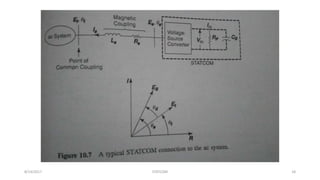
• A typical STATCOM connection is shown in fig. it consists of a VSC using either a GTO or IGBT as a
switching device and a capacitor Cs on the dc side as an energy storage device. The resistance Rp
connected in parallel with Cs represents both the capacitor losses and switching losses. The
STATCOM is connected to the ac system through magnetic coupling , represented by leakage
inductance, Ls and resistance Rs . The STATCOM improves the desired power-system performance,
including dynamic compensation, mitigating the SSR by modulating the reactive power at the
common-coupling point and so forth.
8/14/2017 STATCOM 17
8/14/2017 STATCOM 18
The STATCOM is a shunt connected reactive power compensator device that is capable of
generating and/or absorbing reactive power. STATCOM consists of a voltage source converter that
form a given input of dc voltage produces a set of 3-phase ac output voltage each in phase and
coupled to the corresponding ac system voltage through a relatively small reactance. The device
voltage is provided by an energy storage capacitor.
From fig; I =
𝑣 𝑠<Ө0 −𝑣<0
𝑗𝑋0
SSTATCOM =|V0| < Ө0 *𝐼∗
= V0<Ө0 *[
𝑣 𝑠<Ө0 −𝑣<0
𝑗𝑋0
]∗
=
𝑉0
2
−𝑉0 𝑉<Ө0
−𝑗𝑋
=
𝑉0 𝑉𝑠𝑖𝑛Ө0
𝑋
+ 𝑗
𝑉0
𝑋
(𝑉0 − 𝑉𝑐𝑜𝑠Ө0)
Now,
QSTATCOM =
𝑉0
𝑋
(𝑉0 − 𝑉𝑐𝑜𝑠Ө0)
8/14/2017 STATCOM 19
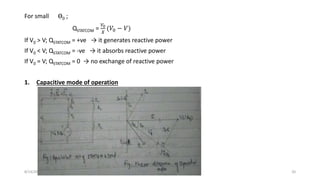
For small Ө0 ;
QSTATCOM =
𝑉0
𝑋
(𝑉0 − 𝑉)
If V0 > V; QSTATCOM = +ve → it generates reactive power
If V0 < V; QSTATCOM = -ve → it absorbs reactive power
If V0 = V; QSTATCOM = 0 → no exchange of reactive power
1. Capacitive mode of operation
8/14/2017 STATCOM 20
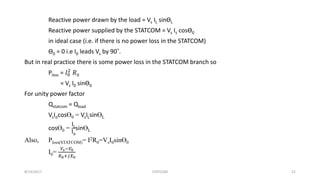
Reactive power drawn by the load = Vs IL sinӨL
Reactive power supplied by the STATCOM = Vs Is cosӨ0
in ideal case (i.e. if there is no power loss in the STATCOM)
Ө0 = 0 i.e I0 leads Vs by 90˚.
But in real practice there is some power loss in the STATCOM branch so
Ploss = 𝐼0
2
𝑅0
= Vs I0 sinӨ0
For unity power factor
Qstatcom = Qload
VsIocosӨ0 = VsILsinӨL
cosӨ0 =
IL
Io
sinӨL
Also, Ploss(STATCOM)= I2R0=VsI0sinӨ0
I0=
𝑉𝑠−𝑉0
𝑅0+𝑗𝑋0
8/14/2017 STATCOM 21
I0
2Ro = VsI0sinӨ0
sinӨ0 =
𝐼0 𝑅0
𝑉𝑠
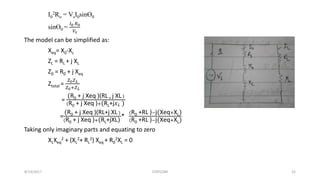
The model can be simplified as:
Xeq= X0-Xc
ZL = RL + j XL
Z0 = R0 + j Xeq
Ztotal =
𝑍0 𝑍 𝐿
𝑍0+𝑍 𝐿
=
(R0 + j Xeq )(RL+ j XL)
(R0 + j Xeq )+(RL+j 𝑋 𝐿 )
=
(R0 + j Xeq )(RL+j XL)
(R0 + j Xeq )+(RL+jXL)
*
(R0 +RL )−j(Xeq+XL)
(R0 +RL )−j(Xeq+XL)
Taking only imaginary parts and equating to zero
XLXeq
2 + (XL
2+ RL
2) Xeq + R0
2XL = 0
8/14/2017 STATCOM 22
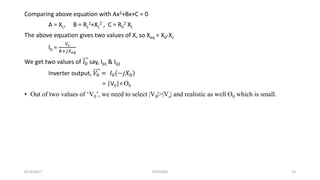
Comparing above equation with Ax2+Bx+C = 0
A = XL, B = RL
2+XL
2 , C = R0
2 XL
The above equation gives two values of X, so Xeq = X0-Xc
I0 =
𝑉𝑠
𝑅+𝑗𝑋 𝑒𝑞
We get two values of 𝐼0 say, I01 & I02
Inverter output, 𝑉0 = 𝐼0 −𝑗𝑋0
= |V0|< Ө0
• Out of two values of ‘V0’, we need to select |V0|>|Vs| and realistic as well Ө0 which is small.
8/14/2017 STATCOM 23
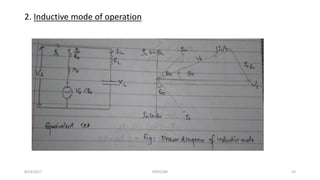
2. Inductive mode of operation
8/14/2017 STATCOM 24
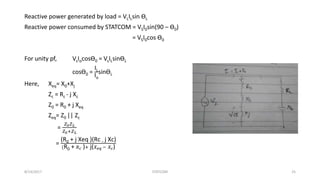
Reactive power generated by load = VLILsin ӨL
Reactive power consumed by STATCOM = VSI0sin(90 – Ө0)
= VSI0cos Ө0
For unity pf, VsIocosӨ0 = VsILsinӨL
cosӨ0 =
IL
Io
sinӨL
Here, Xeq= X0+Xj
Zc = Rc - j Xc
Z0 = R0 + j Xeq
Zeq= Z0 || Zc
=
𝑍0 𝑍 𝐿
𝑍0+𝑍 𝐿
=
(R0 + j Xeq )(Rc − j Xc)
(R0 + 𝑅 𝑐 )+ j( 𝑋 𝑒𝑞 − 𝑋 𝑐)
8/14/2017 STATCOM 25
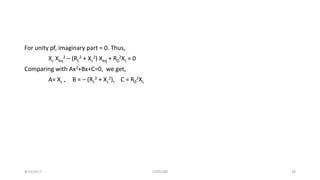
For unity pf, imaginary part = 0. Thus,
Xc Xeq
2 – (RL
2 + Xc
2) Xeq + R0
2XL = 0
Comparing with Ax2+Bx+C=0, we get,
A= Xc , B = – (RL
2 + Xc
2), C = R0
2XL
8/14/2017 STATCOM 26
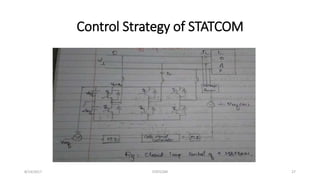
Control Strategy of STATCOM
8/14/2017 STATCOM 27
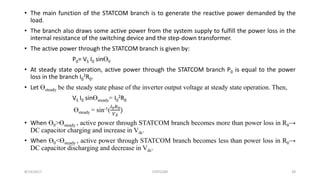
• The main function of the STATCOM branch is to generate the reactive power demanded by the
load.
• The branch also draws some active power from the system supply to fulfill the power loss in the
internal resistance of the switching device and the step-down transformer.
• The active power through the STATCOM branch is given by:
P0= VS I0 sinӨ0
• At steady state operation, active power through the STATCOM branch P0 is equal to the power
loss in the branch I0
2R0.
• Let Өsteady be the steady state phase of the inverter output voltage at steady state operation. Then,
VS I0 sinӨsteady= I0
2R0
Өsteady = sin-1(
𝐼0 𝑅0
𝑉 𝑆
)
• When Ө0>Өsteady , active power through STATCOM branch becomes more than power loss in R0→
DC capacitor charging and increase in Vdc.
• When Ө0<Өsteady , active power through STATCOM branch becomes less than power loss in R0→
DC capacitor discharging and decrease in Vdc.
8/14/2017 STATCOM 28
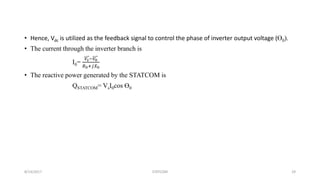
• Hence, Vdc is utilized as the feedback signal to control the phase of inverter output voltage (Ө0).
• The current through the inverter branch is
I0=
𝑉𝑠−𝑉0
𝑅0+𝑗𝑋0
• The reactive power generated by the STATCOM is
QSTATCOM= VsI0cos Ө0
8/14/2017 STATCOM 29

STATCOM

  • 1.
    STATCOM SWITFHING CONVERTER TYPE VARGENERATOR Himal Chaulagain Institute of Engineering Paschimanchal Campus 8/14/2017 STATCOM 1
  • 2.
    INTRODUCTION • The TennesseeValley Authority (TVA) installed the first ±100MVA STATCOM in 1995 for reducing the TVA’s need for load tap changers, thus achieving savings by minimizing the potential for transformer failure. • STATCOM is a shunt connected reactive power compensation device that is capable of generating and/or absorbing reactive power and in which the output can be varied to control the specific parameters of an electric power system. • It is a solid state switching converter capable of generating or absorbing independently controllable real and reactive power at its output terminal when fed from a energy source. • A STATCOM is analogous to an ideal synchronous machine which generates a balanced set of three sinusoidal voltage at the fundamental frequency with controllable amplitude and phase angle. • STATCOM controller provides voltage support by generating or absorbing reactive power at the point of common coupling without the need of large external reactors or capacitor banks. 8/14/2017 STATCOM 2
  • 3.
    STATCOM can improvepower system performance in the following aspects: • Dynamic voltage control in T&D system. • Power-oscillation damping in a power transmission system. • Transient stability • Voltage flickering control • Control of not only reactive power but also active power, if necessary, in the connected line requiring of DC energy source. • Occupying small footprint as it replaces passive banks of circuit elements by compact electronic converters. • Offers modular, factory built equipment so that it reduces site work and commissioning time. • Uses encapsulated electronic converters, thereby minimizing its environmental impact. 8/14/2017 STATCOM 3
  • 4.
    PRINCIPLE OF OPERATION •Provides the desired reactive power generation and absorption entirely by means of electronic processing of the voltage and current waveforms in a voltage source converter (VSC). • VSC is connected to a utility bus through magnetic coupling. • In figure (b) a STATCOM is seen as an adjustable voltage source behind a reactance meaning that capacitor banks and shunt reactors are not needed for reactive power generation and absorption, thereby giving a STATCOM a compact design, or small footprint as well as low noise and magnetic impact. • The exchange of reactive power between the converter and the ac system can be controlled by varying the amplitude of the 3-phase output voltage, Es ,of the converter i.e if the amplitude of the output voltage is increased above that of the utility bus voltage, Et , then a current flows through the reactance from the converter to the ac system and the converter generates capacitive reactive power for the ac system. • If the amplitude of the output voltage is decreased below the utility bus voltage then the current flows from the ac system to the converter and the converter absorbs the inductive-reactive power. 8/14/2017 STATCOM 4
  • 5.
    • If theoutput voltage equals the ac system voltage, the reactive power exchange becomes zero, in which case the STATCOM is said to be in floating state. 8/14/2017 STATCOM 5
  • 6.
    • Adjusting thephase shift between the converter output voltage and the ac system voltage can similarly control real power exchange between the converter and the ac system. • Converter can supply real power to the ac system from its dc energy storage if the converter output voltage is made to lead the ac-system voltage. On the other hand, it can absorb real power from the ac system for the dc system if its voltage lags behind the ac system voltage. • Provides the desired reactive power by exchanging the instantaneous reactive power among the phases of the ac system. • The mechanism by which the converter initially generates and/or absorbs the reactive power can be understood by considering the relationship between the output and the input power of the converter. The converter switches connects the dc input circuit directly to the ac output circuits. Thus, the net instantaneous power at the ac output terminal must always be equal to net instantaneous power at the dc input terminal. 8/14/2017 STATCOM 6
  • 7.
    Assuming that theconverter is operated to supply reactive output power. • In this case the real power provided by the dc source as input to the converter must be zero. Furthermore, because the reactive power at zero frequency is by definition is zero: the dc source supplies no reactive power as input to the converter and thus clearly plays no part in the generation of reactive output power by the converter. • The converter simply interconnects 3-output terminal so that the reactive output current can flow freely among them. If the terminal of the ac system are regarded in this context, the converter establishes a circulating reactive power exchange among the phases. • The real power that the converter exchanges at its ac terminals with ac system must of course be supplied to or absorbed from its dc terminal by the dc capacitor. • Reactive power is generated internally by the action of converter, a dc capacitor must still be connected across the input terminals of the converter. The primary need for the capacitor is to provide a circulating current path as well as a voltage source. • Not to violate the instantaneous power equality constraint at its input and output terminals, the converter must draw a fluctuating current from its dc source. 8/14/2017 STATCOM 7
  • 8.
    • The VSChas the same rated current capability when it operates with the capacitive or inductive reactive current. Therefore, a VSC having a certain MVA rating gives the STATCOM twice the dynamic range in MVAR (contributes to compact design). A dc capacitor bank is used to support the controlled dc voltage needed for the operation of VSC. • The reactive power of a STATCOM is produced by means of power electronic equipment of the VSC type. • The VSC maybe a two-level or three-level type, depending on the required output power and voltage. • Number of VSCs are combined in a multi-pulse connection to form the STATCOM. • During transient conditions caused by the line faults, a PWM mode is used to prevent the fault current from entering the VSCs. • In this way, the STATCOM is able to withstand transients on the ac side without blocking. 8/14/2017 STATCOM 8
  • 9.
    V-I CHARACTERISTICS • ASTATCOM is capable of yielding the full output of capacitive generation almost independently of the system voltage (constant-current output at lower voltages). • The capability is particularly useful for situations in which the STATCOM is needed to support the system voltage during and after faults where the voltage collapse would otherwise, be a limiting factor. • The figure also illustrates that the STATCOM has an increased transient-rating in both the capacitive and the inductive operating regions. • The maximum attainable transient over current in the capacitive region is determined by the maximum current turn off capability of the converter switches. • In inductive region, the converter are naturally commutated; therefore the transient current rating of the STATCOM is limited by the maximum allowable junction temperature of the converter switches. 8/14/2017 STATCOM 9
  • 10.
    • In practice,the semi-conductor switches of the converter are not lossless. So, the energy stored in the dc capacitor is eventually used to meet the internal losses of the converter and the dc capacitor voltage diminishes. • When the STATCOM is used for reactive power generation, the converter itself can keep the capacitor charge to required voltage level accomplished by making the output voltage of the converter lag behind the ac system voltage by small angle 0.1-0.2. In this way, the converter absorbs a small amount of real power from the ac system to meet its internal losses and keep the capacitor voltage at the desired level. Same mechanism can be used to increase or decrease capacitor voltage and thus the amplitude of the converter output voltage to control the VAR generation or absorption. 8/14/2017 STATCOM 10
  • 11.
    • Reactive andreal power exchange between STATCOM and ac system can be controlled independently of each other. • Any combination of real power generation or absorption with VAR generation or absorption is achievable if the STATCOM is equipped with an energy storage device of suitable capacity as depicted in the following figure. With this capability extremely effective control strategy for modulation of reactive and real output power can be devised to improve the transient and dynamic system stability limits. 8/14/2017 STATCOM 11
  • 12.
  • 13.
    • An elementarysix pulse VSC STATCOM consisting of six self commutated semiconductor switches with anti-parallel diodes. • In this converter configuration, IGBTs constitute the switching devices. • With a dc voltage source (which maybe a charged capacitor) the converter can produce a balanced set of 3 quasi square voltage waveforms of a given frequency by connecting a dc source sequentially to the three output terminal via the appropriate converter switches. • The power quality embraces issues such as voltage flicker, voltage dip & voltage rise, as well as, harmonic performance and high frequency noise. • The power electronics devices distorts voltage and current waveforms in a power network influencing power facilities and customers equipment in a diverse manner. • Harmonic current induce abnormal noise and parasitic losses, and harmonic voltages cause a loss of accuracy in measurement instruments and the faulty operation of relays and control system. • Electromagnetic noise, caused by the noise of high frequency, EM waves emitted from power- electronics circuits affects electronics devices used in business & industry and often induces interfering voltage in communication lines. • The corrective measure generally recommended for mitigating harmonics and high frequency noise is to limit their generation at source. 8/14/2017 STATCOM 13
  • 14.
    • In general,the STATCOM output voltage wave is a staircase type wave synthesized from the dc input voltage with appropriate combinations of converter switches. • For example: A six pulse converter as shown is operated typically with either a 120˚ or 180˚ conduction sequence for converter switches. • For a 180˚ conduction sequence, three switches conduct at a time. • For a 120˚ conduction sequence, two switches conduct at a time. • Figure shows the 3-step staircase line voltage vab along with the fundamental component, Vfund for a conduction sequence of 180 ˚. The line voltage vab in terms of its various frequency components, can be described by the following Fourier series equation: vab= 𝑎0 + 𝑛=1 ∞ 𝑎 𝑛 cos ℎ𝑤𝑡 + 𝑏 𝑛 sin ℎ𝑤𝑡 ---------------(i) Where coefficients a0 , an and bn can be determined by considering onefundamental period of vab bn =(2/π) ∫ Vdc sin(h𝑤t) d(𝑤t) (0 to π) ----------------(ii) 8/14/2017 STATCOM 14
  • 15.
    bn =(2/π) ∫Vdc sin(hωt) d(ωt) (α to π-α) = (4Vdc/ πh) cos(hα) Therefore; Vab = ℎ=1,3,5 ∞ 4𝑉 𝑑𝑐 πℎ cos ℎα sin(ℎω𝑡) • For 180˚ conduction sequence, α=30˚. Hence, the triplen harmonics are zero. 8/14/2017 STATCOM 15
  • 16.
    • It isalso noted that the converter has harmonics of frequencies (6K±1)f0 in its output voltage and 6Kf0 in its input current where f0 is the fundamental output frequency and K=1,2,3… • As evident, the high harmonic content in the output voltage makes the simple converter impractical for power system applications. • To reduce harmonic generation various converter configurations and converter switching techniques are suggested. • For example: The first installed commercial STATCOM has a 48 pulse converter configuration so that the staircase ac line output voltage waveform has 21 steps. 8/14/2017 STATCOM 16
  • 17.
    STEADY-STATE MODEL • ASTATCOM is always connected in shunt with the ac system through some magnetic coupling namely the coupling transformer or interface reactor. • A typical STATCOM connection is shown in fig. it consists of a VSC using either a GTO or IGBT as a switching device and a capacitor Cs on the dc side as an energy storage device. The resistance Rp connected in parallel with Cs represents both the capacitor losses and switching losses. The STATCOM is connected to the ac system through magnetic coupling , represented by leakage inductance, Ls and resistance Rs . The STATCOM improves the desired power-system performance, including dynamic compensation, mitigating the SSR by modulating the reactive power at the common-coupling point and so forth. 8/14/2017 STATCOM 17
  • 18.
  • 19.
    The STATCOM isa shunt connected reactive power compensator device that is capable of generating and/or absorbing reactive power. STATCOM consists of a voltage source converter that form a given input of dc voltage produces a set of 3-phase ac output voltage each in phase and coupled to the corresponding ac system voltage through a relatively small reactance. The device voltage is provided by an energy storage capacitor. From fig; I = 𝑣 𝑠<Ө0 −𝑣<0 𝑗𝑋0 SSTATCOM =|V0| < Ө0 *𝐼∗ = V0<Ө0 *[ 𝑣 𝑠<Ө0 −𝑣<0 𝑗𝑋0 ]∗ = 𝑉0 2 −𝑉0 𝑉<Ө0 −𝑗𝑋 = 𝑉0 𝑉𝑠𝑖𝑛Ө0 𝑋 + 𝑗 𝑉0 𝑋 (𝑉0 − 𝑉𝑐𝑜𝑠Ө0) Now, QSTATCOM = 𝑉0 𝑋 (𝑉0 − 𝑉𝑐𝑜𝑠Ө0) 8/14/2017 STATCOM 19
  • 20.
    For small Ө0; QSTATCOM = 𝑉0 𝑋 (𝑉0 − 𝑉) If V0 > V; QSTATCOM = +ve → it generates reactive power If V0 < V; QSTATCOM = -ve → it absorbs reactive power If V0 = V; QSTATCOM = 0 → no exchange of reactive power 1. Capacitive mode of operation 8/14/2017 STATCOM 20
  • 21.
    Reactive power drawnby the load = Vs IL sinӨL Reactive power supplied by the STATCOM = Vs Is cosӨ0 in ideal case (i.e. if there is no power loss in the STATCOM) Ө0 = 0 i.e I0 leads Vs by 90˚. But in real practice there is some power loss in the STATCOM branch so Ploss = 𝐼0 2 𝑅0 = Vs I0 sinӨ0 For unity power factor Qstatcom = Qload VsIocosӨ0 = VsILsinӨL cosӨ0 = IL Io sinӨL Also, Ploss(STATCOM)= I2R0=VsI0sinӨ0 I0= 𝑉𝑠−𝑉0 𝑅0+𝑗𝑋0 8/14/2017 STATCOM 21
  • 22.
    I0 2Ro = VsI0sinӨ0 sinӨ0= 𝐼0 𝑅0 𝑉𝑠 The model can be simplified as: Xeq= X0-Xc ZL = RL + j XL Z0 = R0 + j Xeq Ztotal = 𝑍0 𝑍 𝐿 𝑍0+𝑍 𝐿 = (R0 + j Xeq )(RL+ j XL) (R0 + j Xeq )+(RL+j 𝑋 𝐿 ) = (R0 + j Xeq )(RL+j XL) (R0 + j Xeq )+(RL+jXL) * (R0 +RL )−j(Xeq+XL) (R0 +RL )−j(Xeq+XL) Taking only imaginary parts and equating to zero XLXeq 2 + (XL 2+ RL 2) Xeq + R0 2XL = 0 8/14/2017 STATCOM 22
  • 23.
    Comparing above equationwith Ax2+Bx+C = 0 A = XL, B = RL 2+XL 2 , C = R0 2 XL The above equation gives two values of X, so Xeq = X0-Xc I0 = 𝑉𝑠 𝑅+𝑗𝑋 𝑒𝑞 We get two values of 𝐼0 say, I01 & I02 Inverter output, 𝑉0 = 𝐼0 −𝑗𝑋0 = |V0|< Ө0 • Out of two values of ‘V0’, we need to select |V0|>|Vs| and realistic as well Ө0 which is small. 8/14/2017 STATCOM 23
  • 24.
    2. Inductive modeof operation 8/14/2017 STATCOM 24
  • 25.
    Reactive power generatedby load = VLILsin ӨL Reactive power consumed by STATCOM = VSI0sin(90 – Ө0) = VSI0cos Ө0 For unity pf, VsIocosӨ0 = VsILsinӨL cosӨ0 = IL Io sinӨL Here, Xeq= X0+Xj Zc = Rc - j Xc Z0 = R0 + j Xeq Zeq= Z0 || Zc = 𝑍0 𝑍 𝐿 𝑍0+𝑍 𝐿 = (R0 + j Xeq )(Rc − j Xc) (R0 + 𝑅 𝑐 )+ j( 𝑋 𝑒𝑞 − 𝑋 𝑐) 8/14/2017 STATCOM 25
  • 26.
    For unity pf,imaginary part = 0. Thus, Xc Xeq 2 – (RL 2 + Xc 2) Xeq + R0 2XL = 0 Comparing with Ax2+Bx+C=0, we get, A= Xc , B = – (RL 2 + Xc 2), C = R0 2XL 8/14/2017 STATCOM 26
  • 27.
    Control Strategy ofSTATCOM 8/14/2017 STATCOM 27
  • 28.
    • The mainfunction of the STATCOM branch is to generate the reactive power demanded by the load. • The branch also draws some active power from the system supply to fulfill the power loss in the internal resistance of the switching device and the step-down transformer. • The active power through the STATCOM branch is given by: P0= VS I0 sinӨ0 • At steady state operation, active power through the STATCOM branch P0 is equal to the power loss in the branch I0 2R0. • Let Өsteady be the steady state phase of the inverter output voltage at steady state operation. Then, VS I0 sinӨsteady= I0 2R0 Өsteady = sin-1( 𝐼0 𝑅0 𝑉 𝑆 ) • When Ө0>Өsteady , active power through STATCOM branch becomes more than power loss in R0→ DC capacitor charging and increase in Vdc. • When Ө0<Өsteady , active power through STATCOM branch becomes less than power loss in R0→ DC capacitor discharging and decrease in Vdc. 8/14/2017 STATCOM 28
  • 29.
    • Hence, Vdcis utilized as the feedback signal to control the phase of inverter output voltage (Ө0). • The current through the inverter branch is I0= 𝑉𝑠−𝑉0 𝑅0+𝑗𝑋0 • The reactive power generated by the STATCOM is QSTATCOM= VsI0cos Ө0 8/14/2017 STATCOM 29