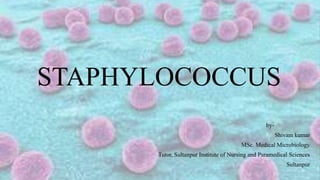
STAPHYLOCOCCUS
by-
Shivam kumar
MSc. Medical Microbiology
Tutor, Sultanpur Institute of Nursing and Paramedical Sciences
Sultanpur
STAPHYLOCOCCUS
INTRODUCTION
• Gram +ve cocci are classified into two families- Micrococcaceae and Streptococcaceae,
differentiated by catalase test.
• Family Micrococcaceae comprise of four genera- Micrococcus, Stomatococcus,
Planococcus and Staphylococcus.
• Staphylococcus species are arranged in clusters, show fermentative pattern in oxidative
fermentation test.
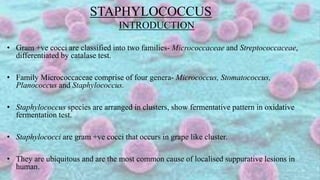
• Staphylococci are gram +ve cocci that occurs in grape like cluster.
• They are ubiquitous and are the most common cause of localised suppurative lesions in
human.
• It was first observe in pus by Von Recklinghausen in (1871) and was first cultured in liquid
medium by Louis Pasteur (1880)
• It was named as Staphylococcus (in Greek, Staphyle means ‘bunch of grapes’ and Kokkos
means berry) by Sir Alexander Ogston (1880).
Morphology
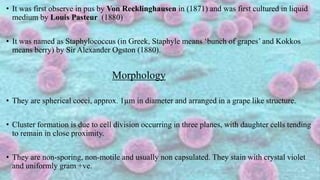
• They are spherical cocci, approx. 1µm in diameter and arranged in a grape like structure.
• Cluster formation is due to cell division occurring in three planes, with daughter cells tending
to remain in close proximity.
• They are non-sporing, non-motile and usually non capsulated. They stain with crystal violet
and uniformly gram +ve.
Cultural characteristics
• They are aerobes and facultative anaerobes.
• Optimum temp. for growth is 370c, optimum pH is 7.5
Growth on different media with diff. characteristics.
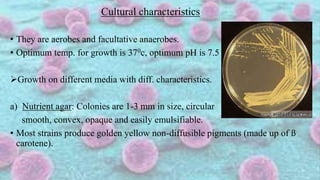
a) Nutrient agar: Colonies are 1-3 mm in size, circular
smooth, convex, opaque and easily emulsifiable.
• Most strains produce golden yellow non-diffusible pigments (made up of ß
carotene).
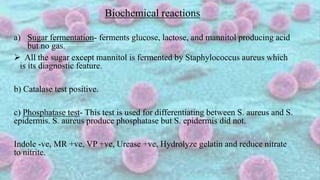
b) Blood agar: Same as nutrient agar but colonies
surrounded by a zone of ß-hemolysis.
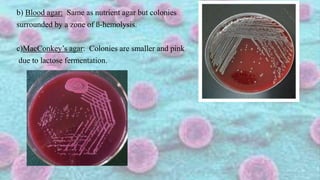
c)MacConkey’s agar: Colonies are smaller and pink
due to lactose fermentation.
Biochemical reactions
a) Sugar fermentation- ferments glucose, lactose, and mannitol producing acid
but no gas.
 All the sugar except mannitol is fermented by Staphylococcus aureus which
is its diagnostic feature.
b) Catalase test positive.
c) Phosphatase test- This test is used for differentiating between S. aureus and S.
epidermis. S. aureus produce phosphatase but S. epidermis did not.
Indole -ve, MR +ve, VP +ve, Urease +ve, Hydrolyze gelatin and reduce nitrate
to nitrite.
Pathogenesis
Pathogenesis of S. aureus involves the following steps-
1) Colonization- on various body surface, such as perineal skin, axilla etc.
2) Introduction into the tissue- introduced into the tissue as a result of minor
abresions. (broken skin)
3) Invasion- invade into the tissue by elaborating the enzyme.
4) Evasion the host defense mechanism- S. aureus exhibit various immune
evasion mechanism, such as-
 Anti-phagocytic activity mediated by microcapsule and protein A.
 Inhibition of leukocyte migration (by chemotaxis inhibitory protein of
staphylococci).
 Intracellular survival inside the endothelial cell (by formation of small
colony variants).
5) Metastatic spread- S. aureus spreads to various distant sites by
hematogenous spread.
Infection and disease
a) Cutaneous infection- these include wounds and burns infection, pustules
(patch of skin filled with pus) etc.
b) Deep infection- these include osteomyelitis, periostitis (inflammation of the
periosteum, which is the most external part of the bone), tonsillitis,
pharyengitis, sinusitis, septisemia, endocarditis etc.
c) Food poisoning- they contaminate the food and produce enterotoxin which
cause illness.
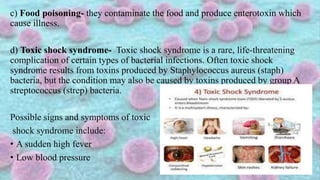
d) Toxic shock syndrome- Toxic shock syndrome is a rare, life-threatening
complication of certain types of bacterial infections. Often toxic shock
syndrome results from toxins produced by Staphylococcus aureus (staph)
bacteria, but the condition may also be caused by toxins produced by group A
streptococcus (strep) bacteria.
Possible signs and symptoms of toxic
shock syndrome include:
• A sudden high fever
• Low blood pressure
• Vomiting or diarrhea, A rash resembling a sunburn particularly on your palms
and soles, Confusion, Muscle aches, Redness of your eyes, mouth and throat,
Seizures, Headaches
Toxic shock syndrome has been associated with:
Having cuts or burns on your skin
Having had recent surgery
Using contraceptive sponges, diaphragms, superabsorbent tampons or
menstrual cups.
e) Exfoliative disease- a severe inflammation of the entire skin surface.
Lab diagnosis
Specimens- Pus from suppurative lesions, sputum from respiratory infection,
food remains and vomit from cases of food poisoning, nasal and perineal swab
from suspected carriers.
Direct microscopy- Direct microscopy with gram stained smear is useful in the
case of pus but it is of no value for smear like sputum where mix flora is
normally present.
Culture smear showing gram +ve cocci in clusters
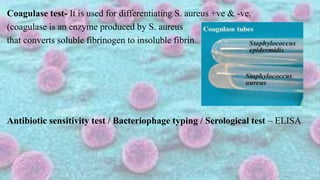
Coagulase test- It is used for differentiating S. aureus +ve & -ve.
(coagulase is an enzyme produced by S. aureus
that converts soluble fibrinogen to insoluble fibrin.
Antibiotic sensitivity test / Bacteriophage typing / Serological test – ELISA

Staphylococcus.pptx

  • 1.
    STAPHYLOCOCCUS by- Shivam kumar MSc. MedicalMicrobiology Tutor, Sultanpur Institute of Nursing and Paramedical Sciences Sultanpur
  • 2.
    STAPHYLOCOCCUS INTRODUCTION • Gram +vecocci are classified into two families- Micrococcaceae and Streptococcaceae, differentiated by catalase test. • Family Micrococcaceae comprise of four genera- Micrococcus, Stomatococcus, Planococcus and Staphylococcus. • Staphylococcus species are arranged in clusters, show fermentative pattern in oxidative fermentation test. • Staphylococci are gram +ve cocci that occurs in grape like cluster. • They are ubiquitous and are the most common cause of localised suppurative lesions in human.
  • 3.
    • It wasfirst observe in pus by Von Recklinghausen in (1871) and was first cultured in liquid medium by Louis Pasteur (1880) • It was named as Staphylococcus (in Greek, Staphyle means ‘bunch of grapes’ and Kokkos means berry) by Sir Alexander Ogston (1880). Morphology • They are spherical cocci, approx. 1µm in diameter and arranged in a grape like structure. • Cluster formation is due to cell division occurring in three planes, with daughter cells tending to remain in close proximity. • They are non-sporing, non-motile and usually non capsulated. They stain with crystal violet and uniformly gram +ve.
  • 4.
    Cultural characteristics • Theyare aerobes and facultative anaerobes. • Optimum temp. for growth is 370c, optimum pH is 7.5 Growth on different media with diff. characteristics. a) Nutrient agar: Colonies are 1-3 mm in size, circular smooth, convex, opaque and easily emulsifiable. • Most strains produce golden yellow non-diffusible pigments (made up of ß carotene).
  • 5.
    b) Blood agar:Same as nutrient agar but colonies surrounded by a zone of ß-hemolysis. c)MacConkey’s agar: Colonies are smaller and pink due to lactose fermentation.
  • 6.
    Biochemical reactions a) Sugarfermentation- ferments glucose, lactose, and mannitol producing acid but no gas.  All the sugar except mannitol is fermented by Staphylococcus aureus which is its diagnostic feature. b) Catalase test positive. c) Phosphatase test- This test is used for differentiating between S. aureus and S. epidermis. S. aureus produce phosphatase but S. epidermis did not. Indole -ve, MR +ve, VP +ve, Urease +ve, Hydrolyze gelatin and reduce nitrate to nitrite.
  • 7.
    Pathogenesis Pathogenesis of S.aureus involves the following steps- 1) Colonization- on various body surface, such as perineal skin, axilla etc. 2) Introduction into the tissue- introduced into the tissue as a result of minor abresions. (broken skin) 3) Invasion- invade into the tissue by elaborating the enzyme. 4) Evasion the host defense mechanism- S. aureus exhibit various immune evasion mechanism, such as-  Anti-phagocytic activity mediated by microcapsule and protein A.  Inhibition of leukocyte migration (by chemotaxis inhibitory protein of staphylococci).
  • 8.
     Intracellular survivalinside the endothelial cell (by formation of small colony variants). 5) Metastatic spread- S. aureus spreads to various distant sites by hematogenous spread. Infection and disease a) Cutaneous infection- these include wounds and burns infection, pustules (patch of skin filled with pus) etc. b) Deep infection- these include osteomyelitis, periostitis (inflammation of the periosteum, which is the most external part of the bone), tonsillitis, pharyengitis, sinusitis, septisemia, endocarditis etc.
  • 9.
    c) Food poisoning-they contaminate the food and produce enterotoxin which cause illness. d) Toxic shock syndrome- Toxic shock syndrome is a rare, life-threatening complication of certain types of bacterial infections. Often toxic shock syndrome results from toxins produced by Staphylococcus aureus (staph) bacteria, but the condition may also be caused by toxins produced by group A streptococcus (strep) bacteria. Possible signs and symptoms of toxic shock syndrome include: • A sudden high fever • Low blood pressure
  • 10.
    • Vomiting ordiarrhea, A rash resembling a sunburn particularly on your palms and soles, Confusion, Muscle aches, Redness of your eyes, mouth and throat, Seizures, Headaches Toxic shock syndrome has been associated with: Having cuts or burns on your skin Having had recent surgery Using contraceptive sponges, diaphragms, superabsorbent tampons or menstrual cups. e) Exfoliative disease- a severe inflammation of the entire skin surface.
  • 11.
    Lab diagnosis Specimens- Pusfrom suppurative lesions, sputum from respiratory infection, food remains and vomit from cases of food poisoning, nasal and perineal swab from suspected carriers. Direct microscopy- Direct microscopy with gram stained smear is useful in the case of pus but it is of no value for smear like sputum where mix flora is normally present. Culture smear showing gram +ve cocci in clusters
  • 12.
    Coagulase test- Itis used for differentiating S. aureus +ve & -ve. (coagulase is an enzyme produced by S. aureus that converts soluble fibrinogen to insoluble fibrin. Antibiotic sensitivity test / Bacteriophage typing / Serological test – ELISA