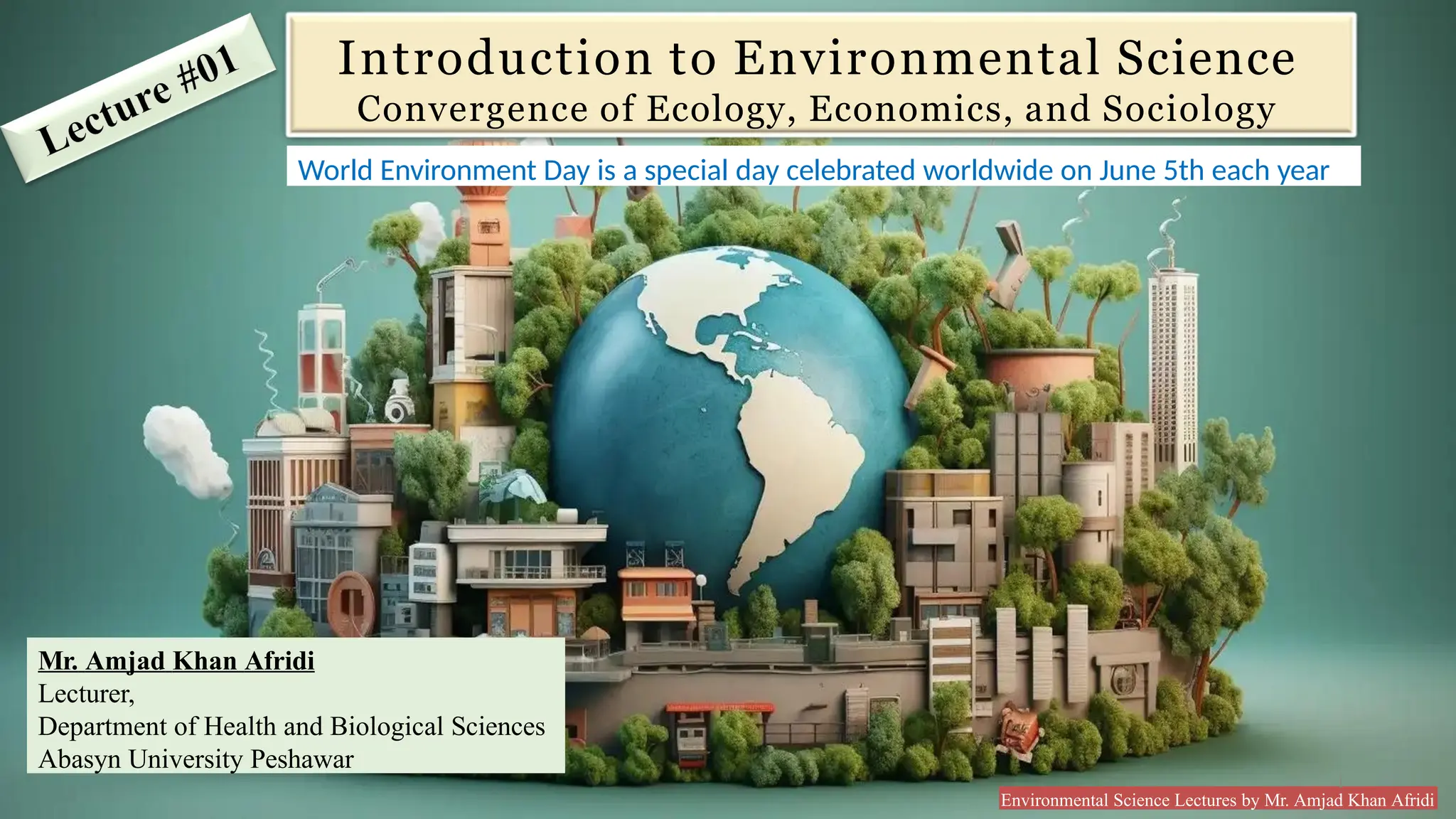
Introduction to Environmental Science
Convergence of Ecology, Economics, and Sociology
Environmental Science Lectures by Mr. Amjad Khan Afridi
1
Mr. Amjad Khan Afridi
Lecturer,
Department of Health and Biological Sciences
Abasyn University Peshawar
World Environment Day is a special day celebrated worldwide on June 5th each year
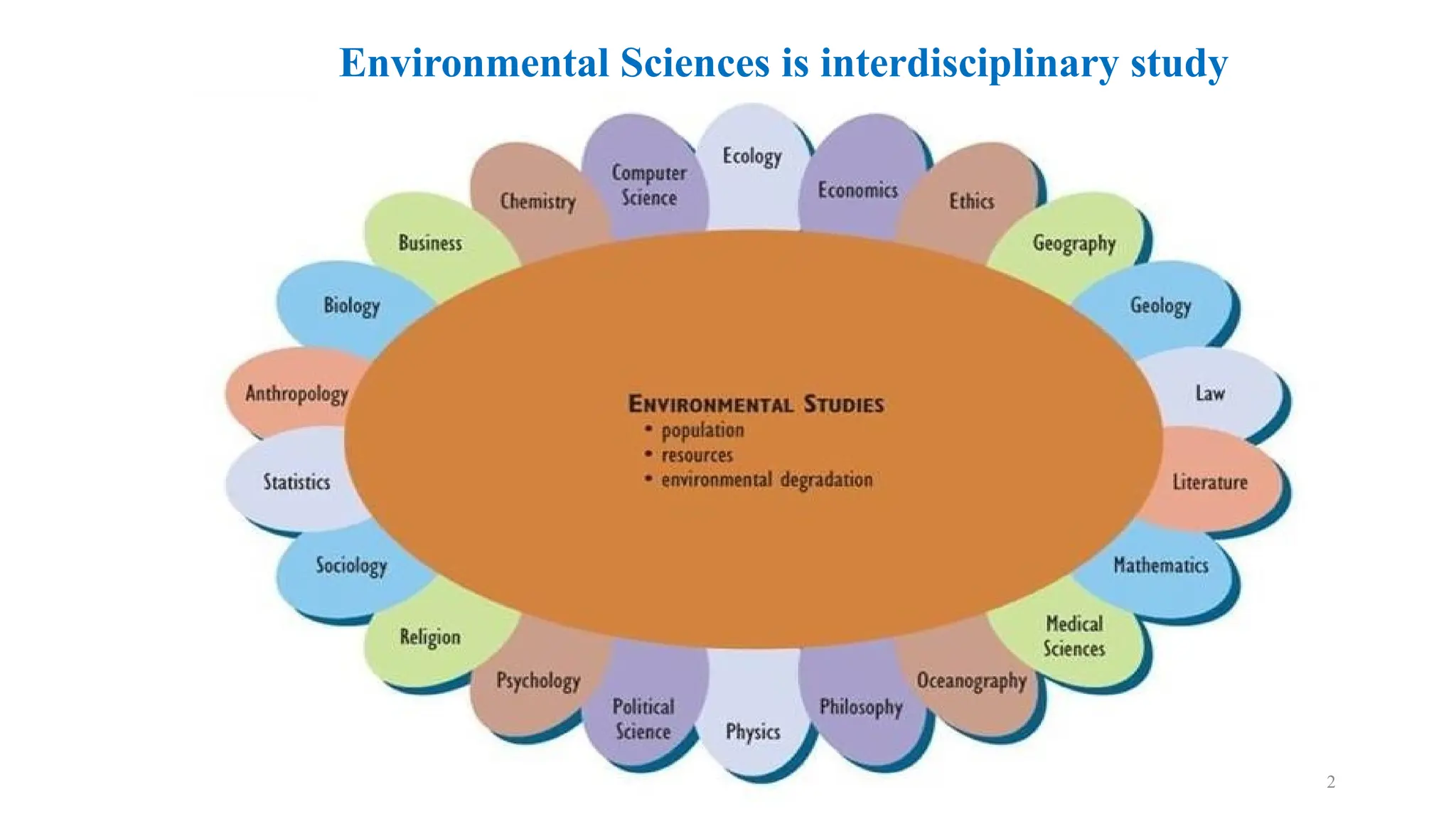
Environmental Sciences is interdisciplinary study
2
What is Environmental Science?
3
• Environmental science is the interdisciplinary study of
physical, chemical, and biological factors affecting organisms.
• It integrates knowledge from multiple disciplines to solve
environmental problems.
Cont.…
4
“Environmental science is inherently interdisciplinary”
• Environmental science is the interdisciplinary study of
biology, chemistry, physics, geology, and social sciences solved
environmental problems or issues.
• Studies relationships between organisms (including humans) and their
environments.
• Focuses on interactions between natural and human-made systems.
• Human activities like industrialization, deforestation, and
pollution affect ecosystems.
• Real-world Example:
• Oil spill: Marine biologists, chemists, and economists collaborate.
5
• Environmental science provides tools to mitigate or reduce these
(natural and human-made) impacts and inform public policies.
Tools: Pollution monitoring, environmental modeling, sustainable agriculture.
Public awareness: Climate change, resource depletion, conservation.
Why is Environmental Science Important?
6
It directs attention towards the problems of population explosion, depletion of
natural resources, pollution, the methods of solving such problems, food
security and sustainable development
It demonstrates how man can derive benefits from environment without
destroying it
To integrate environmental concerns in development planning and
management
Why is Environmental Science Important?
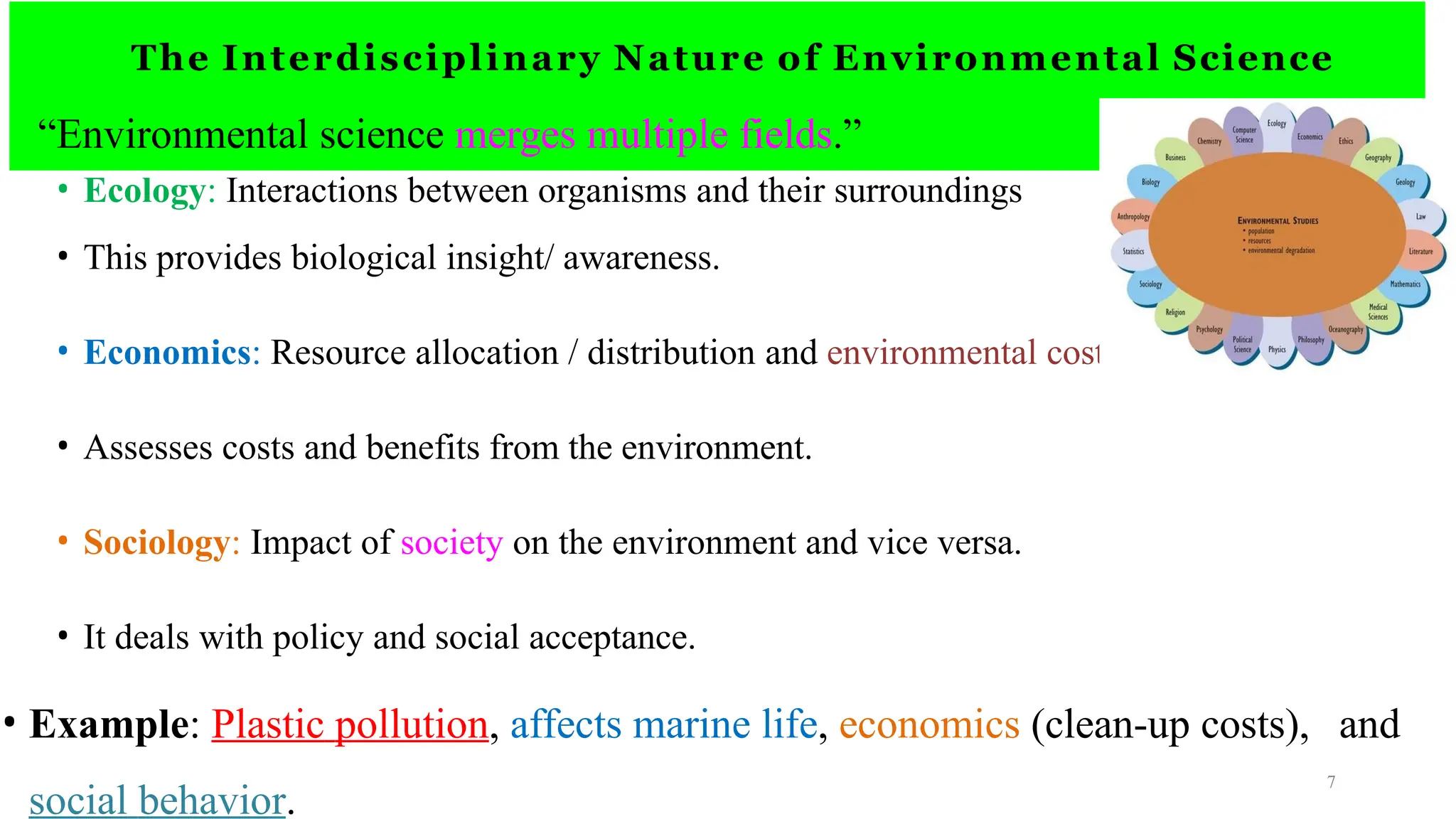
The Interdisciplinary Nature of Environmental Science
“Environmental science merges multiple fields.”
• Ecology: Interactions between organisms and their surroundings
• This provides biological insight/ awareness.
• Economics: Resource allocation / distribution and environmental costs
• Assesses costs and benefits from the environment.
• Sociology: Impact of society on the environment and vice versa.
• It deals with policy and social acceptance.
• Example: Plastic pollution, affects marine life, economics (clean-up costs), and
social behavior.
7
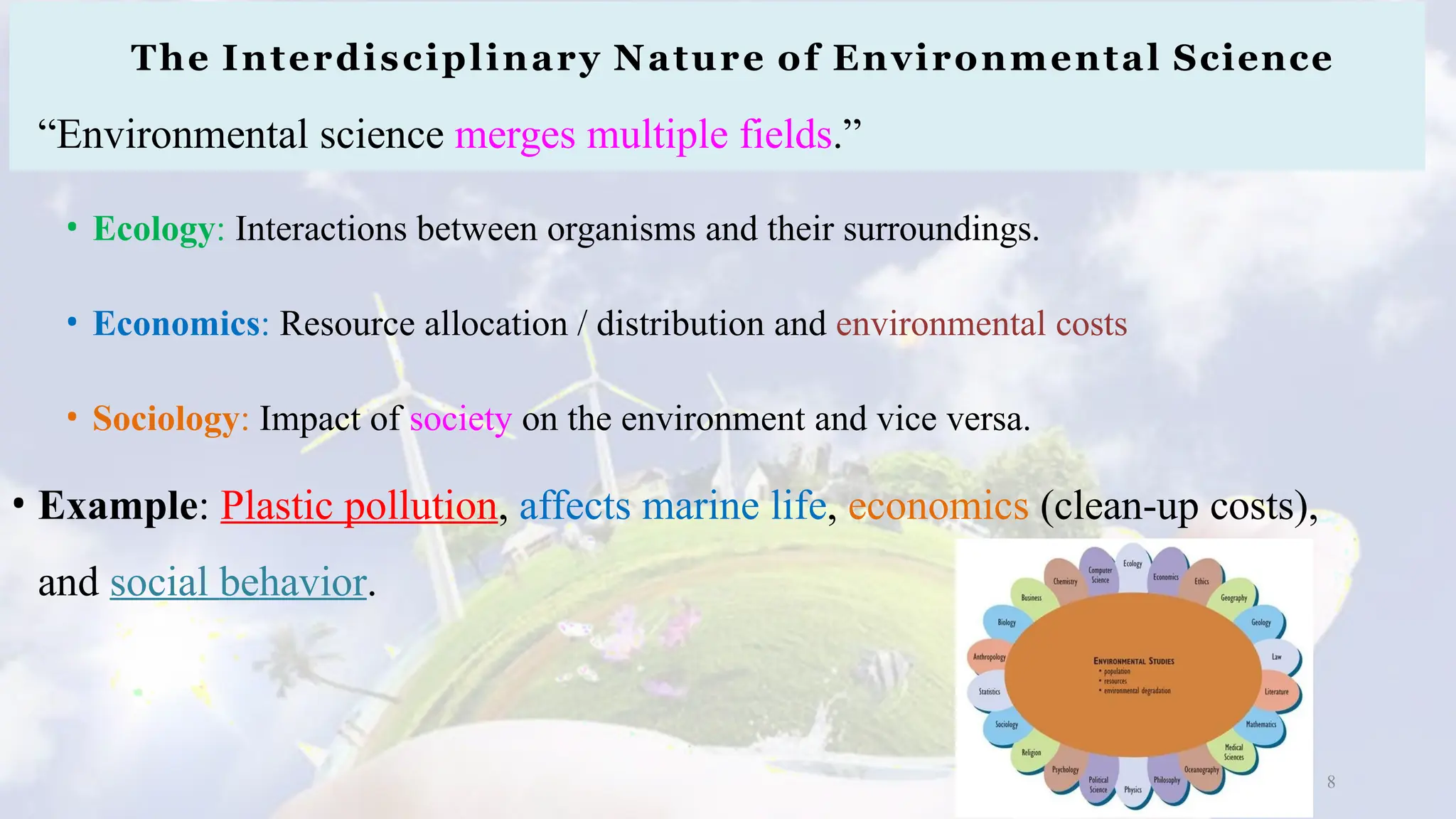
The Interdisciplinary Nature of Environmental Science
“Environmental science merges multiple fields.”
• Ecology: Interactions between organisms and their surroundings.
• Economics: Resource allocation / distribution and environmental costs
• Sociology: Impact of society on the environment and vice versa.
• Example: Plastic pollution, affects marine life, economics (clean-up costs),
and social behavior.
8
Convergence of Ecology, Economics, and Sociology
9
Thes are essential for understanding and addressing complex global challenges like climate
change, biodiversity loss, resource depletion, and inequality. These three disciplines are deeply
interconnected when it comes to building sustainable societies.
“Integration of disciplines is essential for addressing environmental issues.”
• Ecology provides biological insight/ awareness.
• Economics assesses costs and benefits.
• Sociology deals with policy and social acceptance.
• Example: Deforestation impacts biodiversity, economy, and local communities.
Importance of the Convergence
10
“A holistic approach is crucial for resource management.”
 Consider nature, people's lives, and the economy when solving
environmental problems.
 Example: Sustainable forest management balances wildlife protection,
community use, and long-term financial benefits.
History and Evolution of Environmental
Science
11
“Environmental science has ancient roots but became structured in modern
times.”
• Ancient civilizations practiced sustainable resource management.
• Modern environmental science emerged in the mid-20th century
(e.g., Rachel Carson’s Silent Spring).
• Today’s Context: Influences international agreements like the
Paris Agreement on climate change.
Contributions of Environmental Science to Society
11
“Environmental science has a direct impact on policy, technology, and public
health.”
• Development of renewable energy technologies (solar, wind).
• Shaping environmental laws (Clean Air Act, Endangered Species Act).
• Raising public awareness on climate change and conservation.
• Pollution Control and Waste Management
• Biodiversity Protection
• Environmental Health and Public Safety
and much more…….!
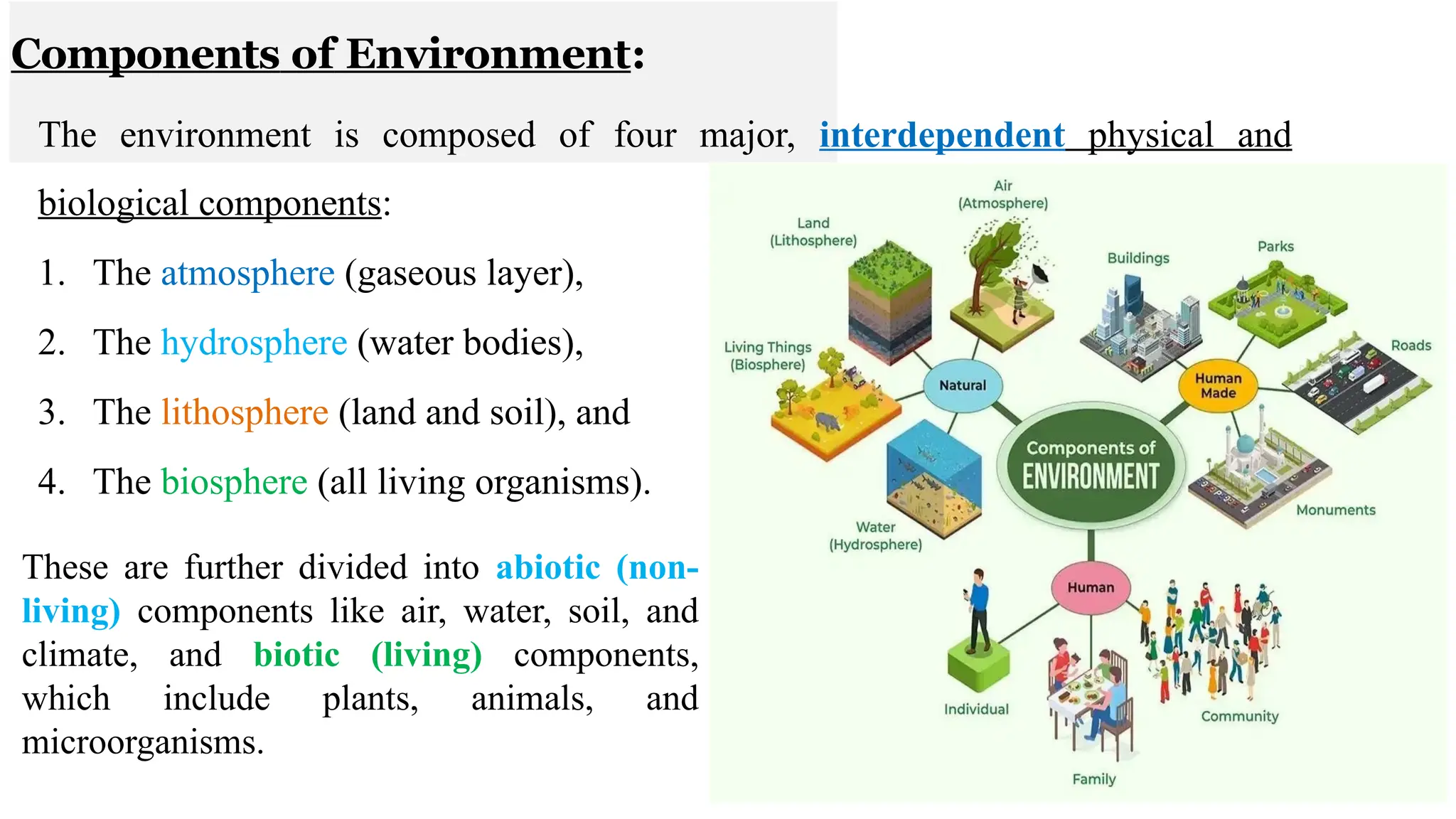
Components of Environment:
The environment is composed of four major, interdependent physical and
biological components:
1. The atmosphere (gaseous layer),
2. The hydrosphere (water bodies),
3. The lithosphere (land and soil), and
4. The biosphere (all living organisms).
13
These are further divided into abiotic (non-
living) components like air, water, soil, and
climate, and biotic (living) components,
which include plants, animals, and
microorganisms.
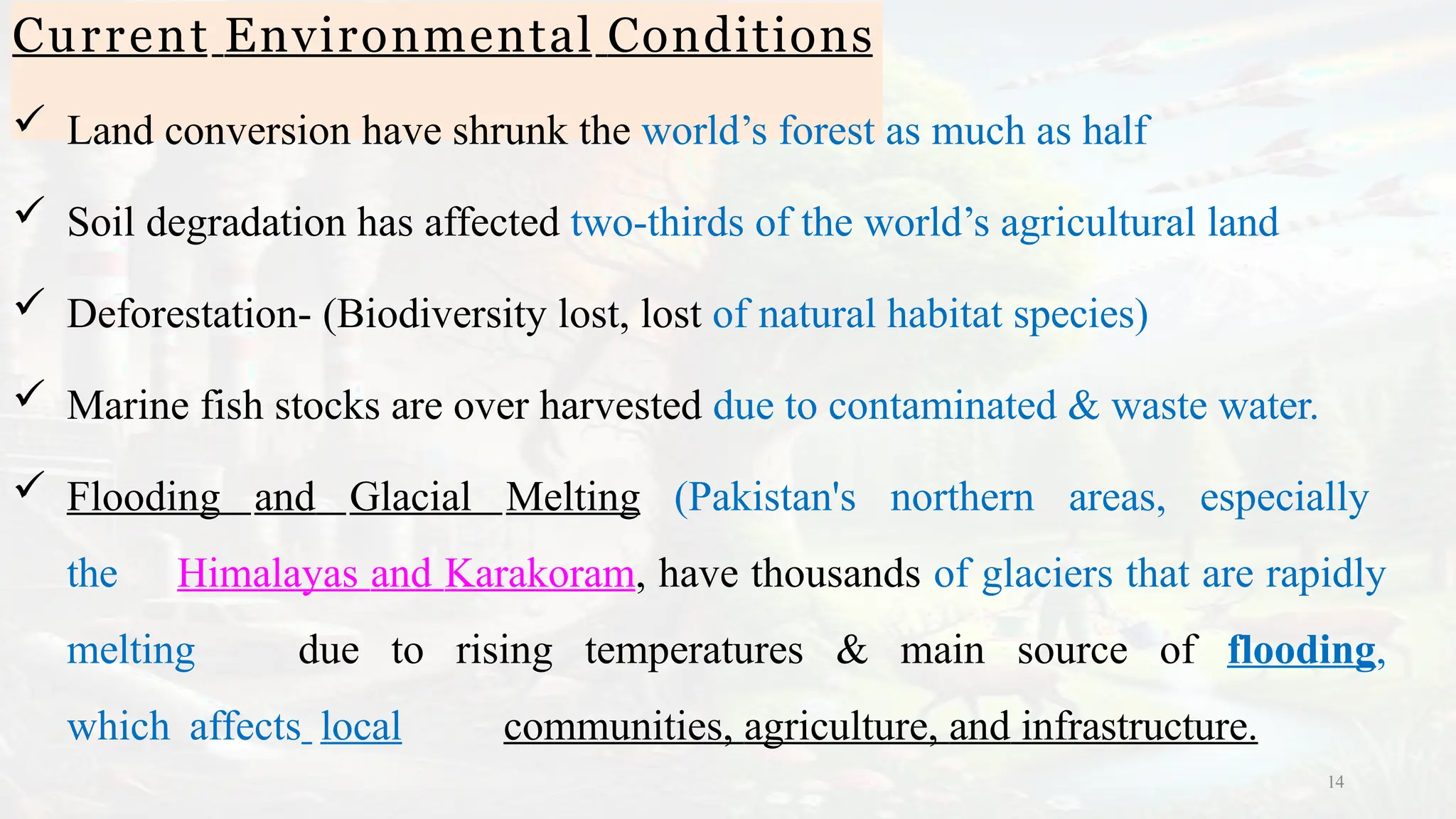
Current Environmental Conditions
14
 Land conversion have shrunk the world’s forest as much as half
 Soil degradation has affected two-thirds of the world’s agricultural land
 Deforestation- (Biodiversity lost, lost of natural habitat species)
 Marine fish stocks are over harvested due to contaminated & waste water.
 Flooding and Glacial Melting (Pakistan's northern areas, especially
the Himalayas and Karakoram, have thousands of glaciers that are rapidly
melting due to rising temperatures & main source of flooding,
which affects local communities, agriculture, and infrastructure.
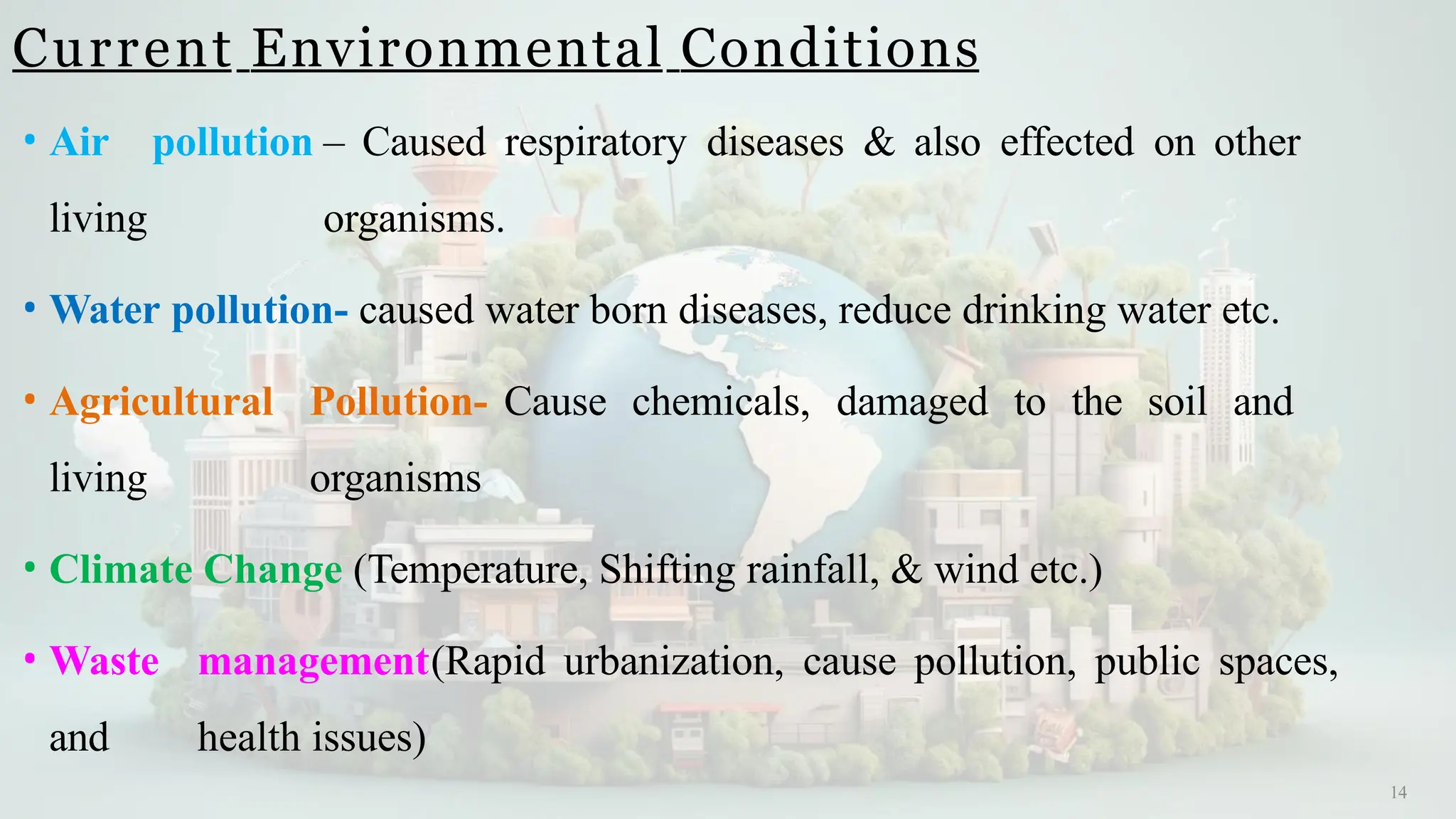
Current Environmental Conditions
14
• Air pollution – Caused respiratory diseases & also effected on other
living organisms.
• Water pollution- caused water born diseases, reduce drinking water etc.
• Agricultural Pollution- Cause chemicals, damaged to the soil and
living organisms
• Climate Change (Temperature, Shifting rainfall, & wind etc.)
• Waste management(Rapid urbanization, cause pollution, public spaces,
and health issues)
How nature works?
 How the environment affects us?
 How we affect the environment?
 How to deal with environmental problems and live more
sustainably?
Goals of environmental science are to learn
Why learning Environmental Science is much more important now?
It directs attention towards the problems of population explosion, depletion
of natural resources, pollution, the methods of solving such problems, food
security and sustainable development
It demonstrates how man can derive benefits from environment
without destroying it
To integrate environmental concerns in development planning
and management
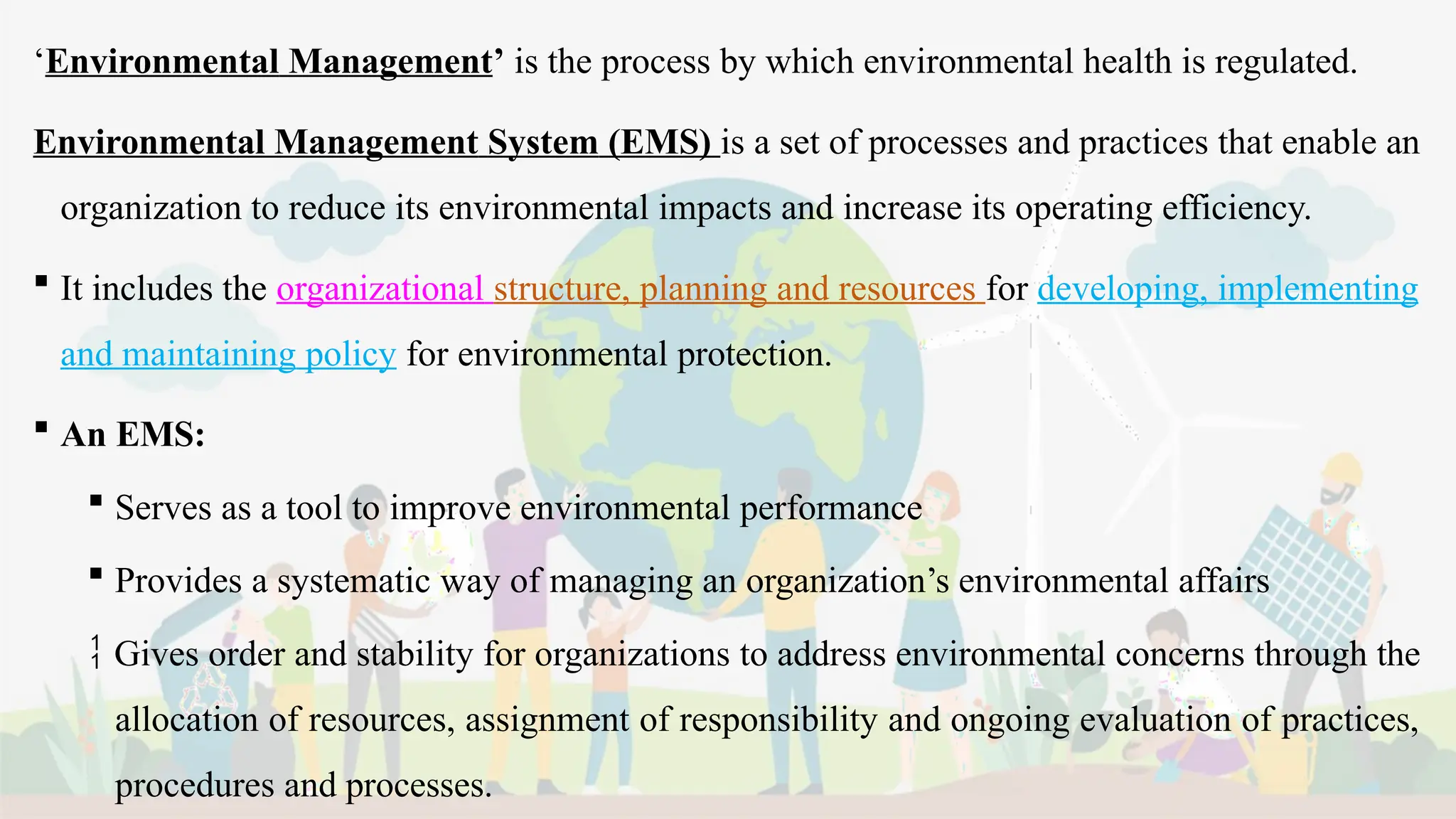
‘Environmental Management’ is the process by which environmental health is regulated.
Environmental Management System (EMS) is a set of processes and practices that enable an
organization to reduce its environmental impacts and increase its operating efficiency.
 It includes the organizational structure, planning and resources for developing, implementing
and maintaining policy for environmental protection.
 An EMS:
 Serves as a tool to improve environmental performance
 Provides a systematic way of managing an organization’s environmental affairs
 Gives order and stability for organizations to address environmental concerns through the
allocation of resources, assignment of responsibility and ongoing evaluation of practices,
procedures and processes.
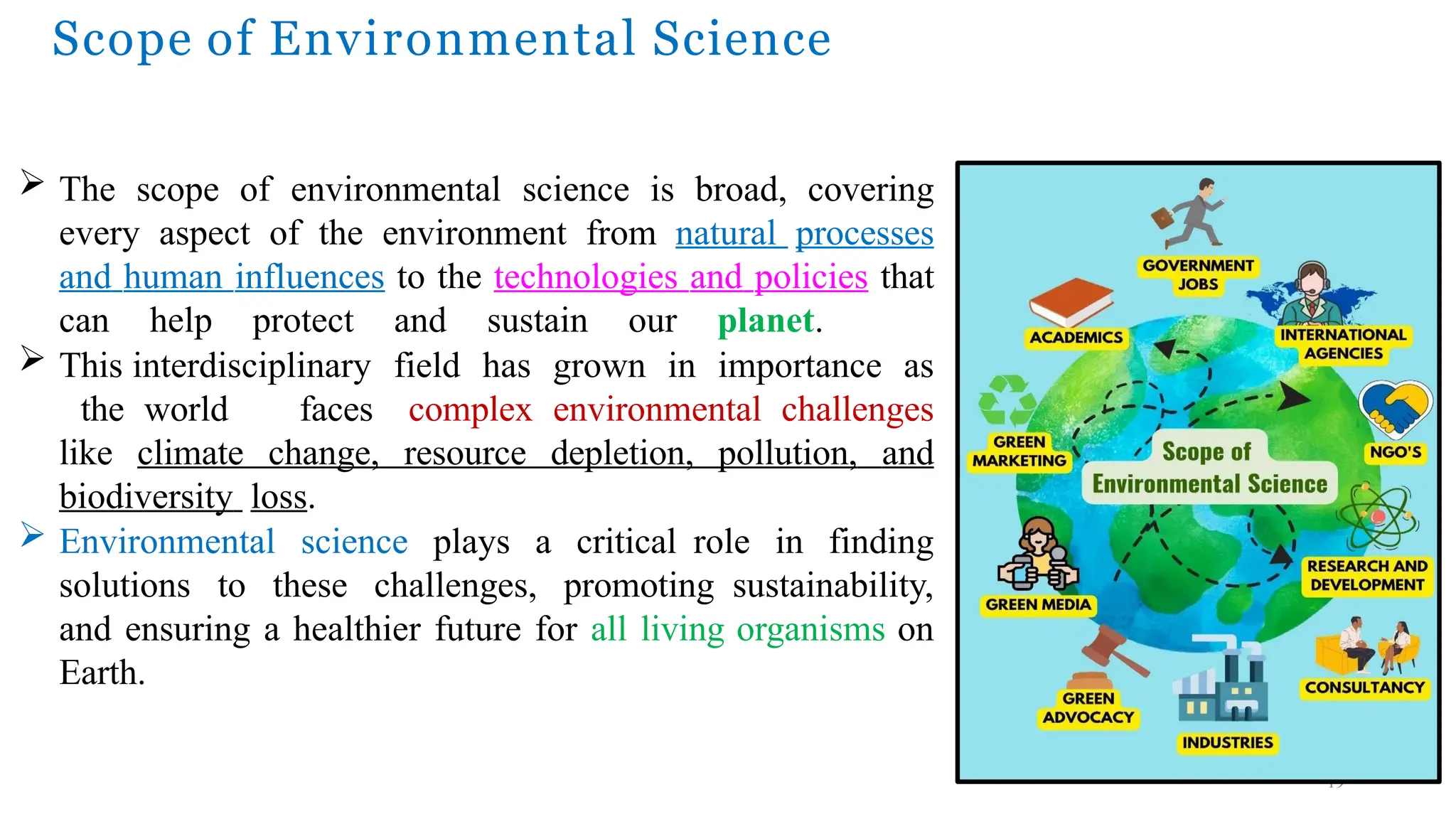
Scope of Environmental Science
19
 The scope of environmental science is broad, covering
every aspect of the environment from natural processes
and human influences to the technologies and policies that
can help protect and sustain our planet.
 This interdisciplinary field has grown in importance as
the world faces complex environmental challenges
like climate change, resource depletion, pollution, and
biodiversity loss.
 Environmental science plays a critical role in finding
solutions to these challenges, promoting sustainability,
and ensuring a healthier future for all living organisms on
Earth.
20
19th March, 2025, Wednesday
Thank You

Introduction to Environmental Science

  • 1.
    Introduction to EnvironmentalScience Convergence of Ecology, Economics, and Sociology Environmental Science Lectures by Mr. Amjad Khan Afridi 1 Mr. Amjad Khan Afridi Lecturer, Department of Health and Biological Sciences Abasyn University Peshawar World Environment Day is a special day celebrated worldwide on June 5th each year
  • 2.
    Environmental Sciences isinterdisciplinary study 2
  • 3.
    What is EnvironmentalScience? 3 • Environmental science is the interdisciplinary study of physical, chemical, and biological factors affecting organisms. • It integrates knowledge from multiple disciplines to solve environmental problems.
  • 4.
    Cont.… 4 “Environmental science isinherently interdisciplinary” • Environmental science is the interdisciplinary study of biology, chemistry, physics, geology, and social sciences solved environmental problems or issues. • Studies relationships between organisms (including humans) and their environments. • Focuses on interactions between natural and human-made systems. • Human activities like industrialization, deforestation, and pollution affect ecosystems. • Real-world Example: • Oil spill: Marine biologists, chemists, and economists collaborate.
  • 5.
    5 • Environmental scienceprovides tools to mitigate or reduce these (natural and human-made) impacts and inform public policies. Tools: Pollution monitoring, environmental modeling, sustainable agriculture. Public awareness: Climate change, resource depletion, conservation. Why is Environmental Science Important?
  • 6.
    6 It directs attentiontowards the problems of population explosion, depletion of natural resources, pollution, the methods of solving such problems, food security and sustainable development It demonstrates how man can derive benefits from environment without destroying it To integrate environmental concerns in development planning and management Why is Environmental Science Important?
  • 7.
    The Interdisciplinary Natureof Environmental Science “Environmental science merges multiple fields.” • Ecology: Interactions between organisms and their surroundings • This provides biological insight/ awareness. • Economics: Resource allocation / distribution and environmental costs • Assesses costs and benefits from the environment. • Sociology: Impact of society on the environment and vice versa. • It deals with policy and social acceptance. • Example: Plastic pollution, affects marine life, economics (clean-up costs), and social behavior. 7
  • 8.
    The Interdisciplinary Natureof Environmental Science “Environmental science merges multiple fields.” • Ecology: Interactions between organisms and their surroundings. • Economics: Resource allocation / distribution and environmental costs • Sociology: Impact of society on the environment and vice versa. • Example: Plastic pollution, affects marine life, economics (clean-up costs), and social behavior. 8
  • 9.
    Convergence of Ecology,Economics, and Sociology 9 Thes are essential for understanding and addressing complex global challenges like climate change, biodiversity loss, resource depletion, and inequality. These three disciplines are deeply interconnected when it comes to building sustainable societies. “Integration of disciplines is essential for addressing environmental issues.” • Ecology provides biological insight/ awareness. • Economics assesses costs and benefits. • Sociology deals with policy and social acceptance. • Example: Deforestation impacts biodiversity, economy, and local communities.
  • 10.
    Importance of theConvergence 10 “A holistic approach is crucial for resource management.”  Consider nature, people's lives, and the economy when solving environmental problems.  Example: Sustainable forest management balances wildlife protection, community use, and long-term financial benefits.
  • 11.
    History and Evolutionof Environmental Science 11 “Environmental science has ancient roots but became structured in modern times.” • Ancient civilizations practiced sustainable resource management. • Modern environmental science emerged in the mid-20th century (e.g., Rachel Carson’s Silent Spring). • Today’s Context: Influences international agreements like the Paris Agreement on climate change.
  • 12.
    Contributions of EnvironmentalScience to Society 11 “Environmental science has a direct impact on policy, technology, and public health.” • Development of renewable energy technologies (solar, wind). • Shaping environmental laws (Clean Air Act, Endangered Species Act). • Raising public awareness on climate change and conservation. • Pollution Control and Waste Management • Biodiversity Protection • Environmental Health and Public Safety and much more…….!
  • 13.
    Components of Environment: Theenvironment is composed of four major, interdependent physical and biological components: 1. The atmosphere (gaseous layer), 2. The hydrosphere (water bodies), 3. The lithosphere (land and soil), and 4. The biosphere (all living organisms). 13 These are further divided into abiotic (non- living) components like air, water, soil, and climate, and biotic (living) components, which include plants, animals, and microorganisms.
  • 14.
    Current Environmental Conditions 14 Land conversion have shrunk the world’s forest as much as half  Soil degradation has affected two-thirds of the world’s agricultural land  Deforestation- (Biodiversity lost, lost of natural habitat species)  Marine fish stocks are over harvested due to contaminated & waste water.  Flooding and Glacial Melting (Pakistan's northern areas, especially the Himalayas and Karakoram, have thousands of glaciers that are rapidly melting due to rising temperatures & main source of flooding, which affects local communities, agriculture, and infrastructure.
  • 15.
    Current Environmental Conditions 14 •Air pollution – Caused respiratory diseases & also effected on other living organisms. • Water pollution- caused water born diseases, reduce drinking water etc. • Agricultural Pollution- Cause chemicals, damaged to the soil and living organisms • Climate Change (Temperature, Shifting rainfall, & wind etc.) • Waste management(Rapid urbanization, cause pollution, public spaces, and health issues)
  • 16.
    How nature works? How the environment affects us?  How we affect the environment?  How to deal with environmental problems and live more sustainably? Goals of environmental science are to learn
  • 17.
    Why learning EnvironmentalScience is much more important now? It directs attention towards the problems of population explosion, depletion of natural resources, pollution, the methods of solving such problems, food security and sustainable development It demonstrates how man can derive benefits from environment without destroying it To integrate environmental concerns in development planning and management
  • 18.
    ‘Environmental Management’ isthe process by which environmental health is regulated. Environmental Management System (EMS) is a set of processes and practices that enable an organization to reduce its environmental impacts and increase its operating efficiency.  It includes the organizational structure, planning and resources for developing, implementing and maintaining policy for environmental protection.  An EMS:  Serves as a tool to improve environmental performance  Provides a systematic way of managing an organization’s environmental affairs  Gives order and stability for organizations to address environmental concerns through the allocation of resources, assignment of responsibility and ongoing evaluation of practices, procedures and processes.
  • 19.
    Scope of EnvironmentalScience 19  The scope of environmental science is broad, covering every aspect of the environment from natural processes and human influences to the technologies and policies that can help protect and sustain our planet.  This interdisciplinary field has grown in importance as the world faces complex environmental challenges like climate change, resource depletion, pollution, and biodiversity loss.  Environmental science plays a critical role in finding solutions to these challenges, promoting sustainability, and ensuring a healthier future for all living organisms on Earth.
  • 20.
    20 19th March, 2025,Wednesday Thank You

Editor's Notes

  • #5 Pollution monitoring refers to the systematic observation, measurement, and analysis of environmental pollutants in air, water, and soil to assess their levels, sources, and impacts. It's a key aspect of environmental protection and public health management. Sustainable agriculture is a method of farming that meets current food and textile needs without compromising the ability of future generations to meet their own needs. It balances environmental health, economic profitability, and social equity.
  • #6 Sustainable agriculture is a method of farming that meets current food and textile needs without compromising the ability of future generations to meet their own needs. It balances environmental health, economic profitability, and social equity.
  • #10 The convergence of ecology, economics, and sociology is essential for solving 21st-century problems. It enables: Integrated / United thinking Balanced policy-making Equitable and sustainable development
  • #13 Main Components of the Environment The environment is generally divided into four major components: 1. 🌱 Atmosphere (Air) The layer of gases surrounding Earth. Supports life by providing oxygen, carbon dioxide, and protecting against harmful solar radiation. Key elements: Oxygen (O₂) Nitrogen (N₂) Carbon dioxide (CO₂) Water vapor Ozone (O₃) Weather and climate Functions: Regulates temperature Enables breathing and photosynthesis Influences climate and weather patterns 2. 💧 Hydrosphere (Water) All forms of water on Earth: oceans, rivers, lakes, groundwater, glaciers, and water vapor. Key components: Freshwater (rivers, lakes, groundwater) Saltwater (oceans, seas) Frozen water (glaciers, polar ice caps) Atmospheric water vapor Functions: Essential for all life processes Helps in nutrient transport Regulates Earth’s temperature 3. 🌍 Lithosphere (Land/Soil) The outer solid crust of the Earth, including rocks, minerals, and soils. Key components: Mountains, valleys, plains, deserts Rocks and minerals Soil (supports plant life) Functions: Provides habitat and nutrients for organisms Supports agriculture and construction Stores natural resources (coal, oil, minerals) 4. 🧬 Biosphere (Living Things) The zone of life on Earth that includes all living organisms—plants, animals, fungi, and microorganisms. Key components: Flora (plants) Fauna (animals) Microorganisms (bacteria, fungi, etc.) Functions: Maintains ecological balance Interacts with all other components Supports biodiversity and food chains