DRUG STABILITY
INDEX
Introduction
Advantages

Types

Stability evaluation for different formulations
Shelf life estimation
Overage calculation
ICH guidelines
“A measure of how pharmaceutical product
maintains its quality attribute over a time”
Stability
   The USP defines the stability of a
    pharmaceutical product as “ extent to which a
    product retains , with in specified limits, and
    throught out its period of storage and use i.e its
    shelf life, the same properties and
    characteristics that it possesed at the time of its
    manufacture”.
Stability is used to determine
   quality of a drug substance or drug product


   shelf life for the drug product


   Recommended storage conditions
Why stability testing is necessary-
Chemical degradation may lead lowering of


concentrataion of drug in dosage form

toxic product may form due to degradation of
active ingridients
Advantages of stability studies

   Assurance to the pateint


   Economic consideration


   Legal requirements
Types of stability


   Chemical
   Physical
   Microbiological
   Therapeutical
   Toxicological
Stability evaluation for different
           formulations
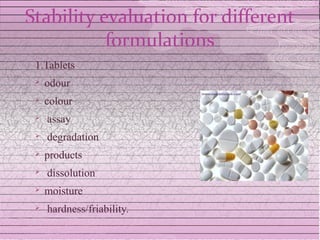
 1.Tablets
    odour
    colour
    assay
    degradation
    products
    dissolution
    moisture
    hardness/friability.
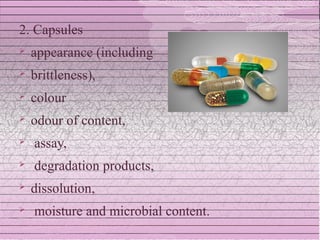
2. Capsules
   appearance (including
   brittleness),
   colour
   odour of content,
   assay,
   degradation products,
   dissolution,
   moisture and microbial content.
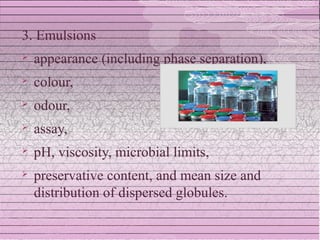
3. Emulsions
   appearance (including phase separation),
   colour,
   odour,
   assay,
   pH, viscosity, microbial limits,
   preservative content, and mean size and
    distribution of dispersed globules.
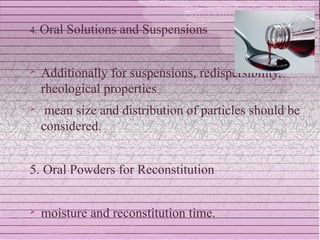
4. Oral   Solutions and Suspensions


   Additionally for suspensions, redispersibility,
    rheological properties
    mean size and distribution of particles should be
    considered.


5. Oral Powders for Reconstitution


   moisture and reconstitution time.
6.Metered-dose Inhalations and Nasal Aerosols

   appearance (including content, container, valve,
    and its components),
   Dose content uniformity
   labeled number of medication actuations per
    container meeting
   aerodynamic particle size distribution,
   microscopic evaluation,
   water content,
   leak rate,
   microbial limits
7.Topical & Ophthalmic and Preparation
 (ointments, creams, lotions, paste, gel,solutions and non-metered aerosols
forapplication to the skin)


-Topical preparations
   clarity, colour,odour, pH, resuspendability (for
    lotions), consistency,
   viscosity,
    preservative and antioxidant content (if
    present), microbiallimits/sterility and weight
    loss (when appropriate).
-Evaluation of ophthalmic or (e.g., creams, ointments,
solutions,and suspensions)


   Sterility
   particulate matter, and extractable.


-Evaluation of non-metered topical aerosols


   delivery rate,
   microbial limits,
   spray pattern,
   water content, and particle size
8. Suppositories


   softening range, dissolution (at 37 C)
   Microbial limits.


9. Small Volume Parenterals (SVPs) & Large
Volume Parenterals (LVPs)


   particulate matter, pH, sterility and
    pyrogen/endotoxin.
10. Transdermal Patches


   in-vitrorelease rates,
   leakage,
   microbial limits/sterility, peel and adhesive forces, and
   the drug release rate.


11. Freeze-dried Products


   Appearance of both freeze-dried and its reconstituted
    product, assay,
   degradation products, pH, water content and rate of
    solution.
Shelf life estimation
               &
overage calculation
What is shelf life ??

               Shelf life (t0.9)
  It is defined as the time necessary for the drug
   to decay to 90% of its original concentration.
Accelerated analysis for chemical stability

   Based on the principles of chemical kinetics
   Test are carried out at different elevated
    temperature that enables prediction of the
    effective life of the preparation at normal
    temperature
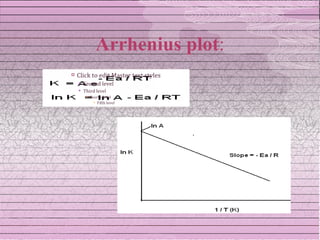
Arrhenius equation
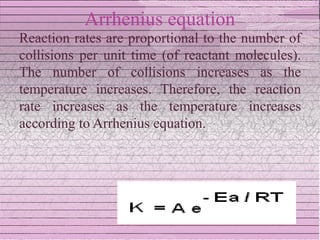
Reaction rates are proportional to the number of
collisions per unit time (of reactant molecules).
The number of collisions increases as the
temperature increases. Therefore, the reaction
rate increases as the temperature increases
according to Arrhenius equation.
K = reaction rate constant
A = frequency factor constant i.e maximum
number of collisions at infinite temperature
Ea = Energy of activation
T = absolute temperature (Kelvin)
Arrhenius plot:
   Click to edit Master text styles
    
        Second level
    
        Third level
         
             Fourth level
               
                 Fifth level
1.According to the Garrett and carper “the
k value for decompostion of a drug in
solution at various elevated temperature are
obtained by plotting some function of
concentration against time”.
Accelerated breakdown of a drug in solution at various
              elevated temperature
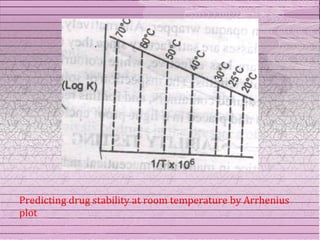
2. The log of specific rates of
decomposition are than plotted aginst the
reciprocal of the absolute temperature and
the resulting line are extraplotted to room
temperature
Predicting drug stability at room temperature by Arrhenius
plot
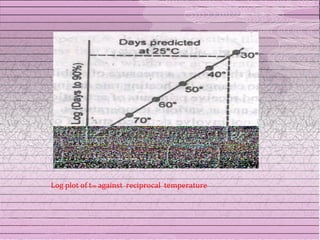
3. Free and Blythe suggested a similar
method in which the fractional life period is
plotted against reciprocal temperature, and
the time in days required for the drug to
decompose to some fraction of its original
potency at R.T is obtained.
Log plot of t90 against reciprocal temperature
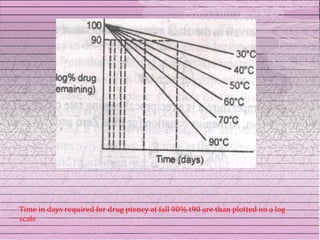
4. The log % of the drug remaining is
plotted against time in days and the time
for the potency to fall to 90% of the
original value i.e t90 is read from the graph.
The log time to 90% is then plotted against
1/T and the time at 25 degree c gives the
shelf life of the product in days
Time in days required for drug ptency at fall 90% t90 are than plotted on a log
scale
Limitations of accelerated analysis
   Carried out only at final package container
   Prediction is not possible at all climatic
    conditions
   Limited to the product formulations
   Only apply to the those which degrade with
    increase in temperature
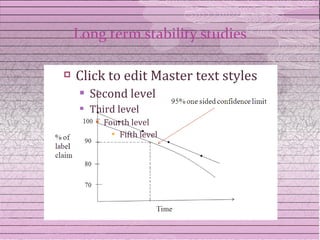
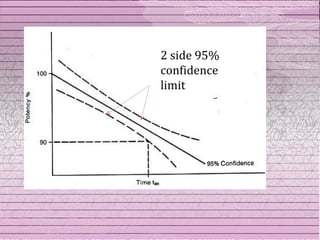
Long term stability studies

   Click to edit Master text styles
       Second level
       Third level
            Fourth level
               
                 Fifth level
2 side 95%
confidence
limit
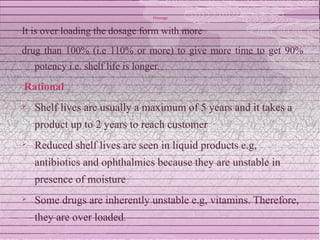
Overage


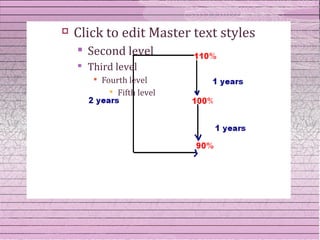
It is over loading the dosage form with more
drug than 100% (i.e 110% or more) to give more time to get 90%
    potency i.e. shelf life is longer.

Rational
   Shelf lives are usually a maximum of 5 years and it takes a
    product up to 2 years to reach customer
   Reduced shelf lives are seen in liquid products e.g,
    antibiotics and ophthalmics because they are unstable in
    presence of moisture
   Some drugs are inherently unstable e.g, vitamins. Therefore,
    they are over loaded.
   Click to edit Master text styles
       Second level
       Third level
         
             Fourth level
               
                 Fifth level
ICH guidelines…………………

   ICH stands for International Conference on
    Harmonization of Technical Requirements for
    Registration of Pharmaceuticals for Human
    use.

Objective
     Harmonization of registration application
    within the three regions of the EU, Japan and
    the United States.
   ensure and assess the safety, quality and
    efficacy of medicines.


The zone concept-

      The whole world is divided into 4 climatic
    zones in order to harmonize and simplify
    stablity testing:
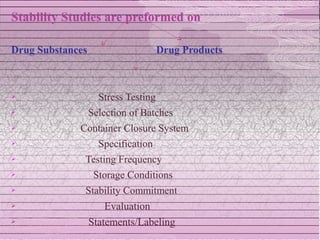
Stability Studies are preformed on

Drug Substances                      Drug Products


                   Stress Testing
                 Selection of Batches
            Container Closure System
                   Specification
             Testing Frequency
                  Storage Conditions
             Stability Commitment
                     Evaluation
                 Statements/Labeling
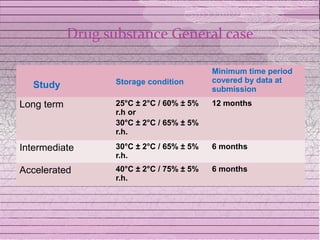
Drug substance General case

                                           Minimum time period
                   Storage condition       covered by data at
   Study                                   submission
Long term          25°C ± 2°C / 60% ± 5%   12 months
                   r.h or
                   30°C ± 2°C / 65% ± 5%
                   r.h.

Intermediate       30°C ± 2°C / 65% ± 5%   6 months
                   r.h.
Accelerated        40°C ± 2°C / 75% ± 5%   6 months
                   r.h.
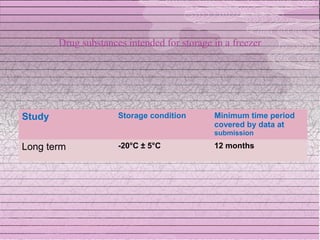
Drug substances intended for storage in a freezer


Study                 Storage condition      Minimum time period
                                             covered by data at
                                             submission

Long term             -20°C ± 5°C            12 months
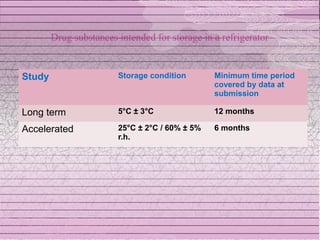
Drug substances intended for storage in a refrigerator


Study                   Storage condition       Minimum time period
                                                covered by data at
                                                submission

Long term               5°C ± 3°C               12 months

Accelerated             25°C ± 2°C / 60% ± 5%   6 months
                        r.h.
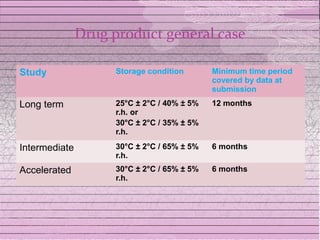
Drug product general case

Study                Storage condition       Minimum time period
                                             covered by data at
                                             submission
Long term            25°C ± 2°C / 40% ± 5%   12 months
                     r.h. or
                     30°C ± 2°C / 35% ± 5%
                     r.h.

Intermediate         30°C ± 2°C / 65% ± 5%   6 months
                     r.h.
Accelerated          30°C ± 2°C / 65% ± 5%   6 months
                     r.h.
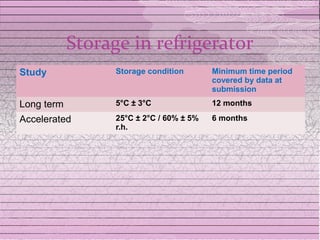
Storage in refrigerator
Study             Storage condition       Minimum time period
                                          covered by data at
                                          submission
Long term         5°C ± 3°C               12 months

Accelerated       25°C ± 2°C / 60% ± 5%   6 months
                  r.h.
THANK
 YOU

Stability testing

  • 1.
  • 2.
    INDEX Introduction Advantages Types Stability evaluation fordifferent formulations Shelf life estimation Overage calculation ICH guidelines
  • 3.
    “A measure ofhow pharmaceutical product maintains its quality attribute over a time”
  • 4.
    Stability  The USP defines the stability of a pharmaceutical product as “ extent to which a product retains , with in specified limits, and throught out its period of storage and use i.e its shelf life, the same properties and characteristics that it possesed at the time of its manufacture”.
  • 5.
    Stability is usedto determine  quality of a drug substance or drug product  shelf life for the drug product  Recommended storage conditions
  • 6.
    Why stability testingis necessary- Chemical degradation may lead lowering of  concentrataion of drug in dosage form toxic product may form due to degradation of active ingridients
  • 7.
    Advantages of stabilitystudies  Assurance to the pateint  Economic consideration  Legal requirements
  • 8.
    Types of stability  Chemical  Physical  Microbiological  Therapeutical  Toxicological
  • 9.
    Stability evaluation fordifferent formulations 1.Tablets  odour  colour  assay  degradation  products  dissolution  moisture  hardness/friability.
  • 10.
    2. Capsules  appearance (including  brittleness),  colour  odour of content,  assay,  degradation products,  dissolution,  moisture and microbial content.
  • 11.
    3. Emulsions  appearance (including phase separation),  colour,  odour,  assay,  pH, viscosity, microbial limits,  preservative content, and mean size and distribution of dispersed globules.
  • 12.
    4. Oral Solutions and Suspensions  Additionally for suspensions, redispersibility, rheological properties  mean size and distribution of particles should be considered. 5. Oral Powders for Reconstitution  moisture and reconstitution time.
  • 13.
    6.Metered-dose Inhalations andNasal Aerosols  appearance (including content, container, valve, and its components),  Dose content uniformity  labeled number of medication actuations per container meeting  aerodynamic particle size distribution,  microscopic evaluation,  water content,  leak rate,  microbial limits
  • 14.
    7.Topical & Ophthalmicand Preparation (ointments, creams, lotions, paste, gel,solutions and non-metered aerosols forapplication to the skin) -Topical preparations  clarity, colour,odour, pH, resuspendability (for lotions), consistency,  viscosity,  preservative and antioxidant content (if present), microbiallimits/sterility and weight loss (when appropriate).
  • 15.
    -Evaluation of ophthalmicor (e.g., creams, ointments, solutions,and suspensions)  Sterility  particulate matter, and extractable. -Evaluation of non-metered topical aerosols  delivery rate,  microbial limits,  spray pattern,  water content, and particle size
  • 16.
    8. Suppositories  softening range, dissolution (at 37 C)  Microbial limits. 9. Small Volume Parenterals (SVPs) & Large Volume Parenterals (LVPs)  particulate matter, pH, sterility and pyrogen/endotoxin.
  • 17.
    10. Transdermal Patches  in-vitrorelease rates,  leakage,  microbial limits/sterility, peel and adhesive forces, and  the drug release rate. 11. Freeze-dried Products  Appearance of both freeze-dried and its reconstituted product, assay,  degradation products, pH, water content and rate of solution.
  • 18.
    Shelf life estimation & overage calculation
  • 19.
    What is shelflife ?? Shelf life (t0.9) It is defined as the time necessary for the drug to decay to 90% of its original concentration.
  • 20.
    Accelerated analysis forchemical stability  Based on the principles of chemical kinetics  Test are carried out at different elevated temperature that enables prediction of the effective life of the preparation at normal temperature
  • 21.
    Arrhenius equation Reaction ratesare proportional to the number of collisions per unit time (of reactant molecules). The number of collisions increases as the temperature increases. Therefore, the reaction rate increases as the temperature increases according to Arrhenius equation.
  • 22.
    K = reactionrate constant A = frequency factor constant i.e maximum number of collisions at infinite temperature Ea = Energy of activation T = absolute temperature (Kelvin)
  • 23.
    Arrhenius plot:  Click to edit Master text styles  Second level  Third level  Fourth level  Fifth level
  • 24.
    1.According to theGarrett and carper “the k value for decompostion of a drug in solution at various elevated temperature are obtained by plotting some function of concentration against time”.
  • 25.
    Accelerated breakdown ofa drug in solution at various elevated temperature
  • 26.
    2. The logof specific rates of decomposition are than plotted aginst the reciprocal of the absolute temperature and the resulting line are extraplotted to room temperature
  • 27.
    Predicting drug stabilityat room temperature by Arrhenius plot
  • 28.
    3. Free andBlythe suggested a similar method in which the fractional life period is plotted against reciprocal temperature, and the time in days required for the drug to decompose to some fraction of its original potency at R.T is obtained.
  • 29.
    Log plot oft90 against reciprocal temperature
  • 30.
    4. The log% of the drug remaining is plotted against time in days and the time for the potency to fall to 90% of the original value i.e t90 is read from the graph. The log time to 90% is then plotted against 1/T and the time at 25 degree c gives the shelf life of the product in days
  • 31.
    Time in daysrequired for drug ptency at fall 90% t90 are than plotted on a log scale
  • 32.
    Limitations of acceleratedanalysis  Carried out only at final package container  Prediction is not possible at all climatic conditions  Limited to the product formulations  Only apply to the those which degrade with increase in temperature
  • 33.
    Long term stabilitystudies  Click to edit Master text styles  Second level  Third level  Fourth level  Fifth level
  • 34.
  • 35.
    Overage It is overloading the dosage form with more drug than 100% (i.e 110% or more) to give more time to get 90% potency i.e. shelf life is longer. Rational  Shelf lives are usually a maximum of 5 years and it takes a product up to 2 years to reach customer  Reduced shelf lives are seen in liquid products e.g, antibiotics and ophthalmics because they are unstable in presence of moisture  Some drugs are inherently unstable e.g, vitamins. Therefore, they are over loaded.
  • 36.
    Click to edit Master text styles  Second level  Third level  Fourth level  Fifth level
  • 37.
    ICH guidelines…………………  ICH stands for International Conference on Harmonization of Technical Requirements for Registration of Pharmaceuticals for Human use. Objective  Harmonization of registration application within the three regions of the EU, Japan and the United States.
  • 38.
    ensure and assess the safety, quality and efficacy of medicines. The zone concept- The whole world is divided into 4 climatic zones in order to harmonize and simplify stablity testing:
  • 40.
    Stability Studies arepreformed on Drug Substances Drug Products  Stress Testing  Selection of Batches  Container Closure System  Specification  Testing Frequency  Storage Conditions  Stability Commitment  Evaluation  Statements/Labeling
  • 41.
    Drug substance Generalcase Minimum time period Storage condition covered by data at Study submission Long term 25°C ± 2°C / 60% ± 5% 12 months r.h or 30°C ± 2°C / 65% ± 5% r.h. Intermediate 30°C ± 2°C / 65% ± 5% 6 months r.h. Accelerated 40°C ± 2°C / 75% ± 5% 6 months r.h.
  • 42.
    Drug substances intendedfor storage in a freezer Study Storage condition Minimum time period covered by data at submission Long term -20°C ± 5°C 12 months
  • 43.
    Drug substances intendedfor storage in a refrigerator Study Storage condition Minimum time period covered by data at submission Long term 5°C ± 3°C 12 months Accelerated 25°C ± 2°C / 60% ± 5% 6 months r.h.
  • 44.
    Drug product generalcase Study Storage condition Minimum time period covered by data at submission Long term 25°C ± 2°C / 40% ± 5% 12 months r.h. or 30°C ± 2°C / 35% ± 5% r.h. Intermediate 30°C ± 2°C / 65% ± 5% 6 months r.h. Accelerated 30°C ± 2°C / 65% ± 5% 6 months r.h.
  • 45.
    Storage in refrigerator Study Storage condition Minimum time period covered by data at submission Long term 5°C ± 3°C 12 months Accelerated 25°C ± 2°C / 60% ± 5% 6 months r.h.
  • 46.