Endotoxin Detection by LALEndotoxin Detection by LAL
for Parenteral Productsfor Parenteral Products
2
Principal Microbiology Tests
STERILITY: Detection of live microorganisms
PYROGEN: Detection of cell-wall fragments
from Gram(-) bacteria. History of a product’s
exposure to GNB
3
Endotoxins and Pyrogens
Pyrogens are fever-inducing agents in
humans and animals
include endotoxin, gram + cell debris, fungi
Endotoxins are components from the
outer membrane of gram-negative
bacteria
4
5
Endotoxin
Endotoxin - Component from outer membrane
of gram-negative bacteria
Environmental (unpurified) endotoxin: complex of protein,
carbohydrate & lipid
Purified endotoxin: lipopolysaccharide molecule of
polysaccharide and lipid a, without protein
6
Purified Endotoxin -
Lipopolysaccharide
Passes through sterilizing membrane filters
Lipid A region causes LAL reaction and potent
pharmacological activities associated with
endotoxin
poorly dispersible in water
pyrogenicity correlates with LAL assays
7
Why Test for Endotoxins?
To protect against adverse reactions (sepsis)
in humans and animals
FDA and USP guidelines require final product
testing on all parenterals and medical devices
To safeguard against diminished
effectiveness of a product due to endotoxin
8
Endotoxicity
ENDOTOXIN CAUSES MYELOID TISSUE
TO RELEASE INFLAMMATORY MEDIATORS
CYTOKINES INDUCE A VARIETY OF
TISSUE DAMAGE
SHOCK and MULTIPLE ORGAN
DYSFUNCTION MAY OCCUR
9
How to test for Endotoxins?
Rabbit Pyrogen Test
FD approved in 1941
LAL / TAL Test
gel clot LAL approved in 1973
kinetic LAL in 1987
Cell based assays
In Vitro pyrogen assay
10
Rabbit Pyrogen Test
Measure the change in
temperature of 3 rabbits,
after intravenous injection of
the test solution.
11
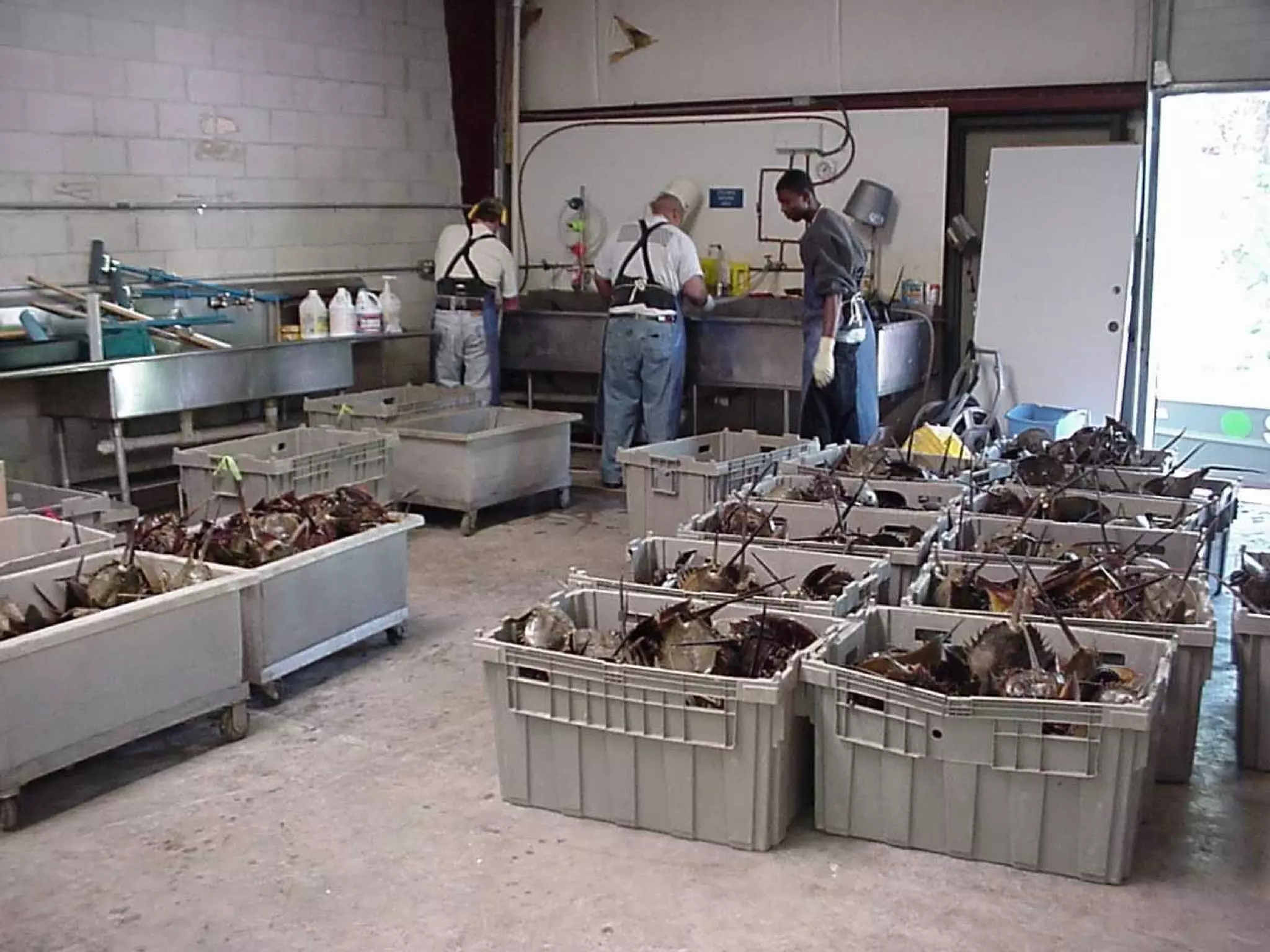
LAL
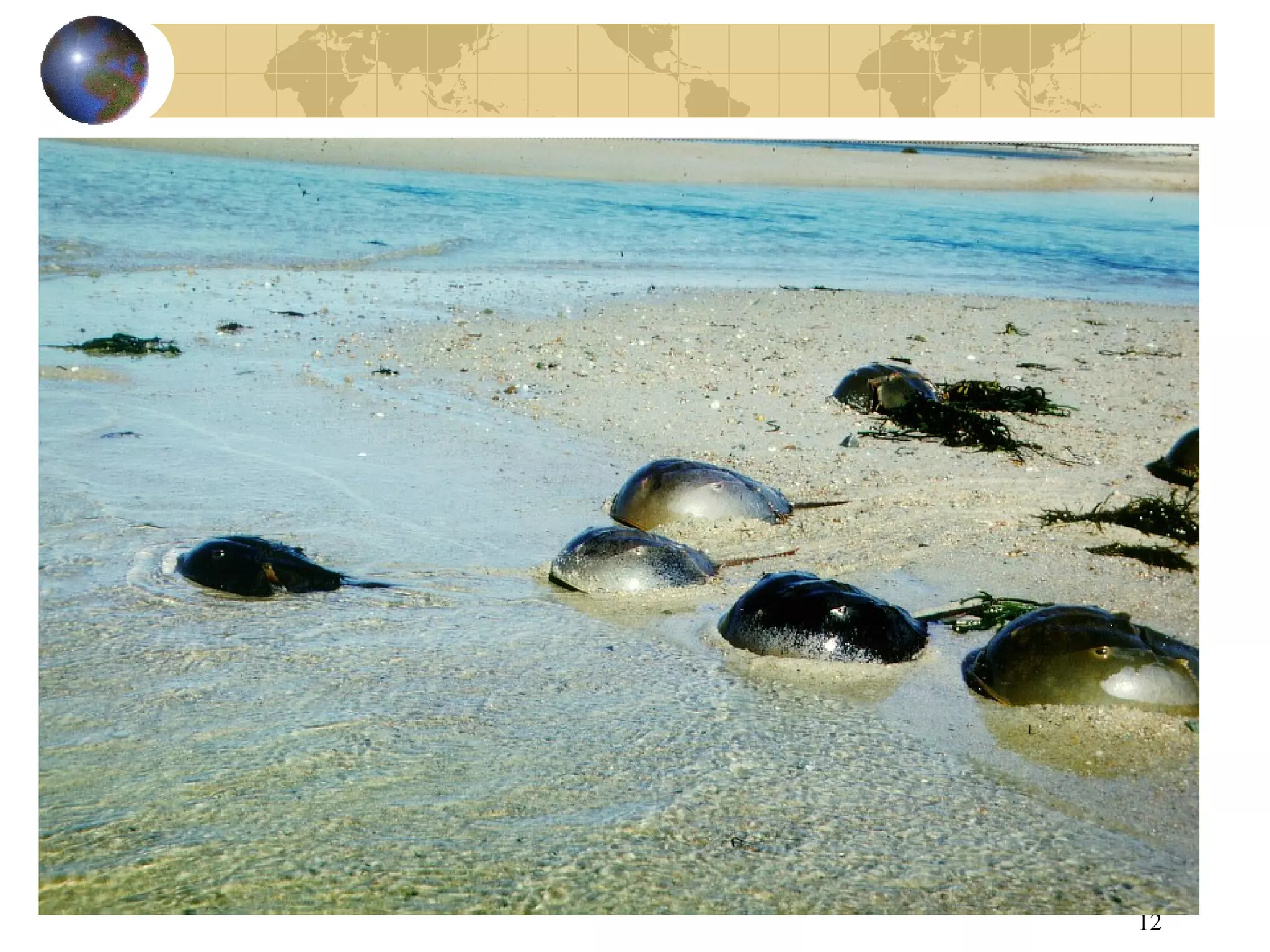
Limulus - genus of Horseshoe Crab
Amoebocyte - blood cells
Lysate - blood extract
LAL is a FDA regulated biological that reacts
chemically in the presence of gram negative cell
debris. This reaction can be measured and
quantified.
12
16
20
Bacterial Endotoxin Test
21
LAL Discoveries by Bang and Levin
Described role of endotoxin in
coagulation of Limulus blood
Prepared Endotoxin - responsive lysate
from Amoebocytes
22
LAL Assay
LAL is > 100 times more sensitive,
specific and accurate
Economy of LAL permits more
testing
Tolerance of rabbits to endotoxin is a
concern for FDA
LAL activity correlates with pyrogenicity
23
History of LAL Regulations
1941 Rabbit Pyrogen test included in USP
1973 FDA announced LAL as a biological product
1977 FDA described conditions for use of LAL as
end-product test for human biological &
medical devices
1980 Federal register drafted guidelines for use of
LAL test for end-product testing of
human & animal injectable drug products
24
History of LAL Regulations
1983 Federal Register lists final guidelines on
LAL testing including chrom and turb
1987 USFDA LAL - Test Guideline
1991 Interim Guidance - Kinetic LAL Test
1995 USP 23 Bacterial Endotoxin Test
1998 European Pharmacopoeia BET
2000 Harmonized BET
25
Other Regulatory Documents
USP monographs
Manufacturer’s Package Insert
Internal SOP
AAMI guidelines
other Pharmacopoeia
26
New Harmonized BET
Effective July 2000
First Microbiological test harmonized by
ICH
Allows use of endotoxin-specific LAL
must test for glucans if suspected in your sample
Includes kinetic LAL methods
Gel Clot & Kinetics –
The Basics
28
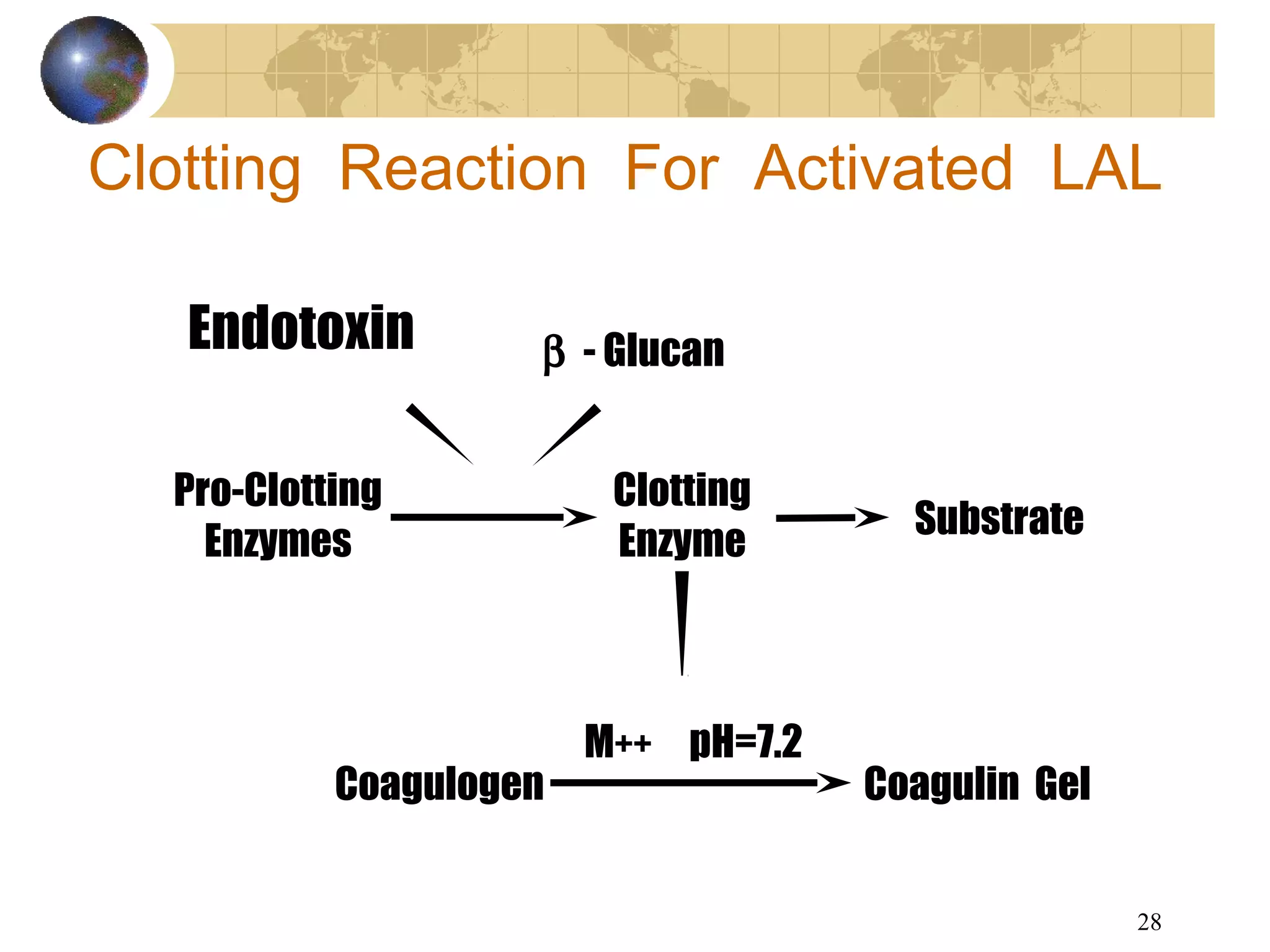
Clotting Reaction For Activated LAL
Endotoxin β - Glucan
Pro-Clotting
Enzymes
Clotting
Enzyme
Substrate
Coagulogen Coagulin Gel
M++ pH=7.2
29
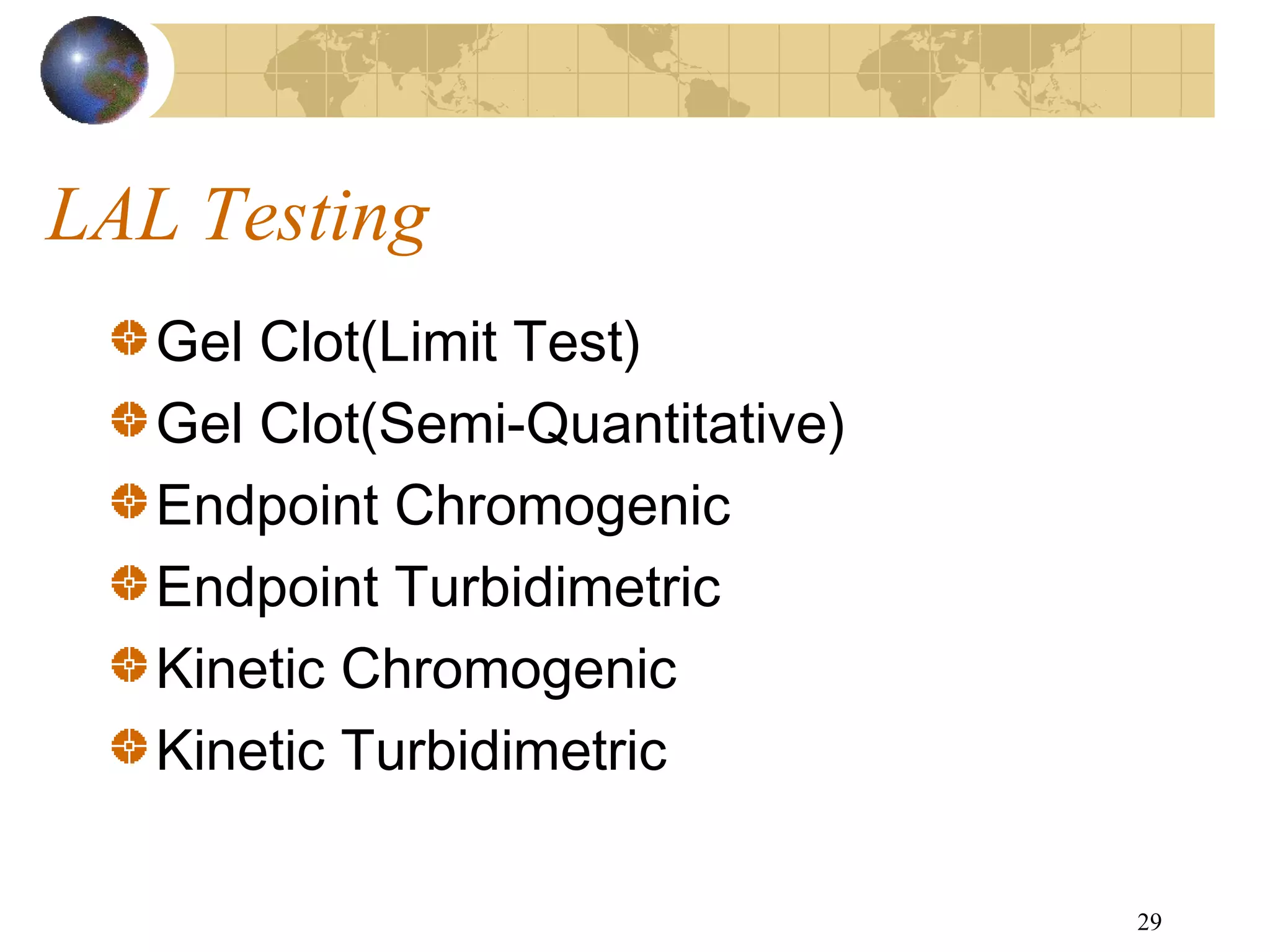
LAL Testing
Gel Clot(Limit Test)
Gel Clot(Semi-Quantitative)
Endpoint Chromogenic
Endpoint Turbidimetric
Kinetic Chromogenic
Kinetic Turbidimetric
30
Summary of Gel Clot Test
Endpoint sought by 180 inversion of
sample tube
Positive = Firm Gel
Negative = Flow down side of tube
August 25, 2003 Woo Jung BSC, Inc. 31
32
Gel Clot Reagent
In general
Lowest reagent cost
Simple reporting (+-)
Found in all
Pharmacopoeia
Good stability
Simple technique
Endosafe
firm gel
buffered lysate
better interference
resistance
.015 EU/ml
33
Sources of gel clot test problems
Use of wrong EU/ng ratio
use of improper reaction or dilution tubes
Incubating temperature too hot or too cold
Improper dilutions
Improper handling of lysate
34
Gel Clot Disadvantages
Limits test
Least sensitive
Most time consuming
Poor trending options
Variability, subjectivity
35
KINETIC LAL TESTING
ENDOTOXIN
CLOTTING CASCADE
CLOT
coagulogen
proclotting enzyme
chromogenic substrate pNA
clotting enzyme
coagulin
36
37
Microplate Absorbance Readers
38
Kinetic LAL Advantages
Quantitative results
Higher throughput (96 wells)
Lower sensitivity (to .001)
Wider standard curve range
Clear concise reporting
Allows for data trending
39
40
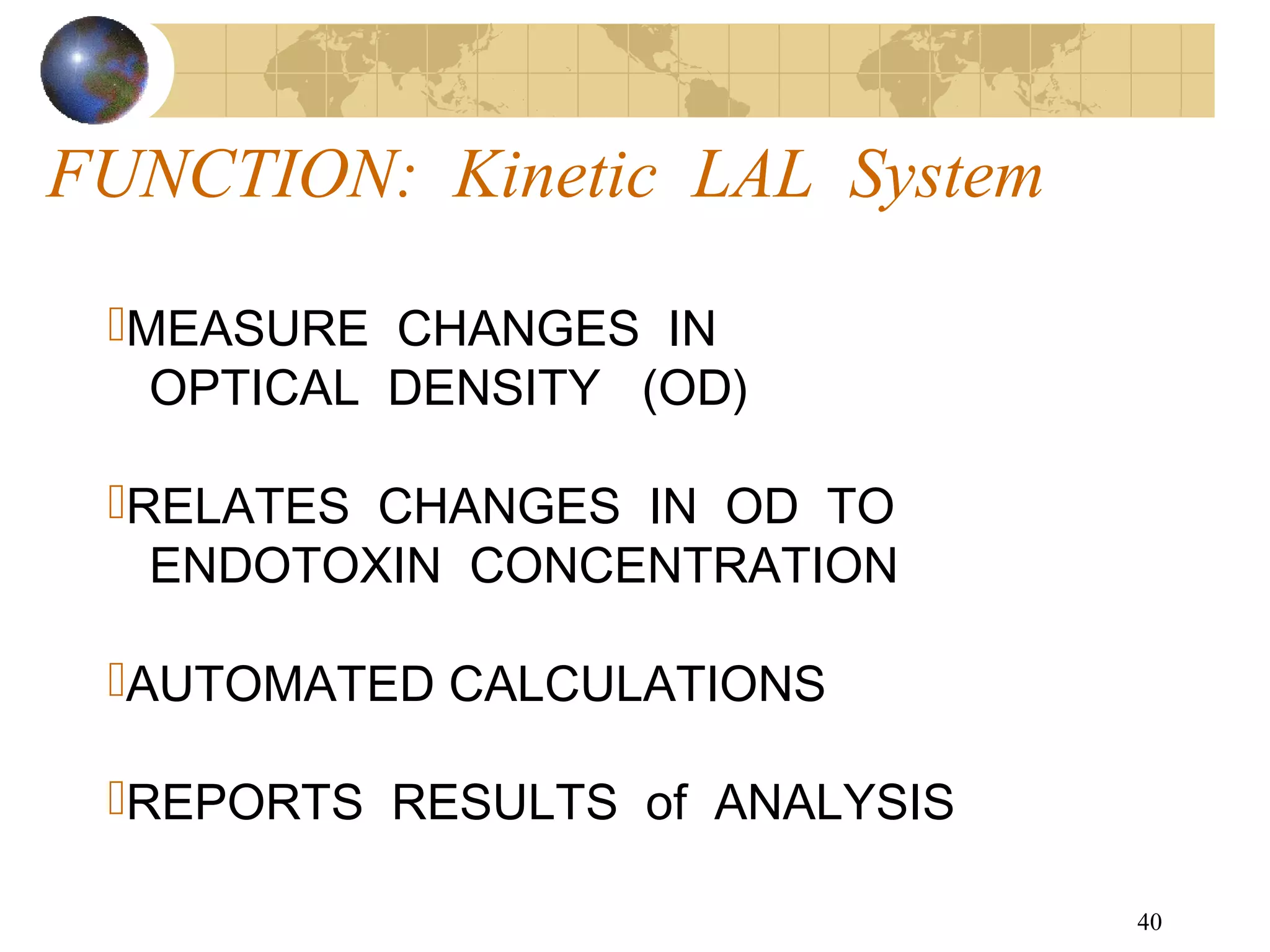
MEASURE CHANGES IN
OPTICAL DENSITY (OD)
RELATES CHANGES IN OD TO
ENDOTOXIN CONCENTRATION
AUTOMATED CALCULATIONS
REPORTS RESULTS of ANALYSIS
FUNCTION: Kinetic LAL System
41
Reaction Time
Optical Density
Principles of QuantitationPrinciples of Quantitation
Change in O.D. over Time
42
Optical Density
Time
Quantitative LAL Test ResultsQuantitative LAL Test Results
Endpoint: “Fixed Time”
43
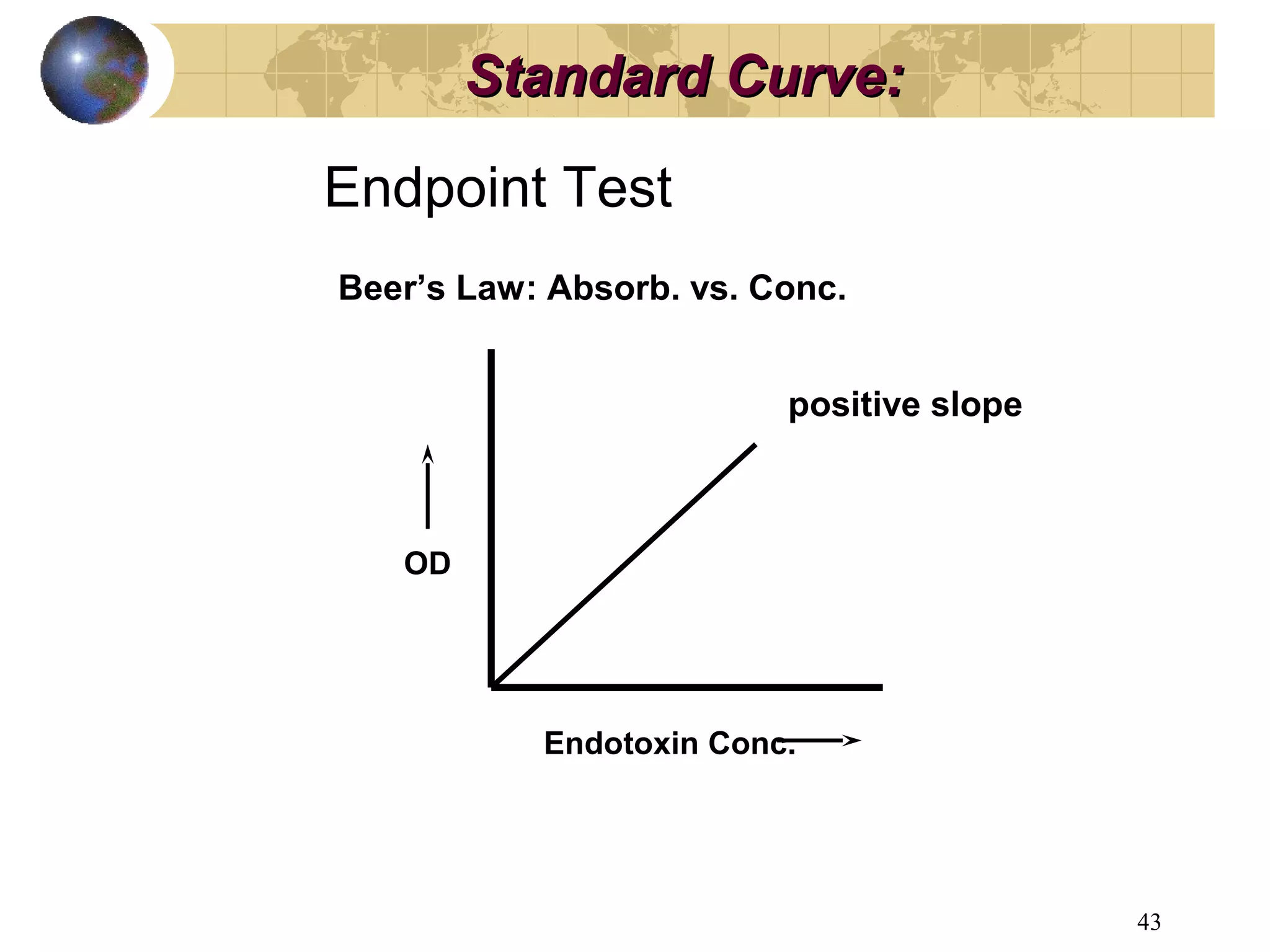
OD
Endotoxin Conc.
Standard Curve:Standard Curve:
Endpoint Test
Beer’s Law: Absorb. vs. Conc.
positive slope
44
Optical Density
Reaction Time
Quantitative LAL ResultsQuantitative LAL Results
“Fixed” Optical Density
45
Standard Curve:Standard Curve:
Kinetic Test
log (Endotoxin Conc.)
Log
(Reaction
Time)
negative slope
46
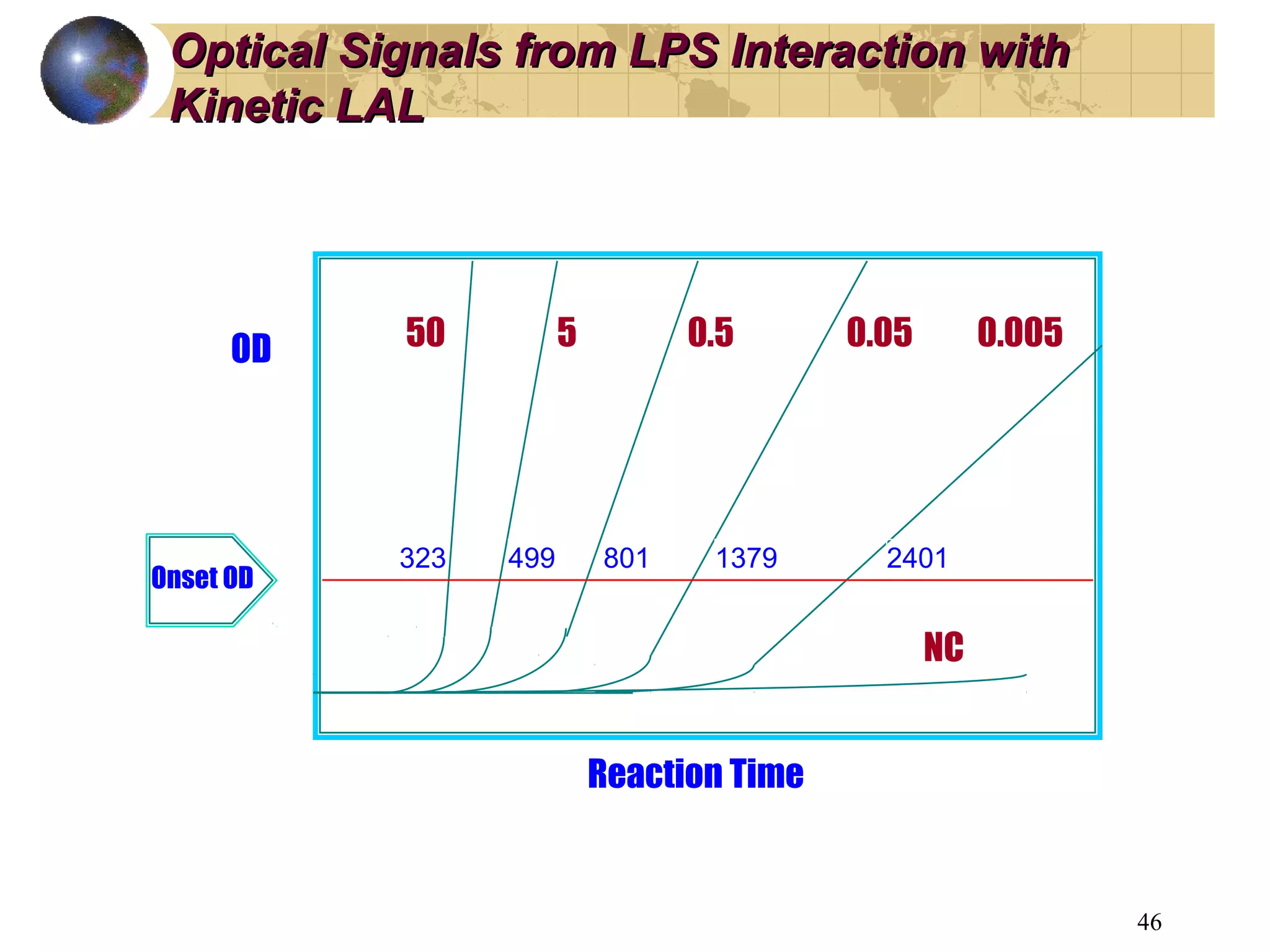
Optical Signals from LPS Interaction withOptical Signals from LPS Interaction with
Kinetic LALKinetic LAL
Reaction Time
OD 50 5 0.5 0.05 0.005
NC
Onset OD
323 499 801 1379 2401
47
Optical Signals from LPS InteractionOptical Signals from LPS Interaction
with Kinetic LALwith Kinetic LAL
Reaction Time
OD
50 5 0.5 0.05 0.005
NC
0.2
0.05
0.1
282 440 700 1161 1837
323 499 801 1379 2401
368 565 914 1643 3262
R
-0.995
-0.999
-1.000
48
How to Quantify the Amount of
Endotoxin in the Sample
A standard
curve is
constructed by
plotting
the log of
onset time
versus
the log of
concentration Log ( Endotoxin Conc. )
Log(ReactionTime)
Sample
49
Summary of Kinetic Assay
The amount of endotoxin present is inversely
proportional to the time of reaction
the more endotoxin present, the quicker the well or
tube will react (change color or become turbid)
A standard curve is generated based on how
long each of the standards take to reach an
onset OD
Unknowns are then compared to the standard
curve to generate a endotoxin values
Selecting Kinetic LAL
Reagents
Turbidimetric or Chromogenic?
51
Selection of Kinetic LAL Reagent
cost of reagent
unique interference problems
analysis time
sensitivity
52
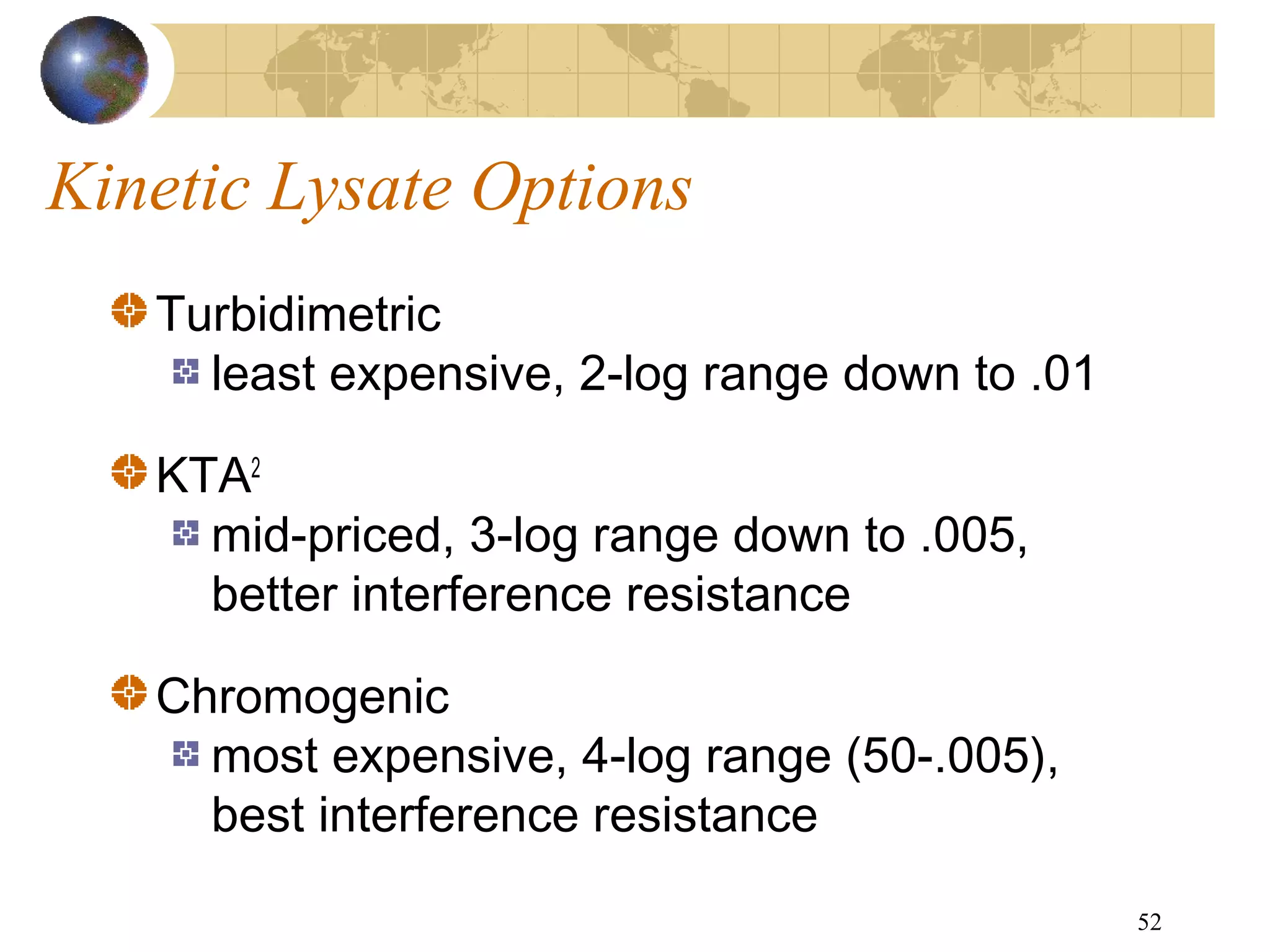
Kinetic Lysate Options
Turbidimetric
least expensive, 2-log range down to .01
KTA2
mid-priced, 3-log range down to .005,
better interference resistance
Chromogenic
most expensive, 4-log range (50-.005),
best interference resistance
53
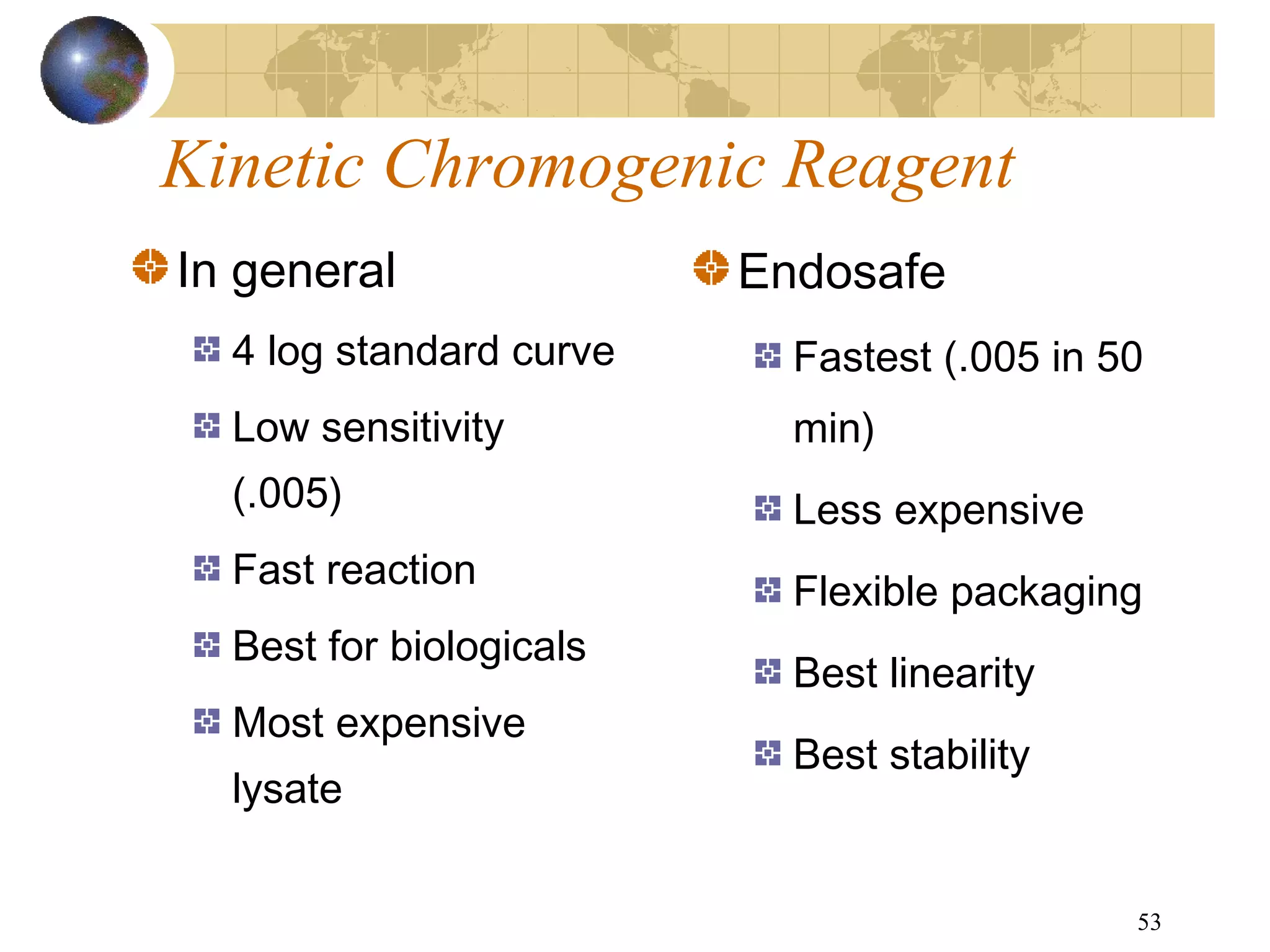
Kinetic Chromogenic Reagent
In general
4 log standard curve
Low sensitivity
(.005)
Fast reaction
Best for biologicals
Most expensive
lysate
Endosafe
Fastest (.005 in 50
min)
Less expensive
Flexible packaging
Best linearity
Best stability
54
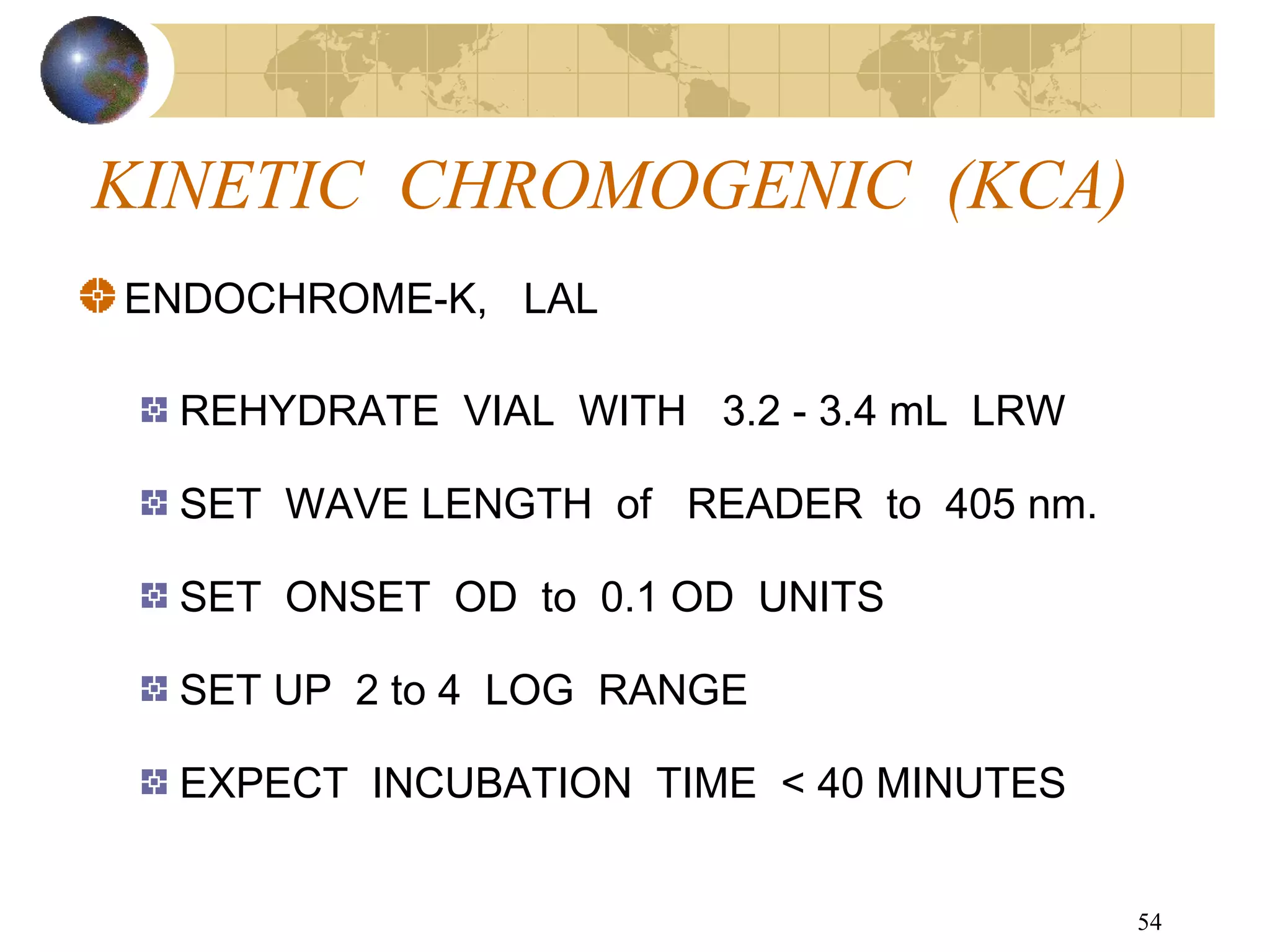
KINETIC CHROMOGENIC (KCA)
ENDOCHROME-K, LAL
REHYDRATE VIAL WITH 3.2 - 3.4 mL LRW
SET WAVE LENGTH of READER to 405 nm.
SET ONSET OD to 0.1 OD UNITS
SET UP 2 to 4 LOG RANGE
EXPECT INCUBATION TIME < 40 MINUTES
55
Kinetic Turbidimetric Reagent
In General
Price similar to gel
Linear over two logs
Stable
.05 in about 50 minutes
Trend analysis
Endosafe KTA
Linear over wider range
Better spike recovery
products other than
water
Also true gel clot
No reconstitution buffer
56
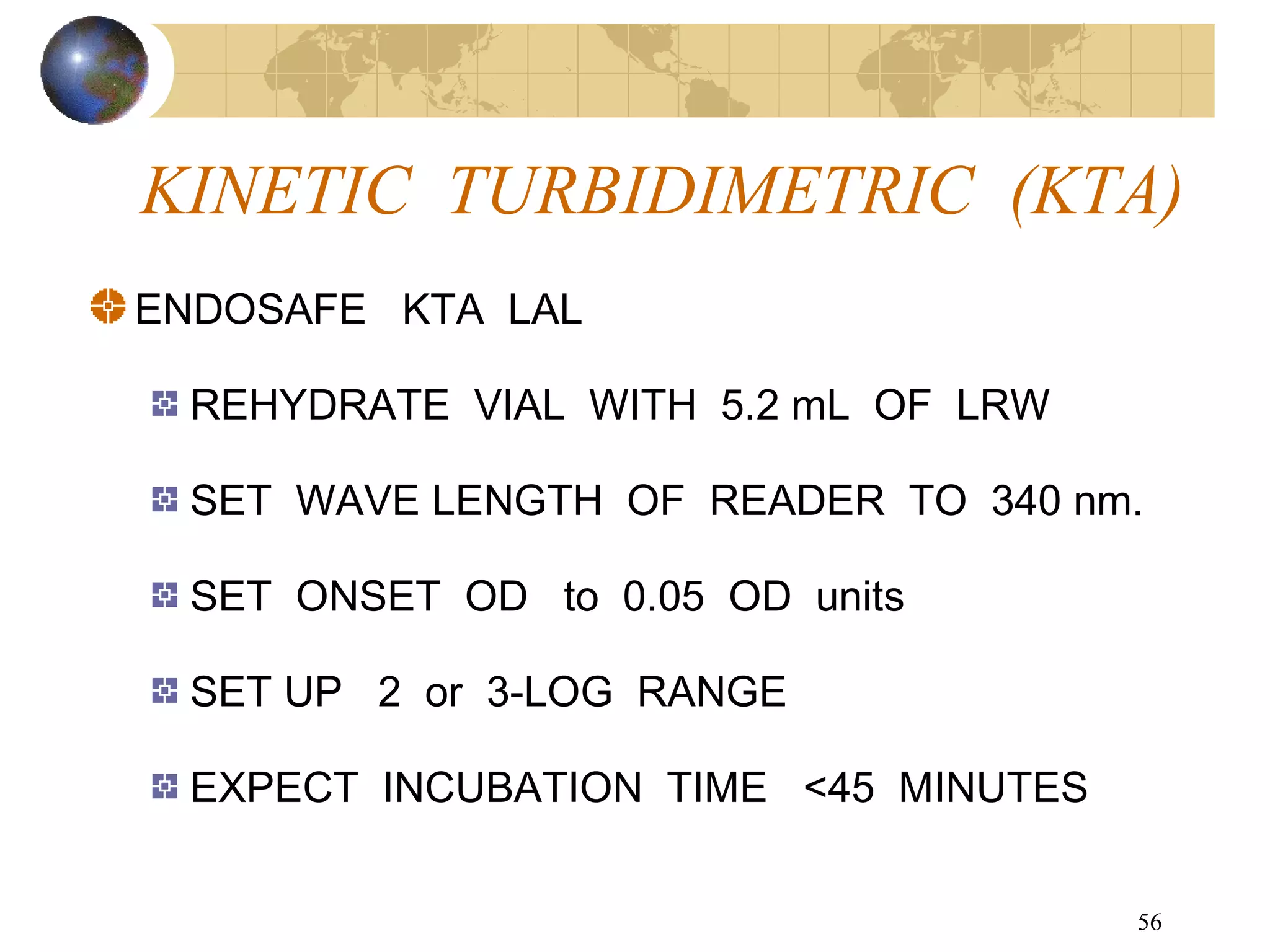
KINETIC TURBIDIMETRIC (KTA)
ENDOSAFE KTA LAL
REHYDRATE VIAL WITH 5.2 mL OF LRW
SET WAVE LENGTH OF READER TO 340 nm.
SET ONSET OD to 0.05 OD units
SET UP 2 or 3-LOG RANGE
EXPECT INCUBATION TIME <45 MINUTES
57
KTA2
Turbidimetric Lysate
1st turb lysate to run at .005 EU/ml
Faster than existing turbs (.005 in < 1 hour)
Interference resistance of chromogenic lysate
Priced closer to conventional turb
Can be used with polynomial regression
58
Glucans ((1-3)-B-D-glucan)
Materials that cause false positive in LAL by
activating Factor-G pathway
Non-pyrogenic
Sources include cellulosic membranes and
fungal or yeast extract
Reacts like endotoxin in gel clot
Causes enhancement in kinetic methods
59
LAL and Glucans
No current LAL on the market is totally
unreactive to glucans
Reactivity tied to extraction method
Variability between lots
Best way to test today is to use glucan
blocker
60
LAL - Test Interference
Inhibition:
Recovery < Expected Amount
Enhancement:
Recovery > Expected Amount
Non-interference:
Recovery = Expected Amount
61
Calculate EL, MVD, MVC
Make sample dilutions between undiluted and
MVD
Screen these dilutions to determine non-
interfering test concentration
Once a non-interfering sample dilution is
determined perform validation on three lots of
this product
Product Screen (Inh / Enh)
62
Measure and document pH of sample +
LAL
If no pH adjustment is made then, the validation
data serves as documentation for routine testing,
and pH measurements will not have to be
performed routinely
If pH adjustments are made then routine testing
should include pH measurement and
documentation.
Product Screen (Inh / Enh)
63
LAL Compatibility
A test sample is compatible with LAL
reagent if the positive product control
(ppc) is recovered.
in gel-clot, at least 2-lambda is recovered
in kinetic LAL, 100 ±50% of a known
amount of CSE is recovered relative to a
standard curve.
64
Scope of Interference Problem
Only 25% of pharmaceuticals are
testable undiluted
Inhibition is usually solved by dilution
Devices are seldom inhibitory, unless
coated
65
Eliminating Causes Of Interference
PROBLEM
pH
Endotoxin loss
Mg depletion
LAL-RM
SOLUTION
Buffered LAL Reagent
In-plate spiking
Permissible Dilution
Endotoxin-Specific buffer
66
Current Trends in LAL Testing
Continued move toward kinetic testing
over 55% of all LAL tests performed today
Compliant software
Database trending
Robotics
In-vitro pyrogen test
LAL Applications
68
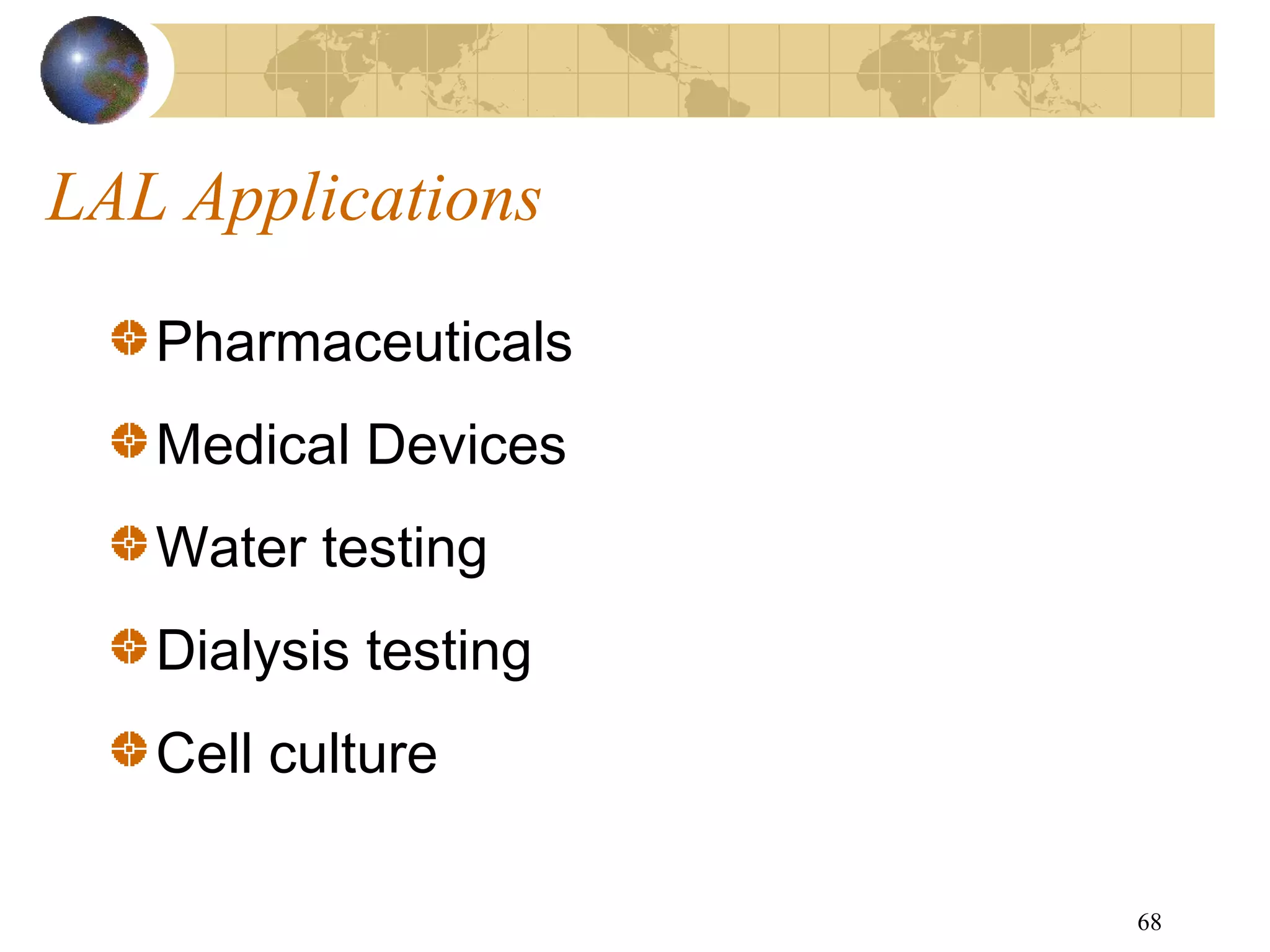
LAL Applications
Pharmaceuticals
Medical Devices
Water testing
Dialysis testing
Cell culture
69
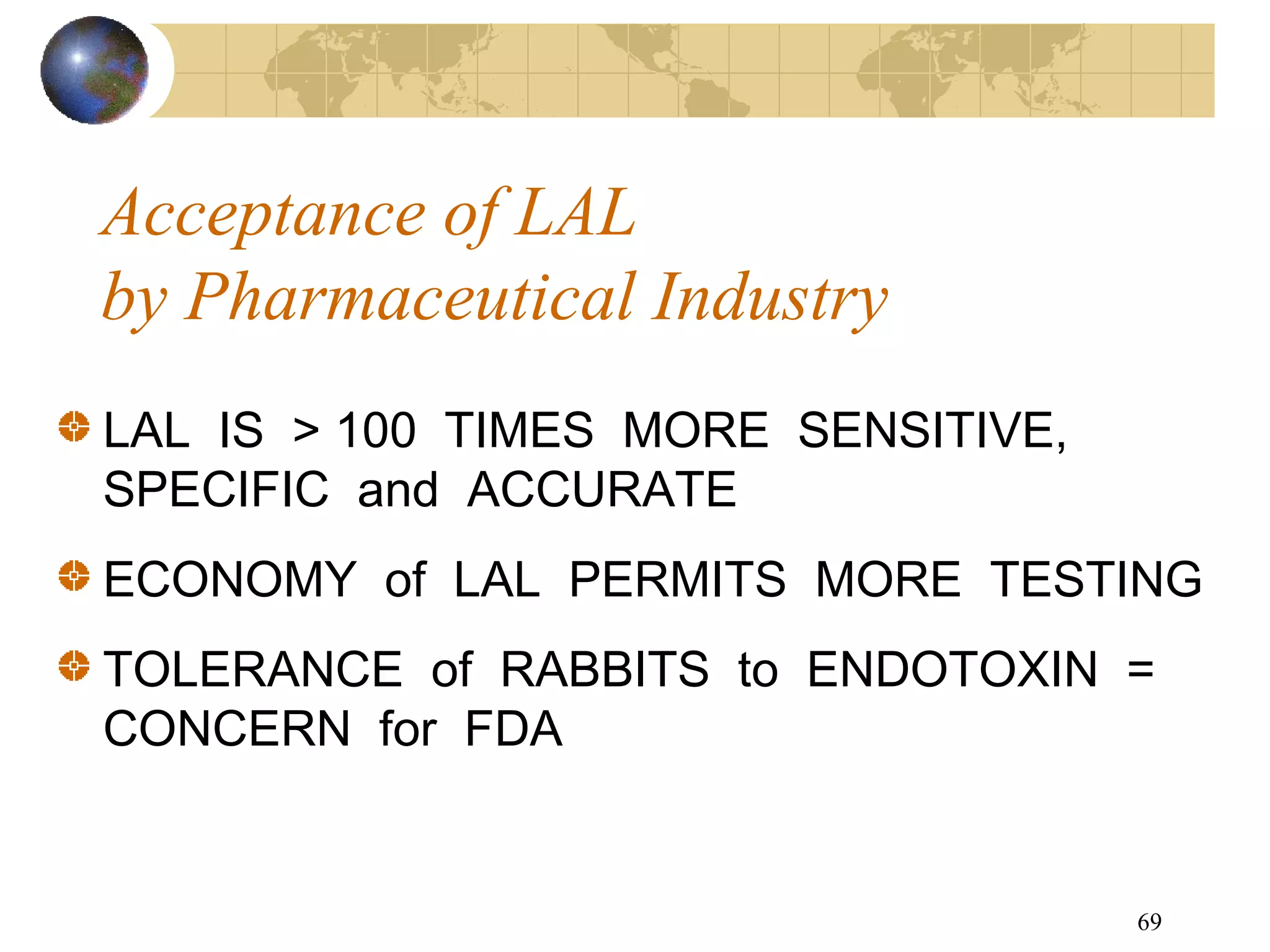
Acceptance of LAL
by Pharmaceutical Industry
LAL IS > 100 TIMES MORE SENSITIVE,
SPECIFIC and ACCURATE
ECONOMY of LAL PERMITS MORE TESTING
TOLERANCE of RABBITS to ENDOTOXIN =
CONCERN for FDA
70
Baxter Report on
Non-Endotoxin Pyrogens
143,196 LAL and 28,410 RABBIT TESTS
ALL PYROGENIC TESTS GAVE POSITIVE
LAL RESULT
NO FALSE-POSITIVE LAL TESTS
NOT ALL POSITIVE LAL TESTS WERE
PYROGENIC in RABBITS
RABBIT WAS OFTEN UNRELIABLE
71
Improved Quality of U. S.
Pharmaceuticals
1974 FDA STUDY FOUND 45% of ALBUMIN
PYROGENIC
REGULATED In-PROCESS TESTING
ELIMINATED PYROGENIC ALBUMIN
PYROGENS REMOVED from INFLUENZA
VACCINES
LAL REQUIRED for SPINAL-FLUID DRUGS
NO OUTBREAKS of FEVER SINCE 1980
72
LAL Application - Medical Devices
1987 FDA Guideline
Extraction test
Endotoxin Limit -
0.05 EU/ml up to 20 EU/device
Turbidimetric most cost effective
method for testing
73
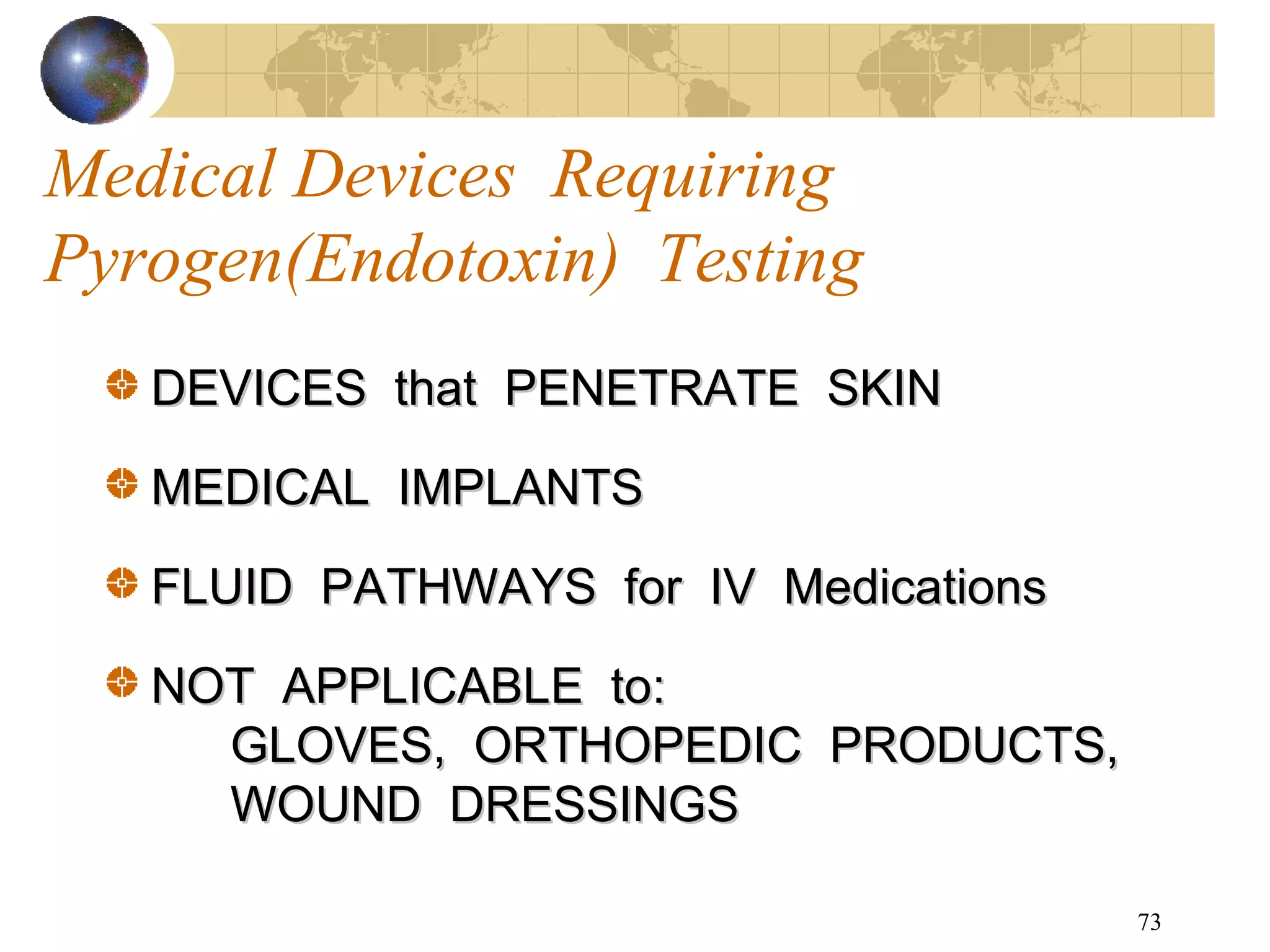
Medical Devices Requiring
Pyrogen(Endotoxin) Testing
DEVICES that PENETRATE SKINDEVICES that PENETRATE SKIN
MEDICAL IMPLANTSMEDICAL IMPLANTS
FLUID PATHWAYS for IV MedicationsFLUID PATHWAYS for IV Medications
NOT APPLICABLE to:NOT APPLICABLE to:
GLOVES, ORTHOPEDIC PRODUCTS,GLOVES, ORTHOPEDIC PRODUCTS,
WOUND DRESSINGSWOUND DRESSINGS
74
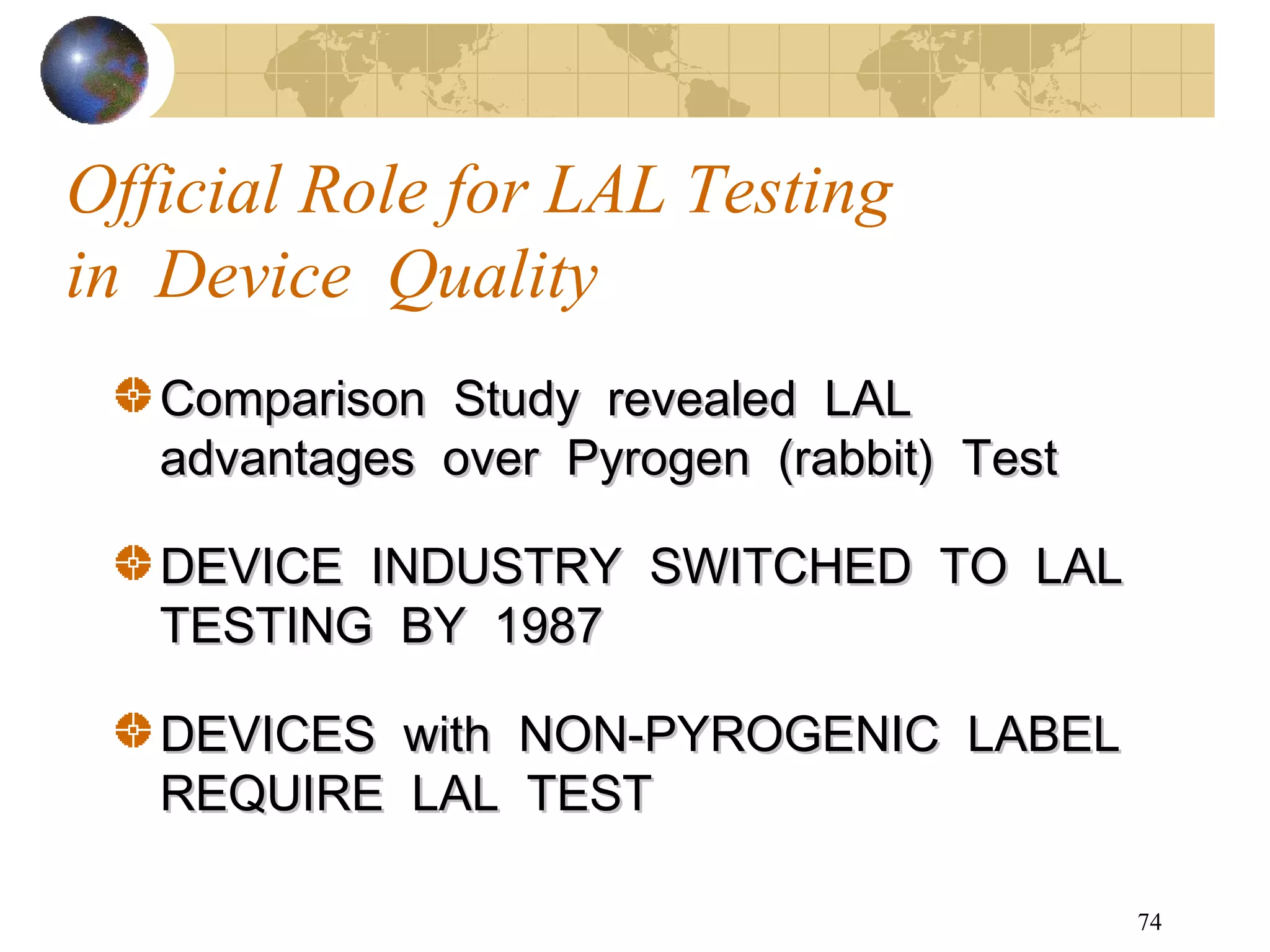
Official Role for LAL Testing
in Device Quality
Comparison Study revealed LALComparison Study revealed LAL
advantages over Pyrogen (rabbit) Testadvantages over Pyrogen (rabbit) Test
DEVICE INDUSTRY SWITCHED TO LALDEVICE INDUSTRY SWITCHED TO LAL
TESTING BY 1987TESTING BY 1987
DEVICES with NON-PYROGENIC LABELDEVICES with NON-PYROGENIC LABEL
REQUIRE LAL TESTREQUIRE LAL TEST
75
LAL Application - Water system
Routine monitoring
Turbidimetric is the lysate of choice
Trending allows you to set action and
alert limits
76
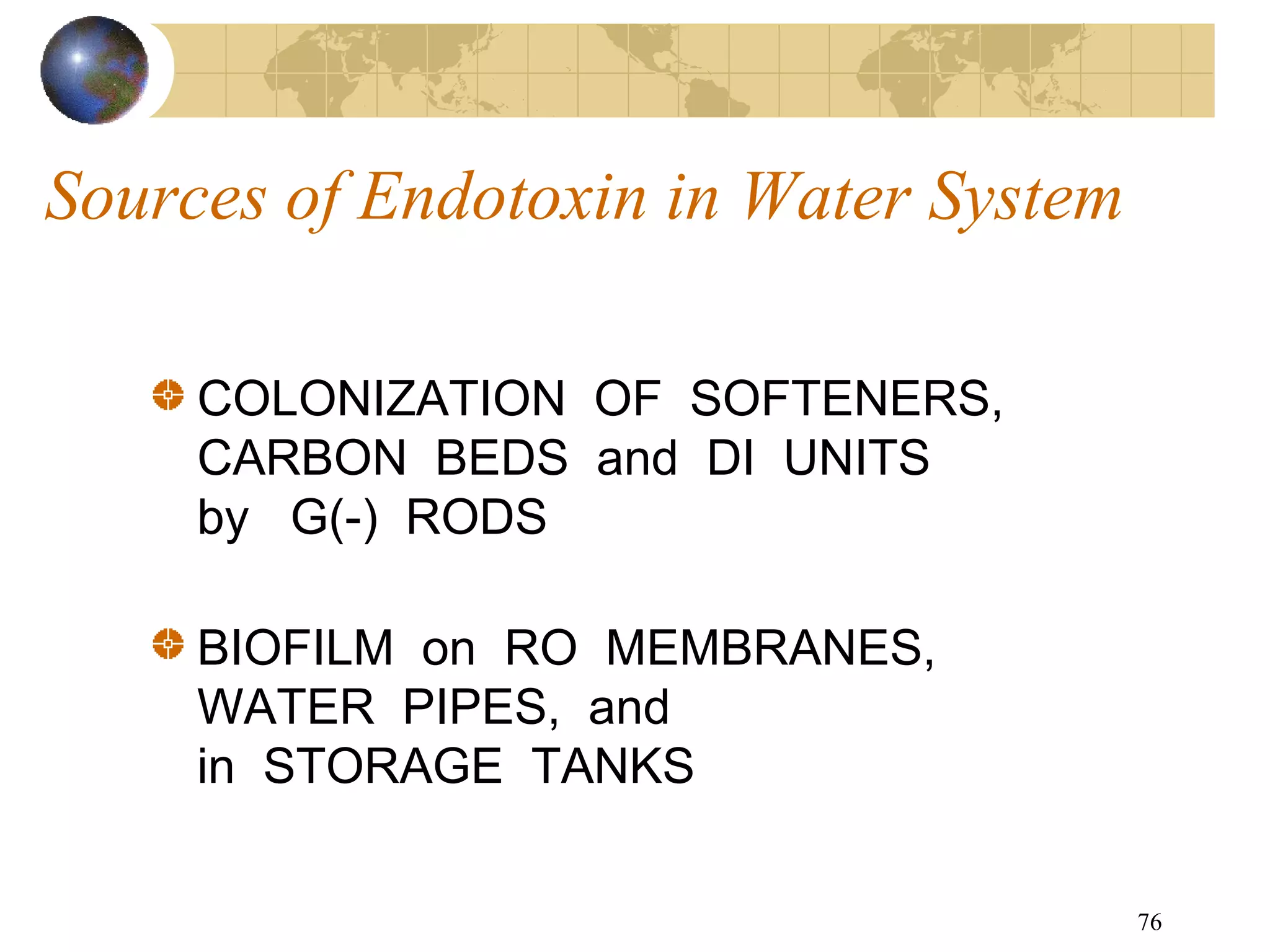
Sources of Endotoxin in Water System
COLONIZATION OF SOFTENERS,
CARBON BEDS and DI UNITS
by G(-) RODS
BIOFILM on RO MEMBRANES,
WATER PIPES, and
in STORAGE TANKS
77
LAL Application - Dialysis
Testing of dialysis water and concentrate
Testing performed in clinics, hospitals, and
reference labs
Gel clot is method of choice because of low
volume of tests
New AMMI limit on water for dialysis is 2
EU/ml
78
LAL Application - cell culture
Effects of endotoxin very greatly depending
on cell line.
in vitro fertilization adversely affected
Classified broadly as a parenteral product
Endotoxin testing by BET is imminent
79
Bacterial Endotoxin Test Validation

Bacterial Endotoxin Test

  • 1.
    Endotoxin Detection byLALEndotoxin Detection by LAL for Parenteral Productsfor Parenteral Products
  • 2.
    2 Principal Microbiology Tests STERILITY:Detection of live microorganisms PYROGEN: Detection of cell-wall fragments from Gram(-) bacteria. History of a product’s exposure to GNB
  • 3.
    3 Endotoxins and Pyrogens Pyrogensare fever-inducing agents in humans and animals include endotoxin, gram + cell debris, fungi Endotoxins are components from the outer membrane of gram-negative bacteria
  • 4.
  • 5.
    5 Endotoxin Endotoxin - Componentfrom outer membrane of gram-negative bacteria Environmental (unpurified) endotoxin: complex of protein, carbohydrate & lipid Purified endotoxin: lipopolysaccharide molecule of polysaccharide and lipid a, without protein
  • 6.
    6 Purified Endotoxin - Lipopolysaccharide Passesthrough sterilizing membrane filters Lipid A region causes LAL reaction and potent pharmacological activities associated with endotoxin poorly dispersible in water pyrogenicity correlates with LAL assays
  • 7.
    7 Why Test forEndotoxins? To protect against adverse reactions (sepsis) in humans and animals FDA and USP guidelines require final product testing on all parenterals and medical devices To safeguard against diminished effectiveness of a product due to endotoxin
  • 8.
    8 Endotoxicity ENDOTOXIN CAUSES MYELOIDTISSUE TO RELEASE INFLAMMATORY MEDIATORS CYTOKINES INDUCE A VARIETY OF TISSUE DAMAGE SHOCK and MULTIPLE ORGAN DYSFUNCTION MAY OCCUR
  • 9.
    9 How to testfor Endotoxins? Rabbit Pyrogen Test FD approved in 1941 LAL / TAL Test gel clot LAL approved in 1973 kinetic LAL in 1987 Cell based assays In Vitro pyrogen assay
  • 10.
    10 Rabbit Pyrogen Test Measurethe change in temperature of 3 rabbits, after intravenous injection of the test solution.
  • 11.
    11 LAL Limulus - genusof Horseshoe Crab Amoebocyte - blood cells Lysate - blood extract LAL is a FDA regulated biological that reacts chemically in the presence of gram negative cell debris. This reaction can be measured and quantified.
  • 12.
  • 16.
  • 20.
  • 21.
    21 LAL Discoveries byBang and Levin Described role of endotoxin in coagulation of Limulus blood Prepared Endotoxin - responsive lysate from Amoebocytes
  • 22.
    22 LAL Assay LAL is> 100 times more sensitive, specific and accurate Economy of LAL permits more testing Tolerance of rabbits to endotoxin is a concern for FDA LAL activity correlates with pyrogenicity
  • 23.
    23 History of LALRegulations 1941 Rabbit Pyrogen test included in USP 1973 FDA announced LAL as a biological product 1977 FDA described conditions for use of LAL as end-product test for human biological & medical devices 1980 Federal register drafted guidelines for use of LAL test for end-product testing of human & animal injectable drug products
  • 24.
    24 History of LALRegulations 1983 Federal Register lists final guidelines on LAL testing including chrom and turb 1987 USFDA LAL - Test Guideline 1991 Interim Guidance - Kinetic LAL Test 1995 USP 23 Bacterial Endotoxin Test 1998 European Pharmacopoeia BET 2000 Harmonized BET
  • 25.
    25 Other Regulatory Documents USPmonographs Manufacturer’s Package Insert Internal SOP AAMI guidelines other Pharmacopoeia
  • 26.
    26 New Harmonized BET EffectiveJuly 2000 First Microbiological test harmonized by ICH Allows use of endotoxin-specific LAL must test for glucans if suspected in your sample Includes kinetic LAL methods
  • 27.
    Gel Clot &Kinetics – The Basics
  • 28.
    28 Clotting Reaction ForActivated LAL Endotoxin β - Glucan Pro-Clotting Enzymes Clotting Enzyme Substrate Coagulogen Coagulin Gel M++ pH=7.2
  • 29.
    29 LAL Testing Gel Clot(LimitTest) Gel Clot(Semi-Quantitative) Endpoint Chromogenic Endpoint Turbidimetric Kinetic Chromogenic Kinetic Turbidimetric
  • 30.
    30 Summary of GelClot Test Endpoint sought by 180 inversion of sample tube Positive = Firm Gel Negative = Flow down side of tube
  • 31.
    August 25, 2003Woo Jung BSC, Inc. 31
  • 32.
    32 Gel Clot Reagent Ingeneral Lowest reagent cost Simple reporting (+-) Found in all Pharmacopoeia Good stability Simple technique Endosafe firm gel buffered lysate better interference resistance .015 EU/ml
  • 33.
    33 Sources of gelclot test problems Use of wrong EU/ng ratio use of improper reaction or dilution tubes Incubating temperature too hot or too cold Improper dilutions Improper handling of lysate
  • 34.
    34 Gel Clot Disadvantages Limitstest Least sensitive Most time consuming Poor trending options Variability, subjectivity
  • 35.
    35 KINETIC LAL TESTING ENDOTOXIN CLOTTINGCASCADE CLOT coagulogen proclotting enzyme chromogenic substrate pNA clotting enzyme coagulin
  • 36.
  • 37.
  • 38.
    38 Kinetic LAL Advantages Quantitativeresults Higher throughput (96 wells) Lower sensitivity (to .001) Wider standard curve range Clear concise reporting Allows for data trending
  • 39.
  • 40.
    40 MEASURE CHANGES IN OPTICALDENSITY (OD) RELATES CHANGES IN OD TO ENDOTOXIN CONCENTRATION AUTOMATED CALCULATIONS REPORTS RESULTS of ANALYSIS FUNCTION: Kinetic LAL System
  • 41.
    41 Reaction Time Optical Density Principlesof QuantitationPrinciples of Quantitation Change in O.D. over Time
  • 42.
    42 Optical Density Time Quantitative LALTest ResultsQuantitative LAL Test Results Endpoint: “Fixed Time”
  • 43.
    43 OD Endotoxin Conc. Standard Curve:StandardCurve: Endpoint Test Beer’s Law: Absorb. vs. Conc. positive slope
  • 44.
    44 Optical Density Reaction Time QuantitativeLAL ResultsQuantitative LAL Results “Fixed” Optical Density
  • 45.
    45 Standard Curve:Standard Curve: KineticTest log (Endotoxin Conc.) Log (Reaction Time) negative slope
  • 46.
    46 Optical Signals fromLPS Interaction withOptical Signals from LPS Interaction with Kinetic LALKinetic LAL Reaction Time OD 50 5 0.5 0.05 0.005 NC Onset OD 323 499 801 1379 2401
  • 47.
    47 Optical Signals fromLPS InteractionOptical Signals from LPS Interaction with Kinetic LALwith Kinetic LAL Reaction Time OD 50 5 0.5 0.05 0.005 NC 0.2 0.05 0.1 282 440 700 1161 1837 323 499 801 1379 2401 368 565 914 1643 3262 R -0.995 -0.999 -1.000
  • 48.
    48 How to Quantifythe Amount of Endotoxin in the Sample A standard curve is constructed by plotting the log of onset time versus the log of concentration Log ( Endotoxin Conc. ) Log(ReactionTime) Sample
  • 49.
    49 Summary of KineticAssay The amount of endotoxin present is inversely proportional to the time of reaction the more endotoxin present, the quicker the well or tube will react (change color or become turbid) A standard curve is generated based on how long each of the standards take to reach an onset OD Unknowns are then compared to the standard curve to generate a endotoxin values
  • 50.
  • 51.
    51 Selection of KineticLAL Reagent cost of reagent unique interference problems analysis time sensitivity
  • 52.
    52 Kinetic Lysate Options Turbidimetric leastexpensive, 2-log range down to .01 KTA2 mid-priced, 3-log range down to .005, better interference resistance Chromogenic most expensive, 4-log range (50-.005), best interference resistance
  • 53.
    53 Kinetic Chromogenic Reagent Ingeneral 4 log standard curve Low sensitivity (.005) Fast reaction Best for biologicals Most expensive lysate Endosafe Fastest (.005 in 50 min) Less expensive Flexible packaging Best linearity Best stability
  • 54.
    54 KINETIC CHROMOGENIC (KCA) ENDOCHROME-K,LAL REHYDRATE VIAL WITH 3.2 - 3.4 mL LRW SET WAVE LENGTH of READER to 405 nm. SET ONSET OD to 0.1 OD UNITS SET UP 2 to 4 LOG RANGE EXPECT INCUBATION TIME < 40 MINUTES
  • 55.
    55 Kinetic Turbidimetric Reagent InGeneral Price similar to gel Linear over two logs Stable .05 in about 50 minutes Trend analysis Endosafe KTA Linear over wider range Better spike recovery products other than water Also true gel clot No reconstitution buffer
  • 56.
    56 KINETIC TURBIDIMETRIC (KTA) ENDOSAFEKTA LAL REHYDRATE VIAL WITH 5.2 mL OF LRW SET WAVE LENGTH OF READER TO 340 nm. SET ONSET OD to 0.05 OD units SET UP 2 or 3-LOG RANGE EXPECT INCUBATION TIME <45 MINUTES
  • 57.
    57 KTA2 Turbidimetric Lysate 1st turblysate to run at .005 EU/ml Faster than existing turbs (.005 in < 1 hour) Interference resistance of chromogenic lysate Priced closer to conventional turb Can be used with polynomial regression
  • 58.
    58 Glucans ((1-3)-B-D-glucan) Materials thatcause false positive in LAL by activating Factor-G pathway Non-pyrogenic Sources include cellulosic membranes and fungal or yeast extract Reacts like endotoxin in gel clot Causes enhancement in kinetic methods
  • 59.
    59 LAL and Glucans Nocurrent LAL on the market is totally unreactive to glucans Reactivity tied to extraction method Variability between lots Best way to test today is to use glucan blocker
  • 60.
    60 LAL - TestInterference Inhibition: Recovery < Expected Amount Enhancement: Recovery > Expected Amount Non-interference: Recovery = Expected Amount
  • 61.
    61 Calculate EL, MVD,MVC Make sample dilutions between undiluted and MVD Screen these dilutions to determine non- interfering test concentration Once a non-interfering sample dilution is determined perform validation on three lots of this product Product Screen (Inh / Enh)
  • 62.
    62 Measure and documentpH of sample + LAL If no pH adjustment is made then, the validation data serves as documentation for routine testing, and pH measurements will not have to be performed routinely If pH adjustments are made then routine testing should include pH measurement and documentation. Product Screen (Inh / Enh)
  • 63.
    63 LAL Compatibility A testsample is compatible with LAL reagent if the positive product control (ppc) is recovered. in gel-clot, at least 2-lambda is recovered in kinetic LAL, 100 ±50% of a known amount of CSE is recovered relative to a standard curve.
  • 64.
    64 Scope of InterferenceProblem Only 25% of pharmaceuticals are testable undiluted Inhibition is usually solved by dilution Devices are seldom inhibitory, unless coated
  • 65.
    65 Eliminating Causes OfInterference PROBLEM pH Endotoxin loss Mg depletion LAL-RM SOLUTION Buffered LAL Reagent In-plate spiking Permissible Dilution Endotoxin-Specific buffer
  • 66.
    66 Current Trends inLAL Testing Continued move toward kinetic testing over 55% of all LAL tests performed today Compliant software Database trending Robotics In-vitro pyrogen test
  • 67.
  • 68.
    68 LAL Applications Pharmaceuticals Medical Devices Watertesting Dialysis testing Cell culture
  • 69.
    69 Acceptance of LAL byPharmaceutical Industry LAL IS > 100 TIMES MORE SENSITIVE, SPECIFIC and ACCURATE ECONOMY of LAL PERMITS MORE TESTING TOLERANCE of RABBITS to ENDOTOXIN = CONCERN for FDA
  • 70.
    70 Baxter Report on Non-EndotoxinPyrogens 143,196 LAL and 28,410 RABBIT TESTS ALL PYROGENIC TESTS GAVE POSITIVE LAL RESULT NO FALSE-POSITIVE LAL TESTS NOT ALL POSITIVE LAL TESTS WERE PYROGENIC in RABBITS RABBIT WAS OFTEN UNRELIABLE
  • 71.
    71 Improved Quality ofU. S. Pharmaceuticals 1974 FDA STUDY FOUND 45% of ALBUMIN PYROGENIC REGULATED In-PROCESS TESTING ELIMINATED PYROGENIC ALBUMIN PYROGENS REMOVED from INFLUENZA VACCINES LAL REQUIRED for SPINAL-FLUID DRUGS NO OUTBREAKS of FEVER SINCE 1980
  • 72.
    72 LAL Application -Medical Devices 1987 FDA Guideline Extraction test Endotoxin Limit - 0.05 EU/ml up to 20 EU/device Turbidimetric most cost effective method for testing
  • 73.
    73 Medical Devices Requiring Pyrogen(Endotoxin)Testing DEVICES that PENETRATE SKINDEVICES that PENETRATE SKIN MEDICAL IMPLANTSMEDICAL IMPLANTS FLUID PATHWAYS for IV MedicationsFLUID PATHWAYS for IV Medications NOT APPLICABLE to:NOT APPLICABLE to: GLOVES, ORTHOPEDIC PRODUCTS,GLOVES, ORTHOPEDIC PRODUCTS, WOUND DRESSINGSWOUND DRESSINGS
  • 74.
    74 Official Role forLAL Testing in Device Quality Comparison Study revealed LALComparison Study revealed LAL advantages over Pyrogen (rabbit) Testadvantages over Pyrogen (rabbit) Test DEVICE INDUSTRY SWITCHED TO LALDEVICE INDUSTRY SWITCHED TO LAL TESTING BY 1987TESTING BY 1987 DEVICES with NON-PYROGENIC LABELDEVICES with NON-PYROGENIC LABEL REQUIRE LAL TESTREQUIRE LAL TEST
  • 75.
    75 LAL Application -Water system Routine monitoring Turbidimetric is the lysate of choice Trending allows you to set action and alert limits
  • 76.
    76 Sources of Endotoxinin Water System COLONIZATION OF SOFTENERS, CARBON BEDS and DI UNITS by G(-) RODS BIOFILM on RO MEMBRANES, WATER PIPES, and in STORAGE TANKS
  • 77.
    77 LAL Application -Dialysis Testing of dialysis water and concentrate Testing performed in clinics, hospitals, and reference labs Gel clot is method of choice because of low volume of tests New AMMI limit on water for dialysis is 2 EU/ml
  • 78.
    78 LAL Application -cell culture Effects of endotoxin very greatly depending on cell line. in vitro fertilization adversely affected Classified broadly as a parenteral product Endotoxin testing by BET is imminent
  • 79.

Editor's Notes

  • #28 I’m please to meet this opportunity to meet all of you and also to give presentation today. I’m Hongjin Min, Endosafe Asia Region Technical Manager. At this time, I would like to talk to all of you about the basics of gel clot and kinetic LAL testing.
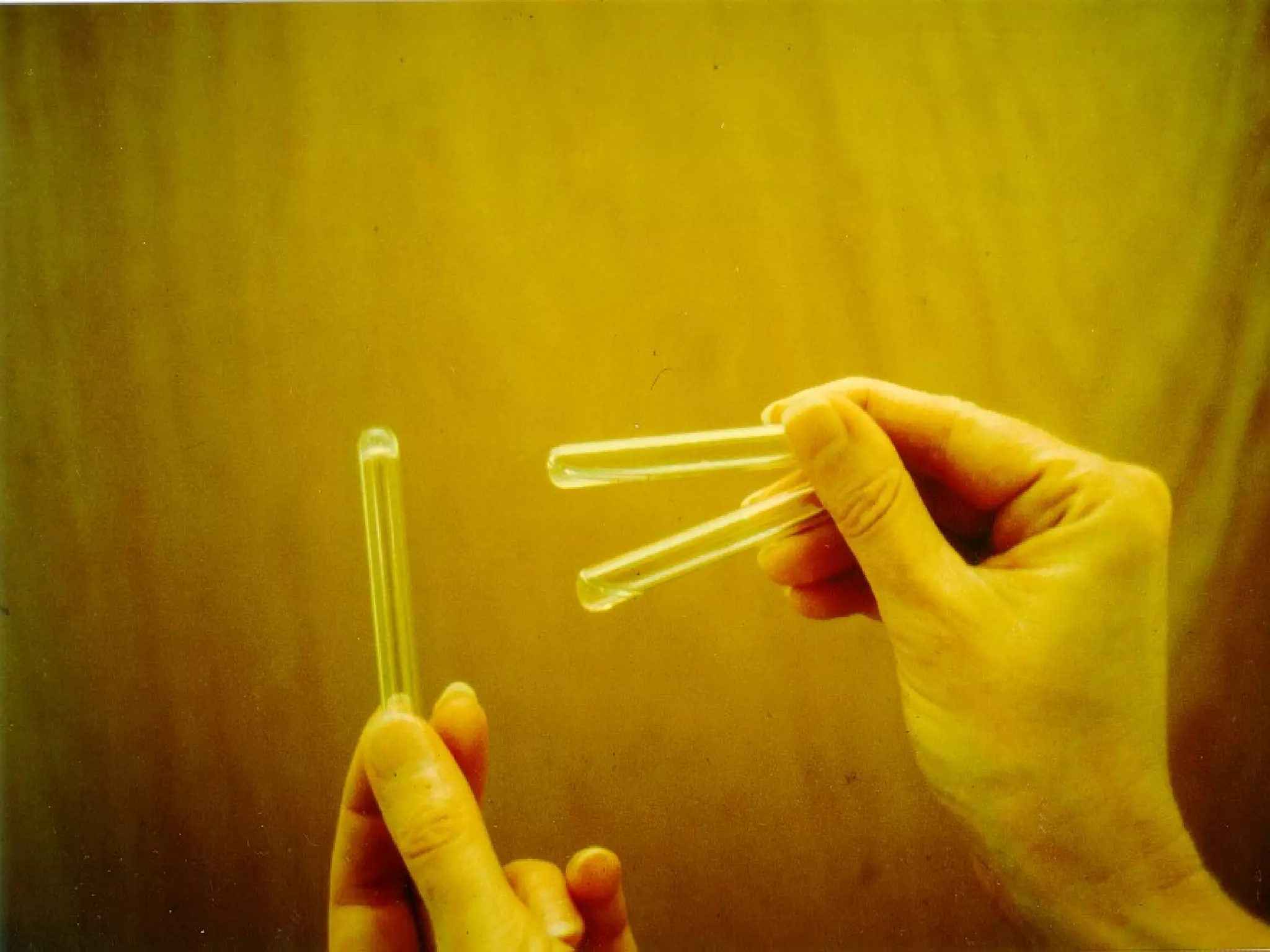
  • #31 Gel clot results are determined after incubation by rotating the tube. If the gel is firm then the test is positive and if gel flows down the tube, then the results are deemed negative.
  • #32 This picture show the positive (on the left) and negative results (on the right). All test results that are not firm gel is a negative result.
  • #33 In general, gel clot reagent are the cheapest LAL. And it generates very simple reporting just positive or negative. We find gel clot methods in all Pharmacopoeia. It has good stability. And due to the simple testing technique, everybody can perform gel clot test without much difficulty. Endosafe’s gel clot LAL has firm gel. So it is very easy to read and record the result. All Endosafe’s LAL is buffered lysate, which means that Endosafe’s LAL has better resistance against interference problems. Endosafe’s fifty test LAL has lowest sensitivity as 0.015EU/ml in the industry.
  • #34 There are several sources of test problem for gel clot method. Wrong RSE/CSE ratio and or EU/ng, can be a problem due to weak or strong potency. Choice of tube is also one problem source. For dilution of endotoxin and sample we need to use borosilicate glass tube or polystyrene disposable plastic tube. Polypropylene or soda lime glass are not good choices. Too hot incubating temperature can cause false positives, too cold temperature can also cause a false negative. Improper dilution can lead to errors. And improper handling of lysate is also a problem source. Lysate should be dissolved gently, some people vortex lysate, this can make the lysate react fast. And storage condition of rehydrated lysate should be well controlled and validated.
  • #35 Gel clot testing has its disadvantages. It’s a limit test, we don’t know how much endotoxin exist in the samples. The test sensitivity is not so sensitive, the lowest sensitive is 0.03 or 0.015EU/ml. And gel clot can be a very time consuming test. It has poor trend analysis option because it show only positive or negative. It has variability and subjectivity to determine the results.
  • #36 This chart show the reaction cascade of kinetic reaction. This side is for kinetic turbidmetric pass, which makes the turbidity for signal KTA. Turbidimetric pass is same as a gel clot. Lower side show the pass for kinetic chromogenic. Through the reaction cascade, clotting enzyme cleave the chromogenic substrate and reveal the p-nitro aniline. It makes yellow color.
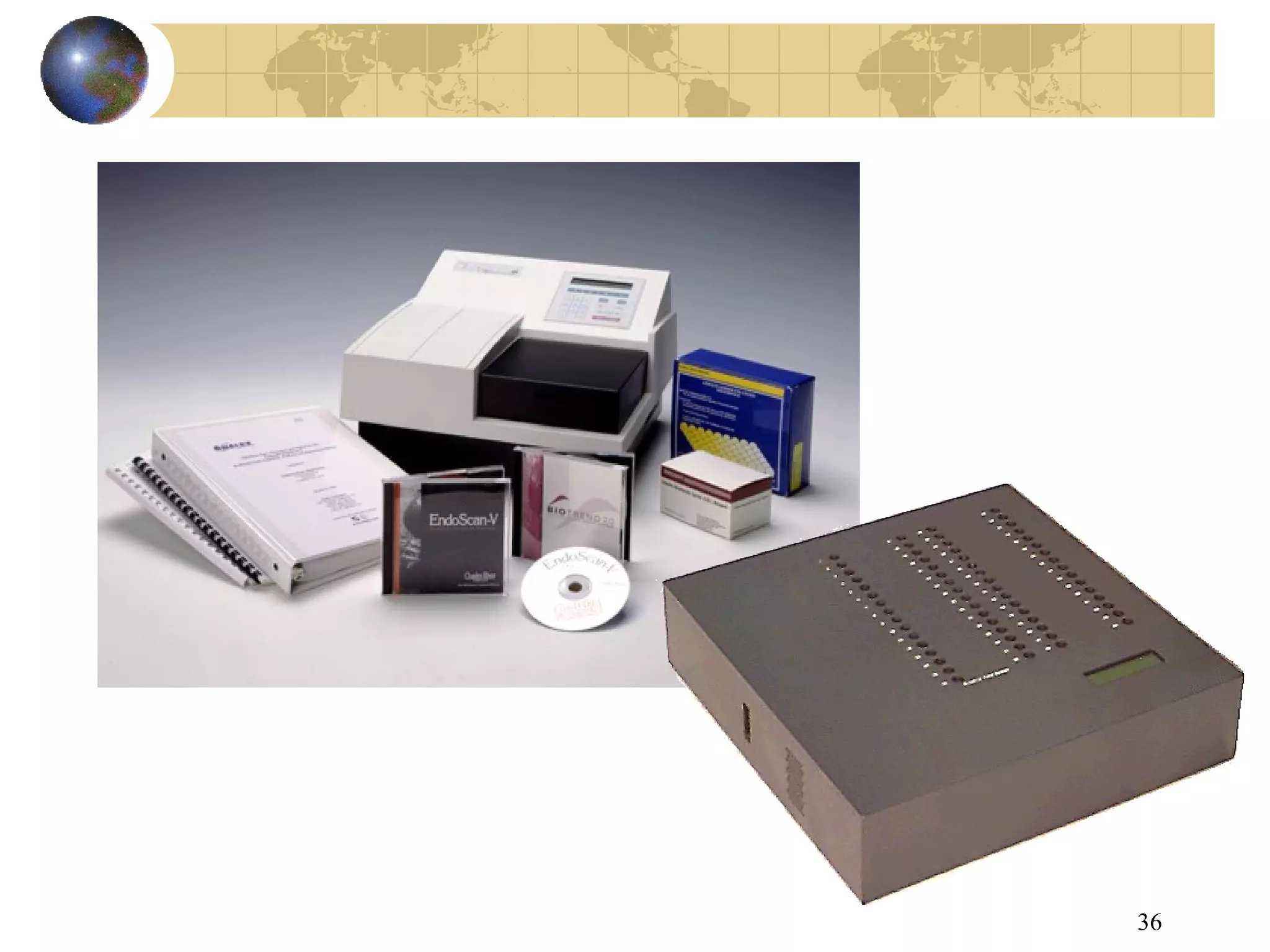
  • #38 … Introducing the Sunrise, Tecan&amp;apos;s new generation of absorbance readers for 96-well microplates.
  • #39 The Kinetic LAL advantages are the following. Kinetic methods are quantitative methods. We can get how much endotoxin exists in a given sample. It gives real value not more or less than values. It can also provide high throughput because we use 96 wells or multi tubes. We can also test down to 0.001EU/ml. And we can test samples that have varied endotoxin level at a time. Normally 2 to 3 log standard range can be used. It generates a clear concise reporting using automatic software. Another advantage is that we can trend the data, which can give us better in-process control.
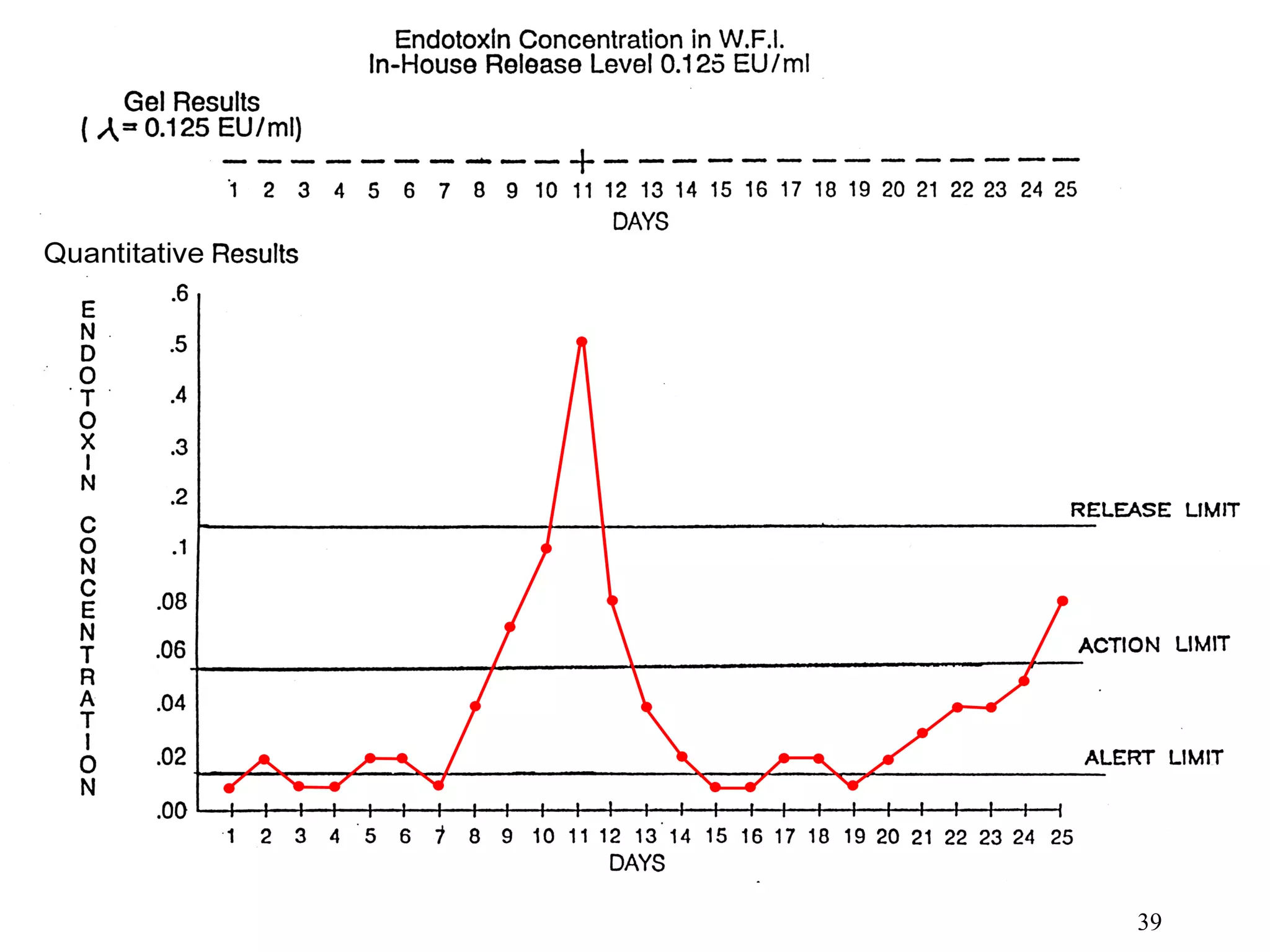
  • #40 This show the example of trend analysis for both of gel and kinetic. By the kinetic method we can predict the increase of endotoxin level from day of eight. So that we may have the opportunity to fix the problem. However by gel clot, we only realize the problem exists at the day of eleven, without an opportunity to fix the problem.
  • #41 Kinetic LAL system has several functions. Kinetic LAL system measures changes on optical density. In other words, how fast the optical density change and relates this change or speed in OD to endotoxin concentration. Software calculates these figures automatically. Reporting includes results and analysis that has been generated by the software.
  • #49 This slide shows how to quantify the amount of endotoxin in a given sample. A standard curve is generated by plotting the log of onset time versus the log of endotoxin concentration. The onset time of unknown is correlated to the curve and then endotoxin value is calculated on the curve.
  • #50 The more endotoxin that is present, the quicker the well or tube will react. So the amount of endotoxin present is inversely proportional to the time of reaction. A standard curve is generated based on how long each of the standards takes to reach an onset OD. Unknown samples are then compared to the standard curve to generate a endotoxin value.