The document elaborates on the International Conference on Harmonization (ICH), which aims to harmonize technical requirements for pharmaceutical registration globally to enhance the safety, efficacy, and quality of medicines. It discusses the structure of ICH, including key regulatory bodies from Europe, Japan, and the USA, as well as the categories of guidelines that have been developed, such as quality, safety, and efficacy topics. Additionally, it outlines the importance of stability testing for drug substances and products, including revised storage conditions and commitment to ongoing stability studies.

Surendra Negi introduces the ICH's aim to harmonize drug registration and ensure quality across regions.
The ICH comprises regulators and industry leaders from EU, Japan, and USA, focusing on quality, safety, efficacy, and multidisciplinary topics.
Importance of stability testing is discussed, including protocol elements and understanding drug storage conditions. Revisions to ICH Q1A guidelines for drug stability and testing, emphasizing conditions, evaluation criteria, and labeling.
References used in the presentation include a text on pharmaceutical technology and ICH official website.
WHAT DOES ICHSTANDS FOR ?
The complete name of ICH is the ‘’ INTERNATIONAL CONFERENCE ON
HARMONIZAT ION ‘’ of technical requirements for registration of
pharmaceuticals for human use.
BIRTH OF ICH
The birth of ICH took at a meeting in April 1990 hosted by the EFPIA in Brussels.
The meeting held by representatives of regulatory agencies and industry
associations of Europe ,Japan and USA .Topic selected for harmonization would
divided into safety, Quality and Efficacy which are basis for approving and
authorizing new drug product.
4.
PURPOSE OF ICH
•The objective of ICH is to increase international
harmonization of technical requirements to ensure that safe,
effective & high quality medicines are developed and
registered in the most efficient & cost- effective manner.
• To eliminates of duplication in the development and
registration process i.e, eliminate the duplications of clinical
trials, evaluations of safety, quality ,efficacy and other
technical requirements.
5.
Goal OF ICH
•To promote international harmonisation by
bringing together the representatives from the
three region(EU, Japan, USA) to established a
common guidelines.
• TO make the information available on ICH,ICH
activities and guidelines to any country or
company that request the information and
facilitate harmonization processes related to
ICH guidelines regionally and globally.
6.
STRUCTURE OF ICH
•Itis a joint initiative involving both regulators bodies & research-
based industry as equal partners .
•The parties involved from the European Union, Japan & the USA are-
1. European Commission ( EC )
2. European Federation of Pharmaceutical Industries & Association (
EFPIA )
3. Ministry of Health, labour & Welfare ( MHLW ),Japan
4. Japan Pharmaceutical Manufacturers Association ( JPMA ).
5. US Food & Drug Administration ( FDA ).
6. Pharmaceutical research & manufacturers of America. ( PhRMA ).
7.
• Three observerswhich represent non-ICH
countries and regions are:
1. World Health Organization (WHO).
2. European Free Trade Area ( EFTA ).
3. Canada.
8.
• ICH hasdeveloped over 45 harmonized guidelines which are divided into 4
major categories
1.QUALITY topics 2. SAFETY TOPICS
3. EFFICACY TOPICS 4.MULTIDISCIPLINARY TOPICS
1. Q
QUALITY topics
Q1A : Stability Testing of New Drug substances &Drug Product.
Q1B : Photostability Testing of New Drug Substances & Product.
Q1C : Stability Testing of New Drug Forms.
Q2 : Analytical Validation.
Q3A : Impurities in New Drug Substances.
Q3B : Impurities in New Drug Products.
Q4 : pharmacopoeias
Q5 : Stability Testing of BiotechnologicalBiological Product.
Q6: Specifications
Q7: Good manufacturing practice
Q8: Pharmaceutical Development
Q9: Quality Risk Management
Q10: Pharmaceutical Quality system
9.
2. ‘S’
SAFETY TOPICS– related to in vivo & in vitro pre
clinical studies. eg.
S1- Carcinogenicity testing.
S2- Genotoxicity testing.
3. ‘E’
EFFICACY TOPICS- related to clinical studies in human
subject. eg.
E4- Dose response studies.
E5- Carcinogenicity testing.
E6- Good clinical practices. (GCP).
10.
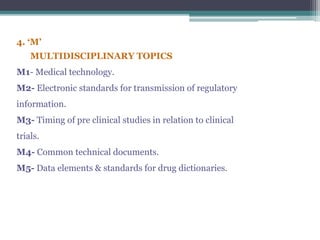
4. ‘M’
MULTIDISCIPLINARY TOPICS
M1-Medical technology.
M2- Electronic standards for transmission of regulatory
information.
M3- Timing of pre clinical studies in relation to clinical
trials.
M4- Common technical documents.
M5- Data elements & standards for drug dictionaries.
11.
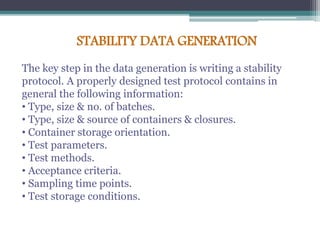
STABILITY DATA GENERATION
Thekey step in the data generation is writing a stability
protocol. A properly designed test protocol contains in
general the following information:
• Type, size & no. of batches.
• Type, size & source of containers & closures.
• Container storage orientation.
• Test parameters.
• Test methods.
• Acceptance criteria.
• Sampling time points.
• Test storage conditions.
12.
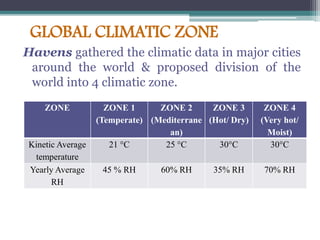
GLOBAL CLIMATIC ZONE
Havensgathered the climatic data in major cities
around the world & proposed division of the
world into 4 climatic zone.
ZONE ZONE 1
(Temperate)
ZONE 2
(Mediterrane
an)
ZONE 3
(Hot/ Dry)
ZONE 4
(Very hot/
Moist)
Kinetic Average
temperature
21 °C 25 °C 30°C 30°C
Yearly Average
RH
45 % RH 60% RH 35% RH 70% RH
13.
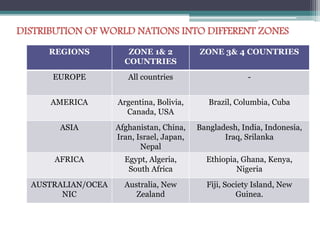
REGIONS ZONE 1&2
COUNTRIES
ZONE 3& 4 COUNTRIES
EUROPE All countries -
AMERICA Argentina, Bolivia,
Canada, USA
Brazil, Columbia, Cuba
ASIA Afghanistan, China,
Iran, Israel, Japan,
Nepal
Bangladesh, India, Indonesia,
Iraq, Srilanka
AFRICA Egypt, Algeria,
South Africa
Ethiopia, Ghana, Kenya,
Nigeria
AUSTRALIAN/OCEA
NIC
Australia, New
Zealand
Fiji, Society Island, New
Guinea.
DISTRIBUTION OF WORLD NATIONS INTO DIFFERENT ZONES
OBJECTIVES OF AGUIDELINE
• This guideline is a revised of the ICHQ1A –stability data
package for new drug substance /DRUG PRODUCT .
•To define stability data package that sufficient for a
registration application within the 3 regions of EU
,JAPAN & USA
•To maintain the quality of drug products, in relation to
safety , efficacy & acceptability throughout the propose
shelf life.
16.
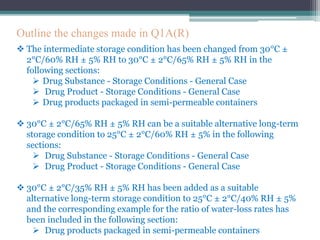
Outline the changesmade in Q1A(R)
The intermediate storage condition has been changed from 30°C ±
2°C/60% RH ± 5% RH to 30°C ± 2°C/65% RH ± 5% RH in the
following sections:
Drug Substance - Storage Conditions - General Case
Drug Product - Storage Conditions - General Case
Drug products packaged in semi-permeable containers
30°C ± 2°C/65% RH ± 5% RH can be a suitable alternative long-term
storage condition to 25°C ± 2°C/60% RH ± 5% in the following
sections:
Drug Substance - Storage Conditions - General Case
Drug Product - Storage Conditions - General Case
30°C ± 2°C/35% RH ± 5% RH has been added as a suitable
alternative long-term storage condition to 25°C ± 2°C/40% RH ± 5%
and the corresponding example for the ratio of water-loss rates has
been included in the following section:
Drug products packaged in semi-permeable containers
17.
GENERAL PRINCIPLES
The purposeof stability testing are:
• To provide evidence on how the quality of a drug
substance or drug product varies with time under the
influence of a variety of environmental factors such as
temperature, humidity & light.
• To estimate the self life of the drug product and its
degradation pathway.
• To recommend storage conditions.
• To established a re-test period of the drug
substance/product for stability testing
• To fulfill the relevant legal requirements concerned with
the purity, safety & efficacy of the drugs.
• To prevent the economical consequences of marketing the
unstable products.
18.
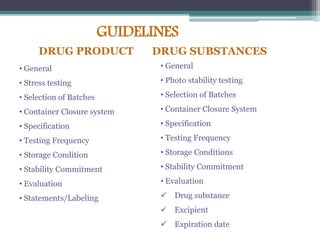
GUIDELINES
DRUG PRODUCT DRUGSUBSTANCES
• General
• Stress testing
• Selection of Batches
• Container Closure system
• Specification
• Testing Frequency
• Storage Condition
• Stability Commitment
• Evaluation
• Statements/Labeling
• General
• Photo stability testing
• Selection of Batches
• Container Closure System
• Specification
• Testing Frequency
• Storage Conditions
• Stability Commitment
• Evaluation
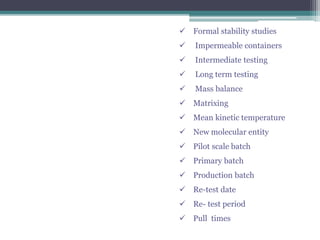
Drug substance
Excipient
Expiration date
19.
Formal stabilitystudies
Impermeable containers
Intermediate testing
Long term testing
Mass balance
Matrixing
Mean kinetic temperature
New molecular entity
Pilot scale batch
Primary batch
Production batch
Re-test date
Re- test period
Pull times
20.
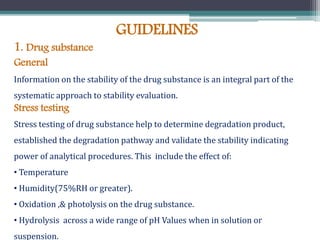
GUIDELINES
1. Drug substance
General
Informationon the stability of the drug substance is an integral part of the
systematic approach to stability evaluation.
Stress testing
Stress testing of drug substance help to determine degradation product,
established the degradation pathway and validate the stability indicating
power of analytical procedures. This include the effect of:
• Temperature
• Humidity(75%RH or greater).
• Oxidation ,& photolysis on the drug substance.
• Hydrolysis across a wide range of pH Values when in solution or
suspension.
21.
.
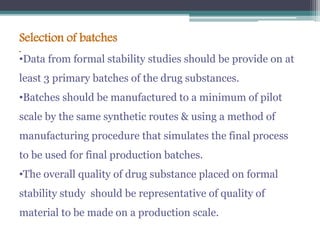
Selection of batches
•Datafrom formal stability studies should be provide on at
least 3 primary batches of the drug substances.
•Batches should be manufactured to a minimum of pilot
scale by the same synthetic routes & using a method of
manufacturing procedure that simulates the final process
to be used for final production batches.
•The overall quality of drug substance placed on formal
stability study should be representative of quality of
material to be made on a production scale.
22.
Container closure system
Thestability studies should be conducted on the drug substance packaged in a
container closure system that is the same as or simulates the packaging
proposed for storage and distribution.
Specification
•It’s a list of test ,reference to analytical procedures , and proposed acceptance
criteria ,is addressed in ICH Q6A &Q6B .in addition, specification for degradation
products in a drug substance is discussed in Q3A.
•Stability study should cover the attributes which likely to change during
storage and influence the quality, safety and efficacy of drug products i.e,
physical, chemical, biological and microbiological attributes.
23.
Testing frequency
•For drugsubstances with a proposed re-test period of at least
12 months, the frequency of testing at the long term storage
condition is 3 months over the first year, every 6 months over
the second year ,and annually thereafter through the proposed
retest period.
•At accelerated storage condition , a minimum three time points
0, 3, 6 months the testing should performed.
•For intermediate study minimum four time points 0, 6, 9 &12
months ,from 12 month study is recommended.
24.
Storage conditions
• Ingeneral ,a drug substance should be evaluated
under storage conditions with appropriate
tolerance that test it’s thermal stability and
sensitivity to moisture.
• The storage conditions & the length of studies
chosen should be sufficient to cover storage,
shipment & subsequent use.
25.
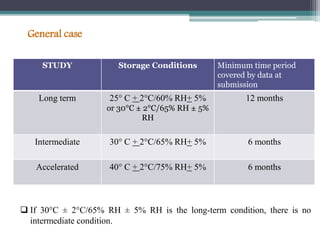
General case
STUDY StorageConditions Minimum time period
covered by data at
submission
Long term 25° C + 2°C/60% RH+ 5%
or 30°C ± 2°C/65% RH ± 5%
RH
12 months
Intermediate 30° C + 2°C/65% RH+ 5% 6 months
Accelerated 40° C + 2°C/75% RH+ 5% 6 months
If 30°C ± 2°C/65% RH ± 5% RH is the long-term condition, there is no
intermediate condition.
26.
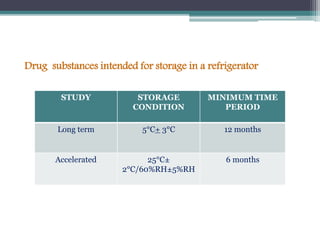
Drug substances intendedfor storage in a refrigerator
STUDY STORAGE
CONDITION
MINIMUM TIME
PERIOD
Long term 5°C+ 3°C 12 months
Accelerated 25°C±
2°C/60%RH±5%RH
6 months
27.
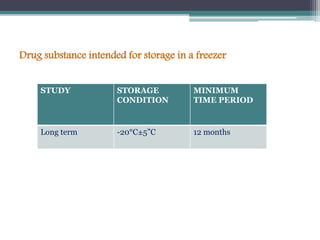
Drug substance intendedfor storage in a freezer
STUDY STORAGE
CONDITION
MINIMUM
TIME PERIOD
Long term -20°C±5”C 12 months
28.
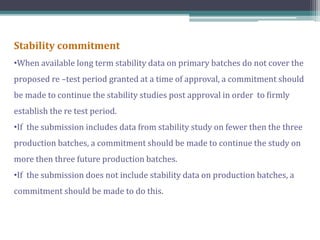
Stability commitment
•When availablelong term stability data on primary batches do not cover the
proposed re –test period granted at a time of approval, a commitment should
be made to continue the stability studies post approval in order to firmly
establish the re test period.
•If the submission includes data from stability study on fewer then the three
production batches, a commitment should be made to continue the study on
more then three future production batches.
•If the submission does not include stability data on production batches, a
commitment should be made to do this.
29.
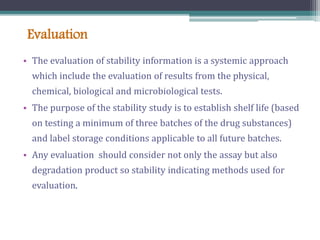
Evaluation
• The evaluationof stability information is a systemic approach
which include the evaluation of results from the physical,
chemical, biological and microbiological tests.
• The purpose of the stability study is to establish shelf life (based
on testing a minimum of three batches of the drug substances)
and label storage conditions applicable to all future batches.
• Any evaluation should consider not only the assay but also
degradation product so stability indicating methods used for
evaluation.
30.
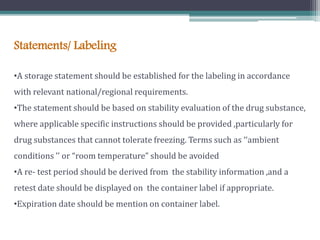
Statements/ Labeling
•A storagestatement should be established for the labeling in accordance
with relevant national/regional requirements.
•The statement should be based on stability evaluation of the drug substance,
where applicable specific instructions should be provided ,particularly for
drug substances that cannot tolerate freezing. Terms such as ‘‘ambient
conditions ’’ or “room temperature” should be avoided
•A re- test period should be derived from the stability information ,and a
retest date should be displayed on the container label if appropriate.
•Expiration date should be mention on container label.
31.
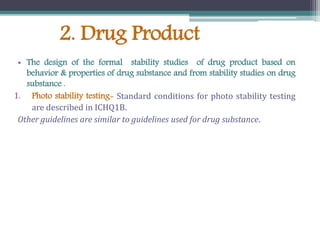
2. Drug Product
•The design of the formal stability studies of drug product based on
behavior & properties of drug substance and from stability studies on drug
substance .
1. Photo stability testing- Standard conditions for photo stability testing
are described in ICHQ1B.
Other guidelines are similar to guidelines used for drug substance.