Accelerated Stability Studies
1
Prepared By : Urmil Chavda (23MPT015)
M.Pharm Semester-I
Departmentof Pharmaceutics
Institute of Pharmacy, Nirma University
Under the Guidance of Dr. Tejal Mehta
Head of Department of Pharmaceutics
Institute of Pharmacy, Nirma University
22-09-2023
• Table of Contents
2
1. Introduction to stability
2. Impact of instability
3. Reasons for Stability Testing
4. Types of Stability studies as per ICH
5. Why do we need to perform Accelerated Stability
studies
6. Accelerated Stability Testing
7. Arrhenius equation
8. How to Carry out Accelerated Stability studies
9. Steps involved in Prediction of Shelf life
10. Stability Profiles : Accelerated stability
studies
11. Advantages
12. Limitations
13. Overages
14. Types of Overages
15. References
22-09-2023
• Introduction to stability
3
 Stability - The capability of a formulation in a specific container closure system to remain intact
within its physical, chemical, microbiological, therapeutic and toxicological specifications
throughout its shelf life.
OR
 A measure of how a pharmaceutical product maintains its quality attributes over time.
Used for
 Establishing shelf life of the drug
 To provide evidence as to how the quality of the drug product varies with time
 To determine container closure system suitability and recommended storage conditions
22-09-2023
• Impact of instability
22-09-2023
4
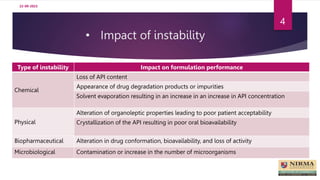
Type of instability Impact on formulation performance
Chemical
Loss of API content
Appearance of drug degradation products or impurities
Solvent evaporation resulting in an increase in an increase in API concentration
Physical
Alteration of organoleptic properties leading to poor patient acceptability
Crystallization of the API resulting in poor oral bioavailability
Biopharmaceutical Alteration in drug conformation, bioavailability, and loss of activity
Microbiological Contamination or increase in the number of microorganisms
• Reasons for stability testing
22-09-2023
5
• Safety of the patient
• Activity of the product
• To determine shelf life and best container system for drug
formulation
• Requirements of regulatory agencies
• To protect the reputation of producer
• To provide a database that may be of value in formulation of other products
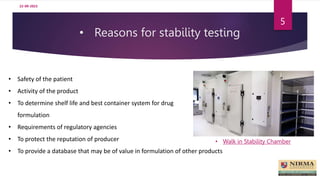
• Walk in Stability Chamber
22-09-2023
6
• Stability studies should include testing of those attributes of the drug substances, that are
susceptible to change during the storage and are likely to influence quality, safety and
efficacy of formulations. The Testing should cover, as appropriate, the physical, chemical,
pharmacological and microbiological stabilities.
• Shelf Life :- Time required for the concentration of the reactant to reduce 90% of its
initial concentration.
• Types of Stability Studies as per ICH
22-09-2023
7
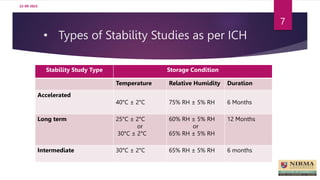
Stability Study Type Storage Condition
Temperature Relative Humidity Duration
Accelerated
40°C ± 2°C 75% RH ± 5% RH 6 Months
Long term 25°C ± 2°C
or
30°C ± 2°C
60% RH ± 5% RH
or
65% RH ± 5% RH
12 Months
Intermediate 30°C ± 2°C 65% RH ± 5% RH 6 months
• Why do we need to perform accelerated
stability testing
22-09-2023
8
• The stability of Pharmaceutical preparations should be evaluated by exposing the product to
normal shelf conditions for a year of extended periods and also the rate of decomposition is
slow at room temperature i.e. such method is time consuming and uneconomical.
• Therefore we use Accelerated stability testing in which the drug or chemicals are placed in stress
full conditions like higher temperature, elevated pH, higher light intensities, which induces the
drug degradation and there after the drug stability is evaluated by correlating the evaluated
drug stability at lower or normal conditions
• Accelerated Stability Studies
22-09-2023
9
According to FDA
• "Studies designed to increase the rate of Physical and Chemical degradation of a drug substance
or drug product by using exaggerated storage conditions".
• Temperature is the main factor which affect drug stability. The most satisfactory method for
expressing the influence of temperature on reaction velocity is Arrhenius method.
• Arrhenius equation is used for accelerated stability studies of any compound
• Explains the effect of temperature on rate of a reaction
• For every 10°C rise in temperature, the speed of the reaction increases about
2-3 times.
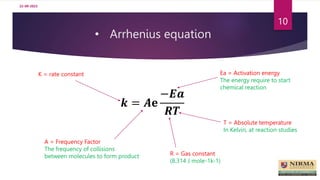
• Arrhenius equation
22-09-2023
10
𝒌 = 𝑨ⅇ
−𝑬𝒂
𝑹𝑻
K = rate constant Ea = Activation energy
The energy require to start
chemical reaction
T = Absolute temperature
In Kelvin, at reaction studies
R = Gas constant
(8.314 J mole-1k-1)
A = Frequency Factor
The frequency of collisions
between molecules to form product
• How to carry out Accelerated Stability
Studies
22-09-2023
11
• It is carried out in basic three steps
1. Product or formulation or any chemical is kept at elevated stress conditions, i.e. elevated
temperature, pH, Light Conditions, humidity etc.
2. Sample withdrawn at regular fixed time intervals for evaluation of recommended parameters.
3. Prediction of shelf life, and establishment of relation between storage conditions
and rate of degradation of product or formulation.
• Steps involved in prediction of shelf life
22-09-2023
12
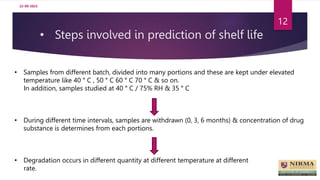
• Samples from different batch, divided into many portions and these are kept under elevated
temperature like 40 ° C , 50 ° C 60 ° C 70 ° C & so on.
In addition, samples studied at 40 ° C / 75% RH & 35 ° C
• During different time intervals, samples are withdrawn (0, 3, 6 months) & concentration of drug
substance is determines from each portions.
• Degradation occurs in different quantity at different temperature at different
rate.
22-09-2023
13
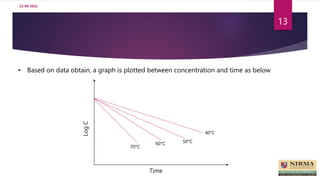
• Based on data obtain, a graph is plotted between concentration and time as below
40°C
60°C 50°C
70°C
Log
C
Time
22-09-2023
14
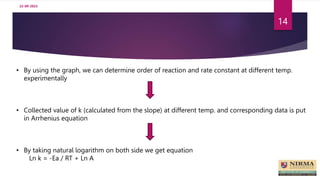
• By using the graph, we can determine order of reaction and rate constant at different temp.
experimentally
• Collected value of k (calculated from the slope) at different temp. and corresponding data is put
in Arrhenius equation
• By taking natural logarithm on both side we get equation
Ln k = -Ea / RT + Ln A
22-09-2023
15
• Converting into Log10
Log k = -Ea/2.303 RT + Log A
Y = m x + c
• A graph is plotted between Log k and its corresponding
reciprocal of temp (1/T).
• The plot is extrapolated to room temperature, 25 ° C to determine k value.
• This k value is substituted into shelf life equation [t90 = 0.105/k ] to determine
shelf life of product.
• Stability Profiles : Accelerated Stability
Study
22-09-2023
16
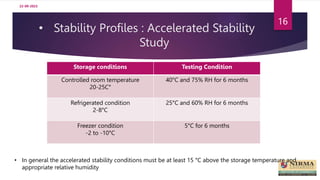
Storage conditions Testing Condition
Controlled room temperature
20-25C°
40°C and 75% RH for 6 months
Refrigerated condition
2-8°C
25°C and 60% RH for 6 months
Freezer condition
-2 to -10°C
5°C for 6 months
• In general the accelerated stability conditions must be at least 15 °C above the storage temperature and
appropriate relative humidity
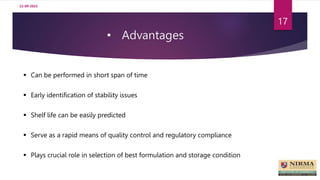
• Advantages
22-09-2023
17
 Can be performed in short span of time
 Early identification of stability issues
 Shelf life can be easily predicted
 Serve as a rapid means of quality control and regulatory compliance
 Plays crucial role in selection of best formulation and storage condition
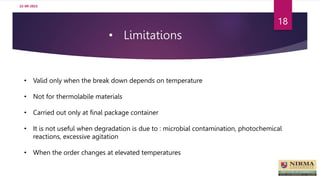
• Limitations
22-09-2023
18
• Valid only when the break down depends on temperature
• Not for thermolabile materials
• Carried out only at final package container
• It is not useful when degradation is due to : microbial contamination, photochemical
reactions, excessive agitation
• When the order changes at elevated temperatures
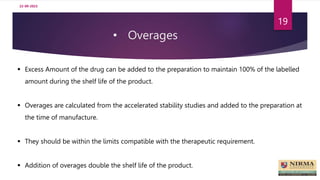
• Overages
22-09-2023
19
 Excess Amount of the drug can be added to the preparation to maintain 100% of the labelled
amount during the shelf life of the product.
 Overages are calculated from the accelerated stability studies and added to the preparation at
the time of manufacture.
 They should be within the limits compatible with the therapeutic requirement.
 Addition of overages double the shelf life of the product.
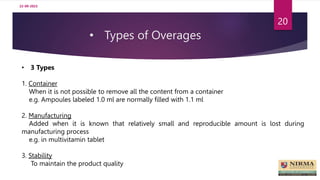
• Types of Overages
22-09-2023
20
• 3 Types
1. Container
When it is not possible to remove all the content from a container
e.g. Ampoules labeled 1.0 ml are normally filled with 1.1 ml
2. Manufacturing
Added when it is known that relatively small and reproducible amount is lost during
manufacturing process
e.g. in multivitamin tablet
3. Stability
To maintain the product quality
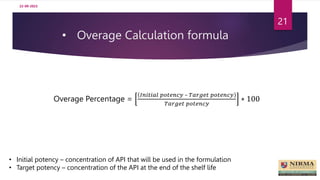
• Overage Calculation formula
22-09-2023
21
Overage Percentage =
𝐼𝑛𝑖𝑡𝑖𝑎𝑙 𝑝𝑜𝑡𝑒𝑛𝑐𝑦 – 𝑇𝑎𝑟𝑔𝑒𝑡 𝑝𝑜𝑡𝑒𝑛𝑐𝑦
𝑇𝑎𝑟𝑔𝑒𝑡 𝑝𝑜𝑡𝑒𝑛𝑐𝑦
∗ 100
• Initial potency – concentration of API that will be used in the formulation
• Target potency – concentration of the API at the end of the shelf life
 REFERENCES
22-09-2023
22
1. ICH Quality Guidelines - Q1A(R2) – referred on 16-09-2023
2. Drug Stability : Principles and Practices, J.T. Carstensen, C.T. Rhodes. New York Marcel Dekker Publication [3rd
edition]
3. “Pharmaceutics the science of dosage form design”, “Kinetics and stability testing, Aulton M.E London
Churchill Livingstone Publication [2nd edition]
4. Pharmaceutical dosage forms tablets, Herbert A. Lieberman, Leon Lachman, Joseph B. Schwartz. New
York Marcel Dekker Publication - Volume 3 [2nd edition]
5. Drug Stability : ICH versus Accelerated Predictive Stability Studies by Olga Gonzalez-Gonzalez
https://www.ncbi.nlm.nih.gov/pmc/articles/PMC9693625/
THANK YOU…….
22-09-2023
23

Accelerated Stability Studies.pptx

  • 1.
    Accelerated Stability Studies 1 PreparedBy : Urmil Chavda (23MPT015) M.Pharm Semester-I Departmentof Pharmaceutics Institute of Pharmacy, Nirma University Under the Guidance of Dr. Tejal Mehta Head of Department of Pharmaceutics Institute of Pharmacy, Nirma University 22-09-2023
  • 2.
    • Table ofContents 2 1. Introduction to stability 2. Impact of instability 3. Reasons for Stability Testing 4. Types of Stability studies as per ICH 5. Why do we need to perform Accelerated Stability studies 6. Accelerated Stability Testing 7. Arrhenius equation 8. How to Carry out Accelerated Stability studies 9. Steps involved in Prediction of Shelf life 10. Stability Profiles : Accelerated stability studies 11. Advantages 12. Limitations 13. Overages 14. Types of Overages 15. References 22-09-2023
  • 3.
    • Introduction tostability 3  Stability - The capability of a formulation in a specific container closure system to remain intact within its physical, chemical, microbiological, therapeutic and toxicological specifications throughout its shelf life. OR  A measure of how a pharmaceutical product maintains its quality attributes over time. Used for  Establishing shelf life of the drug  To provide evidence as to how the quality of the drug product varies with time  To determine container closure system suitability and recommended storage conditions 22-09-2023
  • 4.
    • Impact ofinstability 22-09-2023 4 Type of instability Impact on formulation performance Chemical Loss of API content Appearance of drug degradation products or impurities Solvent evaporation resulting in an increase in an increase in API concentration Physical Alteration of organoleptic properties leading to poor patient acceptability Crystallization of the API resulting in poor oral bioavailability Biopharmaceutical Alteration in drug conformation, bioavailability, and loss of activity Microbiological Contamination or increase in the number of microorganisms
  • 5.
    • Reasons forstability testing 22-09-2023 5 • Safety of the patient • Activity of the product • To determine shelf life and best container system for drug formulation • Requirements of regulatory agencies • To protect the reputation of producer • To provide a database that may be of value in formulation of other products • Walk in Stability Chamber
  • 6.
    22-09-2023 6 • Stability studiesshould include testing of those attributes of the drug substances, that are susceptible to change during the storage and are likely to influence quality, safety and efficacy of formulations. The Testing should cover, as appropriate, the physical, chemical, pharmacological and microbiological stabilities. • Shelf Life :- Time required for the concentration of the reactant to reduce 90% of its initial concentration.
  • 7.
    • Types ofStability Studies as per ICH 22-09-2023 7 Stability Study Type Storage Condition Temperature Relative Humidity Duration Accelerated 40°C ± 2°C 75% RH ± 5% RH 6 Months Long term 25°C ± 2°C or 30°C ± 2°C 60% RH ± 5% RH or 65% RH ± 5% RH 12 Months Intermediate 30°C ± 2°C 65% RH ± 5% RH 6 months
  • 8.
    • Why dowe need to perform accelerated stability testing 22-09-2023 8 • The stability of Pharmaceutical preparations should be evaluated by exposing the product to normal shelf conditions for a year of extended periods and also the rate of decomposition is slow at room temperature i.e. such method is time consuming and uneconomical. • Therefore we use Accelerated stability testing in which the drug or chemicals are placed in stress full conditions like higher temperature, elevated pH, higher light intensities, which induces the drug degradation and there after the drug stability is evaluated by correlating the evaluated drug stability at lower or normal conditions
  • 9.
    • Accelerated StabilityStudies 22-09-2023 9 According to FDA • "Studies designed to increase the rate of Physical and Chemical degradation of a drug substance or drug product by using exaggerated storage conditions". • Temperature is the main factor which affect drug stability. The most satisfactory method for expressing the influence of temperature on reaction velocity is Arrhenius method. • Arrhenius equation is used for accelerated stability studies of any compound • Explains the effect of temperature on rate of a reaction • For every 10°C rise in temperature, the speed of the reaction increases about 2-3 times.
  • 10.
    • Arrhenius equation 22-09-2023 10 𝒌= 𝑨ⅇ −𝑬𝒂 𝑹𝑻 K = rate constant Ea = Activation energy The energy require to start chemical reaction T = Absolute temperature In Kelvin, at reaction studies R = Gas constant (8.314 J mole-1k-1) A = Frequency Factor The frequency of collisions between molecules to form product
  • 11.
    • How tocarry out Accelerated Stability Studies 22-09-2023 11 • It is carried out in basic three steps 1. Product or formulation or any chemical is kept at elevated stress conditions, i.e. elevated temperature, pH, Light Conditions, humidity etc. 2. Sample withdrawn at regular fixed time intervals for evaluation of recommended parameters. 3. Prediction of shelf life, and establishment of relation between storage conditions and rate of degradation of product or formulation.
  • 12.
    • Steps involvedin prediction of shelf life 22-09-2023 12 • Samples from different batch, divided into many portions and these are kept under elevated temperature like 40 ° C , 50 ° C 60 ° C 70 ° C & so on. In addition, samples studied at 40 ° C / 75% RH & 35 ° C • During different time intervals, samples are withdrawn (0, 3, 6 months) & concentration of drug substance is determines from each portions. • Degradation occurs in different quantity at different temperature at different rate.
  • 13.
    22-09-2023 13 • Based ondata obtain, a graph is plotted between concentration and time as below 40°C 60°C 50°C 70°C Log C Time
  • 14.
    22-09-2023 14 • By usingthe graph, we can determine order of reaction and rate constant at different temp. experimentally • Collected value of k (calculated from the slope) at different temp. and corresponding data is put in Arrhenius equation • By taking natural logarithm on both side we get equation Ln k = -Ea / RT + Ln A
  • 15.
    22-09-2023 15 • Converting intoLog10 Log k = -Ea/2.303 RT + Log A Y = m x + c • A graph is plotted between Log k and its corresponding reciprocal of temp (1/T). • The plot is extrapolated to room temperature, 25 ° C to determine k value. • This k value is substituted into shelf life equation [t90 = 0.105/k ] to determine shelf life of product.
  • 16.
    • Stability Profiles: Accelerated Stability Study 22-09-2023 16 Storage conditions Testing Condition Controlled room temperature 20-25C° 40°C and 75% RH for 6 months Refrigerated condition 2-8°C 25°C and 60% RH for 6 months Freezer condition -2 to -10°C 5°C for 6 months • In general the accelerated stability conditions must be at least 15 °C above the storage temperature and appropriate relative humidity
  • 17.
    • Advantages 22-09-2023 17  Canbe performed in short span of time  Early identification of stability issues  Shelf life can be easily predicted  Serve as a rapid means of quality control and regulatory compliance  Plays crucial role in selection of best formulation and storage condition
  • 18.
    • Limitations 22-09-2023 18 • Validonly when the break down depends on temperature • Not for thermolabile materials • Carried out only at final package container • It is not useful when degradation is due to : microbial contamination, photochemical reactions, excessive agitation • When the order changes at elevated temperatures
  • 19.
    • Overages 22-09-2023 19  ExcessAmount of the drug can be added to the preparation to maintain 100% of the labelled amount during the shelf life of the product.  Overages are calculated from the accelerated stability studies and added to the preparation at the time of manufacture.  They should be within the limits compatible with the therapeutic requirement.  Addition of overages double the shelf life of the product.
  • 20.
    • Types ofOverages 22-09-2023 20 • 3 Types 1. Container When it is not possible to remove all the content from a container e.g. Ampoules labeled 1.0 ml are normally filled with 1.1 ml 2. Manufacturing Added when it is known that relatively small and reproducible amount is lost during manufacturing process e.g. in multivitamin tablet 3. Stability To maintain the product quality
  • 21.
    • Overage Calculationformula 22-09-2023 21 Overage Percentage = 𝐼𝑛𝑖𝑡𝑖𝑎𝑙 𝑝𝑜𝑡𝑒𝑛𝑐𝑦 – 𝑇𝑎𝑟𝑔𝑒𝑡 𝑝𝑜𝑡𝑒𝑛𝑐𝑦 𝑇𝑎𝑟𝑔𝑒𝑡 𝑝𝑜𝑡𝑒𝑛𝑐𝑦 ∗ 100 • Initial potency – concentration of API that will be used in the formulation • Target potency – concentration of the API at the end of the shelf life
  • 22.
     REFERENCES 22-09-2023 22 1. ICHQuality Guidelines - Q1A(R2) – referred on 16-09-2023 2. Drug Stability : Principles and Practices, J.T. Carstensen, C.T. Rhodes. New York Marcel Dekker Publication [3rd edition] 3. “Pharmaceutics the science of dosage form design”, “Kinetics and stability testing, Aulton M.E London Churchill Livingstone Publication [2nd edition] 4. Pharmaceutical dosage forms tablets, Herbert A. Lieberman, Leon Lachman, Joseph B. Schwartz. New York Marcel Dekker Publication - Volume 3 [2nd edition] 5. Drug Stability : ICH versus Accelerated Predictive Stability Studies by Olga Gonzalez-Gonzalez https://www.ncbi.nlm.nih.gov/pmc/articles/PMC9693625/
  • 23.