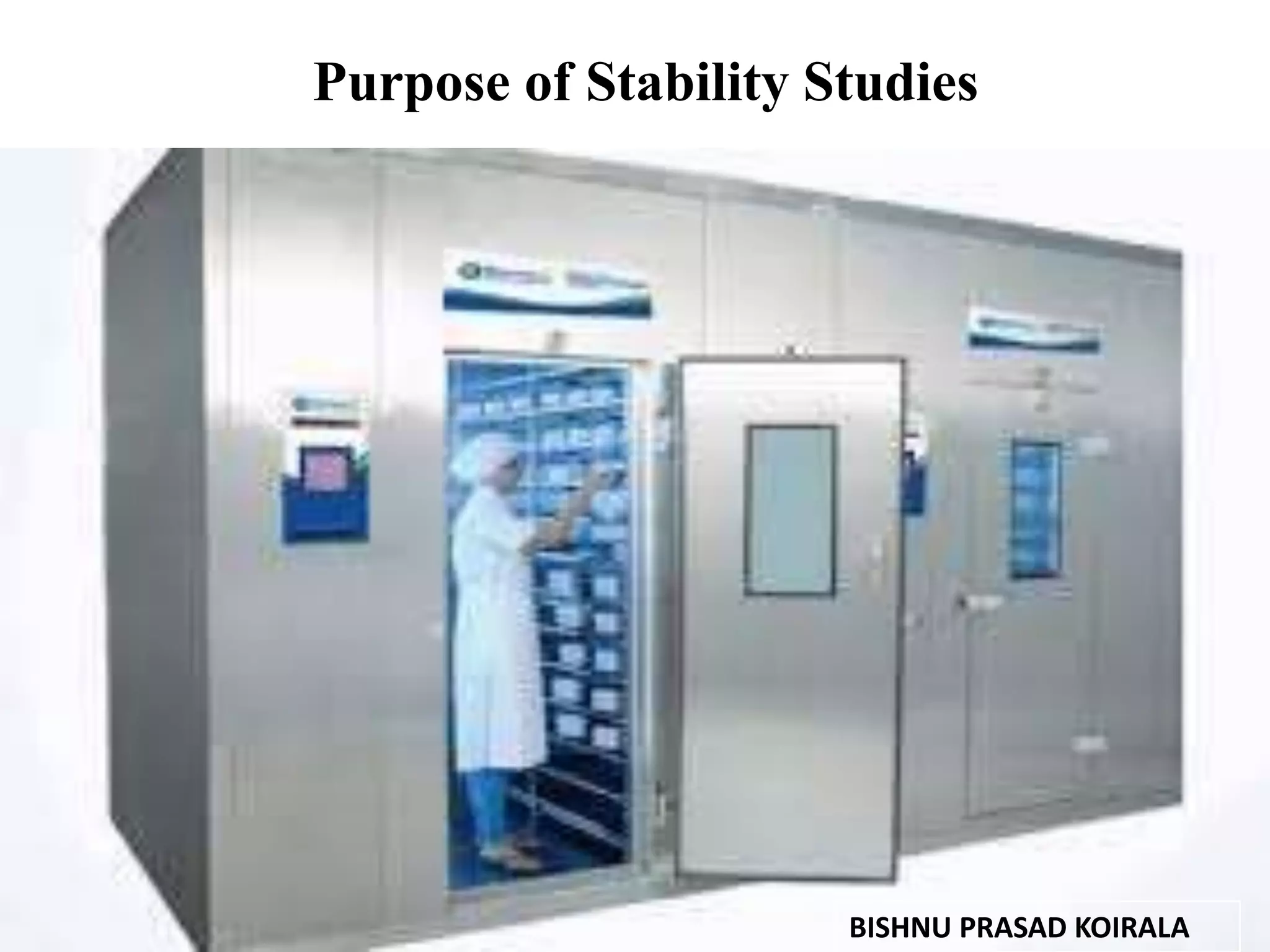
Purpose of Stability Studies
BISHNU PRASAD KOIRALABISHNU PRASAD KOIRALA
STABILITY
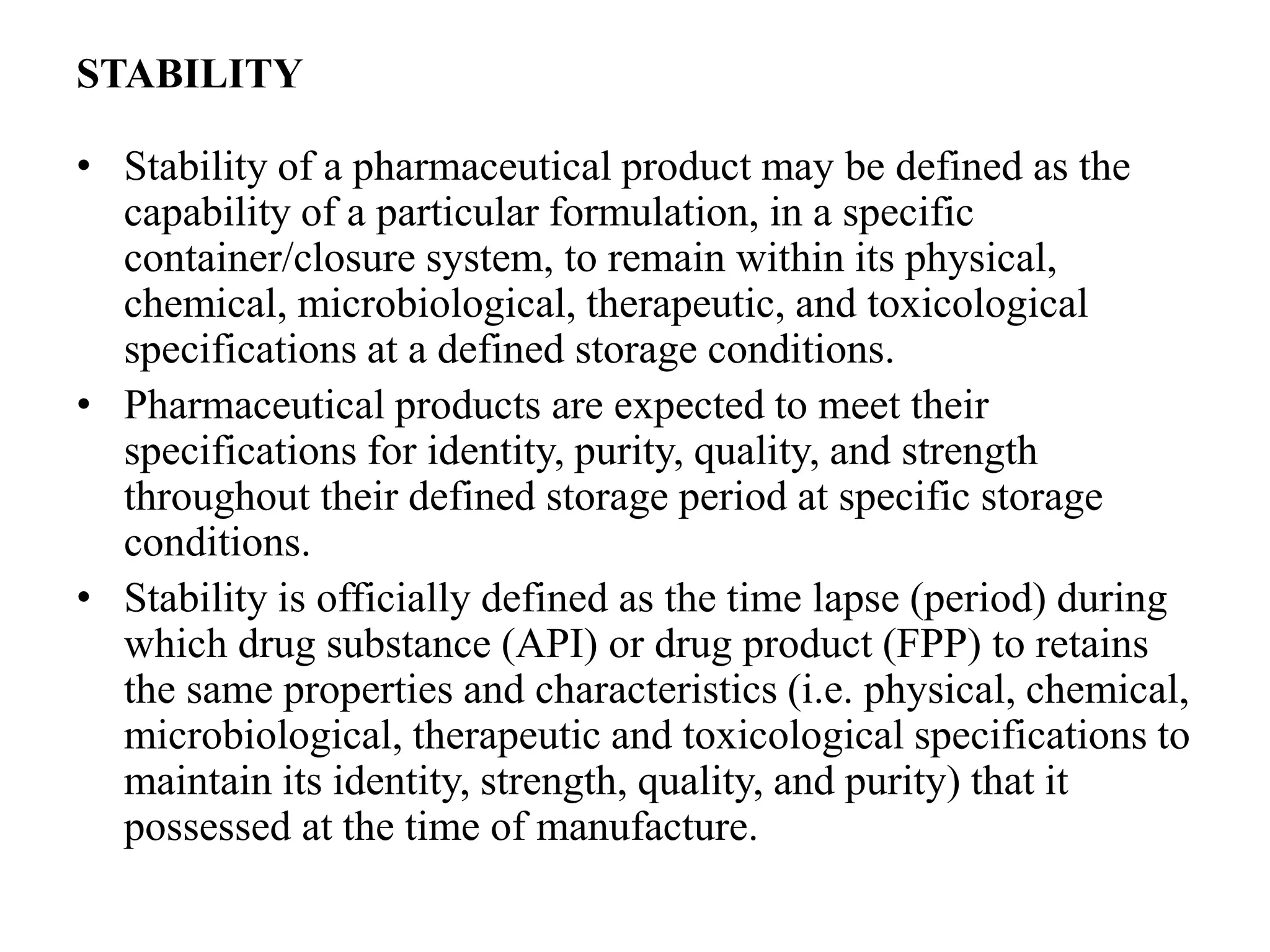
• Stability of a pharmaceutical product may be defined as the
capability of a particular formulation, in a specific
container/closure system, to remain within its physical,
chemical, microbiological, therapeutic, and toxicological
specifications at a defined storage conditions.
• Pharmaceutical products are expected to meet their
specifications for identity, purity, quality, and strength
throughout their defined storage period at specific storage
conditions.
• Stability is officially defined as the time lapse (period) during
which drug substance (API) or drug product (FPP) to retains
the same properties and characteristics (i.e. physical, chemical,
microbiological, therapeutic and toxicological specifications to
maintain its identity, strength, quality, and purity) that it
possessed at the time of manufacture.
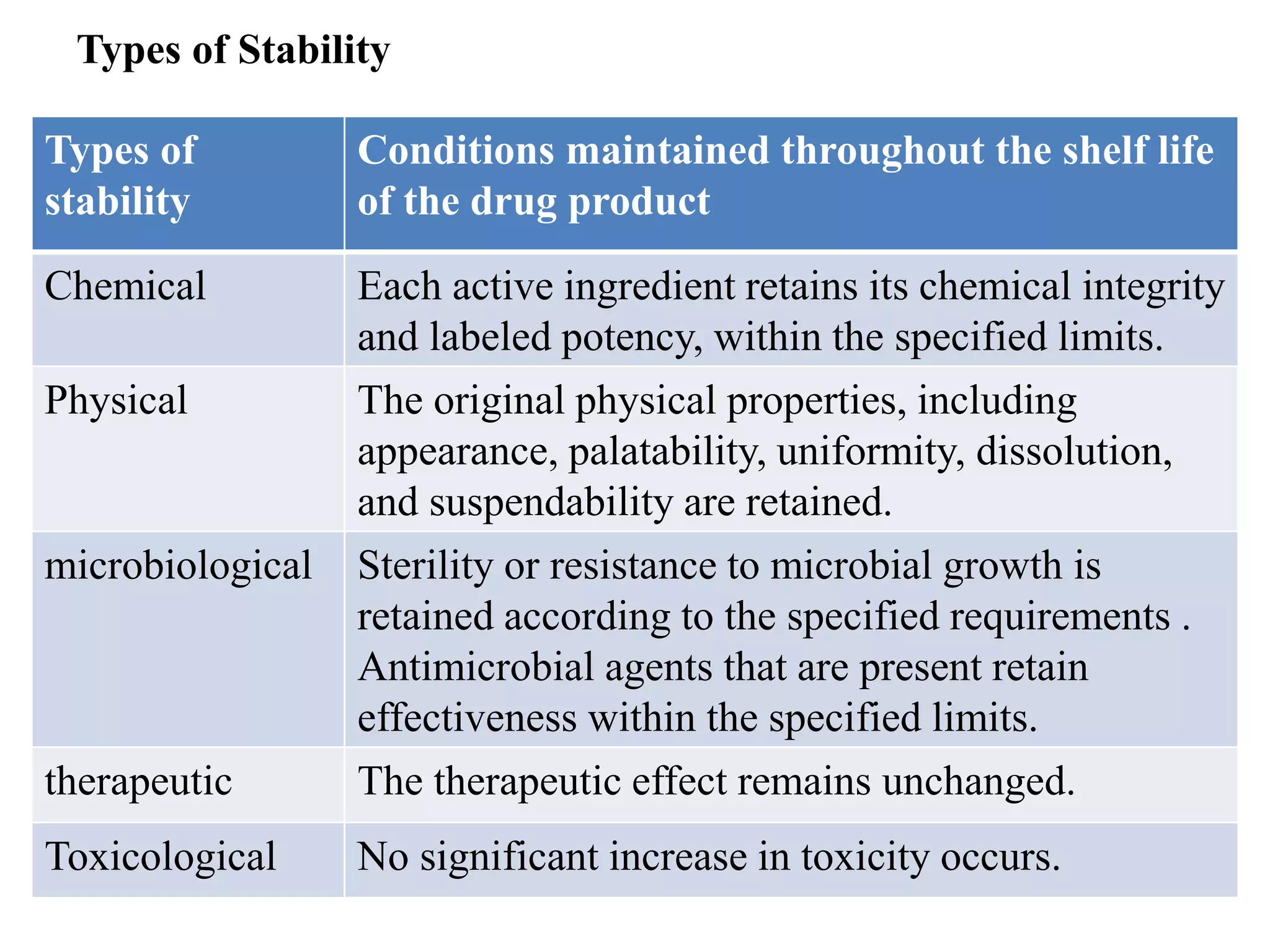
Types of Stability
Types of
stability
Conditions maintained throughout the shelf life
of the drug product
Chemical Each active ingredient retains its chemical integrity
and labeled potency, within the specified limits.
Physical The original physical properties, including
appearance, palatability, uniformity, dissolution,
and suspendability are retained.
microbiological Sterility or resistance to microbial growth is
retained according to the specified requirements .
Antimicrobial agents that are present retain
effectiveness within the specified limits.
therapeutic The therapeutic effect remains unchanged.
Toxicological No significant increase in toxicity occurs.
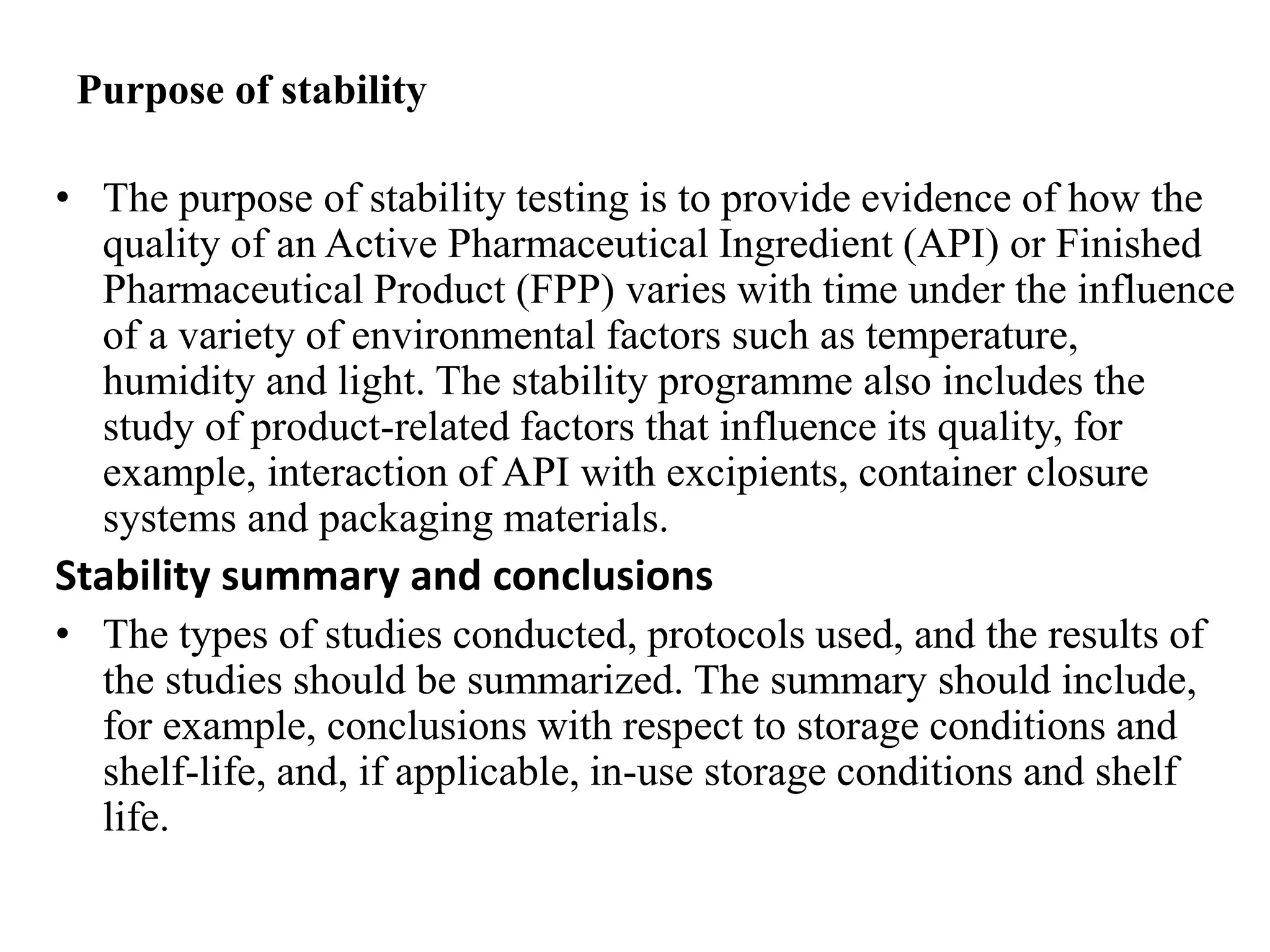
Purpose of stability
• The purpose of stability testing is to provide evidence of how the
quality of an Active Pharmaceutical Ingredient (API) or Finished
Pharmaceutical Product (FPP) varies with time under the influence
of a variety of environmental factors such as temperature,
humidity and light. The stability programme also includes the
study of product-related factors that influence its quality, for
example, interaction of API with excipients, container closure
systems and packaging materials.
Stability summary and conclusions
• The types of studies conducted, protocols used, and the results of
the studies should be summarized. The summary should include,
for example, conclusions with respect to storage conditions and
shelf-life, and, if applicable, in-use storage conditions and shelf
life.
• It should also include: Stress testing, Accelerated, intermediate
(if necessary) and long-term testing, proposed storage
statement and shelf-life.
Summary/ evaluation of stability data
• The information on the stability studies should include details
such as:
• Storage conditions;
• Strength;
• Batch number, including the API batch number(s) and
manufacturer(s);
• Batch size;
• Container closure system including orientation (e.g. erect,
inverted, on-side) where applicable; and
• Completed (and proposed) test intervals.
Evaluation/ discussion of stability data
Common deficiency:
Failure to evaluate and discuss stability data and provide a
conclusion. Trends and OOS results are not explained and discussed.
Obligation:
The discussion of results should focus on observations noted for the
various tests, rather than reporting comments such as “all tests meet
specifications”. This should include ranges of analytical results and
any trends that were observed.
Minimum long term and accelerated data
Common deficiency:
• Failure to provide the minimum required stability data at the time
of submission and to update the data as the assessment progresses.
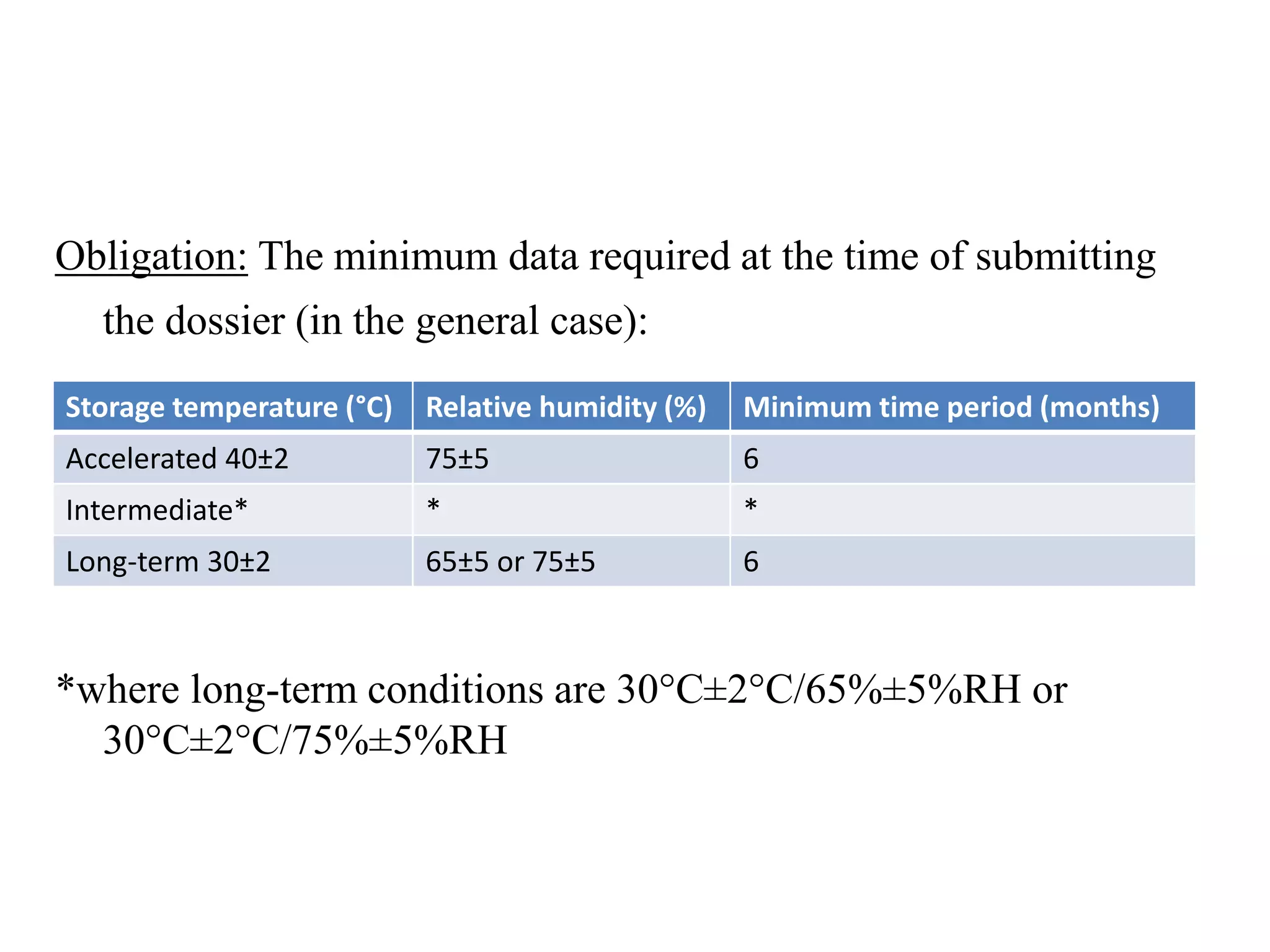
Obligation: The minimum data required at the time of submitting
the dossier (in the general case):
*where long-term conditions are 30°C±2°C/65%±5%RH or
30°C±2°C/75%±5%RH
Storage temperature (°C) Relative humidity (%) Minimum time period (months)
Accelerated 40±2 75±5 6
Intermediate* * *
Long-term 30±2 65±5 or 75±5 6
Official
storage conditions as defined by the USP 349 are as follows:
• Freezer – a place where temperature is maintained
thermostatically between –25°C and –10°C.
• Cold – any temperature not exceeding 8°C and refrigerator is a
cold place where the temperature is maintained
thermostatically between 2 and 8°C.
• Controlled Cold Temperature – temperature maintained
thermostatically between 2° and 8°C.
• Cool is defined as any temperature between 8 and 15°C.
• Room Temperature – the temperature prevailing in a working
area.
• Controlled Room Temperature – temperature maintained
thermostatically between 20 and 25°C.
Official
storage conditions as defined by the USP 349 are as follows:
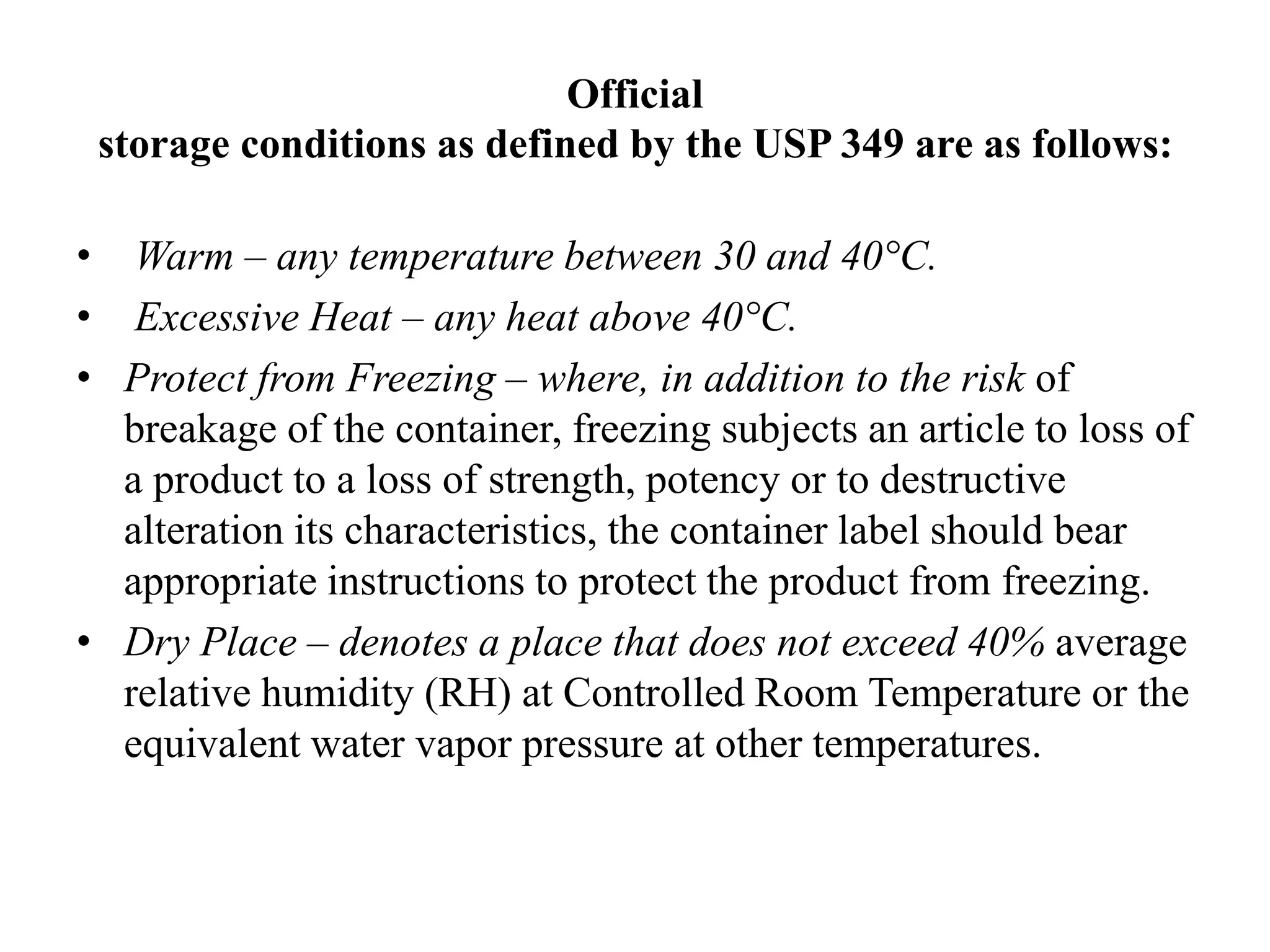
• Warm – any temperature between 30 and 40°C.
• Excessive Heat – any heat above 40°C.
• Protect from Freezing – where, in addition to the risk of
breakage of the container, freezing subjects an article to loss of
a product to a loss of strength, potency or to destructive
alteration its characteristics, the container label should bear
appropriate instructions to protect the product from freezing.
• Dry Place – denotes a place that does not exceed 40% average
relative humidity (RH) at Controlled Room Temperature or the
equivalent water vapor pressure at other temperatures.
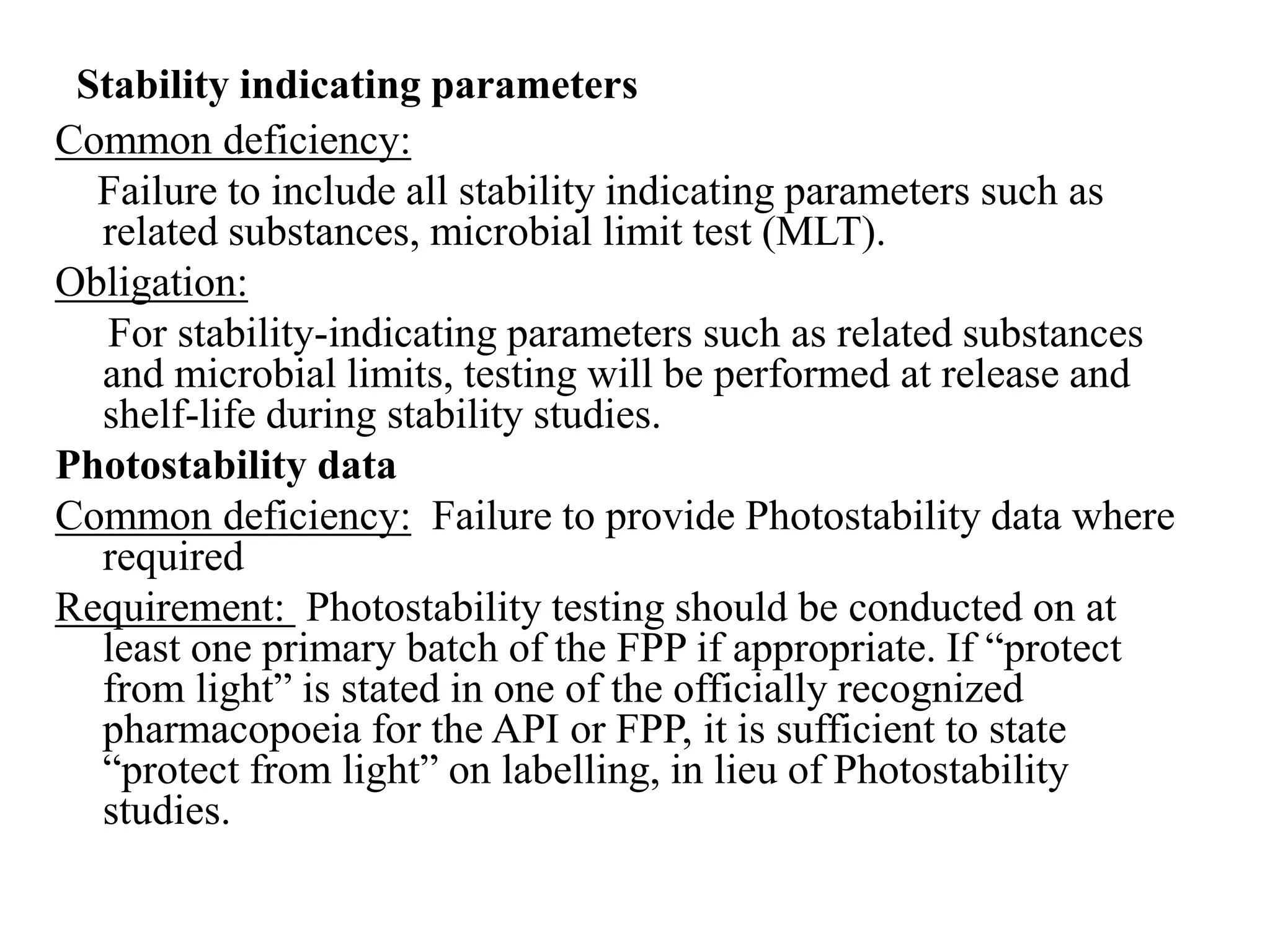
Stability indicating parameters
Common deficiency:
Failure to include all stability indicating parameters such as
related substances, microbial limit test (MLT).
Obligation:
For stability-indicating parameters such as related substances
and microbial limits, testing will be performed at release and
shelf-life during stability studies.
Photostability data
Common deficiency: Failure to provide Photostability data where
required
Requirement: Photostability testing should be conducted on at
least one primary batch of the FPP if appropriate. If “protect
from light” is stated in one of the officially recognized
pharmacopoeia for the API or FPP, it is sufficient to state
“protect from light” on labelling, in lieu of Photostability
studies.
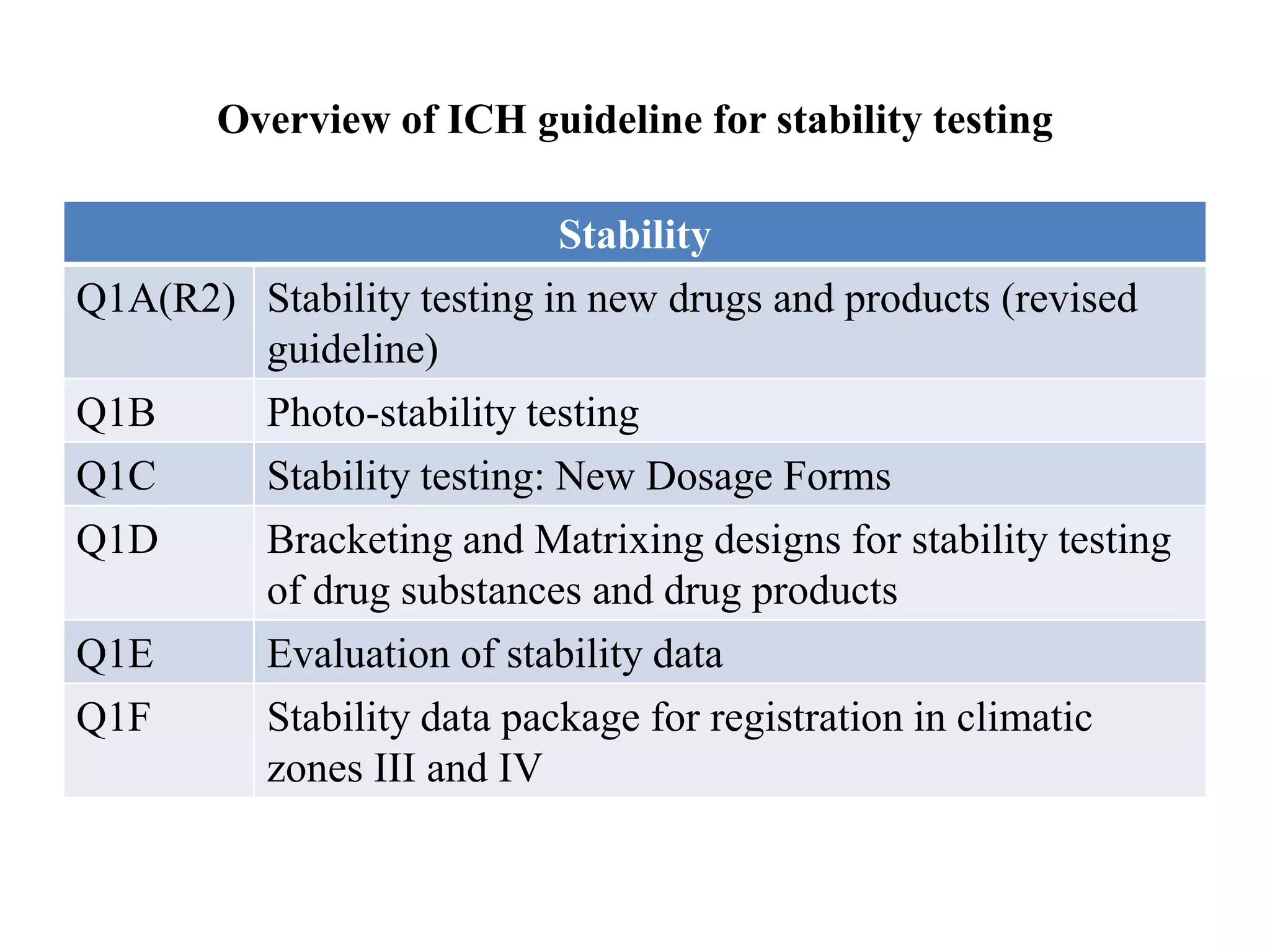
Overview of ICH guideline for stability testing
Stability
Q1A(R2) Stability testing in new drugs and products (revised
guideline)
Q1B Photo-stability testing
Q1C Stability testing: New Dosage Forms
Q1D Bracketing and Matrixing designs for stability testing
of drug substances and drug products
Q1E Evaluation of stability data
Q1F Stability data package for registration in climatic
zones III and IV
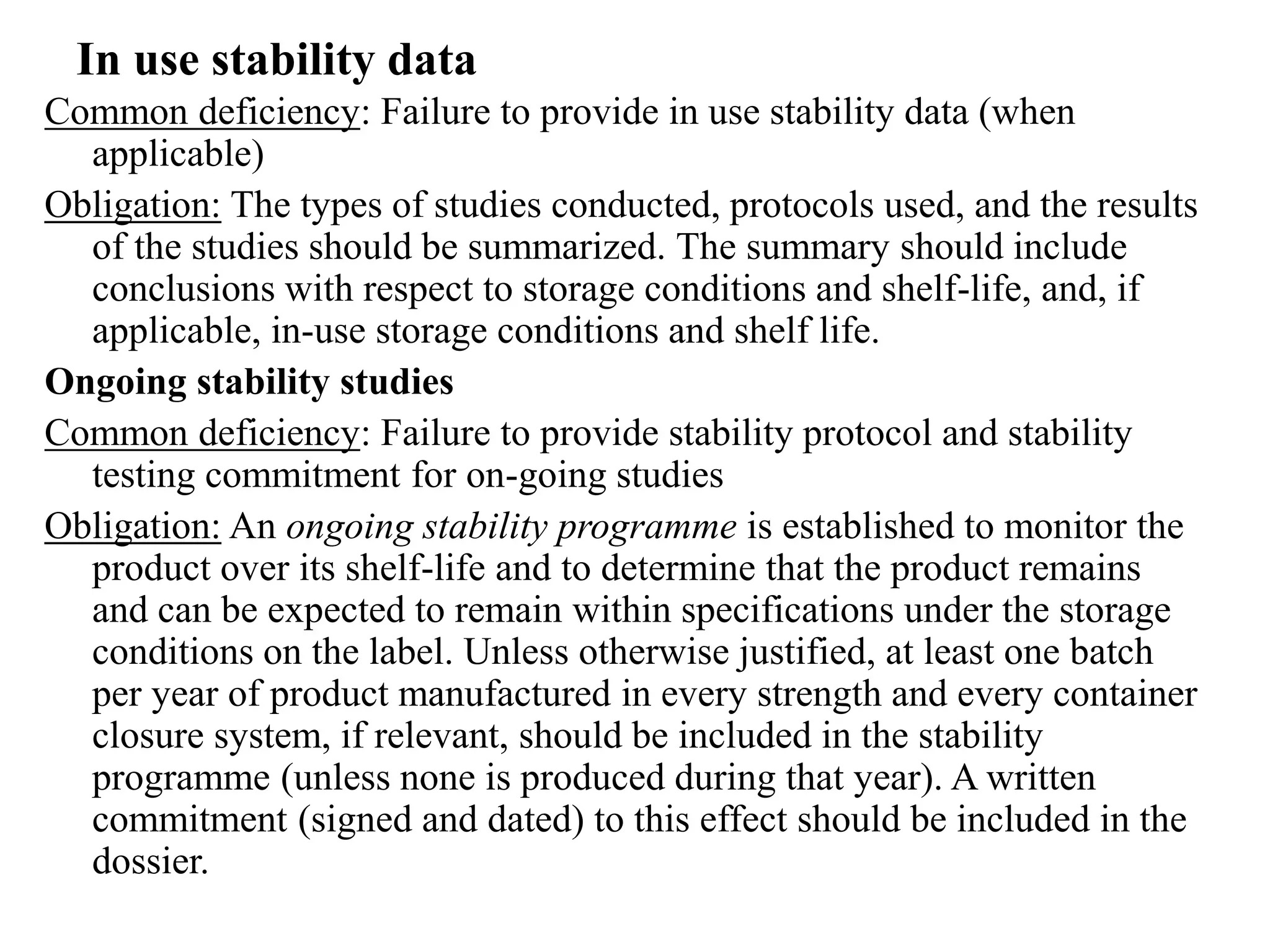
In use stability data
Common deficiency: Failure to provide in use stability data (when
applicable)
Obligation: The types of studies conducted, protocols used, and the results
of the studies should be summarized. The summary should include
conclusions with respect to storage conditions and shelf-life, and, if
applicable, in-use storage conditions and shelf life.
Ongoing stability studies
Common deficiency: Failure to provide stability protocol and stability
testing commitment for on-going studies
Obligation: An ongoing stability programme is established to monitor the
product over its shelf-life and to determine that the product remains
and can be expected to remain within specifications under the storage
conditions on the label. Unless otherwise justified, at least one batch
per year of product manufactured in every strength and every container
closure system, if relevant, should be included in the stability
programme (unless none is produced during that year). A written
commitment (signed and dated) to this effect should be included in the
dossier.
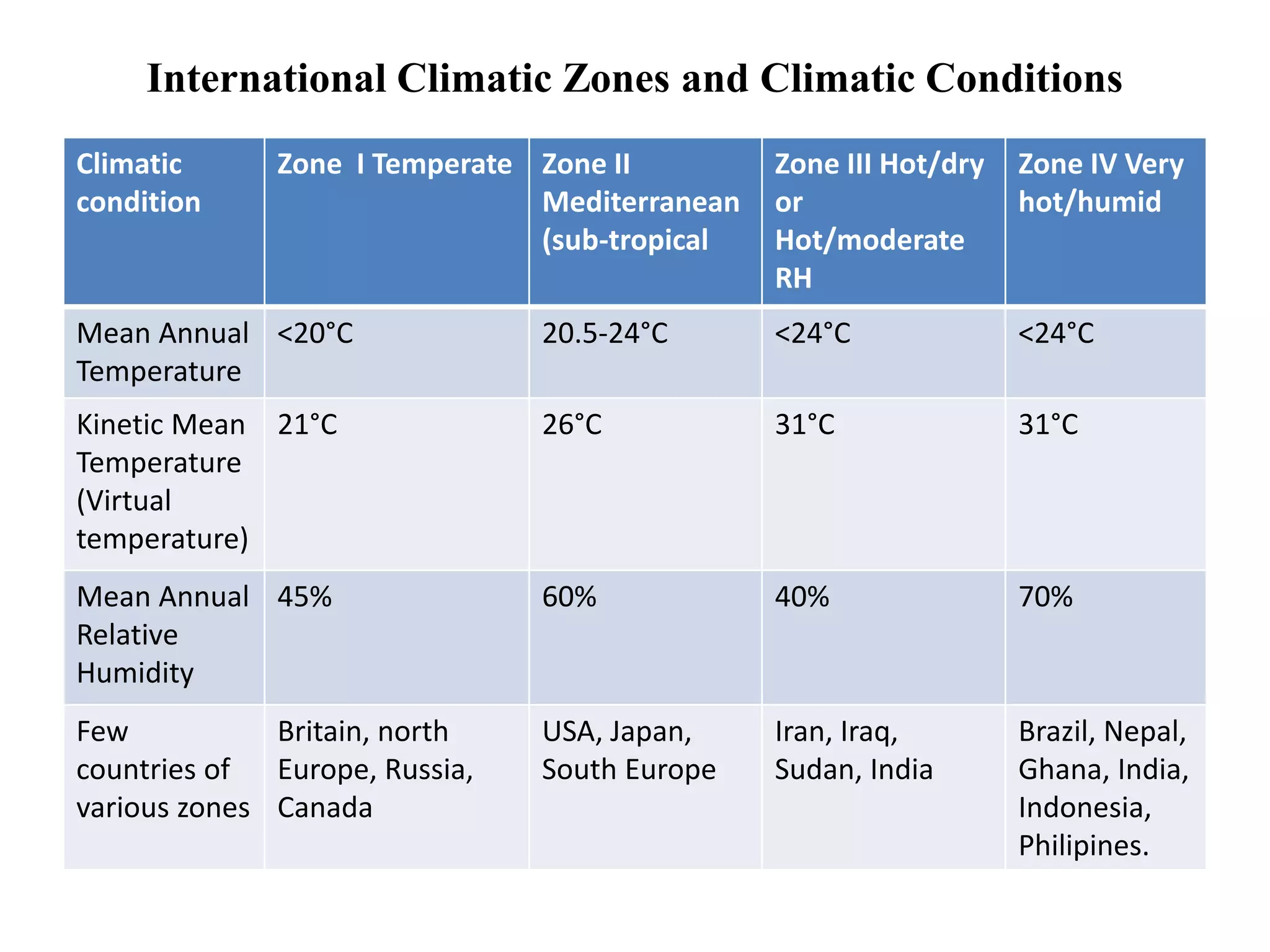
International Climatic Zones and Climatic Conditions
Climatic
condition
Zone I Temperate Zone II
Mediterranean
(sub-tropical
Zone III Hot/dry
or
Hot/moderate
RH
Zone IV Very
hot/humid
Mean Annual
Temperature
<20°C 20.5-24°C <24°C <24°C
Kinetic Mean
Temperature
(Virtual
temperature)
21°C 26°C 31°C 31°C
Mean Annual
Relative
Humidity
45% 60% 40% 70%
Few
countries of
various zones
Britain, north
Europe, Russia,
Canada
USA, Japan,
South Europe
Iran, Iraq,
Sudan, India
Brazil, Nepal,
Ghana, India,
Indonesia,
Philipines.
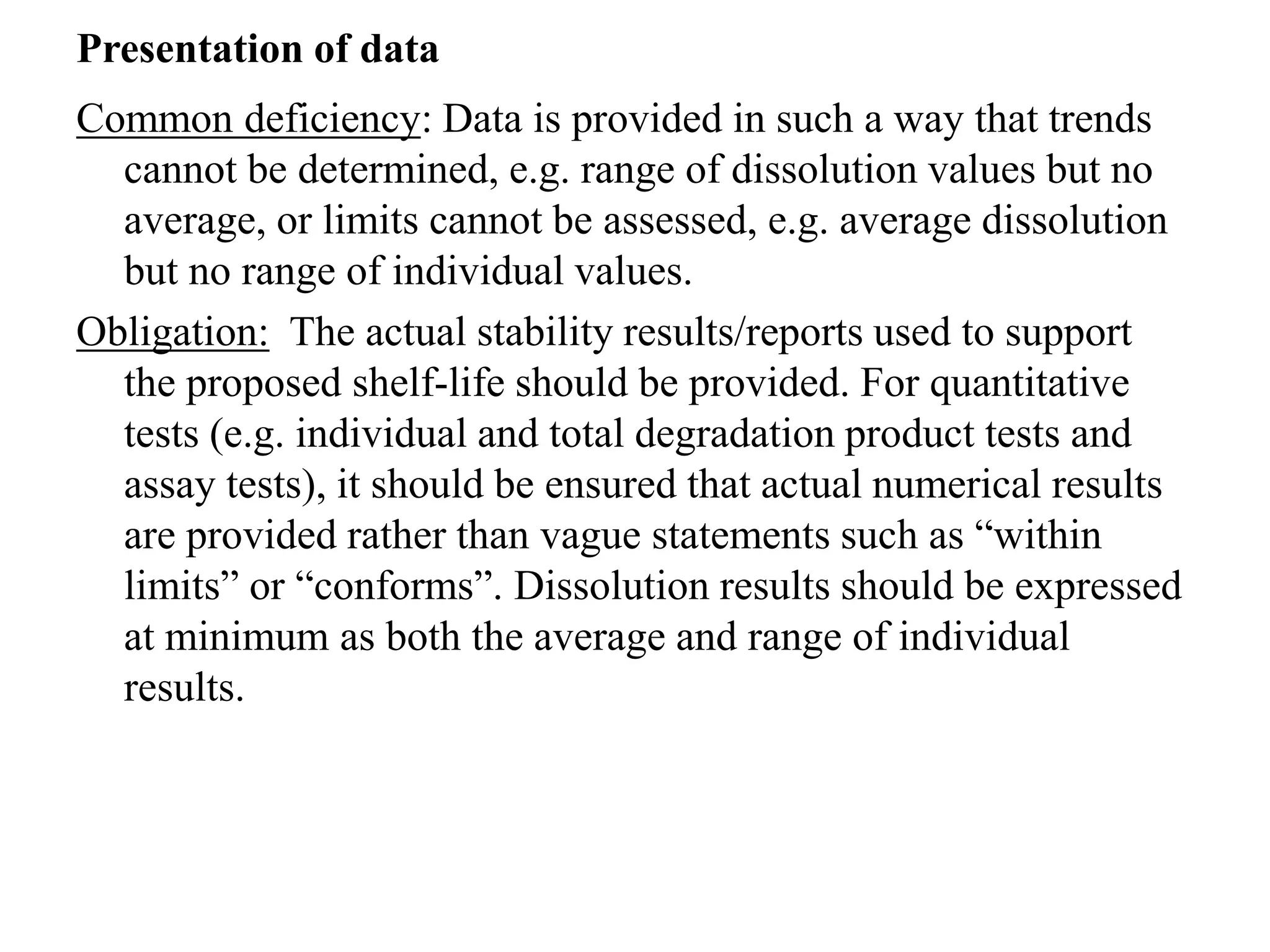
Presentation of data
Common deficiency: Data is provided in such a way that trends
cannot be determined, e.g. range of dissolution values but no
average, or limits cannot be assessed, e.g. average dissolution
but no range of individual values.
Obligation: The actual stability results/reports used to support
the proposed shelf-life should be provided. For quantitative
tests (e.g. individual and total degradation product tests and
assay tests), it should be ensured that actual numerical results
are provided rather than vague statements such as “within
limits” or “conforms”. Dissolution results should be expressed
at minimum as both the average and range of individual
results.
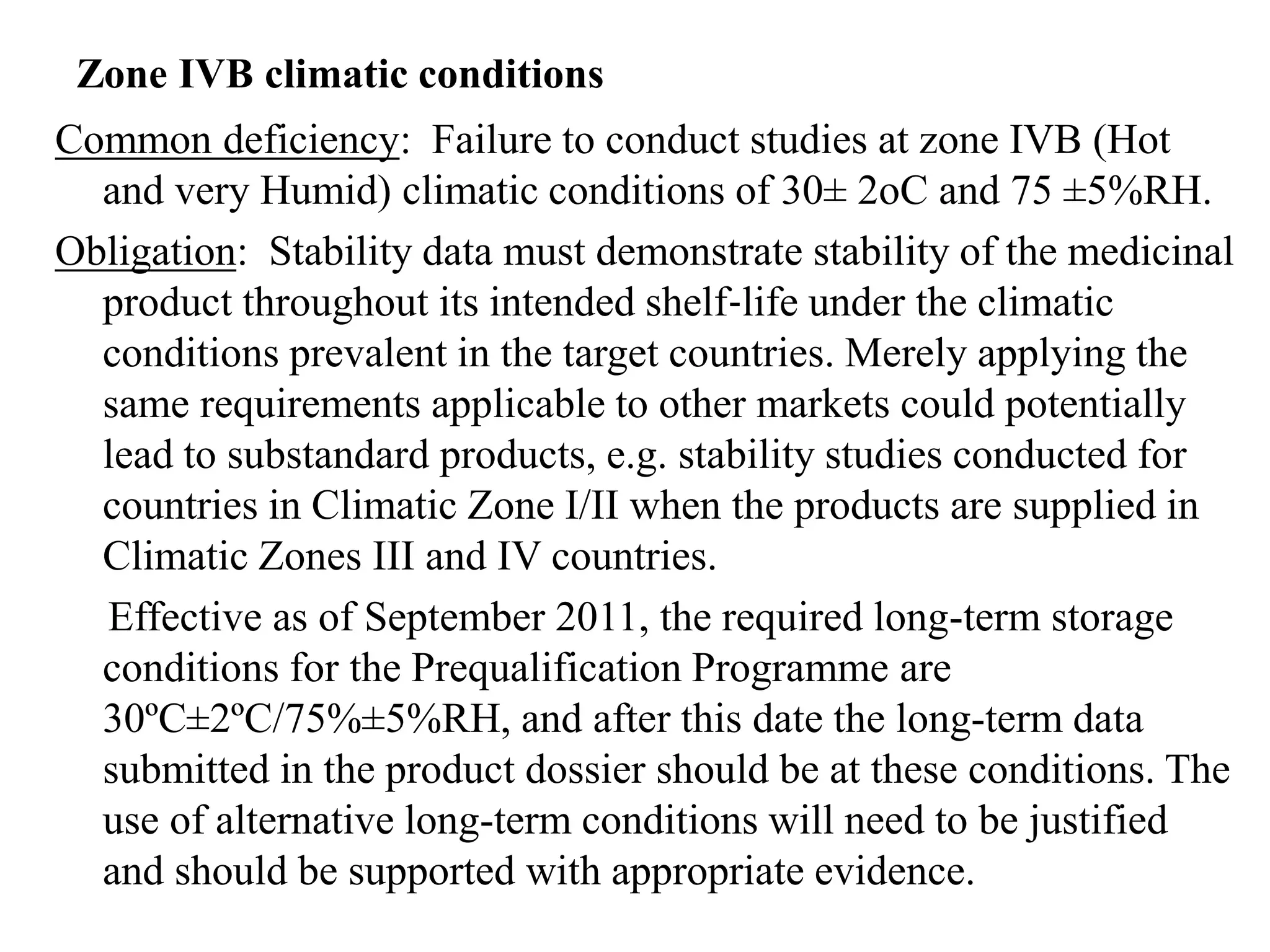
Zone IVB climatic conditions
Common deficiency: Failure to conduct studies at zone IVB (Hot
and very Humid) climatic conditions of 30± 2oC and 75 ±5%RH.
Obligation: Stability data must demonstrate stability of the medicinal
product throughout its intended shelf‐life under the climatic
conditions prevalent in the target countries. Merely applying the
same requirements applicable to other markets could potentially
lead to substandard products, e.g. stability studies conducted for
countries in Climatic Zone I/II when the products are supplied in
Climatic Zones III and IV countries.
Effective as of September 2011, the required long-term storage
conditions for the Prequalification Programme are
30ºC±2ºC/75%±5%RH, and after this date the long-term data
submitted in the product dossier should be at these conditions. The
use of alternative long-term conditions will need to be justified
and should be supported with appropriate evidence.
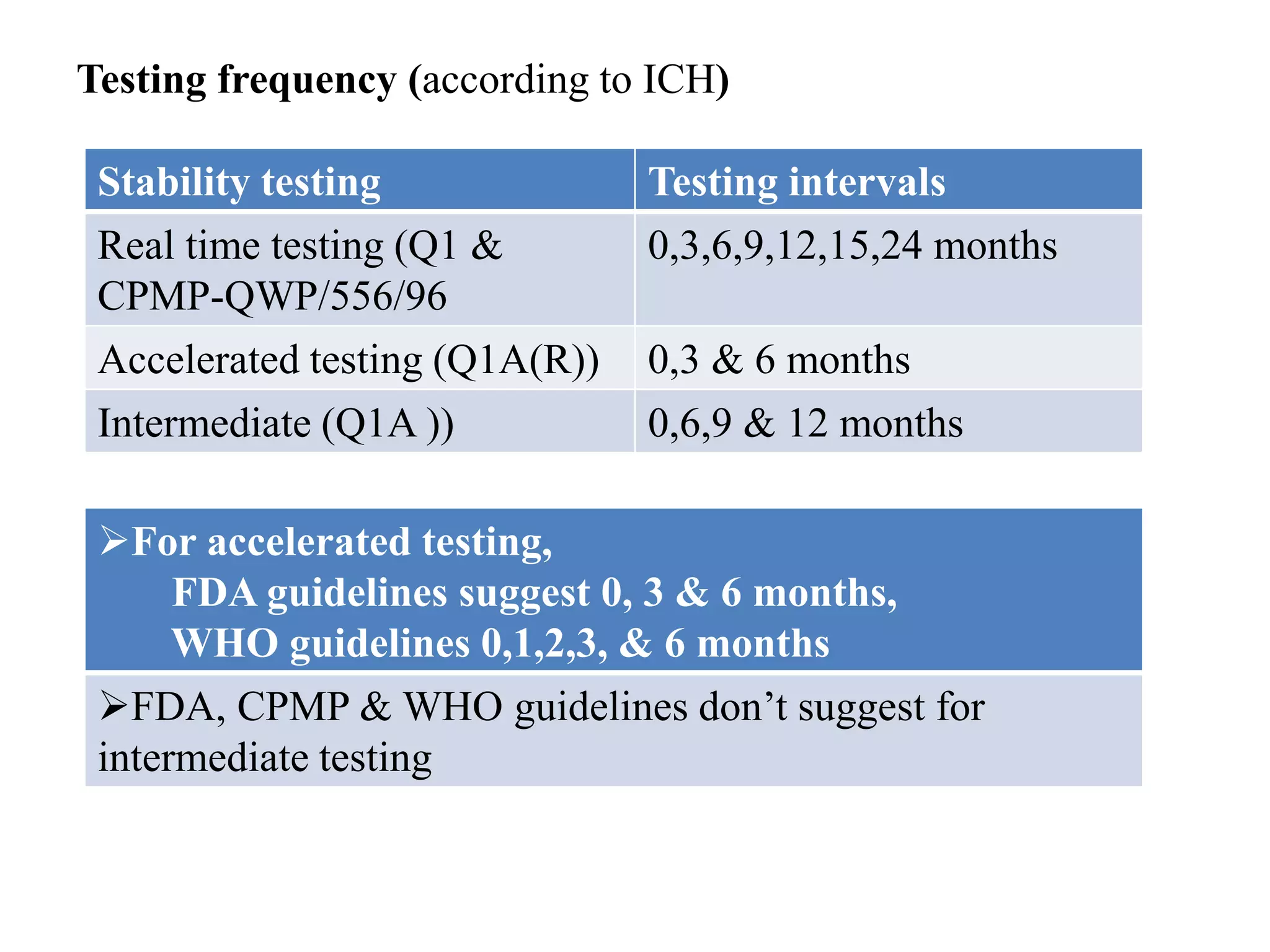
Testing frequency (according to ICH)
Stability testing Testing intervals
Real time testing (Q1 &
CPMP-QWP/556/96
0,3,6,9,12,15,24 months
Accelerated testing (Q1A(R)) 0,3 & 6 months
Intermediate (Q1A )) 0,6,9 & 12 months
For accelerated testing,
FDA guidelines suggest 0, 3 & 6 months,
WHO guidelines 0,1,2,3, & 6 months
FDA, CPMP & WHO guidelines don’t suggest for
intermediate testing
Reduced requirement on Stability
There is a reduced requirement for the number of FPP batches
required to establish the shelf-life, for both complicated FPPs*
(minimum three pilot batches reduced to minimum two pilot
batches) and uncomplicated FPPs (minimum three pilot batches
reduced to minimum one pilot batch and a second batch which may
be smaller).
These batches should be manufactured by a procedure fully
representative of and simulating that to be applied to a full
production-scale batch.
Conclusion
• Determining the authenticity of data submitted! Manufacturers fail
to prove stability of their products or even manipulate or fake the
raw data!
• Inspectors have to confirm the data submitted during GMP
inspections.
References:
Remington essential of pharmaceutics, ICH guidelines, ICDRA, Wiki

Stability basic concepts and purposes

  • 1.
    Purpose of StabilityStudies BISHNU PRASAD KOIRALABISHNU PRASAD KOIRALA
  • 2.
    STABILITY • Stability ofa pharmaceutical product may be defined as the capability of a particular formulation, in a specific container/closure system, to remain within its physical, chemical, microbiological, therapeutic, and toxicological specifications at a defined storage conditions. • Pharmaceutical products are expected to meet their specifications for identity, purity, quality, and strength throughout their defined storage period at specific storage conditions. • Stability is officially defined as the time lapse (period) during which drug substance (API) or drug product (FPP) to retains the same properties and characteristics (i.e. physical, chemical, microbiological, therapeutic and toxicological specifications to maintain its identity, strength, quality, and purity) that it possessed at the time of manufacture.
  • 3.
    Types of Stability Typesof stability Conditions maintained throughout the shelf life of the drug product Chemical Each active ingredient retains its chemical integrity and labeled potency, within the specified limits. Physical The original physical properties, including appearance, palatability, uniformity, dissolution, and suspendability are retained. microbiological Sterility or resistance to microbial growth is retained according to the specified requirements . Antimicrobial agents that are present retain effectiveness within the specified limits. therapeutic The therapeutic effect remains unchanged. Toxicological No significant increase in toxicity occurs.
  • 4.
    Purpose of stability •The purpose of stability testing is to provide evidence of how the quality of an Active Pharmaceutical Ingredient (API) or Finished Pharmaceutical Product (FPP) varies with time under the influence of a variety of environmental factors such as temperature, humidity and light. The stability programme also includes the study of product-related factors that influence its quality, for example, interaction of API with excipients, container closure systems and packaging materials. Stability summary and conclusions • The types of studies conducted, protocols used, and the results of the studies should be summarized. The summary should include, for example, conclusions with respect to storage conditions and shelf-life, and, if applicable, in-use storage conditions and shelf life.
  • 5.
    • It shouldalso include: Stress testing, Accelerated, intermediate (if necessary) and long-term testing, proposed storage statement and shelf-life. Summary/ evaluation of stability data • The information on the stability studies should include details such as: • Storage conditions; • Strength; • Batch number, including the API batch number(s) and manufacturer(s); • Batch size; • Container closure system including orientation (e.g. erect, inverted, on-side) where applicable; and • Completed (and proposed) test intervals.
  • 6.
    Evaluation/ discussion ofstability data Common deficiency: Failure to evaluate and discuss stability data and provide a conclusion. Trends and OOS results are not explained and discussed. Obligation: The discussion of results should focus on observations noted for the various tests, rather than reporting comments such as “all tests meet specifications”. This should include ranges of analytical results and any trends that were observed. Minimum long term and accelerated data Common deficiency: • Failure to provide the minimum required stability data at the time of submission and to update the data as the assessment progresses.
  • 7.
    Obligation: The minimumdata required at the time of submitting the dossier (in the general case): *where long-term conditions are 30°C±2°C/65%±5%RH or 30°C±2°C/75%±5%RH Storage temperature (°C) Relative humidity (%) Minimum time period (months) Accelerated 40±2 75±5 6 Intermediate* * * Long-term 30±2 65±5 or 75±5 6
  • 8.
    Official storage conditions asdefined by the USP 349 are as follows: • Freezer – a place where temperature is maintained thermostatically between –25°C and –10°C. • Cold – any temperature not exceeding 8°C and refrigerator is a cold place where the temperature is maintained thermostatically between 2 and 8°C. • Controlled Cold Temperature – temperature maintained thermostatically between 2° and 8°C. • Cool is defined as any temperature between 8 and 15°C. • Room Temperature – the temperature prevailing in a working area. • Controlled Room Temperature – temperature maintained thermostatically between 20 and 25°C.
  • 9.
    Official storage conditions asdefined by the USP 349 are as follows: • Warm – any temperature between 30 and 40°C. • Excessive Heat – any heat above 40°C. • Protect from Freezing – where, in addition to the risk of breakage of the container, freezing subjects an article to loss of a product to a loss of strength, potency or to destructive alteration its characteristics, the container label should bear appropriate instructions to protect the product from freezing. • Dry Place – denotes a place that does not exceed 40% average relative humidity (RH) at Controlled Room Temperature or the equivalent water vapor pressure at other temperatures.
  • 10.
    Stability indicating parameters Commondeficiency: Failure to include all stability indicating parameters such as related substances, microbial limit test (MLT). Obligation: For stability-indicating parameters such as related substances and microbial limits, testing will be performed at release and shelf-life during stability studies. Photostability data Common deficiency: Failure to provide Photostability data where required Requirement: Photostability testing should be conducted on at least one primary batch of the FPP if appropriate. If “protect from light” is stated in one of the officially recognized pharmacopoeia for the API or FPP, it is sufficient to state “protect from light” on labelling, in lieu of Photostability studies.
  • 11.
    Overview of ICHguideline for stability testing Stability Q1A(R2) Stability testing in new drugs and products (revised guideline) Q1B Photo-stability testing Q1C Stability testing: New Dosage Forms Q1D Bracketing and Matrixing designs for stability testing of drug substances and drug products Q1E Evaluation of stability data Q1F Stability data package for registration in climatic zones III and IV
  • 12.
    In use stabilitydata Common deficiency: Failure to provide in use stability data (when applicable) Obligation: The types of studies conducted, protocols used, and the results of the studies should be summarized. The summary should include conclusions with respect to storage conditions and shelf-life, and, if applicable, in-use storage conditions and shelf life. Ongoing stability studies Common deficiency: Failure to provide stability protocol and stability testing commitment for on-going studies Obligation: An ongoing stability programme is established to monitor the product over its shelf-life and to determine that the product remains and can be expected to remain within specifications under the storage conditions on the label. Unless otherwise justified, at least one batch per year of product manufactured in every strength and every container closure system, if relevant, should be included in the stability programme (unless none is produced during that year). A written commitment (signed and dated) to this effect should be included in the dossier.
  • 13.
    International Climatic Zonesand Climatic Conditions Climatic condition Zone I Temperate Zone II Mediterranean (sub-tropical Zone III Hot/dry or Hot/moderate RH Zone IV Very hot/humid Mean Annual Temperature <20°C 20.5-24°C <24°C <24°C Kinetic Mean Temperature (Virtual temperature) 21°C 26°C 31°C 31°C Mean Annual Relative Humidity 45% 60% 40% 70% Few countries of various zones Britain, north Europe, Russia, Canada USA, Japan, South Europe Iran, Iraq, Sudan, India Brazil, Nepal, Ghana, India, Indonesia, Philipines.
  • 14.
    Presentation of data Commondeficiency: Data is provided in such a way that trends cannot be determined, e.g. range of dissolution values but no average, or limits cannot be assessed, e.g. average dissolution but no range of individual values. Obligation: The actual stability results/reports used to support the proposed shelf-life should be provided. For quantitative tests (e.g. individual and total degradation product tests and assay tests), it should be ensured that actual numerical results are provided rather than vague statements such as “within limits” or “conforms”. Dissolution results should be expressed at minimum as both the average and range of individual results.
  • 15.
    Zone IVB climaticconditions Common deficiency: Failure to conduct studies at zone IVB (Hot and very Humid) climatic conditions of 30± 2oC and 75 ±5%RH. Obligation: Stability data must demonstrate stability of the medicinal product throughout its intended shelf‐life under the climatic conditions prevalent in the target countries. Merely applying the same requirements applicable to other markets could potentially lead to substandard products, e.g. stability studies conducted for countries in Climatic Zone I/II when the products are supplied in Climatic Zones III and IV countries. Effective as of September 2011, the required long-term storage conditions for the Prequalification Programme are 30ºC±2ºC/75%±5%RH, and after this date the long-term data submitted in the product dossier should be at these conditions. The use of alternative long-term conditions will need to be justified and should be supported with appropriate evidence.
  • 16.
    Testing frequency (accordingto ICH) Stability testing Testing intervals Real time testing (Q1 & CPMP-QWP/556/96 0,3,6,9,12,15,24 months Accelerated testing (Q1A(R)) 0,3 & 6 months Intermediate (Q1A )) 0,6,9 & 12 months For accelerated testing, FDA guidelines suggest 0, 3 & 6 months, WHO guidelines 0,1,2,3, & 6 months FDA, CPMP & WHO guidelines don’t suggest for intermediate testing
  • 17.
    Reduced requirement onStability There is a reduced requirement for the number of FPP batches required to establish the shelf-life, for both complicated FPPs* (minimum three pilot batches reduced to minimum two pilot batches) and uncomplicated FPPs (minimum three pilot batches reduced to minimum one pilot batch and a second batch which may be smaller). These batches should be manufactured by a procedure fully representative of and simulating that to be applied to a full production-scale batch. Conclusion • Determining the authenticity of data submitted! Manufacturers fail to prove stability of their products or even manipulate or fake the raw data! • Inspectors have to confirm the data submitted during GMP inspections. References: Remington essential of pharmaceutics, ICH guidelines, ICDRA, Wiki