CSC2515 Fall 2007
Introduction to Machine Learning
Lecture 2: Linear regression
All lecture slides will be available as .ppt, .ps, & .htm at
www.cs.toronto.edu/~hinton
Many of the figures are provided by Chris Bishop
from his textbook: ”Pattern Recognition and Machine Learning”
Linear models
• It is mathematically easy to fit linear models to data.
– We can learn a lot about model-fitting in this relatively simple
case.
• There are many ways to make linear models more powerful while
retaining their nice mathematical properties:
– By using non-linear, non-adaptive basis functions, we can get
generalised linear models that learn non-linear mappings from
input to output but are linear in their parameters – only the linear
part of the model learns.
– By using kernel methods we can handle expansions of the raw
data that use a huge number of non-linear, non-adaptive basis
functions.
– By using large margin kernel methods we can avoid overfitting
even when we use huge numbers of basis functions.
• But linear methods will not solve most AI problems.
– They have fundamental limitations.
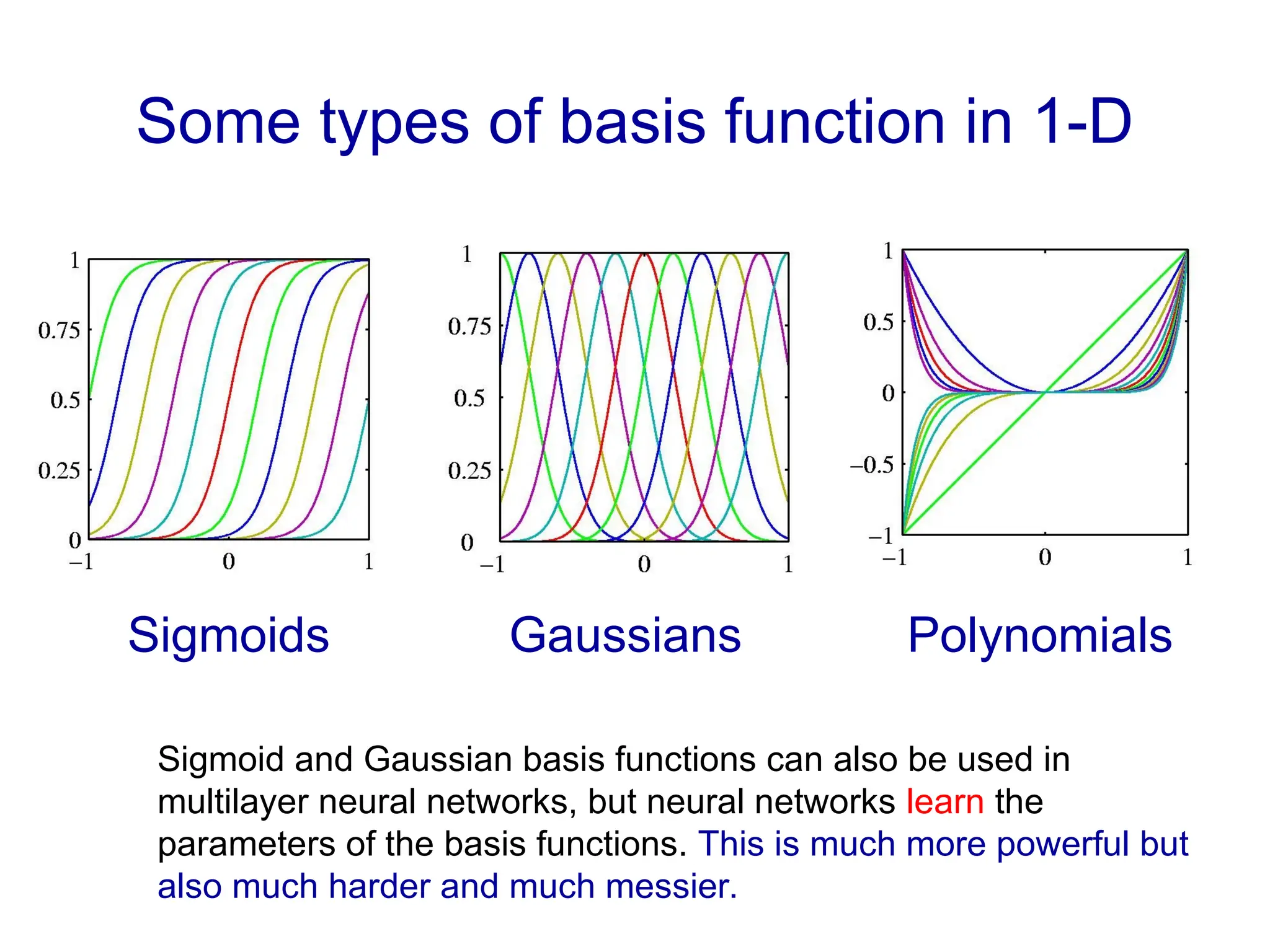
Some types of basis function in 1-D
Sigmoids Gaussians Polynomials
Sigmoid and Gaussian basis functions can also be used in
multilayer neural networks, but neural networks learn the
parameters of the basis functions. This is much more powerful but
also much harder and much messier.
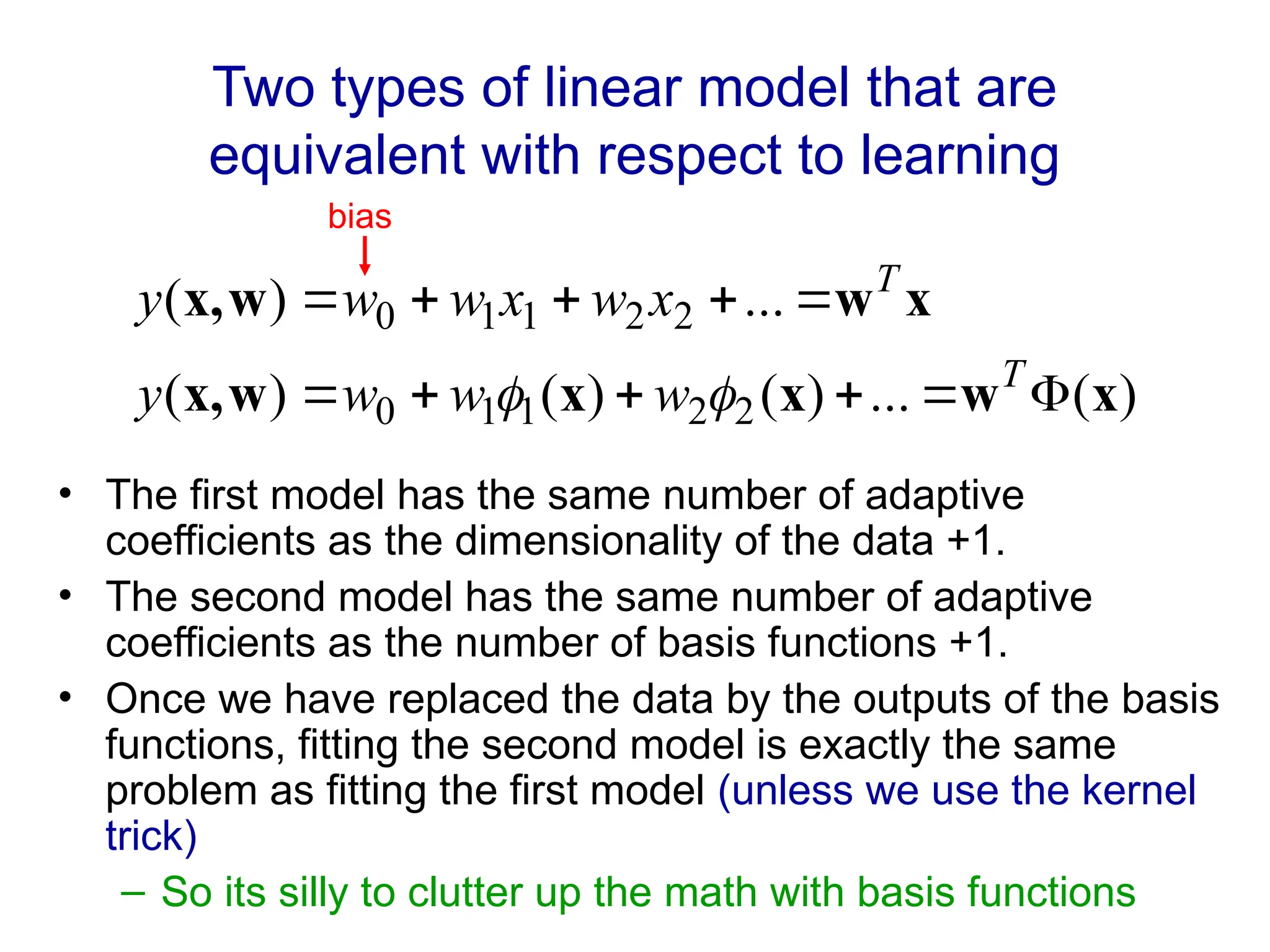
Two types of linear model that are
equivalent with respect to learning
• The first model has the same number of adaptive
coefficients as the dimensionality of the data +1.
• The second model has the same number of adaptive
coefficients as the number of basis functions +1.
• Once we have replaced the data by the outputs of the basis
functions, fitting the second model is exactly the same
problem as fitting the first model (unless we use the kernel
trick)
– So its silly to clutter up the math with basis functions
)
(
...
)
(
)
(
)
(
...
)
(
2
2
1
1
0
2
2
1
1
0
x
w
x
x
w
x,
x
w
w
x,











T
T
w
w
w
y
x
w
x
w
w
y


bias
The loss function
• Fitting a model to data is typically done by finding the
parameter values that minimize some loss function.
• There are many possible loss functions. What criterion
should we use for choosing one?
– Choose one that makes the math easy (squared error)
– Choose one that makes the fitting correspond to
maximizing the likelihood of the training data given
some noise model for the observed outputs.
– Choose one that makes it easy to interpret the learned
coefficients (easy if mostly zeros)
– Choose one that corresponds to the real loss on a
practical application (losses are often asymmetric)
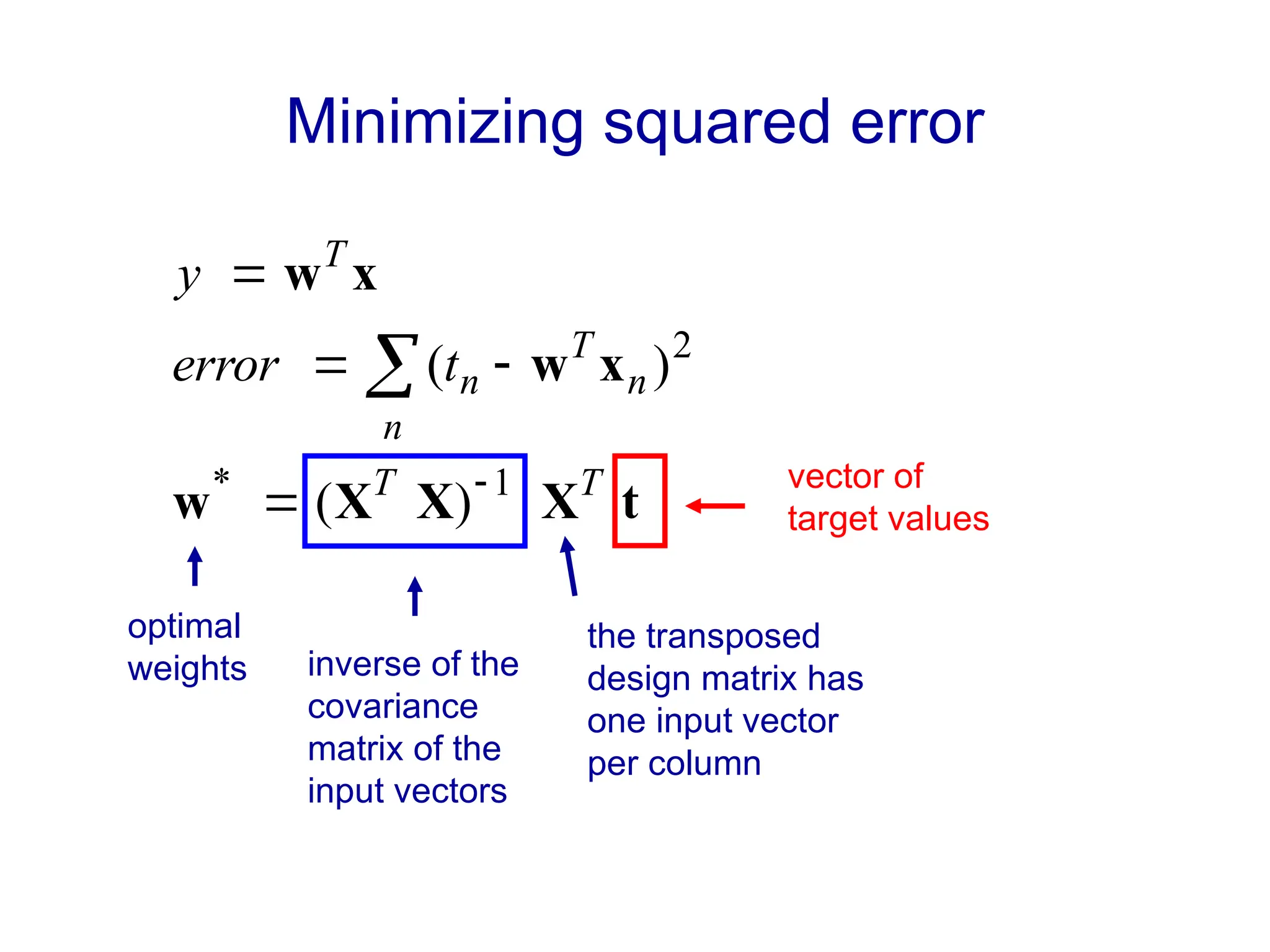
Minimizing squared error
t
X
X
X
w
x
w
x
w
T
T
n
T
n
n
T
t
error
y
1
*
2
)
(
)
(






optimal
weights inverse of the
covariance
matrix of the
input vectors
the transposed
design matrix has
one input vector
per column
vector of
target values
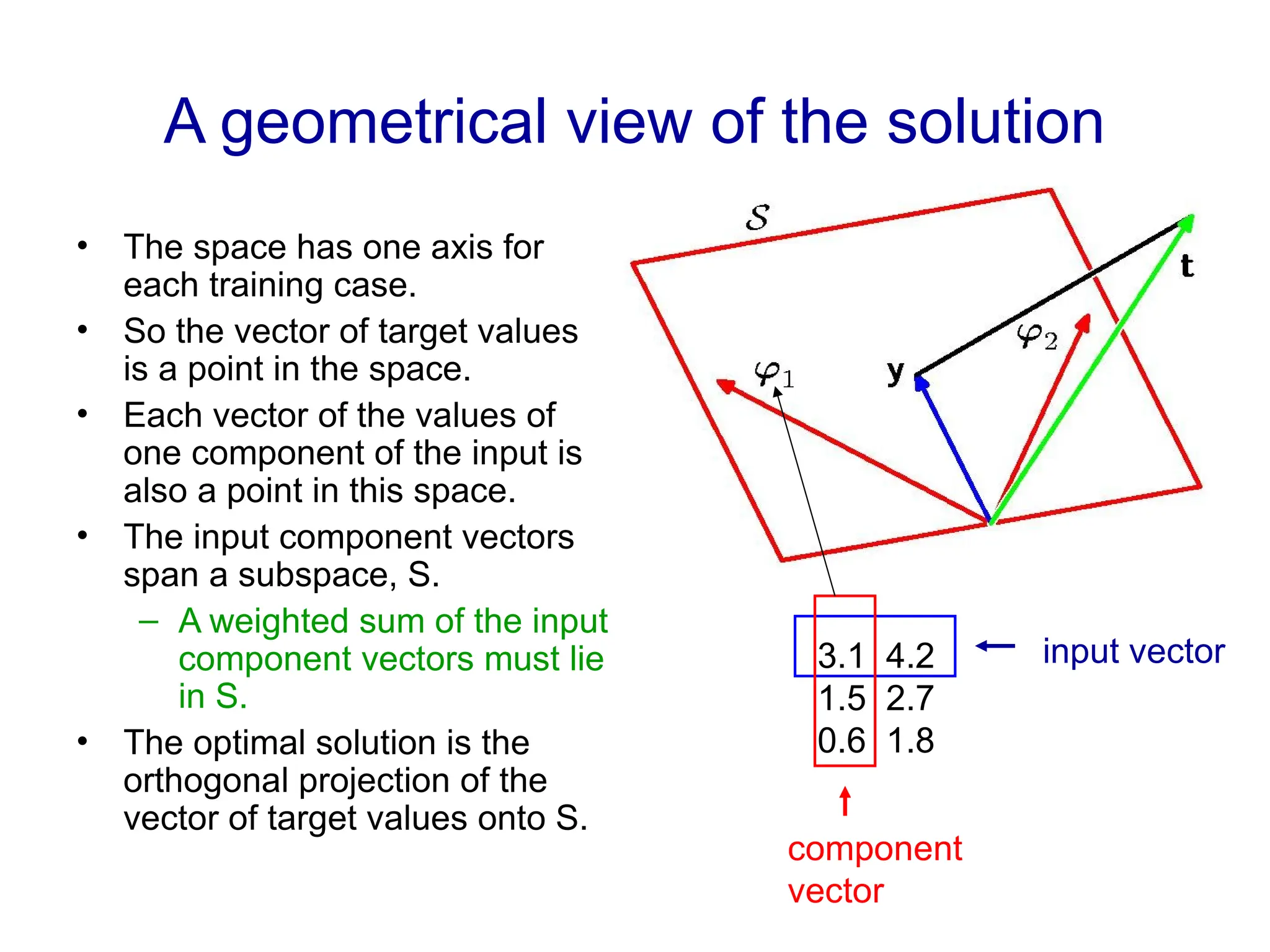
A geometrical view of the solution
• The space has one axis for
each training case.
• So the vector of target values
is a point in the space.
• Each vector of the values of
one component of the input is
also a point in this space.
• The input component vectors
span a subspace, S.
– A weighted sum of the input
component vectors must lie
in S.
• The optimal solution is the
orthogonal projection of the
vector of target values onto S.
3.1 4.2
1.5 2.7
0.6 1.8
input vector
component
vector
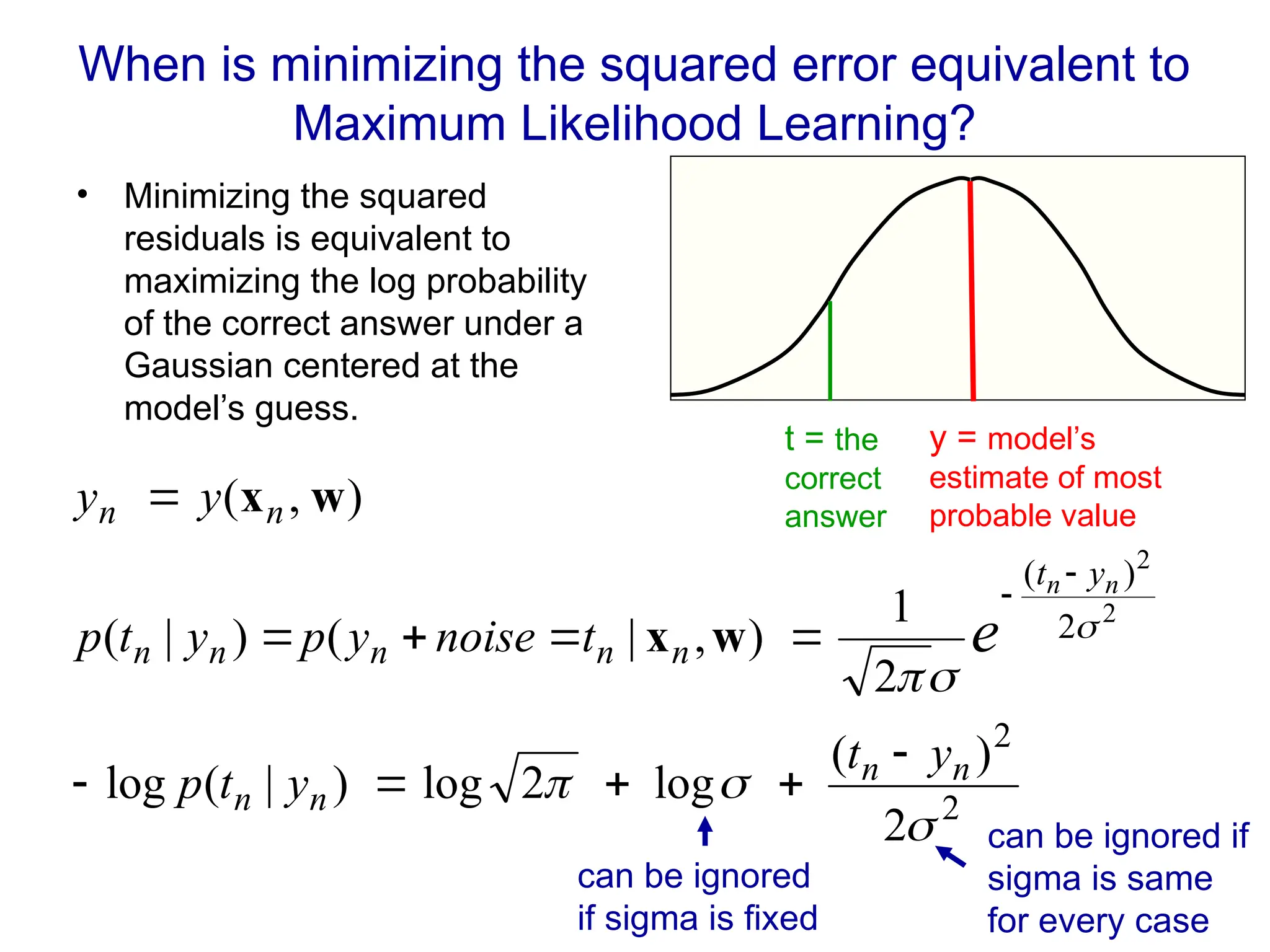
When is minimizing the squared error equivalent to
Maximum Likelihood Learning?
• Minimizing the squared
residuals is equivalent to
maximizing the log probability
of the correct answer under a
Gaussian centered at the
model’s guess.
t = the
correct
answer
y = model’s
estimate of most
probable value
2
2
2
)
(
2
)
(
log
2
log
)
|
(
log
2
1
)
,
|
(
)
|
(
)
,
(
2
2






n
n
n
n
y
t
n
n
n
n
n
n
n
y
t
y
t
p
t
noise
y
p
y
t
p
y
y
n
n
e












w
x
w
x
can be ignored
if sigma is fixed
can be ignored if
sigma is same
for every case
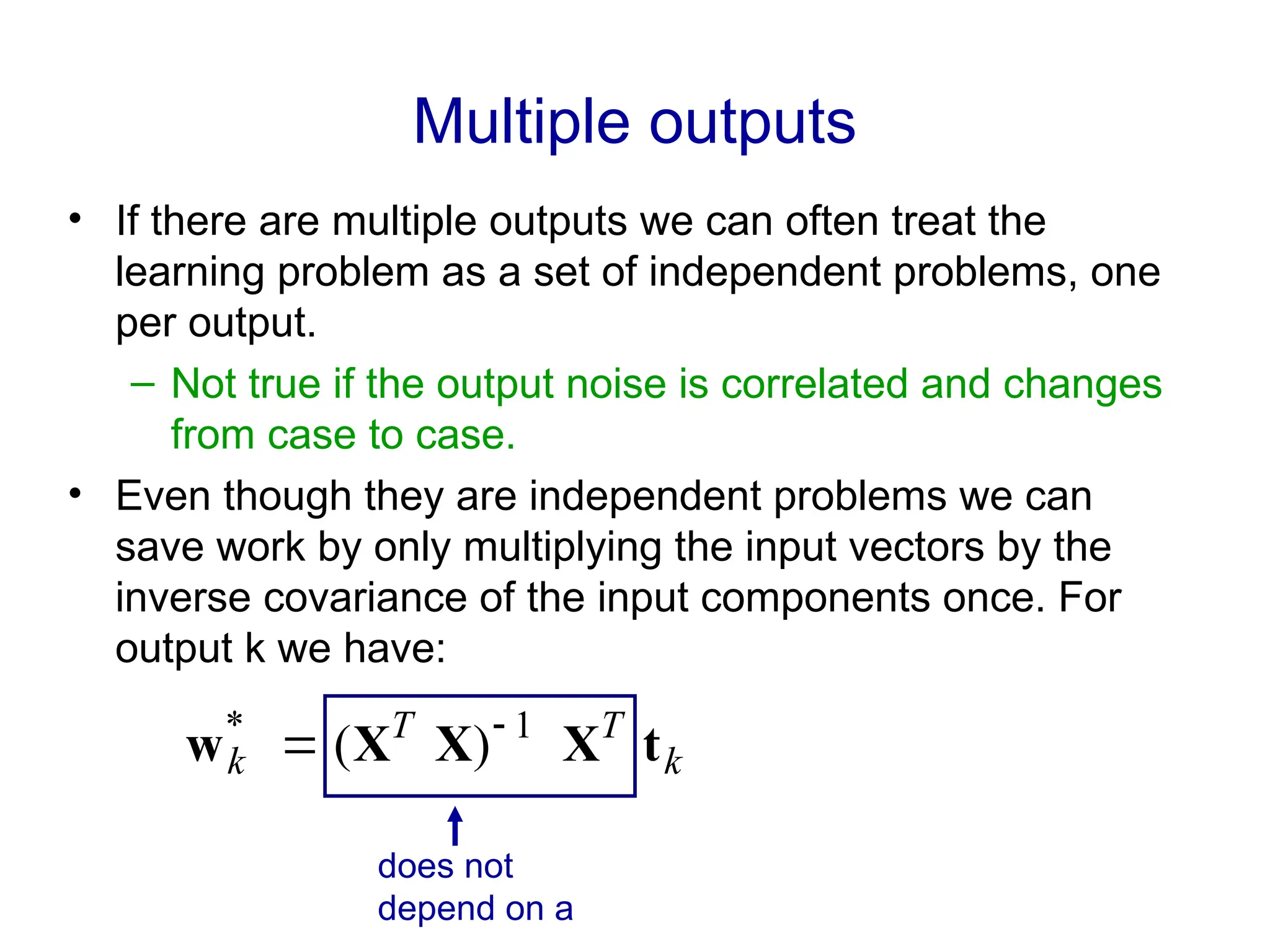
Multiple outputs
• If there are multiple outputs we can often treat the
learning problem as a set of independent problems, one
per output.
– Not true if the output noise is correlated and changes
from case to case.
• Even though they are independent problems we can
save work by only multiplying the input vectors by the
inverse covariance of the input components once. For
output k we have:
k
T
T
k t
X
X
X
w 1
*
)
( 

does not
depend on a
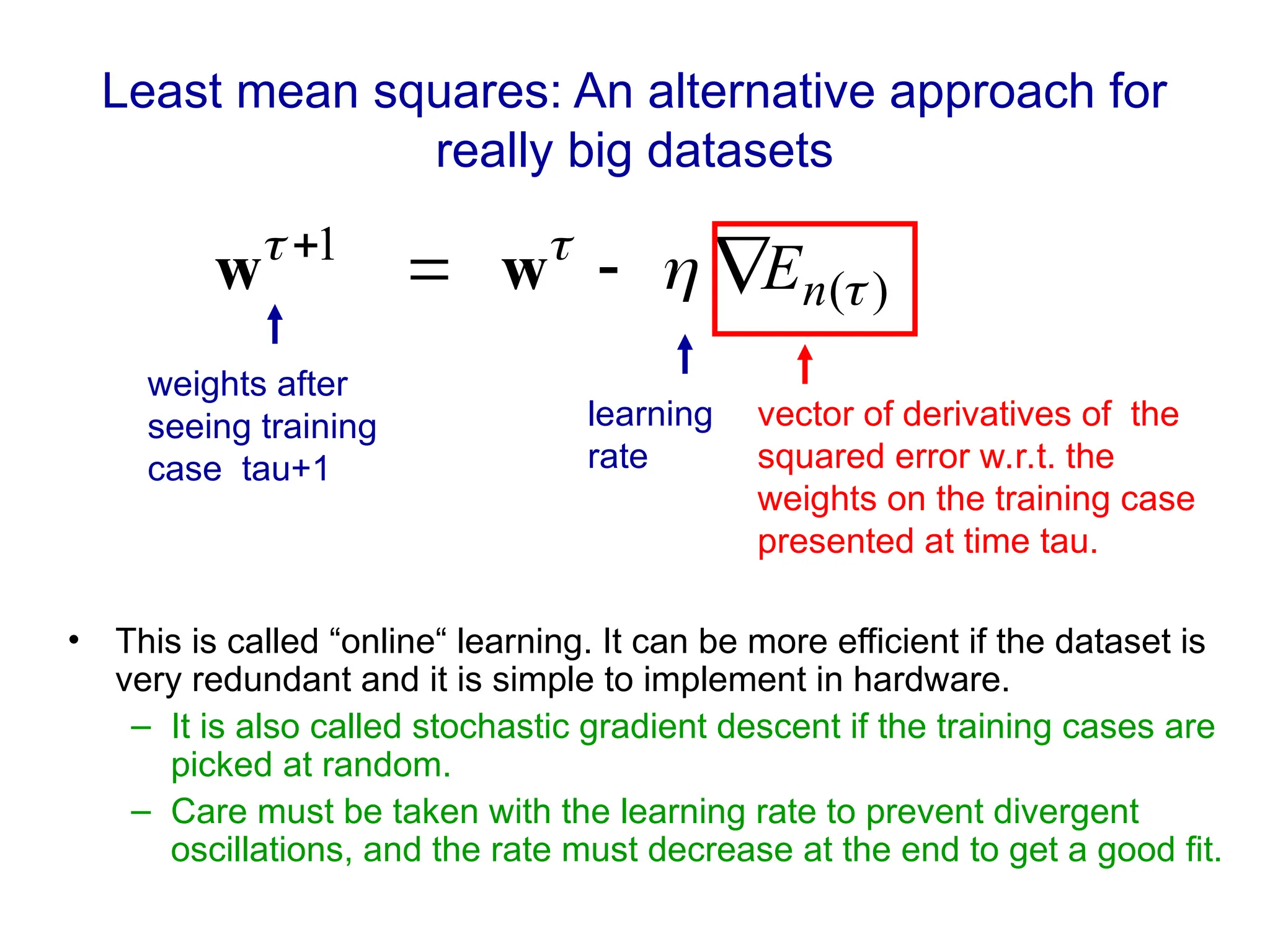
Least mean squares: An alternative approach for
really big datasets
• This is called “online“ learning. It can be more efficient if the dataset is
very redundant and it is simple to implement in hardware.
– It is also called stochastic gradient descent if the training cases are
picked at random.
– Care must be taken with the learning rate to prevent divergent
oscillations, and the rate must decrease at the end to get a good fit.
)
(
1



 n
E




w
w
weights after
seeing training
case tau+1
learning
rate
vector of derivatives of the
squared error w.r.t. the
weights on the training case
presented at time tau.
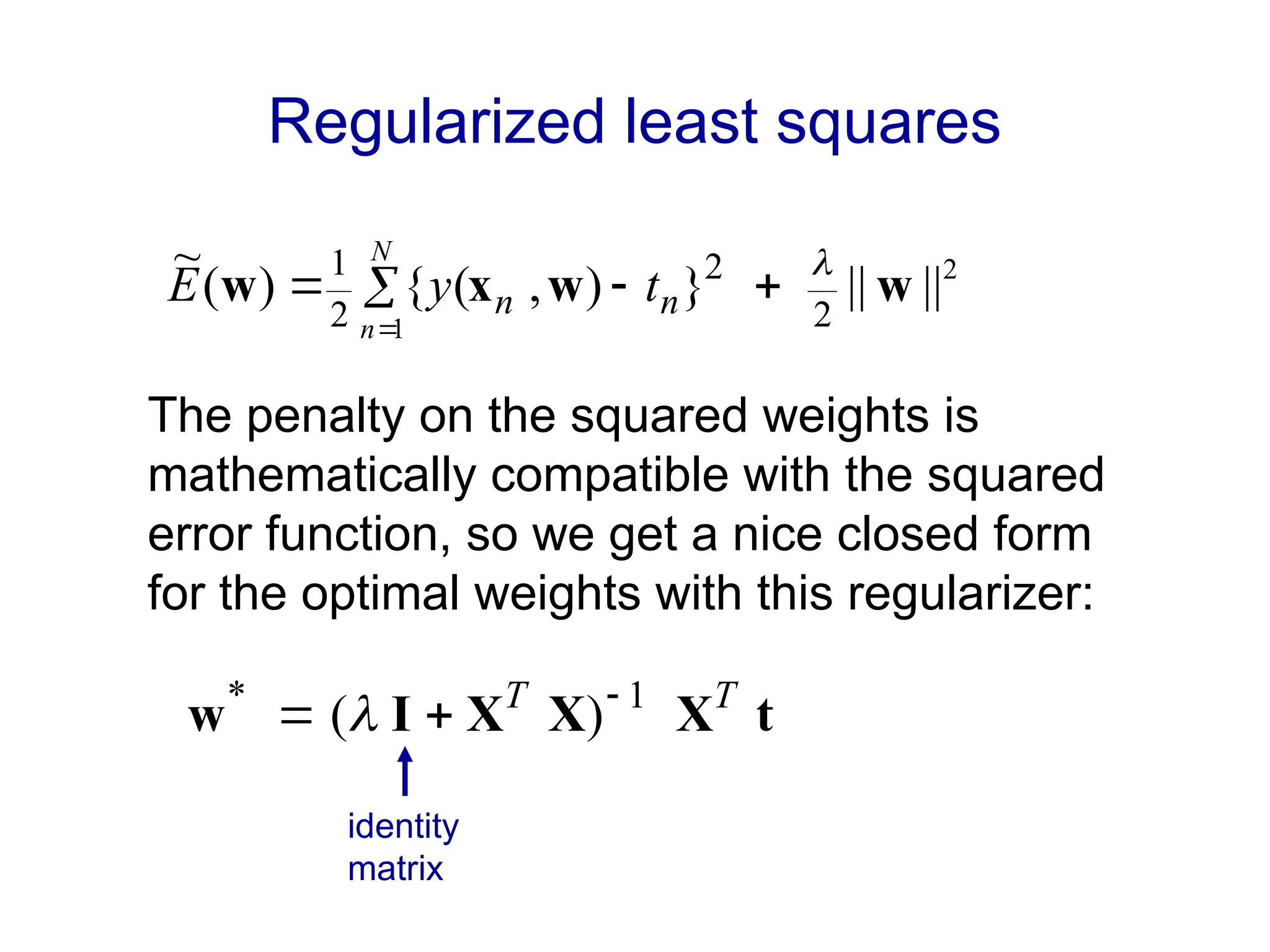
Regularized least squares
2
1
||
||
}
)
,
(
{
)
(
~
2
2
2
1
w
w
x
w






n
n t
y
E
N
n
t
X
X
X
I
w T
T 1
*
)
( 

 
The penalty on the squared weights is
mathematically compatible with the squared
error function, so we get a nice closed form
for the optimal weights with this regularizer:
identity
matrix
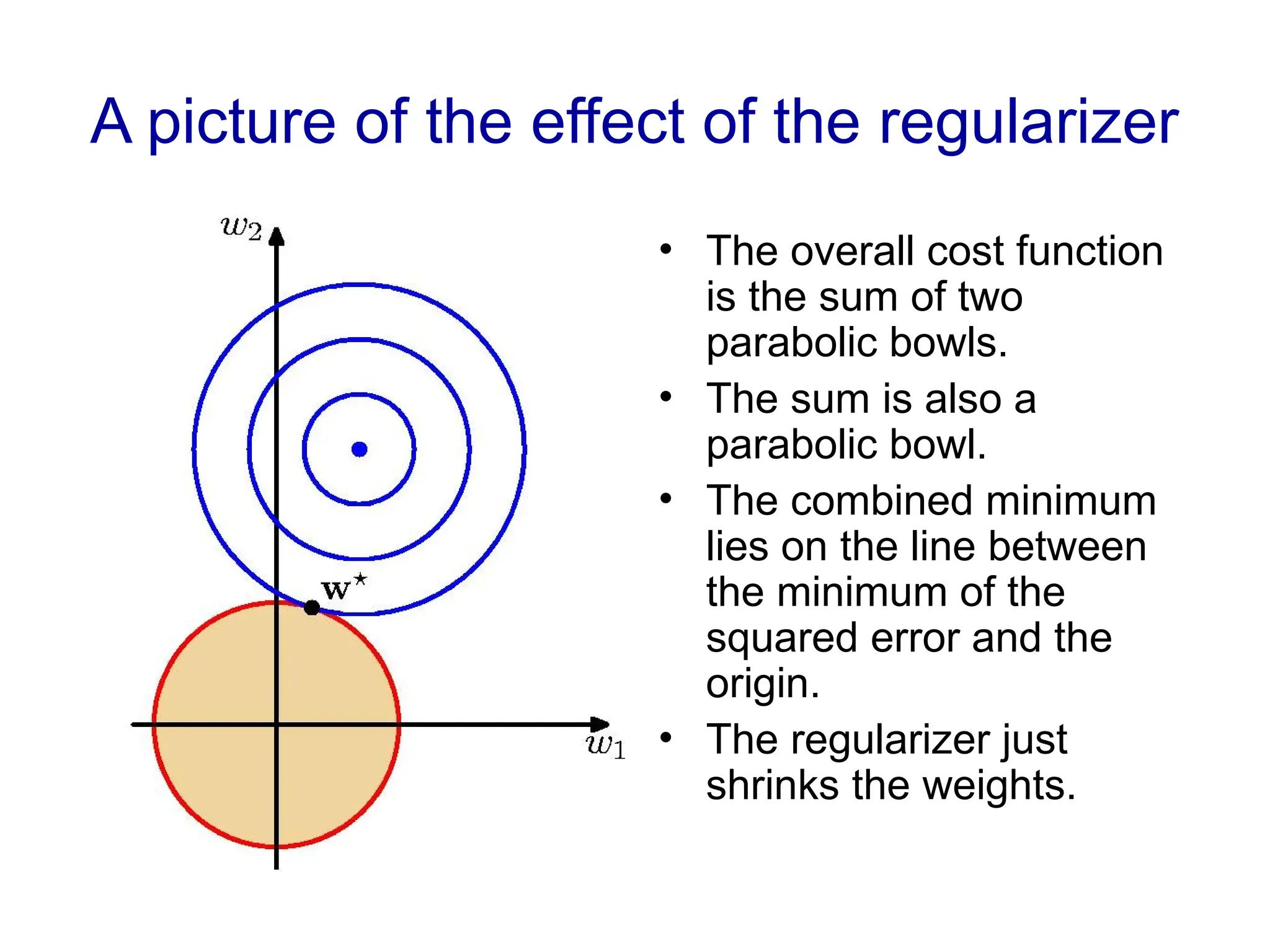
A picture of the effect of the regularizer
• The overall cost function
is the sum of two
parabolic bowls.
• The sum is also a
parabolic bowl.
• The combined minimum
lies on the line between
the minimum of the
squared error and the
origin.
• The regularizer just
shrinks the weights.
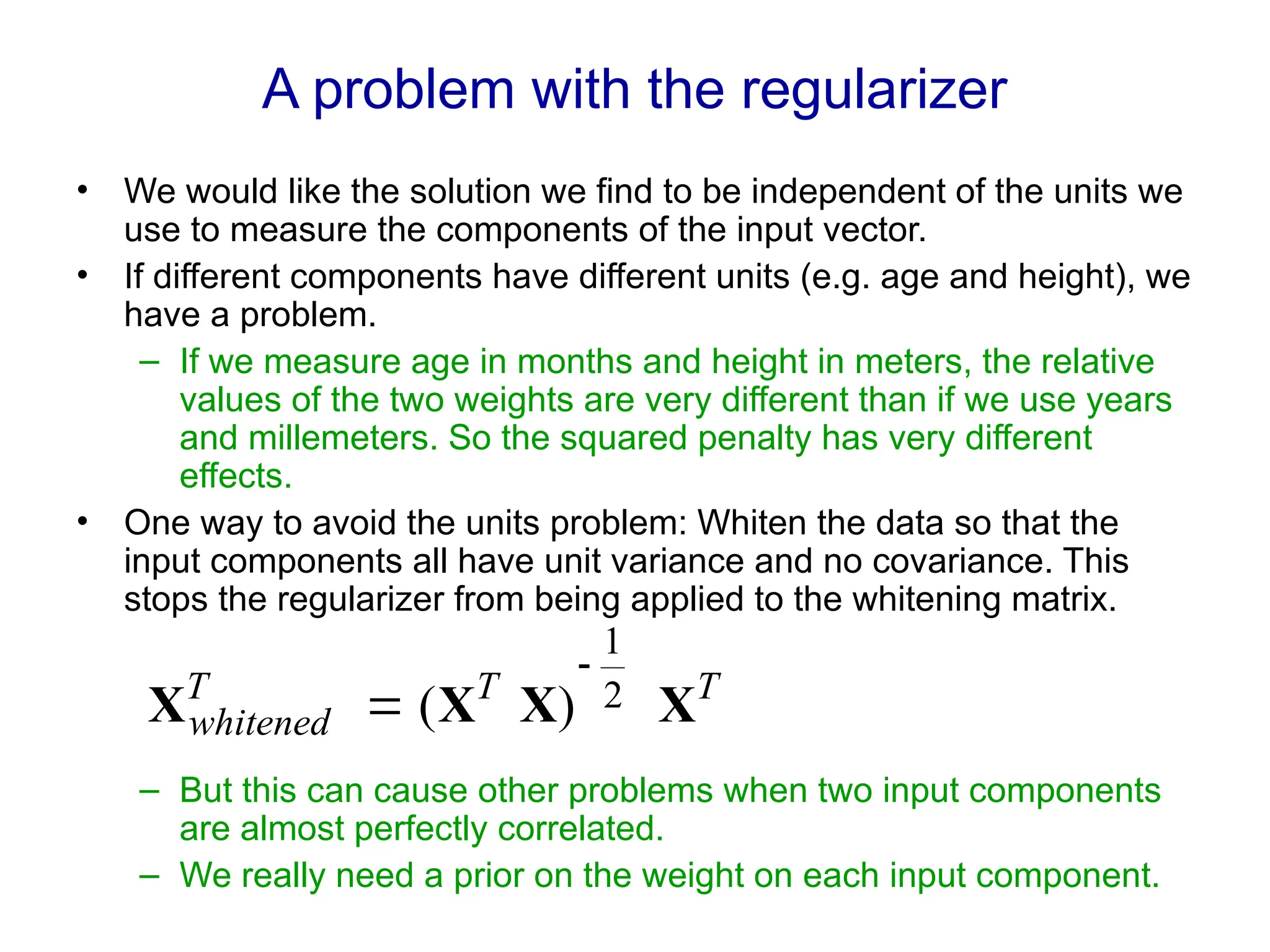
A problem with the regularizer
• We would like the solution we find to be independent of the units we
use to measure the components of the input vector.
• If different components have different units (e.g. age and height), we
have a problem.
– If we measure age in months and height in meters, the relative
values of the two weights are very different than if we use years
and millemeters. So the squared penalty has very different
effects.
• One way to avoid the units problem: Whiten the data so that the
input components all have unit variance and no covariance. This
stops the regularizer from being applied to the whitening matrix.
– But this can cause other problems when two input components
are almost perfectly correlated.
– We really need a prior on the weight on each input component.
T
T
T
whitened X
X
X
X 2
1
)
(


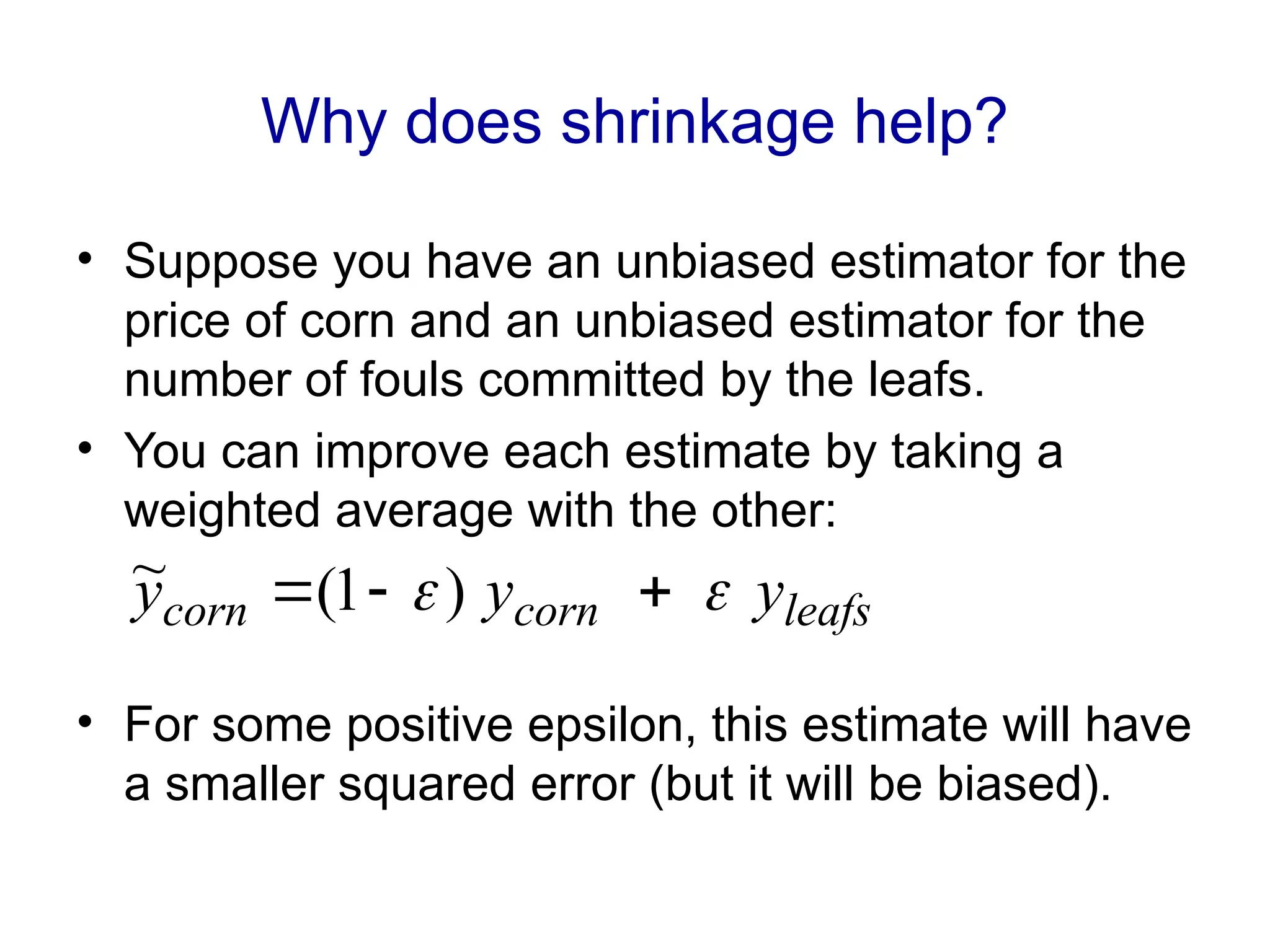
Why does shrinkage help?
• Suppose you have an unbiased estimator for the
price of corn and an unbiased estimator for the
number of fouls committed by the leafs.
• You can improve each estimate by taking a
weighted average with the other:
• For some positive epsilon, this estimate will have
a smaller squared error (but it will be biased).
leafs
corn
corn y
y
y 
 

 )
1
(
~
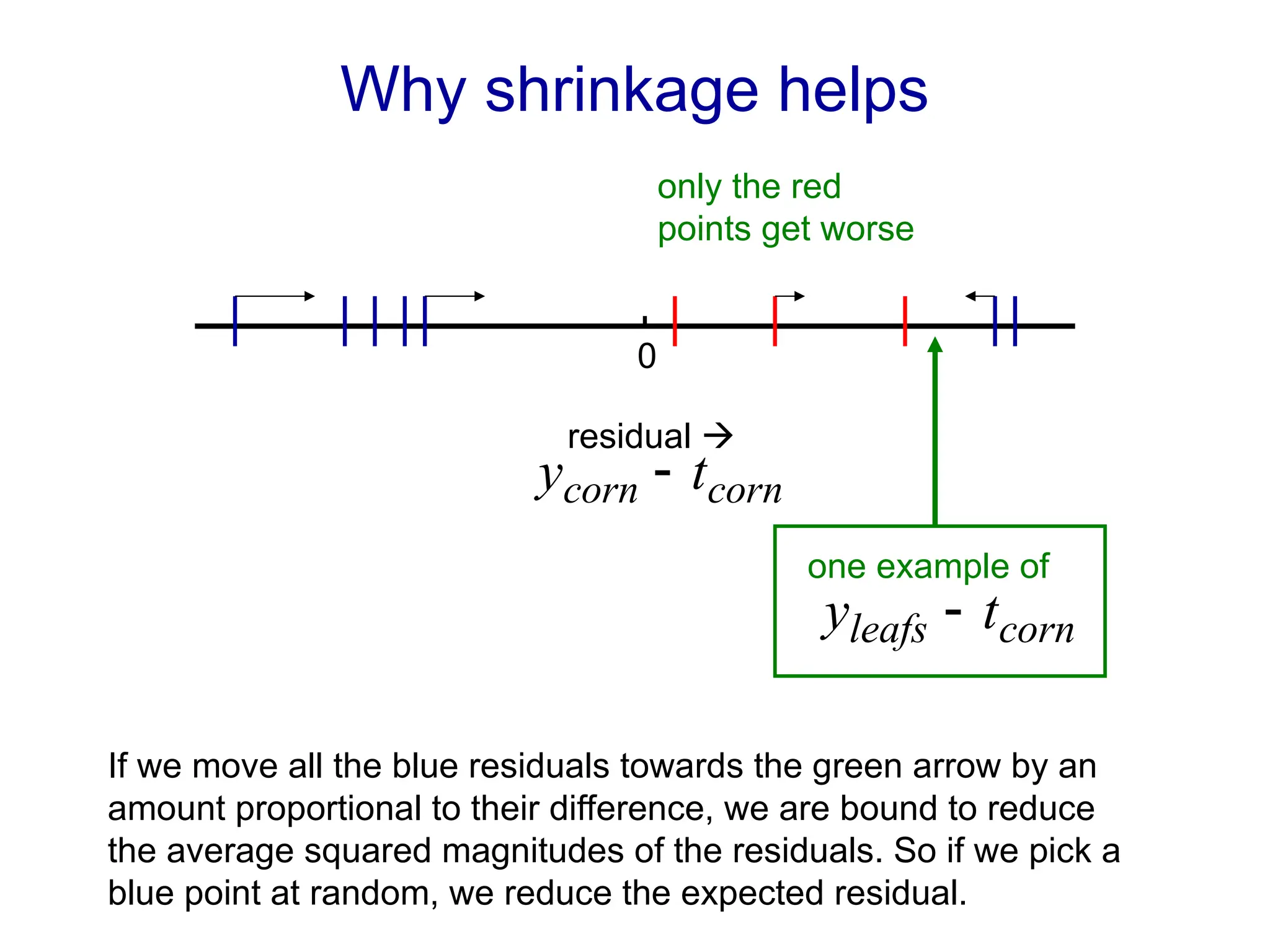
Why shrinkage helps
residual 
0
corn
corn t
y 
corn
leafs t
y 
one example of
If we move all the blue residuals towards the green arrow by an
amount proportional to their difference, we are bound to reduce
the average squared magnitudes of the residuals. So if we pick a
blue point at random, we reduce the expected residual.
only the red
points get worse
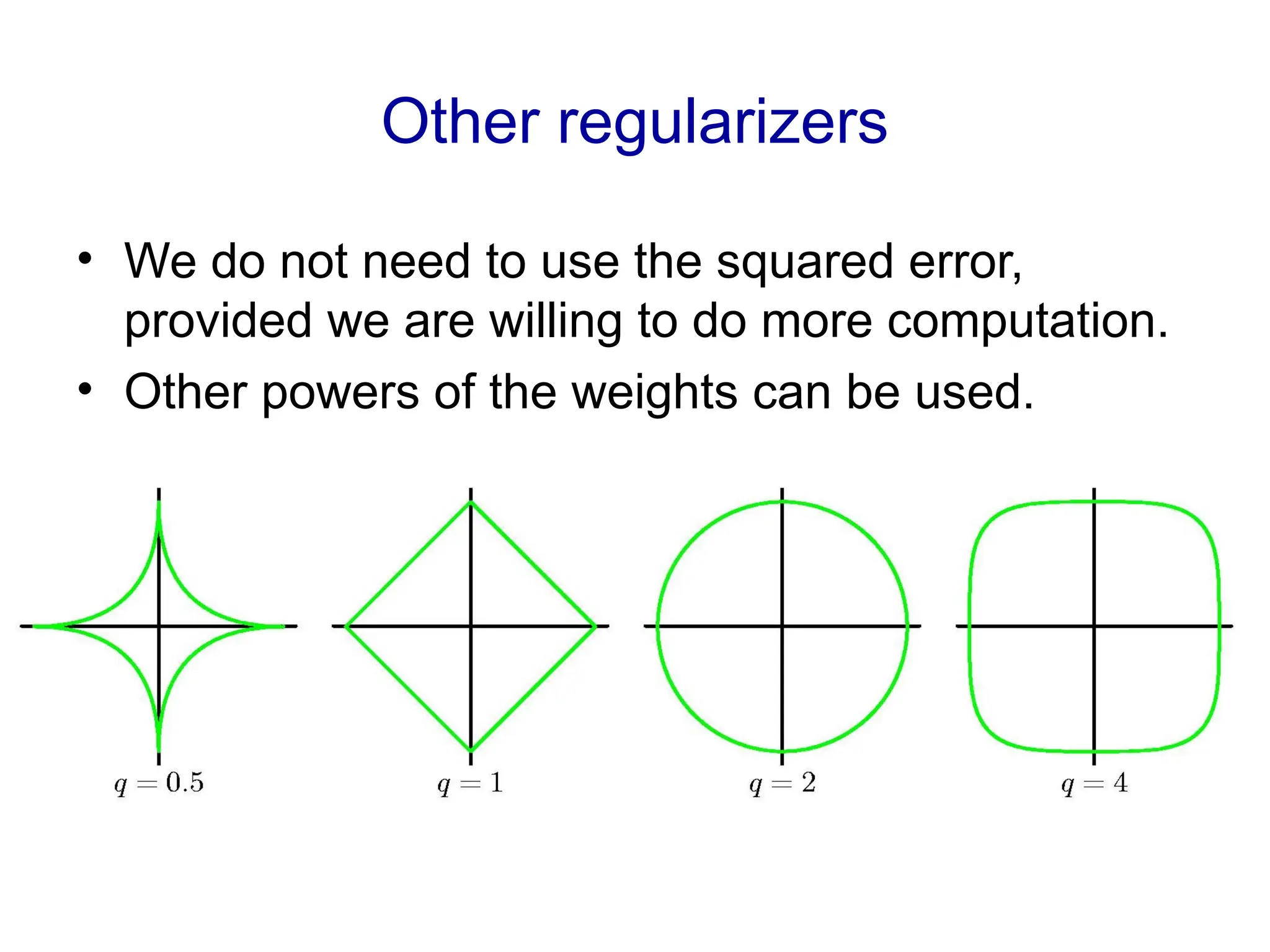
Other regularizers
• We do not need to use the squared error,
provided we are willing to do more computation.
• Other powers of the weights can be used.
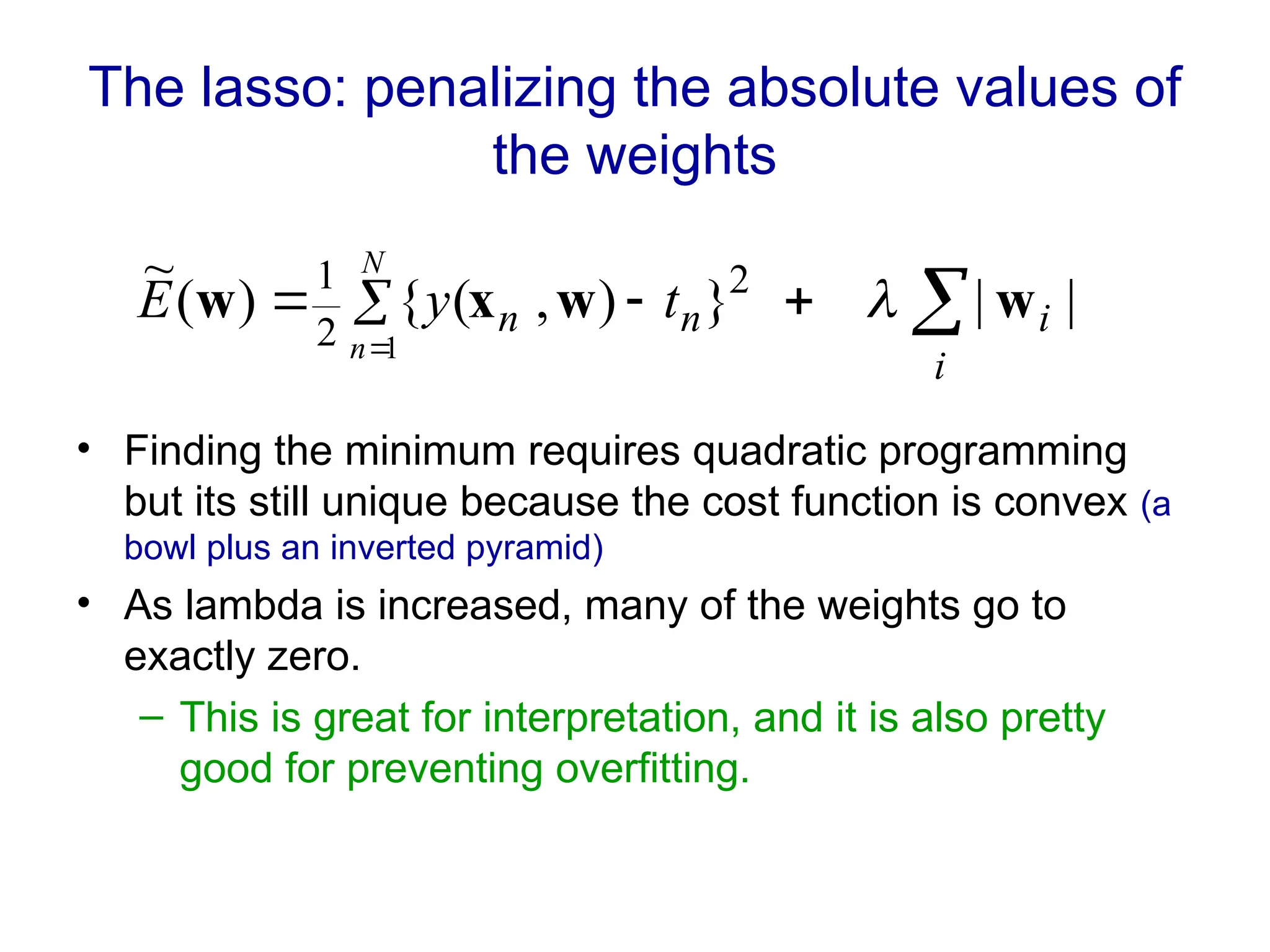
The lasso: penalizing the absolute values of
the weights
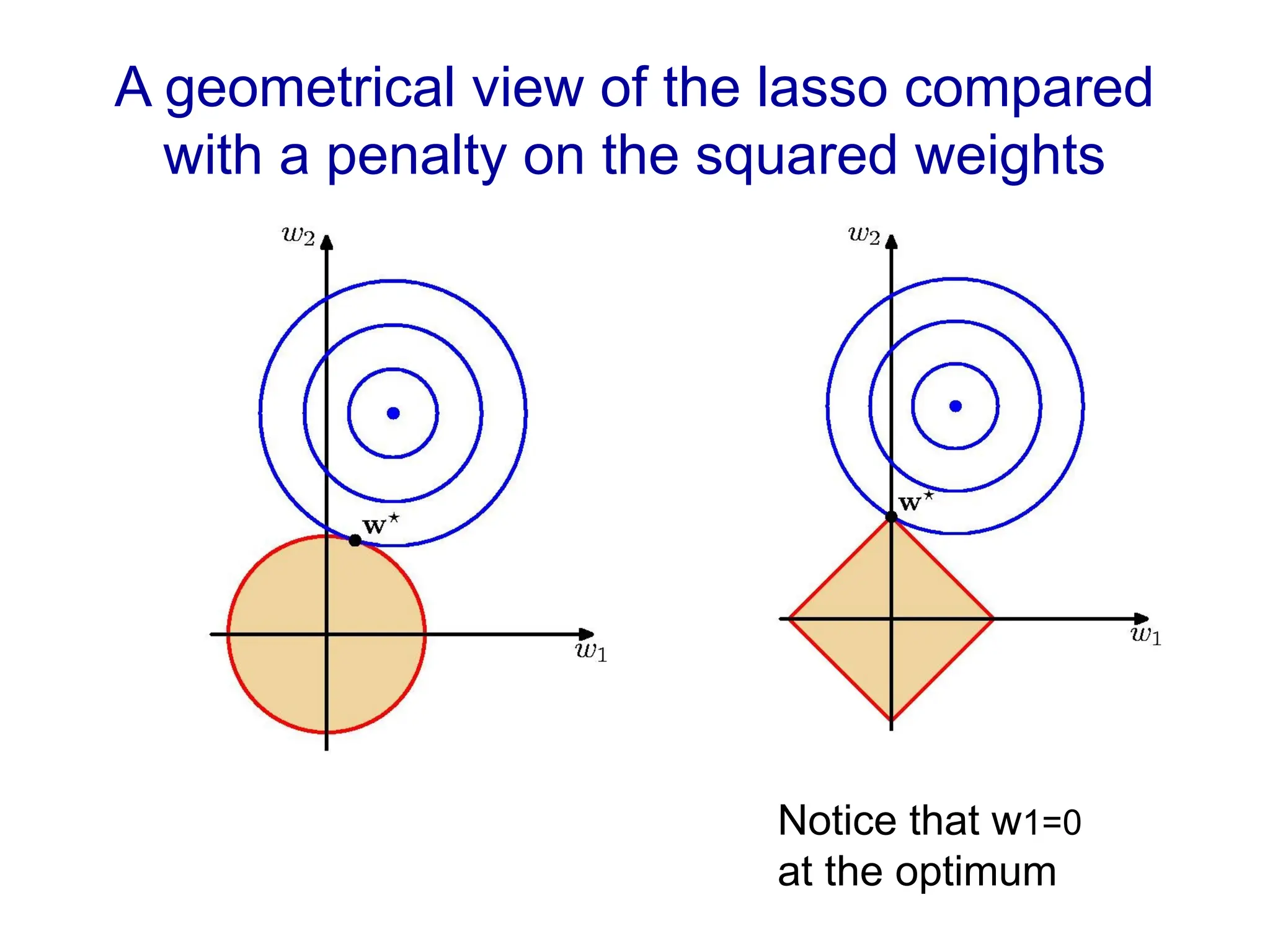
• Finding the minimum requires quadratic programming
but its still unique because the cost function is convex (a
bowl plus an inverted pyramid)
• As lambda is increased, many of the weights go to
exactly zero.
– This is great for interpretation, and it is also pretty
good for preventing overfitting.






i
i
n
n t
y
E
N
n
|
|
}
)
,
(
{
)
(
~ 2
2
1
1
w
w
x
w 
A geometrical view of the lasso compared
with a penalty on the squared weights
Notice that w1=0
at the optimum
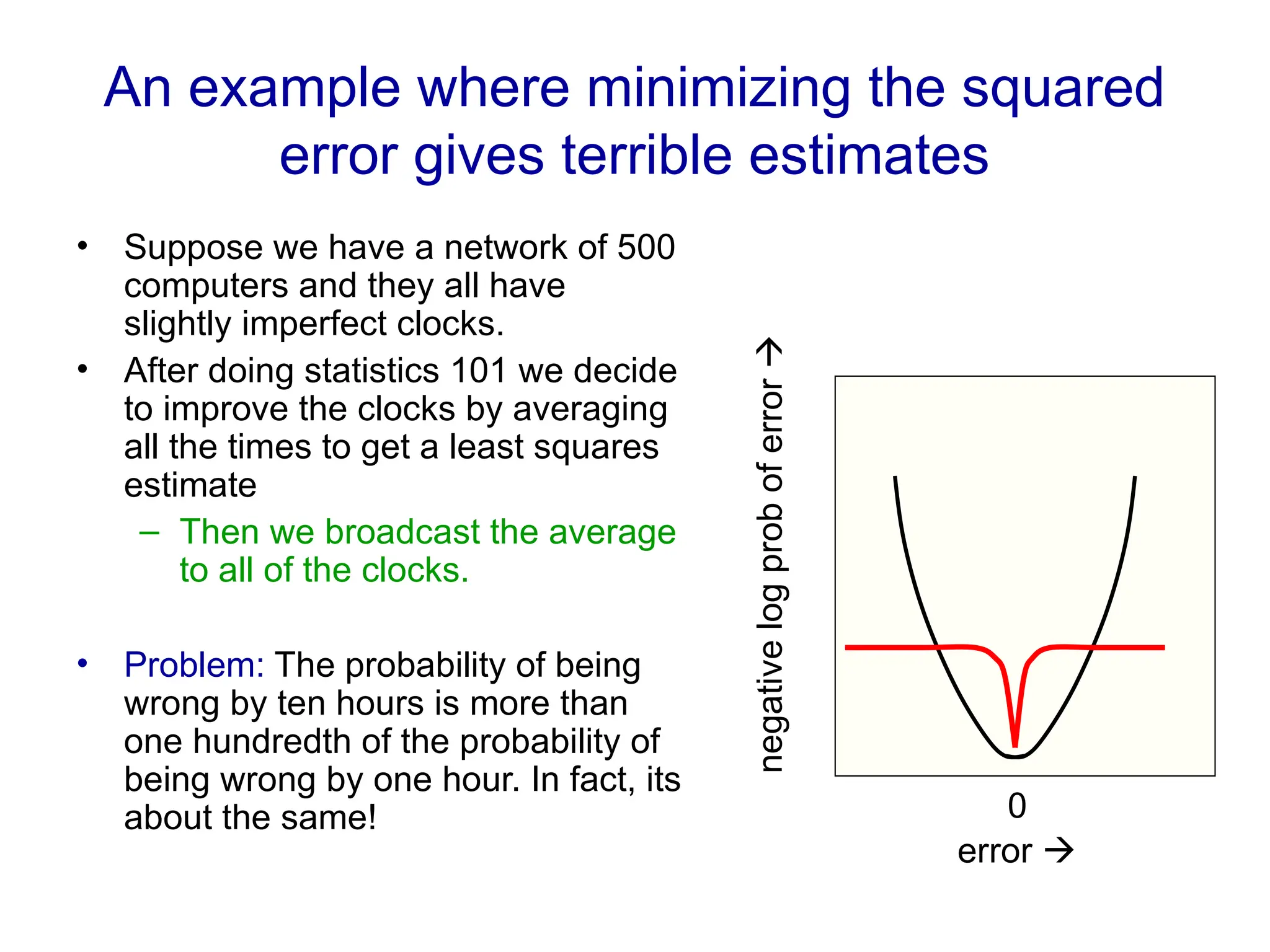
An example where minimizing the squared
error gives terrible estimates
• Suppose we have a network of 500
computers and they all have
slightly imperfect clocks.
• After doing statistics 101 we decide
to improve the clocks by averaging
all the times to get a least squares
estimate
– Then we broadcast the average
to all of the clocks.
• Problem: The probability of being
wrong by ten hours is more than
one hundredth of the probability of
being wrong by one hour. In fact, its
about the same!
error 
0
negative
log
prob
of
error

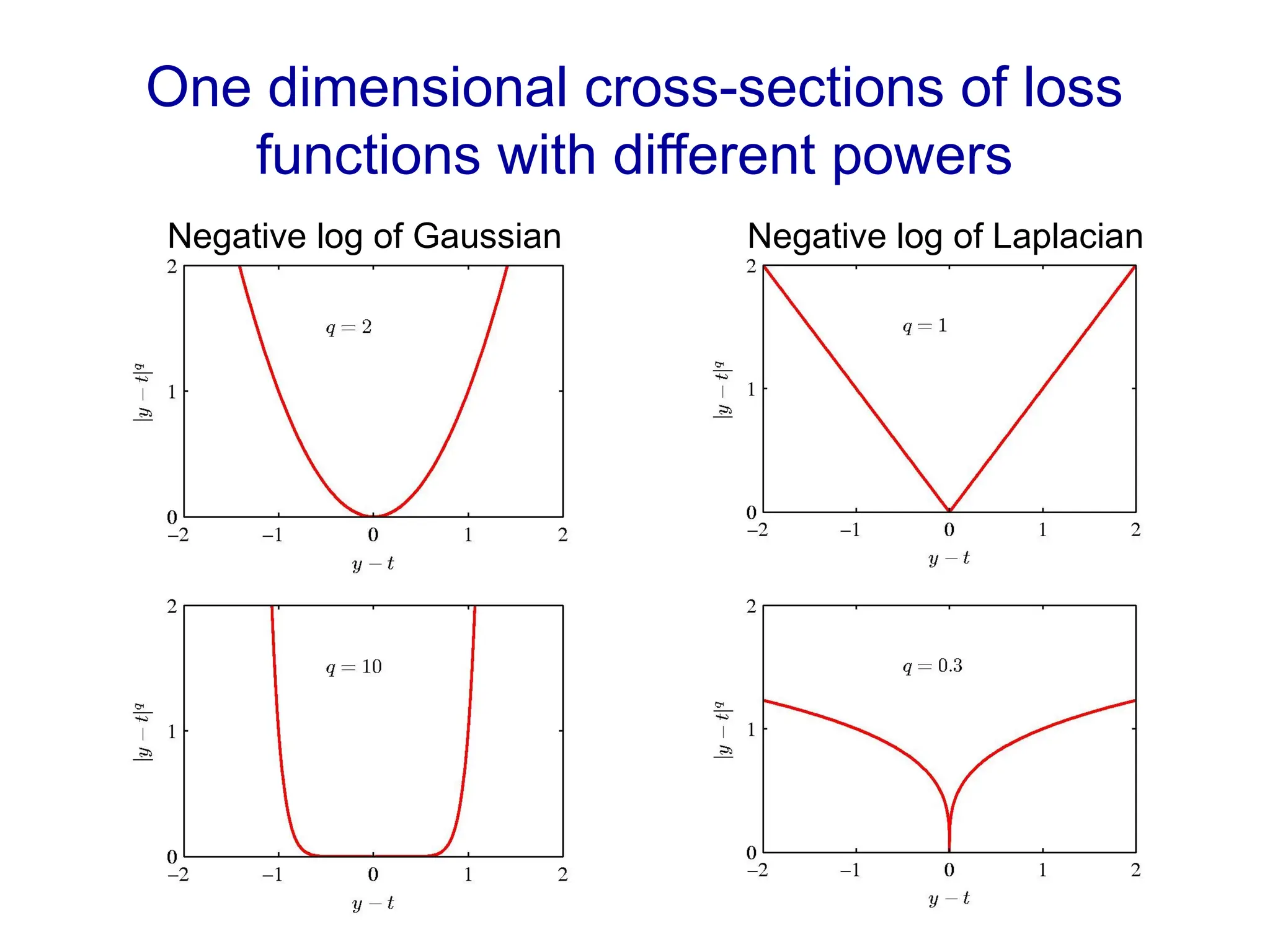
One dimensional cross-sections of loss
functions with different powers
Negative log of Gaussian Negative log of Laplacian
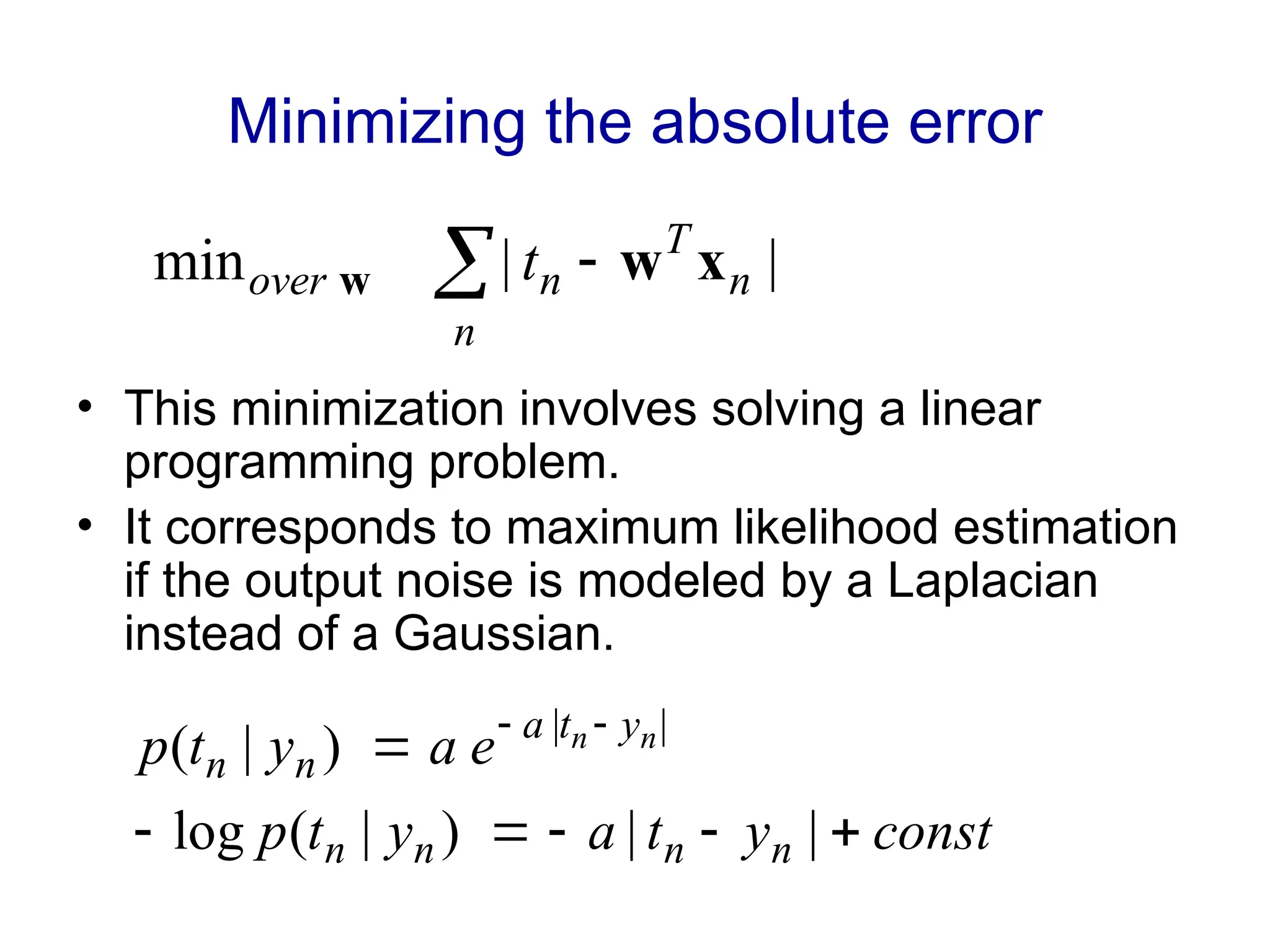
Minimizing the absolute error
• This minimization involves solving a linear
programming problem.
• It corresponds to maximum likelihood estimation
if the output noise is modeled by a Laplacian
instead of a Gaussian.
 
n
n
T
n
over t |
|
min x
w
w
const
y
t
a
y
t
p
e
a
y
t
p
n
n
n
n
y
t
a
n
n
n
n





 

|
|
)
|
(
log
)
|
( |
|
The bias-variance trade-off
(a figment of the frequentists lack of imagination?)
• Imagine that the training set was drawn at random from a
whole set of training sets.
• The squared loss can be decomposed into a “bias” term
and a “variance” term.
– Bias = systematic error in the model’s estimates
– Variance = noise in the estimates cause by sampling
noise in the training set.
• There is also an additional loss due to the fact that the
target values are noisy.
– We eliminate this extra, irreducible loss from the math
by using the average target values (i.e. the unknown,
noise-free values)
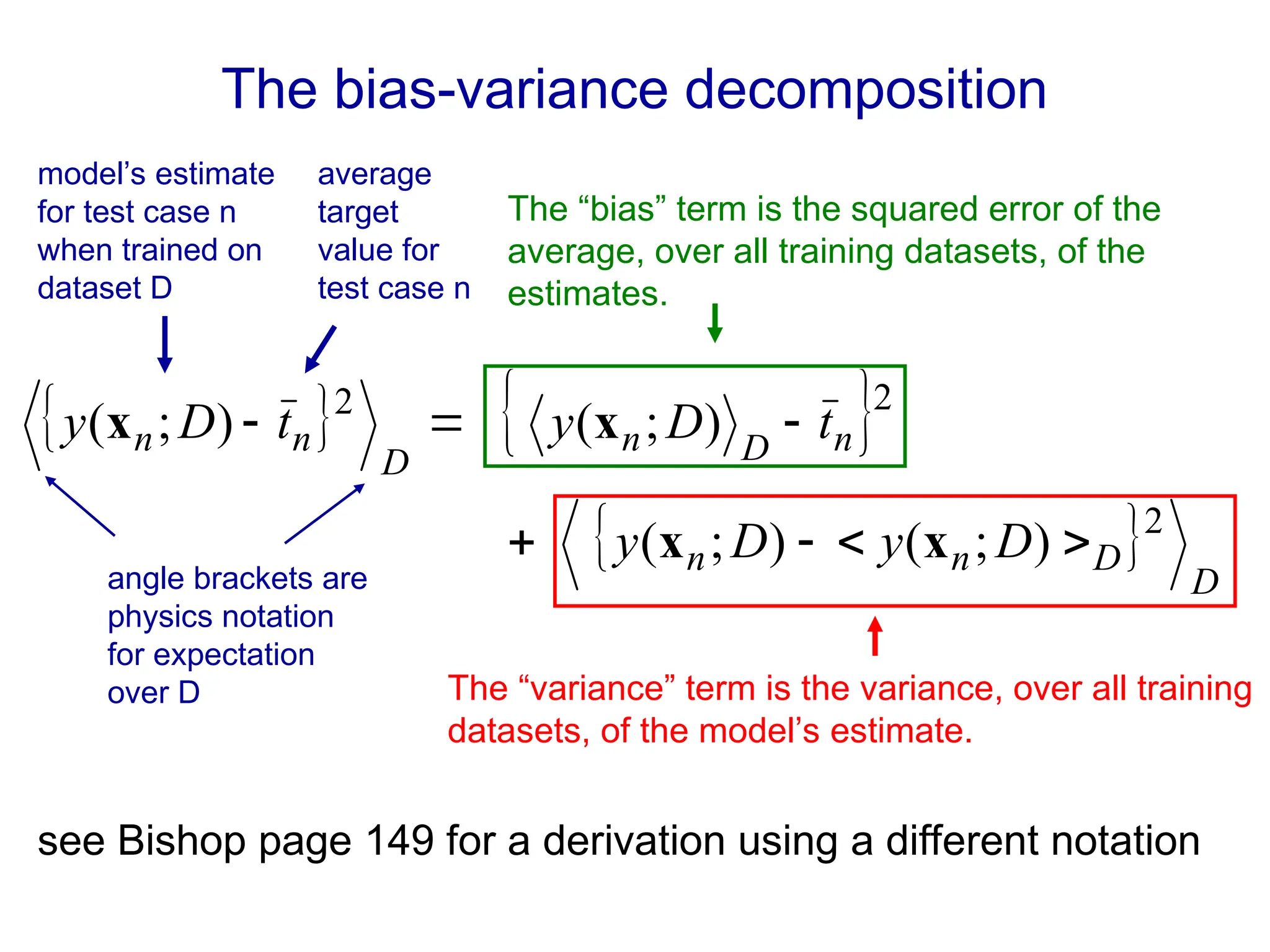
   
 
D
D
n
n
n
D
n
D
n
n
D
y
D
y
t
D
y
t
D
y
2
2
2
)
;
(
)
;
(
)
;
(
)
;
(







x
x
x
x
average
target
value for
test case n
model’s estimate
for test case n
when trained on
dataset D
angle brackets are
physics notation
for expectation
over D
The “bias” term is the squared error of the
average, over all training datasets, of the
estimates.
The “variance” term is the variance, over all training
datasets, of the model’s estimate.
see Bishop page 149 for a derivation using a different notation
The bias-variance decomposition
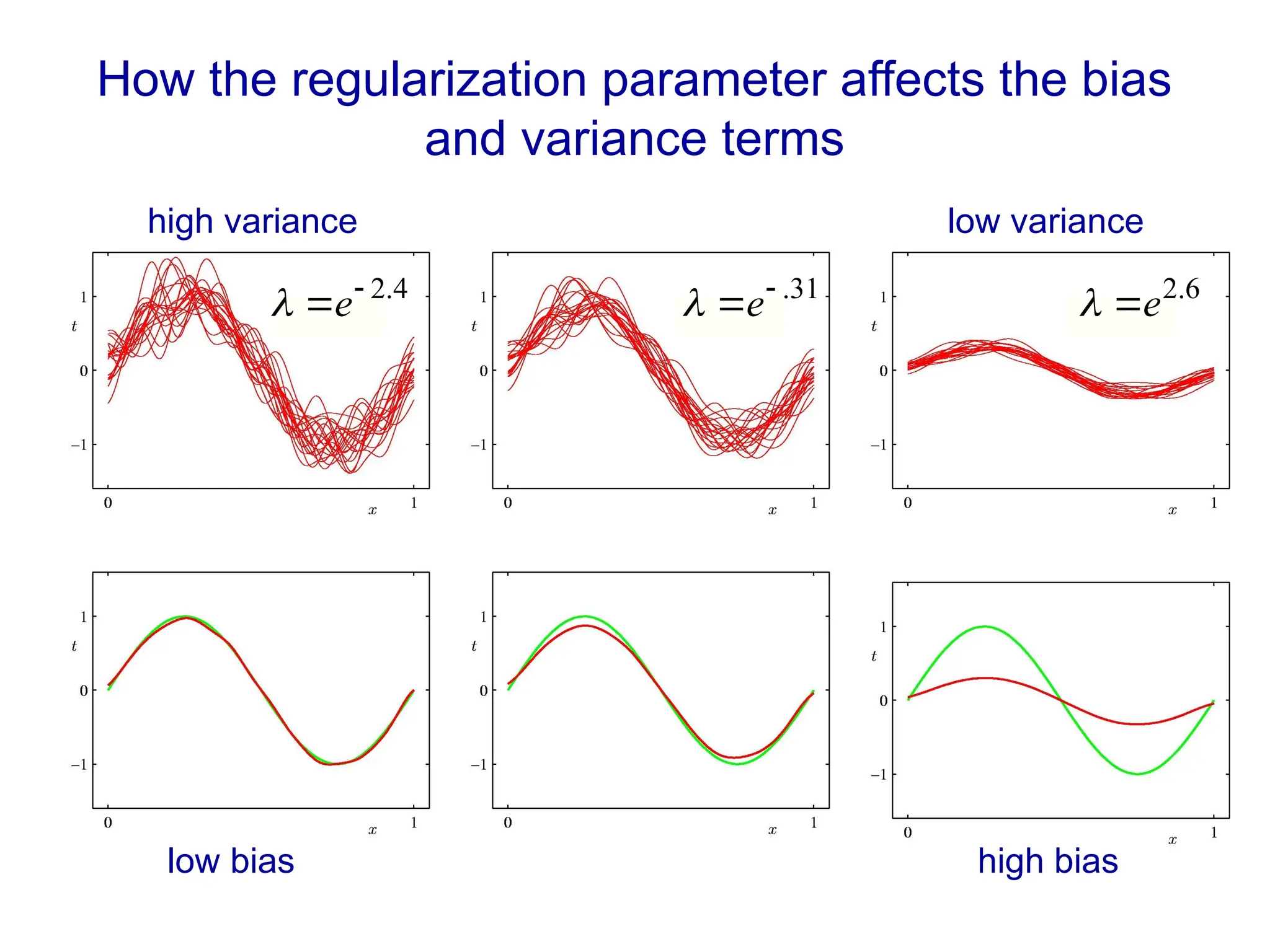
How the regularization parameter affects the bias
and variance terms
low bias high bias
low variance
high variance
4
.
2

e
 31
.

e
 6
.
2
e


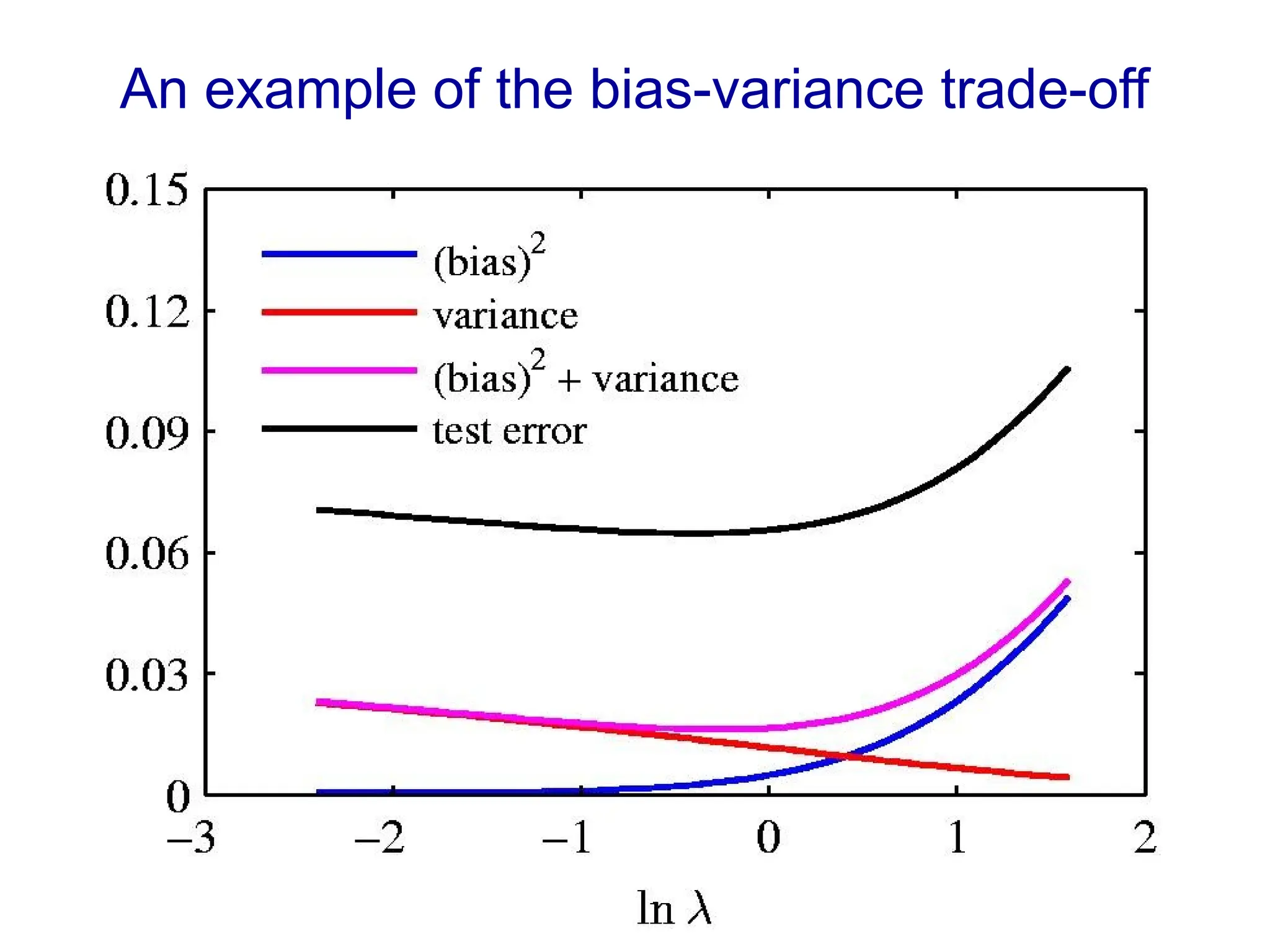
An example of the bias-variance trade-off
Beating the bias-variance trade-off
• We can reduce the variance term by averaging lots of
models trained on different datasets.
– This seems silly. If we had lots of different datasets it
would be better to combine them into one big training
set.
• With more training data there will be much less variance.
• Weird idea: We can create different datasets by bootstrap
sampling of our single training dataset.
– This is called “bagging” and it works surprisingly well.
• But if we have enough computation its better to do the
right Bayesian thing:
– Combine the predictions of many models using the
posterior probability of each parameter vector as the
combination weight.
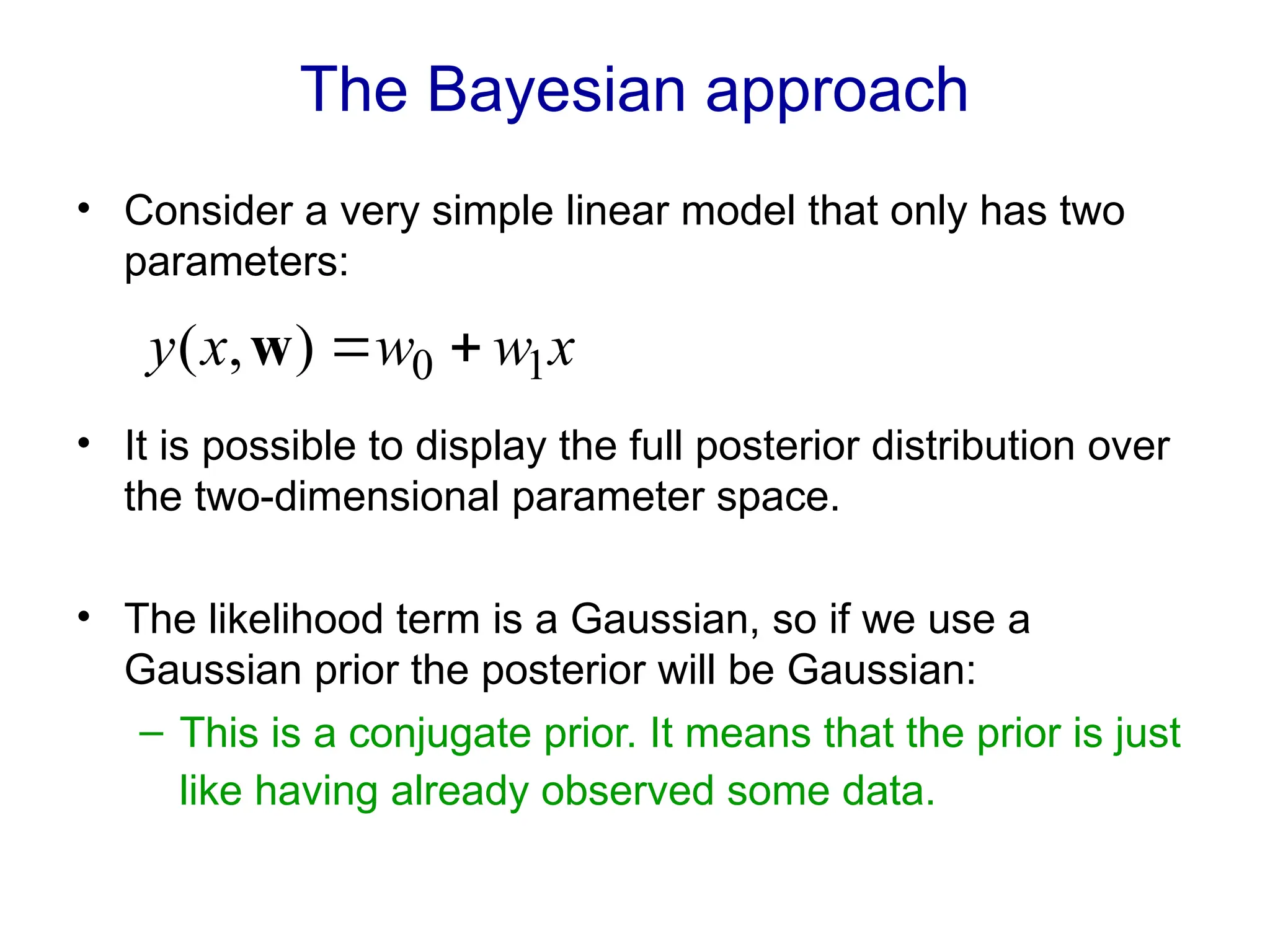
The Bayesian approach
• Consider a very simple linear model that only has two
parameters:
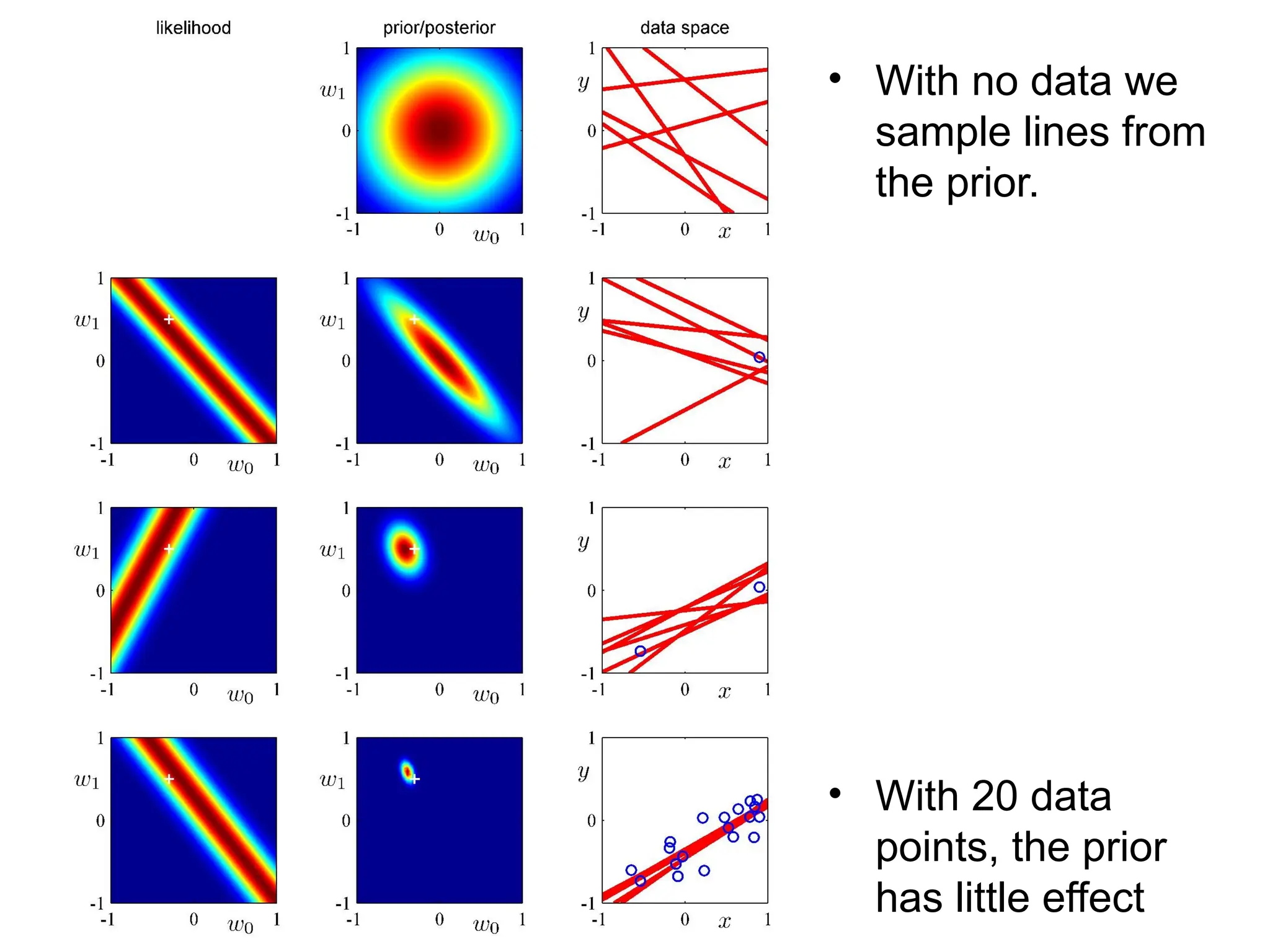
• It is possible to display the full posterior distribution over
the two-dimensional parameter space.
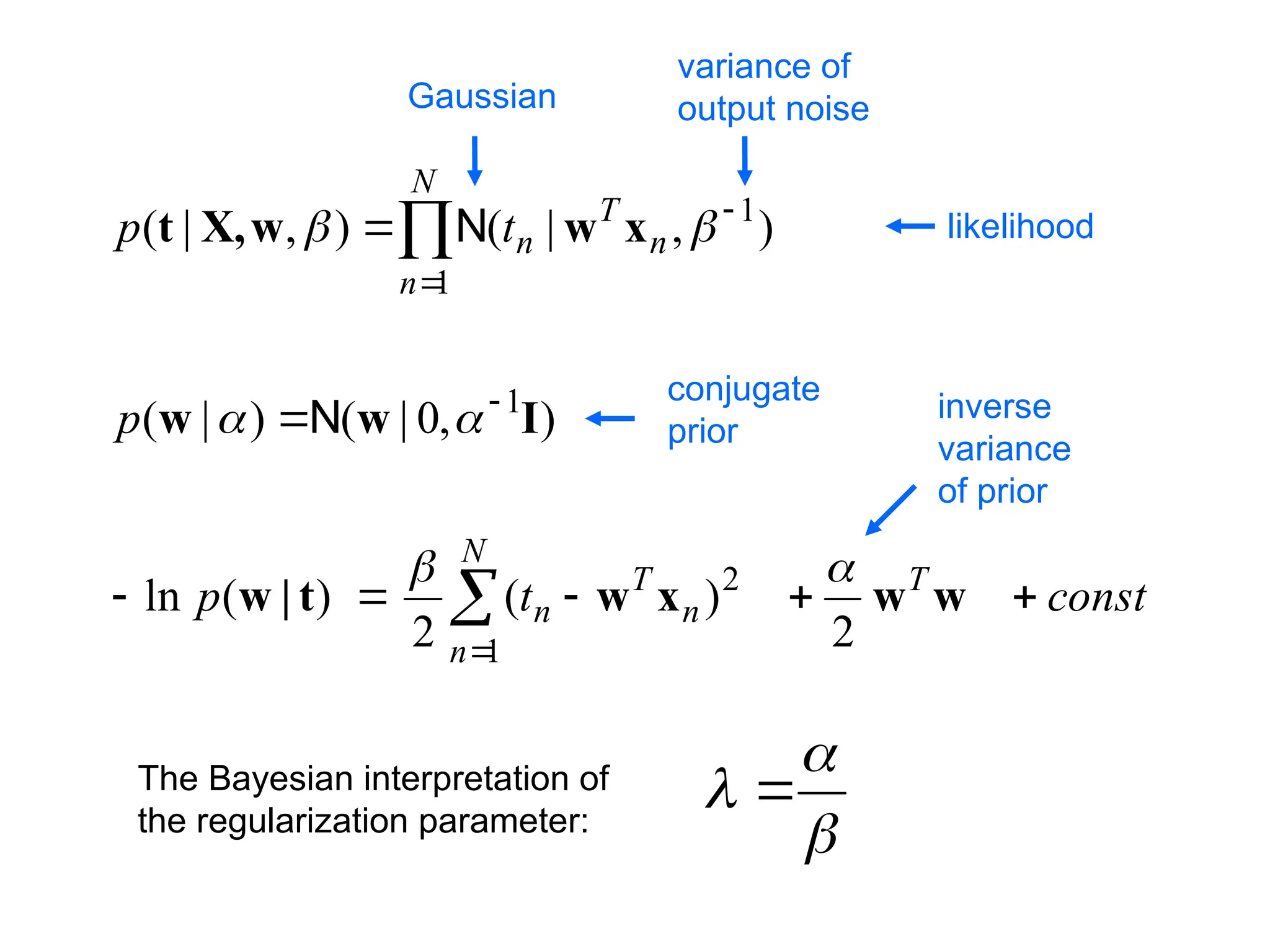
• The likelihood term is a Gaussian, so if we use a
Gaussian prior the posterior will be Gaussian:
– This is a conjugate prior. It means that the prior is just
like having already observed some data.
x
w
w
x
y 1
0
)
,
( 

w
const
t
p
p
t
p
T
N
n
n
T
n
N
n
n
T
n













w
w
x
w
t
|
w
I
w
w
x
w
w
X,
t
1
2
1
1
1
2
)
(
2
)
(
ln
)
,
0
|
(
)
|
(
)
,
|
(
)
,
|
(






N
Ν likelihood
conjugate
prior
Gaussian
variance of
output noise
inverse
variance
of prior


 
The Bayesian interpretation of
the regularization parameter:
• With no data we
sample lines from
the prior.
• With 20 data
points, the prior
has little effect
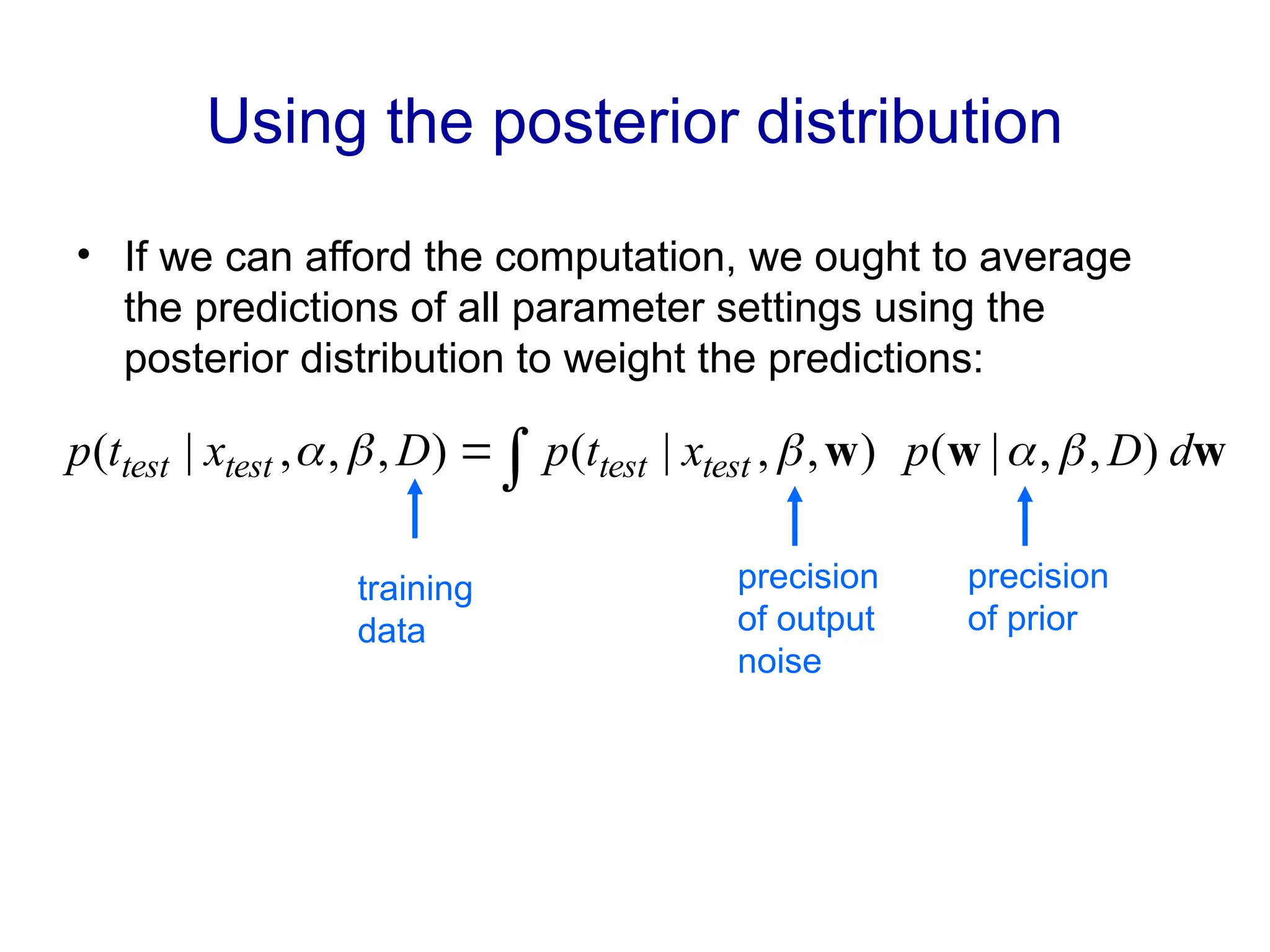
Using the posterior distribution
• If we can afford the computation, we ought to average
the predictions of all parameter settings using the
posterior distribution to weight the predictions:
w
w
w d
D
p
x
t
p
D
x
t
p test
test
test
test )
,
,
|
(
)
,
,
|
(
)
,
,
,
|
( 



 

training
data
precision
of output
noise
precision
of prior
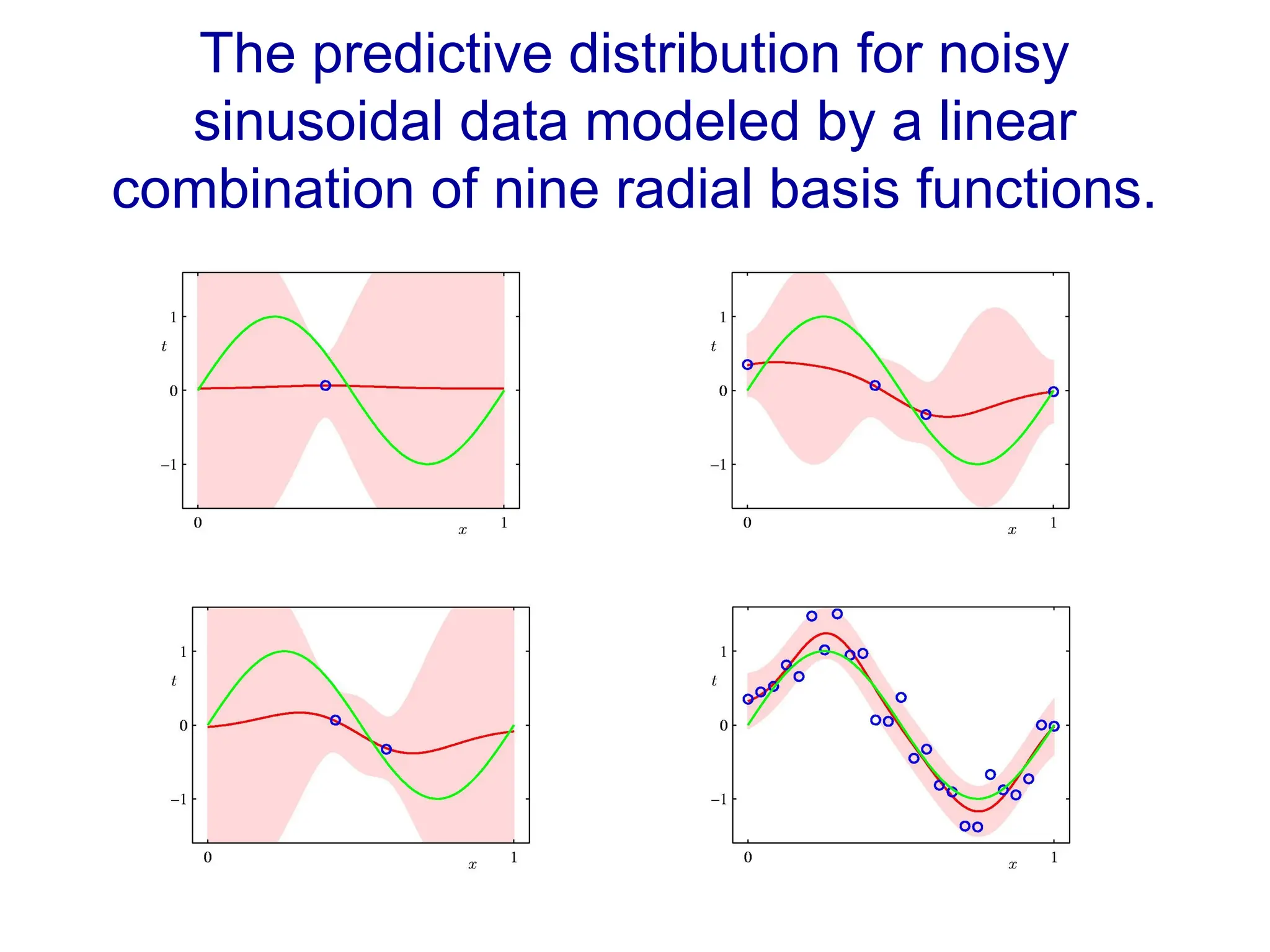
The predictive distribution for noisy
sinusoidal data modeled by a linear
combination of nine radial basis functions.
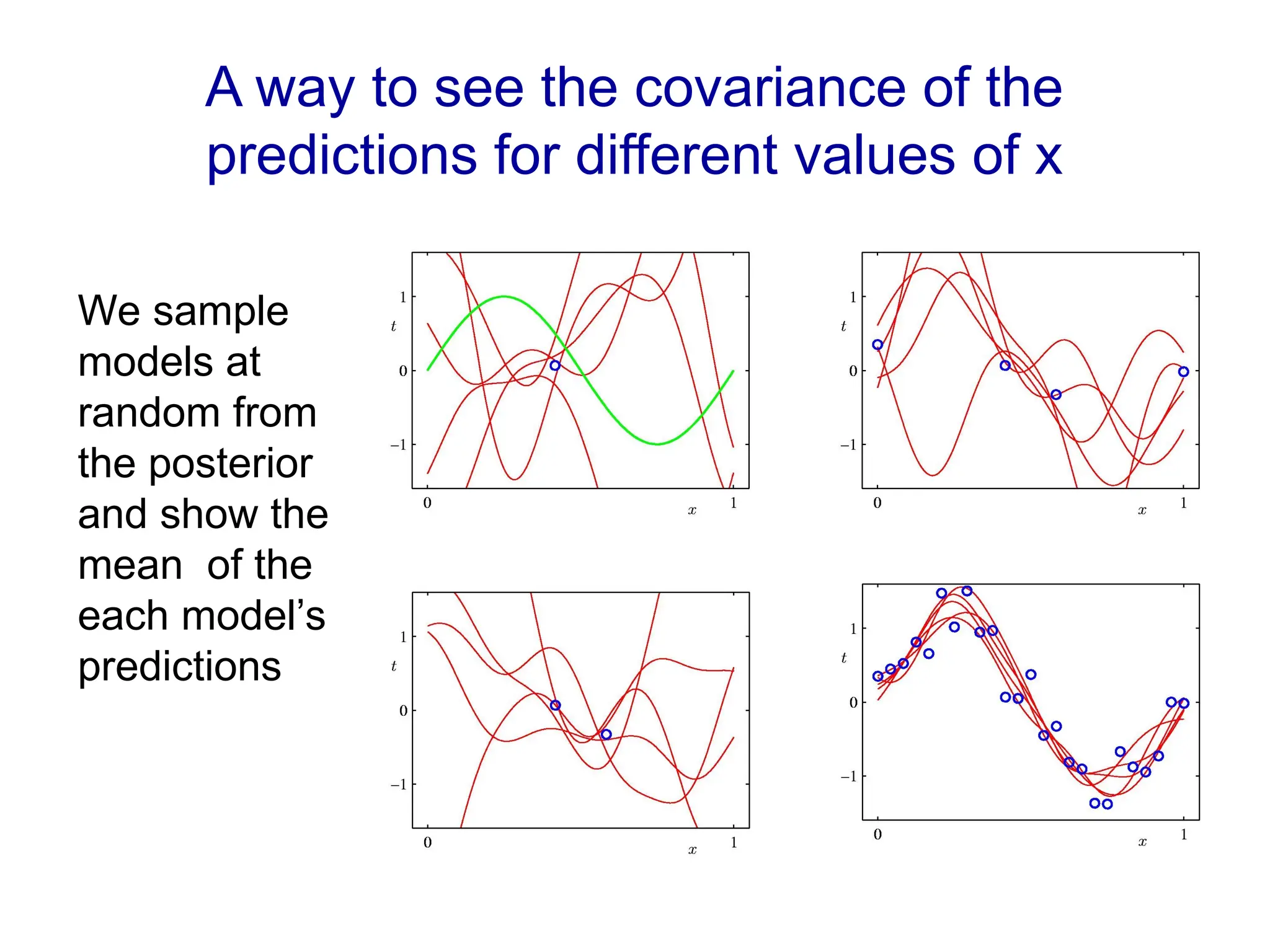
A way to see the covariance of the
predictions for different values of x
We sample
models at
random from
the posterior
and show the
mean of the
each model’s
predictions
Bayesian model comparison
• We usually need to decide between many different models:
– Different numbers of basis functions
– Different types of basis functions
– Different strengths of regularizers
• The frequentist way to decide between models is to hold back a
validation set and pick the model that does best on the validation
data.
– This gives less training data. We can use a small validation set
and evaluate models by training many different times using
different small validation sets. But this is tedious.
• The Bayesian alternative is to use all of the data for training each
model and to use the “evidence” to pick the best model (or to
average over models).
• The evidence is the marginal likelihood with the parameters
integrated out.
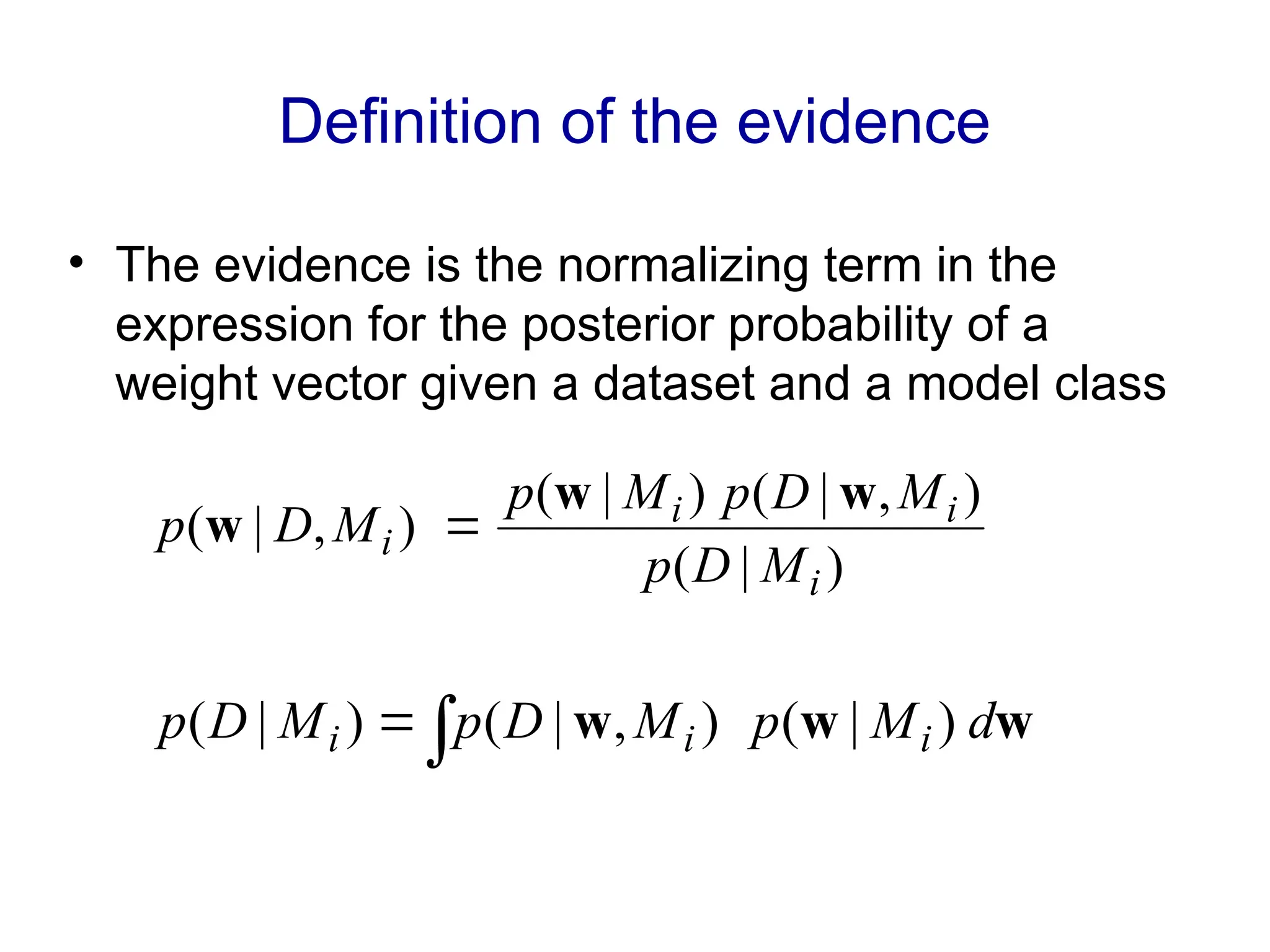
Definition of the evidence
• The evidence is the normalizing term in the
expression for the posterior probability of a
weight vector given a dataset and a model class
w
w
w d
M
p
M
D
p
M
D
p i
i
i )
|
(
)
,
|
(
)
|
( 

)
|
(
)
,
|
(
)
|
(
)
,
|
(
i
i
i
i
M
D
p
M
D
p
M
p
M
D
p
w
w
w 
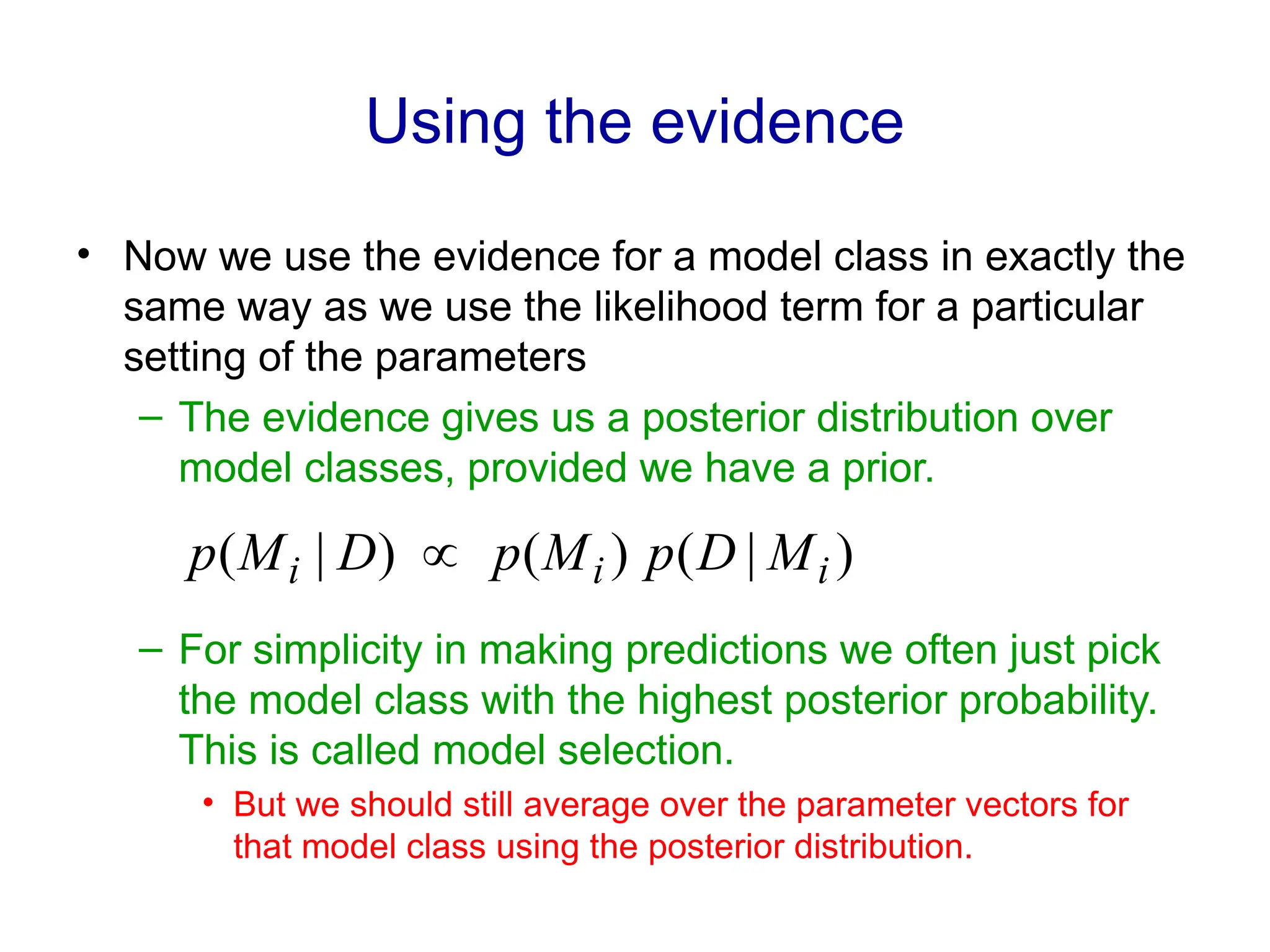
Using the evidence
• Now we use the evidence for a model class in exactly the
same way as we use the likelihood term for a particular
setting of the parameters
– The evidence gives us a posterior distribution over
model classes, provided we have a prior.
– For simplicity in making predictions we often just pick
the model class with the highest posterior probability.
This is called model selection.
• But we should still average over the parameter vectors for
that model class using the posterior distribution.
)
|
(
)
(
)
|
( i
i
i M
D
p
M
p
D
M
p 
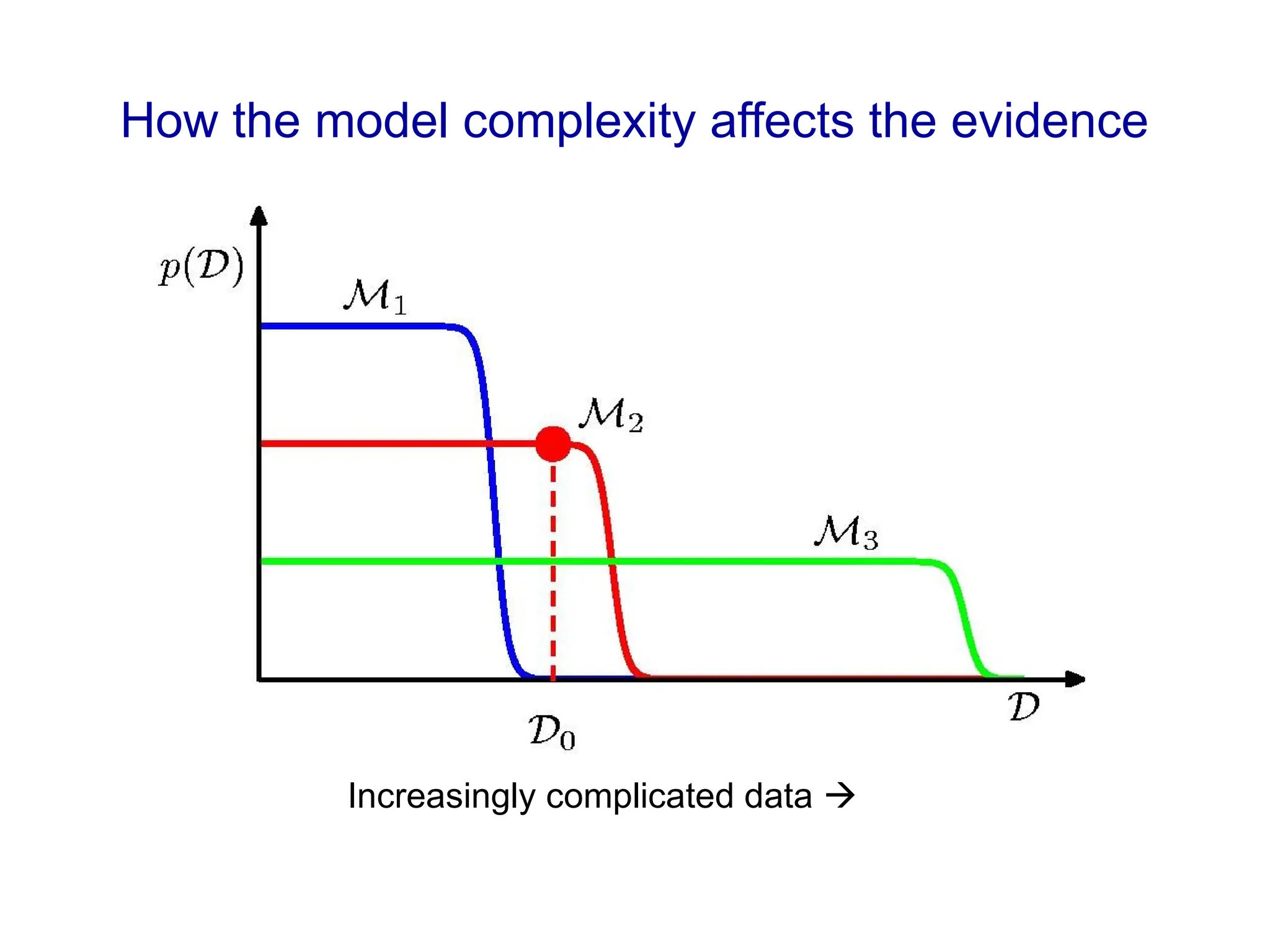
How the model complexity affects the evidence
Increasingly complicated data 
Determining the hyperparameters that
specify the variance of the prior and the
variance of the output noise.
• Ideally, when making a prediction, we would like to
integrate out the hyperparameters, just like we integrate
out the weights
– But this is infeasible even when everything is Gaussian.
• Empirical Bayes (also called the evidence approximation)
means integrating out the parameters but maximizing over
the hyperparameters.
– Its more feasible and often works well.
– It creates ideological disputes.
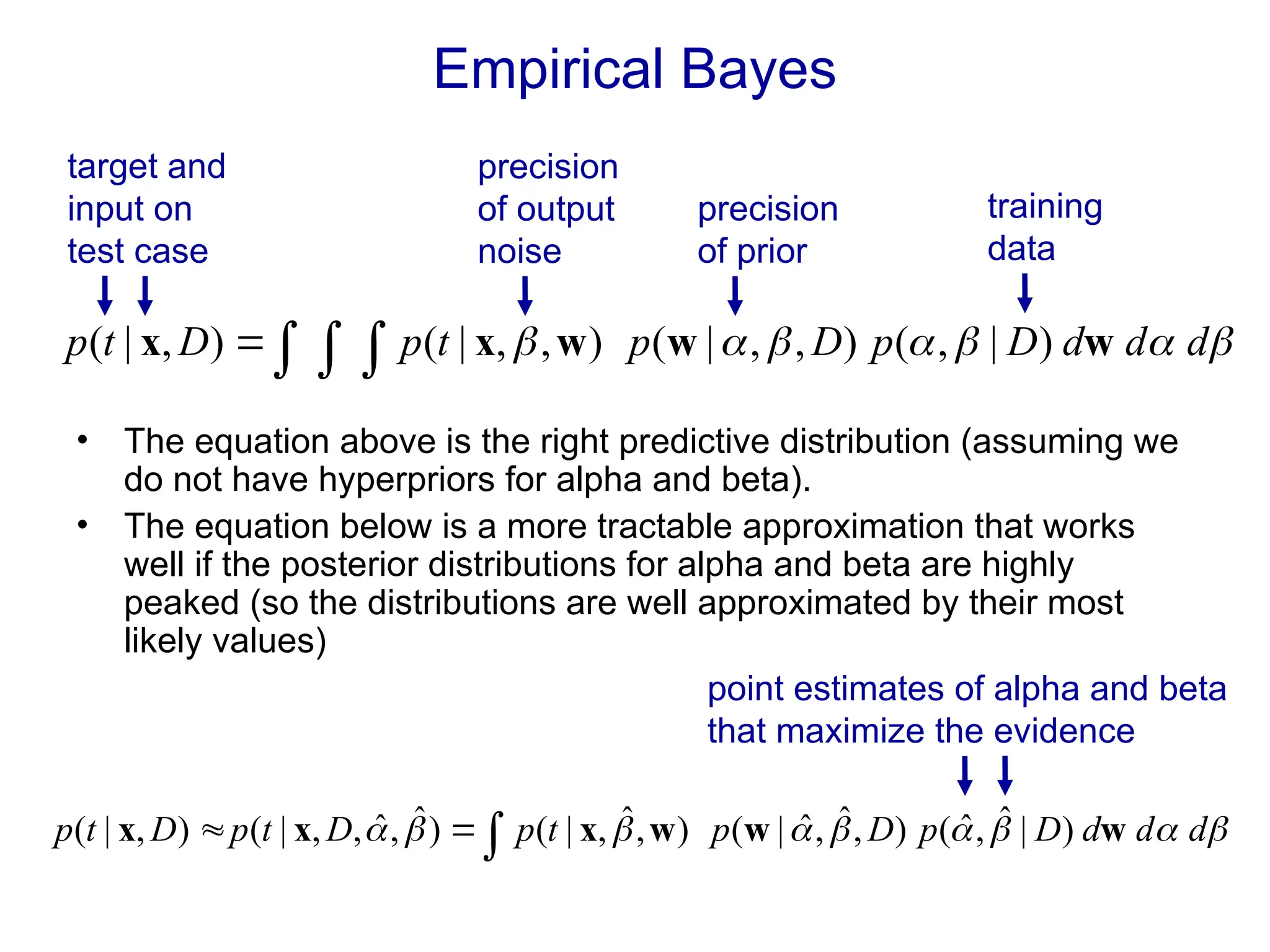
Empirical Bayes
• The equation above is the right predictive distribution (assuming we
do not have hyperpriors for alpha and beta).
• The equation below is a more tractable approximation that works
well if the posterior distributions for alpha and beta are highly
peaked (so the distributions are well approximated by their most
likely values)






 d
d
d
D
p
D
p
t
p
D
t
p w
w
w
x
x )
|
,
(
)
,
,
|
(
)
,
,
|
(
)
,
|
( 



target and
input on
test case
training
data
point estimates of alpha and beta
that maximize the evidence








 d
d
d
D
p
D
p
t
p
D
t
p
D
t
p w
w
w
x
x
x )
|
ˆ
,
ˆ
(
)
,
ˆ
,
ˆ
|
(
)
,
ˆ
,
|
(
)
ˆ
,
ˆ
,
,
|
(
)
,
|
( 


precision
of output
noise
precision
of prior

Introduction to Machine Learning STUDENTS.ppt

  • 1.
    CSC2515 Fall 2007 Introductionto Machine Learning Lecture 2: Linear regression All lecture slides will be available as .ppt, .ps, & .htm at www.cs.toronto.edu/~hinton Many of the figures are provided by Chris Bishop from his textbook: ”Pattern Recognition and Machine Learning”
  • 2.
    Linear models • Itis mathematically easy to fit linear models to data. – We can learn a lot about model-fitting in this relatively simple case. • There are many ways to make linear models more powerful while retaining their nice mathematical properties: – By using non-linear, non-adaptive basis functions, we can get generalised linear models that learn non-linear mappings from input to output but are linear in their parameters – only the linear part of the model learns. – By using kernel methods we can handle expansions of the raw data that use a huge number of non-linear, non-adaptive basis functions. – By using large margin kernel methods we can avoid overfitting even when we use huge numbers of basis functions. • But linear methods will not solve most AI problems. – They have fundamental limitations.
  • 3.
    Some types ofbasis function in 1-D Sigmoids Gaussians Polynomials Sigmoid and Gaussian basis functions can also be used in multilayer neural networks, but neural networks learn the parameters of the basis functions. This is much more powerful but also much harder and much messier.
  • 4.
    Two types oflinear model that are equivalent with respect to learning • The first model has the same number of adaptive coefficients as the dimensionality of the data +1. • The second model has the same number of adaptive coefficients as the number of basis functions +1. • Once we have replaced the data by the outputs of the basis functions, fitting the second model is exactly the same problem as fitting the first model (unless we use the kernel trick) – So its silly to clutter up the math with basis functions ) ( ... ) ( ) ( ) ( ... ) ( 2 2 1 1 0 2 2 1 1 0 x w x x w x, x w w x,            T T w w w y x w x w w y   bias
  • 5.
    The loss function •Fitting a model to data is typically done by finding the parameter values that minimize some loss function. • There are many possible loss functions. What criterion should we use for choosing one? – Choose one that makes the math easy (squared error) – Choose one that makes the fitting correspond to maximizing the likelihood of the training data given some noise model for the observed outputs. – Choose one that makes it easy to interpret the learned coefficients (easy if mostly zeros) – Choose one that corresponds to the real loss on a practical application (losses are often asymmetric)
  • 6.
    Minimizing squared error t X X X w x w x w T T n T n n T t error y 1 * 2 ) ( ) (       optimal weightsinverse of the covariance matrix of the input vectors the transposed design matrix has one input vector per column vector of target values
  • 7.
    A geometrical viewof the solution • The space has one axis for each training case. • So the vector of target values is a point in the space. • Each vector of the values of one component of the input is also a point in this space. • The input component vectors span a subspace, S. – A weighted sum of the input component vectors must lie in S. • The optimal solution is the orthogonal projection of the vector of target values onto S. 3.1 4.2 1.5 2.7 0.6 1.8 input vector component vector
  • 8.
    When is minimizingthe squared error equivalent to Maximum Likelihood Learning? • Minimizing the squared residuals is equivalent to maximizing the log probability of the correct answer under a Gaussian centered at the model’s guess. t = the correct answer y = model’s estimate of most probable value 2 2 2 ) ( 2 ) ( log 2 log ) | ( log 2 1 ) , | ( ) | ( ) , ( 2 2       n n n n y t n n n n n n n y t y t p t noise y p y t p y y n n e             w x w x can be ignored if sigma is fixed can be ignored if sigma is same for every case
  • 9.
    Multiple outputs • Ifthere are multiple outputs we can often treat the learning problem as a set of independent problems, one per output. – Not true if the output noise is correlated and changes from case to case. • Even though they are independent problems we can save work by only multiplying the input vectors by the inverse covariance of the input components once. For output k we have: k T T k t X X X w 1 * ) (   does not depend on a
  • 10.
    Least mean squares:An alternative approach for really big datasets • This is called “online“ learning. It can be more efficient if the dataset is very redundant and it is simple to implement in hardware. – It is also called stochastic gradient descent if the training cases are picked at random. – Care must be taken with the learning rate to prevent divergent oscillations, and the rate must decrease at the end to get a good fit. ) ( 1     n E     w w weights after seeing training case tau+1 learning rate vector of derivatives of the squared error w.r.t. the weights on the training case presented at time tau.
  • 11.
    Regularized least squares 2 1 || || } ) , ( { ) ( ~ 2 2 2 1 w w x w       n nt y E N n t X X X I w T T 1 * ) (     The penalty on the squared weights is mathematically compatible with the squared error function, so we get a nice closed form for the optimal weights with this regularizer: identity matrix
  • 12.
    A picture ofthe effect of the regularizer • The overall cost function is the sum of two parabolic bowls. • The sum is also a parabolic bowl. • The combined minimum lies on the line between the minimum of the squared error and the origin. • The regularizer just shrinks the weights.
  • 13.
    A problem withthe regularizer • We would like the solution we find to be independent of the units we use to measure the components of the input vector. • If different components have different units (e.g. age and height), we have a problem. – If we measure age in months and height in meters, the relative values of the two weights are very different than if we use years and millemeters. So the squared penalty has very different effects. • One way to avoid the units problem: Whiten the data so that the input components all have unit variance and no covariance. This stops the regularizer from being applied to the whitening matrix. – But this can cause other problems when two input components are almost perfectly correlated. – We really need a prior on the weight on each input component. T T T whitened X X X X 2 1 ) (  
  • 14.
    Why does shrinkagehelp? • Suppose you have an unbiased estimator for the price of corn and an unbiased estimator for the number of fouls committed by the leafs. • You can improve each estimate by taking a weighted average with the other: • For some positive epsilon, this estimate will have a smaller squared error (but it will be biased). leafs corn corn y y y      ) 1 ( ~
  • 15.
    Why shrinkage helps residual 0 corn corn t y  corn leafs t y  one example of If we move all the blue residuals towards the green arrow by an amount proportional to their difference, we are bound to reduce the average squared magnitudes of the residuals. So if we pick a blue point at random, we reduce the expected residual. only the red points get worse
  • 16.
    Other regularizers • Wedo not need to use the squared error, provided we are willing to do more computation. • Other powers of the weights can be used.
  • 17.
    The lasso: penalizingthe absolute values of the weights • Finding the minimum requires quadratic programming but its still unique because the cost function is convex (a bowl plus an inverted pyramid) • As lambda is increased, many of the weights go to exactly zero. – This is great for interpretation, and it is also pretty good for preventing overfitting.       i i n n t y E N n | | } ) , ( { ) ( ~ 2 2 1 1 w w x w 
  • 18.
    A geometrical viewof the lasso compared with a penalty on the squared weights Notice that w1=0 at the optimum
  • 19.
    An example whereminimizing the squared error gives terrible estimates • Suppose we have a network of 500 computers and they all have slightly imperfect clocks. • After doing statistics 101 we decide to improve the clocks by averaging all the times to get a least squares estimate – Then we broadcast the average to all of the clocks. • Problem: The probability of being wrong by ten hours is more than one hundredth of the probability of being wrong by one hour. In fact, its about the same! error  0 negative log prob of error 
  • 20.
    One dimensional cross-sectionsof loss functions with different powers Negative log of Gaussian Negative log of Laplacian
  • 21.
    Minimizing the absoluteerror • This minimization involves solving a linear programming problem. • It corresponds to maximum likelihood estimation if the output noise is modeled by a Laplacian instead of a Gaussian.   n n T n over t | | min x w w const y t a y t p e a y t p n n n n y t a n n n n         | | ) | ( log ) | ( | |
  • 22.
    The bias-variance trade-off (afigment of the frequentists lack of imagination?) • Imagine that the training set was drawn at random from a whole set of training sets. • The squared loss can be decomposed into a “bias” term and a “variance” term. – Bias = systematic error in the model’s estimates – Variance = noise in the estimates cause by sampling noise in the training set. • There is also an additional loss due to the fact that the target values are noisy. – We eliminate this extra, irreducible loss from the math by using the average target values (i.e. the unknown, noise-free values)
  • 23.
         D D n n n D n D n n D y D y t D y t D y 2 2 2 ) ; ( ) ; ( ) ; ( ) ; (        x x x x average target value for test case n model’s estimate for test case n when trained on dataset D angle brackets are physics notation for expectation over D The “bias” term is the squared error of the average, over all training datasets, of the estimates. The “variance” term is the variance, over all training datasets, of the model’s estimate. see Bishop page 149 for a derivation using a different notation The bias-variance decomposition
  • 24.
    How the regularizationparameter affects the bias and variance terms low bias high bias low variance high variance 4 . 2  e  31 .  e  6 . 2 e  
  • 25.
    An example ofthe bias-variance trade-off
  • 26.
    Beating the bias-variancetrade-off • We can reduce the variance term by averaging lots of models trained on different datasets. – This seems silly. If we had lots of different datasets it would be better to combine them into one big training set. • With more training data there will be much less variance. • Weird idea: We can create different datasets by bootstrap sampling of our single training dataset. – This is called “bagging” and it works surprisingly well. • But if we have enough computation its better to do the right Bayesian thing: – Combine the predictions of many models using the posterior probability of each parameter vector as the combination weight.
  • 27.
    The Bayesian approach •Consider a very simple linear model that only has two parameters: • It is possible to display the full posterior distribution over the two-dimensional parameter space. • The likelihood term is a Gaussian, so if we use a Gaussian prior the posterior will be Gaussian: – This is a conjugate prior. It means that the prior is just like having already observed some data. x w w x y 1 0 ) , (   w
  • 28.
  • 29.
    • With nodata we sample lines from the prior. • With 20 data points, the prior has little effect
  • 30.
    Using the posteriordistribution • If we can afford the computation, we ought to average the predictions of all parameter settings using the posterior distribution to weight the predictions: w w w d D p x t p D x t p test test test test ) , , | ( ) , , | ( ) , , , | (        training data precision of output noise precision of prior
  • 31.
    The predictive distributionfor noisy sinusoidal data modeled by a linear combination of nine radial basis functions.
  • 32.
    A way tosee the covariance of the predictions for different values of x We sample models at random from the posterior and show the mean of the each model’s predictions
  • 33.
    Bayesian model comparison •We usually need to decide between many different models: – Different numbers of basis functions – Different types of basis functions – Different strengths of regularizers • The frequentist way to decide between models is to hold back a validation set and pick the model that does best on the validation data. – This gives less training data. We can use a small validation set and evaluate models by training many different times using different small validation sets. But this is tedious. • The Bayesian alternative is to use all of the data for training each model and to use the “evidence” to pick the best model (or to average over models). • The evidence is the marginal likelihood with the parameters integrated out.
  • 34.
    Definition of theevidence • The evidence is the normalizing term in the expression for the posterior probability of a weight vector given a dataset and a model class w w w d M p M D p M D p i i i ) | ( ) , | ( ) | (   ) | ( ) , | ( ) | ( ) , | ( i i i i M D p M D p M p M D p w w w 
  • 35.
    Using the evidence •Now we use the evidence for a model class in exactly the same way as we use the likelihood term for a particular setting of the parameters – The evidence gives us a posterior distribution over model classes, provided we have a prior. – For simplicity in making predictions we often just pick the model class with the highest posterior probability. This is called model selection. • But we should still average over the parameter vectors for that model class using the posterior distribution. ) | ( ) ( ) | ( i i i M D p M p D M p 
  • 36.
    How the modelcomplexity affects the evidence Increasingly complicated data 
  • 37.
    Determining the hyperparametersthat specify the variance of the prior and the variance of the output noise. • Ideally, when making a prediction, we would like to integrate out the hyperparameters, just like we integrate out the weights – But this is infeasible even when everything is Gaussian. • Empirical Bayes (also called the evidence approximation) means integrating out the parameters but maximizing over the hyperparameters. – Its more feasible and often works well. – It creates ideological disputes.
  • 38.
    Empirical Bayes • Theequation above is the right predictive distribution (assuming we do not have hyperpriors for alpha and beta). • The equation below is a more tractable approximation that works well if the posterior distributions for alpha and beta are highly peaked (so the distributions are well approximated by their most likely values)        d d d D p D p t p D t p w w w x x ) | , ( ) , , | ( ) , , | ( ) , | (     target and input on test case training data point estimates of alpha and beta that maximize the evidence          d d d D p D p t p D t p D t p w w w x x x ) | ˆ , ˆ ( ) , ˆ , ˆ | ( ) , ˆ , | ( ) ˆ , ˆ , , | ( ) , | (    precision of output noise precision of prior