Visualizing Data using t-SNE 
Laurens van der Maaten and Georey Hinton, JMLR 2008 
Kevin Zhao 
kevinzhaio@gmail.com 
October 30, 2014 
Laurens van der Maaten and Georey Hinton, JMLR 2008 (MCLta-bS)NE October 30, 2014 1 / 33
Overview 
1 Overview 
2 t-Distributed Stochastic Neighbor Embedding 
3 Experiment Setup and Results 
4 Code and Web Resources 
Laurens van der Maaten and Georey Hinton, JMLR 2008 (MCLta-bS)NE October 30, 2014 2 / 33
Introduction 
Overview 
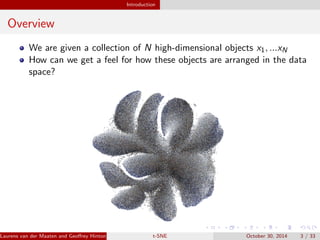
We are given a collection of N high-dimensional objects x1; :::xN 
How can we get a feel for how these objects are arranged in the data 
space? 
Laurens van der Maaten and Georey Hinton, JMLR 2008 (MCLta-bS)NE October 30, 2014 3 / 33
Introduction 
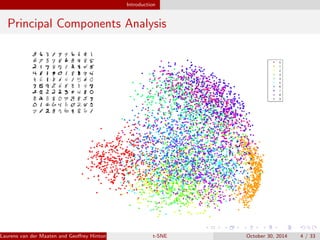
Principal Components Analysis 
Laurens van der Maaten and Georey Hinton, JMLR 2008 (MCLta-bS)NE October 30, 2014 4 / 33
Introduction 
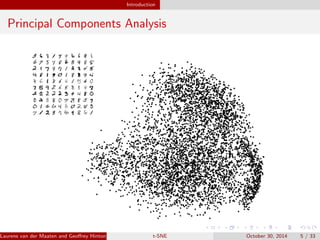
Principal Components Analysis 
Laurens van der Maaten and Georey Hinton, JMLR 2008 (MCLta-bS)NE October 30, 2014 5 / 33
Introduction 
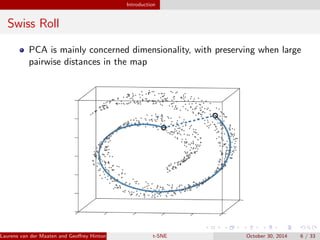
Swiss Roll 
PCA is mainly concerned dimensionality, with preserving when large 
pairwise distances in the map 
Laurens van der Maaten and Georey Hinton, JMLR 2008 (MCLta-bS)NE October 30, 2014 6 / 33
t-Distributed Stochastic Neighbor Embedding 
Introduction 
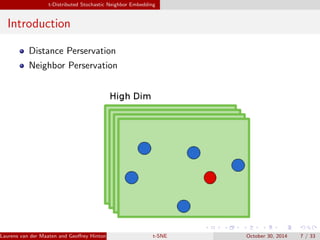
Distance Perservation 
Neighbor Perservation 
Laurens van der Maaten and Georey Hinton, JMLR 2008 (MCLta-bS)NE October 30, 2014 7 / 33
t-Distributed Stochastic Neighbor Embedding 
Introduction 
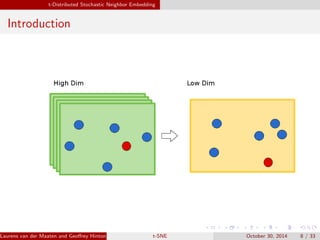
Laurens van der Maaten and Georey Hinton, JMLR 2008 (MCLta-bS)NE October 30, 2014 8 / 33
t-Distributed Stochastic Neighbor Embedding 
Introduction 
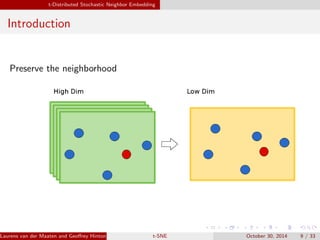
Preserve the neighborhood 
Laurens van der Maaten and Georey Hinton, JMLR 2008 (MCLta-bS)NE October 30, 2014 9 / 33
t-Distributed Stochastic Neighbor Embedding 
Introduction 
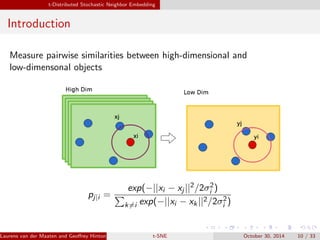
Measure pairwise similarities between high-dimensional and 
low-dimensonal objects 
pj ji = 
exp(jjxi  xj jj2=22 
i ) P 
k6=i exp(jjxi  xk jj2=22 
i ) 
Laurens van der Maaten and Georey Hinton, JMLR 2008 (MCLta-bS)NE October 30, 2014 10 / 33
t-Distributed Stochastic Neighbor Embedding 
Stochastic Neighbor Embedding 
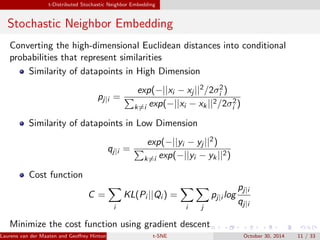
Converting the high-dimensional Euclidean distances into conditional 
probabilities that represent similarities 
Similarity of datapoints in High Dimension 
pj ji = 
exp(jjxi  xj jj2=22 
i ) P 
k6=i exp(jjxi  xk jj2=22 
i ) 
Similarity of datapoints in Low Dimension 
qj ji = 
exp(jjyi  yj jj2 P ) 
k6=i exp(jjyi  yk jj2) 
Cost function 
C = 
X 
i 
KL(Pi jjQi ) = 
X 
i 
X 
j 
pj ji log 
pj ji 
qj ji 
Minimize the cost function using gradient descent 
Laurens van der Maaten and Georey Hinton, JMLR 2008 (MCLta-bS)NE October 30, 2014 11 / 33
t-Distributed Stochastic Neighbor Embedding 
Stochastic Neighbor Embedding 
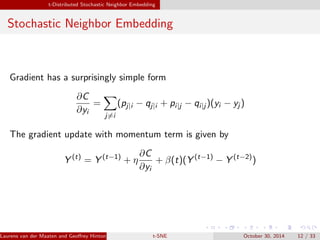
Gradient has a surprisingly simple form 
@C 
@yi 
= 
X 
j6=i 
(pj ji  qj ji + pi jj  qi jj )(yi  yj ) 
The gradient update with momentum term is given by 
Y (t) = Y (t1) +  
@C 
@yi 
+
(t)(Y (t1)  Y (t2)) 
Laurens van der Maaten and Georey Hinton, JMLR 2008 (MCLta-bS)NE October 30, 2014 12 / 33
t-Distributed Stochastic Neighbor Embedding 
Symmetric SNE 
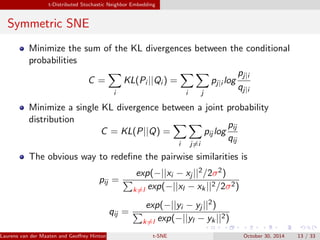
Minimize the sum of the KL divergences between the conditional 
probabilities 
C = 
X 
i 
KL(Pi jjQi ) = 
X 
i 
X 
j 
pj ji log 
pj ji 
qj ji 
Minimize a single KL divergence between a joint probability 
distribution 
C = KL(PjjQ) = 
X 
i 
X 
j6=i 
pij log 
pij 
qij 
The obvious way to rede
ne the pairwise similarities is 
pij = 
exp(jjxi  xj jj2=22 P ) 
k6=l exp(jjxl  xk jj2=22) 
qij = 
P exp(jjyi  yj jj2) 
k6=l exp(jjyl  yk jj2) 
Laurens van der Maaten and Georey Hinton, JMLR 2008 (MCLta-bS)NE October 30, 2014 13 / 33
t-Distributed Stochastic Neighbor Embedding 
Symmetric SNE 
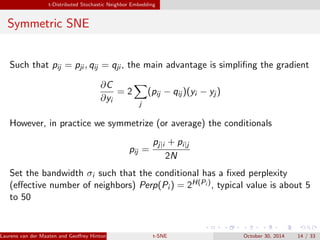
Such that pij = pji ; qij = qji , the main advantage is simpli
ng the gradient 
@C 
@yi 
= 2 
X 
j 
(pij  qij )(yi  yj ) 
However, in practice we symmetrize (or average) the conditionals 
pij = 
pj ji + pi jj 
2N 
Set the bandwidth i such that the conditional has a
xed perplexity 
(eective number of neighbors) Perp(Pi ) = 2H(Pi ), typical value is about 5 
to 50 
Laurens van der Maaten and Georey Hinton, JMLR 2008 (MCLta-bS)NE October 30, 2014 14 / 33
t-Distributed Stochastic Neighbor Embedding 
t-Distribution 
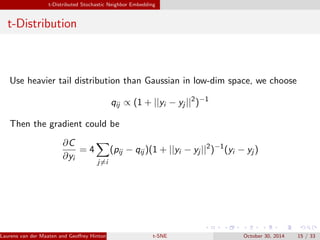
Use heavier tail distribution than Gaussian in low-dim space, we choose 
qij / (1 + jjyi  yj jj2)1 
Then the gradient could be 
@C 
@yi 
= 4 
X 
j6=i 
(pij  qij )(1 + jjyi  yj jj2)1(yi  yj ) 
Laurens van der Maaten and Georey Hinton, JMLR 2008 (MCLta-bS)NE October 30, 2014 15 / 33
t-Distributed Stochastic Neighbor Embedding 
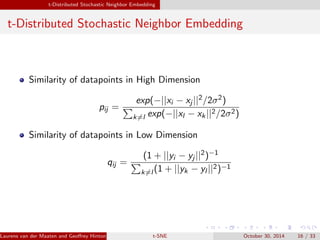
Similarity of datapoints in High Dimension 
pij = 
exp(jjxi  xj jj2=22 P ) 
k6=l exp(jjxl  xk jj2=22) 
Similarity of datapoints in Low Dimension 
qij = 
(1 + jjyi  yj jj2)1 
P 
k6=l (1 + jjyk  yl jj2)1 
Laurens van der Maaten and Georey Hinton, JMLR 2008 (MCLta-bS)NE October 30, 2014 16 / 33
t-Distributed Stochastic Neighbor Embedding 
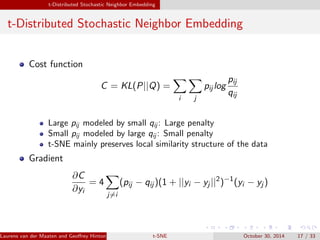
Cost function 
C = KL(PjjQ) = 
X 
i 
X 
j 
pij log 
pij 
qij 
Large pij modeled by small qij : Large penalty 
Small pij modeled by large qij : Small penalty 
t-SNE mainly preserves local similarity structure of the data 
Gradient 
@C 
@yi 
= 4 
X 
j6=i 
(pij  qij )(1 + jjyi  yj jj2)1(yi  yj ) 
Laurens van der Maaten and Georey Hinton, JMLR 2008 (MCLta-bS)NE October 30, 2014 17 / 33
t-Distributed Stochastic Neighbor Embedding 
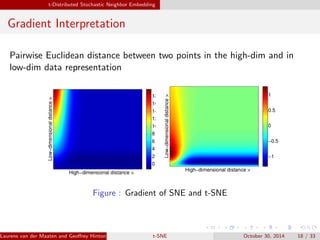
Gradient Interpretation 
Pairwise Euclidean distance between two points in the high-dim and in 
low-dim data representation 
Figure : Gradient of SNE and t-SNE 
Laurens van der Maaten and Georey Hinton, JMLR 2008 (MCLta-bS)NE October 30, 2014 18 / 33
t-Distributed Stochastic Neighbor Embedding 
Gradient Interpretation 
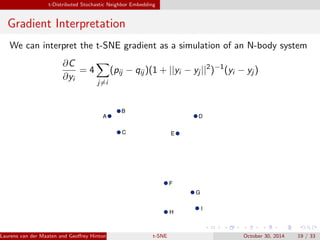
We can interpret the t-SNE gradient as a simulation of an N-body system 
@C 
@yi 
= 4 
X 
j6=i 
(pij  qij )(1 + jjyi  yj jj2)1(yi  yj ) 
Laurens van der Maaten and Georey Hinton, JMLR 2008 (MCLta-bS)NE October 30, 2014 19 / 33
t-Distributed Stochastic Neighbor Embedding 
Gradient Interpretation 
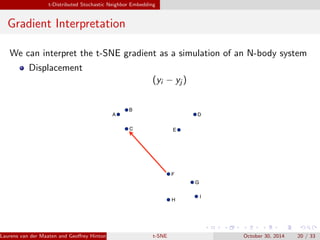
We can interpret the t-SNE gradient as a simulation of an N-body system 
Displacement 
(yi  yj ) 
Laurens van der Maaten and Georey Hinton, JMLR 2008 (MCLta-bS)NE October 30, 2014 20 / 33
t-Distributed Stochastic Neighbor Embedding 
Gradient Interpretation 
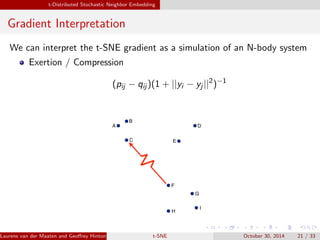
We can interpret the t-SNE gradient as a simulation of an N-body system 
Exertion / Compression 
(pij  qij )(1 + jjyi  yj jj2)1 
Laurens van der Maaten and Georey Hinton, JMLR 2008 (MCLta-bS)NE October 30, 2014 21 / 33
t-Distributed Stochastic Neighbor Embedding 
Gradient Interpretation 
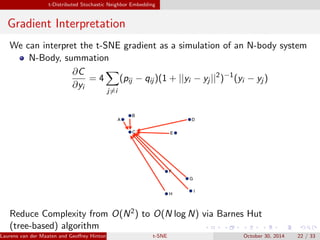
We can interpret the t-SNE gradient as a simulation of an N-body system 
N-Body, summation 
@C 
@yi 
= 4 
X 
j6=i 
(pij  qij )(1 + jjyi  yj jj2)1(yi  yj ) 
Reduce Complexity from O(N2) to O(N log N) via Barnes Hut 
(tree-based) algorithm 
Laurens van der Maaten and Georey Hinton, JMLR 2008 (MCLta-bS)NE October 30, 2014 22 / 33
Experiment Setup and Results 
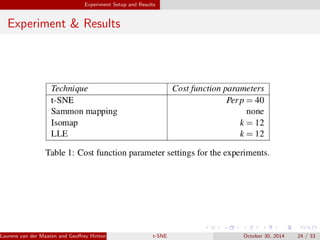
Experiment  Results 
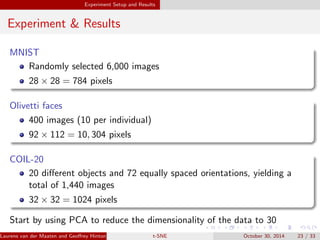
MNIST 
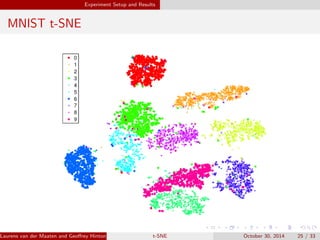
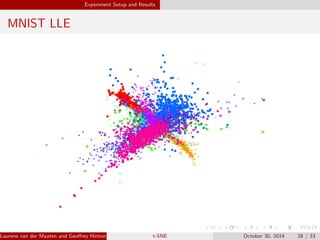
Randomly selected 6,000 images 
28  28 = 784 pixels 
Olivetti faces 
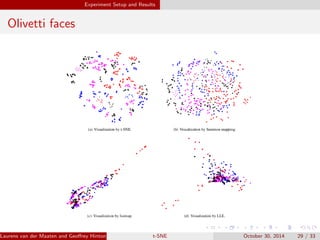
400 images (10 per individual) 
92  112 = 10; 304 pixels 
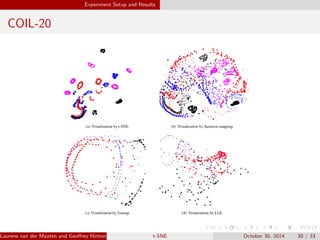
COIL-20 
20 dierent objects and 72 equally spaced orientations, yielding a 
total of 1,440 images 
32  32 = 1024 pixels 
Start by using PCA to reduce the dimensionality of the data to 30 
Laurens van der Maaten and Georey Hinton, JMLR 2008 (MCLta-bS)NE October 30, 2014 23 / 33
Experiment Setup and Results 
Experiment  Results 
Laurens van der Maaten and Georey Hinton, JMLR 2008 (MCLta-bS)NE October 30, 2014 24 / 33
Experiment Setup and Results 
MNIST t-SNE 
Laurens van der Maaten and Georey Hinton, JMLR 2008 (MCLta-bS)NE October 30, 2014 25 / 33
Experiment Setup and Results 
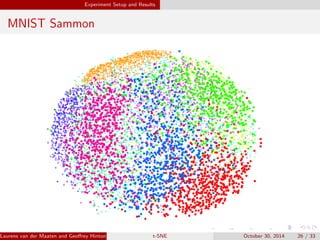
MNIST Sammon 
Laurens van der Maaten and Georey Hinton, JMLR 2008 (MCLta-bS)NE October 30, 2014 26 / 33
Experiment Setup and Results 
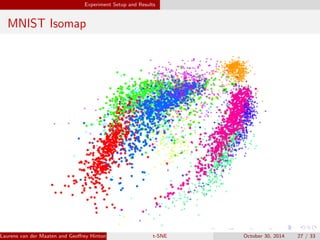
MNIST Isomap 
Laurens van der Maaten and Georey Hinton, JMLR 2008 (MCLta-bS)NE October 30, 2014 27 / 33
Experiment Setup and Results 
MNIST LLE 
Laurens van der Maaten and Georey Hinton, JMLR 2008 (MCLta-bS)NE October 30, 2014 28 / 33
Experiment Setup and Results 
Olivetti faces 
Laurens van der Maaten and Georey Hinton, JMLR 2008 (MCLta-bS)NE October 30, 2014 29 / 33

High Dimensional Data Visualization using t-SNE

  • 1.
    Visualizing Data usingt-SNE Laurens van der Maaten and Georey Hinton, JMLR 2008 Kevin Zhao kevinzhaio@gmail.com October 30, 2014 Laurens van der Maaten and Georey Hinton, JMLR 2008 (MCLta-bS)NE October 30, 2014 1 / 33
  • 2.
    Overview 1 Overview 2 t-Distributed Stochastic Neighbor Embedding 3 Experiment Setup and Results 4 Code and Web Resources Laurens van der Maaten and Georey Hinton, JMLR 2008 (MCLta-bS)NE October 30, 2014 2 / 33
  • 3.
    Introduction Overview Weare given a collection of N high-dimensional objects x1; :::xN How can we get a feel for how these objects are arranged in the data space? Laurens van der Maaten and Georey Hinton, JMLR 2008 (MCLta-bS)NE October 30, 2014 3 / 33
  • 4.
    Introduction Principal ComponentsAnalysis Laurens van der Maaten and Georey Hinton, JMLR 2008 (MCLta-bS)NE October 30, 2014 4 / 33
  • 5.
    Introduction Principal ComponentsAnalysis Laurens van der Maaten and Georey Hinton, JMLR 2008 (MCLta-bS)NE October 30, 2014 5 / 33
  • 6.
    Introduction Swiss Roll PCA is mainly concerned dimensionality, with preserving when large pairwise distances in the map Laurens van der Maaten and Georey Hinton, JMLR 2008 (MCLta-bS)NE October 30, 2014 6 / 33
  • 7.
    t-Distributed Stochastic NeighborEmbedding Introduction Distance Perservation Neighbor Perservation Laurens van der Maaten and Georey Hinton, JMLR 2008 (MCLta-bS)NE October 30, 2014 7 / 33
  • 8.
    t-Distributed Stochastic NeighborEmbedding Introduction Laurens van der Maaten and Georey Hinton, JMLR 2008 (MCLta-bS)NE October 30, 2014 8 / 33
  • 9.
    t-Distributed Stochastic NeighborEmbedding Introduction Preserve the neighborhood Laurens van der Maaten and Georey Hinton, JMLR 2008 (MCLta-bS)NE October 30, 2014 9 / 33
  • 10.
    t-Distributed Stochastic NeighborEmbedding Introduction Measure pairwise similarities between high-dimensional and low-dimensonal objects pj ji = exp(jjxi xj jj2=22 i ) P k6=i exp(jjxi xk jj2=22 i ) Laurens van der Maaten and Georey Hinton, JMLR 2008 (MCLta-bS)NE October 30, 2014 10 / 33
  • 11.
    t-Distributed Stochastic NeighborEmbedding Stochastic Neighbor Embedding Converting the high-dimensional Euclidean distances into conditional probabilities that represent similarities Similarity of datapoints in High Dimension pj ji = exp(jjxi xj jj2=22 i ) P k6=i exp(jjxi xk jj2=22 i ) Similarity of datapoints in Low Dimension qj ji = exp(jjyi yj jj2 P ) k6=i exp(jjyi yk jj2) Cost function C = X i KL(Pi jjQi ) = X i X j pj ji log pj ji qj ji Minimize the cost function using gradient descent Laurens van der Maaten and Georey Hinton, JMLR 2008 (MCLta-bS)NE October 30, 2014 11 / 33
  • 12.
    t-Distributed Stochastic NeighborEmbedding Stochastic Neighbor Embedding Gradient has a surprisingly simple form @C @yi = X j6=i (pj ji qj ji + pi jj qi jj )(yi yj ) The gradient update with momentum term is given by Y (t) = Y (t1) + @C @yi +
  • 13.
    (t)(Y (t1) Y (t2)) Laurens van der Maaten and Georey Hinton, JMLR 2008 (MCLta-bS)NE October 30, 2014 12 / 33
  • 14.
    t-Distributed Stochastic NeighborEmbedding Symmetric SNE Minimize the sum of the KL divergences between the conditional probabilities C = X i KL(Pi jjQi ) = X i X j pj ji log pj ji qj ji Minimize a single KL divergence between a joint probability distribution C = KL(PjjQ) = X i X j6=i pij log pij qij The obvious way to rede
  • 15.
    ne the pairwisesimilarities is pij = exp(jjxi xj jj2=22 P ) k6=l exp(jjxl xk jj2=22) qij = P exp(jjyi yj jj2) k6=l exp(jjyl yk jj2) Laurens van der Maaten and Georey Hinton, JMLR 2008 (MCLta-bS)NE October 30, 2014 13 / 33
  • 16.
    t-Distributed Stochastic NeighborEmbedding Symmetric SNE Such that pij = pji ; qij = qji , the main advantage is simpli
  • 17.
    ng the gradient @C @yi = 2 X j (pij qij )(yi yj ) However, in practice we symmetrize (or average) the conditionals pij = pj ji + pi jj 2N Set the bandwidth i such that the conditional has a
  • 18.
    xed perplexity (eectivenumber of neighbors) Perp(Pi ) = 2H(Pi ), typical value is about 5 to 50 Laurens van der Maaten and Georey Hinton, JMLR 2008 (MCLta-bS)NE October 30, 2014 14 / 33
  • 19.
    t-Distributed Stochastic NeighborEmbedding t-Distribution Use heavier tail distribution than Gaussian in low-dim space, we choose qij / (1 + jjyi yj jj2)1 Then the gradient could be @C @yi = 4 X j6=i (pij qij )(1 + jjyi yj jj2)1(yi yj ) Laurens van der Maaten and Georey Hinton, JMLR 2008 (MCLta-bS)NE October 30, 2014 15 / 33
  • 20.
    t-Distributed Stochastic NeighborEmbedding t-Distributed Stochastic Neighbor Embedding Similarity of datapoints in High Dimension pij = exp(jjxi xj jj2=22 P ) k6=l exp(jjxl xk jj2=22) Similarity of datapoints in Low Dimension qij = (1 + jjyi yj jj2)1 P k6=l (1 + jjyk yl jj2)1 Laurens van der Maaten and Georey Hinton, JMLR 2008 (MCLta-bS)NE October 30, 2014 16 / 33
  • 21.
    t-Distributed Stochastic NeighborEmbedding t-Distributed Stochastic Neighbor Embedding Cost function C = KL(PjjQ) = X i X j pij log pij qij Large pij modeled by small qij : Large penalty Small pij modeled by large qij : Small penalty t-SNE mainly preserves local similarity structure of the data Gradient @C @yi = 4 X j6=i (pij qij )(1 + jjyi yj jj2)1(yi yj ) Laurens van der Maaten and Georey Hinton, JMLR 2008 (MCLta-bS)NE October 30, 2014 17 / 33
  • 22.
    t-Distributed Stochastic NeighborEmbedding Gradient Interpretation Pairwise Euclidean distance between two points in the high-dim and in low-dim data representation Figure : Gradient of SNE and t-SNE Laurens van der Maaten and Georey Hinton, JMLR 2008 (MCLta-bS)NE October 30, 2014 18 / 33
  • 23.
    t-Distributed Stochastic NeighborEmbedding Gradient Interpretation We can interpret the t-SNE gradient as a simulation of an N-body system @C @yi = 4 X j6=i (pij qij )(1 + jjyi yj jj2)1(yi yj ) Laurens van der Maaten and Georey Hinton, JMLR 2008 (MCLta-bS)NE October 30, 2014 19 / 33
  • 24.
    t-Distributed Stochastic NeighborEmbedding Gradient Interpretation We can interpret the t-SNE gradient as a simulation of an N-body system Displacement (yi yj ) Laurens van der Maaten and Georey Hinton, JMLR 2008 (MCLta-bS)NE October 30, 2014 20 / 33
  • 25.
    t-Distributed Stochastic NeighborEmbedding Gradient Interpretation We can interpret the t-SNE gradient as a simulation of an N-body system Exertion / Compression (pij qij )(1 + jjyi yj jj2)1 Laurens van der Maaten and Georey Hinton, JMLR 2008 (MCLta-bS)NE October 30, 2014 21 / 33
  • 26.
    t-Distributed Stochastic NeighborEmbedding Gradient Interpretation We can interpret the t-SNE gradient as a simulation of an N-body system N-Body, summation @C @yi = 4 X j6=i (pij qij )(1 + jjyi yj jj2)1(yi yj ) Reduce Complexity from O(N2) to O(N log N) via Barnes Hut (tree-based) algorithm Laurens van der Maaten and Georey Hinton, JMLR 2008 (MCLta-bS)NE October 30, 2014 22 / 33
  • 27.
    Experiment Setup andResults Experiment Results MNIST Randomly selected 6,000 images 28 28 = 784 pixels Olivetti faces 400 images (10 per individual) 92 112 = 10; 304 pixels COIL-20 20 dierent objects and 72 equally spaced orientations, yielding a total of 1,440 images 32 32 = 1024 pixels Start by using PCA to reduce the dimensionality of the data to 30 Laurens van der Maaten and Georey Hinton, JMLR 2008 (MCLta-bS)NE October 30, 2014 23 / 33
  • 28.
    Experiment Setup andResults Experiment Results Laurens van der Maaten and Georey Hinton, JMLR 2008 (MCLta-bS)NE October 30, 2014 24 / 33
  • 29.
    Experiment Setup andResults MNIST t-SNE Laurens van der Maaten and Georey Hinton, JMLR 2008 (MCLta-bS)NE October 30, 2014 25 / 33
  • 30.
    Experiment Setup andResults MNIST Sammon Laurens van der Maaten and Georey Hinton, JMLR 2008 (MCLta-bS)NE October 30, 2014 26 / 33
  • 31.
    Experiment Setup andResults MNIST Isomap Laurens van der Maaten and Georey Hinton, JMLR 2008 (MCLta-bS)NE October 30, 2014 27 / 33
  • 32.
    Experiment Setup andResults MNIST LLE Laurens van der Maaten and Georey Hinton, JMLR 2008 (MCLta-bS)NE October 30, 2014 28 / 33
  • 33.
    Experiment Setup andResults Olivetti faces Laurens van der Maaten and Georey Hinton, JMLR 2008 (MCLta-bS)NE October 30, 2014 29 / 33